warning LINCOLN MKZ HYBRID 2013 Owners Manual
[x] Cancel search | Manufacturer: LINCOLN, Model Year: 2013, Model line: MKZ HYBRID, Model: LINCOLN MKZ HYBRID 2013Pages: 475, PDF Size: 3.89 MB
Page 307 of 475
•
Only use the sealing compound
before the use by date. The use by
date is on the lower right hand
corner of the label located on the
sealant canister (bottle). Check
the use by date regularly and
replace the canister after four
years.
• Do not store the kit unsecured
inside the passenger compartment
of the vehicle as it may cause injury
during a sudden stop or crash.
Always store the kit in its original
location.
• After sealant use, the tire pressure
monitoring system sensor and
valve stem on the wheel must be
replaced by an authorized Ford
dealer.
• When inflating a tire or other
objects, use the black air hose only.
Do not use the transparent hose
which is designed for sealant
application only.
• Operating the kit could cause an
electrical disturbance in radio, CD,
and DVD player operation.
What to do when a Tire Is
Punctured
A tire puncture within the tire's tread
area can be repaired in two stages
with the kit. •
In the first stage, the tire will be
reinflated with a sealing
compound and air. After the tire
has been reinflated, you will need
to drive the vehicle a short
distance (about 4 miles [6
kilometers]) to distribute the
sealant in the tire.
• In the second stage, you will need
to check the tire pressure and
adjust, if necessary, to the vehicle's
tire inflation pressure.
First Stage: Reinflating the Tire
with Sealing Compound and Air WARNINGS
Do not stand directly over the kit
while inflating the tire. If you
notice any unusual bulges or
deformations in the tire's sidewall
during inflation, stop and call roadside
assistance. If the tire doesn't inflate to the
recommended tire pressure
within 15 minutes, stop and call
roadside assistance. Preparation: Park the vehicle in a safe,
level and secure area, away from
moving traffic. Turn the hazard lights
on. Apply the parking brake and turn
the engine off. Inspect the flat tire for
visible damage.
Sealant compound contains latex. To
avoid any allergic reactions, use the
non-latex gloves located in the
accessory box on the underside of the
kit housing.
305
MKZ (CC9) Wheels and Tires
Page 308 of 475
Do not remove any foreign object that
has pierced the tire. If a puncture is
located in the tire sidewall, stop and
call roadside assistance.
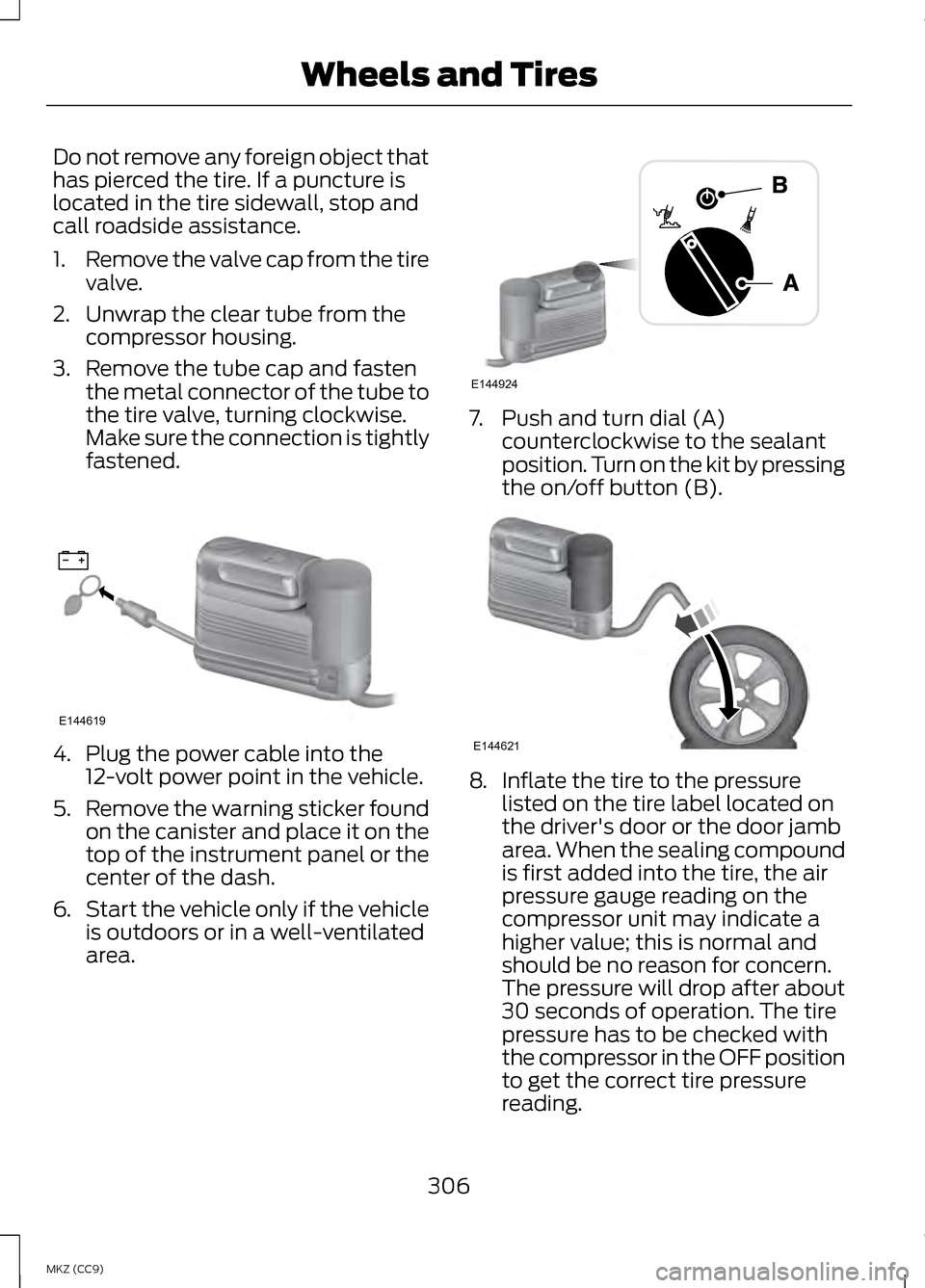
1.
Remove the valve cap from the tire
valve.
2. Unwrap the clear tube from the compressor housing.
3. Remove the tube cap and fasten the metal connector of the tube to
the tire valve, turning clockwise.
Make sure the connection is tightly
fastened. 4. Plug the power cable into the
12-volt power point in the vehicle.
5. Remove the warning sticker found
on the canister and place it on the
top of the instrument panel or the
center of the dash.
6. Start the vehicle only if the vehicle
is outdoors or in a well-ventilated
area. 7. Push and turn dial (A)
counterclockwise to the sealant
position. Turn on the kit by pressing
the on/off button (B). 8.
Inflate the tire to the pressure
listed on the tire label located on
the driver's door or the door jamb
area. When the sealing compound
is first added into the tire, the air
pressure gauge reading on the
compressor unit may indicate a
higher value; this is normal and
should be no reason for concern.
The pressure will drop after about
30 seconds of operation. The tire
pressure has to be checked with
the compressor in the OFF position
to get the correct tire pressure
reading.
306
MKZ (CC9) Wheels and TiresE144619 E144924 E144621
Page 309 of 475
9. When the recommended tire
pressure is reached, turn off the kit
by pressing the on button;
disconnect the kit from the tire
valve and the power point.
Re-install the valve cap on the tire
valve, place the tube cap on the
metal connector, and return the kit
to the stowage area
10. Immediately and cautiously, drive
the vehicle 4 miles (6 kilometers)
to distribute the sealant evenly
inside the tire. Do not exceed 50
mph (80 km/h).
11. After 4 miles (6 kilometers), stop
and check the tire pressure. See
Second stage: Checking tire
pressure.
Note: If you experience any unusual
vibration, ride disturbance or noise
while driving, reduce your speed until
you can safely pull off to the side of the
road to call for roadside assistance.
Note: Do not proceed to the second
stage of this operation.
Second Stage: Checking Tire
Pressure WARNINGS
If you are proceeding from the
First stage: Re–inflating the tire
with sealing compound and air section
and have injected sealant in the tire
and the pressure is below 20 psi (1.4
bar), stop and call roadside
assistance. If tire pressure is above 20
psi (1.4 bar), continue to the next step. The power plug may get hot
after use and should be handled
carefully while unplugging. Check the air pressure of your tires as
follows:
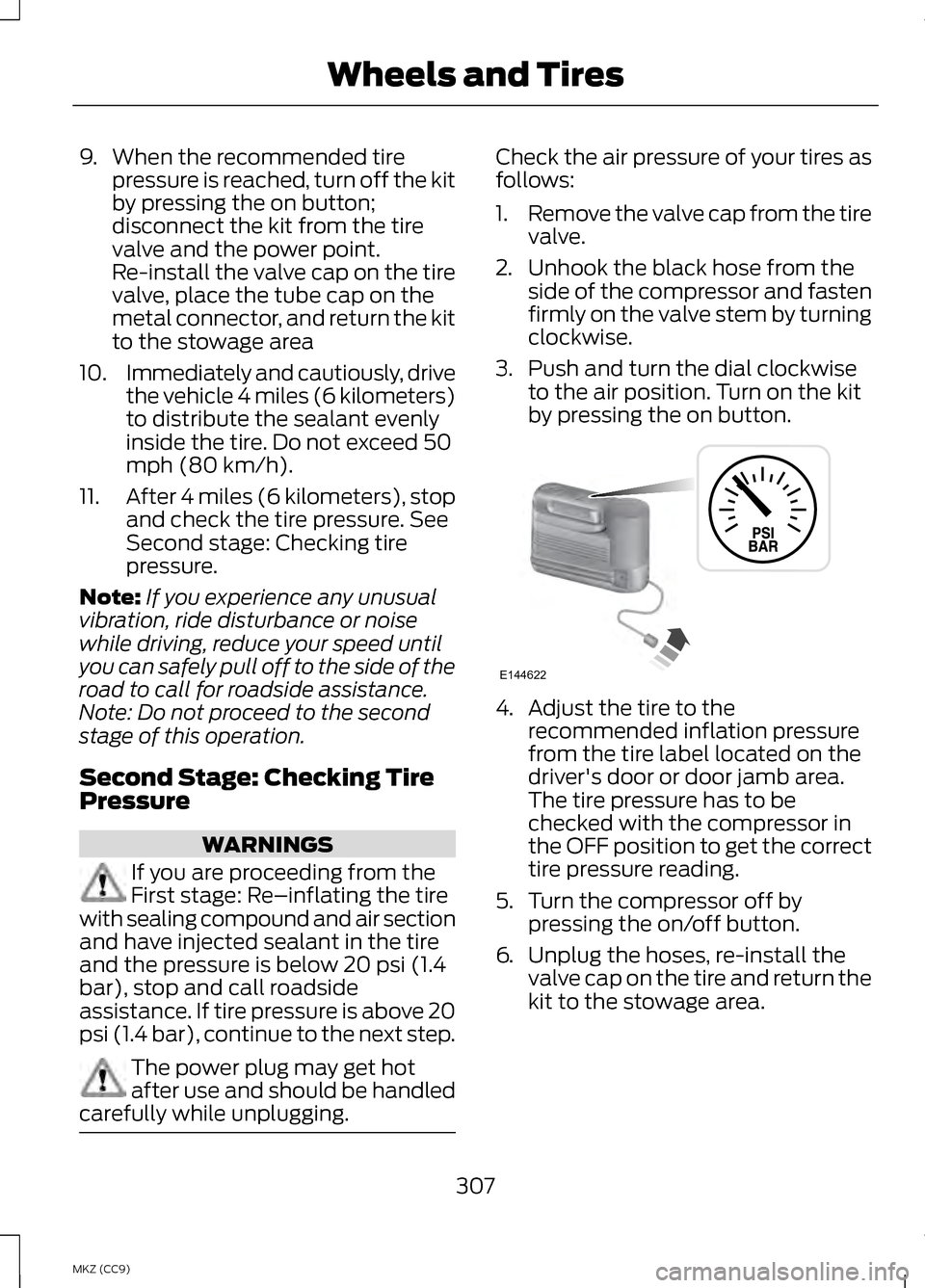
1.
Remove the valve cap from the tire
valve.
2. Unhook the black hose from the side of the compressor and fasten
firmly on the valve stem by turning
clockwise.
3. Push and turn the dial clockwise to the air position. Turn on the kit
by pressing the on button. 4. Adjust the tire to the
recommended inflation pressure
from the tire label located on the
driver's door or door jamb area.
The tire pressure has to be
checked with the compressor in
the OFF position to get the correct
tire pressure reading.
5. Turn the compressor off by pressing the on/off button.
6. Unplug the hoses, re-install the
valve cap on the tire and return the
kit to the stowage area.
307
MKZ (CC9) Wheels and TiresE144622
Page 311 of 475
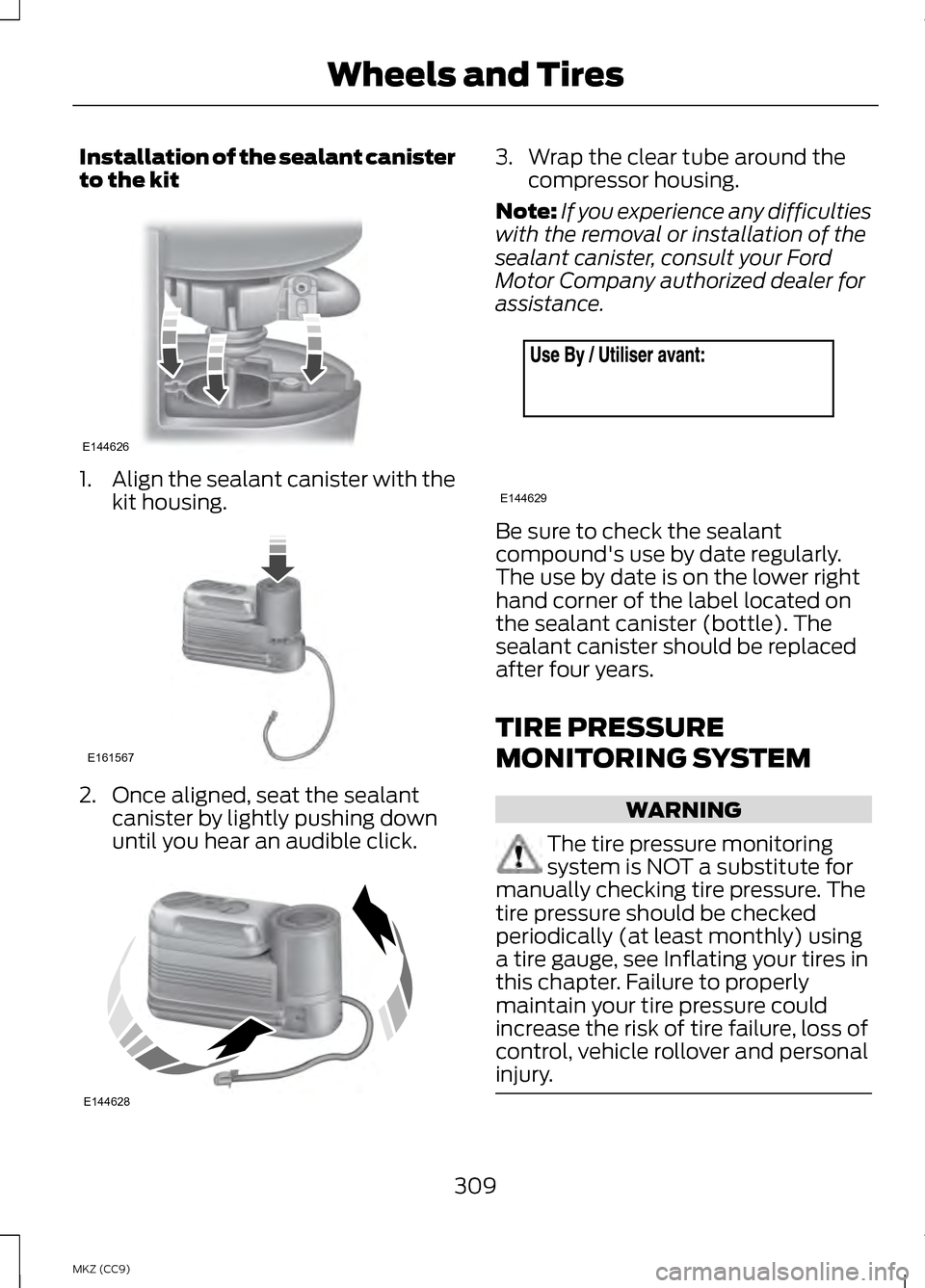
Installation of the sealant canister
to the kit
1.
Align the sealant canister with the
kit housing. 2. Once aligned, seat the sealant
canister by lightly pushing down
until you hear an audible click. 3. Wrap the clear tube around the
compressor housing.
Note: If you experience any difficulties
with the removal or installation of the
sealant canister, consult your Ford
Motor Company authorized dealer for
assistance. Be sure to check the sealant
compound's use by date regularly.
The use by date is on the lower right
hand corner of the label located on
the sealant canister (bottle). The
sealant canister should be replaced
after four years.
TIRE PRESSURE
MONITORING SYSTEM
WARNING
The tire pressure monitoring
system is NOT a substitute for
manually checking tire pressure. The
tire pressure should be checked
periodically (at least monthly) using
a tire gauge, see Inflating your tires in
this chapter. Failure to properly
maintain your tire pressure could
increase the risk of tire failure, loss of
control, vehicle rollover and personal
injury. 309
MKZ (CC9) Wheels and TiresE144626 E161567 E144628 E144629
Page 313 of 475
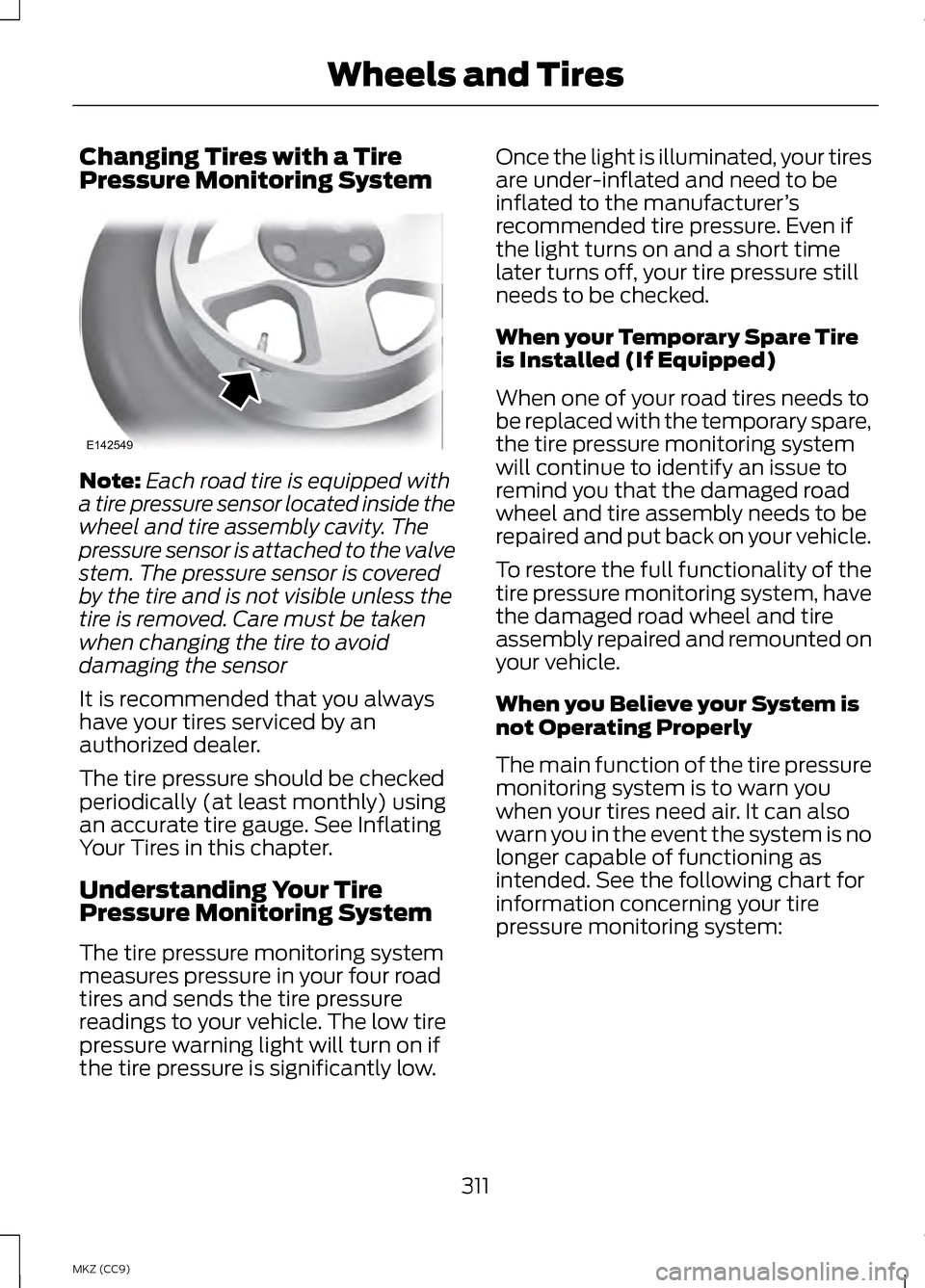
Changing Tires with a Tire
Pressure Monitoring System
Note:
Each road tire is equipped with
a tire pressure sensor located inside the
wheel and tire assembly cavity. The
pressure sensor is attached to the valve
stem. The pressure sensor is covered
by the tire and is not visible unless the
tire is removed. Care must be taken
when changing the tire to avoid
damaging the sensor
It is recommended that you always
have your tires serviced by an
authorized dealer.
The tire pressure should be checked
periodically (at least monthly) using
an accurate tire gauge. See Inflating
Your Tires in this chapter.
Understanding Your Tire
Pressure Monitoring System
The tire pressure monitoring system
measures pressure in your four road
tires and sends the tire pressure
readings to your vehicle. The low tire
pressure warning light will turn on if
the tire pressure is significantly low. Once the light is illuminated, your tires
are under-inflated and need to be
inflated to the manufacturer
’s
recommended tire pressure. Even if
the light turns on and a short time
later turns off, your tire pressure still
needs to be checked.
When your Temporary Spare Tire
is Installed (If Equipped)
When one of your road tires needs to
be replaced with the temporary spare,
the tire pressure monitoring system
will continue to identify an issue to
remind you that the damaged road
wheel and tire assembly needs to be
repaired and put back on your vehicle.
To restore the full functionality of the
tire pressure monitoring system, have
the damaged road wheel and tire
assembly repaired and remounted on
your vehicle.
When you Believe your System is
not Operating Properly
The main function of the tire pressure
monitoring system is to warn you
when your tires need air. It can also
warn you in the event the system is no
longer capable of functioning as
intended. See the following chart for
information concerning your tire
pressure monitoring system:
311
MKZ (CC9) Wheels and TiresE142549
Page 314 of 475
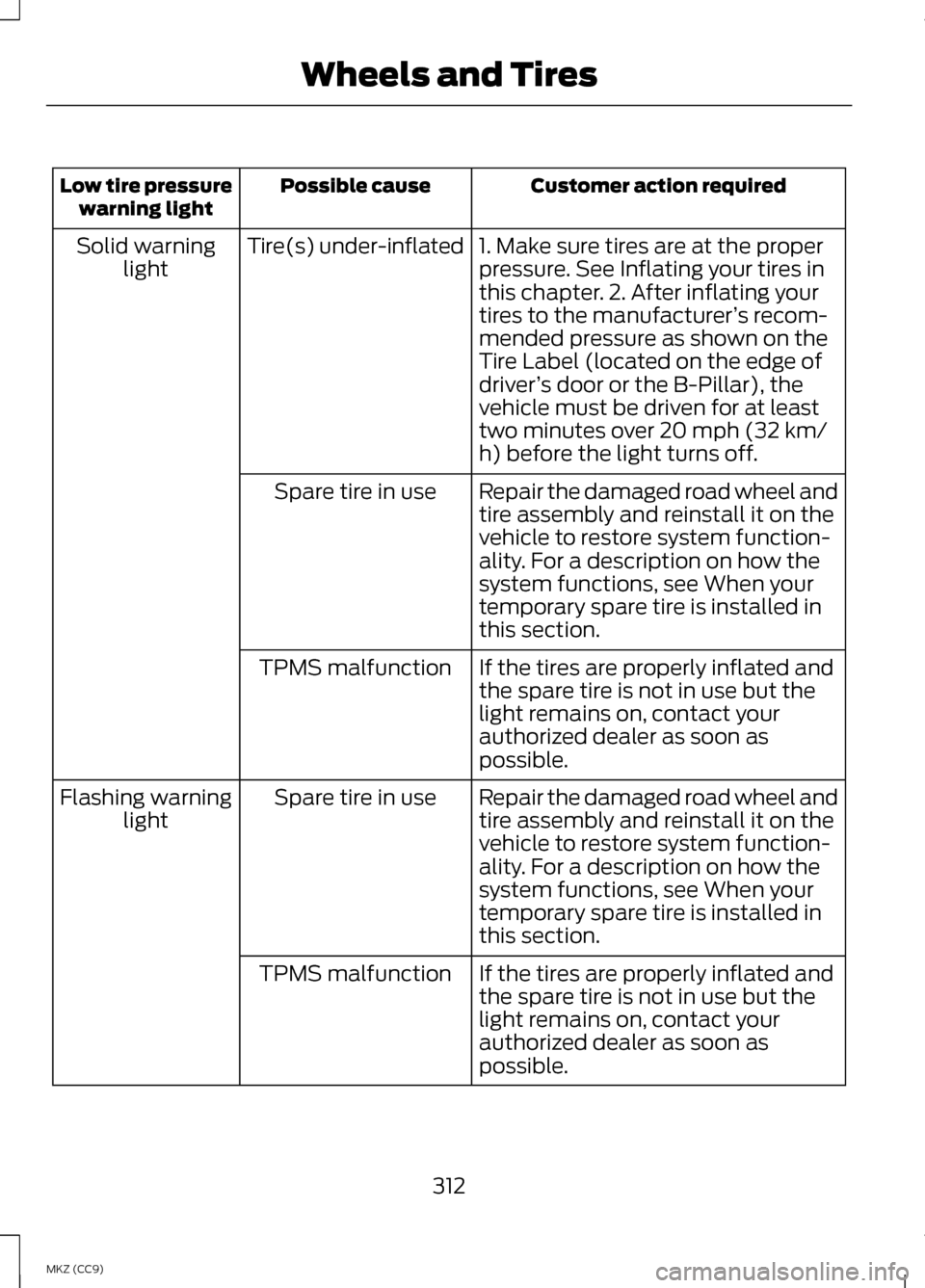
Customer action required
Possible cause
Low tire pressure
warning light
1. Make sure tires are at the proper
pressure. See Inflating your tires in
this chapter. 2. After inflating your
tires to the manufacturer’s recom-
mended pressure as shown on the
Tire Label (located on the edge of
driver ’s door or the B-Pillar), the
vehicle must be driven for at least
two minutes over 20 mph (32 km/
h) before the light turns off.
Tire(s) under-inflated
Solid warning
light
Repair the damaged road wheel and
tire assembly and reinstall it on the
vehicle to restore system function-
ality. For a description on how the
system functions, see When your
temporary spare tire is installed in
this section.
Spare tire in use
If the tires are properly inflated and
the spare tire is not in use but the
light remains on, contact your
authorized dealer as soon as
possible.
TPMS malfunction
Repair the damaged road wheel and
tire assembly and reinstall it on the
vehicle to restore system function-
ality. For a description on how the
system functions, see When your
temporary spare tire is installed in
this section.
Spare tire in use
Flashing warning
light
If the tires are properly inflated and
the spare tire is not in use but the
light remains on, contact your
authorized dealer as soon as
possible.
TPMS malfunction
312
MKZ (CC9) Wheels and Tires
Page 315 of 475
When Inflating your Tires
When putting air into your tires (such
as at a gas station or in your garage),
the tire pressure monitoring system
may not respond immediately to the
air added to your tires.
It may take up to two minutes of
driving over 20 mph (32 km/h) for the
light to turn off after you have filled
your tires to the recommended
inflation pressure
How Temperature Affects your
Tire Pressure
The tire pressure monitoring system
monitors tire pressure in each
pneumatic tire. While driving in a
normal manner, a typical passenger
tire inflation pressure may increase
approximately 2 to 4 psi (14 to 28
kPa) from a cold start situation. If the
vehicle is stationary overnight with the
outside temperature significantly
lower than the daytime temperature,
the tire pressure may decrease
approximately 3 psi (21 kPa) for a drop
of 30°F (17°C) in ambient
temperature. This lower pressure
value may be detected by the TPMS
as being significantly lower than the
recommended inflation pressure and
activate the TPMS warning light for
low tire pressure. If the low tire
pressure warning light is on, visually
check each tire to verify that no tire is
flat. (If one or more tires are flat, repair
as necessary.) Check air pressure in
the road tires. If any tire is
under-inflated, carefully drive the
vehicle to the nearest location where
air can be added to the tires. Inflate
all the tires to the recommended
inflation pressure.
TIRE CARE
Information About Uniform
Tire Quality Grading
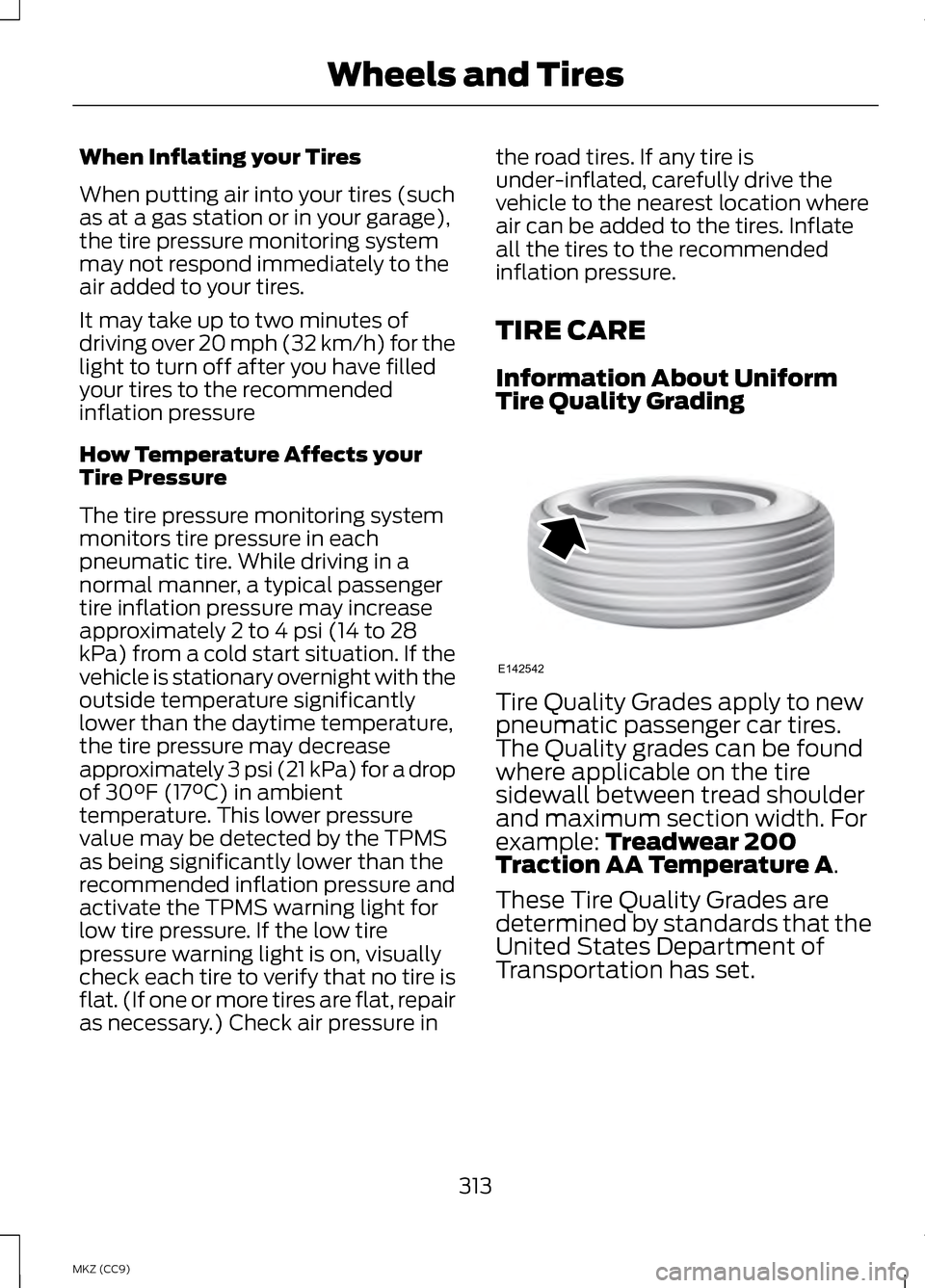
Tire Quality Grades apply to new
pneumatic passenger car tires.
The Quality grades can be found
where applicable on the tire
sidewall between tread shoulder
and maximum section width. For
example: Treadwear 200
Traction AA Temperature A.
These Tire Quality Grades are
determined by standards that the
United States Department of
Transportation has set.
313
MKZ (CC9) Wheels and TiresE142542
Page 316 of 475
Tire Quality Grades apply to new
pneumatic passenger car tires.
They do not apply to deep tread,
winter-type snow tires,
space-saver or temporary use
spare tires, light truck or LT type
tires, tires with nominal rim
diameters of 10 to 12 inches or
limited production tires as defined
in Title 49 Code of Federal
Regulations Part 575.104 (c)(2).
U.S. Department of
Transportation Tire quality
grades: The U.S. Department of
Transportation requires Ford
Motor Company to give you the
following information about tire
grades exactly as the government
has written it.
Treadwear
The treadwear grade is a
comparative rating based on the
wear rate of the tire when tested
under controlled conditions on a
specified government test course.
For example, a tire graded 150
would wear one and one-half (1
½) times as well on the
government course as a tire
graded 100. The relative
performance of tires depends
upon the actual conditions of their
use, however, and may depart
significantly from the norm due to
variations in driving habits, service
practices, and differences in road
characteristics and climate. Traction AA A B C WARNING
The traction grade assigned
to this tire is based on
straight-ahead braking traction
tests, and does not include
acceleration, cornering,
hydroplaning or peak traction
characteristics. The traction grades, from highest
to lowest are AA, A, B, and C. The
grades represent the tire
’s ability
to stop on wet pavement as
measured under controlled
conditions on specified
government test surfaces of
asphalt and concrete. A tire
marked C may have poor traction
performance.
Temperature A B C WARNING
The temperature grade for
this tire is established for a
tire that is properly inflated and
not overloaded. Excessive speed,
underinflation, or excessive
loading, either separately or in
combination, can cause heat
buildup and possible tire failure. The temperature grades are A
(the highest), B and C,
representing the tire
’s resistance
to the generation of heat and its
ability to dissipate heat when
tested under controlled conditions
on a specified indoor laboratory
314
MKZ (CC9) Wheels and Tires
Page 321 of 475
the Safety Compliance
Certification Label (affixed to
either the door hinge pillar,
door-latch post, or the door edge
that meets the door-latch post,
next to the driver's seating
position), or Tire Label which is
located on the B-Pillar or the edge
of the driver
’s door. The cold
inflation pressure should never be
set lower than the recommended
pressure on the vehicle label.
The tire suppliers may have
additional markings, notes or
warnings such as standard load,
radial tubeless, etc.
Additional Information
Contained on the Tire Sidewall
for LT Type Tires
Note: Tire Quality Grades do not
apply to this type of tire. LT type tires have some additional
information beyond those of P
type tires; these differences are
described below.
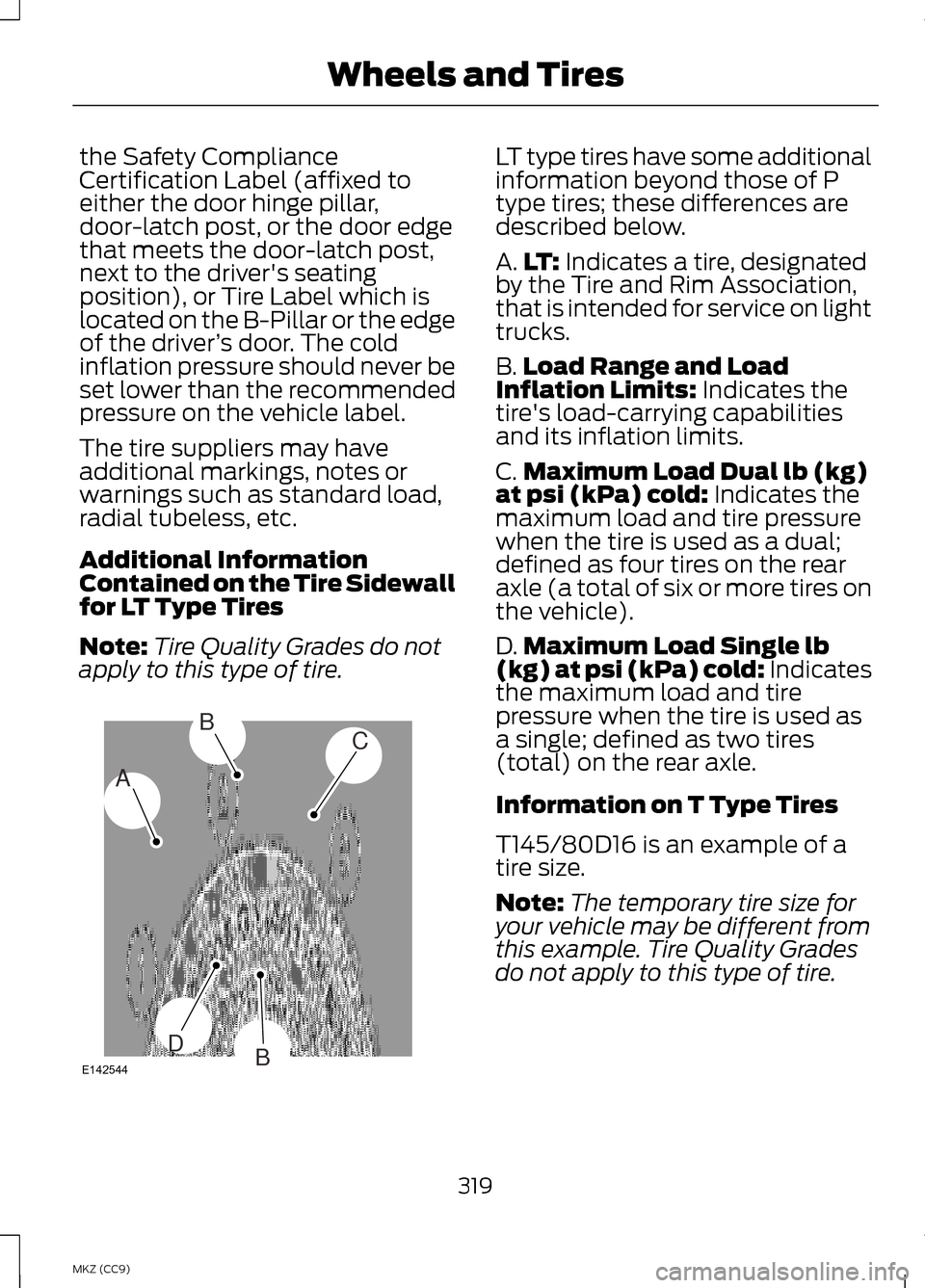
A.
LT: Indicates a tire, designated
by the Tire and Rim Association,
that is intended for service on light
trucks.
B. Load Range and Load
Inflation Limits:
Indicates the
tire's load-carrying capabilities
and its inflation limits.
C. Maximum Load Dual lb (kg)
at psi (kPa) cold:
Indicates the
maximum load and tire pressure
when the tire is used as a dual;
defined as four tires on the rear
axle (a total of six or more tires on
the vehicle).
D. Maximum Load Single lb
(kg) at psi (kPa) cold:
Indicates
the maximum load and tire
pressure when the tire is used as
a single; defined as two tires
(total) on the rear axle.
Information on T Type Tires
T145/80D16 is an example of a
tire size.
Note: The temporary tire size for
your vehicle may be different from
this example. Tire Quality Grades
do not apply to this type of tire.
319
MKZ (CC9) Wheels and TiresA
BC
BDE142544
Page 323 of 475
You are strongly urged to buy a
reliable tire pressure gauge, as
automatic service station gauges
may be inaccurate. Ford
recommends the use of a digital
or dial-type tire pressure gauge
rather than a stick-type tire
pressure gauge.
Use the recommended cold
inflation pressure for optimum tire
performance and wear.
Under-inflation or over-inflation
may cause uneven treadwear
patterns
WARNING
Under-inflation is the most
common cause of tire failures
and may result in severe tire
cracking, tread separation or
blowout, with unexpected loss of
vehicle control and increased risk
of injury. Under-inflation increases
sidewall flexing and rolling
resistance, resulting in heat
buildup and internal damage to
the tire. It also may result in
unnecessary tire stress, irregular
wear, loss of vehicle control and
accidents. A tire can lose up to
half of its air pressure and not
appear to be flat! Always inflate your tires to the
Ford recommended inflation
pressure even if it is less than the
maximum inflation pressure
information found on the tire. The
Ford recommended tire inflation
pressure is found on the Safety
Compliance Certification Label (affixed to either the door hinge
pillar, door-latch post, or the door
edge that meets the door-latch
post, next to the driver's seating
position), or Tire Label which is
located on the B-Pillar or the edge
of the driver
’s door. Failure to
follow the tire pressure
recommendations can cause
uneven treadwear patterns and
adversely affect the way your
vehicle handles
Maximum Permissible Inflation
Pressure is the tire
manufacturer's maximum
permissible pressure and the
pressure at which the maximum
load can be carried by the tire. This
pressure is normally higher than
the manufacturer ’s recommended
cold inflation pressure which can
be found on the Safety
Compliance Certification Label
(affixed to either the door hinge
pillar, door-latch post, or the door
edge that meets the door-latch
post, next to the driver's seating
position), or Tire Label which is
located on the B-Pillar or the edge
of the driver ’s door. The cold
inflation pressure should never be
set lower than the recommended
pressure on the Safety
Compliance Certification Label or
Tire Label.
321
MKZ (CC9) Wheels and Tires