light LINCOLN MKZ HYBRID 2013 Workshop Manual
[x] Cancel search | Manufacturer: LINCOLN, Model Year: 2013, Model line: MKZ HYBRID, Model: LINCOLN MKZ HYBRID 2013Pages: 475, PDF Size: 3.89 MB
Page 169 of 475
Note:
Since engine speed is controlled
by the transmission, it may seem
elevated at times. This is normal hybrid
operation and helps deliver fuel
efficiency and performance.
Neutral: It is not recommended to
idle the vehicle in position N for an
extended period of time because this
will discharge your high voltage
battery and decrease fuel economy.
The engine will not start, and cannot
provide power to the hybrid system in
position
N.
Low Gear:
Low gear (position L) is
designed to mimic the enhanced
engine braking available in non-hybrid
vehicles. Low gear will produce high
engine speeds to provide necessary
engine braking. This is normal and will
not damage your vehicle. In low gear,
the gas engine will remain on more
often than in position
D.
Unique Hybrid Operating
Characteristics
Your vehicle behaves differently
compared to a non-hybrid. Here is a
description of the major differences:
Battery: Your Hybrid is equipped with
a high voltage battery. A cool battery
ensures battery life and provides the
best possible performance. Your
hybrid high voltage battery may
periodically re-condition itself to
ensure maximum efficiency. You may
notice slight changes in driveability
during this process, but it is an
important part of your hybrid's high
voltage battery optimization features. Cabin air cools the high voltage
battery by pulling air through vents in
the rear package tray. Avoid placing
objects on the package tray which
could block air flow through the vents.
If you leave your vehicle inoperative
for over 31 days, it may be necessary
to jumpstart the vehicle. See
Roadside Emergencies
(page 250).
Engine:
The engine speed in your
hybrid is not directly tied to your
vehicle speed. Your vehicle's engine
and transmission are designed to
deliver the power you need at the
most efficient engine speed. During
heavy accelerations, your hybrid may
reach high engine speeds (up to 6000
RPM).
In prolonged mountainous driving, you
may see the engine tachometer
changing without your input. This is
intentional and maintains the battery
charge level. You may also notice
during extended downhill driving that
your engine continues to run instead
of shutting off.
During this engine braking, the engine
stays on, but it is not using any fuel.
You may also hear a slight whine or
whistle when operating your vehicle.
This is the normal operation of the
electric generator in the hybrid
system.
167
MKZ (CC9) Unique Driving Characteristics
Page 173 of 475
Answer
Question
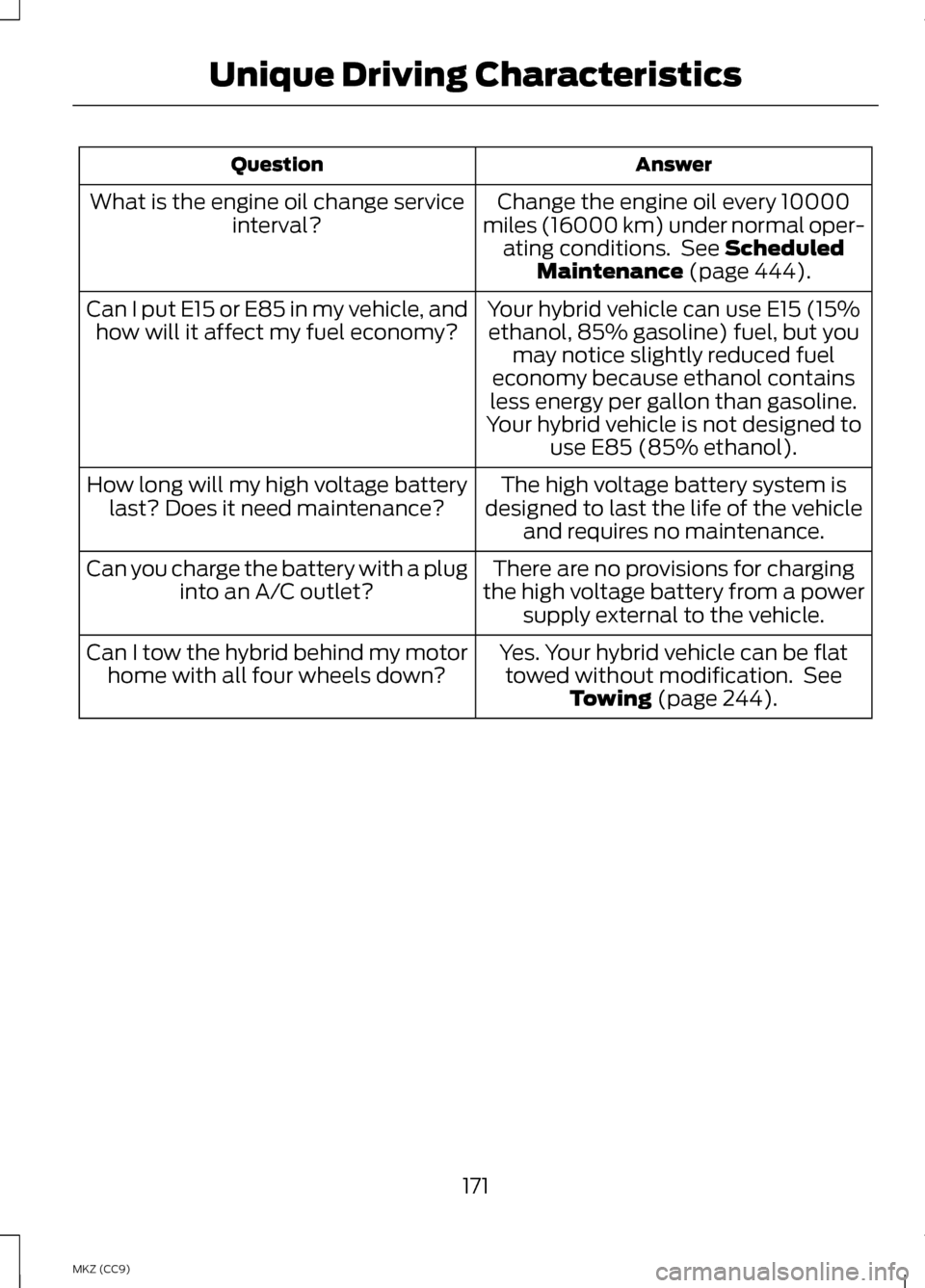
Change the engine oil every 10000
miles (16000 km) under normal oper- ating conditions. See Scheduled
Maintenance (page 444).
What is the engine oil change service
interval?
Your hybrid vehicle can use E15 (15%ethanol, 85% gasoline) fuel, but you may notice slightly reduced fuel
economy because ethanol contains
less energy per gallon than gasoline.
Your hybrid vehicle is not designed to use E85 (85% ethanol).
Can I put E15 or E85 in my vehicle, and
how will it affect my fuel economy?
The high voltage battery system is
designed to last the life of the vehicle and requires no maintenance.
How long will my high voltage battery
last? Does it need maintenance?
There are no provisions for charging
the high voltage battery from a power supply external to the vehicle.
Can you charge the battery with a plug
into an A/C outlet?
Yes. Your hybrid vehicle can be flattowed without modification. See Towing
(page 244).
Can I tow the hybrid behind my motor
home with all four wheels down?
171
MKZ (CC9) Unique Driving Characteristics
Page 175 of 475
•
Fuels can also be harmful if
absorbed through the skin. If fuel
is splashed on the skin, clothing or
both, promptly remove
contaminated clothing and wash
skin thoroughly with soap and
water. Repeated or prolonged skin
contact with fuel liquid or vapor
causes skin irritation.
• Be particularly careful if you are
taking “Antabuse ” or other forms
of disulfiram for the treatment of
alcoholism. Breathing gasoline
vapors, or skin contact could cause
an adverse reaction. In sensitive
individuals, serious personal injury
or sickness may result. If fuel is
splashed on the skin, promptly
wash skin thoroughly with soap
and water. Consult a physician
immediately if you experience an
adverse reaction.
FUEL QUALITY
Note: We recommend that you use
only high quality fuel without additives
or other engine treatments.
Choosing the Right Fuel
Note: Use of any fuel other than those
recommended may cause powertrain
damage, a loss of vehicle performance
and repairs may not be covered under
warranty. If your vehicle is not a flexible fuel
vehicle, then only use unleaded fuel
or unleaded fuel blended with a
maximum of 15% ethanol. Do not use
fuel ethanol (E85), diesel fuel, fuel
methanol, leaded fuel or any other
fuel because it could damage or
impair the emission control system.
The use of leaded fuel is prohibited by
law.
Your vehicle was not designed to use
fuel or fuel additives with metallic
compounds, including
manganese-based additives.
Octane Recommendations
Regular unleaded gasoline with a
pump (R+M)/2 octane rating of 87 is
recommended. Some fuel stations
offer fuels posted as regular with an
octane rating below 87, particularly in
high altitude areas. Fuels with octane
levels below 87 are not
recommended. Premium fuel will
provide improved performance and is
recommended for severe duty use
such as trailer tow.
Do not be concerned if your engine
sometimes knocks lightly. However,
if it knocks heavily while you are using
fuel with the recommended octane
rating, see your authorized dealer to
prevent any engine damage.
RUNNING OUT OF FUEL
Avoid running out of fuel because this
situation may have an adverse effect
on vehicle components.
173
MKZ (CC9) Fuel and Refueling
Page 181 of 475
EMISSION CONTROL
SYSTEM
WARNINGS
Do not park, idle, or drive your
vehicle in dry grass or other dry
ground cover. The emission system
heats up the engine compartment and
exhaust system, which can start a fire. Exhaust leaks may result in entry
of harmful and potentially lethal
fumes into the passenger
compartment. If you smell exhaust
fumes inside your vehicle, have your
dealer inspect your vehicle
immediately. Do not drive if you smell
exhaust fumes. Your vehicle is equipped with various
emission control components and a
catalytic converter that will enable
your vehicle to comply with applicable
exhaust emission standards. To make
sure that the catalytic converter and
other emission control components
continue to work properly:
To make sure that the catalytic
converter and other emission control
components continue to work
properly:
•
Use only the specified fuel listed.
• Avoid running out of fuel.
• Do not turn off the ignition while
your vehicle is moving, especially
at high speeds.
• Have the items listed in scheduled
maintenance information
performed according to the
specified schedule. The scheduled maintenance items
listed in scheduled maintenance
information are essential to the life
and performance of your vehicle and
to its emissions system.
If you use parts other than Ford,
Motorcraft or Ford-authorized parts
for maintenance replacements, or for
service of components affecting
emission control, such non-Ford parts
should be the equivalent to genuine
Ford Motor Company parts in
performance and durability.
Illumination of the service engine soon
indicator, charging system warning
light or the temperature warning light,
fluid leaks, strange odors, smoke or
loss of engine power could indicate
that the emission control system is
not working properly.
An improperly operating or damaged
exhaust system may allow exhaust to
enter the vehicle. Have a damaged or
improperly operating exhaust system
inspected and repaired immediately.
Do not make any unauthorized
changes to your vehicle or engine. By
law, vehicle owners and anyone who
manufactures, repairs, services, sells,
leases, trades vehicles, or supervises
a fleet of vehicles are not permitted
to intentionally remove an emission
control device or prevent it from
working. Information about your
vehicle
’s emission system is on the
Vehicle Emission Control Information
Decal located on or near the engine.
This decal also lists engine
displacement
179
MKZ (CC9) Fuel and Refueling
Page 187 of 475
AUTOMATIC
TRANSMISSION
WARNINGS
Always set the parking brake
fully and make sure the vehicle
is in P (Park). Turn the ignition off
whenever you leave your vehicle. Do not apply the brake pedal and
accelerator pedal
simultaneously. Applying both pedals
simultaneously for more than three
seconds will limit engine rpm, which
may result in difficulty maintaining
speed in traffic and could lead to
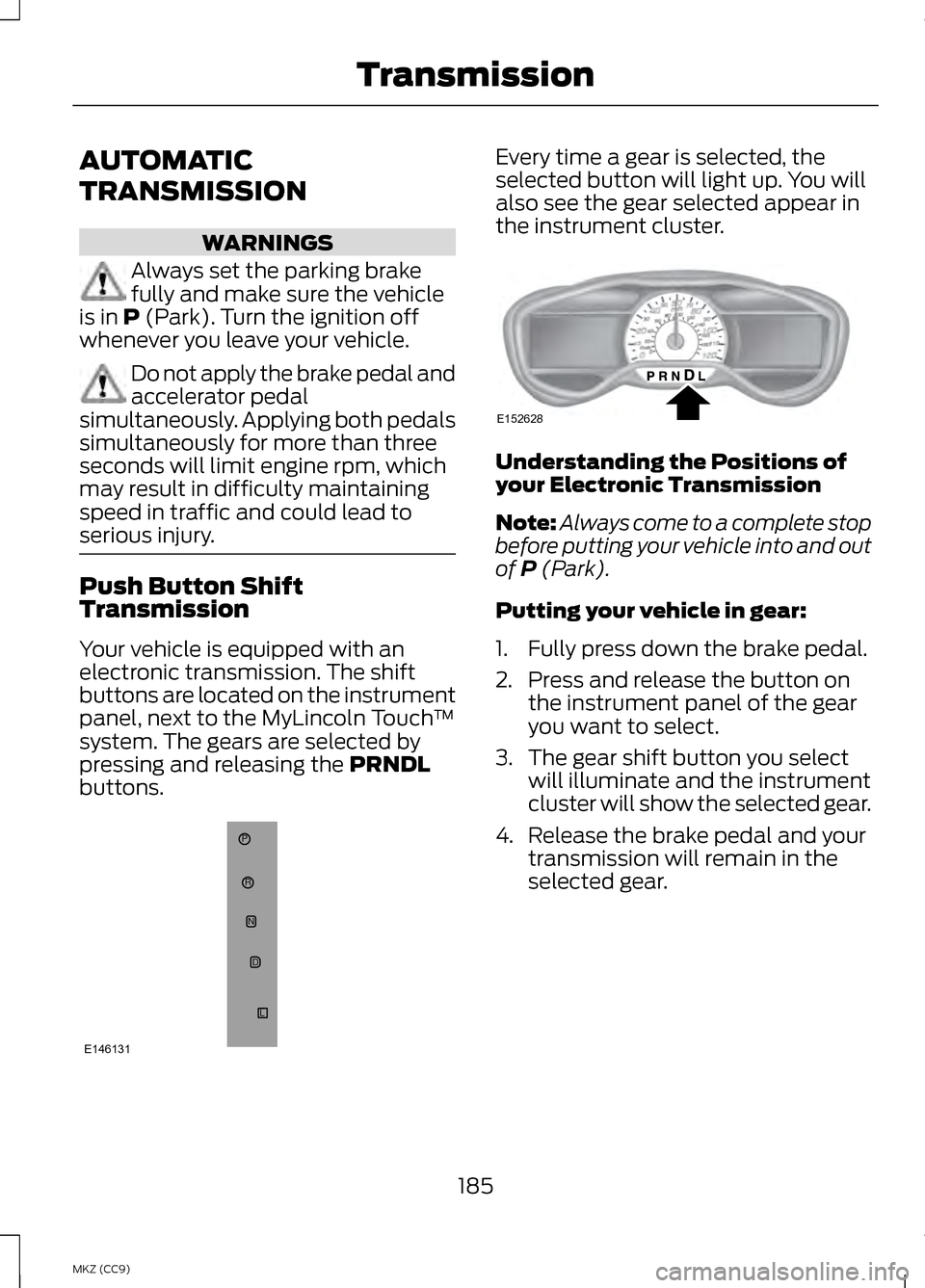
serious injury. Push Button Shift
Transmission
Your vehicle is equipped with an
electronic transmission. The shift
buttons are located on the instrument
panel, next to the MyLincoln Touch
™
system. The gears are selected by
pressing and releasing the
PRNDL
buttons. Every time a gear is selected, the
selected button will light up. You will
also see the gear selected appear in
the instrument cluster.
Understanding the Positions of
your Electronic Transmission
Note:
Always come to a complete stop
before putting your vehicle into and out
of
P (Park).
Putting your vehicle in gear:
1. Fully press down the brake pedal.
2. Press and release the button on the instrument panel of the gear
you want to select.
3. The gear shift button you select will illuminate and the instrument
cluster will show the selected gear.
4. Release the brake pedal and your transmission will remain in the
selected gear.
185
MKZ (CC9) TransmissionP
RN
D
L
E146131 E152628
Page 191 of 475
5. Release the override button.
6.
The vehicle will remain in Stay in
Neutral mode for wrecker towing
purposes or can be shifted to the
desired gear and driven (if the
vehicle can be driven).
7. Release the parking brake.
If Your Vehicle Gets Stuck In
Mud or Snow
Note: Do not rock the vehicle if the
engine is not at normal operating
temperature or damage to the
transmission may occur.
Note: Do not rock the vehicle for more
than a minute or damage to the
transmission and tires may occur, or
the engine may overheat.
If your vehicle gets stuck in mud or
snow, it may be rocked out by shifting
between forward and reverse gears,
stopping between shifts in a steady
pattern. Press lightly on the
accelerator in each gear.
HILL START ASSIST WARNINGS
The system does not replace the
parking brake. When you leave
your vehicle, always apply the parking
brake and put the vehicle in P (Park). You must remain in your vehicle
once you have activated the
system. WARNINGS
During all times, you are
responsible for controlling your
vehicle, supervising the system and
intervening, if required. If the engine is revved
excessively, or if a malfunction
is detected, the system will be
deactivated. The system makes it easier to pull
away when your vehicle is on a slope
without the need to use the parking
brake.
When the system is active, your
vehicle will remain stationary on the
slope for two to three seconds after
you release the brake pedal. This
allows you time to move your foot
from the brake to the accelerator
pedal. The brakes are released
automatically once the engine has
developed sufficient drive to prevent
your vehicle from rolling down the
slope. This is an advantage when
pulling away on a slope, (for example
from a car park ramp, traffic lights or
when reversing uphill into a parking
space).
The system will activate
automatically on any slope that will
cause significant vehicle rollback.
Using Hill Start Assist
1.
Press the brake pedal to bring your
vehicle to a complete standstill.
Keep the brake pedal pressed.
189
MKZ (CC9) Transmission
Page 193 of 475
GENERAL INFORMATION
Note:
Occasional brake noise is
normal. If a metal-to-metal,
continuous grinding or continuous
squeal sound is present, the brake
linings may be worn-out. Have the
system checked by an authorized
dealer. If the vehicle has continuous
vibration or shudder in the steering
wheel while braking, have it checked
by an authorized dealer.
Note: Brake dust may accumulate on
the wheels, even under normal driving
conditions. Some dust is inevitable as
the brakes wear and does not
contribute to brake noise. See
Cleaning the Alloy Wheels (page 299). See Warning Lamps and
Indicators (page 98).
Wet brakes result in reduced braking
efficiency. Gently press the brake
pedal a few times when driving from
a car wash or standing water to dry
the brakes.
Brake Over Accelerator
In the event the accelerator pedal
becomes stuck or entrapped, apply
steady and firm pressure to the brake
pedal to slow the vehicle and reduce
engine power. If you experience this
condition, apply the brakes and bring
your vehicle to a safe stop. Move the
transmission selector lever to position P,
switch the engine off and apply the
parking brake. Inspect the accelerator
pedal for any interference. If none are
found and the condition persists, have
your vehicle towed to the nearest
authorized dealer.
Brake Assist
Brake assist detects when you brake
heavily by measuring the rate at which
you press the brake pedal. It provides
maximum braking efficiency as long
as you press the pedal. Brake assist
can reduce stopping distances in
critical situations.
Anti-lock Brake System
This system helps you maintain
steering control during emergency
stops by keeping the brakes from
locking. This lamp momentarily
illuminates when you turn
the ignition on. If the light
does not illuminate during start up,
remains on or flashes, the anti-lock
braking system may be disabled. Have
the system checked by an authorized
dealer. If the system is disabled,
normal braking is still
effective. If the brake
warning lamp illuminates when you
release the parking brake, have your
system checked by an authorized
dealer.
191
MKZ (CC9) BrakesE144522 E144522
Page 196 of 475
Releasing the electric parking
brake
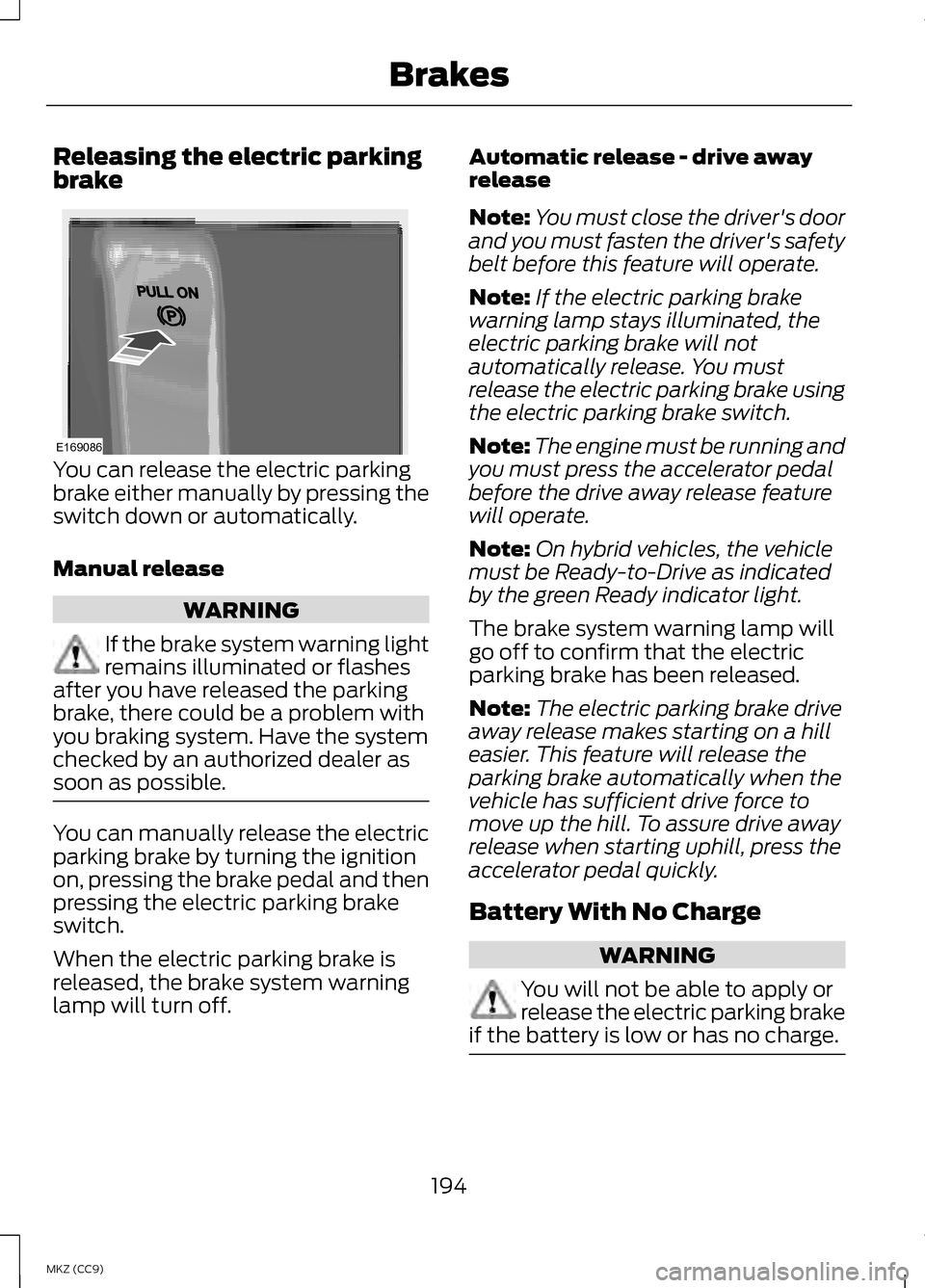
You can release the electric parking
brake either manually by pressing the
switch down or automatically.
Manual release
WARNING
If the brake system warning light
remains illuminated or flashes
after you have released the parking
brake, there could be a problem with
you braking system. Have the system
checked by an authorized dealer as
soon as possible. You can manually release the electric
parking brake by turning the ignition
on, pressing the brake pedal and then
pressing the electric parking brake
switch.
When the electric parking brake is
released, the brake system warning
lamp will turn off. Automatic release - drive away
release
Note:
You must close the driver's door
and you must fasten the driver's safety
belt before this feature will operate.
Note: If the electric parking brake
warning lamp stays illuminated, the
electric parking brake will not
automatically release. You must
release the electric parking brake using
the electric parking brake switch.
Note: The engine must be running and
you must press the accelerator pedal
before the drive away release feature
will operate.
Note: On hybrid vehicles, the vehicle
must be Ready-to-Drive as indicated
by the green Ready indicator light.
The brake system warning lamp will
go off to confirm that the electric
parking brake has been released.
Note: The electric parking brake drive
away release makes starting on a hill
easier. This feature will release the
parking brake automatically when the
vehicle has sufficient drive force to
move up the hill. To assure drive away
release when starting uphill, press the
accelerator pedal quickly.
Battery With No Charge WARNING
You will not be able to apply or
release the electric parking brake
if the battery is low or has no charge. 194
MKZ (CC9) BrakesE169086
Page 198 of 475
PRINCIPLE OF OPERATION
The traction control system helps
avoid drive wheel spin and loss of
traction.
If your vehicle begins to slide, the
system applies the brakes to
individual wheels and, when needed,
reduces engine power at the same
time. If the wheels spin when
accelerating on slippery or loose
surfaces, the system reduces engine
power in order to increase traction.
USING TRACTION
CONTROL
In certain situations (for example,
stuck in snow or mud), turning the
traction control off may be beneficial
as this allows the wheels to spin with
full engine power. Turn off the traction
control system through the
information display. See General
Information (page 103). System Indicator Lights and
Messages WARNING
If a failure has been detected
within the AdvanceTrac system,
the stability control light will
illuminate steadily. Verify that the
AdvanceTrac system was not
manually disabled through the
information display. If the stability
control light still illuminates steadily,
have the system serviced by an
authorized dealer immediately.
Operating your vehicle with
AdvanceTrac disabled could lead to
an increased risk of loss of vehicle
control, vehicle rollover, personal
injury and death. The stability control light
temporarily illuminates on
engine start-up and flashes
when a driving condition activates the
stability system. The stability control off light
temporarily illuminates on
engine start-up and stays on
when you turn the traction control
system off.
When you turn the traction control
system off or on, a message appears
in the information display showing
system status.
196
MKZ (CC9) Traction ControlE138639
Page 210 of 475
Active guidelines are only shown with
fixed guidelines. To use active
guidelines, turn the steering wheel to
point the guidelines toward an
intended path. If the steering wheel
position is changed while reversing,
the vehicle might deviate from the
original intended path.
The fixed and active guidelines fade
in and out depending on the steering
wheel position. The active guidelines
are not shown when the steering
wheel position is straight.
Always use caution while reversing.
Objects in the red zone are closest to
your vehicle and objects in the green
zone are farther away. Objects are
getting closer to your vehicle as they
move from the green zone to the
yellow or red zones. Use the side view
mirrors and rear view mirror to get
better coverage on both sides and rear
of the vehicle.
Selectable settings for this feature are
ACTIVE + FIXED, FIXED and OFF.
Visual Park Aid Alert
Note:
Visual park alert is only available
when the transmission is in R
(Reverse).
Note: The reverse sensing system is
not effective at speeds above 3 mph
(5 km/h) and may not detect certain
angular or moving objects. The system uses red, yellow and green
highlights which appear on top of the
video image when an object is
detected by the reverse sensing
system. The alert highlights the
closest object detected. The reverse
sensing alert can be disabled and if
visual park aid alert is enabled,
highlighted areas are still displayed.
Selectable settings for this feature are
ON and OFF.
Manual Zoom
WARNING
When manual zoom is on, the
full area behind the vehicle is not
shown. Be aware of your surroundings
when using the manual zoom feature. Note:
Manual zoom is only available
when the transmission is in R
(Reverse).
Note: When manual zoom is enabled,
only the centerline is shown.
This allows you to get a closer view of
an object behind the vehicle. The
zoomed image keeps the bumper in
the image to provide a reference. The
zoom is only active while the
transmission is in R (Reverse). When
the transmission is shifted out of R
(Reverse), the feature automatically
turns off and must be reset when it is
used again.
Selectable settings for this feature are
ON and OFF.
208
MKZ (CC9) Parking Aids