height LINCOLN MKZ HYBRID 2014 User Guide
[x] Cancel search | Manufacturer: LINCOLN, Model Year: 2014, Model line: MKZ HYBRID, Model: LINCOLN MKZ HYBRID 2014Pages: 445, PDF Size: 3.8 MB
Page 81 of 445
DAYTIME RUNNING LAMPS (IF
EQUIPPED) WARNING
Always remember to switch your
headlamps on in low light situations
or during inclement weather. The system
does not activate the tail lamps and may
not provide adequate lighting during these
conditions. Failure to activate your
headlamps under these conditions may
result in a collision. The system switches the signature lamps
on in day light conditions.
To switch the system on, switch the
ignition on, and switch the lighting control
to the off, autolamp, or parking lamp
position.
AUTOMATIC HIGH BEAM
CONTROL
(IF EQUIPPED)
The system will automatically turn on your
high beams if it is dark enough and no
other traffic is present. When it detects the
headlights of an approaching vehicle, the
tail lamps of the preceding vehicle or
street lighting, the system will turn off the
high beams before they distract other
drivers. The low beams remain on.
Note: If it appears that automatic control
of the high beams is not functioning
properly, check the windshield in front of
the camera for a blockage. A clear view
of the road is required for proper system
operation. Have any windshield damage
in the area of the camera ’s field-of-view
repaired. Note:
If the system detects a blockage
such as bird droppings, bug splatter, snow
or ice, and you do not observe changes,
the system will go into low beam mode
until you clear the blockage. A message
may also appear in the instrument cluster
display noting the front camera is blocked.
Note: Typical road dust, dirt and water
spots will not affect the performance of
the automatic high beam system .
However, in cold or inclement weather
conditions, you will notice a decrease in
the availability of the high beam system,
especially at start up. If you want to
change the beam state independently of
the system, you may switch the high
beams on or off using the multifunction
switch. Automatic control will resume
when conditions are correct.
Note: Modification of the vehicle ride
height such as using much larger tires,
may degrade feature performance.
A camera sensor, centrally mounted
behind the windshield of your vehicle,
continuously monitors conditions to decide
when to switch the high beams off and on.
Once the system is active, the high beams
will switch on if:
• the ambient light level is low enough
• there is no traffic in front of the vehicle
• the vehicle speed is greater than
25 mph (40 km/h)
The high beams will switch off if:
• the system detects the headlamps of
an approaching vehicle or the tail
lamps of a preceding vehicle.
• vehicle speed falls below
16 mph
(25 km/h)
79
MKZ (CC9) Lighting
Page 265 of 445
2. Press the locking buttons together.
3. Rotate and remove the wiper blade.
4. Install in the reverse order.
Note:
Make sure that the wiper blade
locks into place. Lower the wiper arm and
blade back to the windshield. The wiper
arms will automatically return to their
normal position when the ignition is turned
on.
Replace wiper blades at least once per
year for optimum performance.
Poor wiper quality can be improved by
cleaning the wiper blades and the
windshield.
ADJUSTING THE HEADLAMPS
Vertical Aim Adjustment
The headlamps on your vehicle are
properly aimed at the assembly plant. If
your vehicle has been in an accident, the
alignment of your headlamps should be
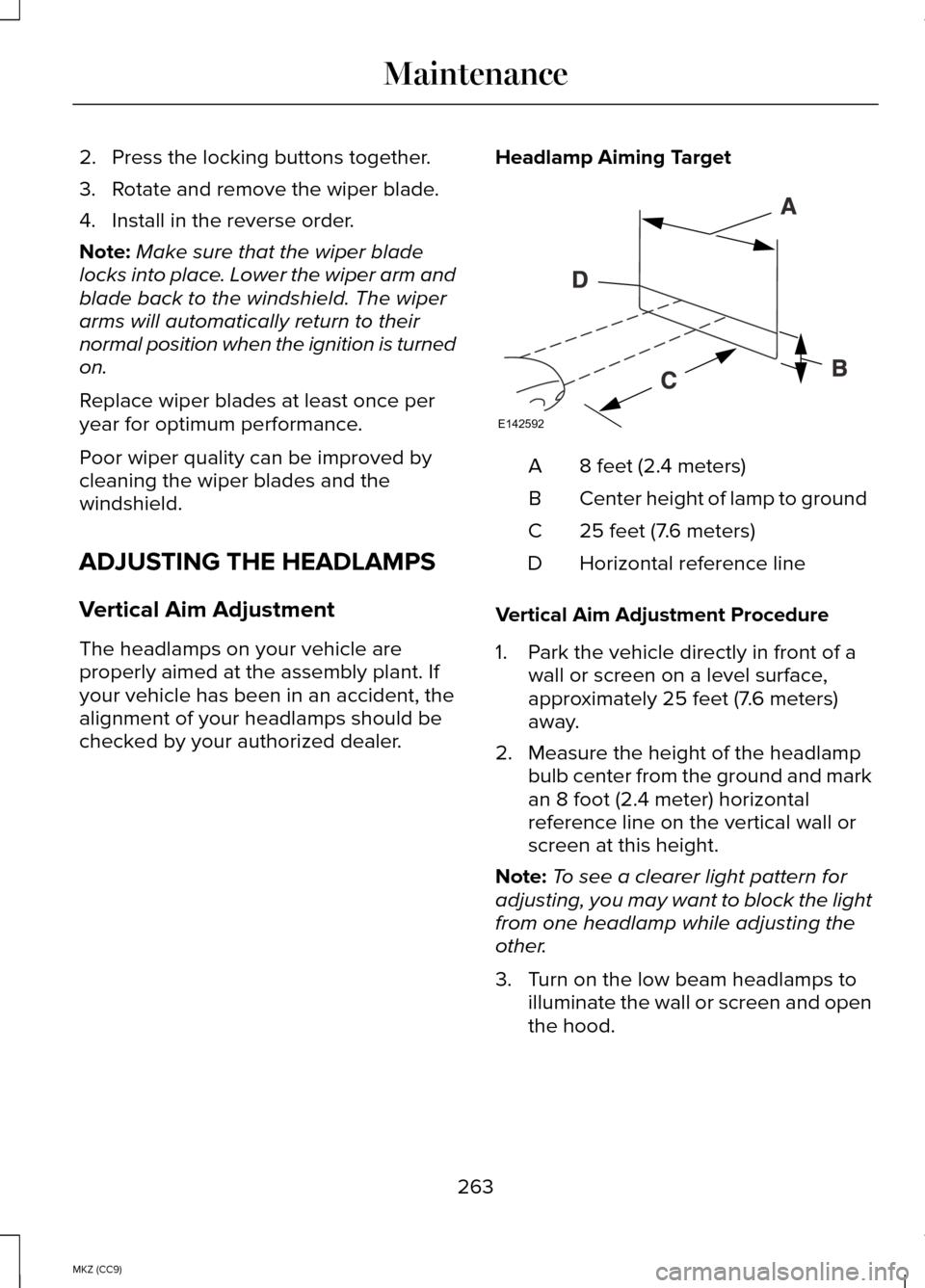
checked by your authorized dealer. Headlamp Aiming Target 8 feet (2.4 meters)
A
Center height of lamp to ground
B
25 feet (7.6 meters)
C
Horizontal reference line
D
Vertical Aim Adjustment Procedure
1. Park the vehicle directly in front of a wall or screen on a level surface,
approximately 25 feet (7.6 meters)
away.
2. Measure the height of the headlamp bulb center from the ground and mark
an 8 foot (2.4 meter) horizontal
reference line on the vertical wall or
screen at this height.
Note: To see a clearer light pattern for
adjusting, you may want to block the light
from one headlamp while adjusting the
other.
3. Turn on the low beam headlamps to illuminate the wall or screen and open
the hood.
263
MKZ (CC9) MaintenanceE142592
Page 287 of 445
Information Contained on the Tire
Sidewall
Both U.S. and Canada Federal
regulations require tire manufacturers
to place standardized information on
the sidewall of all tires. This
information identifies and describes
the fundamental characteristics of the
tire and also provides a U.S. DOT Tire
Identification Number for safety
standard certification and in case of a
recall.
Information on P Type Tires
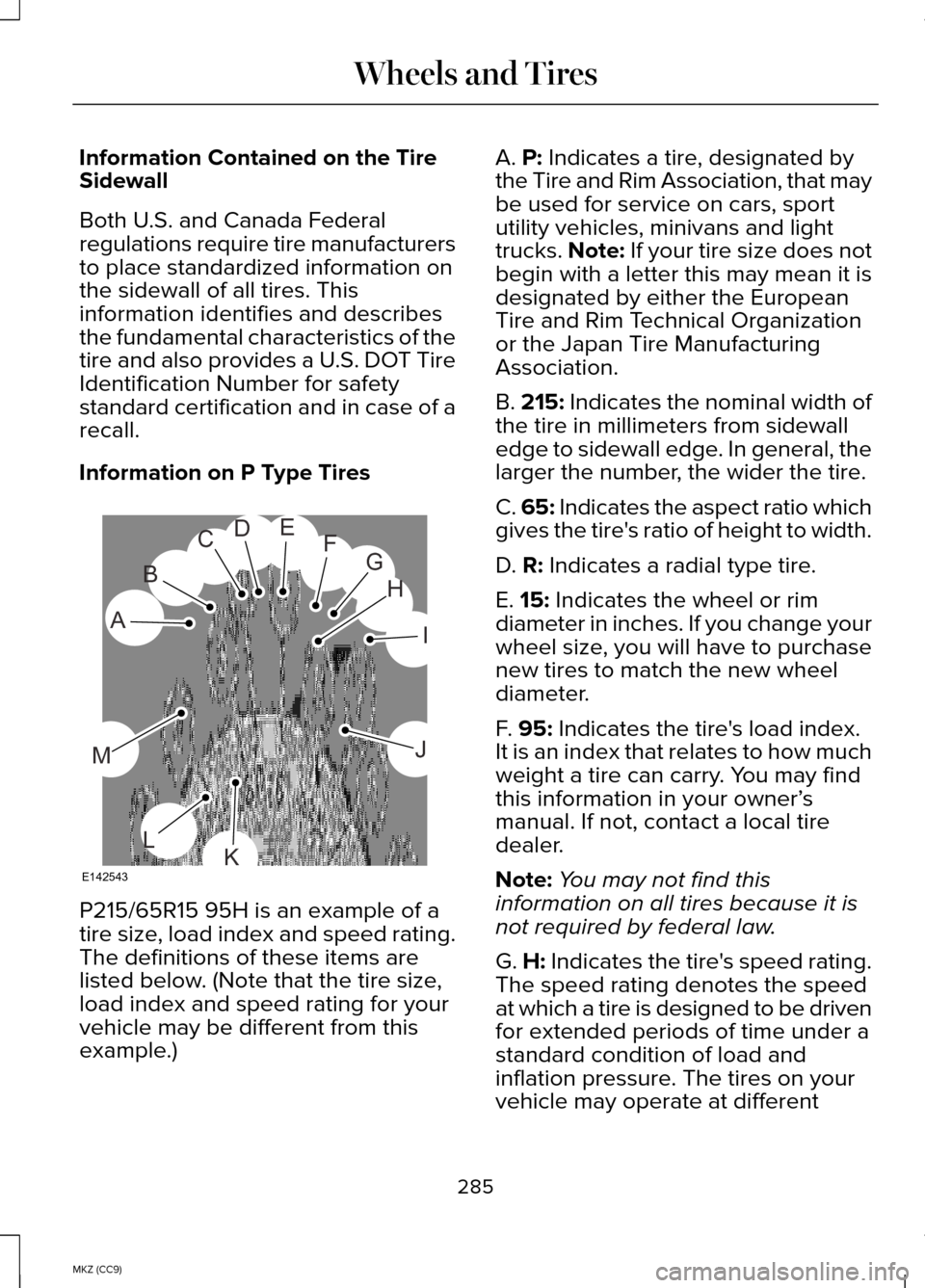
P215/65R15 95H is an example of a
tire size, load index and speed rating.
The definitions of these items are
listed below. (Note that the tire size,
load index and speed rating for your
vehicle may be different from this
example.) A. P: Indicates a tire, designated by
the Tire and Rim Association, that may
be used for service on cars, sport
utility vehicles, minivans and light
trucks. Note: If your tire size does not
begin with a letter this may mean it is
designated by either the European
Tire and Rim Technical Organization
or the Japan Tire Manufacturing
Association.
B.
215: Indicates the nominal width of
the tire in millimeters from sidewall
edge to sidewall edge. In general, the
larger the number, the wider the tire.
C. 65: Indicates the aspect ratio which
gives the tire's ratio of height to width.
D.
R: Indicates a radial type tire.
E.
15: Indicates the wheel or rim
diameter in inches. If you change your
wheel size, you will have to purchase
new tires to match the new wheel
diameter.
F.
95: Indicates the tire's load index.
It is an index that relates to how much
weight a tire can carry. You may find
this information in your owner’ s
manual. If not, contact a local tire
dealer.
Note: You may not find this
information on all tires because it is
not required by federal law.
G.
H: Indicates the tire's speed rating.
The speed rating denotes the speed
at which a tire is designed to be driven
for extended periods of time under a
standard condition of load and
inflation pressure. The tires on your
vehicle may operate at different
285
MKZ (CC9) Wheels and TiresH
I
J
KL
M
A
B
CDEFG
E142543
Page 290 of 445
B. Load Range and Load Inflation
Limits: Indicates the tire's
load-carrying capabilities and its
inflation limits.
C. Maximum Load Dual lb (kg) at psi
(kPa) cold:
Indicates the maximum
load and tire pressure when the tire
is used as a dual; defined as four tires
on the rear axle (a total of six or more
tires on the vehicle).
D.
Maximum Load Single lb (kg) at
psi (kPa) cold: Indicates the maximum
load and tire pressure when the tire
is used as a single; defined as two
tires (total) on the rear axle.
Information on T Type Tires
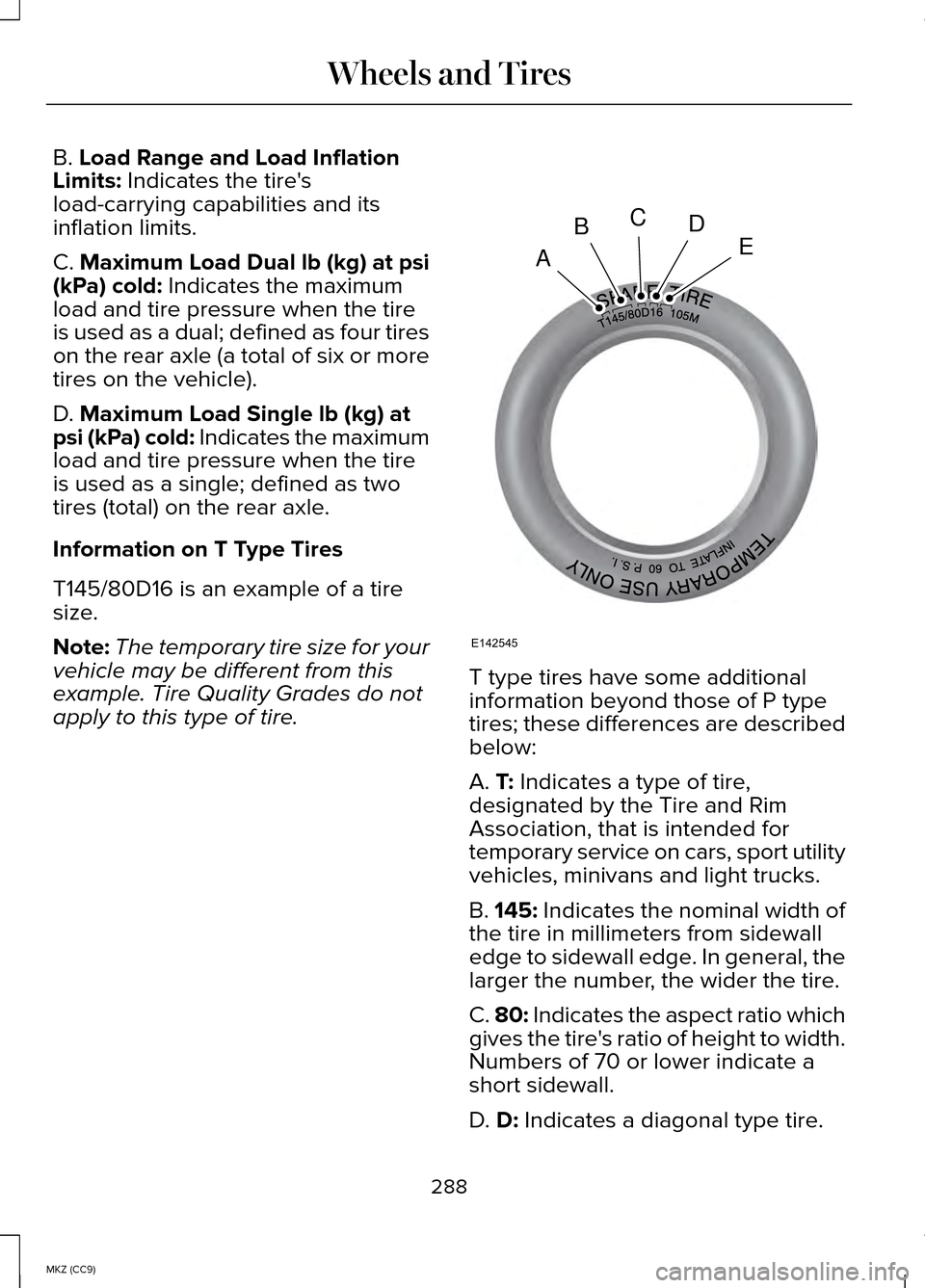
T145/80D16 is an example of a tire
size.
Note: The temporary tire size for your
vehicle may be different from this
example. Tire Quality Grades do not
apply to this type of tire. T type tires have some additional
information beyond those of P type
tires; these differences are described
below:
A.
T: Indicates a type of tire,
designated by the Tire and Rim
Association, that is intended for
temporary service on cars, sport utility
vehicles, minivans and light trucks.
B.
145: Indicates the nominal width of
the tire in millimeters from sidewall
edge to sidewall edge. In general, the
larger the number, the wider the tire.
C. 80: Indicates the aspect ratio which
gives the tire's ratio of height to width.
Numbers of 70 or lower indicate a
short sidewall.
D.
D: Indicates a diagonal type tire.
288
MKZ (CC9) Wheels and TiresA
BCDE
E142545
Page 293 of 445
Note:
Some spare tires operate at a
higher inflation pressure than the
other tires. For T type mini-spare tires
(refer to the Dissimilar spare wheel
and tire assembly information for a
description): Store and maintain at 60
psi (4.15 bar). For full-size and
dissimilar spare tires (refer to the
Dissimilar spare wheel and tire
assembly information for a
description): Store and maintain at the
higher of the front and rear inflation
pressure as shown on the Tire Label.
6. Visually inspect the tires to make
sure there are no nails or other
objects embedded that could poke
a hole in the tire and cause an air
leak.
7. Check the sidewalls to make sure there are no gouges, cuts or
bulges.
Inspecting Your Tires and Wheel
Valve Stems
Periodically inspect the tire treads for
uneven or excessive wear and remove
objects such as stones, nails or glass
that may be wedged in the tread
grooves. Check the tire and valve
stems for holes, cracks, or cuts that
may permit air leakage and repair or
replace the tire and replace the valve
stem. Inspect the tire sidewalls for
cracking, cuts, bruises and other signs
of damage or excessive wear. If
internal damage to the tire is
suspected, have the tire demounted and inspected in case it needs to be
repaired or replaced. For your safety,
tires that are damaged or show signs
of excessive wear should not be used
because they are more likely to blow
out or fail.
Improper or inadequate vehicle
maintenance can cause tires to wear
abnormally. Inspect all your tires,
including the spare, frequently, and
replace them if one or more of the
following conditions exist:
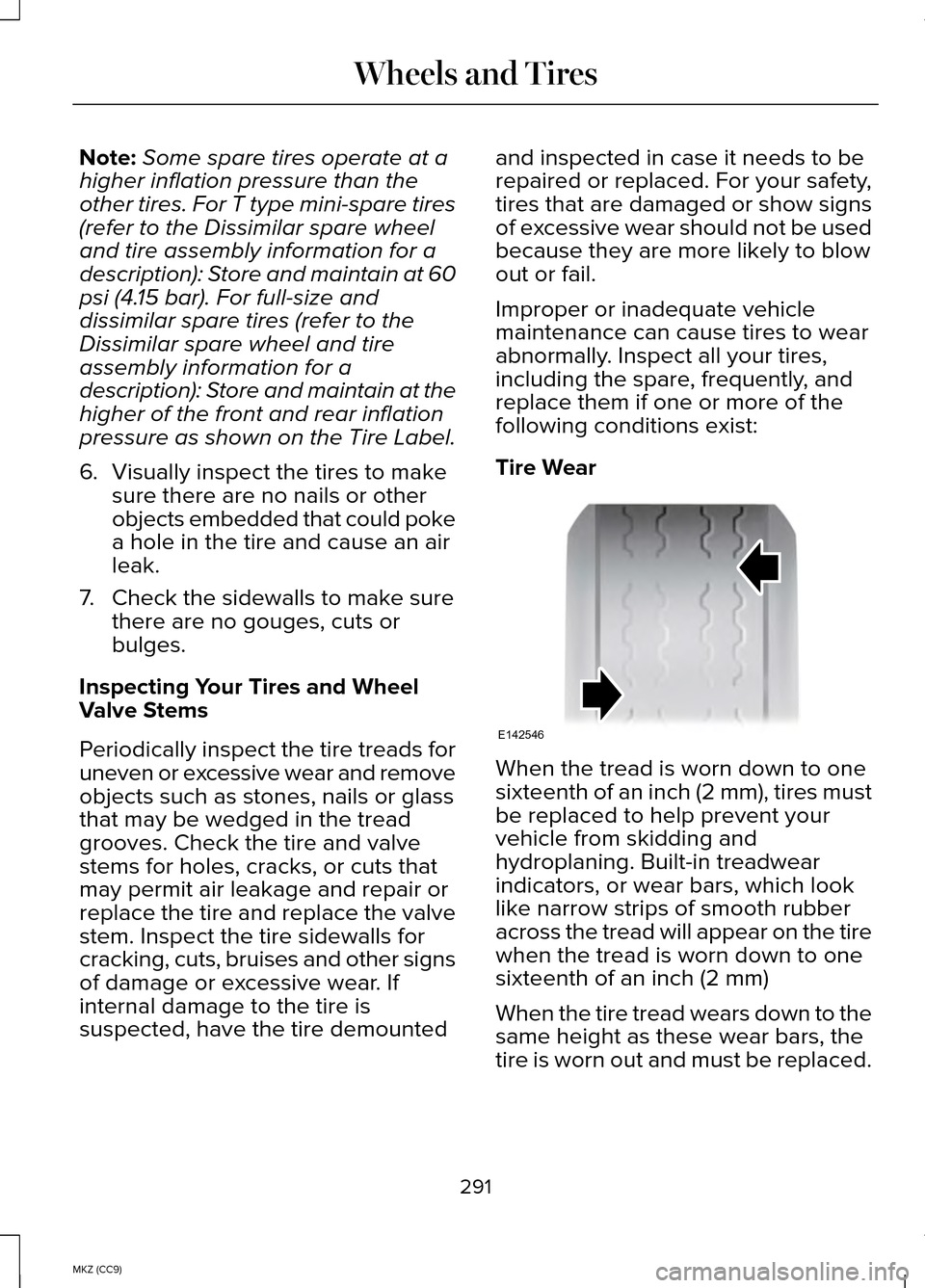
Tire Wear
When the tread is worn down to one
sixteenth of an inch (2 mm), tires must
be replaced to help prevent your
vehicle from skidding and
hydroplaning. Built-in treadwear
indicators, or wear bars, which look
like narrow strips of smooth rubber
across the tread will appear on the tire
when the tread is worn down to one
sixteenth of an inch (2 mm)
When the tire tread wears down to the
same height as these wear bars, the
tire is worn out and must be replaced.
291
MKZ (CC9) Wheels and TiresE142546
Page 440 of 445
Remote Control...........................................48
Car Finder..........................................................50
Intelligent Access Key.....................................48
Remote Start.....................................................50
Replacing the Battery.....................................49
Sounding a Panic Alarm.................................50
Remote Start...............................................127 Automatic Settings.........................................127
Heated and Cooled Devices.......................128
Last Settings.....................................................127
Repairing Minor Paint Damage.............272
Replacement Parts Recommendation.....................................12
Collision Repairs................................................12
Scheduled Maintenance and Mechanical Repairs............................................................12
Warranty on Replacement Parts....................12
Replacing a Lost Key or Remote Control........................................................52
Reporting Safety Defects (Canada Only).........................................................238
Reporting Safety Defects (U.S. Only)..........................................................237
Roadside Assistance...............................225 Vehicles Sold In Canada : Getting Roadside
Assistance..................................................225
Vehicles Sold In Canada : Using Roadside Assistance..................................................226
Vehicles Sold In the United States: Getting Roadside Assistance................................
225
Vehicles Sold In the United States : Using Roadside Assistance................................
225
Roadside Emergencies
..........................225
Running-In See: Breaking-In............................................223
Running Out of Fuel.................................159 Refilling With a Portable Fuel
Container.....................................................160
S
Safety Belt Height Adjustment................34 Safety Belt Minder
......................................35
Belt-Minder®......................................................35
Safety Belts
..................................................29
Principle of Operation.....................................29
Safety Belt Warning Lamp and Indicator Chime
..........................................................35
Conditions of operation.................................35
Safety Precautions
....................................158
Scheduled Maintenance Record.........420
Scheduled Maintenance.........................412
Seats
............................................................129
Security.........................................................67
Settings.......................................................323 Clock.................................................................323
Display..............................................................324
Settings............................................................326
Sound...............................................................325
Vehicle..............................................................325
Side Airbags
.................................................43
Side Curtain Airbags..................................45
Sitting in the Correct Position................129
Snow Chains See: Using Snow Chains.............................296
Special Notices
............................................12
New Vehicle Limited Warranty......................12
Special Instructions..........................................12
Special Operating Conditions Scheduled Maintenance............................................416
Exceptions........................................................417
Speed Control See: Cruise Control.........................................191
Stability Control
.........................................180
Principle of Operation...................................180
Starting a Gasoline Engine
.....................148
Automatic Shutdown.....................................149
Fast Restart......................................................149
Guarding Against Exhaust Fumes.............150
Important Ventilating Information..............150
Switching Off the Vehicle When It Is
Moving..........................................................150
Switching Off the Vehicle When It Is Stationary.....................................................149
438
MKZ (CC9) Index