check oil LINCOLN NAUTILUS 2022 Owners Manual
[x] Cancel search | Manufacturer: LINCOLN, Model Year: 2022, Model line: NAUTILUS, Model: LINCOLN NAUTILUS 2022Pages: 586, PDF Size: 13.97 MB
Page 15 of 586
Post-Crash Alert System.............................318
Automatic Crash Shutoff............................319
Transporting the Vehicle............................319
Towing Your Vehicle
Towing Your Vehicle Precautions.............321
Recreationally Towing Your Vehicle - 2.0L,AWD............................................................321
Recreationally Towing Your Vehicle - 2.0L,FWD.............................................................321
Recreationally Towing Your Vehicle - 2.7L.......................................................................321
Emergency Towing.....................................322
Fuses
Fuse Precautions.........................................323
Under Hood Fuse Box...............................323
Body Control Module Fuse Box..............333
Identifying Fuse Types...............................338
Fuses – Troubleshooting..........................338
Maintenance
Maintenance Precautions.........................339
Opening and Closing the Hood..............339
Under Hood Overview - 2.0L....................341
Under Hood Overview - 2.7L....................343
Engine Oil......................................................345
Checking the Coolant................................347
Changing the Engine Air Filter.................351
Changing the Fuel Filter............................352
Drive Belt Routing Overview - 2.0L........352
Drive Belt Routing Overview - 2.7L.........352
Changing the 12V Battery.........................353
Adjusting the Headlamps.........................355
Exterior Bulbs...............................................358
Interior Bulbs.................................................361
Vehicle Care
Cleaning Products......................................362
Cleaning the Exterior.................................363
Waxing...........................................................365
Cleaning the Interior..................................365
Repairing Minor Paint Damage................367
Body Styling Kits
Body Styling Kit Precautions....................368
Storing Your Vehicle
Preparing Your Vehicle for Storage........369
Removing Your Vehicle From Storage......................................................................370
Wheel and Tire Information
Locating the Tire label................................371
Department of Transportation Uniform TireQuality Grades..........................................371
Information on the Tire Sidewall.............372
Glossary of Tire Terminology....................377
Tire Replacement Requirements.............377
Using Snow Chains....................................380
Tire Care
Checking the Tire Pressures....................382
Inflating the Tires........................................382
Inspecting the Tire for Wear.....................382
Inspecting the Tire for Damage...............383
Inspecting the Wheel Valve Stems.........384
Tire Rotation.................................................384
11
2022 Nautilus (CD9) Canada/United States of America, enUSA, Edition date: 202108, First-PrintingTable of Contents
Page 23 of 586
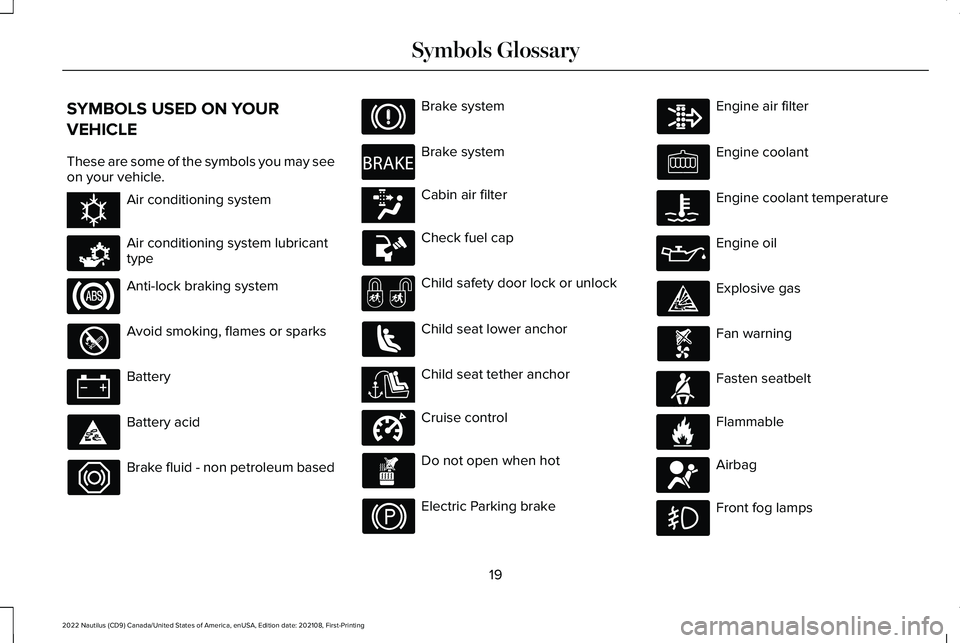
SYMBOLS USED ON YOUR
VEHICLE
These are some of the symbols you may seeon your vehicle.
Air conditioning system
Air conditioning system lubricanttype
Anti-lock braking system
Avoid smoking, flames or sparks
Battery
Battery acid
Brake fluid - non petroleum based
Brake system
Brake system
Cabin air filter
Check fuel cap
Child safety door lock or unlock
Child seat lower anchor
Child seat tether anchor
Cruise control
Do not open when hot
Electric Parking brake
Engine air filter
Engine coolant
Engine coolant temperature
Engine oil
Explosive gas
Fan warning
Fasten seatbelt
Flammable
Airbag
Front fog lamps
19
2022 Nautilus (CD9) Canada/United States of America, enUSA, Edition date: 202108, First-PrintingSymbols GlossaryE162384 E231157 E270480 E139223 E141128 E332905 E71880 E231160 E67017
Page 145 of 586
WHAT IS DISTANCE TO EMPTY
Indicates the approximate distance yourvehicle can travel on the fuel remaining inthe tank. Changes in driving pattern cancause the value to not only decrease but alsoincrease or stay constant for periods of time.
ENGINE COOLANT TEMPERATURE
GAUGE
Indicates the engine coolant temperature.
ENGINE OIL PRESSURE GAUGE
Indicates the engine oil pressure.
Note:This is a configurable gauge.
TRANSMISSION FLUID
TEMPERATURE GAUGE
Indicates the transmission fluid temperature.
Special operating conditions can causehigher than normal operating temperatures.See Special Operating ConditionsScheduled Maintenance (page 471).
Note:This is a configurable gauge.
12V BATTERY GAUGE
Indicates the power of the 12-volt battery.
WHAT ARE THE INSTRUMENT
CLUSTER WARNING LAMPS
Warning lamps alert you to a vehiclecondition that could become serious. Somelamps illuminate when you start your vehicleto make sure they work. If any lamps remainon after starting your vehicle, refer to therespective system warning lamp for furtherinformation.
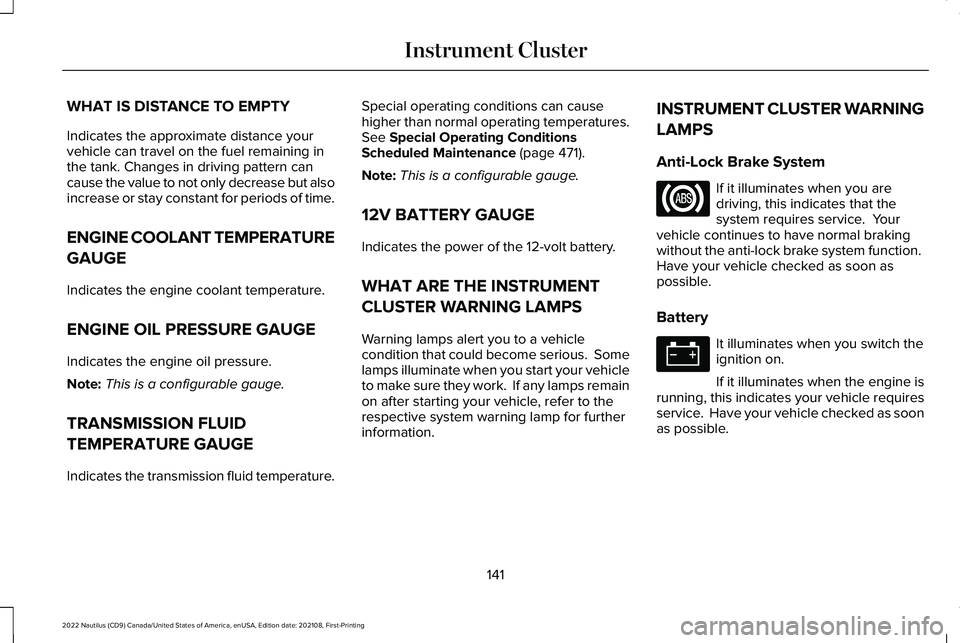
INSTRUMENT CLUSTER WARNING
LAMPS
Anti-Lock Brake System
If it illuminates when you aredriving, this indicates that thesystem requires service. Yourvehicle continues to have normal brakingwithout the anti-lock brake system function. Have your vehicle checked as soon aspossible.
Battery
It illuminates when you switch theignition on.
If it illuminates when the engine isrunning, this indicates your vehicle requiresservice. Have your vehicle checked as soonas possible.
141
2022 Nautilus (CD9) Canada/United States of America, enUSA, Edition date: 202108, First-PrintingInstrument Cluster
Page 147 of 586
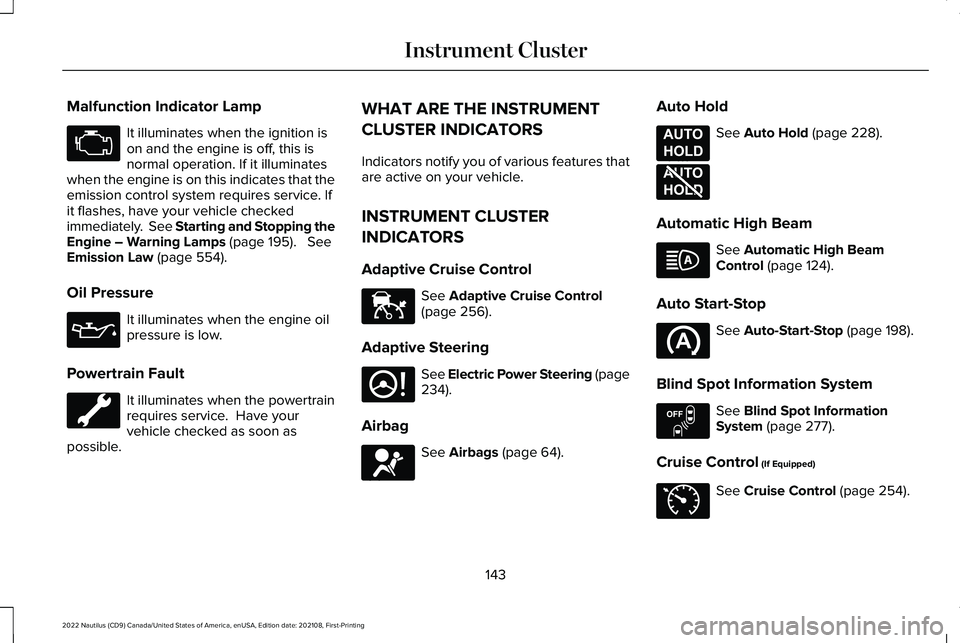
Malfunction Indicator Lamp
It illuminates when the ignition ison and the engine is off, this isnormal operation. If it illuminateswhen the engine is on this indicates that theemission control system requires service. Ifit flashes, have your vehicle checkedimmediately. See Starting and Stopping theEngine – Warning Lamps (page 195). SeeEmission Law (page 554).
Oil Pressure
It illuminates when the engine oilpressure is low.
Powertrain Fault
It illuminates when the powertrainrequires service. Have yourvehicle checked as soon aspossible.
WHAT ARE THE INSTRUMENT
CLUSTER INDICATORS
Indicators notify you of various features thatare active on your vehicle.
INSTRUMENT CLUSTER
INDICATORS
Adaptive Cruise Control
See Adaptive Cruise Control(page 256).
Adaptive Steering
See Electric Power Steering (page234).
Airbag
See Airbags (page 64).
Auto Hold
See Auto Hold (page 228).
Automatic High Beam
See Automatic High BeamControl (page 124).
Auto Start-Stop
See Auto-Start-Stop (page 198).
Blind Spot Information System
See Blind Spot InformationSystem (page 277).
Cruise Control (If Equipped)
See Cruise Control (page 254).
143
2022 Nautilus (CD9) Canada/United States of America, enUSA, Edition date: 202108, First-PrintingInstrument Cluster E144524 E223375 E67017 E197933 E197934 E151262 E71340
Page 346 of 586
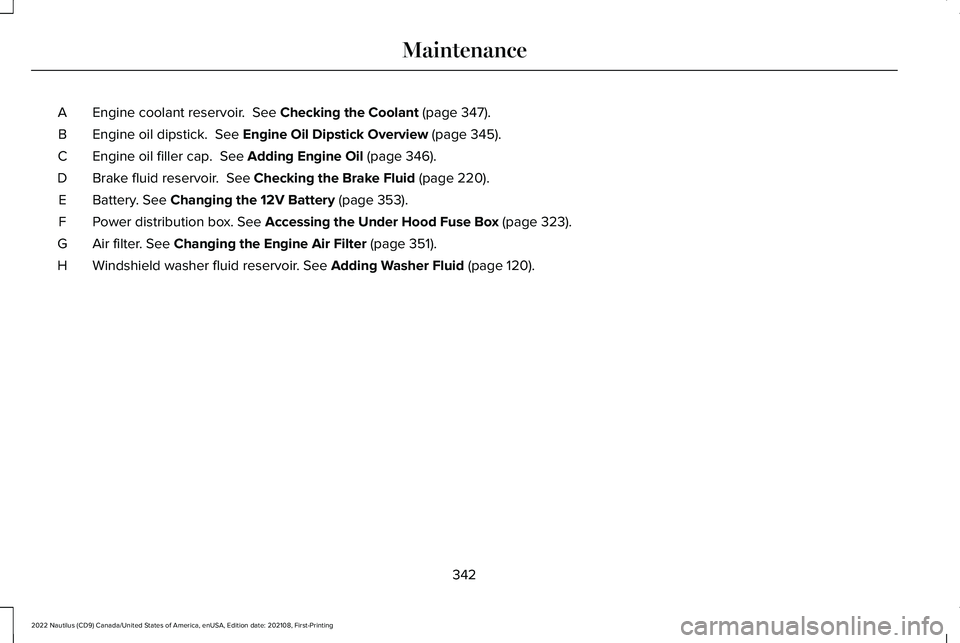
Engine coolant reservoir. See Checking the Coolant (page 347).A
Engine oil dipstick. See Engine Oil Dipstick Overview (page 345).B
Engine oil filler cap. See Adding Engine Oil (page 346).C
Brake fluid reservoir. See Checking the Brake Fluid (page 220).D
Battery. See Changing the 12V Battery (page 353).E
Power distribution box. See Accessing the Under Hood Fuse Box (page 323).F
Air filter. See Changing the Engine Air Filter (page 351).G
Windshield washer fluid reservoir. See Adding Washer Fluid (page 120).H
342
2022 Nautilus (CD9) Canada/United States of America, enUSA, Edition date: 202108, First-PrintingMaintenance
Page 348 of 586
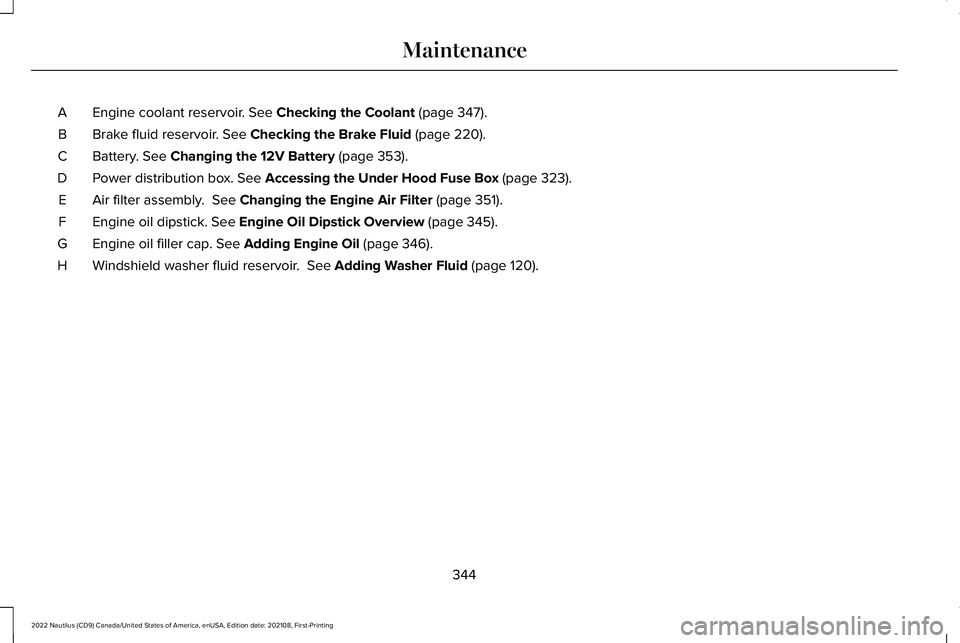
Engine coolant reservoir. See Checking the Coolant (page 347).A
Brake fluid reservoir. See Checking the Brake Fluid (page 220).B
Battery. See Changing the 12V Battery (page 353).C
Power distribution box. See Accessing the Under Hood Fuse Box (page 323).D
Air filter assembly. See Changing the Engine Air Filter (page 351).E
Engine oil dipstick. See Engine Oil Dipstick Overview (page 345).F
Engine oil filler cap. See Adding Engine Oil (page 346).G
Windshield washer fluid reservoir. See Adding Washer Fluid (page 120).H
344
2022 Nautilus (CD9) Canada/United States of America, enUSA, Edition date: 202108, First-PrintingMaintenance
Page 349 of 586
ENGINE OIL
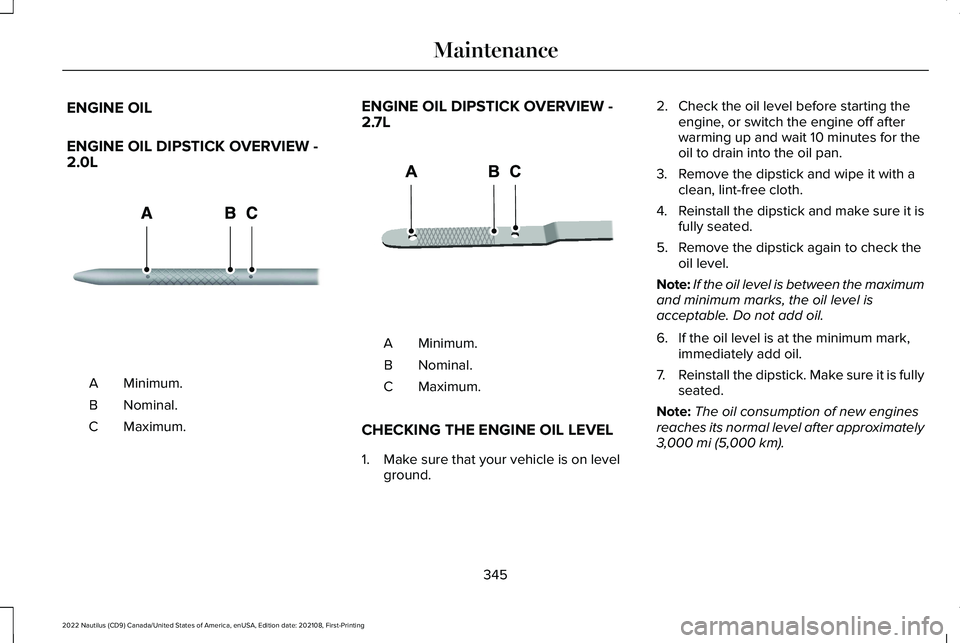
ENGINE OIL DIPSTICK OVERVIEW -2.0L
Minimum.A
Nominal.B
Maximum.C
ENGINE OIL DIPSTICK OVERVIEW -2.7L
Minimum.A
Nominal.B
Maximum.C
CHECKING THE ENGINE OIL LEVEL
1.Make sure that your vehicle is on levelground.
2.Check the oil level before starting theengine, or switch the engine off afterwarming up and wait 10 minutes for theoil to drain into the oil pan.
3.Remove the dipstick and wipe it with aclean, lint-free cloth.
4.Reinstall the dipstick and make sure it isfully seated.
5.Remove the dipstick again to check theoil level.
Note:If the oil level is between the maximumand minimum marks, the oil level isacceptable. Do not add oil.
6.If the oil level is at the minimum mark,immediately add oil.
7.Reinstall the dipstick. Make sure it is fullyseated.
Note:The oil consumption of new enginesreaches its normal level after approximately3,000 mi (5,000 km).
345
2022 Nautilus (CD9) Canada/United States of America, enUSA, Edition date: 202108, First-PrintingMaintenanceE270482 E250320
Page 351 of 586
ENGINE OIL CAPACITY ANDSPECIFICATION
For filling information, please refer to theCapacities and Specifications section of yourowner's manual. See Engine Oil Capacityand Specification (page 410).
CHECKING THE COOLANT
When the engine is cold, check theconcentration and level of the coolant at theintervals listed in the scheduled maintenanceinformation. See Scheduled Maintenance(page 463).
Note:Make sure that the coolant level isbetween the minimum and maximum markson the coolant reservoir.
Note: Coolant expands when it is hot. Thelevel may extend beyond the MAX mark.
If the coolant level is at or below theminimum mark, add prediluted coolantimmediately.
Maintain coolant concentration within 48%to 50%, which equates to a freeze pointbetween -29°F (-34°C) and -35°F (-37°C).Coolant concentration should be checkedusing a refractometer. We do not recommendthe use of hydrometers or coolant test stripsfor measuring coolant concentration.
Adding Coolant
WARNING: Keep your hands andclothing clear of the cooling fan.
WARNING: Do not remove thecoolant reservoir cap when the engine ison or the cooling system is hot. Wait 10minutes for the cooling system to cooldown. Cover the coolant reservoir cap witha thick cloth to prevent the possibility ofscalding and slowly remove the cap.Failure to follow this instruction could resultin personal injury.
WARNING: Do not add enginecoolant when the engine is on or thecooling system is hot. Failure to follow thisinstruction could result in personal injury.
WARNING: Do not add coolantfurther than the MAX mark.
WARNING: Do not put coolant in thewindshield washer reservoir. If sprayed onthe windshield, coolant could make itdifficult to see through the windshield.
WARNING: Do not allow the fluid totouch your skin or eyes. If this happens,rinse the affected areas immediately withplenty of water and contact your physician.
Note: Do not use stop leak pellets, coolingsystem sealants, or non-specified additivesas they can cause damage to the enginecooling or heating systems. Resultingcomponent damage may not be covered bythe vehicle Warranty.
Note:Automotive fluids are notinterchangeable.
347
2022 Nautilus (CD9) Canada/United States of America, enUSA, Edition date: 202108, First-PrintingMaintenance
Page 374 of 586
Hybrid Battery Systems
We recommend the following actions for yourvehicle:
•When storing your vehicle for greaterthan 30 days the state of charge shouldbe approximately 50%. Additionally werecommend disconnecting the 12Vbattery which will reduce system loadson the HV battery.
12 Volt Battery
•Check and recharge as necessary. Keepconnections clean.
Note:It is necessary to reset memoryfeatures if you disconnect the battery cables.
Brakes
Make sure the brakes and parking brakerelease fully.
Note:If you intend on parking your vehiclefor an extended period after cleaning thewheels with a wheel cleaner, drive yourvehicle for a few minutes before doing so toreduce the risk of increased corrosion of thebrake discs, brake pads and linings.
Tires
•Maintain recommended air pressure.
Note:If you intend on parking your vehiclefor an extended period after cleaning thewheels with a wheel cleaner, drive yourvehicle for a few minutes before doing so.This reduces the risk of corrosion of thebrake discs, brake pads and linings.
REMOVING YOUR VEHICLE FROM
STORAGE
When your vehicle is ready to come out ofstorage, do the following:
•We recommend that you change theengine oil before you use your vehicleagain.
•Wash your vehicle to remove any dirt orgrease film build-up on window surfaces.
•Check windshield wipers for anydeterioration.
•Check under the hood for any foreignmaterial that may have collected duringstorage such as mice or squirrel nests.
•Check the exhaust for any foreignmaterial that may have collected duringstorage.
•Check tire pressures and set tire inflationper the Tire Label.
•Check brake pedal operation. Drive yourvehicle 15 ft (4.5 m) back and forth toremove rust build-up.
•Check fluid levels (including coolant, oiland gas) to make sure there are no leaks,and fluids are at recommended levels.
•If you remove the battery, clean thebattery cable ends and check fordamage.
Contact an authorized dealer if you have anyconcerns or issues.
370
2022 Nautilus (CD9) Canada/United States of America, enUSA, Edition date: 202108, First-PrintingStoring Your Vehicle
Page 468 of 586
If your information display resets prematurelyor becomes inoperative, you should performthe oil change interval at six months or5,000 mi (8,000 km) from your last oilchange. Never exceed one year or 10,000 mi(16,000 km) between oil change intervals.
You can drive high performance vehicles insuch a way that may lead to higher oilconsumption including extended time at highengine speeds, high loads, engine braking,hard cornering maneuvers, track and off-roadusage. Under these conditions, oilconsumption of approximately 1 quart per500 miles (1 liter per 800 km) is possible.Check the engine oil level at every refuelingand adjust to maintain proper levels to avoidengine damage.
It is important to rely upon your dealershipto properly diagnose and repair your vehicle.
We strongly recommend only using ourgenuine or our authorized re-manufacturedreplacement parts engineered for yourvehicle.
Additives and Chemicals
We do not recommend using chemicals oradditives not approved by us as part of yourvehicle’s normal maintenance. Please consultyour warranty information.
Oils, Fluids and Flushing
In many cases, fluid discoloration is a normaloperating characteristic and, by itself, doesnot necessarily indicate a concern or that thefluid needs to be changed. Have discoloredfluids that also show signs of overheating orforeign material contamination checkedimmediately.
Make sure to change the vehicle’s oils andfluids at the specified intervals or inconjunction with a repair. Flushing is a viableway to change fluid for many vehiclesub-systems during scheduled maintenance.It is critical that systems are flushed only withnew fluid that is the same as that requiredto fill and operate the system or using ourapproved flushing chemical.
Owner Checks and Services
Make sure you perform the following basicmaintenance checks and inspections.
Check Every Month
The air filter restriction gauge.1
The engine oil level.
Function of all interior and the exterior lights.
464
2022 Nautilus (CD9) Canada/United States of America, enUSA, Edition date: 202108, First-PrintingScheduled Maintenance