fuel pump LINCOLN NAVIGATOR 2010 User Guide
[x] Cancel search | Manufacturer: LINCOLN, Model Year: 2010, Model line: NAVIGATOR, Model: LINCOLN NAVIGATOR 2010Pages: 385, PDF Size: 2.96 MB
Page 354 of 385
When fueling your vehicle:
1. Turn the engine off.
2. Open the fuel filler door.
3. Slowly insert the fuel filler nozzle fully into the fuel system. Pump fuel
as normal.
4. After you are done pumping fuel, slowly remove the fuel filler
nozzle—allow about five seconds after pumping fuel before removing the
fuel filler nozzle. This allows residual fuel to drain back into the fuel tank
and not spill onto the vehicle.
Note:A fuel spillage concern may occur if overfilling the fuel tank. Do
not overfill the tank to the point that the fuel is able to bypass the fuel
filler nozzle. The overfilled fuel may run down the drain located within
the fuel filler housing and to the ground.
If the Check Fuel Fill Inlet lamp or Check Fuel Fill Inlet message comes
on, the fuel fill inlet may not have properly closed. The inlet may have
stuck open or debris may be preventing the inlet from fully closing. At
the next opportunity, safely pull off the road, turn off the engine, open
the fuel filler door and remove any visible debris from the fuel fill
opening. Insert either the fuel fill nozzle or the fuel fill funnel (see
Refilling with a portable fuel containerfor funnel location) provided
with the vehicle several times to dislodge any debris and/or allow the
inlet to close properly. If this action corrects the problem, the Check
Fuel Fill Inlet lamp or Check Fuel Fill Inlet message may not reset
immediately. It may take several driving cycles for the Check Fuel Fill
Inlet lamp or Check Fuel Fill Inlet message to turn off. A driving cycle
consists of an engine start-up (after four or more hours with the engine
off) followed by city/highway driving. Continuing to drive with the Check
Fuel Fill Inlet lamp or Check Fuel Fill Inlet message on may cause the
Service Engine Soon lamp to turn on as well.
WARNING:The fuel system may be under pressure. If you hear
a hissing sound near the fuel filler door (Easy Fuel™ “no cap”
fuel system), do not refuel until the sound stops. Otherwise, fuel may
spray out, which could cause serious personal injury.
Flex Fuel Vehicle (FFV) fuel fill inlet
Flex fuel vehicles have a yellow bezel placed over the fuel fill inlet.
Choosing the right fuel
Use only UNLEADED FUEL and FUEL ETHANOL (Ed75–Ed85).
Maintenance and Specifications
354
2010 Navigator(nav)
Owners Guide(own2002), 1st Printing
USA(fus)
Page 355 of 385
The use of leaded fuel is prohibited by law and could damage your
vehicle.
Your vehicle was not designed to use fuel or fuel additives with metallic
compounds, including manganese-based additives.
Note:Use of any fuel other than those recommended may cause
powertrain damage, a loss of vehicle performance, and repairs may not
be covered under warranty.
Octane recommendations
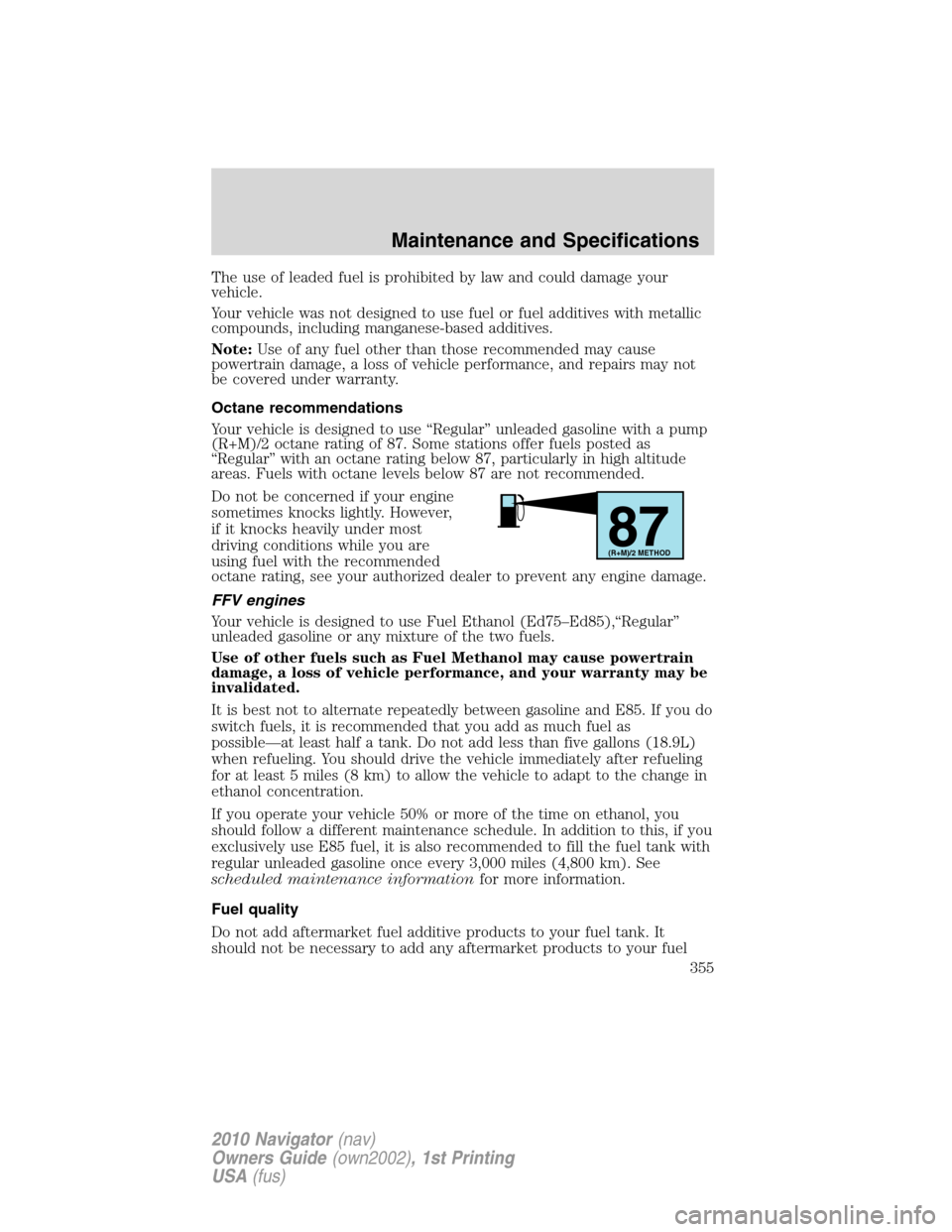
Your vehicle is designed to use “Regular” unleaded gasoline with a pump
(R+M)/2 octane rating of 87. Some stations offer fuels posted as
“Regular” with an octane rating below 87, particularly in high altitude
areas. Fuels with octane levels below 87 are not recommended.
Do not be concerned if your engine
sometimes knocks lightly. However,
if it knocks heavily under most
driving conditions while you are
using fuel with the recommended
octane rating, see your authorized dealer to prevent any engine damage.
FFV engines
Your vehicle is designed to use Fuel Ethanol (Ed75–Ed85),“Regular”
unleaded gasoline or any mixture of the two fuels.
Use of other fuels such as Fuel Methanol may cause powertrain
damage, a loss of vehicle performance, and your warranty may be
invalidated.
It is best not to alternate repeatedly between gasoline and E85. If you do
switch fuels, it is recommended that you add as much fuel as
possible—at least half a tank. Do not add less than five gallons (18.9L)
when refueling. You should drive the vehicle immediately after refueling
for at least 5 miles (8 km) to allow the vehicle to adapt to the change in
ethanol concentration.
If you operate your vehicle 50% or more of the time on ethanol, you
should follow a different maintenance schedule. In addition to this, if you
exclusively use E85 fuel, it is also recommended to fill the fuel tank with
regular unleaded gasoline once every 3,000 miles (4,800 km). See
scheduled maintenance informationfor more information.
Fuel quality
Do not add aftermarket fuel additive products to your fuel tank. It
should not be necessary to add any aftermarket products to your fuel
87(R+M)/2 METHOD
Maintenance and Specifications
355
2010 Navigator(nav)
Owners Guide(own2002), 1st Printing
USA(fus)
Page 356 of 385
tank if you continue to use high quality fuel of the recommended octane
rating. These products have not been approved for your engine and
could cause damage to the fuel system. Repairs to correct the effects of
using an aftermarket product in your fuel may not be covered by your
warranty.
Many of the world’s automakers approved the World-Wide Fuel Charter
that recommends gasoline specifications to provide improved
performance and emission control system protection for your vehicle.
Gasolines that meet the World-Wide Fuel Charter should be used when
available. Ask your fuel supplier about gasolines that meet the
World-Wide Fuel Charter.
Cleaner air
Ford endorses the use of reformulated “cleaner-burning” gasolines to
improve air quality, per the recommendations in theChoosing the right
fuelsection.
Running out of fuel
Avoid running out of fuel because this situation may have an adverse
effect on powertrain components.
If you have run out of fuel:
•You may need to cycle the ignition from off to on several times after
refueling to allow the fuel system to pump the fuel from the tank to
the engine. On restarting, cranking time will take a few seconds longer
than normal.
•Normally, adding 1 gallon (3.8L) of fuel is enough to restart the
engine. If the vehicle is out of fuel and on a steep grade, more than
1 gallon (3.8L) may be required.
•The service engine soon
indicator may come on. For more
information on the service engine soon indicator, refer toWarning
lights and chimesin theInstrument Clusterchapter.
Refilling with a portable fuel container
With the Easy Fuel™ “no cap” fuel system, use the following directions
when filling from a portable fuel container:
WARNING:Do not insert the nozzle of portable fuel containers
or aftermarket funnels into the Easy Fuel™ system. This could
damage the fuel system and its seal, and may cause fuel to run onto
the ground instead of filling the tank, which could result in serious
personal injury.
Maintenance and Specifications
356
2010 Navigator(nav)
Owners Guide(own2002), 1st Printing
USA(fus)
Page 358 of 385
The advertised capacity is the amount of the indicated capacity and the
empty reserve combined. Indicated capacity is the difference in the
amount of fuel in a full tank and a tank when the fuel gauge indicates
empty. Empty reserve is the small amount of fuel remaining in the fuel
tank after the fuel gauge indicates empty.
The amount of usable fuel in the empty reserve varies and should
not be relied upon to increase driving range. When refueling your
vehicle after the fuel gauge indicates empty, you might not be
able to refuel the full amount of the advertised capacity of the
fuel tank due to the empty reserve still present in the tank.
For consistent results when filling the fuel tank:
•Turn the engine/ignition switch to the off position prior to refueling,
an error in the reading will result if the engine is left running.
•Use the same filling rate setting (low — medium — high) each time
the tank is filled.
•Allow no more than two automatic click-offs when filling.
•Always use fuel with the recommended octane rating.
•Use a known quality gasoline, preferably a national brand.
•Use the same side of the same pump and have the vehicle facing the
same direction each time you fill up.
•Have the vehicle loading and distribution the same every time.
Your results will be most accurate if your filling method is consistent.
Calculating fuel economy
1. Fill the fuel tank completely and record the initial odometer reading
(in miles or kilometers).
2. Each time you fill the tank, record the amount of fuel added (in
gallons or liters).
3. After at least three to five tank fill-ups, fill the fuel tank and record
the current odometer reading.
4. Subtract your initial odometer reading from the current odometer
reading.
5. Follow one of the simple calculations in order to determine fuel
economy:
Calculation 1:Divide total miles traveled by total gallons used.
Calculation 2:Multiply liters used by 100, then divide by total
kilometers traveled.
Maintenance and Specifications
358
2010 Navigator(nav)
Owners Guide(own2002), 1st Printing
USA(fus)
Page 382 of 385
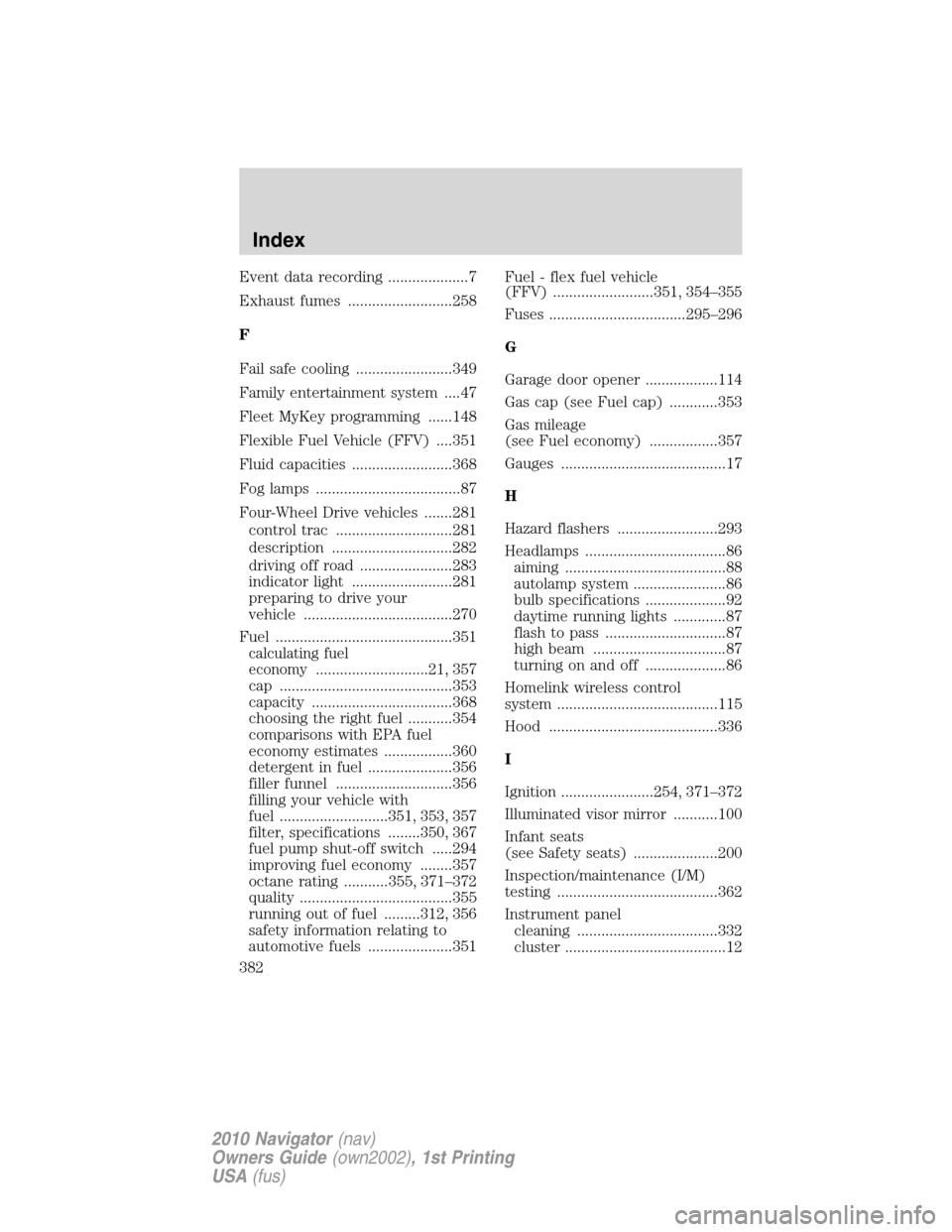
Event data recording ....................7
Exhaust fumes ..........................258
F
Fail safe cooling ........................349
Family entertainment system ....47
Fleet MyKey programming ......148
Flexible Fuel Vehicle (FFV) ....351
Fluid capacities .........................368
Fog lamps ....................................87
Four-Wheel Drive vehicles .......281
control trac .............................281
description ..............................282
driving off road .......................283
indicator light .........................281
preparing to drive your
vehicle .....................................270
Fuel ............................................351
calculating fuel
economy
............................21, 357
cap ...........................................353
capacity ...................................368
choosing the right fuel ...........354
comparisons with EPA fuel
economy estimates .................360
detergent in fuel .....................356
filler funnel .............................356
filling your vehicle with
fuel ...........................351, 353, 357
filter, specifications ........350, 367
fuel pump shut-off switch .....294
improving fuel economy ........357
octane rating ...........355, 371–372
quality ......................................355
running out of fuel .........312, 356
safety information relating to
automotive fuels .....................351Fuel - flex fuel vehicle
(FFV) .........................351, 354–355
Fuses ..................................295–296
G
Garage door opener ..................114
Gas cap (see Fuel cap) ............353
Gas mileage
(see Fuel economy) .................357
Gauges .........................................17
H
Hazard flashers .........................293
Headlamps ...................................86
aiming ........................................88
autolamp system .......................86
bulb specifications ....................92
daytime running lights .............87
flash to pass ..............................87
high beam .................................87
turning on and off ....................86
Homelink wireless control
system ........................................115
Hood ..........................................336
I
Ignition .......................254, 371–372
Illuminated visor mirror ...........100
Infant seats
(see Safety seats) .....................200
Inspection/maintenance (I/M)
testing ........................................362
Instrument panel
cleaning ...................................332
cluster ........................................12
Index
382
2010 Navigator(nav)
Owners Guide(own2002), 1st Printing
USA(fus)