engine oil LINCOLN NAVIGATOR 2014 User Guide
[x] Cancel search | Manufacturer: LINCOLN, Model Year: 2014, Model line: NAVIGATOR, Model: LINCOLN NAVIGATOR 2014Pages: 506, PDF Size: 5.72 MB
Page 260 of 506
Adding Engine Oil
Note:Do not remove the engine oil level dipstick or the filler cap when
the engine is running.
Note:Do not add engine oil further than the MAX mark. Oil levels above
the MAX mark may cause engine damage.
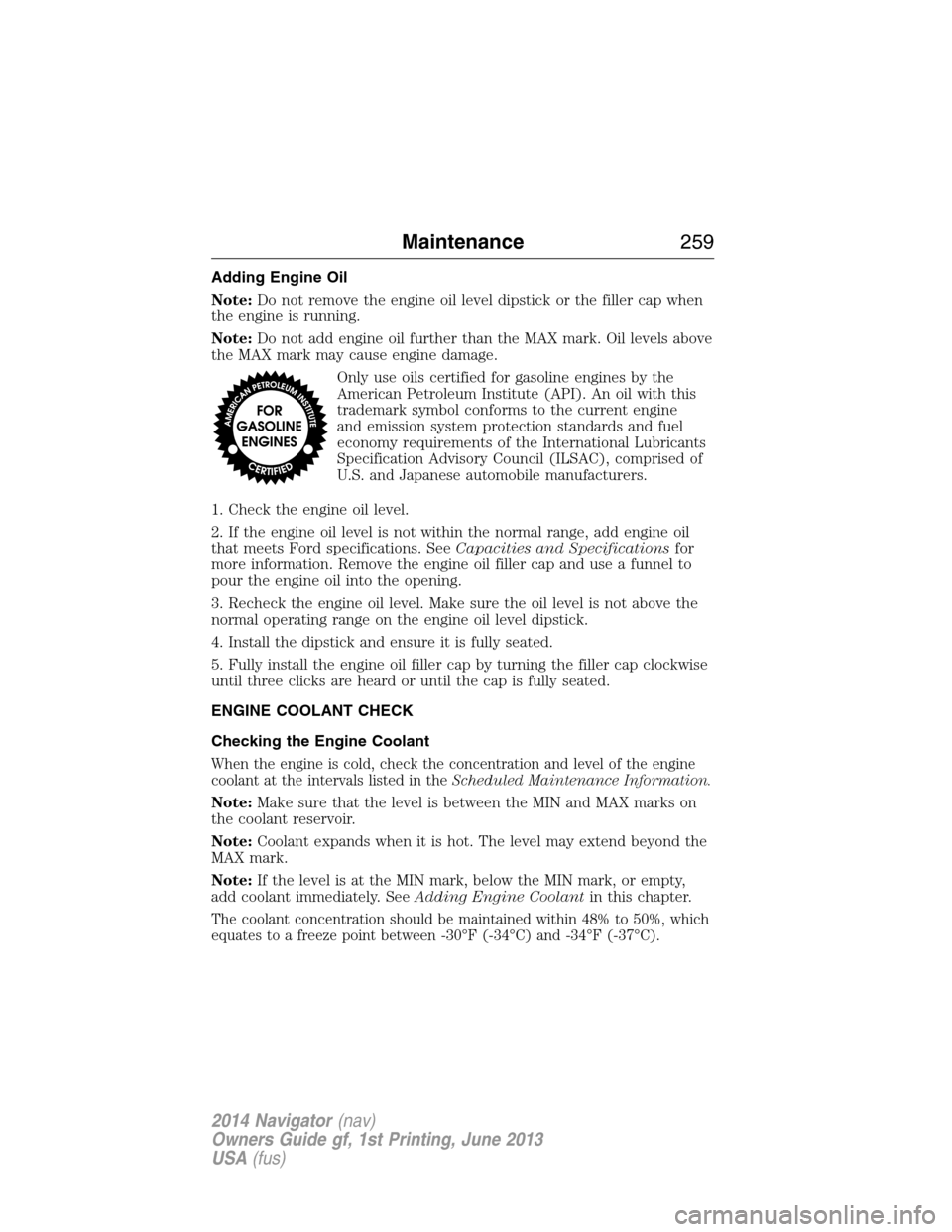
Only use oils certified for gasoline engines by the
American Petroleum Institute (API). An oil with this
trademark symbol conforms to the current engine
and emission system protection standards and fuel
economy requirements of the International Lubricants
Specification Advisory Council (ILSAC), comprised of
U.S. and Japanese automobile manufacturers.
1. Check the engine oil level.
2. If the engine oil level is not within the normal range, add engine oil
that meets Ford specifications. SeeCapacities and Specificationsfor
more information. Remove the engine oil filler cap and use a funnel to
pour the engine oil into the opening.
3. Recheck the engine oil level. Make sure the oil level is not above the
normal operating range on the engine oil level dipstick.
4. Install the dipstick and ensure it is fully seated.
5. Fully install the engine oil filler cap by turning the filler cap clockwise
until three clicks are heard or until the cap is fully seated.
ENGINE COOLANT CHECK
Checking the Engine Coolant
When the engine is cold, check the concentration and level of the engine
coolant at the intervals listed in theScheduled Maintenance Information.
Note:Make sure that the level is between the MIN and MAX marks on
the coolant reservoir.
Note:Coolant expands when it is hot. The level may extend beyond the
MAX mark.
Note:If the level is at the MIN mark, below the MIN mark, or empty,
add coolant immediately. SeeAdding Engine Coolantin this chapter.
The coolant concentration should be maintained within 48% to 50%, which
equates to a freeze point between -30°F (-34°C) and -34°F (-37°C).
Maintenance259
2014 Navigator(nav)
Owners Guide gf, 1st Printing, June 2013
USA(fus)
Page 282 of 506
CLEANING THE ENGINE
Engines are more efficient when they are clean because grease and dirt
buildup keep the engine warmer than normal.
When washing:
•Take care when using a power washer to clean the engine.
The high-pressure fluid could penetrate the sealed parts and cause
damage.
•Do not spray a hot engine with cold water to avoid cracking the
engine block or other engine components.
•Spray Motorcraft® Engine Shampoo and Degreaser on all parts that
require cleaning and pressure rinse clean. In Canada, use Motorcraft®
Engine Shampoo.
•Never wash or rinse the engine while it is hot or running; water in the
running engine may cause internal damage.
•Never wash or rinse any ignition coil, spark plug wire or spark plug
well, or the area in and around these locations.
•Cover the battery, power distribution box, and air filter assembly to
prevent water damage when cleaning the engine.
CLEANING THE WINDOWS AND WIPER BLADES
The windows and wiper blades should be cleaned regularly. If the wipers
do not wipe properly, substances on the vehicle’s glass or the wiper
blades may cause squeaking or chatter noise from the blades, and
streaking and smearing of the windshield. To clean these items, follow
these tips:
•The windows may be cleaned with a non-abrasive cleaner such as
Motorcraft® Ultra-Clear Spray Glass Cleaner.
•The wiper blades can be cleaned with isopropyl (rubbing) alcohol or
Motorcraft Premium Windshield Washer Concentrates in the U.S., or
Motorcraft Premium Quality Windshield Washer Fluid in Canada.
Replace your wiper blades when they appear worn or do not function
properly.
•Do not use abrasive materials, as they may cause scratches.
•Do not use fuel, kerosene, or paint thinner to clean any parts.
Vehicle Care281
2014 Navigator(nav)
Owners Guide gf, 1st Printing, June 2013
USA(fus)
Page 286 of 506
VEHICLE STORAGE
If you plan on storing your vehicle for an extended period of time
(30 days or more), read the following maintenance recommendations to
make sure your vehicle stays in good operating condition.
All motor vehicles and their components were engineered and tested for
reliable, regular driving. Long-term storage under various conditions may
lead to component degradation or failure unless specific precautions are
taken to preserve the components.
General
•Store all vehicles in a dry, ventilated place.
•Protect from sunlight, if possible.
•If vehicles are stored outside, they require regular maintenance to
protect against rust and damage.
Body
•Wash vehicle thoroughly to remove dirt, grease, oil, tar or mud from
exterior surfaces, rear-wheel housing and underside of front fenders.
•Periodically wash vehicles stored in exposed locations.
•Touch up raw or primed metal to prevent rust.
•Cover chrome and stainless steel parts with a thick coat of auto wax
to prevent discoloration. Re-wax as necessary when the vehicle is
washed.
•Lubricate hood latch, all door latches and trunk lid hinges with a light
grade oil.
•Cover interior trim to prevent fading.
•Keep all rubber parts free from oil and solvents.
Engine
•The engine oil and filter should be changed prior to storage, as used
engine oil contains contaminates that may cause engine damage.
•Start the engine every 15 days. Run at fast idle until it reaches normal
operating temperature.
•With your foot on the brake, shift through all the gears while the
engine is running.
Fuel system
•Fill the fuel tank with high-quality fuel until the first automatic shutoff
of the fuel pump nozzle.
Vehicle Care285
2014 Navigator(nav)
Owners Guide gf, 1st Printing, June 2013
USA(fus)
Page 320 of 506
ENGINE SPECIFICATIONS
Engine 5.4L V8 Engine
Cubic inches 330
Fuel Minimum 87 octane or (E-85)
Firing order 1-3-7-2-6-5-4-8
Ignition system Coil on plug
Spark plug gap 0.039–0.043 inch
(1.05 +/– 0.05 mm)
Compression ratio 9.8:1
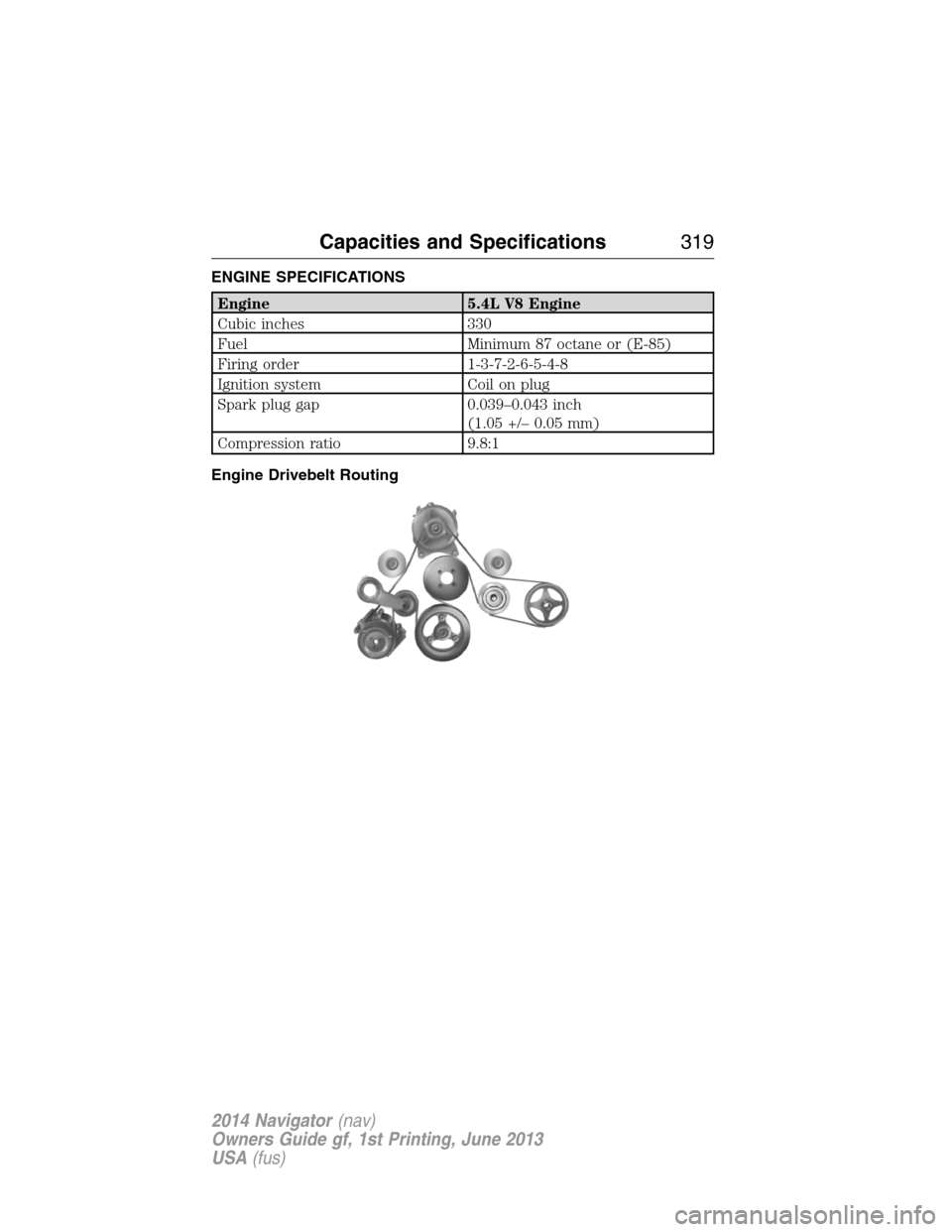
Engine Drivebelt Routing
Capacities and Specifications319
2014 Navigator(nav)
Owners Guide gf, 1st Printing, June 2013
USA(fus)
Page 321 of 506
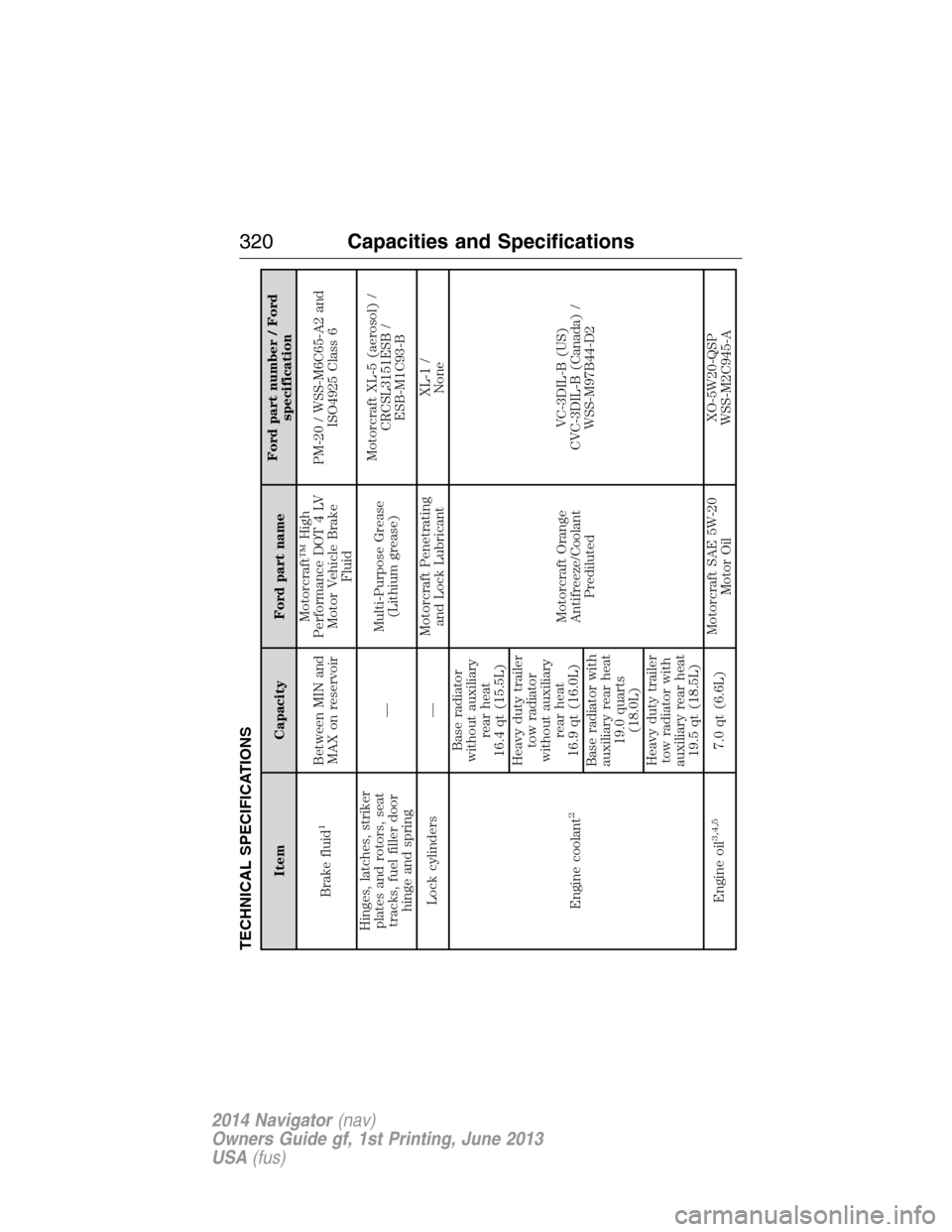
TECHNICAL SPECIFICATIONS
Item Capacity Ford part nameFord part number / Ford
specification
Brake fluid
1
Between MIN and
MAX on reservoirMotorcraft™ High
Performance DOT 4 LV
Motor Vehicle Brake
FluidPM-20 / WSS-M6C65-A2 and
ISO4925 Class 6
Hinges, latches, striker
plates and rotors, seat
tracks, fuel filler door
hinge and spring—Multi-Purpose Grease
(Lithium grease)Motorcraft XL-5 (aerosol) /
CRCSL3151ESB /
ESB-M1C93-B
Lock cylinders —Motorcraft Penetrating
and Lock LubricantXL-1 /
None
Engine coolant
2
Base radiator
without auxiliary
rear heat
16.4 qt (15.5L)
Motorcraft Orange
Antifreeze/Coolant
PredilutedVC-3DIL-B (US)
CVC-3DIL-B (Canada) /
WSS-M97B44-D2 Heavy duty trailer
tow radiator
without auxiliary
rear heat
16.9 qt (16.0L)
Base radiator with
auxiliary rear heat
19.0 quarts
(18.0L)
Heavy duty trailer
tow radiator with
auxiliary rear heat
19.5 qt (18.5L)
Engine oil
3,4,5
7.0 qt (6.6L)Motorcraft SAE 5W-20
Motor OilXO-5W20-QSP
WSS-M2C945-A
320Capacities and Specifications
2014 Navigator(nav)
Owners Guide gf, 1st Printing, June 2013
USA(fus)
Page 323 of 506
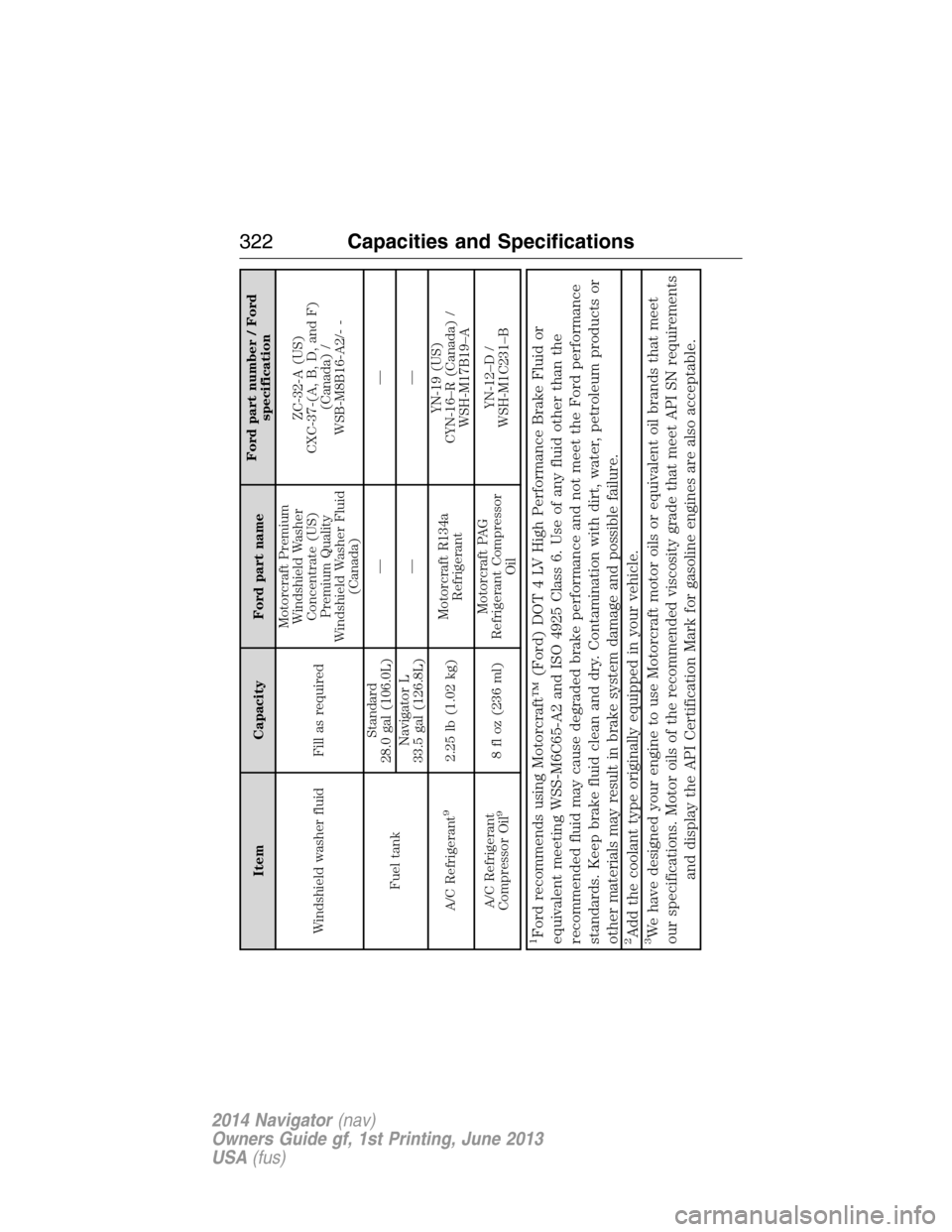
Item Capacity Ford part nameFord part number / Ford
specification
Windshield washer fluid Fill as requiredMotorcraft Premium
Windshield Washer
Concentrate (US)
Premium Quality
Windshield Washer Fluid
(Canada)ZC-32-A (US)
CXC-37-(A, B, D, and F)
(Canada) /
WSB-M8B16-A2/- -
Fuel tankStandard
28.0 gal (106.0L)——
Navigator L
33.5 gal (126.8L)——
A/C Refrigerant
9
2.25 lb (1.02 kg)Motorcraft R134a
RefrigerantYN-19 (US)
CYN-16–R (Canada) /
WSH-M17B19–A
A/C Refrigerant
Compressor Oil
9
8 fl oz (236 ml)Motorcraft PAG
Refrigerant Compressor
OilYN-12–D /
WSH-M1C231–B
1Ford recommends using Motorcraft™ (Ford) DOT 4 LV High Performance Brake Fluid or
equivalent meeting WSS-M6C65-A2 and ISO 4925 Class 6. Use of any fluid other than the
recommended fluid may cause degraded brake performance and not meet the Ford performance
standards. Keep brake fluid clean and dry. Contamination with dirt, water, petroleum products or
other materials may result in brake system damage and possible failure.2Add the coolant type originally equipped in your vehicle.3We have designed your engine to use Motorcraft motor oils or equivalent oil brands that meet
our specifications. Motor oils of the recommended viscosity grade that meet API SN requirements
and display the API Certification Mark for gasoline engines are also acceptable.
322Capacities and Specifications
2014 Navigator(nav)
Owners Guide gf, 1st Printing, June 2013
USA(fus)
Page 324 of 506
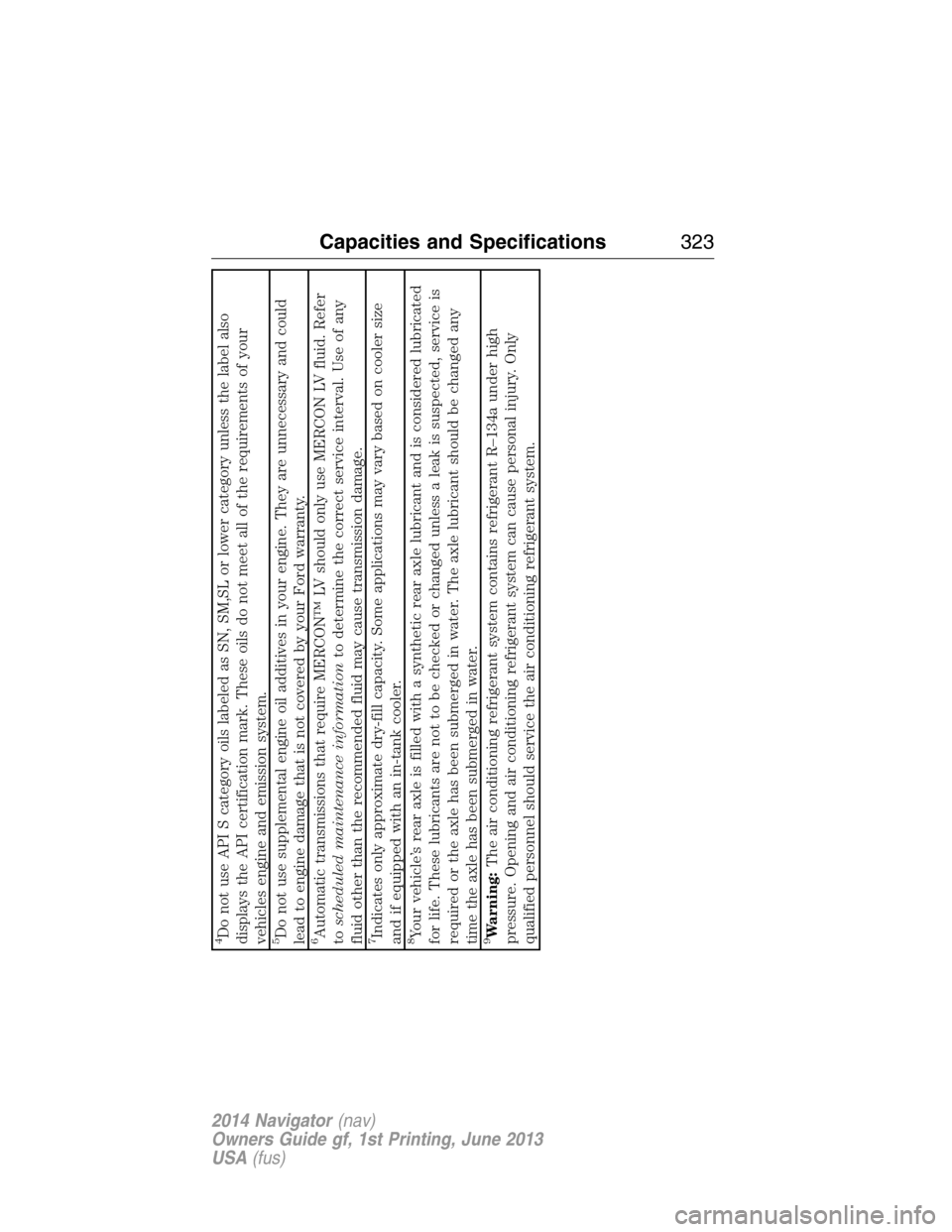
4Do not use API S category oils labeled as SN, SM,SL or lower category unless the label also
displays the API certification mark. These oils do not meet all of the requirements of your
vehicles engine and emission system.5Do not use supplemental engine oil additives in your engine. They are unnecessary and could
lead to engine damage that is not covered by your Ford warranty.6Automatic transmissions that require MERCON™ LV should only use MERCON LV fluid. Refer
toscheduled maintenance informationto determine the correct service interval. Use of any
fluid other than the recommended fluid may cause transmission damage.7Indicates only approximate dry-fill capacity. Some applications may vary based on cooler size
and if equipped with an in-tank cooler.8Your vehicle’s rear axle is filled with a synthetic rear axle lubricant and is considered lubricated
for life. These lubricants are not to be checked or changed unless a leak is suspected, service is
required or the axle has been submerged in water. The axle lubricant should be changed any
time the axle has been submerged in water.9Warning:The air conditioning refrigerant system contains refrigerant R–134a under high
pressure. Opening and air conditioning refrigerant system can cause personal injury. Only
qualified personnel should service the air conditioning refrigerant system.
Capacities and Specifications323
2014 Navigator(nav)
Owners Guide gf, 1st Printing, June 2013
USA(fus)
Page 325 of 506
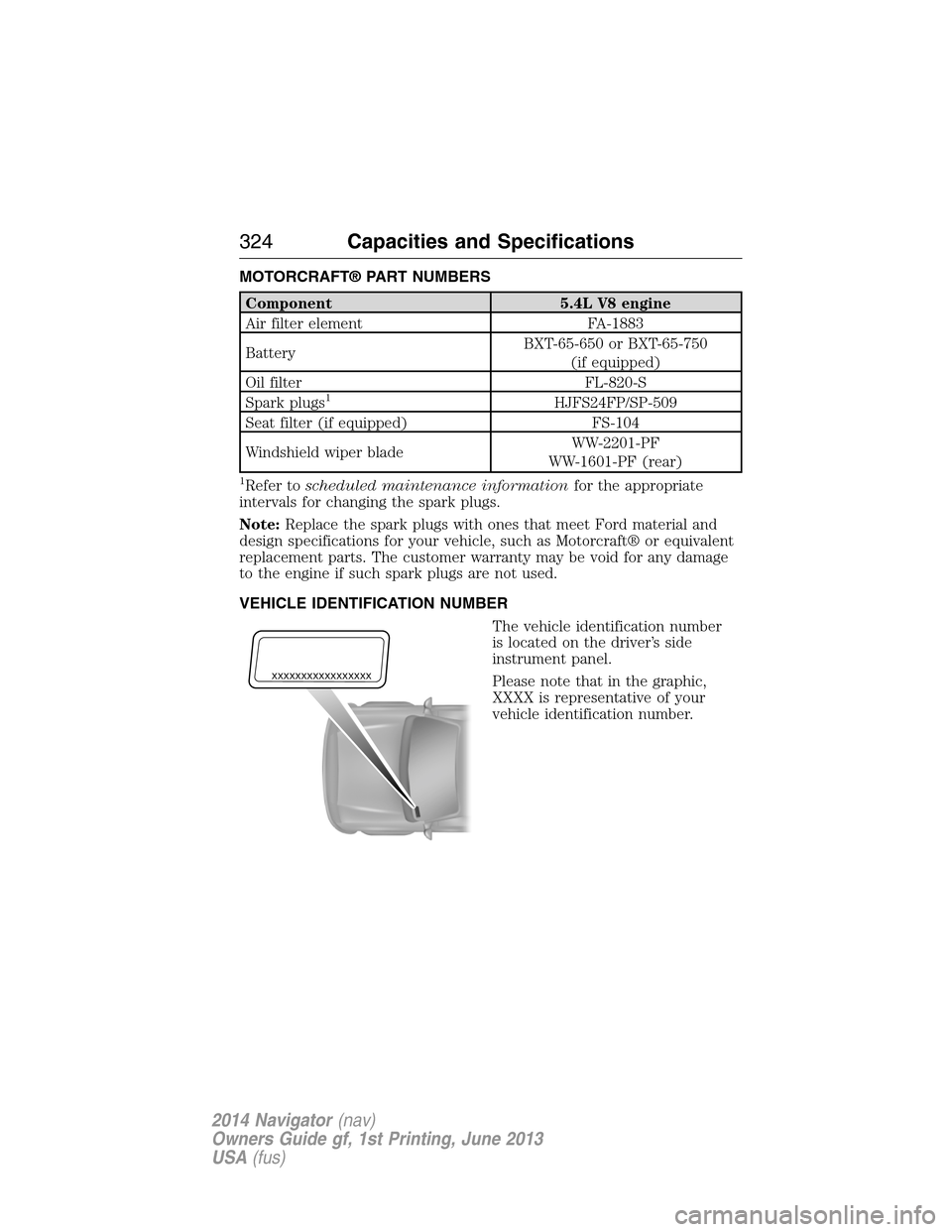
MOTORCRAFT® PART NUMBERS
Component 5.4L V8 engine
Air filter element FA-1883
BatteryBXT-65-650 or BXT-65-750
(if equipped)
Oil filter FL-820-S
Spark plugs
1HJFS24FP/SP-509
Seat filter (if equipped) FS-104
Windshield wiper bladeWW-2201-PF
WW-1601-PF (rear)
1Refer toscheduled maintenance informationfor the appropriate
intervals for changing the spark plugs.
Note:Replace the spark plugs with ones that meet Ford material and
design specifications for your vehicle, such as Motorcraft® or equivalent
replacement parts. The customer warranty may be void for any damage
to the engine if such spark plugs are not used.
VEHICLE IDENTIFICATION NUMBER
The vehicle identification number
is located on the driver’s side
instrument panel.
Please note that in the graphic,
XXXX is representative of your
vehicle identification number.
XXXXXXXXXXXXXXXXX
324Capacities and Specifications
2014 Navigator(nav)
Owners Guide gf, 1st Printing, June 2013
USA(fus)
Page 483 of 506
Convenience
Many dealerships have extended evening and Saturday hours to make
your service visit more convenient and they offer one stop shopping.
They can perform any services that are required on your vehicle, from
general maintenance to collision repairs.
Note:Not all dealers have extended hours or body shops. Please contact
your dealer for details.
Protecting Your Investment
Maintenance is an investment that pays dividends in the form of
improved reliability, durability and resale value. To maintain the proper
performance of your vehicle and its emission control systems, make sure
you have scheduled maintenance performed at the designated intervals.
Your vehicle is very sophisticated and built with multiple, complex,
performance systems. Every manufacturer develops these systems using
different specifications and performance features. That is why it is
important to rely upon your dealership to properly diagnose and repair
your vehicle.
Ford Motor Company has recommended maintenance intervals for
various parts and component systems based upon engineering testing.
Ford Motor Company relies upon this testing to determine the most
appropriate mileage for replacement of oils and fluids to protect your
vehicle at the lowest overall cost to you and recommends against
maintenance schedules that deviate from the scheduled maintenance
information.
We strongly recommend the use of only genuine Ford, Motorcraft or
Ford-authorized re-manufactured replacement parts engineered for your
vehicle.
Additives and Chemicals
This owner’s manual and the Ford Workshop Manual list the
recommended additives and chemicals for your vehicle. We do not
recommend using chemicals or additives not approved by us as part
of your vehicle’s normal maintenance. Please consult your warranty
information.
482Scheduled Maintenance
2014 Navigator(nav)
Owners Guide gf, 1st Printing, June 2013
USA(fus)
Page 484 of 506
Oils, Fluids and Flushing
In many cases, fluid discoloration is a normal operating characteristic
and, by itself, does not necessarily indicate a concern or that the
fluid needs to be changed. However, a qualified expert, such as the
factory-trained technicians at your dealership, should inspect discolored
fluids that also show signs of overheating or foreign material
contamination immediately.
Make sure to change your vehicle’s oils and fluids at the specified intervals
or in conjunction with a repair. Flushing is a viable way to change fluid for
many vehicle sub-systems during scheduled maintenance. It is critical that
systems are flushed only with new fluid that is the same as that required to
fill and operate the system or using a Ford-approved flushing chemical.
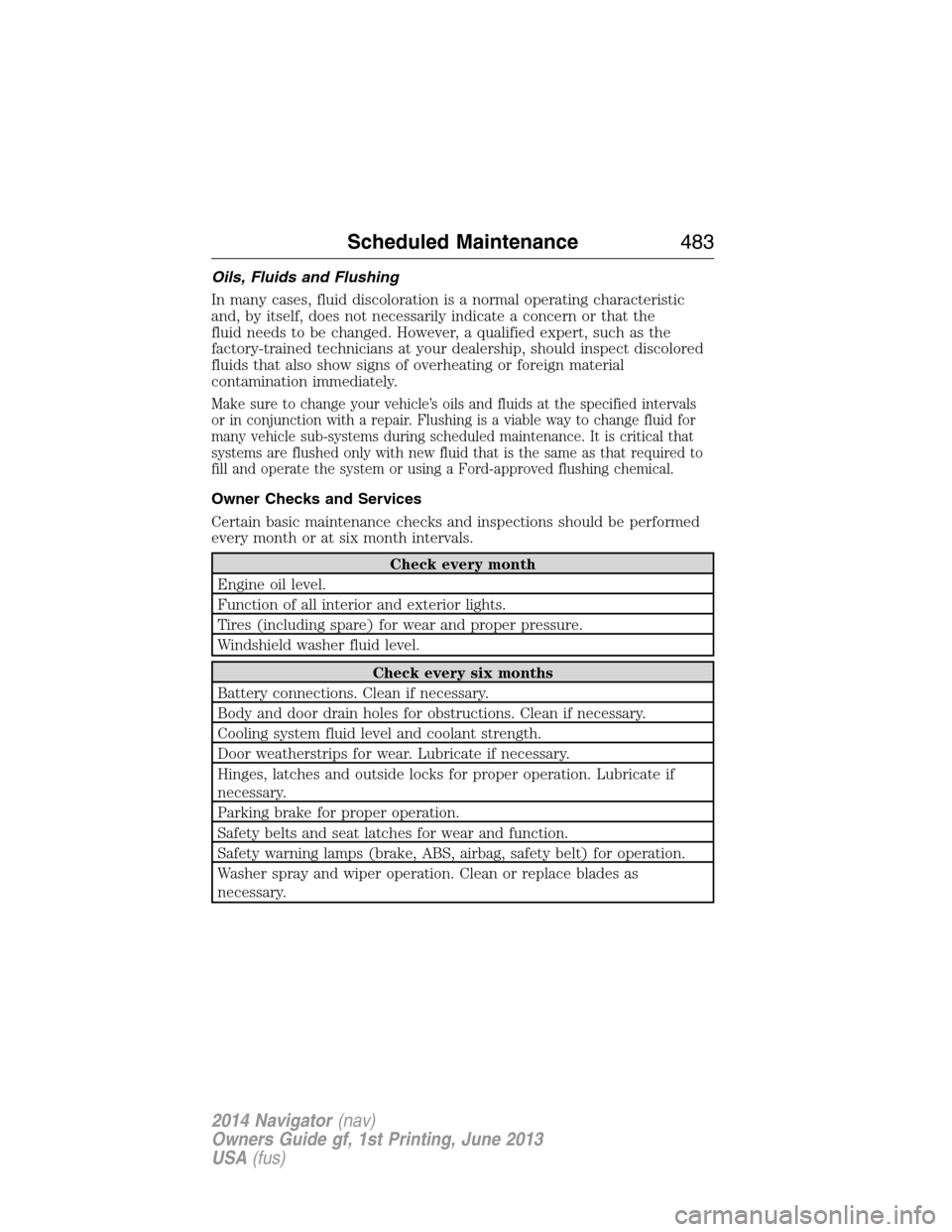
Owner Checks and Services
Certain basic maintenance checks and inspections should be performed
every month or at six month intervals.
Check every month
Engine oil level.
Function of all interior and exterior lights.
Tires (including spare) for wear and proper pressure.
Windshield washer fluid level.
Check every six months
Battery connections. Clean if necessary.
Body and door drain holes for obstructions. Clean if necessary.
Cooling system fluid level and coolant strength.
Door weatherstrips for wear. Lubricate if necessary.
Hinges, latches and outside locks for proper operation. Lubricate if
necessary.
Parking brake for proper operation.
Safety belts and seat latches for wear and function.
Safety warning lamps (brake, ABS, airbag, safety belt) for operation.
Washer spray and wiper operation. Clean or replace blades as
necessary.
Scheduled Maintenance483
2014 Navigator(nav)
Owners Guide gf, 1st Printing, June 2013
USA(fus)