flat tire LINCOLN NAVIGATOR 2023 User Guide
[x] Cancel search | Manufacturer: LINCOLN, Model Year: 2023, Model line: NAVIGATOR, Model: LINCOLN NAVIGATOR 2023Pages: 660, PDF Size: 14.04 MB
Page 442 of 660
The traction grades, from highest tolowest are AA, A, B, and C. The gradesrepresent the tire’s ability to stop on wetpavement as measured under controlledconditions on specified government testsurfaces of asphalt and concrete. A tiremarked C may have poor tractionperformance.
Temperature A B C
WARNING: The temperaturegrade for this tire is established for atire that is properly inflated and notoverloaded. Excessive speed,underinflation, or excessive loading,either separately or in combination,can cause heat buildup and possible
tire failure.
The temperature grades are A (thehighest), B and C, representing the tire’sresistance to the generation of heat andits ability to dissipate heat when testedunder controlled conditions on aspecified indoor laboratory test wheel.Sustained high temperature can cause
the material of the tire to degenerateand reduce tire life, and excessivetemperature can lead to sudden tirefailure. The grade C corresponds to alevel of performance which allpassenger car tires must meet under theFederal Motor Vehicle Safety StandardNo. 139. Grades B and A representhigher levels of performance on thelaboratory test wheel than the minimumrequired by law.
INFORMATION ON THE TIRE
SIDEWALL
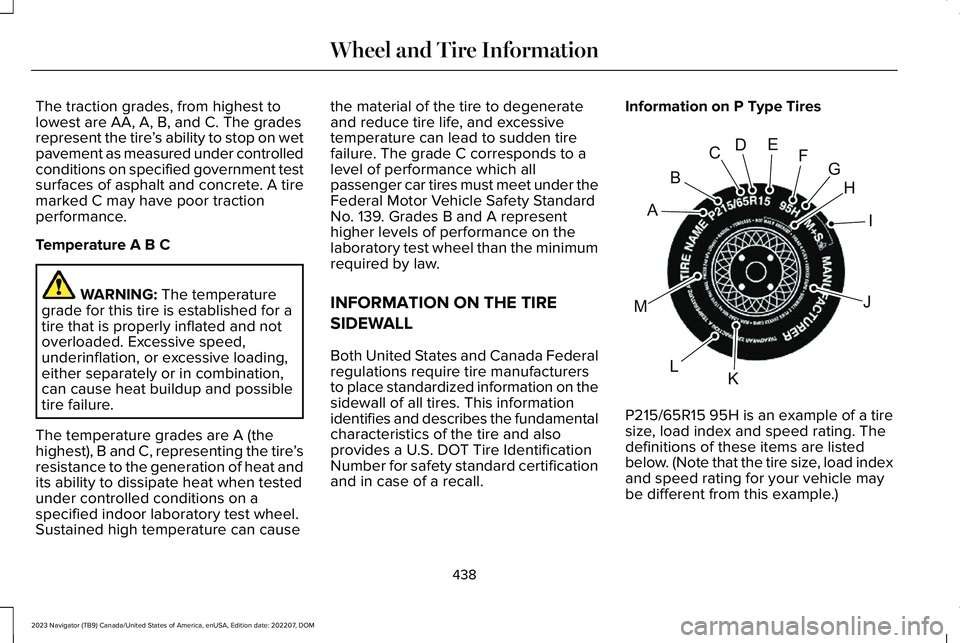
Both United States and Canada Federalregulations require tire manufacturersto place standardized information on thesidewall of all tires. This informationidentifies and describes the fundamentalcharacteristics of the tire and alsoprovides a U.S. DOT Tire IdentificationNumber for safety standard certificationand in case of a recall.
Information on P Type Tires
P215/65R15 95H is an example of a tiresize, load index and speed rating. Thedefinitions of these items are listedbelow. (Note that the tire size, load indexand speed rating for your vehicle maybe different from this example.)
438
2023 Navigator (TB9) Canada/United States of America, enUSA, Edition date: 202207, DOMWheel and Tire InformationHIJKLMABCDEFGE142543
Page 443 of 660
A. P: Indicates a tire, designated by theTire and Rim Association, that may beused for service on cars, sport utilityvehicles, minivans and light trucks. Note:If your tire size does not begin with aletter this may mean it is designated byeither the European Tire and RimTechnical Organization or the Japan TireManufacturing Association.
B. 215: Indicates the nominal width ofthe tire in millimeters from sidewall edgeto sidewall edge. In general, the largerthe number, the wider the tire.
C. 65: Indicates the aspect ratio whichgives the tire's ratio of height to width.
D. R: Indicates a radial type tire.
E. 15: Indicates the wheel or rim
diameter in inches. If you change yourwheel size, you will have to purchasenew tires to match the new wheeldiameter.
F. 95: Indicates the tire's load index. Itis an index that relates to how muchweight a tire can carry. You may find thisinformation in your owner’s manual. Ifnot, contact a local tire dealer.
Note:You may not find this informationon all tires because it is not required byfederal law.
G. H: Indicates the tire's speed rating.The speed rating denotes the speed atwhich a tire is designed to be driven forextended periods of time under astandard condition of load and inflationpressure. The tires on your vehicle mayoperate at different conditions for loadand inflation pressure. These speedratings may need to be adjusted for thedifference in conditions. The ratings
range from 81 mph (130 km/h) to186 mph (299 km/h). These ratings arelisted in the following chart.
Note:You may not find this informationon all tires because it is not required byfederal law.
Speed ratingLetter rating
81 mph (130 km/h)M
87 mph (140 km/h)N
99 mph (159 km/h)Q
106 mph (171 km/h)R
112 mph (180 km/h)S
118 mph (190 km/h)T
124 mph (200 km/h)U
130 mph (210 km/h)H
149 mph (240 km/h)V
439
2023 Navigator (TB9) Canada/United States of America, enUSA, Edition date: 202207, DOMWheel and Tire Information
Page 445 of 660
*Traction: The traction grades, fromhighest to lowest are AA, A, B, and C.The grades represent the tire's ability tostop on wet pavement as measuredunder controlled conditions on specifiedgovernment test surfaces of asphalt andconcrete. A tire marked C may havepoor traction performance.
*Temperature: The temperature gradesare A (the highest), B and C,representing the tire's resistance to thegeneration of heat and its ability todissipate heat when tested undercontrolled conditions on a specifiedindoor laboratory test wheel.
M. Maximum Inflation Pressure:Indicates the tire manufacturers'maximum permissible pressure or the
pressure at which the maximum loadcan be carried by the tire. This pressureis normally higher than the vehiclemanufacturer's recommended coldinflation pressure which can be foundon the Safety Compliance CertificationLabel (affixed to either the door hingepillar, door-latch post, or the door edgethat meets the door-latch post, next to
the driver's seating position), or TireLabel which is located on the B-Pillar orthe edge of the driver’s door. The coldinflation pressure should never be setlower than the recommended pressureon the vehicle label.
The tire suppliers may have additionalmarkings, notes or warnings such asstandard load or radial tubeless.
Additional Information Contained onthe Tire Sidewall for LT Type Tires
Note:Tire Quality Grades do not applyto this type of tire.
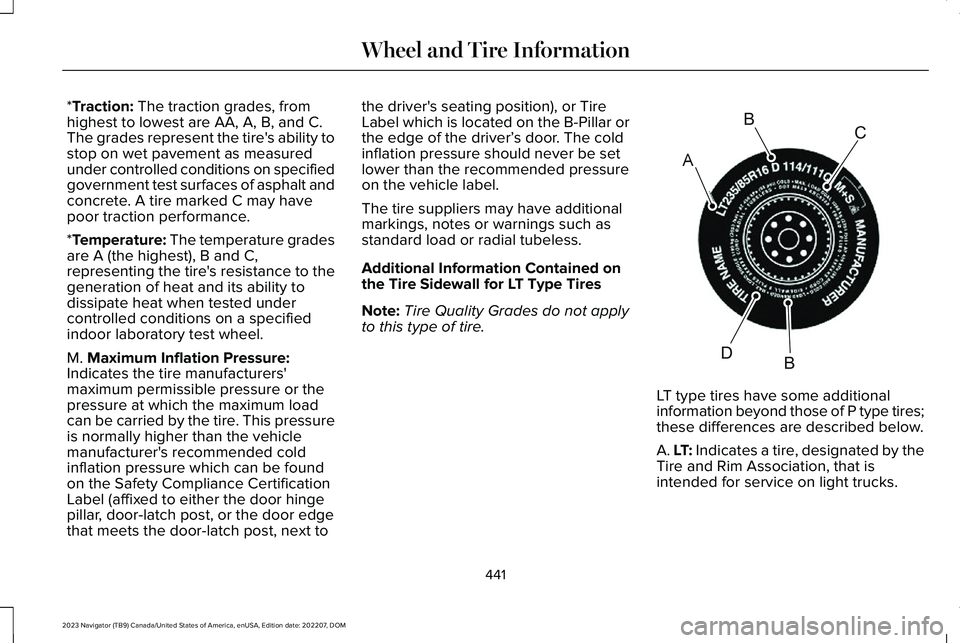
LT type tires have some additional
information beyond those of P type tires;these differences are described below.
A. LT: Indicates a tire, designated by theTire and Rim Association, that isintended for service on light trucks.
441
2023 Navigator (TB9) Canada/United States of America, enUSA, Edition date: 202207, DOMWheel and Tire InformationABCBDE142544
Page 446 of 660
B. Load Range and Load InflationLimits: Indicates the tire's load-carryingcapabilities and its inflation limits.
C. Maximum Load Dual lb (kg) at psi(kPa) cold: Indicates the maximum loadand tire pressure when the tire is usedas a dual, defined as four tires on therear axle (a total of six or more tires onthe vehicle).
D. Maximum Load Single lb (kg) at psi(kPa) cold: Indicates the maximum loadand tire pressure when the tire is usedas a single, defined as two tires (total)on the rear axle.
Information on T Type Tires
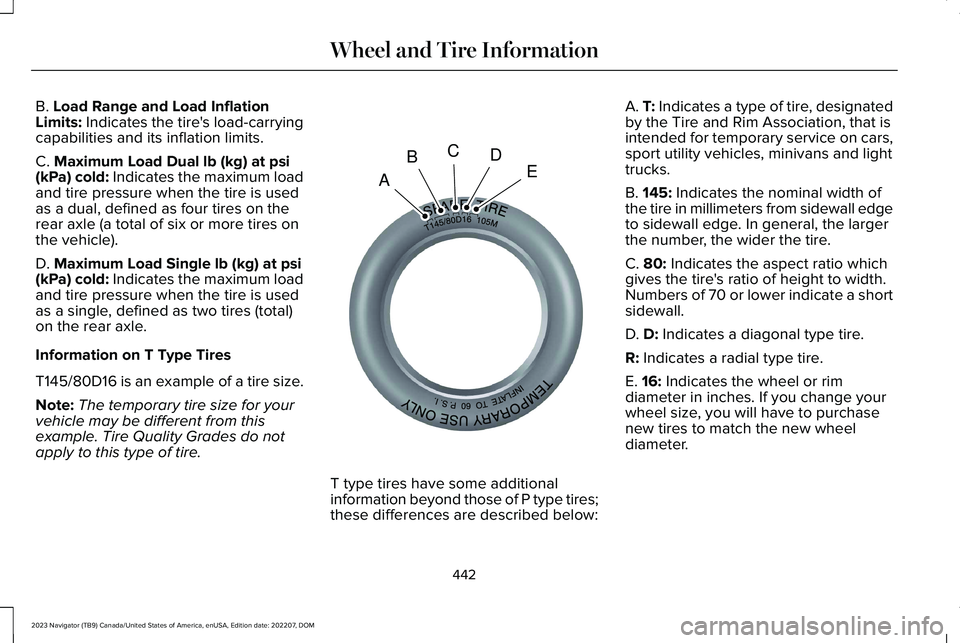
T145/80D16 is an example of a tire size.
Note:The temporary tire size for yourvehicle may be different from thisexample. Tire Quality Grades do notapply to this type of tire.
T type tires have some additionalinformation beyond those of P type tires;these differences are described below:
A. T: Indicates a type of tire, designatedby the Tire and Rim Association, that isintended for temporary service on cars,sport utility vehicles, minivans and lighttrucks.
B. 145: Indicates the nominal width ofthe tire in millimeters from sidewall edgeto sidewall edge. In general, the largerthe number, the wider the tire.
C. 80: Indicates the aspect ratio whichgives the tire's ratio of height to width.Numbers of 70 or lower indicate a shortsidewall.
D. D: Indicates a diagonal type tire.
R: Indicates a radial type tire.
E. 16: Indicates the wheel or rimdiameter in inches. If you change your
wheel size, you will have to purchasenew tires to match the new wheeldiameter.
442
2023 Navigator (TB9) Canada/United States of America, enUSA, Edition date: 202207, DOMWheel and Tire InformationABCDEE142545
Page 447 of 660
GLOSSARY OF TIRE
TERMINOLOGY
*Tire label: A label showing the originalequipment tire sizes, recommendedinflation pressure and the maximumweight the vehicle can carry.
*Tire Identification Number (TIN): Anumber on the sidewall of each tireproviding information about the tirebrand and manufacturing plant, tire sizeand date of manufacture. Also referredto as DOT code.
*Inflation pressure: A measure of theamount of air in a tire.
*Standard load: A class of P-metric orMetric tires designed to carry amaximum load at set pressure. Forexample: For P-metric tires 35 psi(2.4 bar) and for Metric tires 36 psi(2.5 bar). Increasing the inflationpressure beyond this pressure will notincrease the tire’s load carryingcapability.
*Extra load: A class of P-metric or Metrictires designed to carry a heaviermaximum load at 42 psi (2.9 bar).Increasing the inflation pressure beyondthis pressure will not increase the tire’sload carrying capability.
*kPa: Kilopascal, a metric unit of airpressure.
*PSI: Pounds per square inch, a standardunit of air pressure.
*Cold tire pressure: The tire pressurewhen the vehicle has been stationaryand out of direct sunlight for an hour ormore and prior to the vehicle beingdriven for 1 mi (1.6 km).
*Recommended inflation pressure: Thecold inflation pressure found on the
Safety Compliance Certification Label(affixed to either the door hinge pillar,door-latch post, or the door edge thatmeets the door-latch post, next to thedriver's seating position), or Tire Labellocated on the B-Pillar or the edge of thedriver door.
* B-pillar: The structural member at theside of the vehicle behind the front door.
*Bead area of the tire: Area of the tirenext to the rim.
* Sidewall of the tire: Area between thebead area and the tread.
*Tread area of the tire: Area of theperimeter of the tire that contacts theroad when mounted on the vehicle.
*Rim: The metal support (wheel) for atire or a tire and tube assembly uponwhich the tire beads are seated.
443
2023 Navigator (TB9) Canada/United States of America, enUSA, Edition date: 202207, DOMWheel and Tire Information
Page 448 of 660
TIRE REPLACEMENT
REQUIREMENTS
AGE
WARNING: Tires degrade overtime depending on many factors suchas weather, storage conditions, andconditions of use (load, speed, inflationpressure) the tires experiencethroughout their lives.In general, tires should be replacedafter six years regardless of treadwear. However, heat caused by hotclimates or frequent high loadingconditions can accelerate the agingprocess and may require tires to bereplaced more frequently.You should replace your spare tirewhen you replace the road tires orafter six years due to aging even if ithas not been used.
U.S. DOT Tire Identification Number
Both United States and Canada Federalregulations require tire manufacturersto place standardized information on thesidewall of all tires. This informationidentifies and describes the fundamentalcharacteristics of the tire and alsoprovides a U.S. DOT Tire IdentificationNumber for safety standard certificationand in case of a recall.
This begins with the letters DOT andindicates that the tire meets all federalstandards. The next two numbers orletters are the plant code designatingwhere it was manufactured, the next twoare the tire size code and the last fournumbers represent the week and yearthe tire was built. For example, the
numbers 317 mean the 31st week of1997. After 2000, the numbers go to fourdigits. For example, 2501 means the25th week of 2001. The numbers inbetween are identification codes usedfor traceability. This information is usedto contact customers if a tire defectrequires a recall.
Tire Replacement Requirements
Your vehicle is equipped with tiresdesigned to provide a safe ride andhandling capability.
WARNING: Only usereplacement tires and wheels that arethe same size, load index, speedrating, and type as those originallyprovided for your vehicle. Therecommended tire and wheel sizescan be found on the Tire Label on thedriver side door frame or the edge ofthe driver door. If this information isnot found in those locations, or foradditional options, contact yourauthorized dealer. Use of any tire orwheel not recommended, could affect
the safety and performance of yourvehicle, which could result in anincreased risk of loss of vehiclecontrol, vehicle rollover, personalinjury and death.
444
2023 Navigator (TB9) Canada/United States of America, enUSA, Edition date: 202207, DOMWheel and Tire Information
Page 449 of 660
WARNING: To reduce the risk ofserious injury, when mountingreplacement tires and wheels, youshould not exceed the maximumpressure indicated on the sidewall ofthe tire to set the beads withoutadditional precautions listed below. Ifthe beads do not seat at the maximumpressure indicated, re-lubricate andtry again.
WARNING: For a mountingpressure more than 20 psi (1.38 bar)greater than the maximum pressure,a Ford dealer or other tire serviceprofessional should do the mounting.
WARNING: Always inflate steelcarcass tires with a remote air fill withthe person inflating standing at aminimum of 12 ft (3.66 m) away fromthe wheel and tire assembly.
WARNING: When inflating thetire for mounting pressures up to20 psi (1.38 bar) greater than themaximum pressure on the tire sidewall,the following precautions must betaken to protect the person mountingthe tire:
•Make sure that you have the correcttire and wheel size.
•Lubricate the tire bead and wheelbead seat area again.
•Stand at a minimum of 12 ft (3.66 m)away from the wheel and tireassembly.
•Use both eye and ear protection.
Important: Remember to replace thewheel valve stems when the road tiresare replaced on your vehicle.
It is recommended that the two fronttires or two rear tires generally bereplaced as a pair if the worn tires stillhave usable depth.
To avoid potential Four-Wheel Drive(4WD) malfunction or (4WD) systemdamage, it is recommended to replaceall four tires rather than mixingsignificantly worn tires with new tires.
The tire pressure sensors mounted inthe wheels (originally installed on yourvehicle) are not designed to be used inaftermarket wheels.
The use of wheels or tires notrecommended may affect the operationof your tire pressure monitoring system.
If the tire pressure monitoring systemindicator is flashing, your system ismalfunctioning. Your replacement tiremight be incompatible with your tirepressure monitoring system, or somecomponent of the system may be
damaged.
445
2023 Navigator (TB9) Canada/United States of America, enUSA, Edition date: 202207, DOMWheel and Tire Information
Page 450 of 660
USING SNOW CHAINS
WARNING: Do not exceed 30 mph(50 km/h). Failure to follow this instructioncould result in the loss of control of yourvehicle, personal injury or death.
WARNING: Do not use snow chainson snow-free roads.
WARNING: Only fit snow chains tospecified tires.
WARNING: If your vehicle is fittedwith wheel trims, remove them beforefitting snow chains.
WARNING: If you choose to installsnow tires on your vehicle, they must bethe same size, construction, and load rangeas the original tires listed on the tireplacard, and they must be installed on allfour wheels. Mixing tires of different sizeor construction on your vehicle canadversely affect your vehicle's handlingand braking, and may lead to loss ofvehicle control.
WARNING: Wheels and tires mustbe the same size, load index and speedrating as those originally fitted on thevehicle. Use of any other tire or wheel canaffect the safety and performance of yourvehicle. Additionally, the use ofnon-recommended tires and wheels cancause steering, suspension, axle, transfercase or power transfer unit failure. Followthe recommended tire inflation pressures
found on the Safety ComplianceCertification label, or the Tire Label on theB-Pillar or the edge of the driver door.Failure to follow this instruction could resultin loss of vehicle control, vehicle rollover,or personal injury or death.
Only use snow chains on rear wheels. Installsnow chains in pairs. Do not useself-tensioning snow chains.
Only use snow chains on the followingspecified tire sizes. Only install chains thatare 15mm or less (SAE Class S chains).
•265/70R17
•275/65R18
We recommend you use steel wheels of thesame size and specification if snow chainsare required because chains may chipaluminum wheels.
Follow these guidelines when using snowtires and traction devices:
446
2023 Navigator (TB9) Canada/United States of America, enUSA, Edition date: 202207, DOMWheel and Tire Information
Page 453 of 660
CHECKING THE TIRE PRESSURES
Safe operation of your vehicle requiresthat your tires are properly inflated.Every day before you drive, check yourtires.
At least once a month and before longtrips, inspect each tire and check the tirepressure with a tire gauge. Inflate alltires to the recommended inflationpressure. See Inflating the Tires (page449).
INFLATING THE TIRES
WARNING: Under-inflation is themost common cause of tire failures
and may result in severe tire cracking,tread separation or blowout, withunexpected loss of vehicle control andincreased risk of injury. Under-inflationincreases sidewall flexing and rollingresistance, resulting in heat buildup
and internal damage to the tire. It alsomay result in unnecessary tire stress,irregular wear, loss of vehicle controland accidents. A tire can lose up tohalf of its air pressure and not appearto be flat!
WARNING: Do not use the tirepressure displayed in the informationdisplay as a tire pressure gauge.Failure to follow this instruction couldresult in personal injury or death.
Use the recommended cold inflationpressure for optimum tire performanceand wear. Under-inflation orover-inflation may cause uneventreadwear patterns.
Inflate your tires to the recommendedinflation pressure even if it is less thanthe maximum inflation pressureinformation found on the tire. You canfind the tire label with the recommendedtire inflation pressure next to the tire sizeon the B-Pillar or the edge of the driverdoor.
The recommended tire inflation pressureis also found on the Safety ComplianceCertification Label, affixed to either thedoor hinge pillar, door-latch post, or thedoor edge that meets the door-latch onthe B-pillar, or on the edge of the driverdoor.
Failure to follow the tire pressurerecommendations can cause uneventreadwear patterns and adversely affectthe way your vehicle handles.
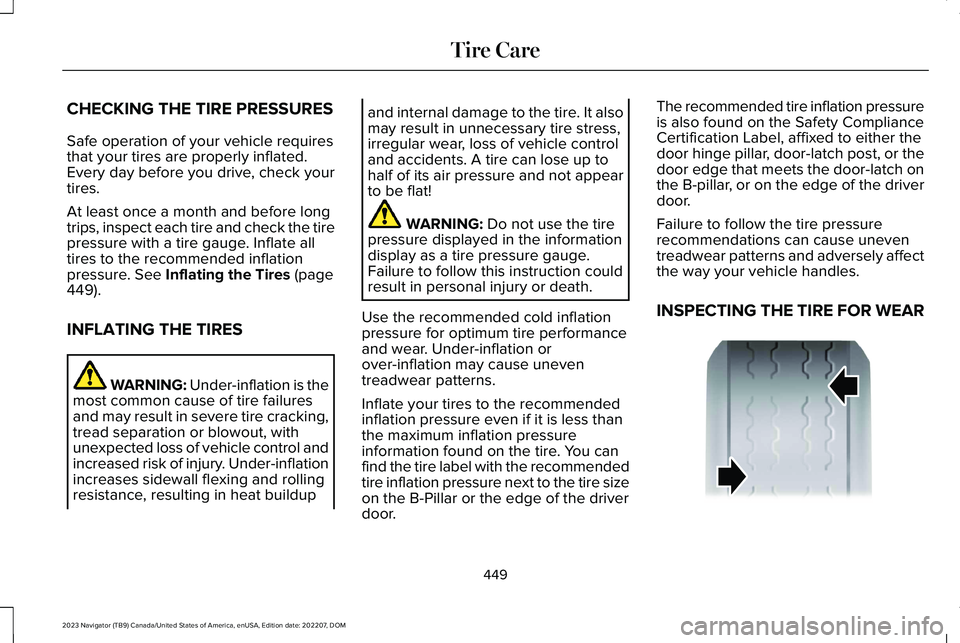
INSPECTING THE TIRE FOR WEAR
449
2023 Navigator (TB9) Canada/United States of America, enUSA, Edition date: 202207, DOMTire CareE142546
Page 454 of 660
When the tread is worn down to onesixteenth of an inch (2 mm), tires mustbe replaced to help prevent your vehiclefrom skidding and hydroplaning. Built-intreadwear indicators, or wear bars,which look like narrow strips of smoothrubber across the tread will appear onthe tire when the tread is worn down toone sixteenth of an inch (2 mm).
When the tire tread wears down to thesame height as these wear bars, the tireis worn out and must be replaced.
The tires should also be balancedperiodically. An unbalanced tire andwheel assembly may result in irregulartire wear.
Periodically inspect the tire treads foruneven or excessive wear and remove
objects such as stones, nails or glassthat may be wedged in the treadgrooves.
INSPECTING THE TIRE FOR
DAMAGE
Inspect the tire sidewalls for cracking,cuts, bruises and other signs of damageor excessive wear. If internal damage tothe tire is suspected, have the tiredismounted and inspected in case itneeds to be repaired or replaced. Foryour safety, tires that are damaged orshow signs of excessive wear shouldnot be used because they are morelikely to blow out or fail.
Periodically inspect the tire treads andsidewalls for damage, such as bulges inthe tread or sidewalls, cracks in thetread groove and separation in the treador sidewall. If damage is observed orsuspected, have the tire inspected by atire professional.
Safety Practices
WARNING: If your vehicle isstuck in snow, mud or sand, do notrapidly spin the tires; spinning the tirescan tear the tire and cause anexplosion. A tire can explode in as littleas three to five seconds.
WARNING: Do not spin thewheels at over 34 mph (55 km/h). Thetires may fail and injure a passengeror bystander.
Highway Hazards
No matter how carefully you drive, thereis always the possibility that you could
eventually have a flat tire on thehighway. Drive slowly to the closest safearea out of traffic. This could furtherdamage the flat tire, but your safety ismore important.
450
2023 Navigator (TB9) Canada/United States of America, enUSA, Edition date: 202207, DOMTire Care