seats LINCOLN NAVIGATOR 2023 Owners Manual
[x] Cancel search | Manufacturer: LINCOLN, Model Year: 2023, Model line: NAVIGATOR, Model: LINCOLN NAVIGATOR 2023Pages: 660, PDF Size: 14.04 MB
Page 5 of 660
Contacting Us
Contacting Us..................................................17
Introduction
About This Publication..................................19
Using This Publication..................................20
Symbols Glossary
Symbols Used on Your Vehicle...................21
Data Privacy
Data Privacy....................................................24
Service Data....................................................25
Event Data.......................................................26
Settings Data..................................................26
Connected Vehicle Data..............................27
Mobile Device Data.......................................27
Emergency Call System Data.....................28
Visual Search
Steering Wheel..............................................29
Instrument Panel.............................................31
Vehicle Interior...............................................33
Front Exterior..................................................35
Rear Exterior....................................................37
Child Safety
Child Safety Precautions.............................39
Child Restraint Anchor Points.....................40
Child Restraints...............................................41
Installing Child Restraints............................44
Booster Seats.................................................48
Child Safety Locks..........................................51
Seatbelts
Seatbelt Precautions....................................52
Fastening and Unfastening the Seatbelts.........................................................................53
Sensitive Locking Mode...............................54
Automatic Locking Mode.............................54
Adjusting the Seatbelts During Pregnancy........................................................................55
Adjusting the Seatbelt Height....................56
Seatbelt Reminder.........................................56
Checking the Seatbelts...............................58
Seatbelt Extensions......................................58
Personal Safety System™
What Is the Personal Safety System.........60
How Does the Personal Safety SystemWork.............................................................60
Personal Safety System Components........................................................................60
Airbags
How Do the Front Airbags Work................61
How Do the Side Airbags Work..................61
How Does the Safety Canopy™ Work.......62
Airbag Precautions........................................63
Properly Adjusting the Driver and FrontPassenger Seats........................................64
Children and Airbags....................................65
Front Passenger Sensing System.............65
Crash Sensors and Airbag Indicator........68
Disposing of Airbags....................................69
911 Assist
What Is 911 Assist...........................................70
How Does 911 Assist Work..........................70
Emergency Call Requirements...................70
1
2023 Navigator (TB9) Canada/United States of America, enUSA, Edition date: 202207, DOMTable of Contents
Page 9 of 660
Remote Start
What Is Remote Start...................................156
Remote Start Precautions..........................156
Remote Start Limitations............................156
Enabling Remote Start................................156
Remotely Starting and Stopping theVehicle........................................................156
Extending the Remote Start Duration.......................................................................157
Remote Start Remote Control Indicators.......................................................................157
Remote Start Settings.................................157
Climate Control
Identifying the Climate Control Unit........159
Switching Climate Control On and Off.......................................................................159
Switching Recirculated Air On and Off.......................................................................159
Switching Air Conditioning On and Off.......................................................................159
Switching Defrost On and Off...................159
Switching Maximum Defrost On and Off.......................................................................159
Switching Maximum Cooling On and Off.......................................................................160
Switching the Heated Rear Window Onand Off........................................................160
Setting the Blower Motor Speed.............160
Setting the Temperature............................160
Directing the Flow of Air............................160
Auto Mode......................................................161
Climate Control Hints..................................162
Rear Passenger Climate Control
Identifying the Rear Passenger ClimateControl Unit...............................................164
Switching the Rear Passenger ClimateControls On and Off................................164
Setting the Blower Motor Speed.............164
Setting the Temperature............................165
Directing the Flow of Air............................165
Rear Auto Mode...........................................165
Rear Passenger Climate Control Indicators.......................................................................165
Interior Air Quality
What Is the Cabin Air Filter........................166
Replacing the Cabin Air Filter...................166
Front Seats
Front Seat Precautions...............................167
Sitting in the Correct Position...................167
Power Seats..................................................168
Massage Seats..............................................172
Heated Seats.................................................173
Ventilated Seats............................................174
Rear Seats
Manual Seats.................................................175
Power Seats...................................................179
Massage Seats.............................................182
Heated Seats................................................182
Ventilated Seats...........................................183
Rear Occupant Alert System
What is the Rear Occupant Alert System.......................................................................184
5
2023 Navigator (TB9) Canada/United States of America, enUSA, Edition date: 202207, DOMTable of Contents
Page 38 of 660
See Opening the Center Console (page 200).A
See Moving the Seat Backward and Forward (page 170).B
See Moving the Seat Backward and Forward (page 176).C
See Accessing the Third Row Seats (page 178).D
See Sitting in the Correct Position (page 167).E
34
2023 Navigator (TB9) Canada/United States of America, enUSA, Edition date: 202207, DOMVisual Search
Page 44 of 660
manufacturer. A safety seat that isimproperly installed or utilized, isinappropriate for your child's height, age,or weight or does not properly fit the childmay increase the risk of serious injury ordeath.
WARNING: Do not allow a passengerto hold a child on their lap when yourvehicle is moving. Failure to follow thisinstruction could result in personal injuryor death in the event of a sudden stop orcrash.
WARNING: Do not use pillows, booksor towels to boost your child's height.Failure to follow this instruction could resultin personal injury or death.
WARNING: Properly secure childrestraints or booster seats when they arenot in use. They could become projectilesin a sudden stop or crash. Failure to followthis instruction could result in personalinjury or death.
WARNING: Do not put the shouldersection of the seatbelt or allow the child toput the shoulder section of the seatbeltunder their arm or behind their back.Failure to follow this instruction couldreduce the effectiveness of the seatbeltand increase the risk of injury or death ina crash.
WARNING: Do not leave children orpets unattended in your vehicle. Failure tofollow this instruction could result inpersonal injury or death.
When installing a child restraint withseatbelts:
•Place the vehicle seat in the uprightposition before you install the childrestraint.
•Use the correct seatbelt buckle for thatseating position.
•Insert the belt tongue into the buckle.Make sure the tongue is securelyfastened in the buckle.
•Keep the buckle release button pointingup and away from the child restraint, withthe tongue between the child restraintand the release button, to preventaccidental unbuckling.
•Put the seatbelt in the automatic lockingmode.
CHILD RESTRAINT ANCHOR POINTS
WHAT ARE THE CHILD RESTRAINTANCHOR POINTS
Anchor points allow you to quickly and safelyinstall a child restraint.
LOCATING THE CHILD RESTRAINTLOWER ANCHOR POINTS
Second Row Bench Seat
40
2023 Navigator (TB9) Canada/United States of America, enUSA, Edition date: 202207, DOMChild Safety
Page 45 of 660
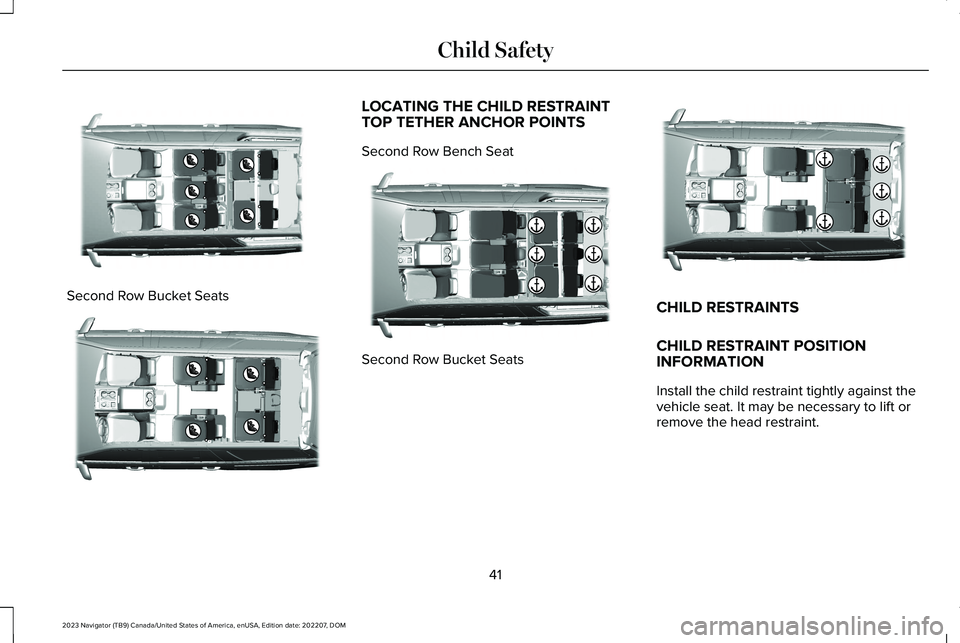
Second Row Bucket Seats
LOCATING THE CHILD RESTRAINTTOP TETHER ANCHOR POINTS
Second Row Bench Seat
Second Row Bucket Seats
CHILD RESTRAINTS
CHILD RESTRAINT POSITIONINFORMATION
Install the child restraint tightly against thevehicle seat. It may be necessary to lift orremove the head restraint.
41
2023 Navigator (TB9) Canada/United States of America, enUSA, Edition date: 202207, DOMChild SafetyE347175 E347230 E347177 E347235
Page 47 of 660
CHILD RESTRAINTS RECOMMENDATION
Recommended Restraint TypeChild Size, Height, Weight, or Age
Use a child restraint (sometimes called an infant carrier,convertible seat, or toddler seat).Children weighing 40 lb (18 kg) or less (generally age four or younger).
Use a belt-positioning booster seat.
Children who have outgrown or no longer properly fit in a child restraint (generallychildren who are less than 57 in (1.45 m) tall, are greater than age four and lessthan age 12, and between 40 lb (18 kg) and 80 lb (36 kg) and upward to 100 lb(45 kg) if recommended by your child restraint manufacturer).
Use a vehicle seatbelt having the lap belt snug and lowacross the hips, shoulder belt centered across theshoulder and chest, and seat backrest upright.
Children who have outgrown or no longer properly fit in a belt-positioning boosterseat (generally children who are at least 57 in (1.45 m) tall or greater than 80 lb(36 kg) or 100 lb (45 kg) if recommended by child restraint manufacturer).
You are required by law to properly use childrestraints for infants and toddlers in theUnited States, Canada and Mexico.
Many states and provinces require that smallchildren use approved booster seats untilthey reach age eight, a height of 57 in(1.45 m) tall, or 80 lb (36 kg). Check your localand state or provincial laws for specificrequirements about the safety of children inyour vehicle.
When possible, properly restrain children 12years of age and under in a rear seatingposition of your vehicle. Accident statisticssuggest that children are safer when properlyrestrained in the rear seating positions thanin a front seating position.
When installing a rear facing child restraint,adjust the vehicle seats to avoid interferencebetween the child restraint and the vehicleseat in front of the child restraint.
43
2023 Navigator (TB9) Canada/United States of America, enUSA, Edition date: 202207, DOMChild Safety
Page 49 of 660
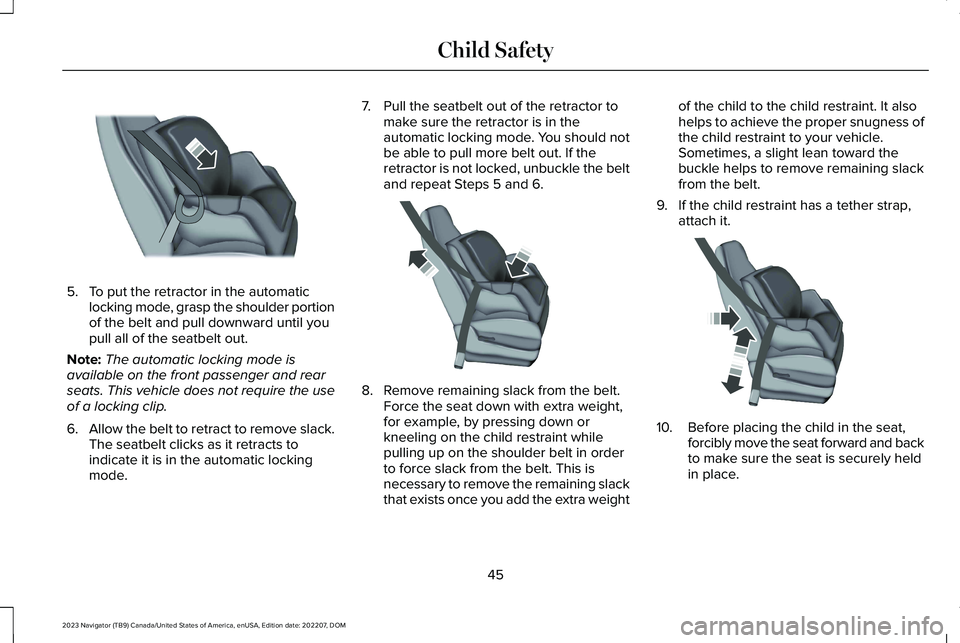
5.To put the retractor in the automaticlocking mode, grasp the shoulder portionof the belt and pull downward until youpull all of the seatbelt out.
Note:The automatic locking mode isavailable on the front passenger and rearseats. This vehicle does not require the useof a locking clip.
6.Allow the belt to retract to remove slack.The seatbelt clicks as it retracts toindicate it is in the automatic lockingmode.
7.Pull the seatbelt out of the retractor tomake sure the retractor is in theautomatic locking mode. You should notbe able to pull more belt out. If theretractor is not locked, unbuckle the beltand repeat Steps 5 and 6.
8.Remove remaining slack from the belt.Force the seat down with extra weight,for example, by pressing down orkneeling on the child restraint whilepulling up on the shoulder belt in orderto force slack from the belt. This isnecessary to remove the remaining slackthat exists once you add the extra weight
of the child to the child restraint. It alsohelps to achieve the proper snugness ofthe child restraint to your vehicle.Sometimes, a slight lean toward thebuckle helps to remove remaining slackfrom the belt.
9.If the child restraint has a tether strap,attach it.
10.Before placing the child in the seat,forcibly move the seat forward and backto make sure the seat is securely heldin place.
45
2023 Navigator (TB9) Canada/United States of America, enUSA, Edition date: 202207, DOMChild SafetyE142875 E142533 E142534
Page 52 of 660
Attach the tether strap only to theappropriate tether anchor. The tether strapmay not work properly if attachedsomewhere other than the correct tetheranchor.
If you install a child restraint with rigid LATCHattachments, do not tighten the tether strapenough to lift the child restraint off thevehicle seat cushion when the child is seatedin it. Keep the tether strap just snug withoutlifting the front of the child restraint. Keepingthe child restraint just touching the vehicleseat gives the best protection in a severecrash.
Once you have installed the child restraintusing either the seatbelt, the lower anchorsof the LATCH system, or both, you can attachthe top tether strap.
BOOSTER SEATS
Use a belt-positioning booster seat forchildren who have outgrown or no longerproperly fit in a child restraint and meet thefollowing criteria.
•Generally children who are less than57 in (1.45 m) tall.
•Are greater than age four (4) and lessthan age twelve (12).
•Are between 40 lb (18 kg) and 80 lb(36 kg) and upward to 100 lb (45 kg).
Many state and provincial laws require thatchildren use approved booster seats untilthey reach age eight, a height of 57 in(1.45 m) tall, or 80 lb (36 kg).
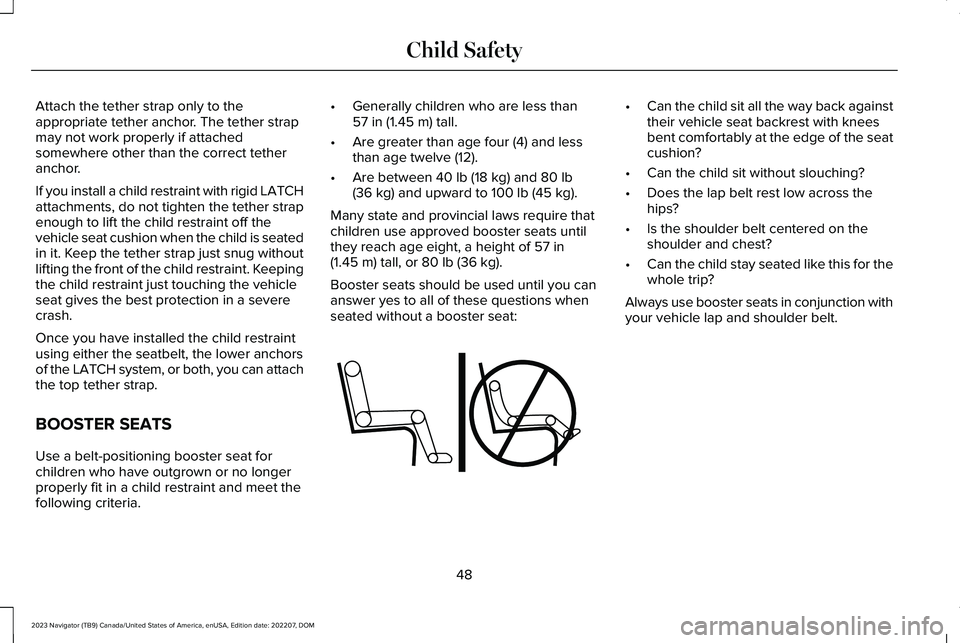
Booster seats should be used until you cananswer yes to all of these questions whenseated without a booster seat:
•Can the child sit all the way back againsttheir vehicle seat backrest with kneesbent comfortably at the edge of the seatcushion?
•Can the child sit without slouching?
•Does the lap belt rest low across thehips?
•Is the shoulder belt centered on theshoulder and chest?
•Can the child stay seated like this for thewhole trip?
Always use booster seats in conjunction withyour vehicle lap and shoulder belt.
48
2023 Navigator (TB9) Canada/United States of America, enUSA, Edition date: 202207, DOMChild SafetyE142595
Page 53 of 660
Types of Booster Seats
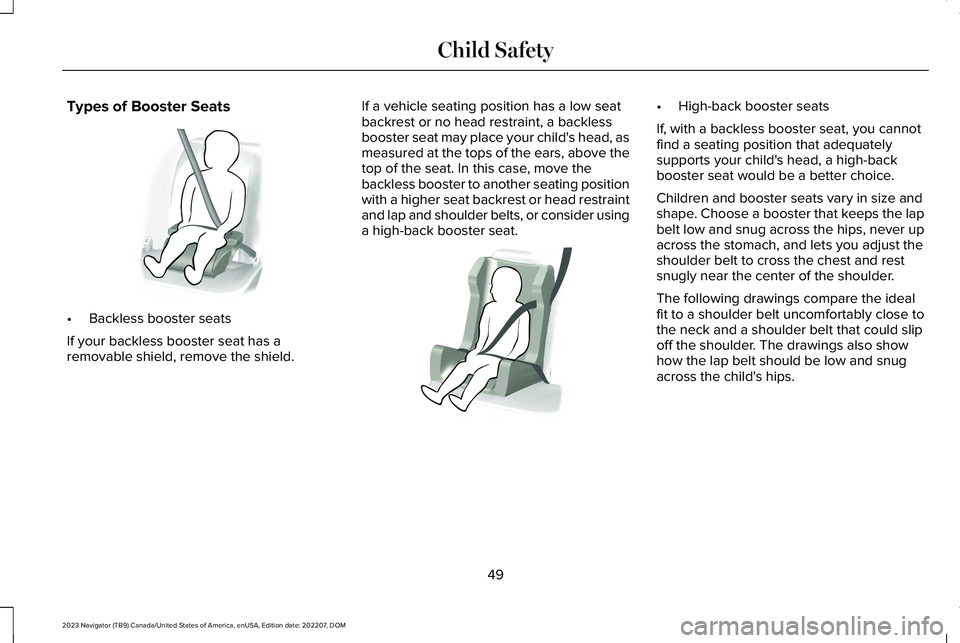
•Backless booster seats
If your backless booster seat has aremovable shield, remove the shield.
If a vehicle seating position has a low seatbackrest or no head restraint, a backlessbooster seat may place your child's head, asmeasured at the tops of the ears, above thetop of the seat. In this case, move thebackless booster to another seating positionwith a higher seat backrest or head restraintand lap and shoulder belts, or consider usinga high-back booster seat.
•High-back booster seats
If, with a backless booster seat, you cannotfind a seating position that adequatelysupports your child's head, a high-backbooster seat would be a better choice.
Children and booster seats vary in size andshape. Choose a booster that keeps the lapbelt low and snug across the hips, never upacross the stomach, and lets you adjust theshoulder belt to cross the chest and restsnugly near the center of the shoulder.
The following drawings compare the idealfit to a shoulder belt uncomfortably close tothe neck and a shoulder belt that could slipoff the shoulder. The drawings also showhow the lap belt should be low and snugacross the child's hips.
49
2023 Navigator (TB9) Canada/United States of America, enUSA, Edition date: 202207, DOMChild SafetyE68924 E70710
Page 56 of 660
SEATBELT PRECAUTIONS
WARNING: Always drive and ridewith your seatback upright and the lap beltsnug and low across the hips.
WARNING: Children must always beproperly restrained.
WARNING: Do not allow a passengerto hold a child on their lap when yourvehicle is moving. Failure to follow thisinstruction could result in personal injuryor death in the event of a sudden stop orcrash.
WARNING: All occupants of yourvehicle, including the driver, should alwaysproperly wear their seatbelts, even whenan airbag supplemental restraint system isprovided. Failure to properly wear yourseatbelt could seriously increase the riskof injury or death.
WARNING: It is extremely dangerousto ride in a cargo area, inside or outside ofa vehicle. In a crash, people riding in theseareas are more likely to be seriouslyinjured or killed. Do not allow people toride in any area of your vehicle that is notequipped with seats and seatbelts. Makesure everyone in your vehicle is in a seatand properly using a seatbelt. Failure tofollow this warning could result in seriouspersonal injury or death.
WARNING: In a rollover crash, anunbelted person is significantly more likelyto die than a person wearing a seatbelt.
WARNING: Each seating position inyour vehicle has a specific seatbeltassembly made up of one buckle and onetongue designed to be used as a pair. Usethe shoulder belt on the outside shoulderonly. Never wear the shoulder belt underthe arm. Never use a single seatbelt formore than one person.
WARNING: Even with advancedrestraints systems, properly restrainchildren 12 and under in a rear seatingposition. Failure to follow this couldseriously increase the risk of injury ordeath.
WARNING: Seatbelts and seats maybe hot in a vehicle that is in the sunshine.The hot seatbelts or seats may burn a smallchild. Check seat covers and bucklesbefore you place a child anywhere nearthem.
WARNING: If your vehicle is involvedin a crash, have the seatbelts andassociated components inspected as soonas possible. Failure to follow this instructioncould result in personal injury or death.
All seating positions in this vehicle haveseatbelts. All occupants of the vehicle shouldproperly wear their seatbelts, even when anairbag supplemental restraint system isprovided.
52
2023 Navigator (TB9) Canada/United States of America, enUSA, Edition date: 202207, DOMSeatbelts