engine LINCOLN TOWN CAR 1998 Owner's Manual
[x] Cancel search | Manufacturer: LINCOLN, Model Year: 1998, Model line: TOWN CAR, Model: LINCOLN TOWN CAR 1998Pages: 188, PDF Size: 1.29 MB
Page 93 of 188
heater-defroster system to respond
quickly. They are strongly
recommended if you live in a
region where temperatures reach
-23ÉC (-10ÉF) or below.
For best results, plug the heater in
at least three hours before starting
the vehicle. Using the heater for
longer than three hours will not
harm the engine, so the heater can
be plugged in the night before
starting the vehicle.
To prevent electrical
shock, do not use your
heater with ungrounded
electrical systems or
two-pronged (cheater) adapters.
Guarding against exhaust
fumes
Although odorless and colorless,
carbon monoxide is present in
exhaust fumes. Take precautions
to avoid its dangerous effects.
If you ever smell exhaust
fumes of any kind inside
your vehicle, have your dealer
inspect and fix your vehicle
immediately. Do not drive if you
smell exhaust fumes. These
fumes are harmful and could kill
you.
Starting
94
Page 94 of 188
Have the exhaust and body
ventilation systems checked
whenever:
²the vehicle is raised for service.
²the sound of the exhaust system
changes.
²the vehicle has been damaged in
a collision.
Important ventilating
information
If the engine is idling while the
vehicle is stopped in an open area
for long periods of time, open the
windows at least 2.5 cm (one
inch).
Adjust the heating or air
conditioning (if equipped) to bring
in fresh air.
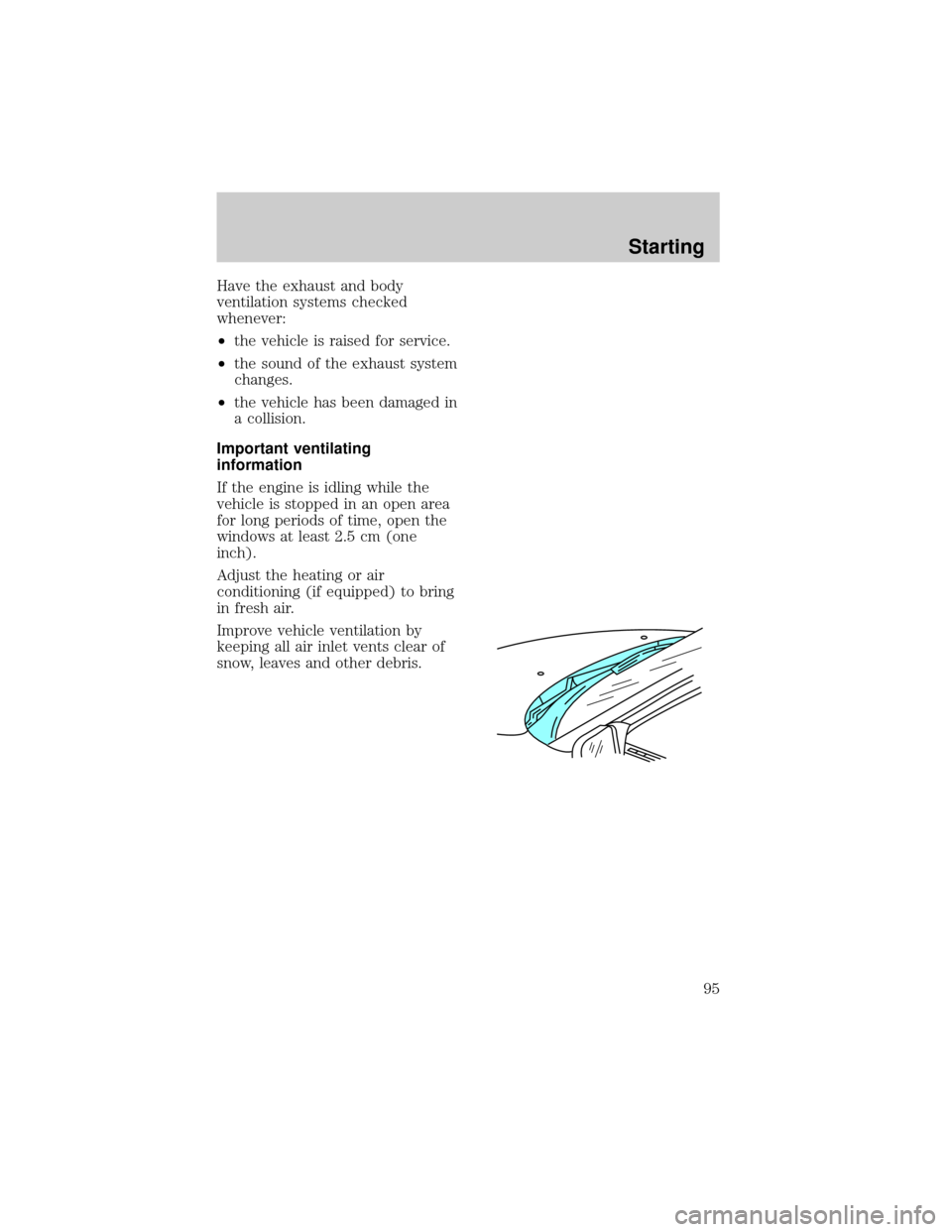
Improve vehicle ventilation by
keeping all air inlet vents clear of
snow, leaves and other debris.
Starting
95
Page 99 of 188

Wheel-speed sensors allow excess
rear wheel spin to be detected by
the Traction Controlyportion of
the ABS computer. Any excessive
wheel spin is controlled by
automatically applying and
releasing the rear brakes in
conjunction with engine torque
reductions. Engine torque
reduction is realized via the fully
electronic spark and fuel injection
systems. This process is very
sensitive to driving conditions and
very fast acting. The rear wheels
ªsearchº for optimum traction
several times a second and
adjustment are made accordingly.
The Traction Controlysystem will
allow your vehicle to make better
use of available traction on
slippery surfaces. The system is a
driver aid which makes your
vehicle easier to handle primarily
on snow and ice covered roads.
During Traction Controly
operation you may hear an electric
motor type of sound coming from
the engine compartment and the
engine will not ªrev-upº when you
push further on the accelerator.
This is normal system behavior.
If you should become stuck in
snow or ice or on a very slippery
road surface, tyro switching the
Traction Controlysystem off. This
may allow excess wheel spin to
ªdigº the vehicle out a enable a
successful ªrockingº maneuver.
If the Traction Controlysystem is
cycled excessively, the brake
Driving
100
Page 100 of 188

portion of the system will shut
down to prevent the rear brakes
from overheating. A limited
Traction Controlyfunction using
only engine torque reduction will
still control wheels from
over-spinning. When the rear
brakes have cooled down, the
system will again function
normally. Anti-lock braking is not
affected by this condition and will
function normally during the cool
down period.
If the engine coolant temperature
is below þ23ÉC (þ10ÉF) the engine
torque reduction portion of the
Traction Controlysystem isNOT
active. The system will operate
normally when the engine coolant
warms up.
Traction control switch
The traction control switch is
located on the left side of the
glove compartment. The traction
control system defaults to ON
when the ignition key is turned
from OFF to RUN.
The traction control must be
turned off if you are using a
mini-spare tire in a rear wheel
position.
STEERING
Your vehicle is equipped with
power steering. Power steering
uses energy from the engine to
help steer the vehicle.
Never hold the steering wheel to
the extreme right or the extreme
Driving
101
Page 101 of 188

left for more than a few seconds
when the engine is running. This
action could damage the power
steering pump.
Speed sensitive steering
The steering in your vehicle is
speed sensitive. At high speeds,
steering assist will decrease to
improve steering feel. At lower
speeds, maneuverability will be
increased.
If the amount of effort required to
steer your vehicle changes at a
constant vehicle speed, have the
power steering system checked by
your dealer or a qualified service
technician.
AIR SUSPENSION SYSTEM
The air suspension system is
designed to improve ride, handling
and general vehicle performance
during:
²certain road conditions
²steering maneuvers
²braking
²accelerations
This system keeps the rear of your
vehicle at a constant level by
automatically adding air or
releasing air from the springs.
Driving
102
Page 103 of 188
is possible that a fuse has blown
and the vehicle's brakelamps may
not be operating properly. Refer to
Fuses and relaysin theRoadside
emergencieschapter.
Do not drive your vehicle
until you verify that the
brakelamps are working.
If your vehicle gets stuck in mud
or snow it may be rocked out by
shifting from forward and reverse
gears in a steady pattern. Press
lightly on the accelerator in each
gear.
Do not rock the vehicle for
more than a few minutes. The
transmission and tires may be
damaged or the engine may
overheat.
Always set the parking
brake fully and make sure
the gearshift is latched in P
(Park). Turn off the ignition
whenever you leave your vehicle.
Driving with a 4±speed
automatic transmission
Understanding gearshift
positions
Pull the gearshift lever towards
you and downward to move the
automatic gearshift.
Driving
104
Page 105 of 188
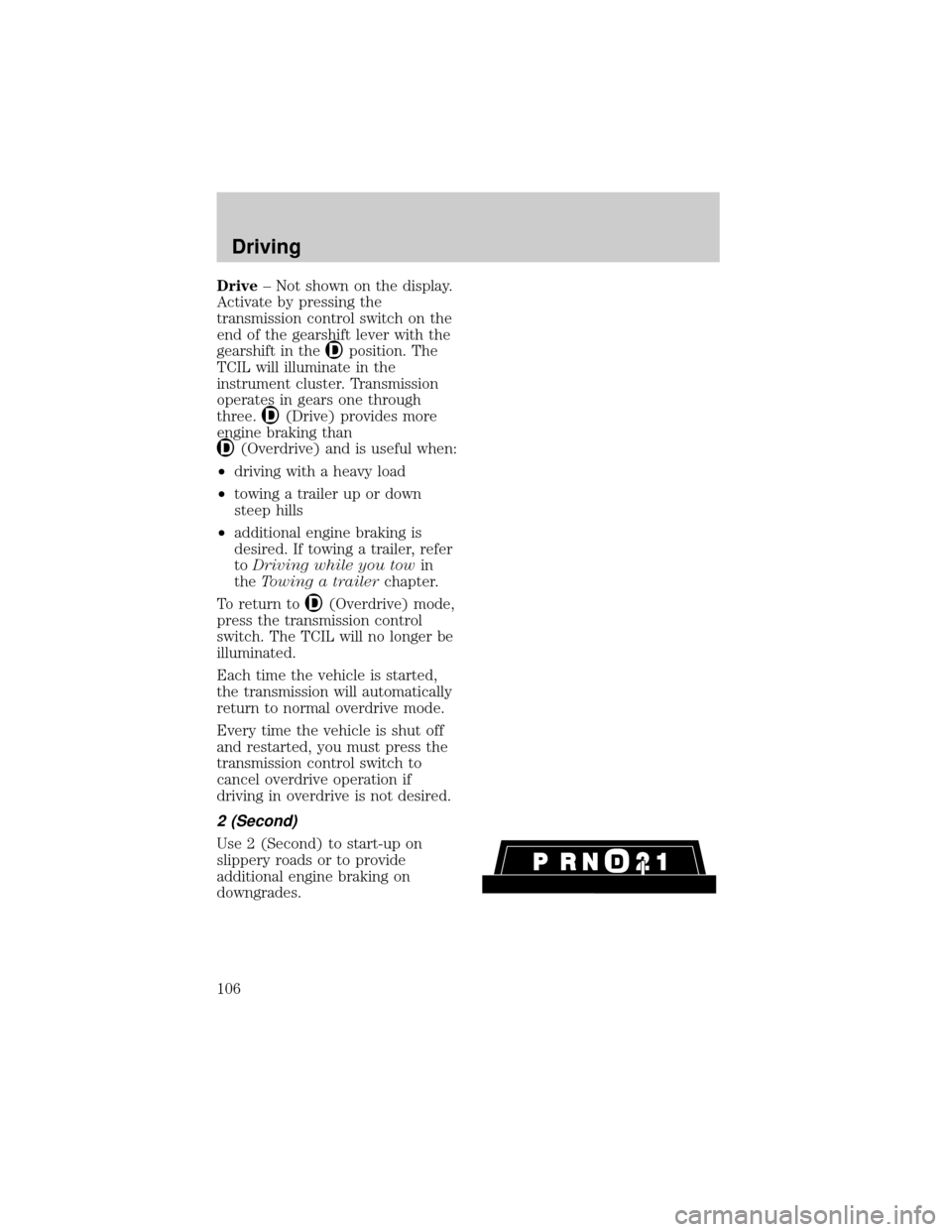
Drive± Not shown on the display.
Activate by pressing the
transmission control switch on the
end of the gearshift lever with the
gearshift in the
position. The
TCIL will illuminate in the
instrument cluster. Transmission
operates in gears one through
three.
(Drive) provides more
engine braking than
(Overdrive) and is useful when:
²driving with a heavy load
²towing a trailer up or down
steep hills
²additional engine braking is
desired. If towing a trailer, refer
toDriving while you towin
theTowing a trailerchapter.
To return to
(Overdrive) mode,
press the transmission control
switch. The TCIL will no longer be
illuminated.
Each time the vehicle is started,
the transmission will automatically
return to normal overdrive mode.
Every time the vehicle is shut off
and restarted, you must press the
transmission control switch to
cancel overdrive operation if
driving in overdrive is not desired.
2 (Second)
Use 2 (Second) to start-up on
slippery roads or to provide
additional engine braking on
downgrades.
Driving
106
Page 106 of 188
1 (First)
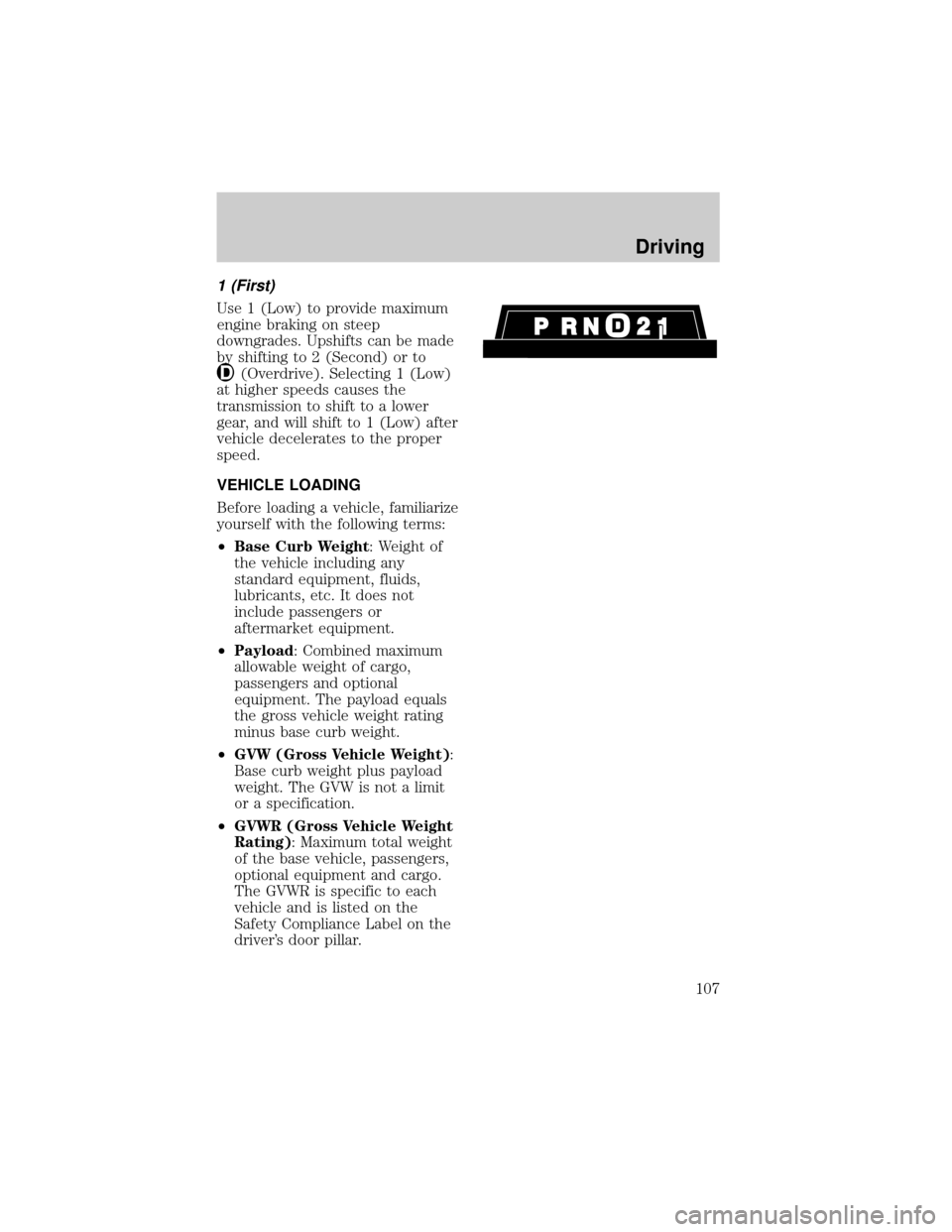
Use 1 (Low) to provide maximum
engine braking on steep
downgrades. Upshifts can be made
by shifting to 2 (Second) or to
(Overdrive). Selecting 1 (Low)
at higher speeds causes the
transmission to shift to a lower
gear, and will shift to 1 (Low) after
vehicle decelerates to the proper
speed.
VEHICLE LOADING
Before loading a vehicle, familiarize
yourself with the following terms:
²Base Curb Weight: Weight of
the vehicle including any
standard equipment, fluids,
lubricants, etc. It does not
include passengers or
aftermarket equipment.
²Payload: Combined maximum
allowable weight of cargo,
passengers and optional
equipment. The payload equals
the gross vehicle weight rating
minus base curb weight.
²GVW (Gross Vehicle Weight):
Base curb weight plus payload
weight. The GVW is not a limit
or a specification.
²GVWR (Gross Vehicle Weight
Rating): Maximum total weight
of the base vehicle, passengers,
optional equipment and cargo.
The GVWR is specific to each
vehicle and is listed on the
Safety Compliance Label on the
driver's door pillar.
Driving
107
Page 107 of 188
²GAWR (Gross Axle Weight
Rating): Carrying capacity for
each axle system. The GAWR is
specific to each vehicle and is
listed on the Safety Compliance
Label on the driver's door pillar.
Do not exceed the GVWR
or the GAWR specified on
the Safety Compliance
Certification Label.
Do not use replacement tires with
lower weight capacities than the
originals because they may lower
the vehicle's GVWR and GAWR
limitations. Replacement tires with
a higher weight limit than the
originals do not increase the
GVWR and GAWR limitations.
Your vehicle is classified as a light
duty towing vehicle. It does not
come from the factory fully
equipped to tow. No towing
packages are available through
Ford or Mercury/Lincoln dealers.
Do not tow a trailer until your
vehicle has been driven at least
3 200 km (2 000 miles).
Towing a trailer places an
additional load on your vehicle's
engine, transmission, brakes, tires
and suspension. Inspect these
components carefully after towing.
The amount of weight your loaded
trailer should be no more than
907 kg (2 000 lbs.).
Driving
108
Page 108 of 188
Do not exceed the GVWR
or the GAWR specified on
the Safety Compliance
Certification Label.
Towing trailers beyond the
maximum recommended
gross trailer weight could result
in engine damage,
transmission/axle damage,
structural damage, loss of
control, and personal injury.
Preparing to tow
Use the proper equipment for
towing a trailer, and make sure it
is properly attached to your
vehicle. See your dealer or a
reliable trailer dealer if you require
assistance.
Hitches
Do not use hitches that clamp onto
the vehicle bumper. Use a load
carrying hitch. You must distribute
the load in your trailer so that
10 ± 15% of the total weight of the
trailer is on the tongue.
Safety chains
Always connect the trailer's safety
chains to the vehicle. To connect
the trailer's safety chains, cross the
chains under the trailer tongue and
allow slack for turning corners.
If you use a rental trailer, follow
the instructions that the rental
agency gives to you.
Driving
109