lock LINCOLN TOWN CAR 1998 Owner's Guide
[x] Cancel search | Manufacturer: LINCOLN, Model Year: 1998, Model line: TOWN CAR, Model: LINCOLN TOWN CAR 1998Pages: 188, PDF Size: 1.29 MB
Page 87 of 188

able to pull more belt out). If the
retractor is not locked, unbuckle
the belt and repeat steps two
through nine.
Check to make sure the child seat
is properly secured before each
use.
Installing a child safety seat in
the center seating position with
adjustable lap belt
1. Lengthen the lap belt. To
lengthen the belt, hold the tongue
so that its bottom is perpendicular
to the direction of webbing while
sliding the tongue up the webbing.
2. Place the child safety seat in the
center seating position.
3. Route the tongue and webbing
through the child seat according to
the child seat manufacturer's
instructions.
4. Insert the belt tongue into the
proper buckle for the center
seating position until you hear a
snap and feel it latch. Make sure
the tongue is securely fastened to
the buckle by pulling on tongue.
5. Push down on the child seat
while pulling on the loose end of
the lap belt webbing to tighten the
belt.
6. Before placing the child into the
child seat, forcibly tilt the child
seat from side to side and in
forward direction to make sure
that the seat is held securely in
place. If the child seat moves
Seating and safety restraints
88
Page 92 of 188
Make sure the corresponding lights
illuminate briefly. If a light fails to
illuminate, have the vehicle
serviced.
²If the driver's safety belt is
fastened, the light (
) will not
illuminate.
STARTING THE ENGINE
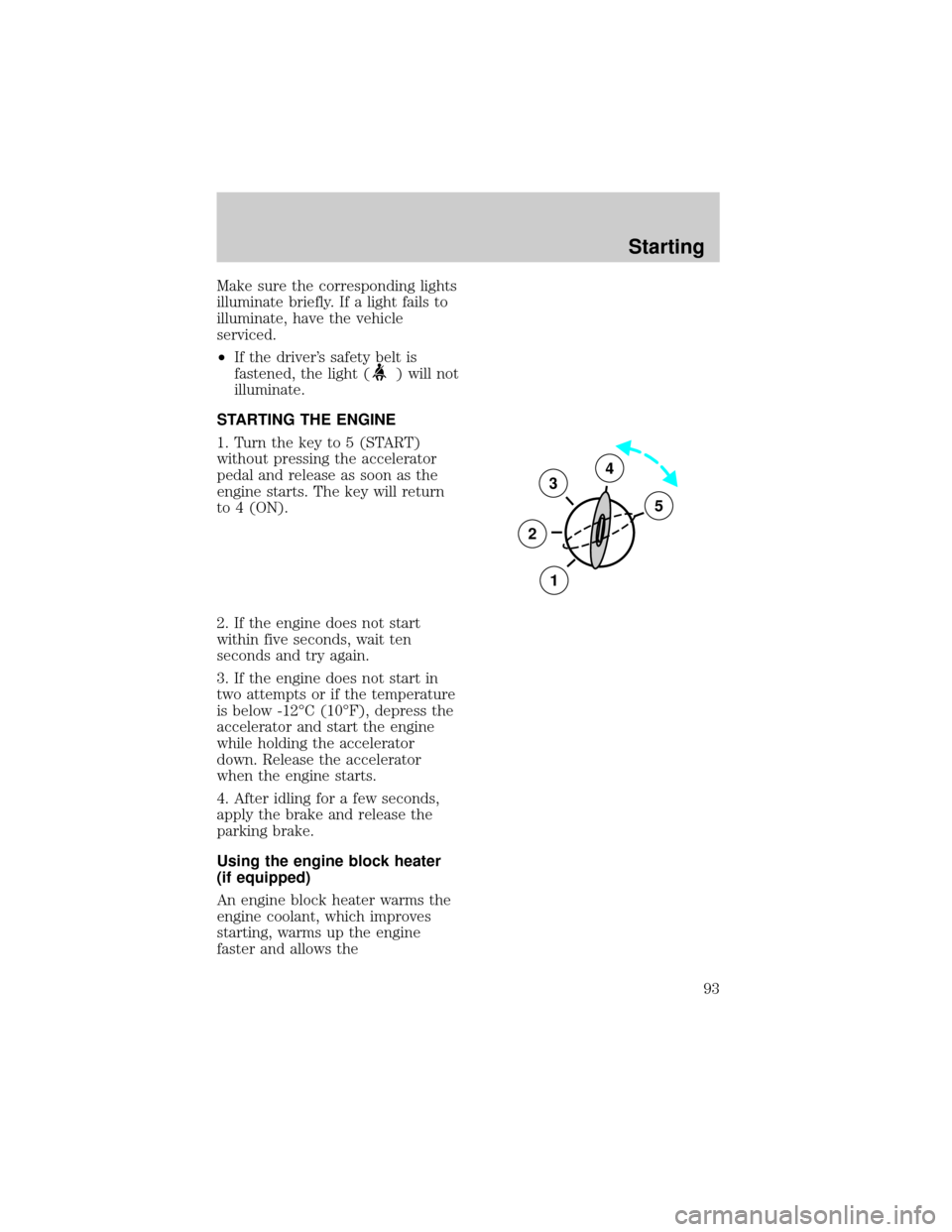
1. Turn the key to 5 (START)
without pressing the accelerator
pedal and release as soon as the
engine starts. The key will return
to 4 (ON).
2. If the engine does not start
within five seconds, wait ten
seconds and try again.
3. If the engine does not start in
two attempts or if the temperature
is below -12ÉC (10ÉF), depress the
accelerator and start the engine
while holding the accelerator
down. Release the accelerator
when the engine starts.
4. After idling for a few seconds,
apply the brake and release the
parking brake.
Using the engine block heater
(if equipped)
An engine block heater warms the
engine coolant, which improves
starting, warms up the engine
faster and allows the
3
2
1
5
4
Starting
93
Page 95 of 188

BRAKES
Your brakes are self-adjusting.
Refer to the ªService Guideº for
scheduled maintenance.
Occasional brake noise is normal
and often does not indicate a
performance concern with the
vehicle's brake system. In normal
operation, automotive brake
systems may emit occasional or
intermittent squeal or groan noises
when the brakes are applied. Such
noises are usually heard during the
first few brake applications in the
morning; however, they may be
heard at any time while braking
and can be aggravated by
environmental conditions such as
cold, heat, moisture, road dust, salt
or mud. If a ªmetal-to-metal,º
ªcontinuous grindingº or
ªcontinuous squealº sound is
present while braking, the brake
linings may be worn-out and
should be inspected by a qualified
service technician.
Anti-lock brake system (ABS)
On vehicles equipped with an
anti-lock braking system (ABS), a
noise from the hydraulic pump
motor and pulsation in the pedal
may be observed during ABS
braking events. Pedal pulsation
coupled with noise while braking
under panic conditions or on loose
gravel, bumps, wet or snowy roads
is normal and indicates proper
functioning of the vehicle's
anti-lock brake system. If the
vehicle has continuous vibration or
Driving
96
Page 96 of 188
shudder while braking, felt mainly
in the steering wheel, the vehicle
most likely needs service.
The ABS operates by detecting the
onset of wheel lock up during
brake applications and
compensating for this tendency.
The front wheels are prevented
from locking even when the brakes
are firmly applied. The
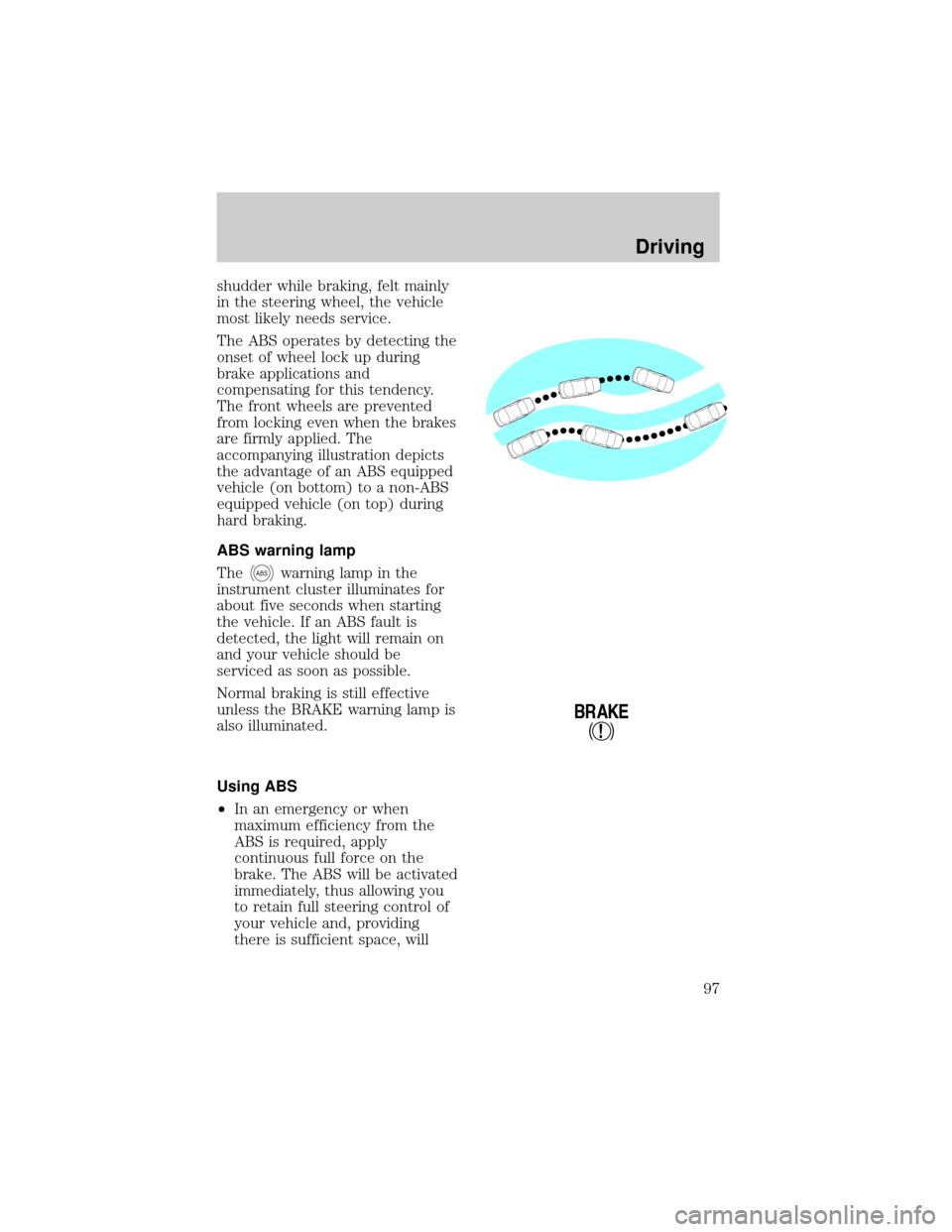
accompanying illustration depicts
the advantage of an ABS equipped
vehicle (on bottom) to a non-ABS
equipped vehicle (on top) during
hard braking.
ABS warning lamp
The
ABSwarning lamp in the
instrument cluster illuminates for
about five seconds when starting
the vehicle. If an ABS fault is
detected, the light will remain on
and your vehicle should be
serviced as soon as possible.
Normal braking is still effective
unless the BRAKE warning lamp is
also illuminated.
Using ABS
²In an emergency or when
maximum efficiency from the
ABS is required, apply
continuous full force on the
brake. The ABS will be activated
immediately, thus allowing you
to retain full steering control of
your vehicle and, providing
there is sufficient space, will
!
BRAKE
Driving
97
Page 98 of 188
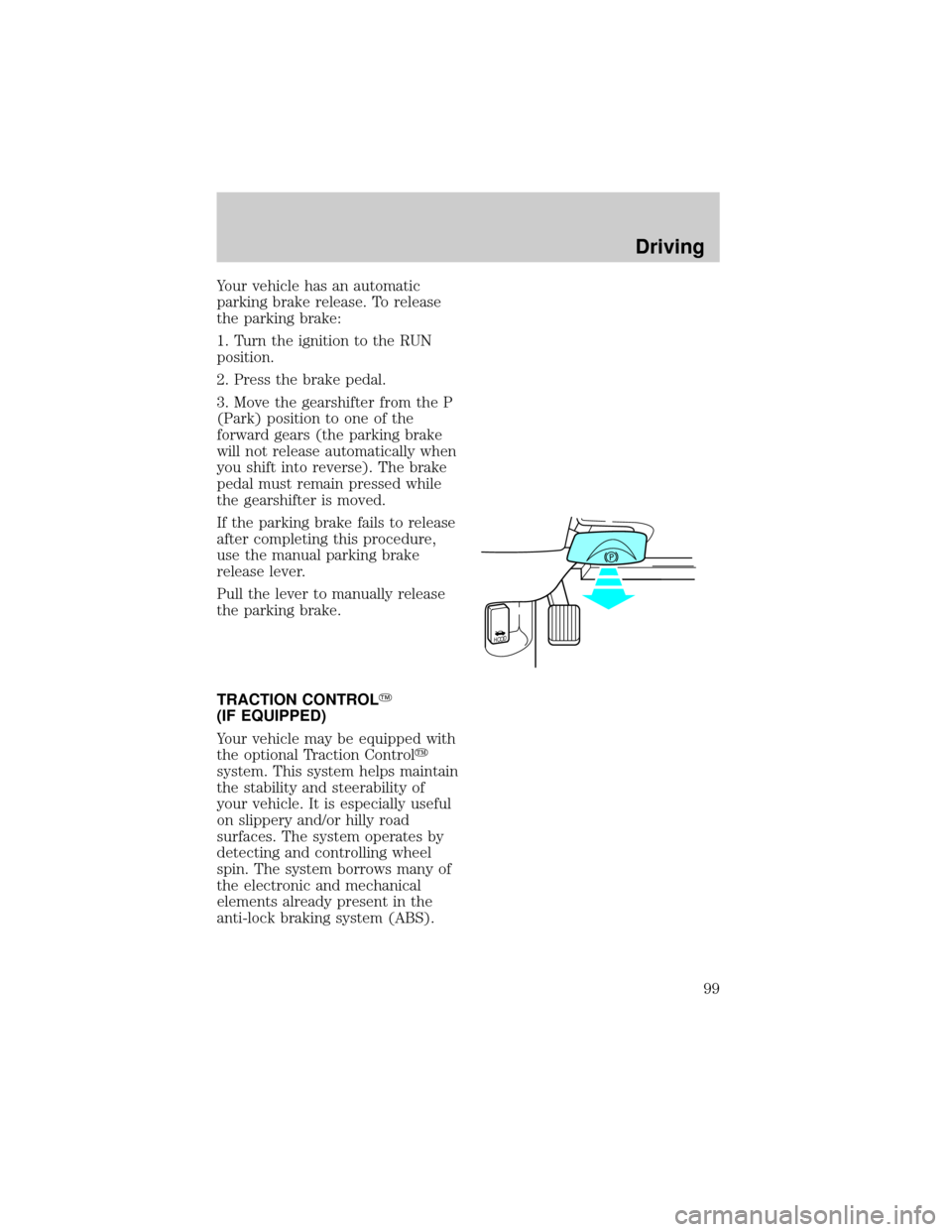
Your vehicle has an automatic
parking brake release. To release
the parking brake:
1. Turn the ignition to the RUN
position.
2. Press the brake pedal.
3. Move the gearshifter from the P
(Park) position to one of the
forward gears (the parking brake
will not release automatically when
you shift into reverse). The brake
pedal must remain pressed while
the gearshifter is moved.
If the parking brake fails to release
after completing this procedure,
use the manual parking brake
release lever.
Pull the lever to manually release
the parking brake.
TRACTION CONTROLY
(IF EQUIPPED)
Your vehicle may be equipped with
the optional Traction Controly
system. This system helps maintain
the stability and steerability of
your vehicle. It is especially useful
on slippery and/or hilly road
surfaces. The system operates by
detecting and controlling wheel
spin. The system borrows many of
the electronic and mechanical
elements already present in the
anti-lock braking system (ABS).
HOOD
Driving
99
Page 100 of 188

portion of the system will shut
down to prevent the rear brakes
from overheating. A limited
Traction Controlyfunction using
only engine torque reduction will
still control wheels from
over-spinning. When the rear
brakes have cooled down, the
system will again function
normally. Anti-lock braking is not
affected by this condition and will
function normally during the cool
down period.
If the engine coolant temperature
is below þ23ÉC (þ10ÉF) the engine
torque reduction portion of the
Traction Controlysystem isNOT
active. The system will operate
normally when the engine coolant
warms up.
Traction control switch
The traction control switch is
located on the left side of the
glove compartment. The traction
control system defaults to ON
when the ignition key is turned
from OFF to RUN.
The traction control must be
turned off if you are using a
mini-spare tire in a rear wheel
position.
STEERING
Your vehicle is equipped with
power steering. Power steering
uses energy from the engine to
help steer the vehicle.
Never hold the steering wheel to
the extreme right or the extreme
Driving
101
Page 102 of 188
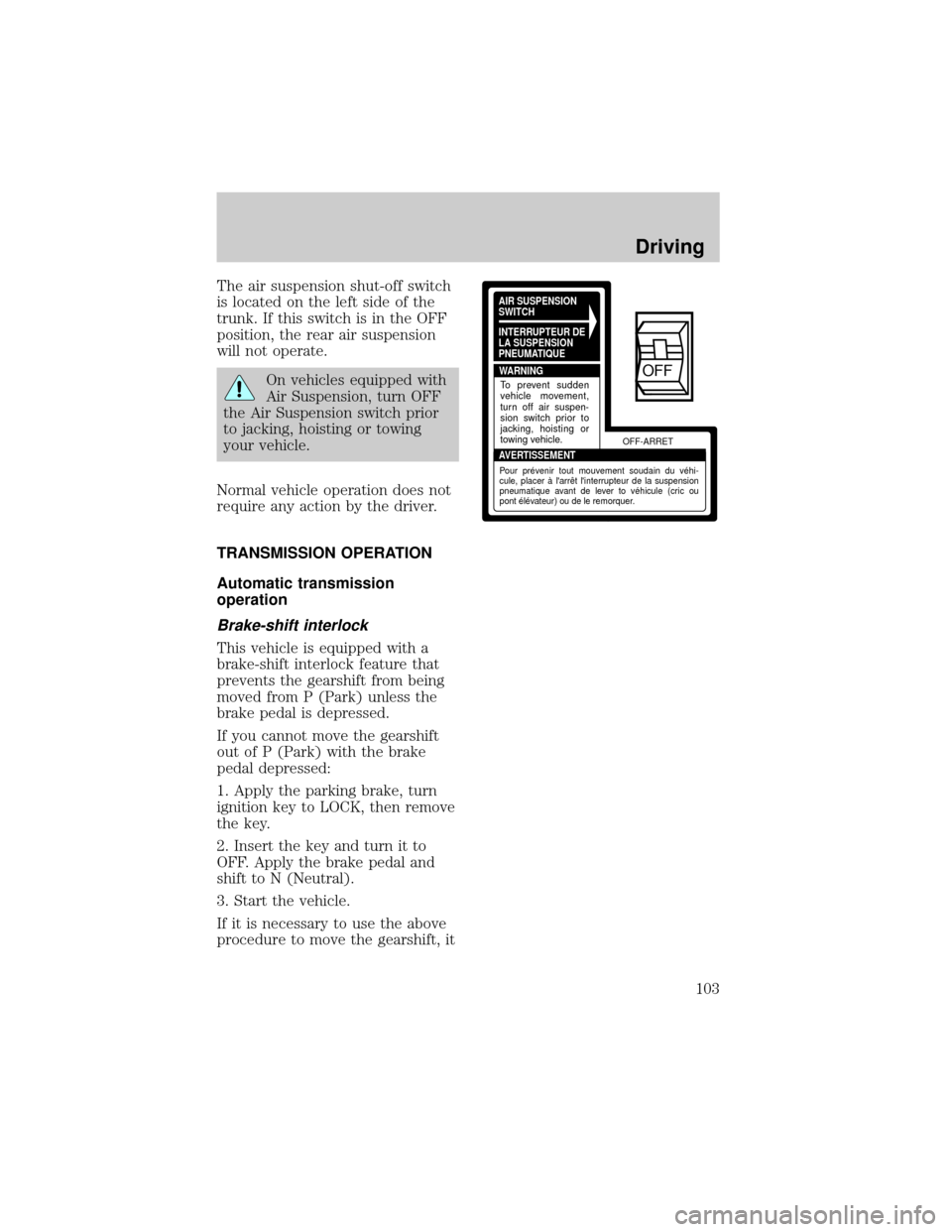
The air suspension shut-off switch
is located on the left side of the
trunk. If this switch is in the OFF
position, the rear air suspension
will not operate.
On vehicles equipped with
Air Suspension, turn OFF
the Air Suspension switch prior
to jacking, hoisting or towing
your vehicle.
Normal vehicle operation does not
require any action by the driver.
TRANSMISSION OPERATION
Automatic transmission
operation
Brake-shift interlock
This vehicle is equipped with a
brake-shift interlock feature that
prevents the gearshift from being
moved from P (Park) unless the
brake pedal is depressed.
If you cannot move the gearshift
out of P (Park) with the brake
pedal depressed:
1. Apply the parking brake, turn
ignition key to LOCK, then remove
the key.
2. Insert the key and turn it to
OFF. Apply the brake pedal and
shift to N (Neutral).
3. Start the vehicle.
If it is necessary to use the above
procedure to move the gearshift, it
AIR SUSPENSION
SWITCH
INTERRUPTEUR DE
LA SUSPENSION
PNEUMATIQUE
WARNING
AVERTISSEMENTOFF-ARRET
To prevent sudden
vehicle movement,
turn off air suspen-
sion switch prior to
jacking, hoisting or
towing vehicle.
Pour prévenir tout mouvement soudain du véhi-
cule, placer à l'arrêt l'interrupteur de la suspension
pneumatique avant de lever to véhicule (cric ou
pont élévateur) ou de le remorquer.
OFF
Driving
103
Page 117 of 188

The fuses are coded as follows.
Fuse/Relay
LocationFuse Amp
RatingDescription
1 10A Lighting Control Module (LCM)
2 30A EATC Blower Motor
3 10A Lighting Control Module (LCM)
4 7.5A Instrument Cluster
5 7.5A Lighting Control Module (LCM)
6 15A EATC, Heated Seats
7 15A Lighting Control Module (LCM),
Day/Night Sensor/Amplifier
8 10A Shift Lock, Speed Control, Air
Suspension, Steering Wheel Rotation
Sensor
9 20A Lighting Control Module (LCM),
Multi-Function Switch
10 20A Brake Pedal Position (BPP) Switch,
Brake Pressure Switch
11 10A Electronic Crash Sensor
12 15A Instrument Cluster, Anti-Theft, Ignition
Switch
13 10A Anti-Lock Brake Module, Traction
Control Switch
14 7.5A Transmission Control Switch, Lighting
Control Module (LCM)
15 20A Multi-Function Switch
16 30A Wiper Control Module (WCM),
Windshield Wiper Motor
17 10A Digital Transmission Range (DTR)
Sensor
18 7.5A Lighting Control Module (LCM), Front
Radio Control Unit, Cellular Telephone
Transceiver, Electronic Day/Night Mirror,
Compass Module
Roadside emergencies
118
Page 118 of 188

Fuse/Relay
LocationFuse Amp
RatingDescription
19 10A EATC, Clock, Instrument Cluster, PCM
20 7.5A Lighting Control Module (LCM), ABS,
Shift Lock
21 20A Multi-Function Switch
22 20A Multi-Function Switch, High Mounted
Stop Lamps
23 20A Datalink Connector, I/P Cigar Lighter
24 5A Front Radio Control Unit
25 15A Lighting Control Module (LCM)
26 5A Digital Transmission Range (DTR)
Sensor
27 20A Fuel Filler Door Release Switch
28 10A Heated Mirrors
29 20A LF Door Module
30 7.5A LF Seat Module, Trunk Lid Release
Switch, Door Lock Switches, LF Seat
Control Switch, LF Door Module, Power
Mirror Switch
31 7.5A Main Light Switch, Lighting Control
Module (LCM)
32 15A Not Used
33 15A Front Radio Control Unit, Digital
Compact Disk Changer, Cellular
Telephone Transceiver
Relay 1 - Accessory Delay Relay
Roadside emergencies
119
Page 120 of 188

The high-current fuses are coded
as follows.
Fuse/Relay
LocationFuse Amp
RatingDescription
1 50A** Ignition Switch
2 40A** Ignition Switch
3 50A** Cooling Fan
4 30A** PCM Power Relay
5 40A** I/P Fuse Panel, Fuses 10, 19, 21, 23, 25,
27, 32
6 30A** Starting System
7 50A** I/P Fuse Panel, Fuses 1, 3, 5, 7, 9, 31
8 30A** Power Seats, I/P Fuse Panel, Fuse 30
9 50A** Anti-Lock Brakes
10 40A** Rear Defrost
11 40A** Accessory Delay Relay, I/P Fuse Panel,
Fuse 29
12 30A** Air Suspension
13 15A* Charging System
14 20A* Fuel Pump
15 10A* Air Bags
16 30A* Heated Seats
17 10A* Air Suspension
18 15A* Horn
19 30A* Subwoofer, I/P Fuse Panel, Fuse 23
20 15A* Fuel Injectors
21 15A* Heated Oxygen Sensors
22 Ð Not Used
23 Ð Not Used
24 20A* Auxiliary Power Outlet
25 30A** Power Lumbar, Power Seats
26 30A CB Cooling Fan
27 Ð Not Used
Roadside emergencies
121