parking LOTUS ELISE 2005 User Guide
[x] Cancel search | Manufacturer: LOTUS, Model Year: 2005, Model line: ELISE, Model: LOTUS ELISE 2005Pages: 205, PDF Size: 4.51 MB
Page 96 of 205
NOTICE: The Elise is not equipped with conventional separate shock absorbing bumpers, so extra care should be taken when parking to guard against body damage. The Lotus Elise does
not offer the same kind and degree of impact resistance or
energy absorption afforded by conventional U.S. bumper sys
-
tems. Care is also required, due to the low ground clearance, to guard against car underside damage caused by ramps, kerbs
and road humps.
Paint Care The acr ylic enamel finish of the Lotus Elise is extremely
resistant to all normal forms of atmospheric attack. Following
the simple maintenance procedure summarised below will help retain the gloss, colour and protective properties of the paint
throughout the life of the car. However, car finishes are not im
-
mune to damage and amongst the more common causes of deterioration are:
- Atmospheric contaminants; dust, soot, ash, and acidic or
alkaline aerosol mist can chemically attack paint.
- Abrasion; blowing sand and dust, or a dirty washing cloth.
- Tree sap and insect fluids; can form a water-insoluble polymer
that adheres to the paint.
- Bird excrement; highly acidic or alkaline, they can chemically etch the paint. Wash off immediately.
- Leaves; contain tannic acid which can stain light finishes.
- Impact damage; granite chippings thrown up from poor or recently dressed road surfaces can subject the body to severe
localised impact, and result in paint chips, especially around
the vulnerable frontal panels. Do not follow other cars too closely in such circumstances. For optimum paintwork pro
-
tection, Lotus recommends the use of a self adhesive film kit
which your dealer will be pleased to supply and/or fit.
- Moisture entrapment; Long term use of a non-breathable car cover can trap moisture and/or induce condensation and promote water penetration of the paint film.
Ventilation Water lying on the paint surface for a lengthy period will even
-
tually penetrate the paint film. Although the effects will not be
visible immediately, a deterioration in the protective properties
of the paint film will ultimately result.
Servicing & Maintenance
94
oh_croft_InD.indd 9420/05/2004 07:59:03ProCarManuals.com
Page 116 of 205
Auxiliary Drive BeltA single, multi-rib type auxiliary belt is used to transmit drive
from the crankshaft to the alternator, water pump, and (if fitted)
air conditioning compressor. The belt is automatically tensioned,
and requires no periodic maintenance other than a visual check of its condition. If the belt exhibits any evidence of physical dam
-
age, cracking, fraying, perishing, abrasion or contamination, it
should be renewed. In the case of contamination, the cause
must be identified and rectified, and each of the pulleys must be thoroughly degreased before the new belt is fitted. It is recommended that auxiliary belt replacement be en
-
trusted to your Lotus dealer.
Sparking Plugs The Elise uses a direct ignition system with an individual
high tension coil mounted atop each of the four spark plugs and protected by a plastic cover, screw fixed to the engine.
WARNING: The voltages produced with this ignition system can
cause serious and potentially fatal injur y. Never touch
any ignition components when the engine is running or being cranked.
The spark plugs should be renewed in accordance with the
Maintenance Schedule, with the gaps set to 0.043 in. (1.1 mm).
This operation should be entrusted to your Lotus dealer.
Servicing & Maintenance
114
oh_croft_InD.indd 11420/05/2004 07:59:09ProCarManuals.com
Page 118 of 205
NOTICE:
• On cars used on a race track or in a competitive manner,
special vigilance is required due to the severity of tire operating conditions, with careful inspections carried
out between sessions.
• Take care when parking to avoid tire contact with high
or sharp edged kerbs. Such mistreatment can cause
internal damage to the tire structure and this may not be readily apparent. The wheel rims may also be distorted or damaged by careless parking, and result in wheel
imbalance or loss of tire pressure. Similar damage may also be caused by potholes, rocks or other highway
debris.
WARNING:
• Damage to wheels and tires may cause an accident in which you or others may be killed or seriously
injured. If the wheels or tires have been damaged,
have them replaced.
• Safety considerations should always be paramount when assessing tire condition and serviceability, and the tires replaced if any doubt exists, or if the
legal tread depth limits are approached.
• Poorly maintained and improperly used tires are dangerous.
• Overloading your tires can cause overheating as a result of too much friction. You could have a blow
out and a serious accident in which you could be killed or seriously injured. See ‘Tire Placard La
-
bel’.
• Underinflated tires pose the same danger as over loaded tires. The resulting accident could cause serious injury, or death. Check all tires frequently
and maintain at the recommended pressure. Tire
pressures should be checked only when the tires
are cold.
• Overinflated tires are more likely to be cut, punc- tured or broken by a sudden impact - such as hitting a pothole. Keep tires at the recommended pressure.
• Installing improper tires on your car can affect handling and stability. This can cause a crash
in which you can be killed or seriously injured.
Tires & Wheels
116
oh_croft_InD.indd 11620/05/2004 07:59:09ProCarManuals.com
Page 132 of 205
If the battery is to be disconnected, the following precautions
should be taken: i) Ensure that all electrical loads (e.g. lights) are switched off. If
the car is fitted with security coded audio equipment, check
that the code is available for entering after battery reconnec
-
tion.
ii) Wait for at least ten seconds after switching off the ig-
nition to allow the engine management system to adjust the
setting of some components ready for re-starting.
iii) Ensure the alarm is disarmed. If the battery is disconnected
when armed, the alarm will be triggered.
iv) Disconnect the
negative (earth; black; ‘-’) battery cable first,
and re-connect last.
WARNING:
If the battery positive terminal is inadvertently earthed
(e.g. when using a spanner) whilst the negative terminal
is still connected, the resultant short circuit with heavy sparking and current flow could cause serious burns.
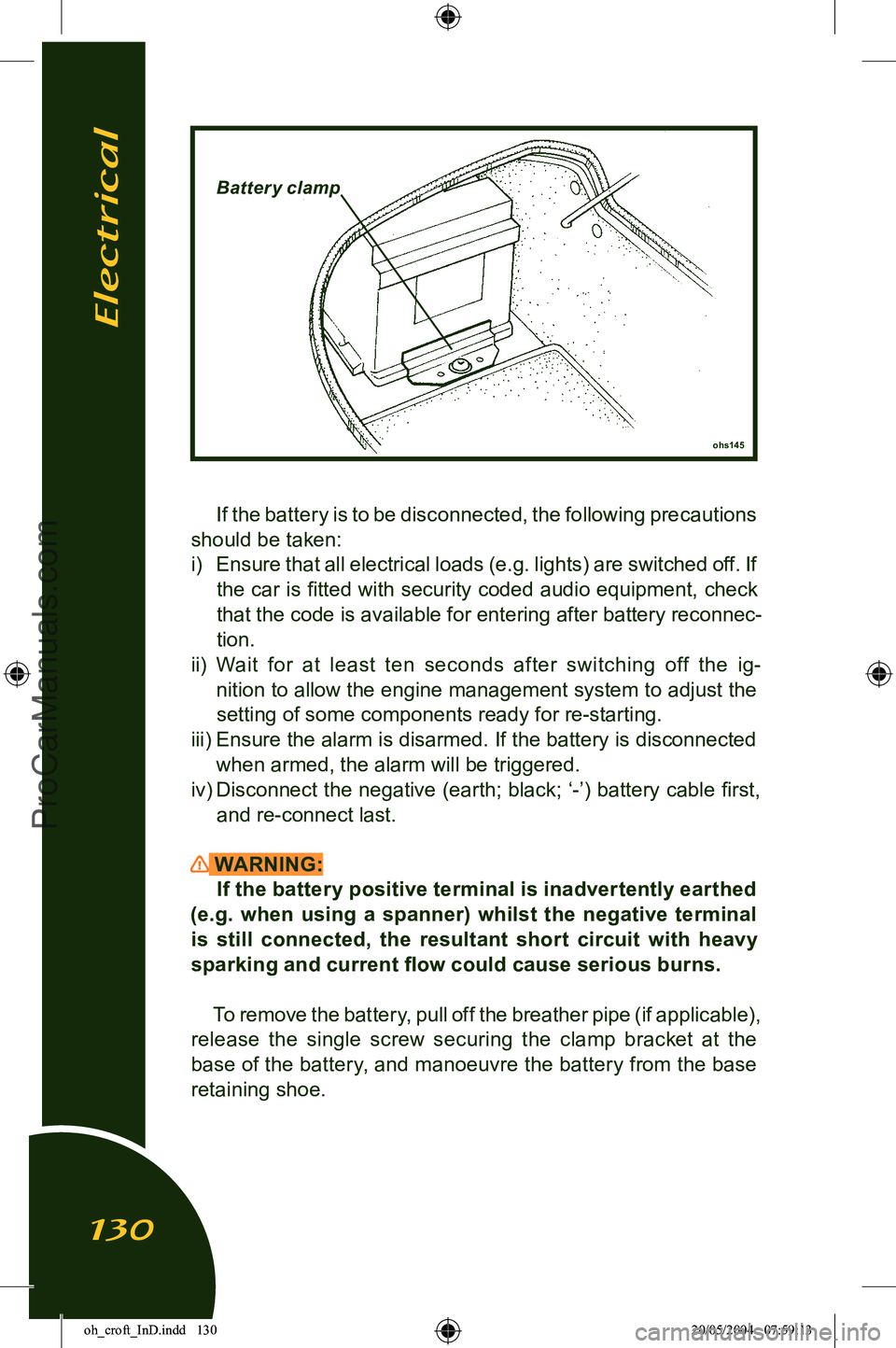
To remove the battery, pull off the breather pipe (if applicable),
release the single screw securing the clamp bracket at the
base of the battery, and manoeuvre the battery from the base
retaining shoe.
ohs145
Batter y clamp
Electrical
130
oh_croft_InD.indd 13020/05/2004 07:59:13ProCarManuals.com
Page 138 of 205
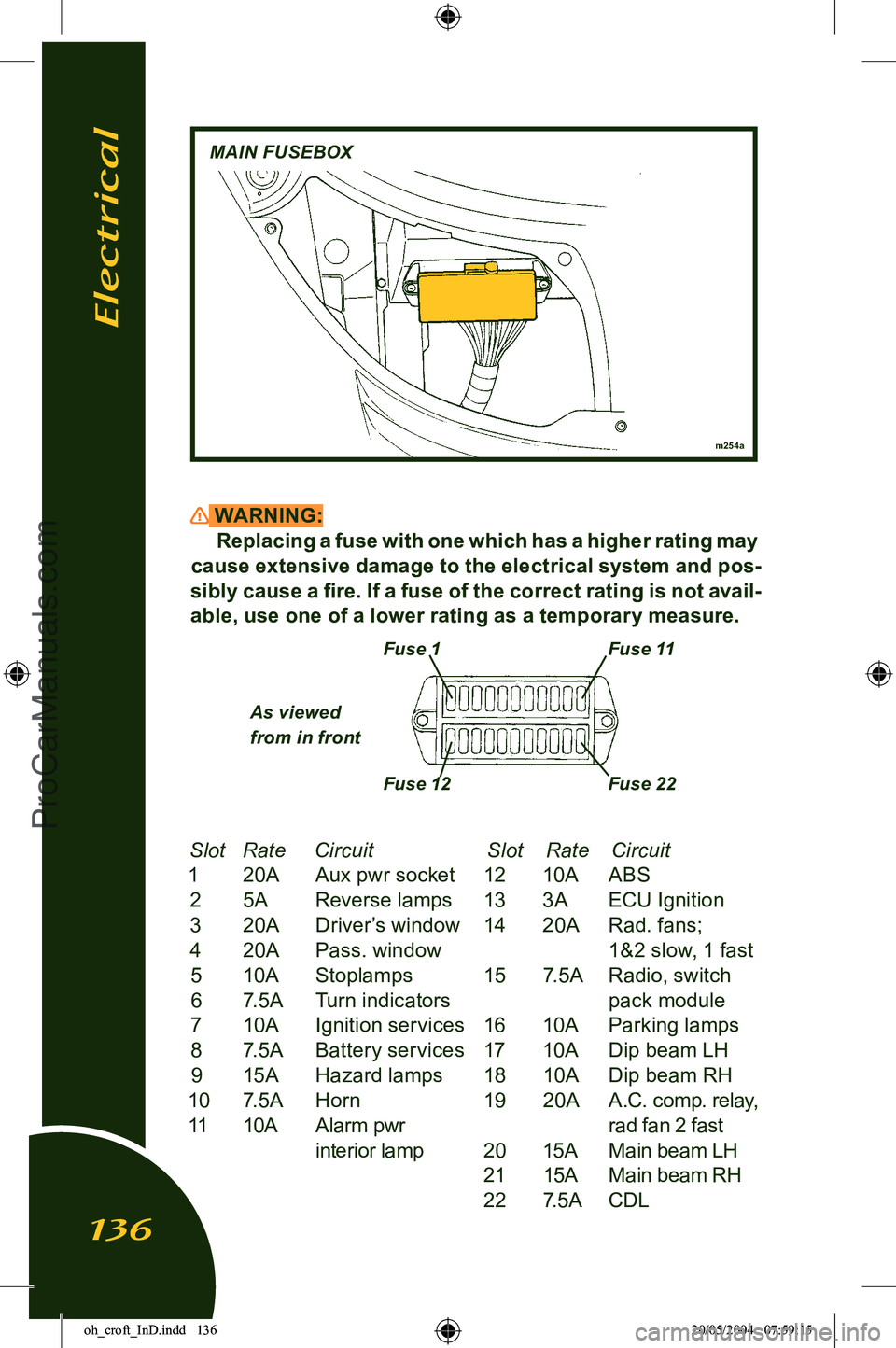
WARNING:Replacing a fuse with one which has a higher rating may
cause extensive damage to the electrical system and pos
-
sibly cause a fire. If a fuse of the correct rating is not avail
-
able, use one of a lower rating as a temporary measure.
Slot
Rate Circuit Slot Rate Circuit
1 20A Aux pwr socket 12 10A ABS 2 5A Reverse lamps 13 3A ECU Ignition
3 20A Driver’s window 14 20A Rad. fans;
4 20A Pass. window 1&2 slow, 1 fast 5 10A Stoplamps 15 7.5A Radio, switch6 7.5A Turn indicators pack module
7 10A Ignition services 16 10A Parking lamps
8 7.5A Battery services 17 10A Dip beam LH9 15A Hazard lamps 18 10A Dip beam RH
10 7.5A Horn 19 20A A.C. comp. relay,
11 10A Alarm pwr rad fan 2 fast interior lamp 20 15A Main beam LH
21 15A Main beam RH
22 7.5A CDL
m254a
MAIN FUSEBOX
Fuse 1Fuse 11
Fuse 12 Fuse 22
As viewed
from in front
Electrical
136
oh_croft_InD.indd 13620/05/2004 07:59:15ProCarManuals.com
Page 144 of 205
BULB REPLACEMENT
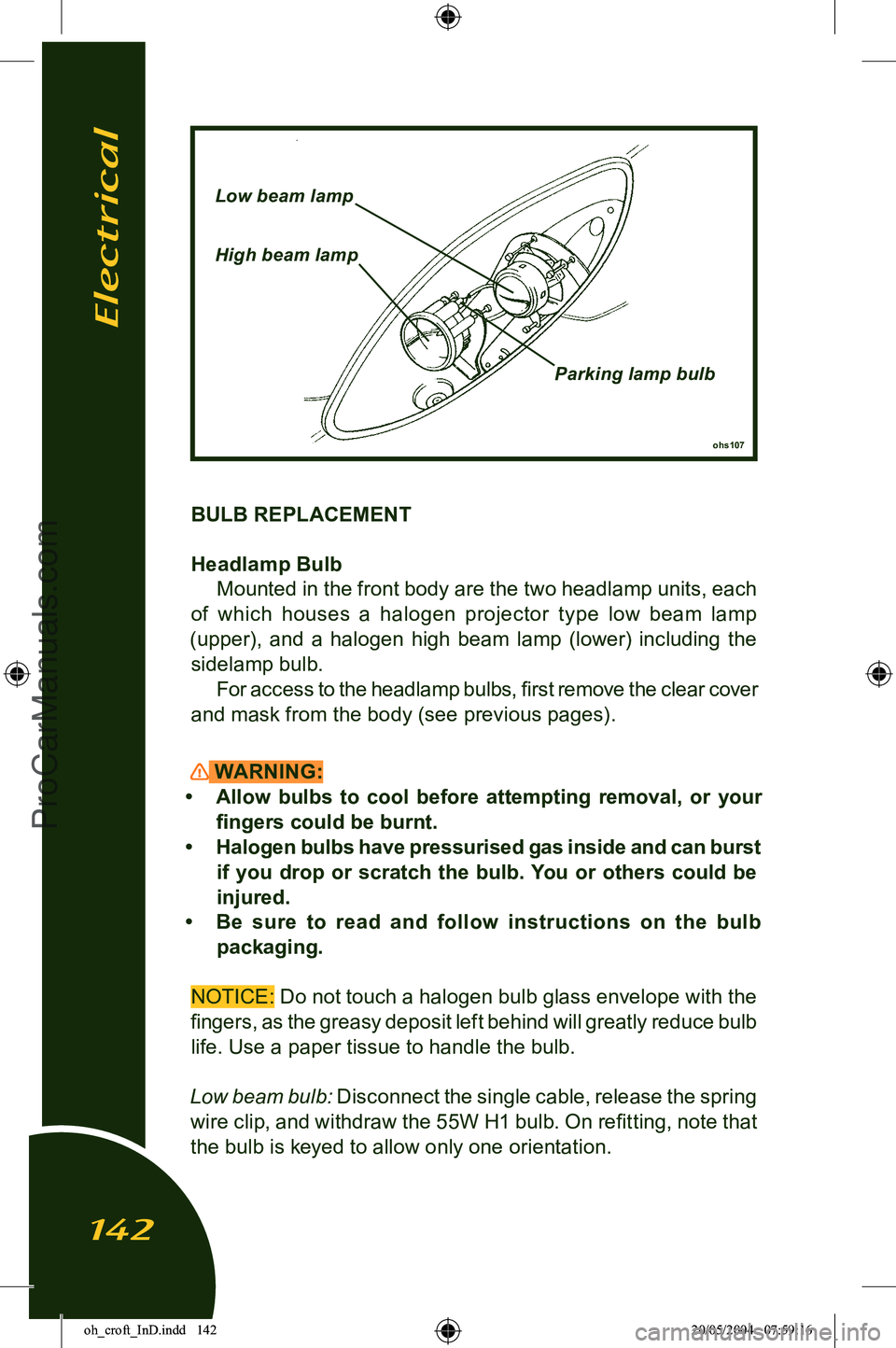
Headlamp BulbMounted in the front body are the two headlamp units, each
of which houses a halogen projector type low beam lamp
(upper), and a halogen high beam lamp (lower) including the sidelamp bulb. For access to the headlamp bulbs, first remove the clear cover
and mask from the body (see previous pages).
WARNING:
• Allow bulbs to cool before attempting removal, or your fingers could be burnt.
• Halogen bulbs have pressurised gas inside and can burst if you drop or scratch the bulb. You or others could be
injured.
• Be sure to read and follow instructions on the bulb
packaging.
NOTICE: Do not touch a halogen bulb glass envelope with the
fingers, as the greasy deposit left behind will greatly reduce bulb life. Use a paper tissue to handle the bulb.
Low beam bulb: Disconnect the single cable, release the spring wire clip, and withdraw the 55W H1 bulb. On refitting, note that the bulb is keyed to allow only one orientation.
ohs107
Low beam lamp
High beam lamp
Parking lamp bulb
Electrical
142
oh_croft_InD.indd 14220/05/2004 07:59:16ProCarManuals.com
Page 145 of 205
High beam bulb: Disconnect the two cables from the bulb, re-
lease the spring wire clip, and withdraw the 55W H7 bulb. On re
-
fitting, note that the bulb is keyed to allow only one orientation.
Parking lamp: Twist the bulb holder counterclockwise to release
from the main beam lamp, and withdraw the bayonet fitting T4
W bulb.
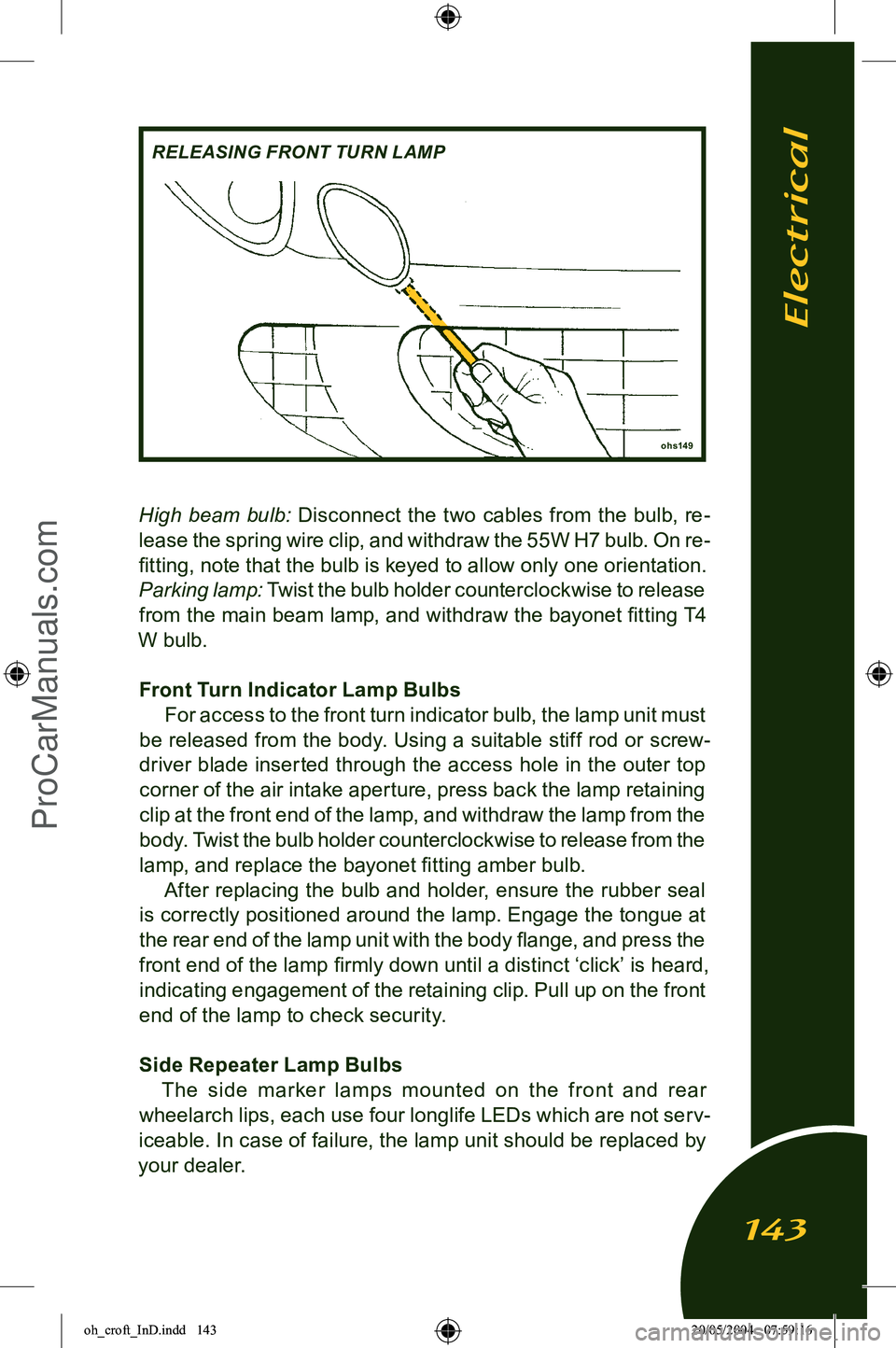
Front Turn Indicator Lamp Bulbs For access to the front turn indicator bulb, the lamp unit must
be released from the body. Using a suitable stiff rod or screw
-
driver blade inserted through the access hole in the outer top
corner of the air intake aperture, press back the lamp retaining
clip at the front end of the lamp, and withdraw the lamp from the body. Twist the bulb holder counterclockwise to release from the
lamp, and replace the bayonet fitting amber bulb. After replacing the bulb and holder, ensure the rubber seal
is correctly positioned around the lamp. Engage the tongue at
the rear end of the lamp unit with the body flange, and press the
front end of the lamp firmly down until a distinct ‘click’ is heard, indicating engagement of the retaining clip. Pull up on the front
end of the lamp to check security.
Side Repeater Lamp Bulbs The side mar ker lamps mounted on the front and rear
wheelarch lips, each use four longlife LEDs which are not serv
-
iceable. In case of failure, the lamp unit should be replaced by
your dealer.
ohs149
RELEASING FRONT TURN LAMP
Electrical
143
oh_croft_InD.indd 14320/05/2004 07:59:16ProCarManuals.com
Page 148 of 205
LIFTING AND TOWING
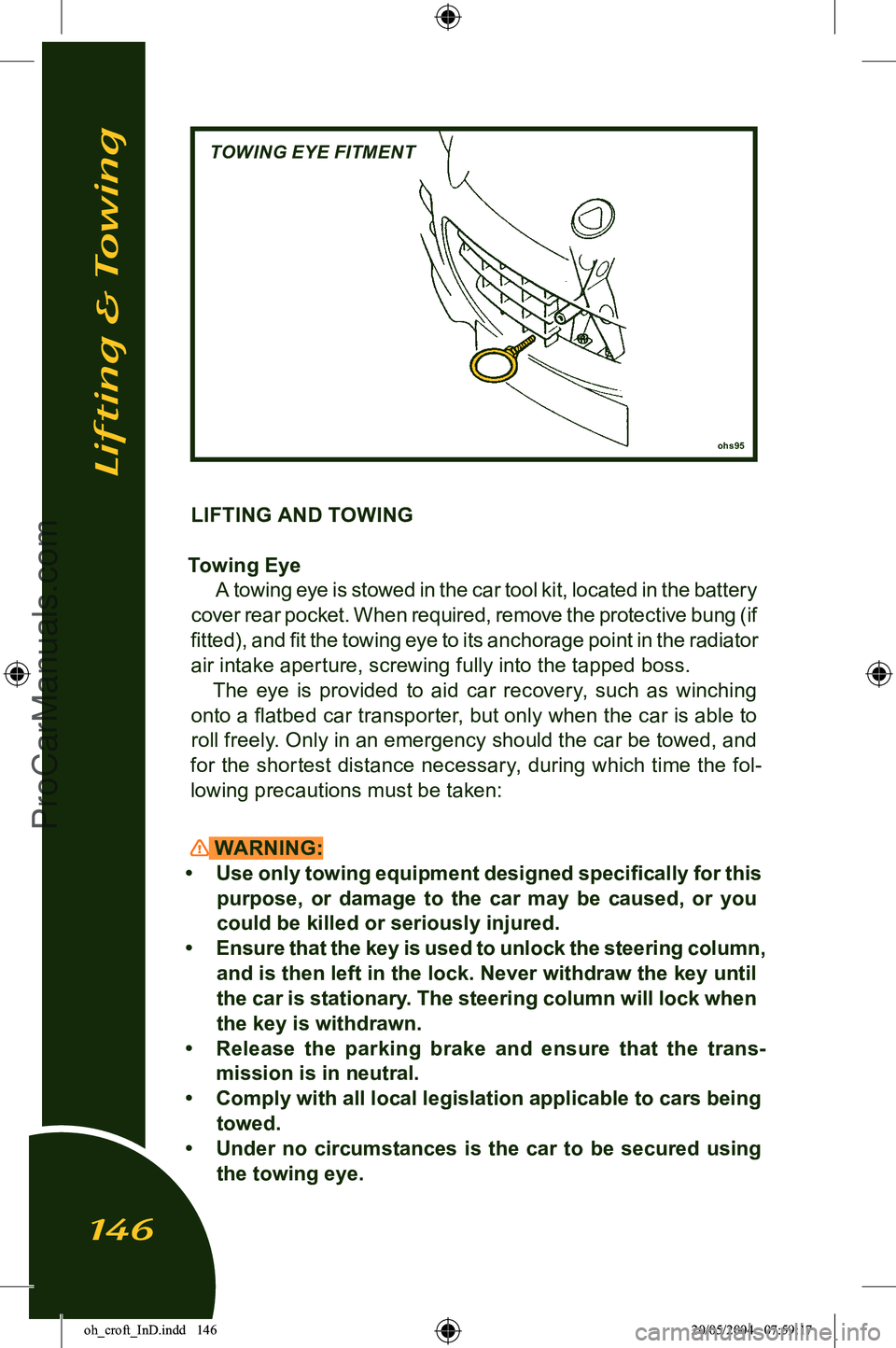
Towing Eye A towing eye is stowed in the car tool kit, located in the battery
cover rear pocket. When required, remove the protective bung (if
fitted), and fit the towing eye to its anchorage point in the radiator air intake aperture, screwing fully into the tapped boss.
The eye is provided to aid car recovery, such as winching
onto a flatbed car transporter, but only when the car is able to roll freely. Only in an emergency should the car be towed, and
for the shortest distance necessary, during which time the fol
-
lowing precautions must be taken:
WARNING:
• Use only towing equipment designed specifically for this purpose, or damage to the car may be caused, or you
could be killed or seriously injured.
• Ensure that the key is used to unlock the steering column, and is then left in the lock. Never withdraw the key until
the car is stationary. The steering column will lock when
the key is withdrawn.
• Release the parking brake and ensure that the trans
-
mission is in neutral.
• Comply with all local legislation applicable to cars being
towed.
• Under no circumstances is the car to be secured using
the towing eye.
ohs95
TOWING EYE FITMENT
Lifting & Towing
146
oh_croft_InD.indd 14620/05/2004 07:59:17ProCarManuals.com
Page 150 of 205
Lifting Your Car
WARNING:
• Using a lifting jack can be dangerous. If the car falls off the jack, you or others could be seriously injured or killed.
NEVER get under a car when it is supported only by a
jack.
• Before raising the car with a jack: - Turn off the engine;
- Firmly apply the parking brake;
- Engage first or reverse gear;
- Securely chock all wheels not to be lifted.
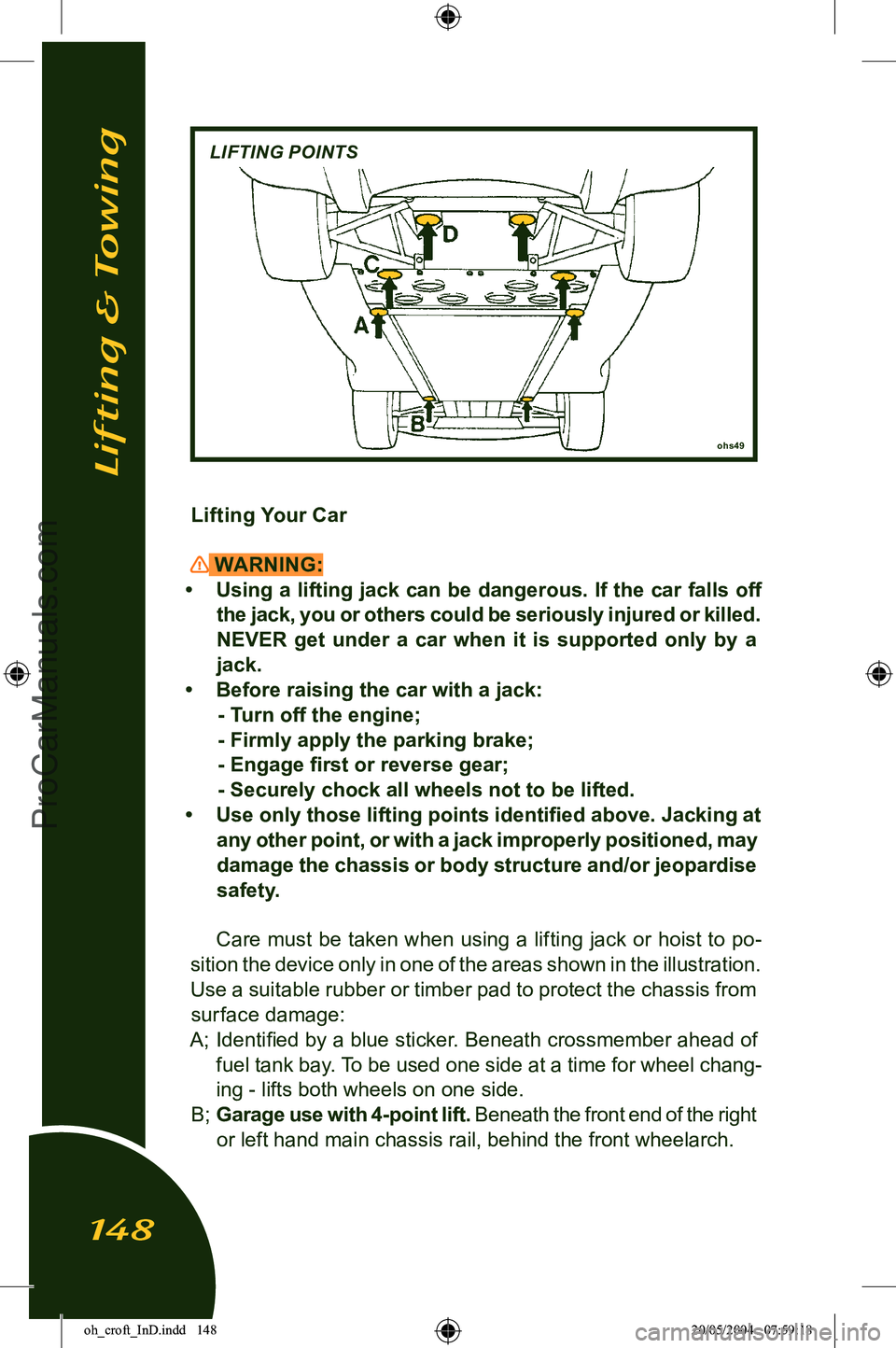
• Use only those lifting points identified above. Jacking at any other point, or with a jack improperly positioned, may
damage the chassis or body structure and/or jeopardise safety.
Care must be taken when using a lifting jack or hoist to po
-
sition the device only in one of the areas shown in the illustration.
Use a suitable rubber or timber pad to protect the chassis from
surface damage:
A; Identified by a blue sticker. Beneath crossmember ahead of fuel tank bay. To be used one side at a time for wheel chang
-
ing - lifts both wheels on one side.
B; Garage use with 4-point lift. Beneath the front end of the right
or left hand main chassis rail, behind the front wheelarch.
ohs49
LIFTING POINTS
Lifting & Towing
148
oh_croft_InD.indd 14820/05/2004 07:59:18ProCarManuals.com
Page 154 of 205
Storing Your EliseIf you intend to store your Elise for a prolonged period, con
-
sult your Lotus dealer who will be pleased to advise you. We recommend that the car is stored inside a secure garage. The
following guidelines are provided for your information:
• Ensure the engine oil and filter, coolant and brake fluid have recently been renewed. The a.c. system should be in good
working order and fully charged.
• Thoroughly clean the inside and outside of the car, including the engine compartment. If necessary, use a ‘jet’ washer to remove dirt and salt deposits from the underside, but do not
use around bearings, hydraulic components, painted surfaces or the soft top roof. Allow to dry completely.
• Chock the road wheels, leave off the parking brake, and engage reverse gear.
• Increase the tire pressures to 60 psi (4 bar). If possible, move the car slightly every month to help avoid flat spots on the
Tires.
• Either leave the battery in the car and connect a battery management (conditioner) type of charger, or remove the battery and trickle charge every two months. Note that with
the battery disconnected or removed, the alarm system is
de-activated.
• Unless the garage is equipped with a de-humidifier, the use of drying agents (Silica-Gel) is recommended in cars with
leather upholstery and in conditions of high humidity.
• The use of unapproved car covers may have a detrimental effect on the car’s paint finish and such damage will not be
covered by your car’s warranty.
In general, the Elise will be kept in best operating condition
by regular use.
Accessories
152
oh_croft_InD.indd 15220/05/2004 07:59:19ProCarManuals.com