turn LOTUS ELISE 2005 Owner's Manual
[x] Cancel search | Manufacturer: LOTUS, Model Year: 2005, Model line: ELISE, Model: LOTUS ELISE 2005Pages: 205, PDF Size: 4.51 MB
Page 66 of 205
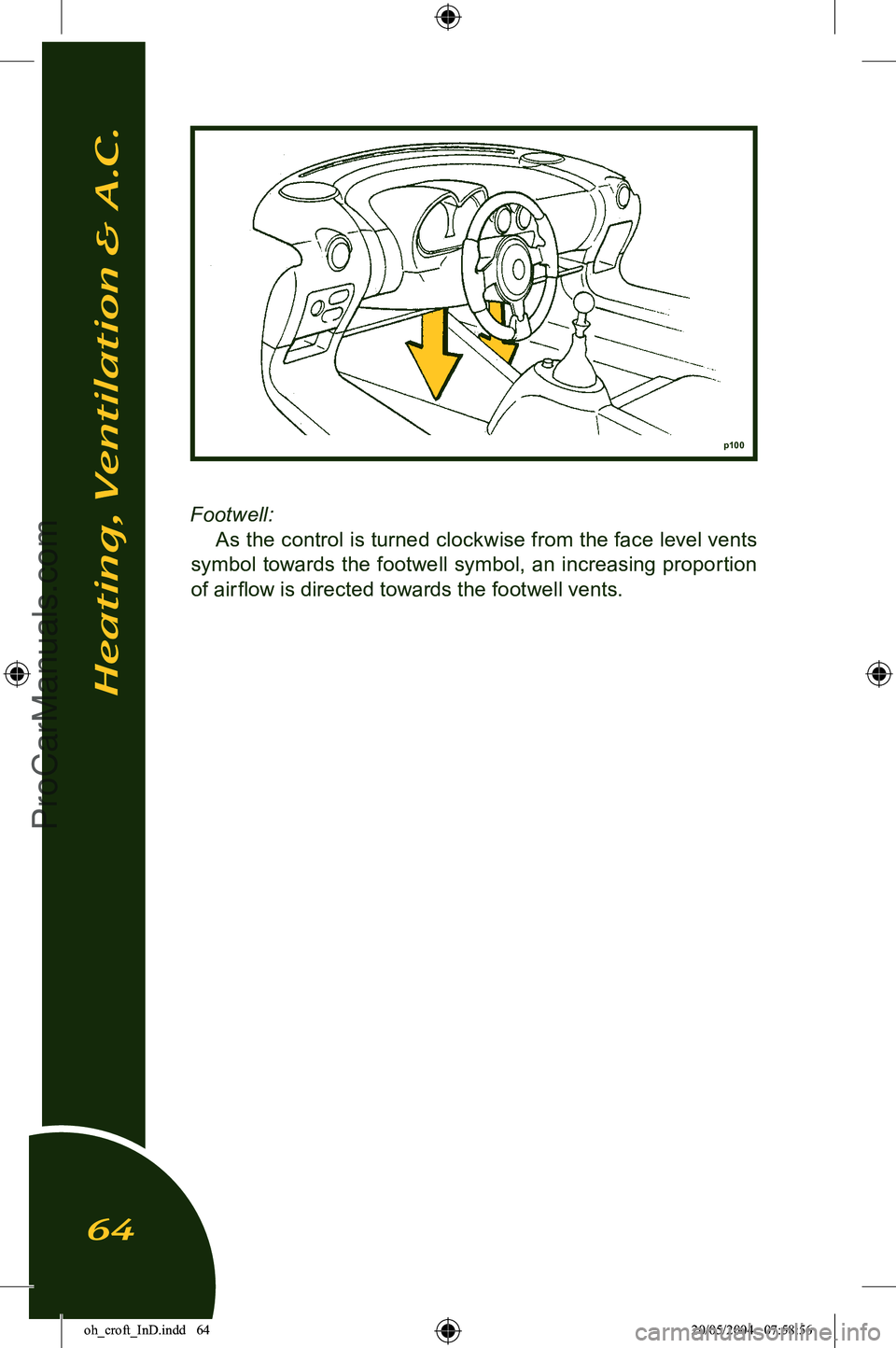
Footwell:
As the control is turned clockwise from the face level vents
symbol towards the footwell symbol, an increasing proportion
of air flow is directed towards the footwell vents.
p100
Heating, Ventilation & A.C.
64
oh_croft_InD.indd 6420/05/2004 07:58:56ProCarManuals.com
Page 67 of 205
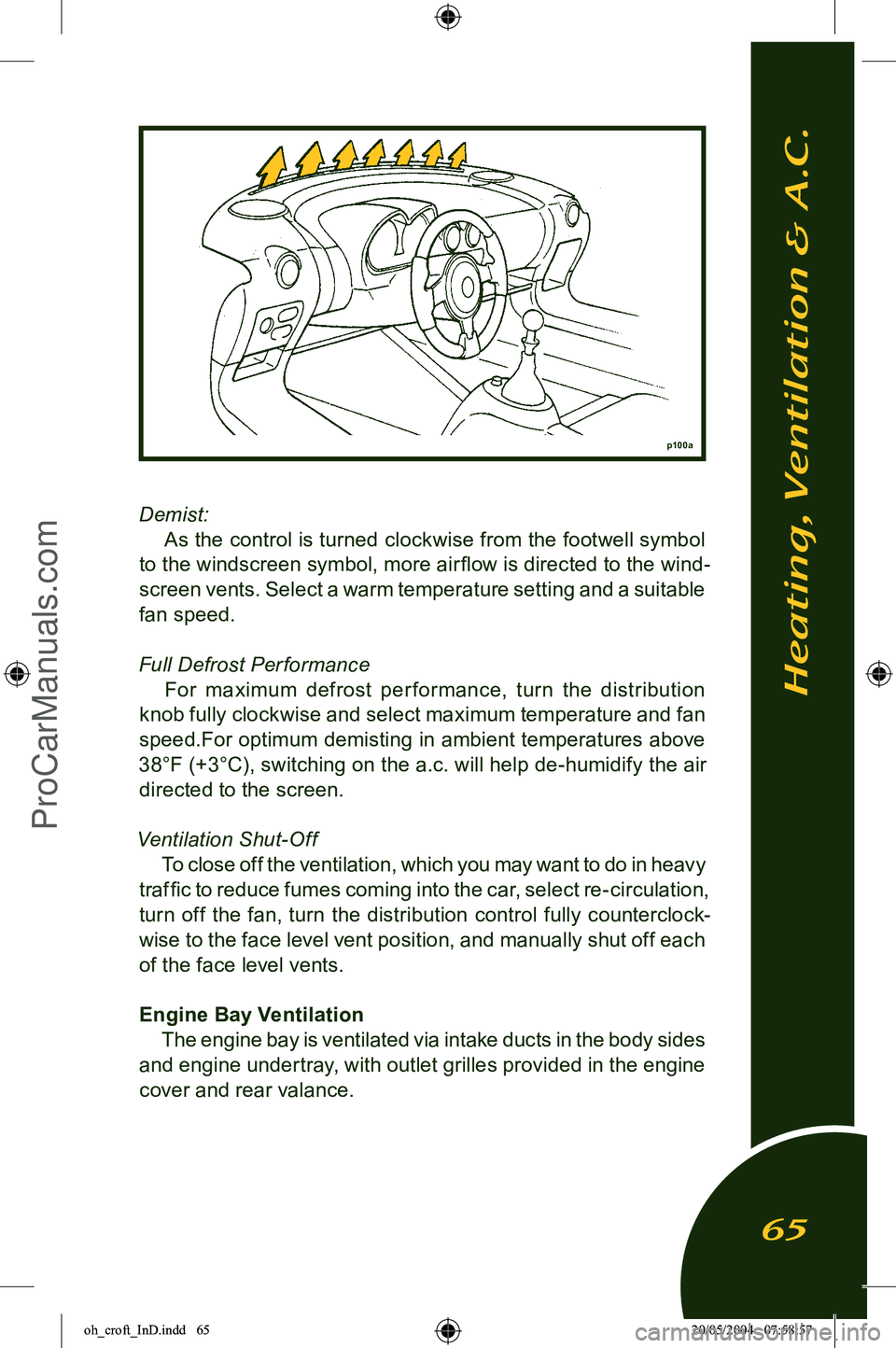
Demist:
As the control is turned clockwise from the footwell symbol
to the windscreen symbol, more air flow is directed to the wind
-
screen vents. Select a warm temperature setting and a suitable
fan speed.
Full Defrost Per formance For maximum defrost per formance, turn the distribution
knob fully clockwise and select maximum temperature and fan
speed.For optimum demisting in ambient temperatures above
38°F (+3°C), switching on the a.c. will help de-humidify the air directed to the screen.
Ventilation Shut-Off To close off the ventilation, which you may want to do in heavy
traffic to reduce fumes coming into the car, select re-circulation,
turn off the fan, turn the distribution control fully counterclock
-
wise to the face level vent position, and manually shut off each of the face level vents.
Engine Bay Ventilation The engine bay is ventilated via intake ducts in the body sides
and engine undertray, with outlet grilles provided in the engine
cover and rear valance.
p100a
Heating, Ventilation & A.C.
65
oh_croft_InD.indd 6520/05/2004 07:58:57ProCarManuals.com
Page 72 of 205
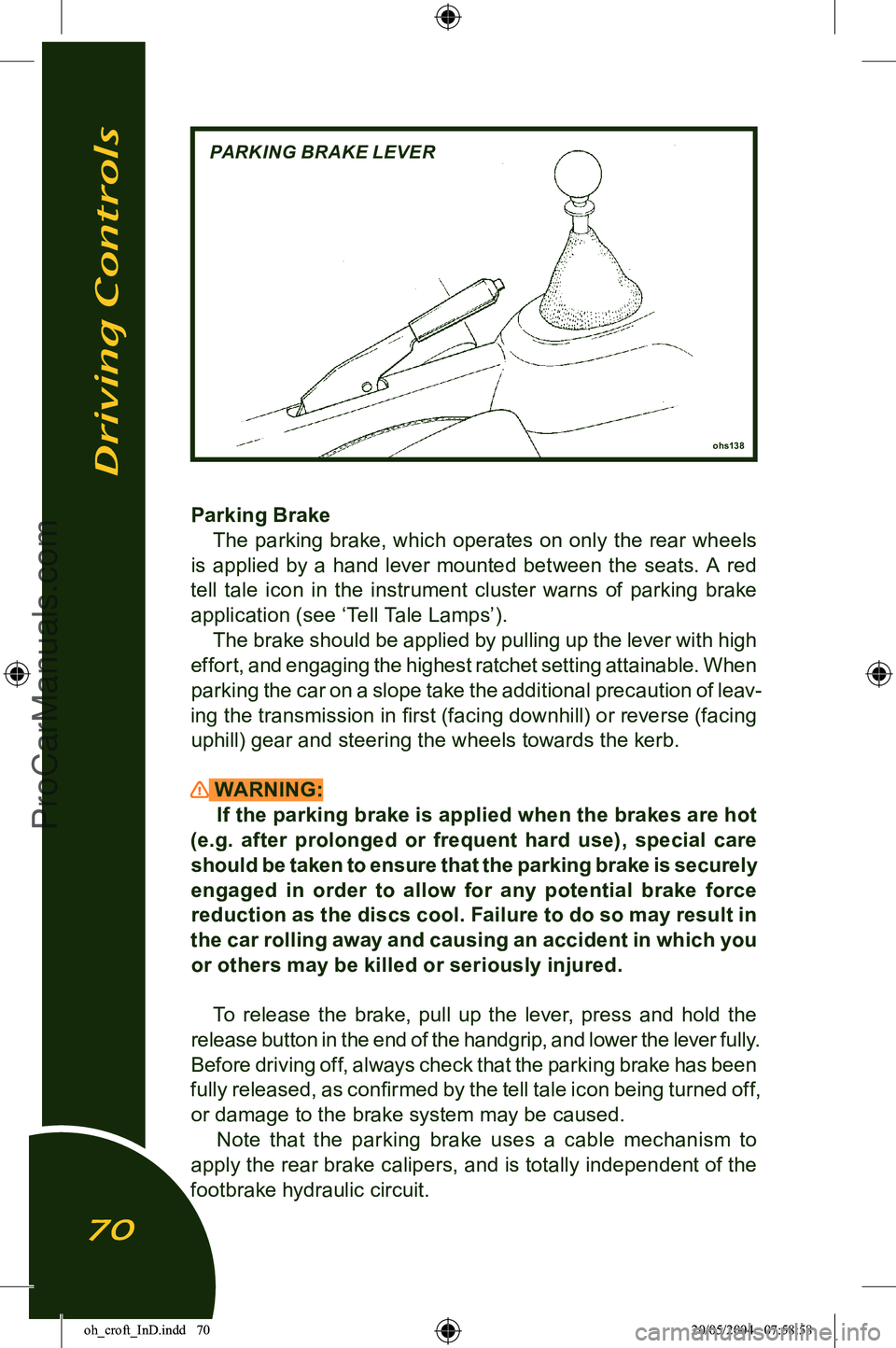
Parking BrakeThe parking brake, which operates on only the rear wheels
is applied by a hand lever mounted between the seats. A red
tell tale icon in the instrument cluster warns of parking brake application (see ‘Tell Tale Lamps’). The brake should be applied by pulling up the lever with high
effort, and engaging the highest ratchet setting attainable. When
parking the car on a slope take the additional precaution of leav
-
ing the transmission in first (facing downhill) or reverse (facing uphill) gear and steering the wheels towards the kerb.
WARNING: If the parking brake is applied when the brakes are hot
(e.g. after prolonged or frequent hard use), special care
should be taken to ensure that the parking brake is securely engaged in order to allow for any potential brake force
reduction as the discs cool. Failure to do so may result in
the car rolling away and causing an accident in which you
or others may be killed or seriously injured.
To release the brake, pull up the lever, press and hold the
release button in the end of the handgrip, and lower the lever fully.
Before driving off, always check that the parking brake has been
fully released, as confirmed by the tell tale icon being turned off,
or damage to the brake system may be caused. Note that the parking brake uses a cable mechanism to
apply the rear brake calipers, and is totally independent of the
footbrake hydraulic circuit.
Driving Controls
70
ohs138
PARKING BRAKE LEVER
oh_croft_InD.indd 7020/05/2004 07:58:58ProCarManuals.com
Page 74 of 205
STARTING PROCEDURE & ENGINE BREAK-IN
WARNING:CARBON MONOXIDE - Be aware of the danger of carbon
monoxide! Never run the engine in an enclosed space. The
exhaust gases contain carbon monoxide, a deadly gas
which is particularly dangerous, as being colourless odour
-
less and tasteless, its presence is very difficult to detect.
Before starting the engine, always check that the parking
brake is firmly applied, the transmission is in neutral, and as
an extra precaution, depress the clutch pedal. Switch off any
unnecessary electrical loads.
Starting a Cold or Warm Engine
The fuel injection and engine management system controls fuel delivery and engine settings under all normal operating conditions.
i) Insert the key into the steering lock/ignition switch and turn to
position ‘l’ to unlock the column. Before turning on the igni
-
tion; if the security tell tale in the tachometer face is flashing, mobilise the engine by pressing once, and for a full second,
the larger of the two buttons on the transmitter fob.
ii) Turn the key to position ‘II’ to switch on the ignition, and pause
for a moment to allow the fuel system to prime.
iii) Depress the clutch pedal as a precaution, and without moving
the accelerator, press the ‘Start’ button at the left hand end of
the dashboard to engage the starter motor. Release the button
as soon as the engine starts. Allow a cold engine to idle for
10 seconds before driving off, but if ambient temperatures are below freezing, allow the engine and screen heating systems
to warm up for a few minutes before driving.
iv) If the engine fails to start within 15 seconds, stop cranking
and pause for 10 seconds before a second attempt.
v) If further efforts are unsuccessful, contact your dealer or seek
other expert help.
WARNING:
An unattended car with a running engine is potentially
hazardous. Turn off the engine before leaving the car.
Starting & Engine Break-In
72
oh_croft_InD.indd 7220/05/2004 07:58:58ProCarManuals.com
Page 75 of 205
NOTICE: The use of wide throttle openings and/or high rpm before the engine has reached normal running temperature will
result in premature wear, and should be avoided.
Idle Speed Engine idle speed is controlled electronically by the engine
management computer, and is normally about 850 rpm. A
raised idle speed is required under certain operating conditions
including the engine warm up phase, when the increased speed helps the catalytic converter to reach operating temperature, as
well as inhibiting engine stall. Idle speed will return to normal automatically when the engine has warmed sufficiently.
Engine Break-In Although the Elise powertrain is built to close tolerances
using modern technology, the progressive and sympathetic
breaking-in (or bedding-in) of a new engine and transmission
remains a major factor in attaining ef ficient operation with
smooth, durable and economic performance to last throughout
the life of the car.
NOTICE: Failure to comply with the following break-in provi
-
sions could invalidate the terms of the car warranty:
It is important during the car’s early life to limit the workload on
the engine and thus control the heat generated within it, which is primarily a function of throttle opening and rpm. However, being
too sympathetic on the car will not allow the piston rings to bed in
satisfactorily, so a balance of spirited and gentle use is required.
For the first 600 miles (1,000 km), use no more than moderate
throttle openings (about half of the available accelerator pedal
travel) and do not run the engine continuously at engine speeds over 4,500 rpm. Occasional short bursts at wider throttle and
higher rpm will be beneficial, as will a constantly changing cruis
-
ing speed and making full use of the gearbox. Do not allow the
engine to labour in too high a gear ratio, but change down and
let the engine operate in its natural power band. When changing gear, use only a light touch on the gear lever.
Forcing the change will cause unnecessary wear on the system components and result in higher shift efforts being required. Al
-
low the brakes to bed-in by avoiding needless heavy braking for
the first 100 miles (160 km). Both gearchange and brake pedal
Starting & Engine Break-In
73
oh_croft_InD.indd 7320/05/2004 07:58:59ProCarManuals.com
Page 79 of 205
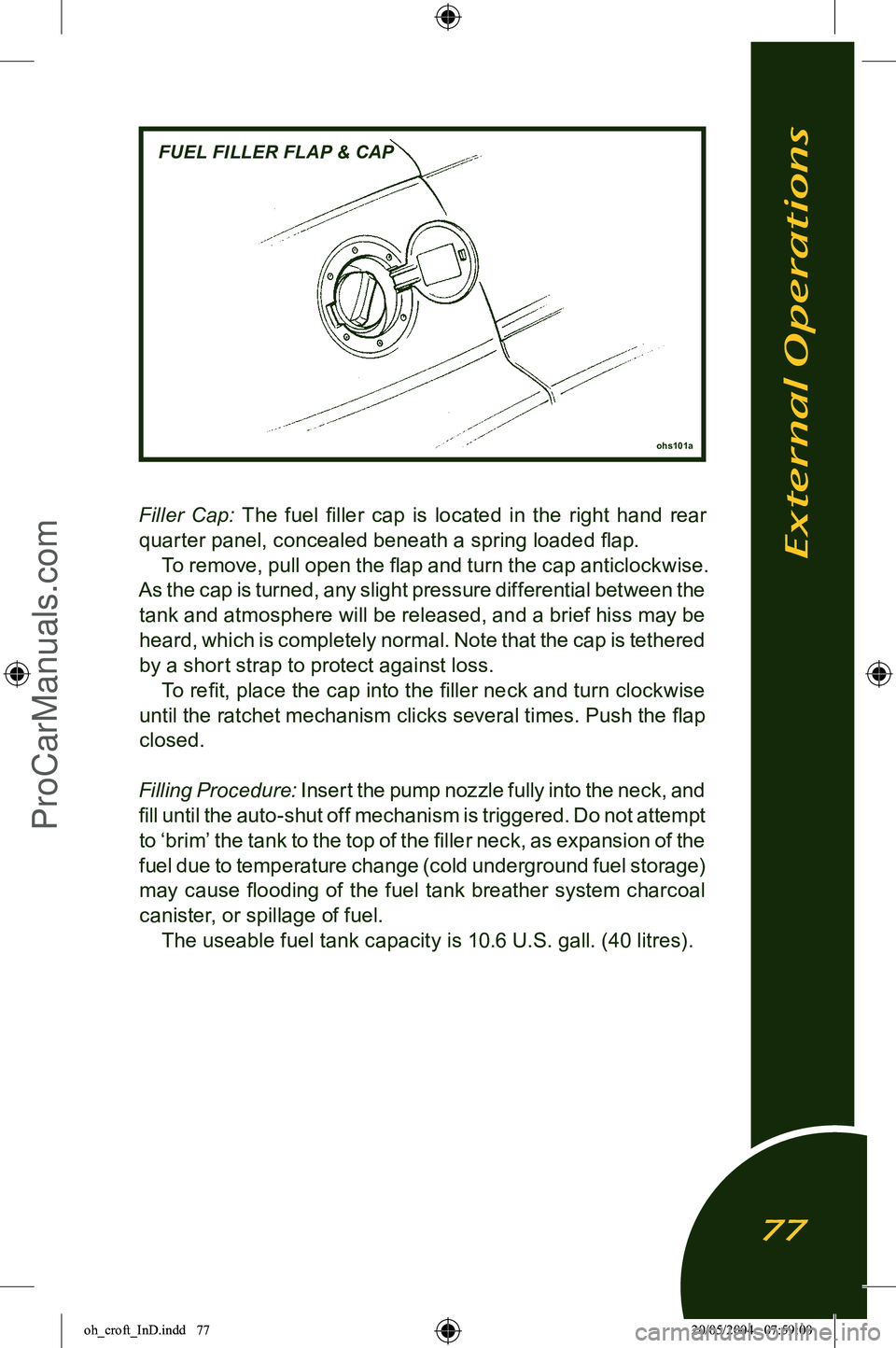
Filler Cap: The fuel filler cap is located in the right hand rear
quarter panel, concealed beneath a spring loaded flap. To remove, pull open the flap and turn the cap anticlockwise.
As the cap is turned, any slight pressure differential between the tank and atmosphere will be released, and a brief hiss may be heard, which is completely normal. Note that the cap is tethered by a short strap to protect against loss.
To refit, place the cap into the filler neck and turn clockwise
until the ratchet mechanism clicks several times. Push the flap closed.
Filling Procedure:
Insert the pump nozzle fully into the neck, and
fill until the auto-shut off mechanism is triggered. Do not attempt to ‘brim’ the tank to the top of the filler neck, as expansion of the
fuel due to temperature change (cold underground fuel storage) may cause flooding of the fuel tank breather system charcoal
canister, or spillage of fuel. The useable fuel tank capacity is 10.6 U.S. gall. (40 litres).
ohs101a
FUEL FILLER FLAP & CAP
External Operations
77
oh_croft_InD.indd 7720/05/2004 07:59:00ProCarManuals.com
Page 81 of 205
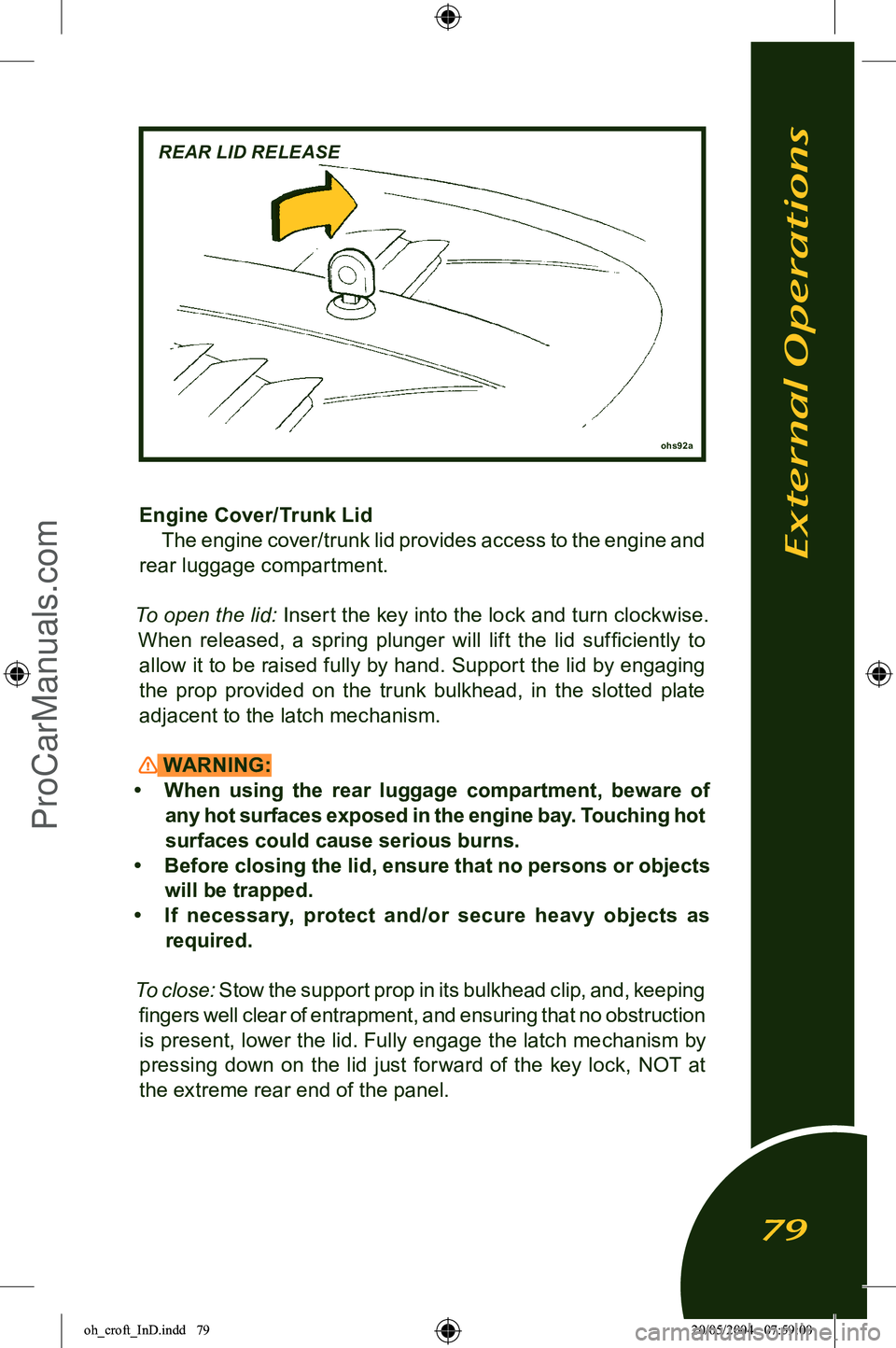
Engine Cover/Trunk LidThe engine cover/trunk lid provides access to the engine and
rear luggage compartment.
To open the lid: Insert the key into the lock and turn clockwise. When released, a spring plunger will lift the lid sufficiently to allow it to be raised fully by hand. Support the lid by engaging
the prop provided on the trunk bulkhead, in the slotted plate adjacent to the latch mechanism.
WARNING:
• When using the rear luggage compartment, beware of any hot surfaces exposed in the engine bay. Touching hot
surfaces could cause serious burns.
• Before closing the lid, ensure that no persons or objects
will be trapped.
• If necessary, protect and/or secure heavy objects as required.
To close: Stow the support prop in its bulkhead clip, and, keeping
fingers well clear of entrapment, and ensuring that no obstruction is present, lower the lid. Fully engage the latch mechanism by pressing down on the lid just forward of the key lock, NOT at
the extreme rear end of the panel.
ohs92a
REAR LID RELEASE
External Operations
79
oh_croft_InD.indd 7920/05/2004 07:59:00ProCarManuals.com
Page 91 of 205
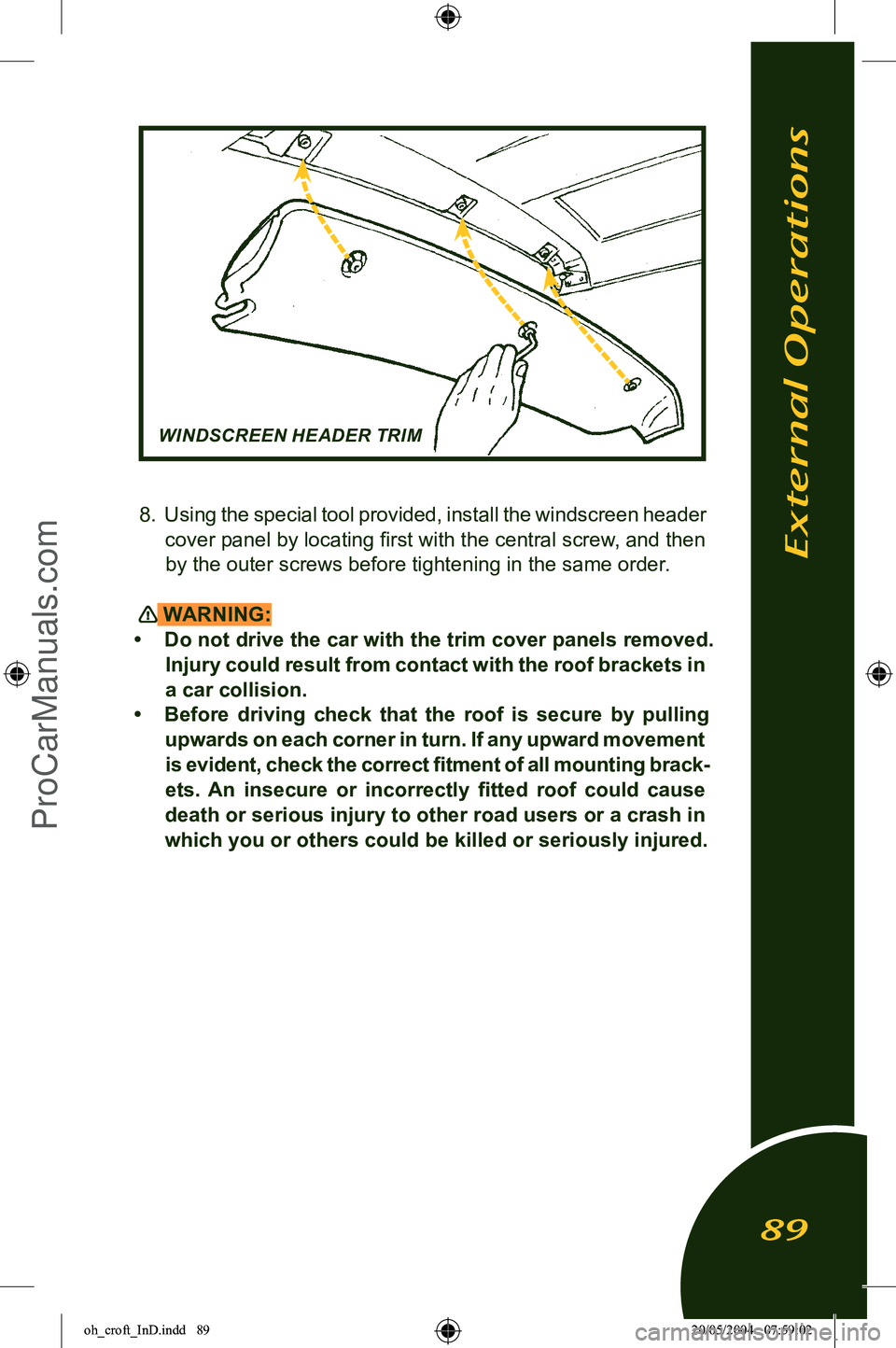
8. Using the special tool provided, install the windscreen header
cover panel by locating first with the central screw, and then by the outer screws before tightening in the same order.
WARNING:
• Do not drive the car with the trim cover panels removed. Injury could result from contact with the roof brackets in
a car collision.
• Before driving check that the roof is secure by pulling upwards on each corner in turn. If any upward movement
is evident, check the correct fitment of all mounting brack
-
ets. An insecure or incorrectly fitted roof could cause
death or serious injury to other road users or a crash in
which you or others could be killed or seriously injured.
WINDSCREEN HEADER TRIM
External Operations
89
oh_croft_InD.indd 8920/05/2004 07:59:02ProCarManuals.com
Page 102 of 205
pressing firmly to ensure that the handle is fully seated. With-
draw the dipstick again to inspect the oil level, which should lie between the two dimples on the end of the stick. The oil level
should be maintained at the upper of these two marks in order
to provide optimum engine protection.
Topping Up
: If topping up is necessary, unscrew the oil filler cap
from the left hand end of the cam cover. Add a suitable quantity of the recommended engine oil (see ‘Recommended Lubricants’)
taking care not to spill any oil onto engine or electrical compo
-
nents; use a funnel if necessary. The difference between high and low dipstick marks is equiv
-
alent to 1.6 U.S. quarts (1.5 litre). Allow several minutes for the oil to drain through to the sump before re-checking the oil level.
Do NOT over fill, or lubrication will be degraded and consump
-
tion increased as the oil becomes aerated. Refit the filler cap,
turning clockwise until secure.
Engine Oil Change The use of high quality oil, renewed at the specified intervals,
is the key to engine longevity and sustained performance. Ad
-
here strictly to the engine oil and filter change intervals specified
in the Maintenance Schedule.
For access to the engine sump and filter, the engine bay
undertray must first be removed. This is most easily achieved
with the car raised on a garage hydraulic lift, or alternatively, parked over an inspection pit.
The drain plug is located at the rear of the sump, and should
be removed to drain the sump immediately after a run when
the oil is warm and the impurities are still held in suspension.
On cars fitted with front mounted oil coolers, it is not necessary routinely to attempt to drain the cooler circuit. Servicing & Maintenance
100
oh_croft_InD.indd 10020/05/2004 07:59:05ProCarManuals.com
Page 104 of 205
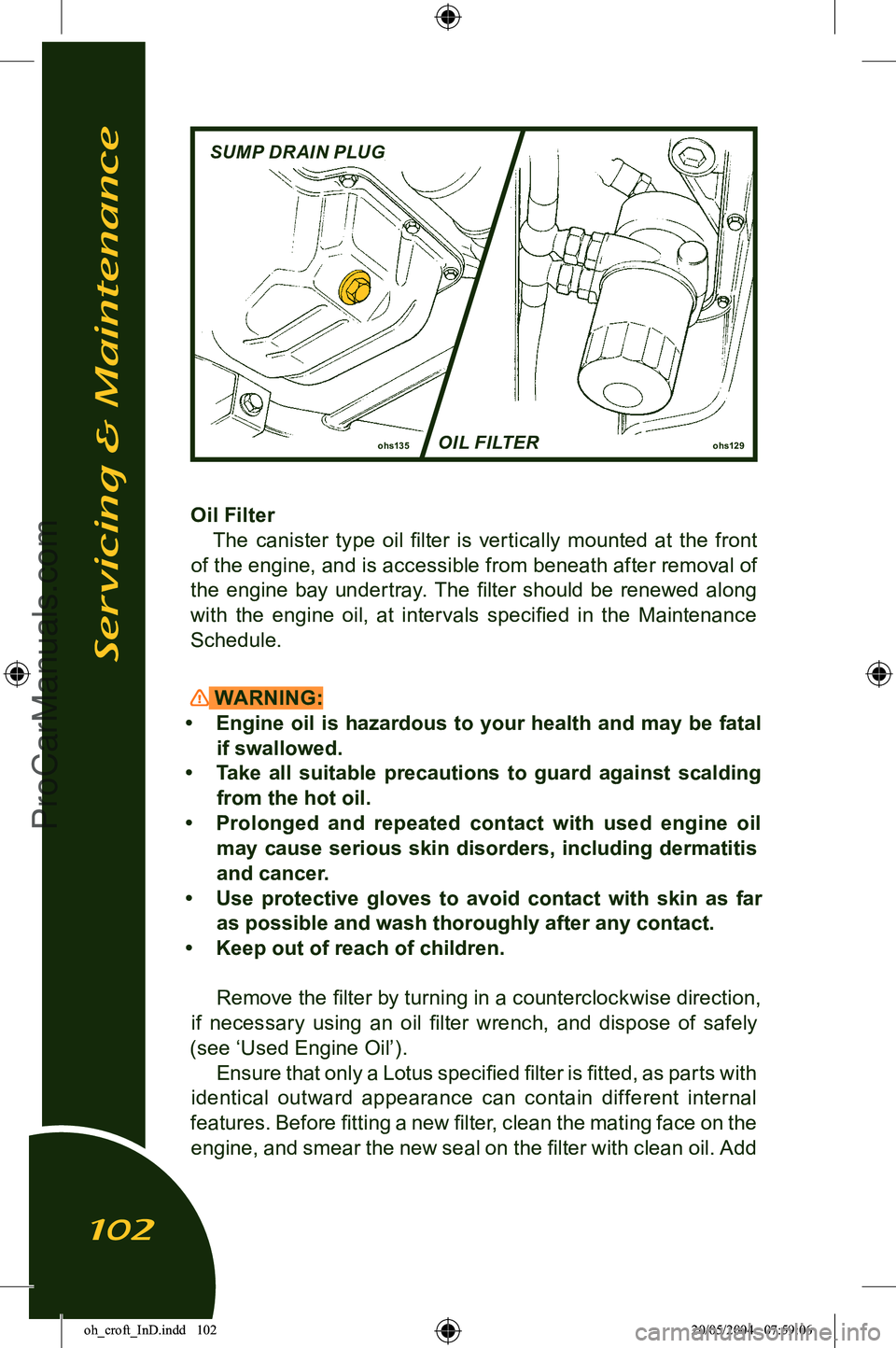
Oil FilterThe canister type oil filter is vertically mounted at the front
of the engine, and is accessible from beneath after removal of
the engine bay undertray. The filter should be renewed along
with the engine oil, at intervals specified in the Maintenance
Schedule.
WARNING:
• Engine oil is hazardous to your health and may be fatal
if swallowed.
• Take all suitable precautions to guard against scalding
from the hot oil.
• Prolonged and repeated contact with used engine oil may cause serious skin disorders, including dermatitis
and cancer.
• Use protective gloves to avoid contact with skin as far
as possible and wash thoroughly after any contact.
• Keep out of reach of children.
Remove the filter by turning in a counterclockwise direction,
if necessary using an oil filter wrench, and dispose of safely
(see ‘Used Engine Oil’). Ensure that only a Lotus specified filter is fitted, as parts with
identical outward appearance can contain different internal
features. Before fitting a new filter, clean the mating face on the engine, and smear the new seal on the filter with clean oil. Add
ohs129
ohs135
SUMP DRAIN PLUG
OIL FILTER
Servicing & Maintenance
102
oh_croft_InD.indd 10220/05/2004 07:59:06ProCarManuals.com