warning MASERATI GRANTURISMO 2019 Owners Manual
[x] Cancel search | Manufacturer: MASERATI, Model Year: 2019, Model line: GRANTURISMO, Model: MASERATI GRANTURISMO 2019Pages: 286, PDF Size: 8.08 MB
Page 153 of 286
Engine Start Failure CAUTION!
• Do not attempt to push or tow your
vehicle to get it started. Vehicles
equipped with an automatic
transmission cannot be started this
way.
• If the vehicle battery is dead, booster
cables may be used to obtain a start
from a booster battery or the
battery in another vehicle. This type
of start can be dangerous if done
improperly. See “Auxiliary Jump
Start Procedure” in section “In an
Emergency” for further information.
Starting by cold engine
Start-of
f slowly, avoiding sudden
acceleration and rev the engine up at
low medium speeds. High-
performance driving should be
avoided until the engine temperature
reaches 65-70°C (149-158°F).
Engine Turn-Off • Place the shift lever in P (Park) (see
“Automatic Transmission” in this
section).
• With the engine at idle, turn the key
in the ignition switch to STOP (OFF) position. A burst on the accelerator
pedal before turning off the engine
has no purpose and increases fuel
consumption.
WARNING!
Never leave a vehicle out of the P
(Park) position, as it could move.
The key can only be removed from the
ignition
switch when the transmission
is in P (Park) position and within 30
seconds after turning the key to STOP
(OFF) position. If you do not remove
the key within 30 seconds, you will
need to turn it back to MAR (ON) and
then to STOP (OFF) position to have a
further 30 seconds within which to
remove the key from the ignition
switch.
In the event that the key unlocking
system fails or if it is not possible to
shift the transmission to P (Park)
position, to remove the key you must
turn it to STOP (OFF) position, then
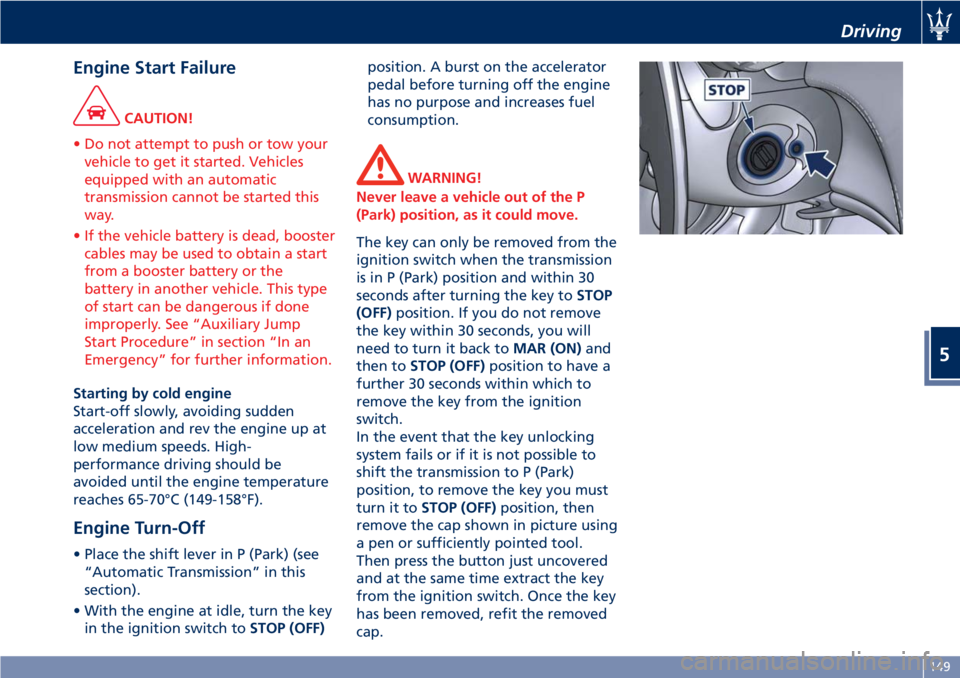
remove the cap shown in picture using
a pen or sufficiently pointed tool.
Then press the button just uncovered
and at the same time extract the key
from the ignition switch. Once the key
has been removed, refit the removed
cap. Driving
5
149
Page 154 of 286
Automatic Transmission The electronic shift lever replaces the
conventional mechanical lever and has
no mechanical connection to the
transmission. The transmission is
operated by electrical actuators on the
hydraulic system and all commands to
the control system are transmitted by
the CAN network.
The automatic transmission has six
forward gear ratios and one reverse
gear. The gears can also be engaged
manually once you have shifted the
transmission shift lever to the sector
provided.
CAUTION!
In order to properly use the automatic
transmission, it is essential that you
read through the whole chapter, so
that you can understand right from
the start what the correct and
permitted operations are.
Damage to the transmission may occur
if the following precautions are not
observed:
• Shift into P (Park) only after the
vehicle has come to a complete stop.
This is the default position of the
lever and should be used every time the key in the ignition switch is
turned to STOP (OFF) position.
• Shift into or out of R (Reverse) only
after the vehicle has come to a
complete stop and the engine is at
idle speed.
• Do not shift between P (Park), R
(Reverse), N (Neutral) or D (Drive)
when the engine is above idle speed.
• To effect any change from vehicle
stop to R (Reverse), D (Drive), 1 st
or
2 nd
gear, it is necessary to keep the
brake pedal fully depressed.
WARNING!
• It is dangerous to move the shift
lever out of P (Park) or N (Neutral) if
the engine speed is higher than idle
speed. Only shift into gear when the
engine is idling normally and when
your foot is firmly pressing on the
brake pedal.
• As with all vehicles, you should
never exit a vehicle while the engine
is running. Before exiting a vehicle,
always apply the electronic parking
brake, shift the transmission into P
(Park), and turn the engine off.
• When leaving the vehicle, always
remove the key from the ignition switch and lock your vehicle.
• Do not leave the key in or near the
vehicle.
The transmission system is equipped
with
"Shift-Lock" and "Key-Lock"
safety functions.
Shift-Lock
This safety function allows you to shift
from P (Park) to another position only
if the brake pedal is depressed. This
prevents the vehicle from involuntarily
jumping forward or backward.
Key-Lock
This function allows you to remove the
key from the ignition switch only
when the transmission shift lever is in
P (Park) position and within a
maximum time of 30 seconds. When
this time has elapsed, the key can no
longer be removed.
Automatic Transmission Lever Automatic transmission is operated by
a lever with unlock button to engage
R (Reverse) and P (Park) located on the
central console.
By using the transmission shift lever it
is possible to select following
positions, indicated on the gear display
at the side of the transmission shiftDriving
5
150
Page 155 of 286
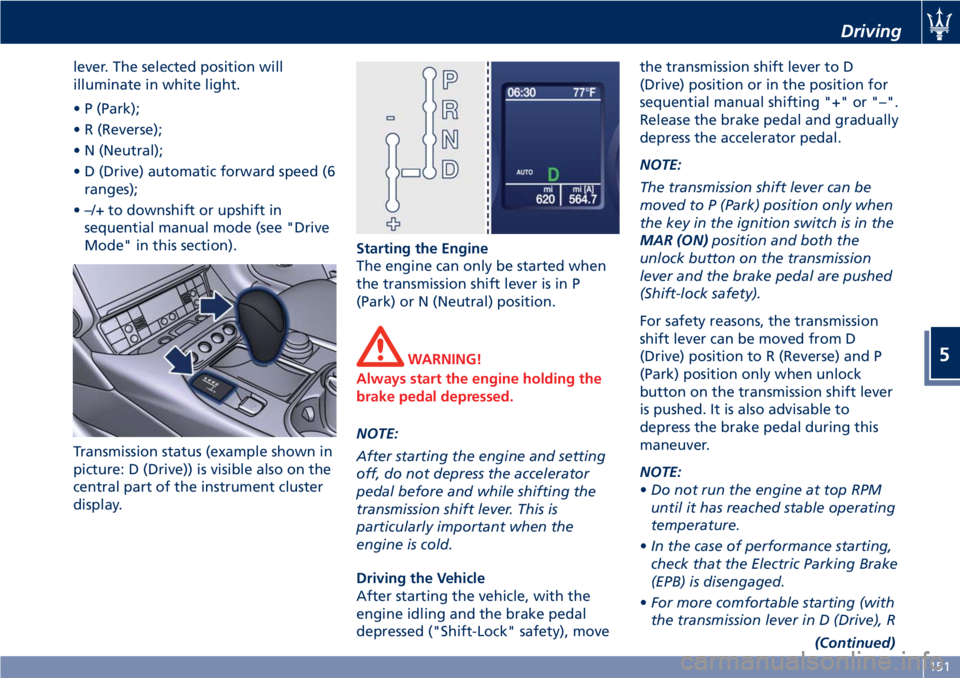
lever. The selected position will
illuminate in white light.
• P (Park);
• R (Reverse);
• N (Neutral);
• D (Drive) automatic forward speed (6
ranges);
• –/+ to downshift or upshift in
sequential manual mode (see "Drive
Mode" in this section).
Transmission status (example shown in
picture: D (Drive)) is visible also on the
central part of the instrument cluster
display. Starting the Engine
The engine can only be started when
the transmission shift lever is in P
(Park) or N (Neutral) position.
WARNING!
Always start the engine holding the
brake pedal depressed.
NOTE:
After
starting the engine and setting
off, do not depress the accelerator
pedal before and while shifting the
transmission shift lever. This is
particularly important when the
engine is cold.
Driving the Vehicle
After starting the vehicle, with the
engine idling and the brake pedal
depressed ("Shift-Lock" safety), move the transmission shift lever to D
(Drive) position or in the position for
sequential manual shifting "+" or "–".
Release the brake pedal and gradually
depress the accelerator pedal.
NOTE:
The transmission shift lever can be
moved to P (Park) position only when
the key in the ignition switch is in the
MAR (ON) position and both the
unlock button on the transmission
lever and the brake pedal are pushed
(Shift-lock safety).
For safety reasons, the transmission
shift lever can be moved from D
(Drive) position to R (Reverse) and P
(Park) position only when unlock
button on the transmission shift lever
is pushed. It is also advisable to
depress the brake pedal during this
maneuver.
NOTE:
• Do not run the engine at top RPM
until it has reached stable operating
temperature.
• In the case of performance starting,
check that the Electric Parking Brake
(EPB) is disengaged.
• For more comfortable starting (with
the transmission lever in D (Drive), R
(Continued)Driving
5
151
Page 156 of 286
(Continued)
(Reverse) or MANUAL and the
Electric Parking Brake (EPB)
engaged), push the brake pedal,
manually deactivate the EPB system
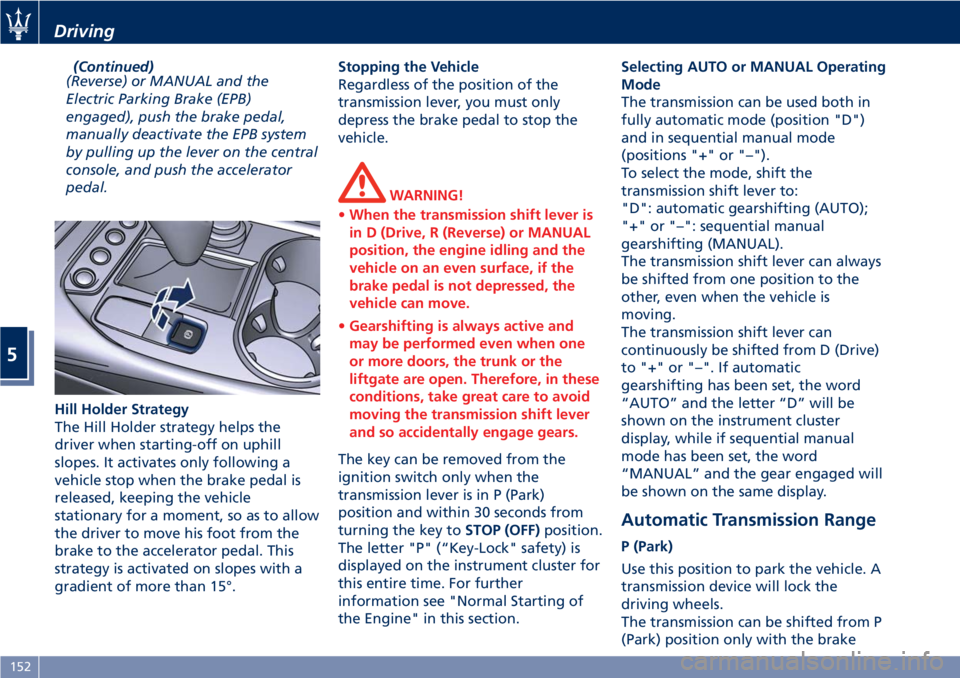
by pulling up the lever on the central
console, and push the accelerator
pedal.
Hill Holder Strategy
The Hill Holder strategy helps the
driver when starting-off on uphill
slopes. It activates only following a
vehicle stop when the brake pedal is
released, keeping the vehicle
stationary for a moment, so as to allow
the driver to move his foot from the
brake to the accelerator pedal. This
strategy is activated on slopes with a
gradient of more than 15°. Stopping the Vehicle
Regardless of the position of the
transmission lever, you must only
depress the brake pedal to stop the
vehicle.
WARNING!
• When the transmission shift lever is
in D (Drive, R (Reverse) or MANUAL
position, the engine idling and the
vehicle on an even surface, if the
brake pedal is not depressed, the
vehicle can move.
• Gearshifting is always active and
may be performed even when one
or more doors, the trunk or the
liftgate are open. Therefore, in these
conditions, take great care to avoid
moving the transmission shift lever
and so accidentally engage gears.
The key can be removed from the
ignition
switch only when the
transmission lever is in P (Park)
position and within 30 seconds from
turning the key to STOP (OFF) position.
The letter "P" (“Key-Lock" safety) is
displayed on the instrument cluster for
this entire time. For further
information see "Normal Starting of
the Engine" in this section. Selecting AUTO or MANUAL Operating
Mode
The transmission can be used both in
fully automatic mode (position "D")
and in sequential manual mode
(positions "+" or "–").
To select the mode, shift the
transmission shift lever to:
"D": automatic gearshifting (AUTO);
"+" or "–": sequential manual
gearshifting (MANUAL).
The transmission shift lever can always
be shifted from one position to the
other, even when the vehicle is
moving.
The transmission shift lever can
continuously be shifted from D (Drive)
to "+" or "–". If automatic
gearshifting has been set, the word
“AUTO” and the letter “D” will be
shown on the instrument cluster
display, while if sequential manual
mode has been set, the word
“MANUAL” and the gear engaged will
be shown on the same display.
Automatic Transmission Range P (Park)
Use this position to park the vehicle. A
transmission device will lock the
driving wheels.
The transmission can be shifted from P
(Park) position only with the brakeDriving
5
152
Page 157 of 286
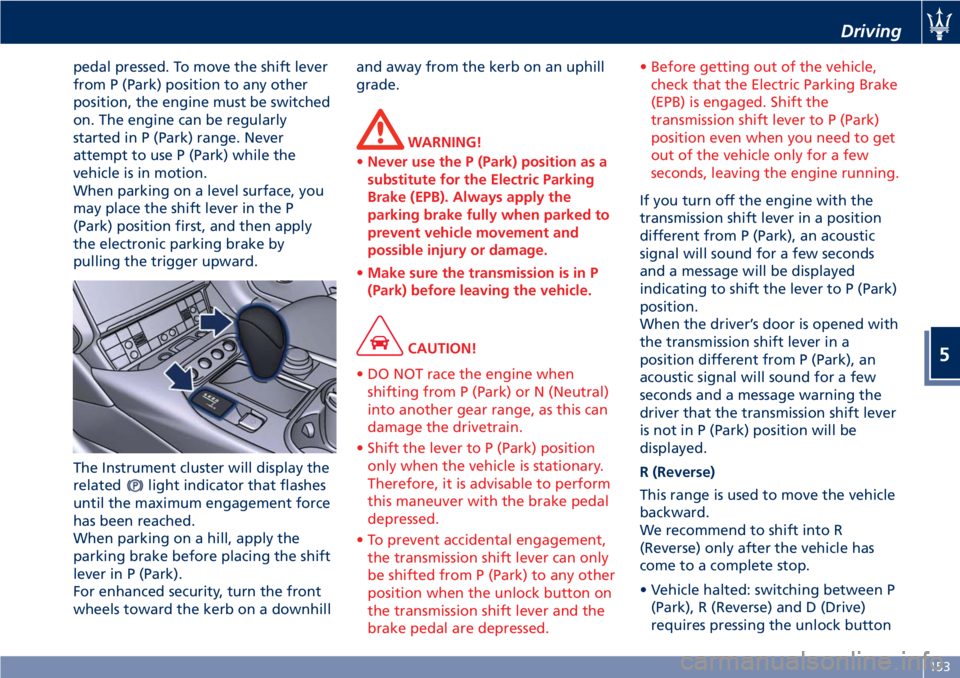
pedal pressed. To move the shift lever
from P (Park) position to any other
position, the engine must be switched
on. The engine can be regularly
started in P (Park) range. Never
attempt to use P (Park) while the
vehicle is in motion.
When parking on a level surface, you
may place the shift lever in the P
(Park) position first, and then apply
the electronic parking brake by
pulling the trigger upward.
The Instrument cluster will display the
related
light indicator that flashes
until the maximum engagement force
has been reached.
When parking on a hill, apply the
parking brake before placing the shift
lever in P (Park).
For enhanced security, turn the front
wheels toward the kerb on a downhill and away from the kerb on an uphill
grade.
WARNING!
• Never use the P (Park) position as a
substitute for the Electric Parking
Brake (EPB). Always apply the
parking brake fully when parked to
prevent vehicle movement and
possible injury or damage.
• Make sure the transmission is in P
(Park) before leaving the vehicle.
CAUTION!
• DO NOT race the engine when
shifting from P (Park) or N (Neutral)
into another gear range, as this can
damage the drivetrain.
• Shift the lever to P (Park) position
only when the vehicle is stationary.
Therefore, it is advisable to perform
this maneuver with the brake pedal
depressed.
• To prevent accidental engagement,
the transmission shift lever can only
be shifted from P (Park) to any other
position when the unlock button on
the transmission shift lever and the
brake pedal are depressed. • Before getting out of the vehicle,
check that the Electric Parking Brake
(EPB) is engaged. Shift the
transmission shift lever to P (Park)
position even when you need to get
out of the vehicle only for a few
seconds, leaving the engine running.
If you turn off the engine with the
transmission
shift lever in a position
different from P (Park), an acoustic
signal will sound for a few seconds
and a message will be displayed
indicating to shift the lever to P (Park)
position.
When the driver’s door is opened with
the transmission shift lever in a
position different from P (Park), an
acoustic signal will sound for a few
seconds and a message warning the
driver that the transmission shift lever
is not in P (Park) position will be
displayed.
R (Reverse)
This range is used to move the vehicle
backward.
We recommend to shift into R
(Reverse) only after the vehicle has
come to a complete stop.
• Vehicle halted: switching between P
(Park), R (Reverse) and D (Drive)
requires pressing the unlock button Driving
5
153
Page 158 of 286
on the lever and brake pedal: N
(Neutral) is reached only by pressing
the unlock button on the lever.
• Vehicle moving: the driver can switch
from R (Reverse) to N (Neutral), or
vice versa, by pressing the unlock
button on the shift lever.
When the transmission shift lever is in
R (Reverse) position, the system emits
an acoustic signal for a few seconds.
You can also shift the transmission
shift lever to R (Reverse) position when
the vehicle is not completely
stationary, however, this does not
mean that reverse gear is actually
engaged, since there is a limit speed
above which the gear may not be
engaged. When the speed goes below
this limit, reverse gear is engaged.
CAUTION!
To prevent accidental engagement,
the transmission shift lever can only be
moved from R (Reverse) to any other
position when the unlock button is
pressed. It is advisable to also depress
the brake pedal when shifting to this
position.
N (Neutral)
This
range should be used when you
need to move the vehicle. • Vehicle halted and engine started:
switching from N (Neutral) to R
(Reverse), P (Park) and/or D (Drive)
requires brake pedal and unlock
button pressed.
• Vehicle moving: switching from N
(Neutral) to R (Reverse) and/or D
(Drive) requires pressing the unlock
button. Switching to R (Reverse)
starting from N (Neutral) is only
possible if the vehicle is moving
backward, while switching to D
(Drive) starting from N (Neutral) is
only possible if the vehicle is moving
forward.
Set the parking brake and shift the
transmission into P (Park) if you must
leave the vehicle.
WARNING!
Do not switch to N (Neutral) and/or
never turn off the ignition to coast
downhill. These are unsafe practices
that limit driver’s response to
changing traffic or road conditions. It
is possible to lose control of the
vehicle and have a collision.
CAUTION!
Towing the vehicle, coasting, or driving for any other reason with the
transmission in N (Neutral) can result
in transmission damage. See “Towing a
Disabled Vehicle” in section “In an
Emergency” for further information.
D (Drive)
This
range should be used for most city
and highway driving. It provides the
smoothest upshifts and downshifts and
the best fuel economy. The
transmission automatically shifts up
and down through all gears.
When this automatic forward gear is
set, the letter “D” illuminates on the
gear display and on the instrument
cluster.
The D (Drive) position provides
optimum driving characteristics under
all normal operating conditions of the
vehicle.
• Vehicle stationary: switching from D
(Drive) to R (Reverse) and/or to P
(Park) requires brake pedal and
unlock button pressed: reaching N
(Neutral) starting from D (Drive) is
allowed by only pressing the unlock
button on the shift lever.
• To enable special operations while
the car is moving at a low speed,
such as getting out of marsh or snow,
it is possible to run quickly from DDriving
5
154
Page 160 of 286
the efficiency of engine braking
together with the standard braking
system.
ESC System Operations
In order to prevent unstable driving
conditions, the ESC system may request
the transmission system to deactivate
gearshifting. The system handles this
request depending on the gear
engaged and on the rpm, and decides
whether to accept it or not.
Driving with Cruise Control
With the Cruise Control function
activated, the transmission system
selects such settings as to provide
enhanced comfort and fuel-economy.
MC Start Strategy (for MC version
only)
With the aim of optimizing standing
starts for performance driving (only
recommended for use in areas closed
to traffic and in accordance with the
Highway Code), the automatic
transmission system is equipped with
quick start strategy.
This strategy is activated when the
following conditions occur
simultaneously:
• AUTO and SPORT modes active;
•
ESC mode off;
• brake pedal depressed. In these conditions, the driver has the
possibility to accelerate and, keeping
the brake pedal depressed, keep the
vehicle standing until reaching an
engine speed between 2300 an 2500
rpm. Then, upon releasing the brake
pedal, have the best standing start
performance.
WARNING!
This strategy must only be used on
vehicles in areas closed to traffic, in
accordance with the Highway Code
and only by skilled drivers.
Transmission Malfunction and
Overheating Conditions Transmission Failure
Transmission function is electronically
monitored to detect abnormal
conditions. If a condition that could
result in transmission damage is
detected, Transmission Limp Home
Mode will be activated. In this
situation, the transmission may
operate only in certain gears, or may
not shift at all.
CAUTION!
In these conditions, we recommended that you stop the vehicle and turn off
the engine for at least one minute.
When restarting the engine, the
self-diagnosis system may cancel the
malfunction, which will in any case be
recorded by the ECU.
A message and the
warning light
in the instrument cluster will inform
the driver about the transmission
failure.
In failure conditions, the transmission
shift lever can however be shifted to R
(Reverse), N (Neutral) and D (Drive)
position.
When shifting to D (Drive) position,
only a few gears will be available,
depending on the malfunction found.
CAUTION!
If a transmission failure is signaled,
take your vehicle to the nearest
Authorized Maserati Dealer as soon as
possible to have the problem
corrected.
If the failure is signaled when the
engine
is started, it means that the
transmission ECU detected a fault
when the vehicle was last used. Also in
this case, take your vehicle to the
nearest Center of the AuthorizedDriving
5
156
Page 161 of 286
Maserati Dealer to have the
transmission checked.
WARNING!
When the transmission is
malfunctioning, drive very carefully
considering that vehicle performance
is reduced. In addition, the reverse
gear safety lock may not be active:
absolutely do not shift the lever to R
(Reverse) when the vehicle is moving.
Transmission Oil Overtemperature
If
the transmission oil temperature
exceeds the operating limit, a message
and the
red warning light
illuminates on the instrument cluster.
In this case, slow down until
temperature returns to normal level
(the light will turn off).
If this is not sufficient, we recommend
to stop the vehicle, shift the lever to
position P (Park) or N (Neutral) and
keep the engine idle until the
red
temperature warning light turns off
and the message disappears from the
display. Resume driving without
demanding high engine performance.
If the
red warning light and the
related message turns on again, it is
advisable to stop the vehicle, turn off
the engine and wait for the engine/transmission assembly to fully
cool down.
Transmission Manual Release of P
(Park) Position
See chapter “Transmission Manual
Release of P (Park) Position” in section
“In an Emergency”.
Onboard Computer (Trip) The trip computer screen pages are
accessible through the “Trip” softkey
in the lower bar of the MTC+ main
menus.
The selectable submenus are the
following:
• Current Trip.
• Trip A.
• Trip B.
• Service.
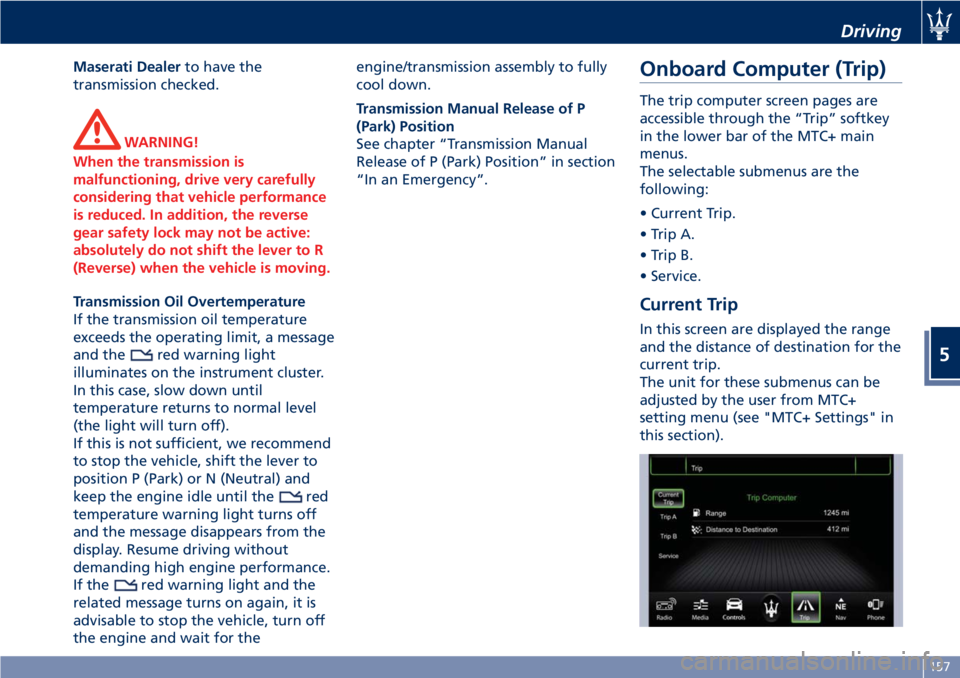
Current Trip In this screen are displayed the range
and the distance of destination for the
current trip.
The unit for these submenus can be
adjusted by the user from MTC+
setting menu (see "MTC+ Settings" in
this section). Driving
5
157
Page 164 of 286
(gears are shifted at low engine
speeds).
In NORMAL mode, the system
controlling suspension damping uses a
shock absorber "softer" setting (see
"Skyhook Suspension" in section
"Understanding the Vehicle").
As SPORT mode has a lower priority
than ICE (low-grip) mode, if this is
already active when activating SPORT
mode, the system will ignore the
command.
CAUTION!
• Vs NORMAL mode, SPORT mode is
characterized by faster gearshifting,
electronic suspension management
(Skyhook), opening of by-pass
exhaust valves (above 3000 rpm with
the vehicle in motion).
• In addition to enhancing
performance, opening of the exhaust
also increases noise levels of the
vehicle.
In SPORT mode, fast gearshifting
however
, always depends on the
accelerator pedal travel and on the
engine rpm, as in NORMAL mode.
When in SPORT mode, the system
controlling suspension damping uses a
shock absorber "harder" setting (see "Skyhook Suspension" in section
"Understanding the Vehicle").
In MANUAL mode, DOWN-shifts with
the accelerator pedal released, will
have a braking effect approaching the
skidding limit of the driving wheels on
dry asphalt.
Under sports-style driving conditions
with gearshifts at high engine rpm,
double-clutching when up-shifting is
performed automatically.
WARNING!
It is advisable not to use SPORT mode
on roads with low or medium grip
conditions (e.g. ice, snow, or wet
roads) as the driving wheels could skid
during gearshifts.
Therefore, excessive use of the vehicle
in SPORT mode is advisable only on
race tracks.
If you use MANUAL and SPORT mode
in
combination for sports-style driving,
when starting-off or shifting gears,
you may perceive an initial slipping of
the driving wheels even on dry roads.
ICE (low-grip) Mode
This mode can be used on particularly
slippery road surfaces (e.g., rain, snow,
ice). To activate/deactivate this mode, press button "ICE" on the central
console. The word “ICE” will illuminate
on the instrument cluster display.
In “low-grip” mode, the system uses
2nd instead of 1st gear; this means
that 2nd gear will automatically be
engaged (gearshift lever in D (Drive)
position) in the event of standing
starts in automatic mode; on the other
hand, when in sequential manual
mode (transmission lever in MANUAL
"+"), moving the transmission lever
from N (Neutral), or R (Reverse) or
when the vehicle stops, 2nd gear will
automatically be engaged.
When sequential manual mode is
selected with 2nd gear engaged, a
downshift request will be ignored.
While driving, the system
automatically switches to the upper
gear if the engine reaches the
preestablished speed rate (3000 rpm).
ICE (low-grip) mode has priority over
SPORT mode and assists the ESC
system.
WARNING!
A downshift request from 6th to 5th
gear will only be accepted if the
engine speed rate in 5th gear is lower
than 3000 rpm. As ICE (low-grip) modeDriving
5
160
Page 165 of 286
can be activated at any time and the
system limits the engine speed rate to
3000 rpm in all gears except for the
6th, unrequested gearshifts could take
place.
In any case, it is advisable to
deactivate
SPORT mode before
selecting ICE (low-grip) mode.
When sequential manual gearshifting
is active, regardless of the mode set
(NORMAL / SPORT / ICE), the
transmission will automatically upshift
or downshift when reaching the
minimum and maximum rpm. This is
to prevent engine overrevving or
underrevving.
(ESC Off) Mode
The ESC system is designed to
automatically activate every time the
engine is started and can be
deactivated by pressing
(ESC Off)
button on the central console for
about 2 seconds. The
(ESC Off)
amber warning light illuminates on
the instrument cluster as well as on
the display, where it is accompanied
by a specific message.
The ESC (Electronic Stability Control)
antiyawing system incorporates all of
the vehicle control systems: ABS, EBD,
ASR and MSR (see "Brake and Stability Control System" in this section for
further information).
The system is fitted with a unit that
predicts the vehicle behavior with
extreme accuracy. The system can
detect when the driver is about to lose
control of the vehicle. In this case, it
can activate the brake calipers
individually and engine control, in
order to create a torque sufficient to
resist the vehicle’s yawing moment.
Press
(ESC Off) button again to
reactivate the system.
The
(ESC On) amber warning light
on the instrument cluster flashes
during all the operating phases.
, the system is automatically disabled
and cannot be re-activated. While
driving, this condition is signaled by
the
(ESC On) amber warning light,
that illuminates both on the
instrument cluster as well as on the
multi-function display, where it is
accompanied by the message “ESC
unavailable go to dealer”.
When the engine is started, the system
malfunction is indicated by the
illumination of the
(ESC On) amber
warning light. CAUTION!
• In the event of a fault, and with the
ESC system disabled ( (ESC Off)
button pressed), the vehicle behaves
as if it were not equipped with this
system: however, we recommend
you contact the Authorized Maserati
Dealer as soon as possible to have
the system checked.
• If you have to tow the vehicle with 2
wheels raised, make sure the key in
the ignition switch is in the STOP
(OFF) position. Otherwise, with the
ESC system active (
(ESC Off)
button not pressed), the control unit
will store a malfunction with
consequent illumination of the
(ESC On) amber warning lights on
the instrument cluster and on the
display. Should this occur, contact
the Authorized Maserati Dealer to
have the system repaired.
• In low- and medium-grip conditions
(e.g., rain, snow, ice, sand, etc.) it is
advisable not to activate SPORT
mode, even with the ESC system
active (
(ESC Off) button not
pressed). Driving
5
161