battery MASERATI GRANTURISMO CONVERTIBLE 2019 Owner's Manual
[x] Cancel search | Manufacturer: MASERATI, Model Year: 2019, Model line: GRANTURISMO CONVERTIBLE, Model: MASERATI GRANTURISMO CONVERTIBLE 2019Pages: 296, PDF Size: 9.01 MB
Page 158 of 296

and heated rear window even when
the system is off.
To activate the A/C system again, select
one of the following options:
• Fan speed “+” (button3);
• A/C compressor (button 6);
• MAX DEF (button 8);
• AUTO (button 10).
Recirculation
It is enabled by pressing button
and allows using only the air of
the passenger compartment.
The recirculation can operate in the
following modes: Automatic Mode
When the compressor is deactivated or
outside temperatures are below 37 °F
(3 °C), the automatic recirculation
function is deactivated automatically.
After prolonged operation (over 15
minutes in a row), the system
deactivates the recirculation function
automatically for safety reasons,
allowing the exchange of air once
again.
Forced Closed Recirculation
In this operating mode, the
illumination of the amber LED
indicates that the recirculation vent is
closed.
Forced Open Recirculation
In this operating mode, the LED turned
off indicates that the outside air intake
is open.
AUTO Mode
When this button is pressed (one
button per zone), automatic mode will
control the following functions once
again:
• air distribution (for the side
concerned);
• fan speed;
• compressor operation (illumination of the ECON LED);
• air recirculation.
REAR Mode
Press the button REAR 12 (relative LED
illuminated) to open/close the air flow
to the rear vents.
This function is active in both “MONO”
and “DUAL-ZONE” modes.
System Initialization Procedure
Every time the battery is reconnected,
when the vehicle is started the system
must be initialized by activating the
compressor. The display automatically
shows the passenger compartment
temperatures set to 72 °F (22 °C).
The system is configured as follows:
• AUTO (automatic operation, the words “FULL AUTO” appear on the
display);
Dashboard Instruments and Controls
4
154
Page 163 of 296

Engine Start Failure
CAUTION!
• Do not attempt to push or tow your vehicle to get it started. Vehicles
equipped with an automatic
transmission cannot be started this
way.
• If the vehicle battery is dead, booster cables may be used to obtain a start
from a booster battery or the
battery in another vehicle. This type
of start can be dangerous if done
improperly. See “Auxiliary Jump
Start Procedure” in section “In an
Emergency” for further information.
Starting by cold engine
Start-of
f slowly, avoiding sudden
acceleration and rev the engine up at
low medium speeds. High-
performance driving should be
avoided until the engine temperature
reaches 149-158°F (65-70°C).
Engine Turn-Off
• Place the shift lever in P (Park) (see “Automatic Transmission” in this
section).
• With the engine at idle, turn the key in the ignition switch to STOP (OFF)position. A burst on the accelerator
pedal before turning off the engine
has no purpose and increases fuel
consumption.
WARNING!
Never leave a vehicle out of the P
(Park) position, as it could move.
The key can only be removed from the
ignition
switch when the transmission
is in P (Park) position and within 30
seconds after turning the key to STOP
(OFF) position. If you do not remove
the key within 30 seconds, you will
need to turn it back to MAR (ON)and
then to STOP (OFF) position to have a
further 30 seconds within which to
remove the key from the ignition
switch.
In the event that the key unlocking
system fails or if it is not possible to
shift the transmission to P (Park)
position, to remove the key you must
turn it to STOP (OFF) position, then
remove the cap shown in picture using
a pen or sufficiently pointed tool.
Then press the button just uncovered
and at the same time extract the key
from the ignition switch. Once the key
has been removed, refit the removed
cap.
Driving
5
159
Page 176 of 296

(Continued)
• Driving on parabolic curves will
deactivate the system.
PARK OFF Mode
T
o deactivate manual operation of the
parking brake, with the engine on,
press the "PARK OFF" button on the
central console. The words “PARK
OFF” appear on the instrument cluster
display for 5 seconds, after which they
remain displayed but in smaller size.
To reactivate automatic operation,
press the "PARK OFF" button once
again, the words “PARK ON” appear
on the display for 5 seconds.
CAUTION!
• In certain conditions when the battery voltage is low, the electric
parking brake system may
temporarily be deactivated for safety
reasons. Therefore, typically upon
starting the engine, when the
battery voltage drops, the message
“PARK OFF” may temporarily be
displayed on the instrument cluster,
indicating that automatic operation
is temporarily disabled. • In the case of performance starting,
check that the electric parking brake
is disengaged.
For further information see "Parking
Brake"
in this section.
Sequential Manual Operation
(MANUAL)
In this mode, the transmission interacts
with the driver in order to allow
manual shift and ensure increased
control of the vehicle. The current
mode allows the gear system to
optimize the engine brake action,
remove undesired shifting into higher
and lower gears and improve the
overall performance of the vehicle.
With automatic transmission selected
(D (Drive) position), shift the
transmission shift lever to position “+”
o “–”.
When this mode is selected, the
symbol “+” or “–” illuminates on the
gear display, based on the position of
the transmission shift lever, and the
gear engaged is shown on the
instrument cluster display.
WARNING!
When sequential manual operation is
selected, upshifting or downshifting
must be performed manually.
To engage the gears, shift the
transmission
shift lever to one of the
following two positions:
"+" (UP) to engage a higher gear;
"–" (DOWN) to engage a lower gear.
CAUTION!
• However, some conditions will remain automatically controlled, for
example, when the engine is
overrevving or underrevving, the
system automatically engages a
higher or lower gear.
• If you request a gearshift in conditions where the engine is
overrevving or underrevving, the
system will not accept the command.
• The ECU is programmed to control one gearshift at a time, therefore,
fast and repeated actions will not
necessarily result in a gearshift. A
higher or lower gear is engaged only
if the previous procedure requested
has been completed.
Driving
5
172
Page 179 of 296

If you attempt to disengage the
parking brake without having
depressed the service brake pedal, a
message will be displayed to warn
you to do so.
• The EPB command activation while
running, generates a deceleration of
the vehicle with strong deceleration
(Dynamic Braking). It is therefore
recommended to use of this feature
only in case of emergency. The
stability of the car is guaranteed by
the action of the activated ESC
system.
Deactivating Automatic
Operation
To deactivate automatic operation of
the parking brake, with the engine
on, press the "PARK OFF" button on
the central console. The words “PARK OFF” appear on the
display for 5 seconds, after which they
remain displayed but in smaller size.
To reactivate automatic operation,
press the "PARK OFF" button once
again, the words “PARK ON” appear
on the display for 5 seconds.
CAUTION!
• In certain conditions when the battery voltage is low, the electric
parking brake system may
temporarily be deactivated for safety
reasons. Therefore, typically upon
starting the engine, when the
battery voltage drops, the message
“PARK OFF” may temporarily be
displayed on the instrument cluster,
indicating that automatic operation
is temporarily disabled. • In the case of performance starting,
check that the parking brake is
disengaged.
Failure Indication
In the event of electric parking brake
system failure, the
warning light
on the display will light up.
Depending on the message displayed,
it signals the following failures of the
EPB system:
• “Parking brake failure: go to dealer” If the message warning you to go to
the nearest Authorized Maserati
Dealer is displayed, drive slowly and
remember that the electric parking
brake device is not functioning.
• “EPB is overheated” If the vehicle has been stationary
(key in the ignition switch to STOP
(OFF) position) for about 15 minutes
without using the parking brake,
and the warning light illuminates
again after restarting the engine,
slowly drive to the nearest
Authorized Maserati Dealer .
• “EPB failure only manual unlock allowed: see handbook”
In this case, follow the manual
emergency deactivation procedure
in order to release the parking brake
(see “Emergency Release of the
Driving
5
175
Page 180 of 296

Parking Brake” in section “In an
Emergency”).
• “Parking Brake system revision: go to dealer”
The EPB system requires
maintenance, therefore contact an
Authorized Maserati Dealer to have
the system corrected.
WARNING!
In the event of an EPB failure, take
your vehicle to the nearest Authorized
Maserati Dealer as soon as possible.
Initialize the EPB System after a
Battery
Disconnecting
After the detachment and the
subsequent connection of the battery,
on the instrument cluster display the
warning light will light up.
To initialize the EPB system lift, release
and lift again the lever located next to
the transmission shift lever.
Emergency Disengagement
In case of brake lock with complete
electrical system failure, it is necessary
to act on the electric actuator using
the special tool provided in the tool kit
to release the pressure of the parking
brake shoes (see “Emergency Release of the Parking Brake” chapter in
section “In an Emergency”).
EPB Operation with
Overheated Brakes
Driving on mountain roads with steep
slopes or a sports use of the vehicle
could overheat the brake system
components. In these conditions,
parking brake must not be used since
the push of the power actuator might
not be sufficient to ensure vehicle
braking, especially on a slope.
Drive normally without braking to
allow the brakes to cool down a few
minutes before stopping. In this way,
the automatic or manual activation of
the parking brake will ensure vehicle
braking.
Parking
Straighten the wheels and turn off the
engine.
Before leaving the vehicle, make sure
that the parking brake is fully applied
in automatic or manual mode and
place the transmission lever in the P
(Park) position.
Remove the key from the ignition
switch.
WARNING!
• Always check that the vehicle is
locked before leaving it.
• Never leave children unattended in
the vehicle.
• Do not park the vehicle on paper,
grass, dry leaves or other flammable
materials. They could catch fire if
they come into contact with hot
parts of the exhaust system.
• Do not leave the engine running
while the vehicle is unattended.
CAUTION!
When you need to park the vehicle on
a steep slope, both with the engine on
and off, it is recommended not only to
Driving
5
176
Page 203 of 296
“--,--” will be displayed in the place of
the values.
NOTE:
•The system will not perform
calibration if the pressure is below 2
bar (29 psi).
• To allow the system to acquire the
sensors’s data, after the startup of
the car, if possible avoid to stop.
During this interval the TFT display
can show screen page with dashes
“--,--” in the place of the pressure
levels of each tire.
• If calibration is not completed within
10 minutes of driving the car, the
instrument cluster shows “TPMS
Malfunction” pop-up message and
“Tire Pressure” screen disappear. The
warning light remains light on.
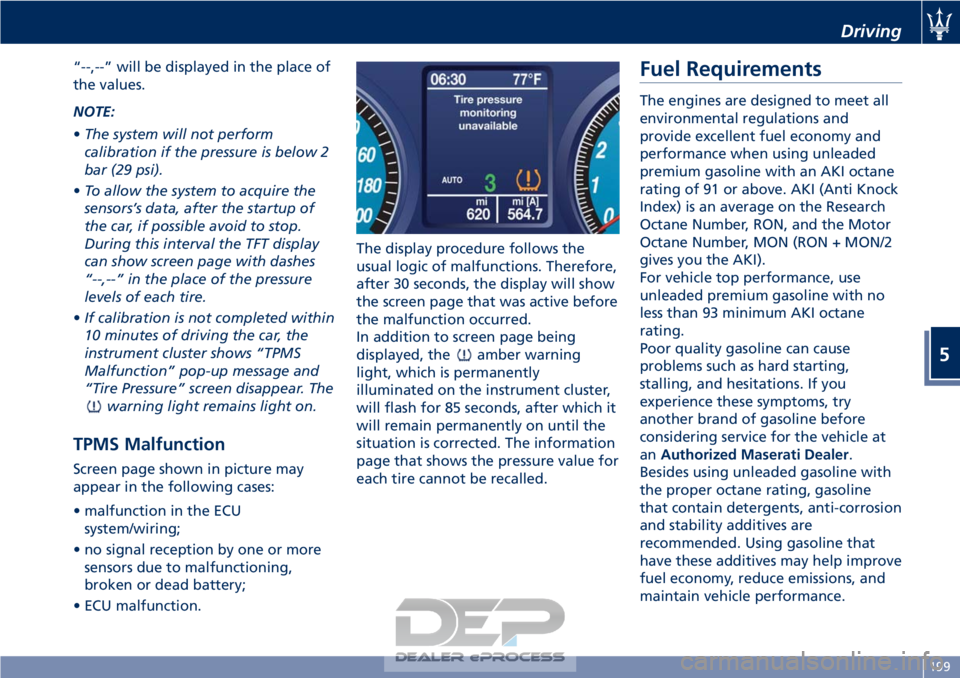
TPMS Malfunction
Screen page shown in picture may
appear in the following cases:
• malfunction in the ECU
system/wiring;
• no signal reception by one or more sensors due to malfunctioning,
broken or dead battery;
• ECU malfunction. The display procedure follows the
usual logic of malfunctions. Therefore,
after 30 seconds, the display will show
the screen page that was active before
the malfunction occurred.
In addition to screen page being
displayed, the
amber warning
light, which is permanently
illuminated on the instrument cluster,
will flash for 85 seconds, after which it
will remain permanently on until the
situation is corrected. The information
page that shows the pressure value for
each tire cannot be recalled.
Fuel Requirements
The engines are designed to meet all
environmental regulations and
provide excellent fuel economy and
performance when using unleaded
premium gasoline with an AKI octane
rating of 91 or above. AKI (Anti Knock
Index) is an average on the Research
Octane Number, RON, and the Motor
Octane Number, MON (RON + MON/2
gives you the AKI).
For vehicle top performance, use
unleaded premium gasoline with no
less than 93 minimum AKI octane
rating.
Poor quality gasoline can cause
problems such as hard starting,
stalling, and hesitations. If you
experience these symptoms, try
another brand of gasoline before
considering service for the vehicle at
an Authorized Maserati Dealer .
Besides using unleaded gasoline with
the proper octane rating, gasoline
that contain detergents, anti-corrosion
and stability additives are
recommended. Using gasoline that
have these additives may help improve
fuel economy, reduce emissions, and
maintain vehicle performance.
Driving
5
199
Page 212 of 296
emergency starting, only use an
auxiliary battery.
• While driving, if the engine does not run smoothly, you may continue
driving but reducing engine
performance to a minimum; you
should then contact the Authorized
Maserati Dealer as soon as possible.
• Never run the engine, even if only for testing, with one or more spark
plugs disconnected.
• Do not warm up the engine letting it idle before starting off, except in the
event that the external temperature
is very low and, even then, for no
longer than 30 seconds.
Catalytic Converter Warnings
During normal operation the catalytic
converter produces high temperatures.
Failure to comply with following rules
can create fire hazards.
• Do not park the vehicle onflammable materials (e.g. grass, dry
leaves, pine needles, etc.).
• Do not install heat guards and do not remove those already fitted to
the catalytic converter and to the
exhaust manifold.
• Do not spray anything on the catalytic converter, Oxygen sensor
and exhaust manifold. In addition to the catalytic converter
system, the vehicles are equipped with
a system for controlling fuel vapor
emissions. This system, called ORVR,
has been designed to help reduce
atmospheric pollution by the
evaporation from the fuel system
during the refueling process. Also,
specific to these vehicles is the fuel
filler neck which comes equipped with
a sealed plug that is grounded to
avoid possible sparking during
re-fueling.
WARNING!
California Proposition 65
Operating, servicing and maintaining
a passenger vehicle or off-road vehicle
can expose you to chemicals including
such as, engine exhaust, carbon
monoxide, phthalates and lead, that
which are know to the State of
California to cause cancer and birth
defects or other reproductive harm. To
minimize exposure, avoid breathing
exhaust, do not idle the engine except
as necessary, service your vehicle in a
well-ventilated area and wear gloves
or wash your hands frequently when
servicing your vehicle. For more
information go to: www.P65Warnings.ca.gov/passenger-
vehicle
Other Tips
• Do not warm up the engine when
the vehicle is stationary: in these
conditions the engine heats up much
more slowly, thus increasing fuel
consumption and emissions. It is
advisable to move off slowly,
avoiding high engine rpm.
• As soon as traffic conditions and the route permit it, use a higher gear.
• Avoid depressing the accelerator repeatedly during stops at traffic
lights or before turning off the
engine.
• Keep your speed as regular as possible, avoiding unnecessary
braking and acceleration, which
cause fuel wastage and strongly
increase exhaust emissions.
• Turn the engine off if the vehicle remains stationary for a long time.
• Check the tire pressure regularly: if the pressure is too low, fuel
consumption increases and the tires
are damaged.
• Do not transport unnecessary heavy objects in the trunk compartment.
Driving
5
208
Page 216 of 296

Tool Kit
The tool bag and other first aid
equipment are located in the trunk
compartment and are available by
lifting the floor panel.
The tools in the bag are the following:
•8+10mmopen end wrench;
• 13 + 17 mm open end wrench;
• double flat + cross-head screwdriver;
• tow hook;
• tool for electric parking brakeactuator release;
• soft top hinge locking/unlocking tool.
Hazard Warning Flashers
The hazard warning flashers switch is
located in the central console under
the A/C controls.
Press the switch to turn on the hazard
warning flashers to warn oncoming
traffic of an emergency. When these
lights illuminate, the turn signals, the
related indicator lights on the
instrument cluster and the button start
flashing.
Press the switch a second time to turn
off the hazard warning flashers.
Hazard warning flashers operation
does not depend on the position of
the key in the ignition switch.
This is an emergency warning system
and it should not be used when the
vehicle is in motion. Use it when your
vehicle is disabled and it is creating a
safety hazard for other motorists.
When you must leave the vehicle to
seek assistance, the hazard warning
flashers will continue to operate even
though the key has been removed
from the ignition switch.
CAUTION!
• When the hazard warning flashers are activated, the turn signals
control is disabled. • The extended use of the hazard
warning flashers may wear down
your battery.
In an Emergency
6
212
Page 221 of 296

• Remove from the compressor casethe inflation hose and the cable with
a plug for the power outlet.
• Unscrew the valve cap of the compact spare wheel and screw the
fitting of the inflation hose onto the
valve.
• Insert the plug in one of the available power outlets fitted in the
trunk or passenger compartment.
• Turn the key in the ignition switch in MAR (ON) position.
• Turn the compressor on by pressing the switch.
• Stop the compressor pressing switch again, when the pressure indicated
by the gage reaches the
recommended level (see “Tire
Inflation Pressure” in section
“Features and Specifications”) and
screw the cap on the compact spare
wheel valve.
CAUTION!
• In order to obtain a more accurate reading, the compressor should be
switched off when checking the tire
pressure of the compact spare wheel
on the pressure gage.
• Do not run the compressor for more than 20 minutes: there is a risk it
could overheat. Also, prolonged
power absorption may discharge the
battery, subsequently preventing the
engine from starting.
• The compressor has been designed exclusively to inflate compact spare
wheels; do not use it to inflate air
mattresses, dinghies etc.
• Fit the adapter on the wrench. Extend
the wrench as shown, then
loosen by approximately one turn, the five bolts on the wheel to be
changed.
• Open the jack partially, releasing and turning the control lever clockwise.
• Place the jack near the wheel to be changed in one of the indicated
positions.
• Make sure that the head of the jack is correctly inserted in one of the
slots beneath the sole bar.
In an Emergency
6
217
Page 225 of 296

Manual Release Procedure
To manually release the parking brake,
you need to use the special tool
provided in the tool kit (see "Tool Kit"
in this section).
Proceed as follows:
• remove any luggage and/or the bagcontaining the compact spare wheel
(if equipped) from the trunk
compartment;
• remove the floor panel from the trunk compartment;
• remove the inside covering panel from the battery compartment;
• remove the container in the rear part of the trunk compartment
unscrewing its fastenings;
• remove the cap on the right-hand side of the EPB actuator;
• insert the flexible end of the special tool into place; • turn the special tool handle
clockwise until it is released;
• remove the flexible end of the tool from its seat on the actuator and
close it with the cap;
• reinstall the coverings and the equipment removed for the
operation.
WARNING!
After each manual emergency release
procedure, the electric parking brake
system remains non functioning until
the situation is corrected by
anAuthorized Maserati Dealer.
Transmission Manual
Release of P (Park)
Position
The manual disengagement of the
shift from P (Park) has the purpose to
allow pushing or towing the vehicle if
not normally possible using the shift
lever (such as in the event of a battery
failure with inability to start the
engine).
The current procedure is exclusively
intended for emergency situations,
but not for frequent use.
WARNING!
Before performing the manual release
of P (Park) position, if possible, always
secure your vehicle by fully applying
the parking brake. Performing this
operation will allow your vehicle to
roll away if it is not secured by the
parking brake. Performing the manual
release of P (Park) position on an
unsecured vehicle could lead to
serious injury or death for those in or
around the vehicle.
• Move in the rearmost position the driver's
seat.
In an Emergency
6
221