battery MASERATI GRANTURISMO CONVERTIBLE 2019 Service Manual
[x] Cancel search | Manufacturer: MASERATI, Model Year: 2019, Model line: GRANTURISMO CONVERTIBLE, Model: MASERATI GRANTURISMO CONVERTIBLE 2019Pages: 296, PDF Size: 9.01 MB
Page 254 of 296
(Continued)
flames are kept well away from the
battery while it is charging.
• Before using a charger to charge or
maintain the battery charge status,
carefully follow the instructions
provided to ensure the charger is
connected to the battery safely and
correctly.
It is possible to recharge the battery
without
disconnecting the cables of
the vehicle electrical system.
• To access the battery remove the floor panel from the trunk
compartment and remove the inside
covering panel on the battery
compartment as previously shown
(see “Auxiliary Jump-Start
Procedure” in section “In an
Emergency”).
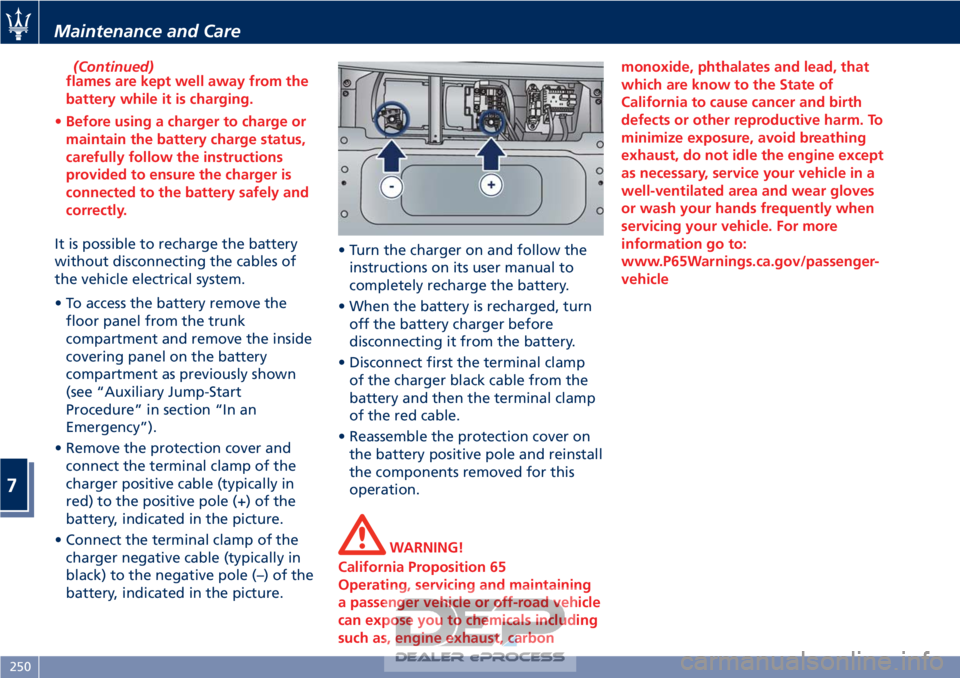
• Remove the protection cover and connect the terminal clamp of the
charger positive cable (typically in
red) to the positive pole (+) of the
battery, indicated in the picture.
• Connect the terminal clamp of the charger negative cable (typically in
black) to the negative pole (–) of the
battery, indicated in the picture. • Turn the charger on and follow the
instructions on its user manual to
completely recharge the battery.
• When the battery is recharged, turn off the battery charger before
disconnecting it from the battery.
• Disconnect first the terminal clamp of the charger black cable from the
battery and then the terminal clamp
of the red cable.
• Reassemble the protection cover on the battery positive pole and reinstall
the components removed for this
operation.
WARNING!
California Proposition 65
Operating, servicing and maintaining
a passenger vehicle or off-road vehicle
can expose you to chemicals including
such as, engine exhaust, carbon monoxide, phthalates and lead, that
which are know to the State of
California to cause cancer and birth
defects or other reproductive harm. To
minimize exposure, avoid breathing
exhaust, do not idle the engine except
as necessary, service your vehicle in a
well-ventilated area and wear gloves
or wash your hands frequently when
servicing your vehicle. For more
information go to:
www.P65Warnings.ca.gov/passenger-
vehicle
Maintenance and Care
7
250
Page 255 of 296
Fuse Replacement
Used Fuses Characteristics
When an electrical device is not
functioning, check that the
corresponding fuse is in proper
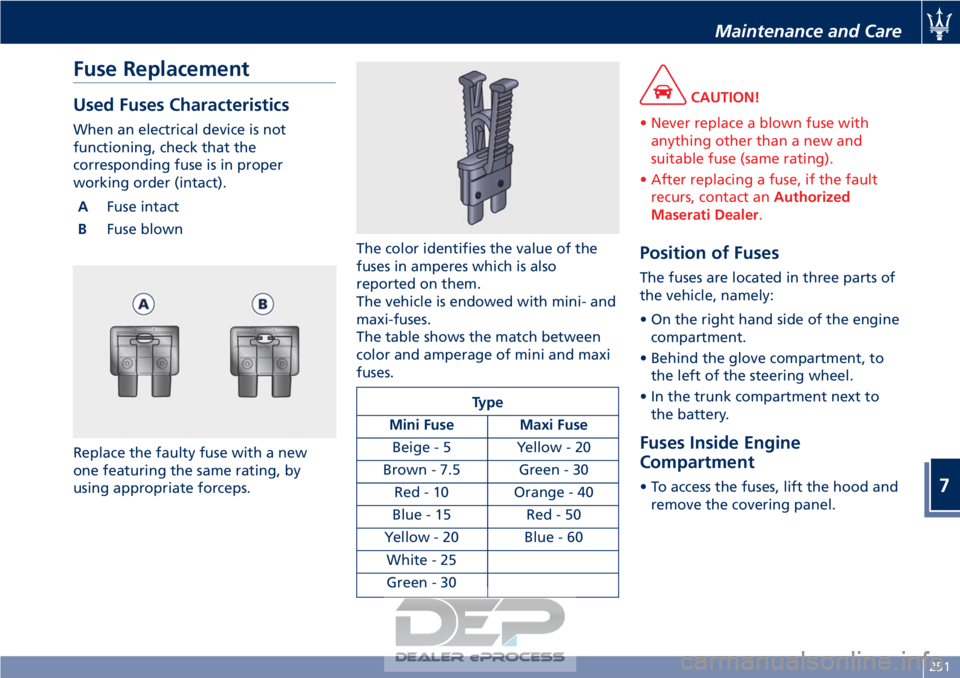
working order (intact).A Fuse intact
B Fuse blown
Replace the faulty fuse with a new
one featuring the same rating, by
using appropriate forceps. The color identifies the value of the
fuses in amperes which is also
reported on them.
The vehicle is endowed with mini- and
maxi-fuses.
The table shows the match between
color and amperage of mini and maxi
fuses.
Type
Mini Fuse Maxi Fuse Beige - 5 Yellow - 20
Brown - 7.5 Green - 30 Red - 10 Orange - 40
Blue-15 Red-50
Yellow - 20 Blue - 60 White - 25
Green - 30
CAUTION!
• Never replace a blown fuse with anything other than a new and
suitable fuse (same rating).
• After replacing a fuse, if the fault recurs, contact an Authorized
Maserati Dealer.
Position of Fuses
The fuses are located in three parts of
the vehicle, namely:
• On the right hand side of the engine compartment.
• Behind the glove compartment, to the left of the steering wheel.
• In the trunk compartment next to the battery.
Fuses Inside Engine
Compartment
• To access the fuses, lift the hood andremove the covering panel.
Maintenance and Care
7
251
Page 259 of 296
Pos. Amp. –Color System / Component
F39 15 A – Blue NIM (Inside Roof
Node), NCL (Air
conditioning and
heating system
node), OBD socket,
CSA (Alarm system
siren ECU), CAV
(Motion sensing
alarm ECU), radio,
NAVTRAK
F40 30 A – Green Heated rear window
F41 - Not used
F42 7.5 A – Brown NCL and windshield
wiper control
F43 30 A – Green Windshield
wiper/washer
(Connected Devices
Relay INT/A)
F44 20 A – Yellow Front and rear power
outlets (INT/A device
relay) front seat
heating (passenger
side)
F45 - Not used
F46 20 A – Yellow NPG/NPP locksPos. Amp. –
Color System / Component
F47 30 A – Green NPG (Driver’s door
node)
F48 30 A – Green NPP (Passenger’s
door node)
F49 7.5 A – Brown NVO (Steering wheel
node), CSG (Power
steering ECU), CSP
(Twilight/rain sensor
ECU), NIM (Inside
Roof Node), NCL,
Radio, CEM, CRP,
domelight molding,
NAVTRAK
F50 7.5 A – Brown Air bag system
F51 7.5 A – Brown NCA (Automatic
Gearbox Node)
F52 15 A – Blue Front seat heating
(driver side) (INT/A
device relay)
F53 10 A – Red Rear fog lights
Fuses in Trunk Compartment
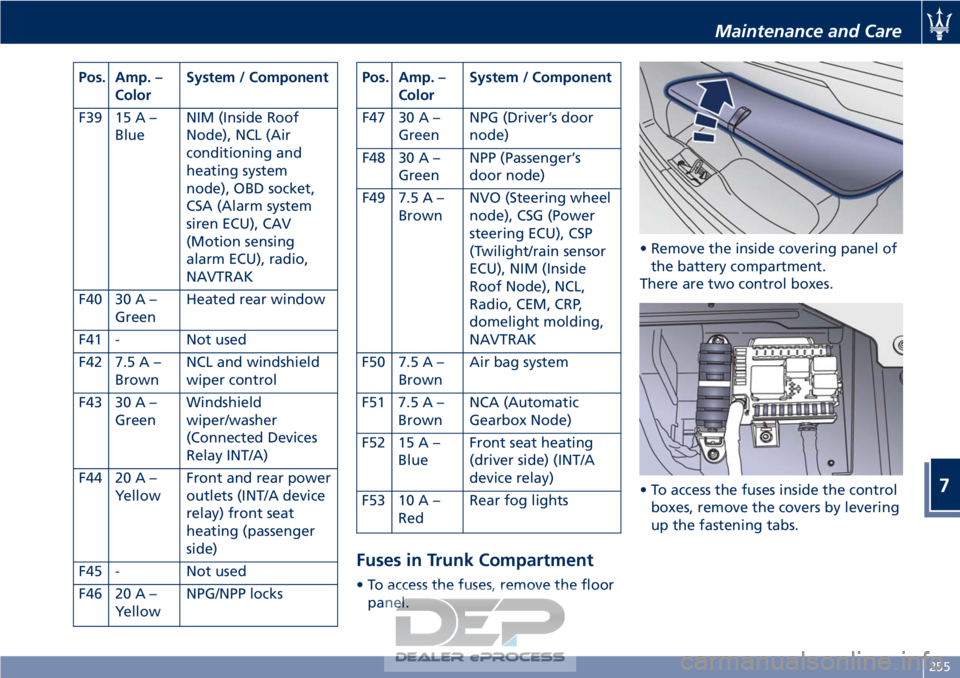
• To access the fuses, remove the floor
panel. • Remove the inside covering panel of
the battery compartment.
There are two control boxes.
• To access the fuses inside the control boxes, remove the covers by levering
up the fastening tabs.
Maintenance and Care
7
255
Page 260 of 296
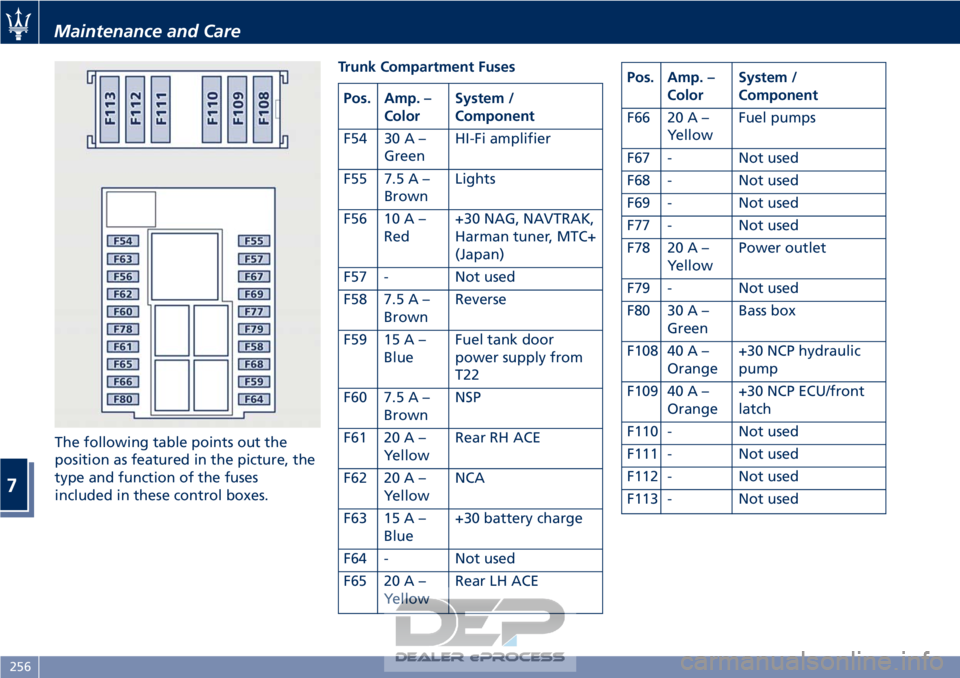
The following table points out the
position as featured in the picture, the
type and function of the fuses
included in these control boxes.Trunk Compartment Fuses
Pos. Amp. –
Color System /
Component
F54 30 A – Green HI-Fi amplifier
F55 7.5 A – Brown Lights
F56 10 A – Red +30 NAG, NAVTRAK,
Harman tuner, MTC+
(Japan)
F57 - Not used
F58 7.5 A – Brown Reverse
F59 15 A – Blue Fuel tank door
power supply from
T22
F60 7.5 A – Brown NSP
F61 20 A – Yellow Rear RH ACE
F62 20 A – Yellow NCA
F63 15 A – Blue +30 battery charge
F64 - Not used
F65 20 A – Yellow Rear LH ACE
Pos. Amp. –
Color System /
Component
F66 20 A – Yellow Fuel pumps
F67 - Not used
F68 - Not used
F69 - Not used
F77 - Not used
F78 20 A – Yellow Power outlet
F79 - Not used
F80 30 A – Green Bass box
F108 40 A – Orange +30 NCP hydraulic
pump
F109 40 A – Orange +30 NCP ECU/front
latch
F110 - Not used
F111 - Not used
F112 - Not used
F113 - Not used
Maintenance and Care
7
256
Page 273 of 296
Vehicle Stored for Long
Periods
If the vehicle is going to be stored for
over a month, follow the below
precautions:
• Wash and dry the vehiclethoroughly.
• Store the vehicle in a covered, dry and, if possible, ventilated area.
• Select P (Park) and turn off the engine.
• Turn the key in the ignition switch in STOP (OFF) position.
• Disconnect the battery (refer “Maintenance-Free Battery” in this
section) or connect a battery charger
(refer to paragraph “Maintaining
Battery Charge” of chapter “Battery
Statement” in this section).
• Check the battery charge status. During parking, this check must be
carried out every three weeks.
Recharge the battery if the open
circuit voltage is lower than 12.2 V.
• Check that the parking brake is NOT engaged.
• Do not empty the engine cooling system.
• Clean and protect the painted parts applying protective wax. • Clean and protect polished metal
parts with special products available
on the market.
• Talc the windshield wiper blades and raise them from the windshield.
• Cover the vehicle with a long cloth in breathable fabric (available from
the Authorized Maserati Dealer ). Do
not use thick plastic sheets, which do
not allow the humidity on the
vehicle surface to evaporate.
• Inflate the tires up to a pressure which must be 1 bar (14.5 psi) higher
than the normally prescribed one,
and check it at regular intervals.
NOTE:
The Authorized Maserati Dealer can
provide you with any information
about the available “Indoor and
Outdoor Car Covers”, available in the
“Genuine Accessories” range.
WARNING!
The tire pressure must be brought
back to the prescribed value before
reusing the vehicle (see “Tire Inflation
Pressure” in section “Features and
Specifications”).
Restarting the Vehicle
Before restarting the vehicle after a
long period of inactivity, we
recommend that you carry out the
following operations.
• Check the tires for pressure and for any damages, cuts or cracks. If this is
the case, have them replaced.
• Do not dry-rub the external surface of the vehicle.
• Visually inspect if there are any fluid leaks (oil, brake and clutch fluid,
engine coolant etc.).
• Have the engine oil and filter replaced.
• Check the fluid levels in the brake system, as well as the engine coolant
level.
• Check the air filter and have them replaced if necessary.
• Reconnect the battery after checking the charge status (refer to
“Maintenance-Free Battery” in this
section) and perform the initializing
procedure if applicable.
• With the transmission in N (Neutral), let the engine idle for several
minutes.
Maintenance and Care
7
269
Page 274 of 296
WARNING!
The engine idle must be performed
outdoors. Exhaust gases contain
carbon monoxide which is strongly
toxic and potentially lethal.
WARNING!
California Proposition 65
Operating, servicing and maintaining
a passenger vehicle or off-road vehicle
can expose you to chemicals including
such as, engine exhaust, carbon
monoxide, phthalates and lead, that
which are know to the State of
California to cause cancer and birth
defects or other reproductive harm. To
minimize exposure, avoid breathing
exhaust, do not idle the engine except
as necessary, service your vehicle in a
well-ventilated area and wear gloves
or wash your hands frequently when
servicing your vehicle. For more
information go to:
www.P65Warnings.ca.gov/passenger-
vehicle
Battery Statement
Battery Statement Status of
Charge
To avoid problems with ignition and/or
the electrical system in general when
you are driving, the battery charge
status is constantly maintained and
guaranteed by the vehicle's recharge
circuit; the main component of which
is the alternator. This circuit is only
able to supply voltage to the battery
when the vehicle is traveling.
The
warning light on the
instrument cluster (see “Instrument
Cluster” in section “Dashboard
Instruments and Controls”), will
indicate any malfunctions in the
recharge circuit or an insufficient
battery charge status (flashing).
The vehicle is fitted with advanced
electronic systems, such as, for
example, the alarm system and various
electronic control modules, which
consume power even when the key in
the ignition switch is in the STOP (OFF)
position and the vehicle is not being
used.
Therefore, it is fundamental that the
battery is properly charged to ensure
that the engine starts properly and that all the electrical/electronic systems
in the vehicle work efficiently.
Maintaining Battery Charge
If you perform short daily trips
(approximately 10 miles/16 km), which
correspond to an annual total of 4000
miles/6000 km, or when the vehicle is
not going to be used for one week or
more, Maserati recommends
connecting the vehicle to a battery
charger, to save you the trouble of
having to recharge the battery (see
“Battery Charge Maintainer
Operation” in this chapter).
The battery charge maintainer will
keep the battery charged properly and
at the correct voltage levels required
by the systems and devices in the
vehicle.
Before using the battery charge
maintainer, carefully follow the
instructions provided.
If you do not use a battery charge
maintainer to prevent the battery
from going dead when you are not
going to use the vehicle for long
periods of time, you need to check and
recharge the battery at least once
every three weeks. Make this check if
you perform short daily trips
(approximately 10 mi/16 km) which
correspond to an annual total of 4000
Maintenance and Care
7
270
Page 275 of 296
miles/6000 km. Please note that
allowing the battery to go dead
repeatedly can cause premature wear
on the internal cells and greatly
reduce their life, leading to problems
with the ignition system and other
electrical/electronic systems.
TheAuthorized Maserati Dealer is
available to advise you on how to
recharge your battery correctly and
give you useful information on battery
care and maintenance.
NOTE:
The Authorized Maserati Dealer can
provide you with any information
about the Maserati approved “Battery
Charger and Conditioner”, available in
the “Genuine Accessories” range.
WARNING!
The process of charging or recharging
the battery produces hydrogen, a
dangerous gas that can explode and
cause serious injuries. When charging
or recharging the battery, follow the
recommended precautions at all
times:
• always charge or recharge the
battery in a well-ventilated
environment; •
never charge or recharge a battery
that has frozen: it can explode due
to hydrogen trapped inside the ice
crystals;
• ensure that any sparks or open
flames are nowhere near the battery
while it is charging;
• before using a charger to charge or
maintain the battery charge status,
carefully follow the instructions
provided to ensure the charger is
connected to the battery safely and
correctly.
Battery Charge Maintainer
Operation
Charge Maintainer Socket
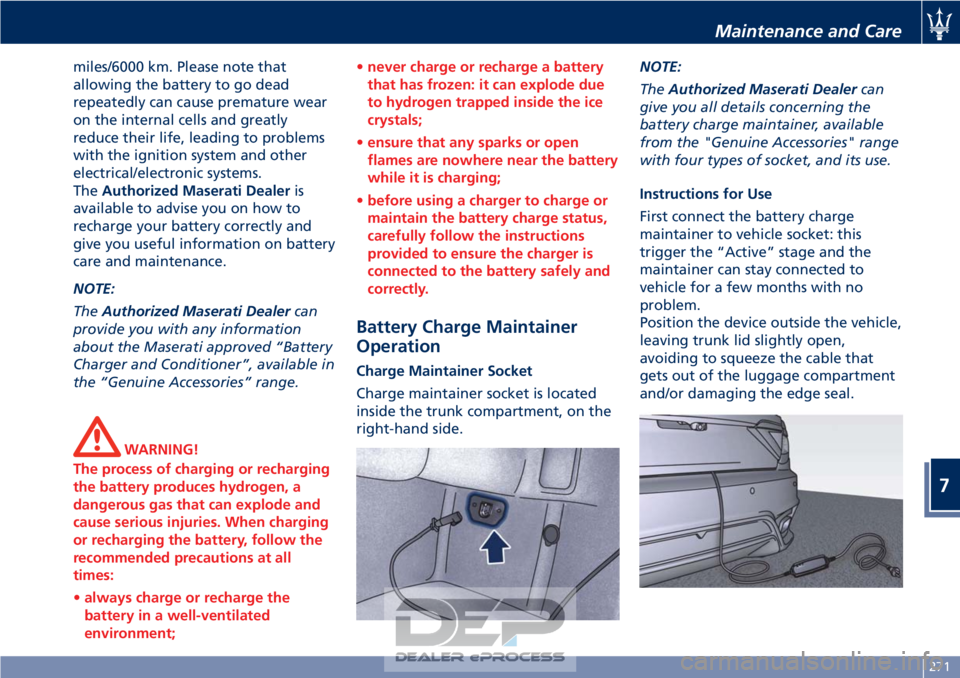
Charge maintainer socket is located
inside the trunk compartment, on the
right-hand side. NOTE:
The
Authorized Maserati Dealer can
give you all details concerning the
battery charge maintainer, available
from the "Genuine Accessories" range
with four types of socket, and its use.
Instructions for Use
First connect the battery charge
maintainer to vehicle socket: this
trigger the “Active” stage and the
maintainer can stay connected to
vehicle for a few months with no
problem.
Position the device outside the vehicle,
leaving trunk lid slightly open,
avoiding to squeeze the cable that
gets out of the luggage compartment
and/or damaging the edge seal.
Maintenance and Care
7
271
Page 276 of 296
WARNING!
Set the battery maintainer in view,
away from any heat source and out of
reach of children.
Battery charge maintaining process
can
be stopped at any time by
disconnecting the power cable from
the mains.
Always disconnect the power cable
mains end first and then remove it
from vehicle socket.
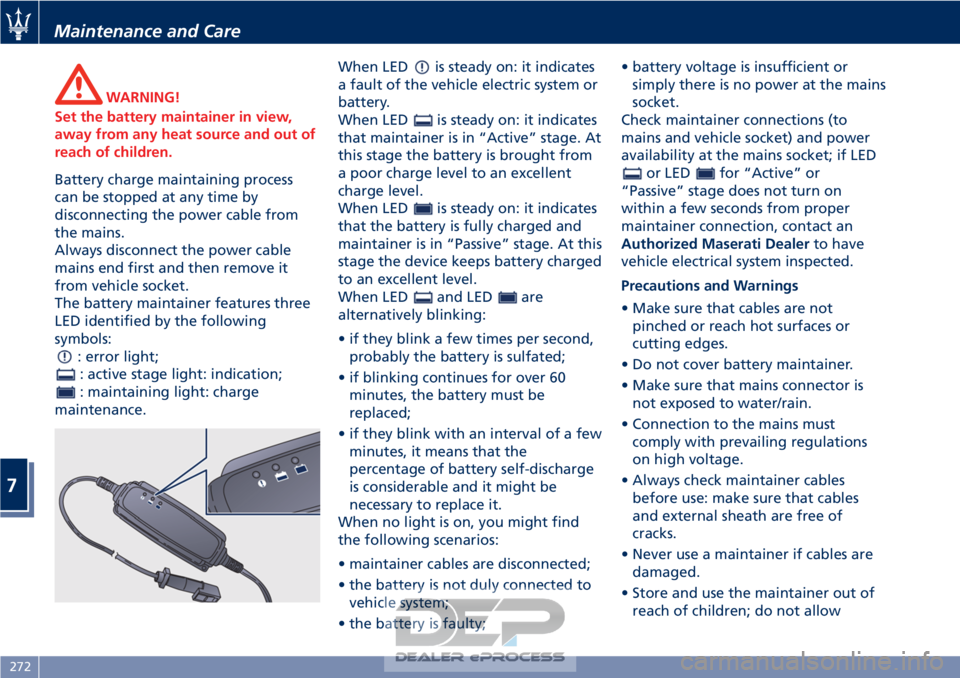
The battery maintainer features three
LED identified by the following
symbols:
: error light;
: active stage light: indication;
: maintaining light: charge
maintenance. When LED
is steady on: it indicates
a fault of the vehicle electric system or
battery.
When LED
is steady on: it indicates
that maintainer is in “Active” stage. At
this stage the battery is brought from
a poor charge level to an excellent
charge level.
When LED
is steady on: it indicates
that the battery is fully charged and
maintainer is in “Passive” stage. At this
stage the device keeps battery charged
to an excellent level.
When LED
and LEDare
alternatively blinking:
• if they blink a few times per second, probably the battery is sulfated;
• if blinking continues for over 60 minutes, the battery must be
replaced;
• if they blink with an interval of a few minutes, it means that the
percentage of battery self-discharge
is considerable and it might be
necessary to replace it.
When no light is on, you might find
the following scenarios:
• maintainer cables are disconnected;
• the battery is not duly connected to vehicle system;
• the battery is faulty; • battery voltage is insufficient or
simply there is no power at the mains
socket.
Check maintainer connections (to
mains and vehicle socket) and power
availability at the mains socket; if LED
or LEDfor “Active” or
“Passive” stage does not turn on
within a few seconds from proper
maintainer connection, contact an
Authorized Maserati Dealer to have
vehicle electrical system inspected.
Precautions and Warnings
• Make sure that cables are not pinched or reach hot surfaces or
cutting edges.
• Do not cover battery maintainer.
• Make sure that mains connector is not exposed to water/rain.
• Connection to the mains must comply with prevailing regulations
on high voltage.
• Always check maintainer cables before use: make sure that cables
and external sheath are free of
cracks.
• Never use a maintainer if cables are damaged.
• Store and use the maintainer out of reach of children; do not allow
Maintenance and Care
7
272
Page 277 of 296
children to play with the battery
charge maintainer.
Protection from Overheating
The supplied battery charge
maintainer features a protection
against overheating.
In case ambient temperature
increases, output power is reduced.
Service
• Battery maintainer does not require any maintenance.
• Do not disassemble the battery maintainer.
• The maintainer case can be cleaned with a soft damp cloth or using mild
detergent.
• Always disconnect the maintainer from the mains before cleaning it.
Maintenance and Care
7
273
Page 290 of 296
Abbreviations.................7
ABS (Anti-lock Braking System) . . .179
A/C Air Filter Replacement .......263
Accessories Aftermarket Parts and Accessories
Statement .................11
Accident, in the event of ........213
A/C System Maintenance ........262
Airbag.....................46 Air bag System Components .....46
Air bag Warning Light .........66
Passenger Air bag Labels .......18
Supplemental Restraint System
(SRS) .....................46
Air Conditioning Controls .......151
Air Conditioning Distribution .....112
Alarm, Vehicle Security ..........26
ALR (Automatic Locking Retractor) . .43
Assistance ....................9
Assistance, if you need .........9
Audio Controls ...............138
Steering Wheel Audio Controls . .138
Audio, Customer Setting ........147
Audio System ................140
Automatic Transmission ........160
Automatic Transmission Range . .162
AUX, USB and SD Memory Card Ports .....................132
Battery ....................247
Access the Battery ...........226
Jump Start Procedure ........226
Maintenance - Free Battery . . . .247 To Reconnect the Battery
......248
Bluetooth, Customer settings .....147
Bodywork Maintenance and Care . .265 Protection from Atmospheric
Agents ..................265
Useful Advice to Keep the
Bodywork in Good Condition . . .265
Brakes Brake and Stability Control
System ...................177
Brake Fluid Level Check .......242
Brake Overheating ..........182
Parking Brake ..............174
Parking Brake - Manual
Release ..................220
Using the Brakes ............181
Bulb Replacement ............257
Cargo Area .................107
Child Restraint Systems
Children too large for Booster
Seats .....................
56
Infants and Child Restraints .....55
Lower Anchors and Tether for
Children (LATCH) ............57
Older Children and Child
Restraints .................55
Tips on getting the most out of
your child restraint ...........56
Clock, analog ................144
Comfort Pack Front Seats ........76
Driver Memory Seat ..........77
Front Heated Seats ...........76 Console
Central Console Components ....73
Front Dome Console
Components ...............71
Cruise Control ...............185
Cupholders Front Seats Cupholders .......103
Rear Seats Cupholders ........104
Dashboard Components .........70
Data, Technical ..............279
Defroster ...................66
Doors Components .............72
Drive Mode, Controls ..........169
Driving Conditions Before the Trip .............204
Driving at Night ............204
Driving in Fog ..............205
Driving in the Mountains ......205
Driving in the Rain ..........204
Driving on Snow or Ice ........206
Driving through Flooded
Sections ..................206
Safe Driving ...............204
DRL (Daytime Running Light) ......83
Easy Entry/Exit function .........79
EDR (Event Data Recorder) .......52
Emergency Emergency Fuel Filler Door
Release ..................203
Hazard Warning Flasher .......88
In the Event of an Accident . . . .213
Index
9
286