brake fluid MAZDA 323 1992 Workshop Manual Suplement
[x] Cancel search | Manufacturer: MAZDA, Model Year: 1992, Model line: 323, Model: MAZDA 323 1992Pages: 279, PDF Size: 24.15 MB
Page 7 of 279
GI HOW TO USE THIS MANUAL/FUNDAMENTAL PROCEDURES
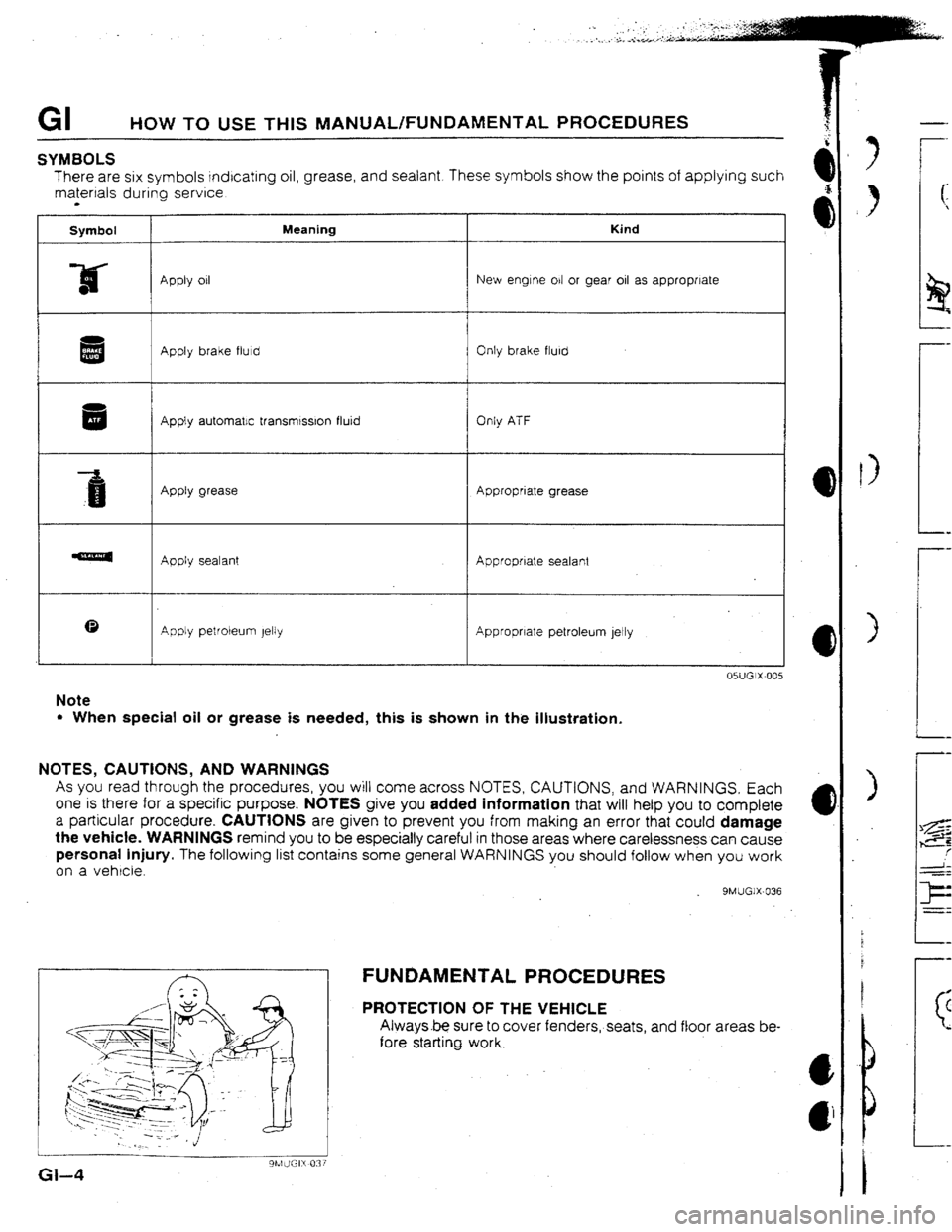
SYM00LS
There are six symbols indicating oil, grease, and sealant. These symbols show the points of applying such
matertals during service
*
Symbol
w-
l Apply otl Meaning Kind
New engtne 011 or gear 011 as approprkate
Apply brake fluid Only brake fluId
I
Apply automatic transmtsslon fluid Only ATF
Apply grease Appropriate grease
Apply sealant Approprrate sealant
0
Apply petroleum Jelly
Appropriate petroleum jetty
05UGIX-005 Note
l When special oil or grease is needed, this is shown in the illustration.
NOTES, CAUTIONS, AND WARNINGS
As you read through the procedures, you will come across NOTES, CAUTIONS, and WARNINGS. Each
one IS there fur a specific purpose.
NOTES give you added information that wilt help you to complete
a particular procedure. CAUTlONS are given to prevent you from making an error that could damage
the vehicle. WARNINGS remind you to be especially careful in those areas where carelessness can cause
personal injury. The following list contains some general WARNINGS you should follow when you work
on a vehrcle
. 9MUGlX.036
FUNDAMENTAL PROCEDURES PROTECTION OF THE VEHICLE
Always .be sure to cover fenders, seats, and
fore starting work. floor areas be-
1
T.
i
8
s
Q
8
e
Page 21 of 279
A PRE-DELIVERY INSPECTION TABLE
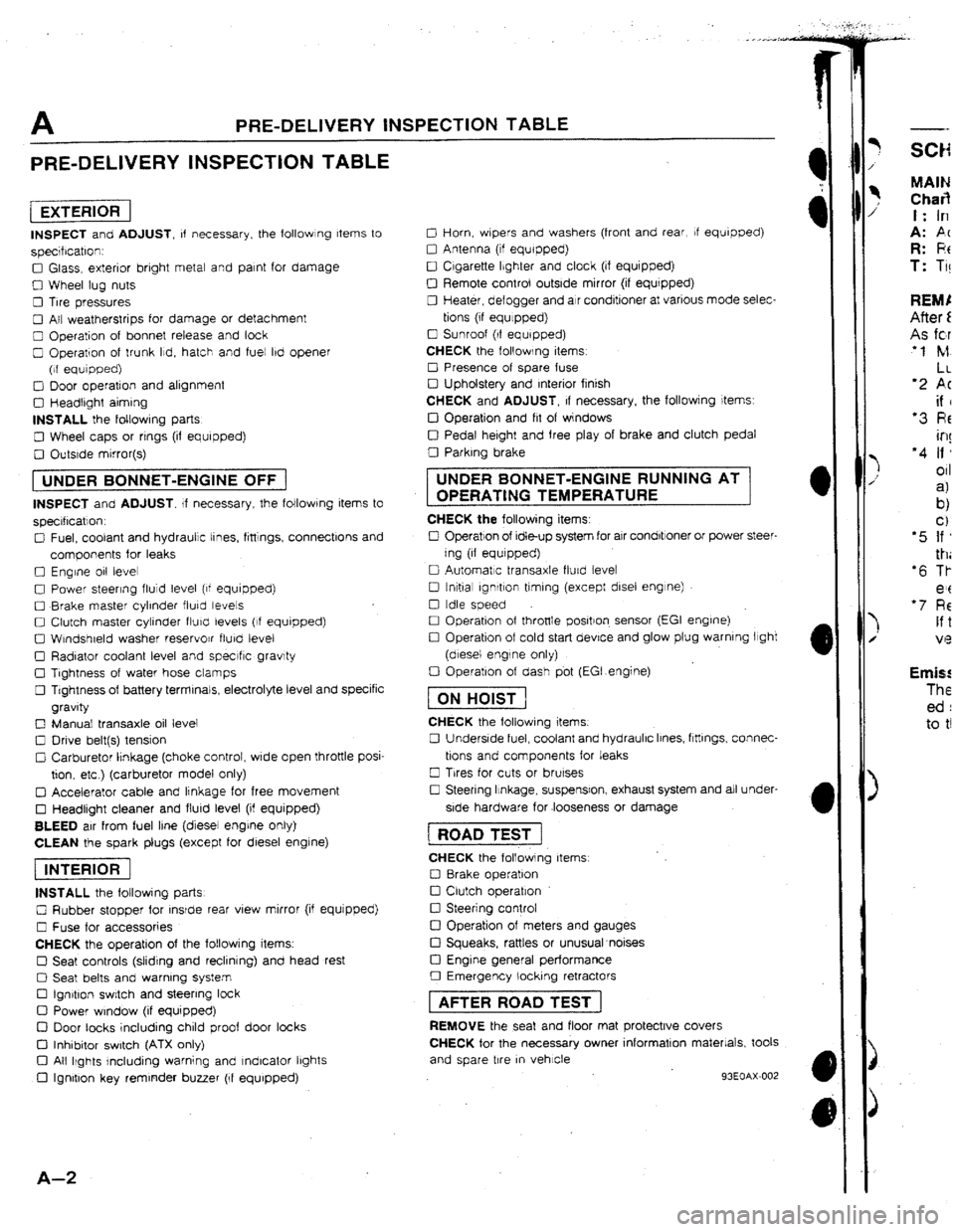
PRE-DELIVERY INSPECTION TABLE
[EXTERlORI
INSPECT and ADJUST, of necessary. the followlng Items to
specrfrcatron:
0 Glass, exterior bright metal and paint for damage
0 Wheel lug nuts
0 Tire pressures
0 All weatherstrips for damage or detachment
0 Operation of bonnet release and look
0 Operation of trunk Ild, hatch and fuel lbd opener
(of equipped)
0 Door operation and alignment
0 Headtrght aiming
INSTALL the foltowrng parts
0 Wheel caps or rrngs (if equipped)
0 Outsrde mirror(s)
1 UNDER BONNET-ENGINE OFF j
INSPECT and ADJUST. If necessary, the following items to
specrflcatlon.
0 Fuel, coolant and hydraulic tines, fittings, connectlons and
components for leaks
0 Engine 011 level
0 Power steering fluid level (of equipped)
0 Brake master cylinder fluky levels
0 Clutch master cylinder fturcl levels (If equipped)
0 Wtndshreld washer reservojr flurd level
0 Radiator coolant level and specrfic gravity
0 Tightness of water hose clamps
0 Tightness of battery terminals, electrolyte level and specific
gravity
0 Manual transaxle oil level
0 Drive belt(s) tension
Cl Carburetor lrnkage (choke control, wrde open throttle posi-
tion. etc ) (carburetor model only)
q Accelerator cable and linkage for free movement
0 Headlight cleaner and flurd level (if equipped)
BLEED air from fuel line (diesel engrne only)
CLEAN the spark plugs (except for diesel engine)
piEi6F]
INSTALL the following parts
0 Rubber stopper for rnsrde rear view mirror (if equjpped)
0 Fuse for accessories
CHECK the operation of the following items.
0 Seat controls (sliding and reclining) and head rest
0 Seat belts and warning system
Cl Ign&on switch and steering lock
0 Power window (if equipped)
D Door tacks including child proof door locks
Cl Inhibitor switch (ATX only)
Cl All Ikghts rncluding warning and Indicator lbghts
0 Ignition key reminder buzzer (If equipped)
A-Z
0 Horn, wbpers and washers (front and rear, If equipped)
0 Antenna (tf equipped)
0 Cigarette Ibghter and clock (if equipped)
0 Remote control outside mirror (if equrpped)
0 Heater, defogger and air conditioner at various mode selec-
tions (if equlppedj
0 Sunroof (If equipped)
CHECK the following items
0 Presence of spare fuse
0 Upholstery and Interior finish
CHECK and ADJUST, If necessary, the followjng items:
IJ Operation and fit of windows
0 Pedal height and free play of brake and clutch pedal
0 Parking brake UNDER BONNET-ENGINE RUNNING AT
OPERATING TEMPERATURE
CHECK the following items:
0 Operation of Idle-up system for air condbtroner or power steer-
ing (if equrpped)
0 Automatic transaxle flurd levet
0 tnltial ignrtlon timing (except disel engine)
0 Idle speed
0 Operation of throttle positron. sensor (EGI engrne)
0 Operation of cold start device and glow plug warning light
(diesel engine only)
0 Operation of dash pbt (EGI.engine)
fTiGGJ
CHECK the following items.
0 Underside fuel, coolant and hydraulic Irnes, ftttlngs, connec-
tions and components for leaks
0 Trres for cuts or brurses
0 Steering Itnkage, suspensron, exhaust system and all under-
side hardware for .looseness or damage 1 ROAD TEST j
CHECK the following items
0 8rake operation
0 Clutch operation
0 Steering control
!ZI Operation of meters and gauges
Cl Squeaks, rattles or unusual noises
Cl Engine general performance
0 Emergency locking retractors 1 AFTER ROAD TEST ]
REMOVE the seat and floor mat protective covers
CHECK for the necessary owner information materials, took
and spare tire
m vehicle
93EOAX-002
-- MAIN Char3 t: In
A: PC R: F!t T: Ti! Emis! The ed : to t!
Page 22 of 279
SCHEDULED MAINTENANCE SERVICES A
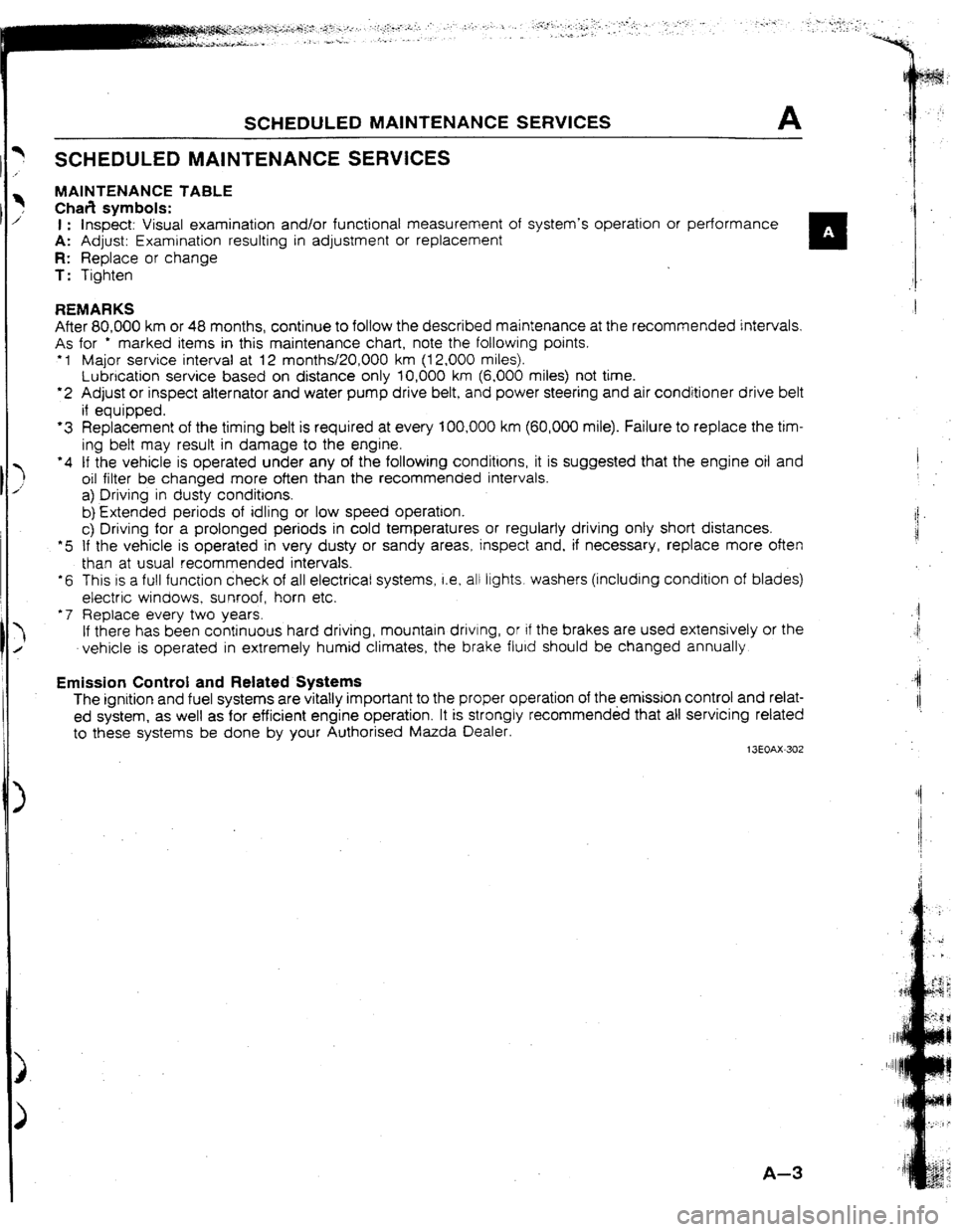
SCHEDULED MAINTENANCE SERVICES
MAINTENANCE TABLE
Chafi symbols:
1 : Inspect: Visual examination and/or functional measurement of system’s operation or
performance , A: Adjust: Examination resulting in adjustment or replacement
n
R: Replace or change
T: Tighten
REMARKS
After 80,000 km or 48 months, continue to follow the described maintenance at the recommended intervals.
As for * marked items in this maintenance chart, note the following points.
+ 1 Major service interval at 12 months/20,000 km (12,000 miles).
Lubrication service based on distance only 10,000 km (6,000 miles) not time.
l 2 Adjust or inspect alternator and water pump drive belt, and power steering and air conditioner drive belt
if equipped.
‘3 Replacement of the timing belt is required at every 100,000 km (60,000 mile). Failure to replace the tim-
ing bett may result in damage to the engine.
‘4 tf the vehicle is operated under any of the following conditions, it is suggested that the engine oil and
oil filter be changed more often than the recommended intervals.
a) Driving in dusty conditions. I
:
b) Extended periods of idling or low speed operation. i
i!
c) Driving for a prolonged periods in cold temperatures or regularly driving onty short distances.
*5 If the vehicle is operated in very dusty or sandy areas, inspect and, if necessary, replace more often
than at usual recommended intervals.
l 6 This IS a full function check of all electrical systems, i.e, atl
ltghts. washers (including condition of blades)
electric windows, sunroof, horn etc.
‘7 Replace every two years. $1
‘I
If there has been continuous hard driving, mountain
drivtng, or if the brakes are used extensively or the
vehicle is operated in extremely humid climates, the brake fluid should be changed annually.
Emission Control and Related Systems
The ignition and fuel systems are vitally important to the proper operation of the-emission control and relat-
ed system, as well as for efficient engine operation. It is strongly recommended that all servicing related
to these systems be done by your Authorised Mazda Dealer.
13EOAX-302 -4
I!
A-3
Page 95 of 279

OUTLINE M
OUTttNE
OUTLiNE OF CONSTRUCTION
l TKe construction and operation of the front and rear axles are basically the same as previous models.
l Because of the use of a high power engine, the following parts are modified to improve rigidity.
(I) Larger front and rear bearings are used.
(2) Larger front and rear knuckles are used.
(3) A five-stud wheel hub is used.
l An ice scraper is newly installed on the rear knuckle to prevent ice from building up on the brake caliper.
(Refer to page M-14.)
13EOMX-303
SPECIWCATIONS
Hem Speclficatlons
Front driveshaft
Joint type inside
Double offset joint
Outsrde Bell joint
Length of joint (between center of joint) Right
392 I15.4)
mm lrn)
Left 306 IO.831
Shaft drameter mm fin)
21.0 (0.83)
Rear driveshaft
Inside
Joint type Double offset joint
Outside 5ell joint
Length of joint (between center of joint) Right
519.5 [ 20.5 1
mm [in]
Left.
489.5 ( 19.3 )
Shaft diameter mm (in) 21.0 [O&3]
Joint shaft
I
Length of joint
Shaft diameter
Front axle
mm jin] 357.2 114.11
mm {in] 21.0 {0.83]
4
Bearing play axial direction mm tin)
0.05 IO.002 ]
I
Rear axle
Bearing play axial direction mm (inj
Rear dtfferentlal (viscous limited slip differential) 0.05 (0.002 1
Reduction aear Hypoid gear
Differentral gear
Drfferential ratio Straight bevel gear
3.909
Number of teeth Ring gear .
Drive binion aear
43
If
Fluid I Grade API Service GL-5
Above -t8*C (O*F) SAE 90
Viscosity .
Below -18*C i O*Fl SAE 8OW
1 I Capacity L I US qt, imp stl 1 0.65 !O.SS, 0.571
1
13EOMX-304
M-3
Page 114 of 279

OUTLlNE P
OUTLfNE
OUTLINE OF CONSTRUCTION
l The brake system remains similar to that of the previous model. l However, because all new models use a higher-horsepower engine, the brake system is enlarged as a whole.
l Vehicles without ABS use a portless-type master cylinder
13EOPX-303
SPECIFICATIONS
Brake pedal
Master cylinder
Front drsc brake
Rear disc brake
Power brake unit
Braking force control device
Brake fluid
Parking brake Item Specification
Type Suspended
I
PedaJ lever ratio 4.1
Max. stroke mm [in] 140 j5.511
I,
Type Tandem
Cylinder inner diameter mm {in] Without ABS: 25.4 j 1 .UO ]
With ABS: 23.8 to.941 3-
Type Ventilated disc ?
Cylinder bore mm [in)
57.2 12.253
Pad dimensions (area x thickness)
mm2 {rn2) xmm [In) 5,200 (8.OSl x 10 (0.39)
Disc plate dimensions mm (in]
(outer diameter x thickness) 274x24 (10.79x0.94)
Type Solid disc
Cylinder bore mm Jon]
34.9 j 1.37 ]
Pad dimensions (area x thrckness)
mm’ (in21 xmm [in) 3,200 I4.961 x8 (0.31)
DISC plate dimensions mm t,n]
(outer diameter x thickness) 280x10 (tl.02xu.39]
il
Type Without ABS: Vacuum multIplier
With ABS: Hydraulrc muttiplier
Diameter mm Iln]
(without ABS) 188.4 17.42) +215.2 t8.47)
We Without ABS: Dual proportioning valve
With ASS: Proportioning valve
FMVSS 116, DOT-3, SAE J1703
Mechanical twGrear-wheel control
Type
Operation system Center lever
13EOPX.304 t
Page 116 of 279

I :
;!
i
I
I
CONVENTIONAL BRAKE SYSTEM P
CONVENTIONAL BRAKE SYSTEM
PREPARATION
SST
49 0259 770B
Wrench, fiare nut For
removal and 49 U043 OAO
Gauge set, oil
pressure For
Inspectron of
brake fluId
pressure
49 uo43 004
Gauge, oil
pressure
{Part 04
49 U043 OAO) For
inspection of
brake fluid
pressure 49 UO43 005
Joint
(Part of
49 UO43 OAO) For
inspection of
brake fluid
o pressure
49 0208 70tA
Air-out tool, boot For
removal of
piston seal 49 FAf8 602
Wrench, disc
brake piston For
removal and
installat!on of disc
call per piston
49 1258 071
Puller, bearing For 49 0221 600C
removal of caliper
a-- E;.;d tool, disc needle bearing For
installation of
brake pads
Page 117 of 279
P CONVENTIONAL BRAKE SYSTEM
93GOW74:
13EOPX-307
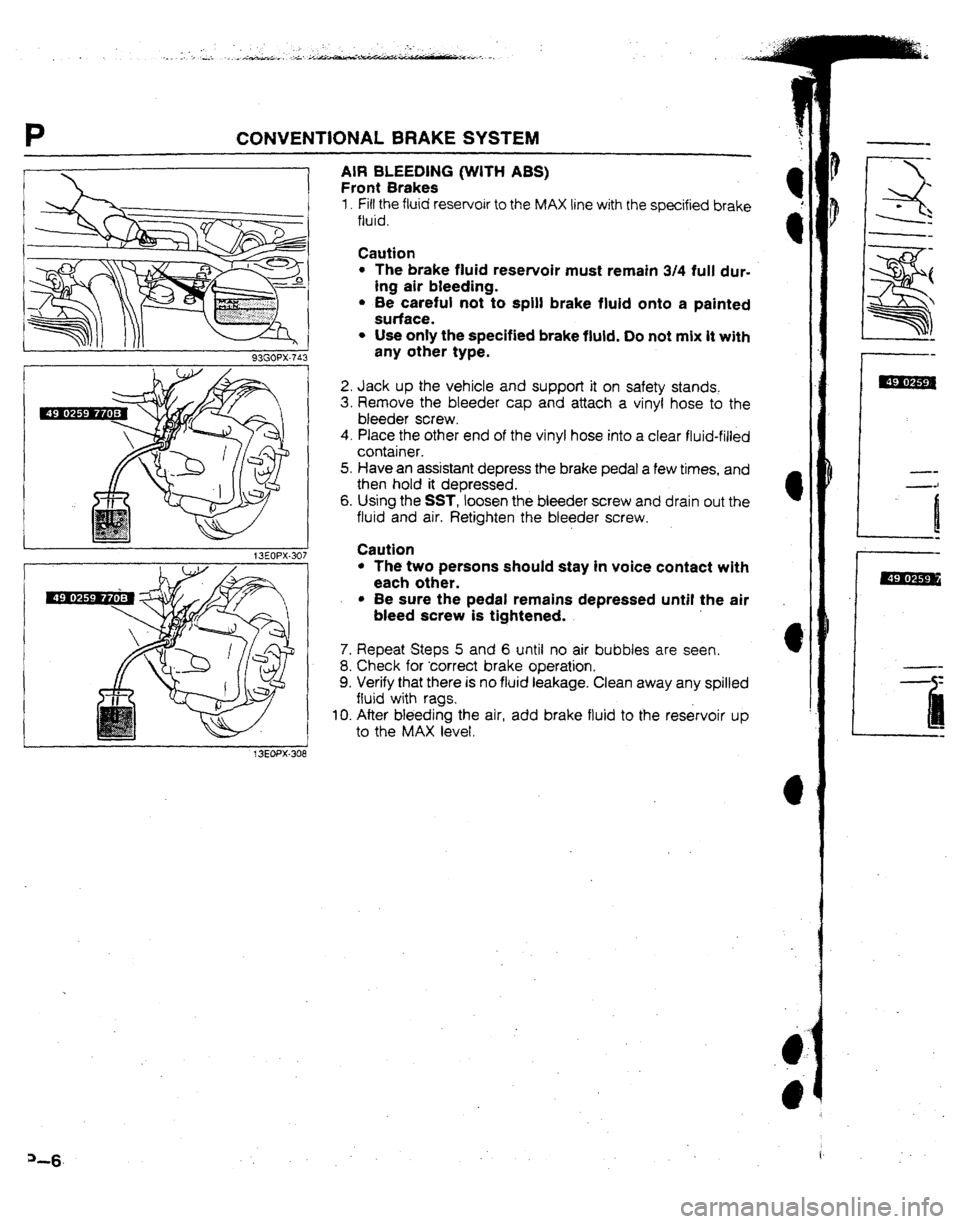
AIR BLEEDlNG (WITH ABS)
Front Brakes
1. Fill the fluid reservoir to the MAX line with the specified brake
fluid.
Caution
l The brake fluid reservoir must remain 3/4 full dur-
ing air bleeding.
l Be careful not to spill brake fluid onto a painted
surface.
l Use only the specified brake fluid. Do not mix it with
any other type.
2. Jack up the vehicle and support it on safety stands.
3. Remove the bleeder cap and attach a vinyl hose to the
bleeder screw.
4. PIace the other end of the vinyl hose into a clear fluid-filled
container.
5. Have an assistant depress the brake pedal a few times, and
then hold it depressed.
6. Using the SST, loosen the bleeder screw and drain out the
fluid and air. Retighten the bleeder screw.
Caution
l The two persons should stay in voice contact with
each other.
l Be sure the pedal remains depressed until the air
bleed screw is tightened.
7. Repeat Steps 5 and 6 until no air bubbles are seen.
8. Check for ‘correct brake operation.
9. Verify that there is no fluid leakage. Clean away any spilled
fluid with rags.
IO. After bleeding the air, add brake fluid to the reservoir up
to the MAX level.
Page 118 of 279
CONVENTlONAL BRAKE SYSTEM P
13EOPX-309
f3EOPX-310
13EOPX-311
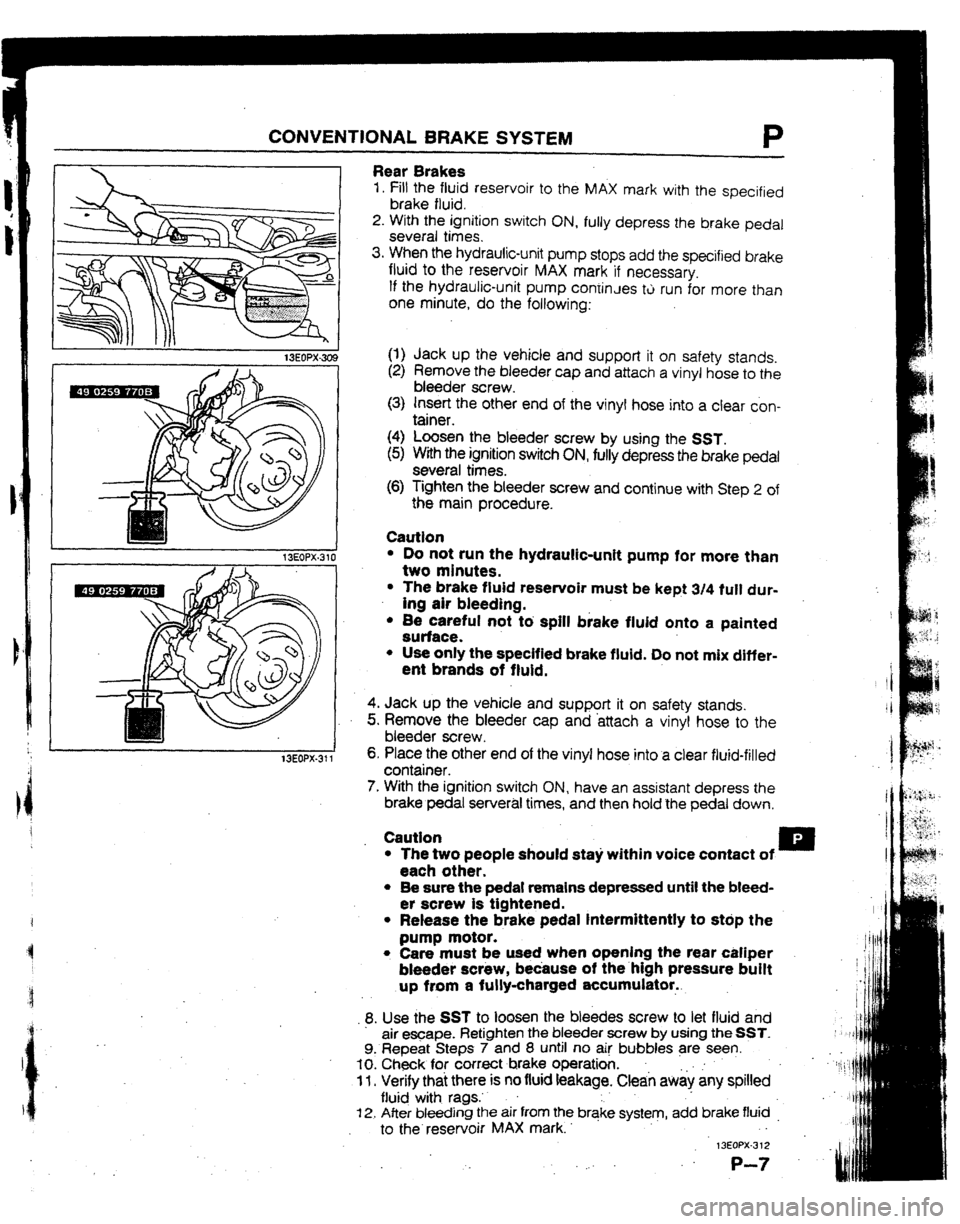
Rear Brakes
1. Fill the fluid reservoir to the MAX mark with the specified
brake fluid.
2. With the ignition switch ON, fully depress the brake pedal
several times.
3. When the hydraulic-unit pump stops add the specified brake
fluid to the reservoir MAX mark if necessary,
If the hydraulic-unit pump coniinJes tti run for more than
one minute, do the following:
(1) Jack up the vehicle and support it on safety stands.
(2) Remove the bleeder cap and attach a vinyl hose to the
bleeder screw.
(3) Insert the other end of the vinyl hose into a clear con-
tainer.
(4) Loosen the bleeder screw by using the SST.
(5) With the ignition switch ON, fully depress the brake pedal
several times.
(6) Tighten the bleeder screw and continue with Step 2 of
the main procedure.
Cautfon
l Do not run the hydraulic-unit pump for more than
two minutes.
l The brake fluid reservoir must be kept 3/4 fult dur-
ing air bleeding.
l 8e careful not tb spill brake fluid onto a painted
surface.
l Use only the specified brake fluid. Do not mix differ-
ent brands of fluid.
4. Jack up the vehicle and support it on safety stands.
5. Remove the bleeder cap and -attach a vinyl hose to the
bleeder screw I
6, Place the other end of the vinyl hose into a clear fluid-filled
container.
7. With the ignition switch ON, have an assistant depress the
brake pedal serveral times, and then hold the pedal down.
Caution .
l The two people should sta)i within voice contact of u
each other.
l Be sure the pedal remains depressed until the bleed-
er screw is tightened.
l Release the brake pedal intermittently to stdp the
pump motor.
l Care must be used when opening the rear caliper
bleeder screw, because of the.high pressure buift
up from a fully-charged accumulator..
9. Use the SST to loosen the bleedes screw to let fluid and
air e-ape. Retighten the bleeder screw by using the SST.
9. Repeat Steps 7 and 8 until no ai! bubbles are seen.
IO. Check for correct brake operation. .
11 l Verify thai there is no fluid feakage. Clean aw& any spilled
flu@ with rags.’ .
f 2. After bleeding the air from the brqke system, add brake fluid _
to the reservoir MAX mark. . -
13EOPX-3 12
,: .
P-7
Page 119 of 279

P CONVENTIONAL BRAKE SYSTEM
1 t3EOPX.314
@ 66.7 kPa
Iso0 mmHg.
19.7 inHg)
16EOPX-05t
1
13EOPX.315
P-8
POWER BRAKE UNIT
Quick Inspection (On-vehicle)
Power brake unit function check
(Method-using tester)
Connect the SST, vacuum gauge A, and pedal depression
force gauge B as shown in the figure. After bleeding the
air from the SST, conduct the test as described in the 3steps
below.
Note l
Use commercMty available vacuum gauge and ped.
al depression force gauge.
a) Checking for vacuum loss
Unloaded condition
1. Start the engine.
2. Stop the engine when the vacuum gauge reading reaches
66.7 kPa (500 mmHg, 19.7 inHg ) .
3. Observe the vacuum gauge for 15 seconds. If the gauge
shows 63.3-66.7 kPa [475--500 mmHg, 18.7-19.7
inHg 1, the unit is operating.
Loaded condition
1. Start the engine.
2. Depress the brake pedal with a fdrrce of 196 N I20 kgf,
44 Ibfj.
3. With the brake pedal depressed, stop the engine when the
vacuum gauge reading reaches 66.7 kPa {SO0 mmlig,
19.7 inHg].
4. Observe the vacuum gauge for 15 seconds. If the gauge
shows 63.3-66.7 kPa I475--500 mmHg; 18.7-l 9.7
inHg 1, the unit is operating.
b) Checking for hydraulic pressure
1, If with the engine stopped (vacuum 0 kPa (0 mmHg, 0
hltlg 1) the fluid pressure is within specification, the unit is
operating.
Pedal force N fkgf. Ibf]
Fluid pressure kPa (kgf/cm2, psi)
196 LZO. 441 1080 111. 1561 min.
2, Start the engine. Depress the brake pedal when.the vacu-
urn reaches 66.7 kPa 1500 mmHg, 19.7 intlg 1. If the flu-
id pressure is within specification, the unit is operating.
Pedal force N 1 kgf, fbf I Fluid pressure .kPa { kgflcm’. ps 1
196 I20,441 6670 {68, 967
1 min.
-- WlTHOU
&
d
I=-
-
1 MASTER CYUh
.
i_
Page 120 of 279

CONVENTIONAL BRAKE SYSTEM P
WlfH ABS
1 f3EOPX-3 I 7
I* 44 44’
/
13EOPX-318
MASTER CYLINDER PRESSURE kPa f kgffcm2, psi 1
16AOPX-m 0
PRUPORTIONING VALVE
Inspection
1. Connect the SST to the brake pipes with adapters as shown
in the figure.
Adapter and flare nut tightening torque:
12.8-21.5 Nsm f 130-220 kgfcm, I 134 90 inlbf 1
Note
l Disconnect and connect the brake pipes with SST.
2. Bleed the air from the brake system.
3. Depress the brake pedal until the master cylinder pressure
equals A; then record rear brake pressure A’.
4. Depress the brake pedal again, apply additional pressure
until the pressure equals B; then record pressure B’.
Fluid pressure
kPa { kgVcm2, psi]
A
A’ 8
8’
WITHOUT 1960
1960
ABS 120, 284 (20,284] 5880
1 al96 12, 28)
(60, 853) 2750 (28, 3881
*I96 12,281
WITH ABS $;;4 1960 f 20,284) 5880
1 *196 12,261 160, 853 3140 {32, 455)
1
*294 [3,42)
-,
--.
. p-g.’