fuel MAZDA 626 1987 Workshop Manual
[x] Cancel search | Manufacturer: MAZDA, Model Year: 1987, Model line: 626, Model: MAZDA 626 1987Pages: 1865, PDF Size: 94.35 MB
Page 627 of 1865

4C FUEL SYSTEM
Inspection
1. Check the fuel tank for cracks and corrosion.
2. If any defect is found, repair or replace the tank.
Warning
Before repairing, clean the fuel tank thorough-
ly with steam to remove all explosive fuel and
fumes.
Installation
Install in the reverse order of removal, referring to the installation note.
Torque Specifications
4C-66
76G04C-126
Page 628 of 1865

FUEL SYSTEM 4C
Installation note
Hoses
1. Push the ends of the main fuel hose, fuel return
hose, and evaporation hoses onto the fuel tank fit-
tings at least 25 mm (1.0 in).
2. Push the fuel filler hose onto the fuel tank pipe and
filler pipe at least 35 mm (1.4 in).
Steering angle transfer shaft
(4-wheel steering)
Refer to section 10
4C—67
Page 629 of 1865

4C PRC SYSTEM
PRESSURE REGULATOR CONTROL
(PRC)
SYSTEM
Distributor (Ne signal)
I Fuel
(To fuel tank)
76G04C-128
To prevent percolation of the fuel during idle after the engine is restarted, vacuum is cut to the pres-
sure regulator, increasing the fuel pressure.
Specified time: Approx. 120 sec.
Operating condition: Coolant temperature — above 70°C (158°F)
Intake air temperature — above 30°C (86°F)....Unleaded fuel
above 50°C (122°F)....Leaded fuel
4C-68
Page 630 of 1865
PRC SYSTEM 4C
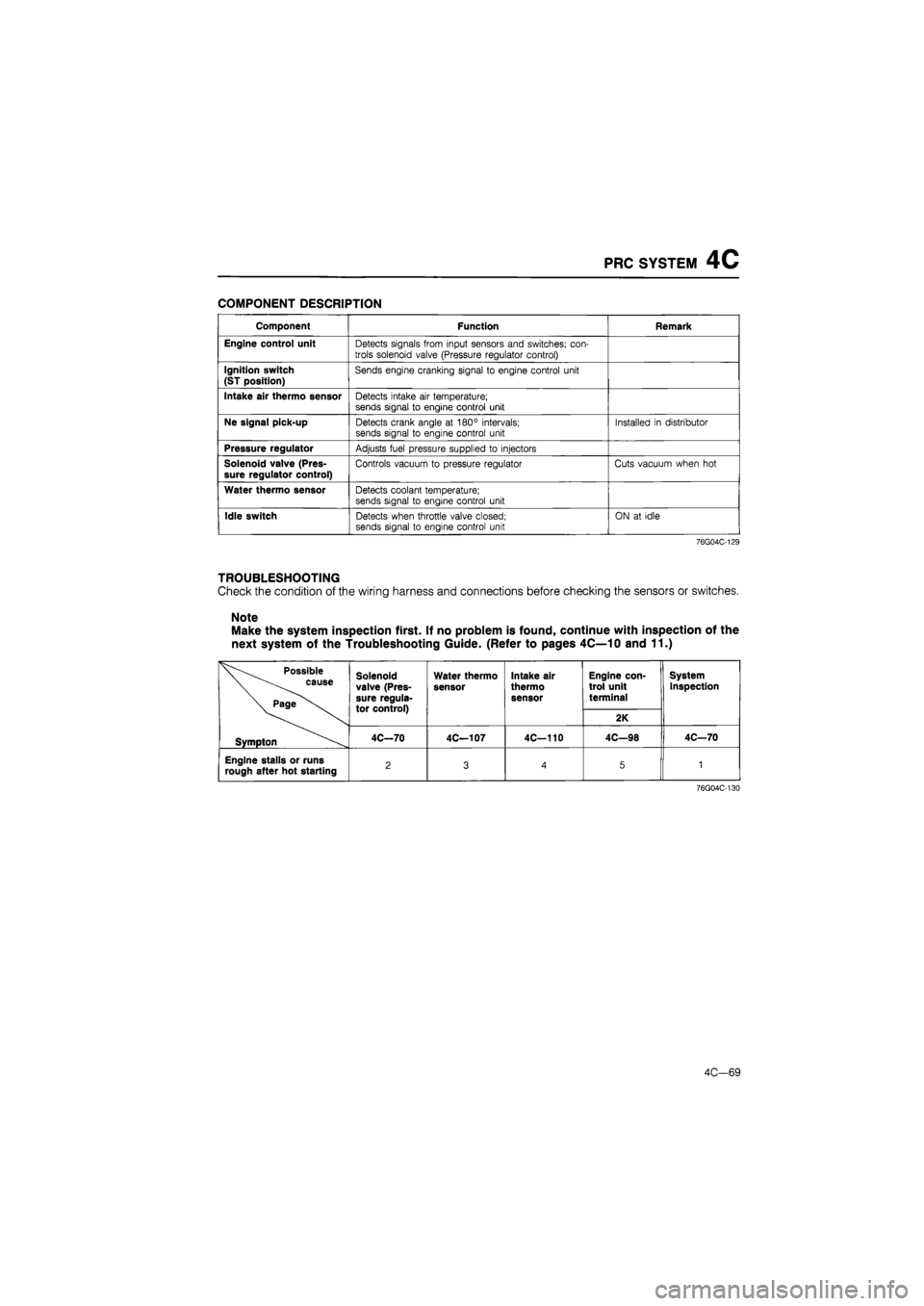
COMPONENT DESCRIPTION
Component Function Remark
Engine control unit Detects signals from input sensors and switches; con-trols solenoid valve (Pressure regulator control)
Ignition switch
(ST position)
Sends engine cranking signal to engine control unit
Intake air thermo sensor Detects intake air temperature; sends signal to engine control unit
Ne signal pick-up Detects crank angle at 180° intervals; sends signal to engine control unit Installed in distributor
Pressure regulator Adjusts fuel pressure supplied to injectors
Solenoid valve (Pres-
sure regulator control)
Controls vacuum to pressure regulator Cuts vacuum when hot
Water thermo sensor Detects coolant temperature; sends signal to engine control unit
Idle switch Detects when throttle valve closed; sends signal to engine control unit ON at idle
76G04C-129
TROUBLESHOOTING
Check the condition of the wiring harness and connections before checking the sensors or switches.
Note
Make the system inspection first. If no problem is found, continue with inspection of the
next system of the Troubleshooting Guide. (Refer to pages 4C—10 and 11.)
Possible
\ cause
\ Page
Solenoid valve (Pres-sure regula-tor control)
Water thermo
sensor
Intake air
thermo
sensor
Engine con-trol unit terminal
System inspection Solenoid valve (Pres-sure regula-tor control) 2K
Symplon 4C—70 4C—107 4C-110 4C—98 4C—70
Engine stalls or runs rough after hot starting 2 3 4 5 1
76G04C-130
4C-69
Page 631 of 1865

4C PRC SYSTEM
System Inspection
1. Connect the SST to the engine. (Refer to page
4C-53.)
2. Start the engine.
76G04C-131
Hi?
Jpll ssil
Water thermo sensor ^^^Tta^e air thermo sensor
76G04C-132
Operating time Fuel line pressure kPa (kg/cm2, psi)
After starting: for 120 sec. 235-275 (2.4-2.8, 34-40)
After 120 sec. 186-226 (1.9-2.3, 27-33)
3. Warm up the engine to normal operating temper-
ature and stop the engine.
Warning
Be careful when disconnecting the water ther-
mo sensor connector because the surround-
ing area is very hot.
4. Disconnect the water thermo sensor connector.
Connect a resistor (200 fl) to the sensor connector.
5. Heat the intake air thermo sensor to above specifi-
cation.
Specification: 30°C (86°F)....unleaded fuel
50°C (122°F)....leaded fuel
6. Restart the engine.
7. Check the fuel line pressure and operating times
as shown in the chart.
76G04C-133
Solenoid Valve (Pressure Regulator Control)
Inspection
1. Disconnect the vacuum hose from the vacuum
pipe.
2. Blow through the solenoid valve from vacuum hose
A.
3. Check that air flows from port B.
76G04C-134
4C—70
Page 633 of 1865

4C DECELERATION CONTROL SYSTEM
DECELERATION CONTROL SYSTEM
Distributor
(Ne signal)
Idle switch
QSO-Water thermo sensor
=5
A/C switch
Engine control unit
Detection of
fuel cut
condition Determi-
nation of
fuel cut
speed
* *
1
T
No.3
I
No.4
No.2
The fuel cut system is provided as a deceleration control system.
This system is to improve fuel consumption.
86U04A-121
4C—72
Page 634 of 1865

DECELERATION CONTROL SYSTEM 4C
COMPONENT DESCRIPTION
Component Function Remarks
Engine control unit Detects signals from input sensors and switches; cuts fuel injection
Idle switch Detects when throttle valve fully closed; sends signal to engine control unit ON at idle
Ne signal pick-up Detects crank angle at 180° intervals; sends signal to engine control unit Installed in distributor
Water thermo sensor Detects coolant temperature; sends signal to engine control unit
76G04C-135
TROUBLESHOOTING
Check the condition of the wiring harness and connectors before checking the sensor or switches.
Note
Make the system inspection first. If no problem is found, continue with inspection of the
next system of the Troubleshooting Guide. (Refer to page 4C—10 and 11.)
Possible cause Water thermo sensor System inspection
Page 4C—107 4C—74
Checking order 2 1
76G04C-136
4C-73
Page 636 of 1865

ESA CONTROL SYSTEM 4C
ELECTRONIC SPARK ADVANCE
(ESA)
CONTROL SYSTEM
Throttle sensor
76G04C-139
This system electronically controls the ignition timing to obtain better engine performance.
The best ignition timing is determined and set within the engine control unit based on signals from
the various sensors and switches.
The knock control function is used only with leaded fuel engines.
4C-75
Page 637 of 1865
4C ESA CONTROL SYSTEM
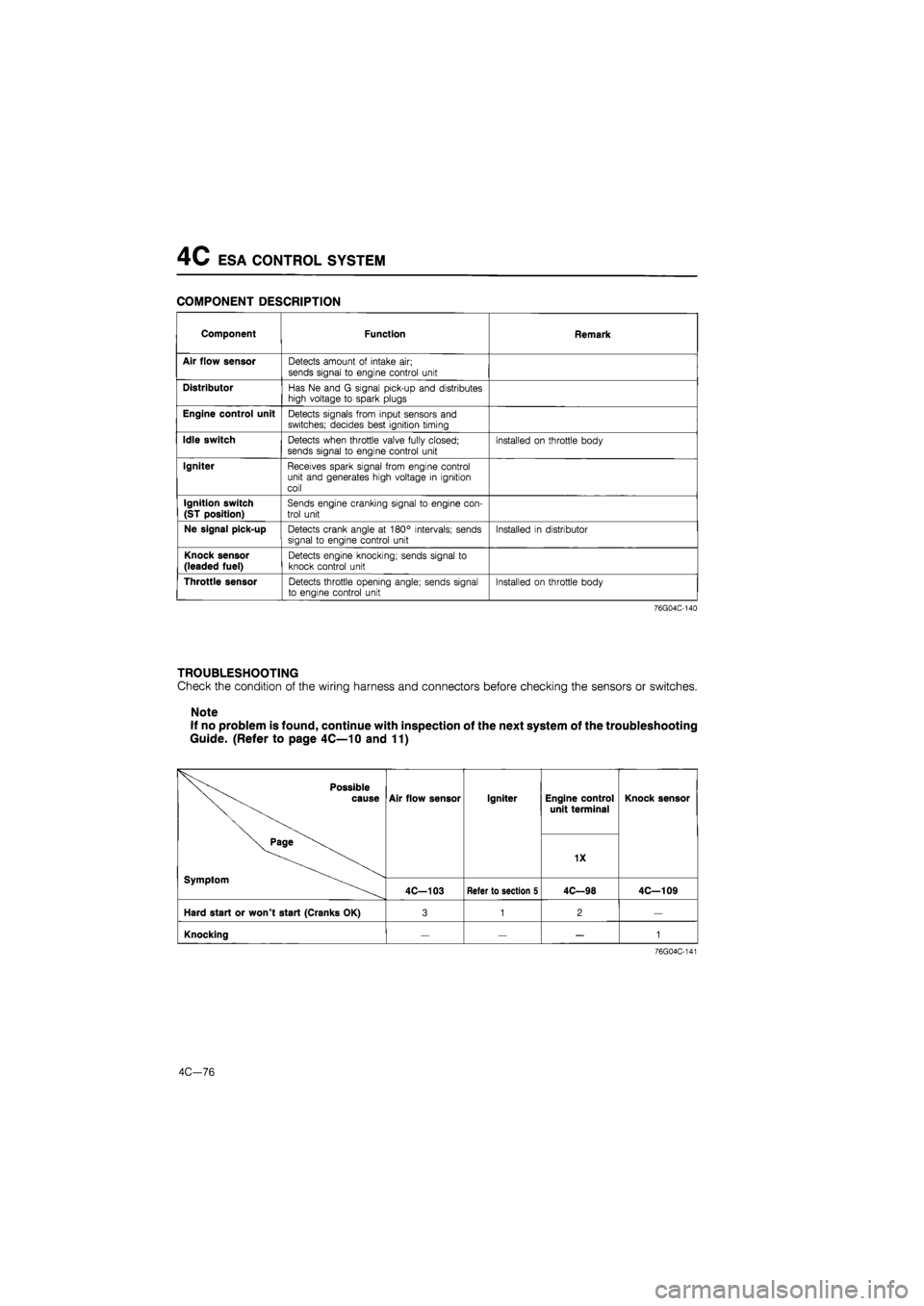
COMPONENT DESCRIPTION
Component Function Remark
Air flow sensor Detects amount of intake air;
sends signal to engine control unit
Distributor Has Ne and G signal pick-up and distributes high voltage to spark plugs
Engine control unit Detects signals from input sensors and switches; decides best ignition timing
Idle switch Detects when throttle valve fully closed; sends signal to engine control unit Installed on throttle body
Igniter Receives spark signal from engine control unit and generates high voltage in ignition coil
Ignition switch
(ST position) Sends engine cranking signal to engine con-trol unit
Ne signal pick-up Detects crank angle at 180° intervals; sends signal to engine control unit Installed in distributor
Knock sensor (leaded fuel) Detects engine knocking; sends signal to knock control unit
Throttle sensor Detects throttle opening angle; sends signal to engine control unit Installed on throttle body
76G04C-140
TROUBLESHOOTING
Check the condition of the wiring harness and connectors before checking the sensors or switches.
Note
If no problem is found, continue with inspection of the next system of the troubleshooting
Guide. (Refer to page 4C—10 and 11)
Possible cause
Page
Symptom
Air flow sensor Igniter Engine control
unit terminal Knock sensor Possible cause
Page
Symptom
Air flow sensor Igniter
1X
Knock sensor Possible cause
Page
Symptom
4C—103 Refer to section 5 4C—98 4C—109
Hard start or won't start (Cranks OK) 3 1 2 —
Knocking — 1
76G04C-141
4C-76
Page 638 of 1865

EGR SYSTEM (UNLEADED FUEL) 4C
EXHAUST GAS RECIRCULATION
(EGR)
SYSTEM (UNLEADED FUEL)
This system introduces exhaust gas into the intake manifold to reduce NOx emissions. It operates de-
pending on the engine load, engine speed (1,500—3,500 rpm), engine coolant temperature (above
70°C, 158°F), and radiator coolant temperature (above 17°C, 63°F).
COMPONENT DESCRIPTION
Component Function Remark
EGR control valve Recirculates portion of exhaust gas
EGR modulator valve Controls vacuum acting on EGR control valve
Engine control unit Detects signals from input sensors and switches; con-trols solenoid valve (EGR)
Ne signal pick-up Detects crank angle at 180° intervals; sends signal to engine control unit
Solenoid valve (EGR) Controls vacuum to EGR control valve
Throttle sensor Detects throttle valve opening angle; sends signal to en-
gine control unit
Installed on throttle body
Water thermo sensor Detects coolant temperature; sends signal to engine control unit
Water thermo switch Detects radiator coolant temperature; sends signal to engine control unit ON: above 17°C (63°F)
76G04C-143
AC—17