fuel MAZDA 626 1987 Workshop Manual
[x] Cancel search | Manufacturer: MAZDA, Model Year: 1987, Model line: 626, Model: MAZDA 626 1987Pages: 1865, PDF Size: 94.35 MB
Page 639 of 1865
4C EGR SYSTEM (UNLEADED FUEL)
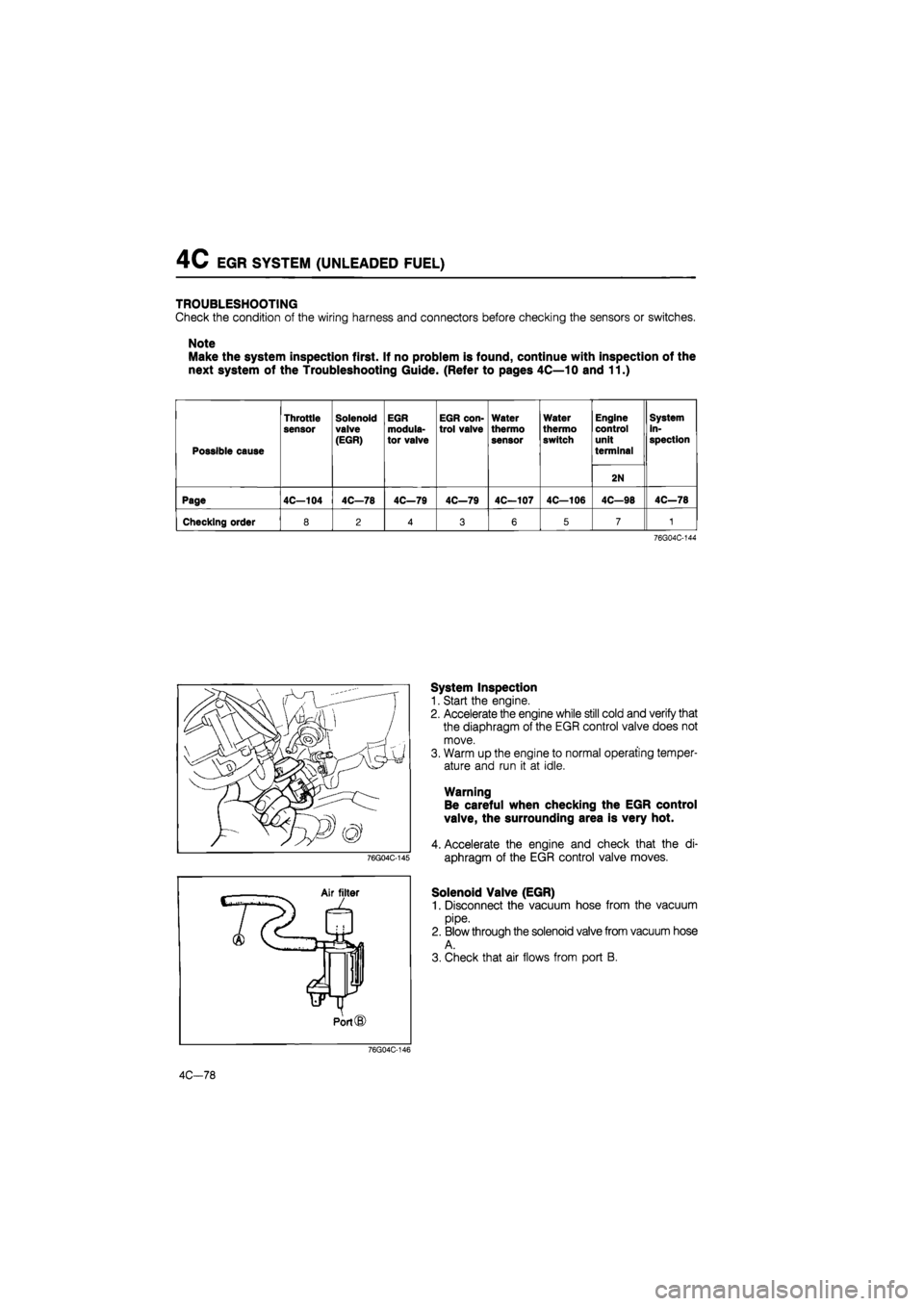
TROUBLESHOOTING
Check the condition of the wiring harness and connectors before checking the sensors or switches.
Note
Make the system inspection first. If no problem is found, continue with inspection of the
next system of the Troubleshooting Guide. (Refer to pages 4C—10 and 11.)
Possible cause
Throttle
sensor
Solenoid valve
(EGR)
EGR
modula-
tor valve
EGR con-trol valve
Water
thermo
sensor
Water
thermo switch
Engine control unit
terminal
System in-spection
2N
Page 4C—104 4C—78 4C—79 4C—79 4C—107 4C—106 4C—98 4C—78
Checking order 8 2 4 3 6 5 7 1
76G04C-144
System Inspection
1. Start the engine.
2. Accelerate the engine while still cold and verify that
the diaphragm of the EGR control valve does not
move.
3. Warm up the engine to normal operating temper-
ature and run it at idle.
Warning
Be careful when checking the EGR control
valve, the surrounding area is very hot.
4. Accelerate the engine and check that the di-
aphragm of the EGR control valve moves.
Solenoid Valve (EGR)
1. Disconnect the vacuum hose from the vacuum
pipe.
2. Blow through the solenoid valve from vacuum hose
A.
3. Check that air flows from port B.
76G04C-146
4C-78
Page 640 of 1865
EGR SYSTEM (UNLEADED FUEL) 4C
Apply 12V
J* Port
76G04C-147
86U04A-133
76G04C-148
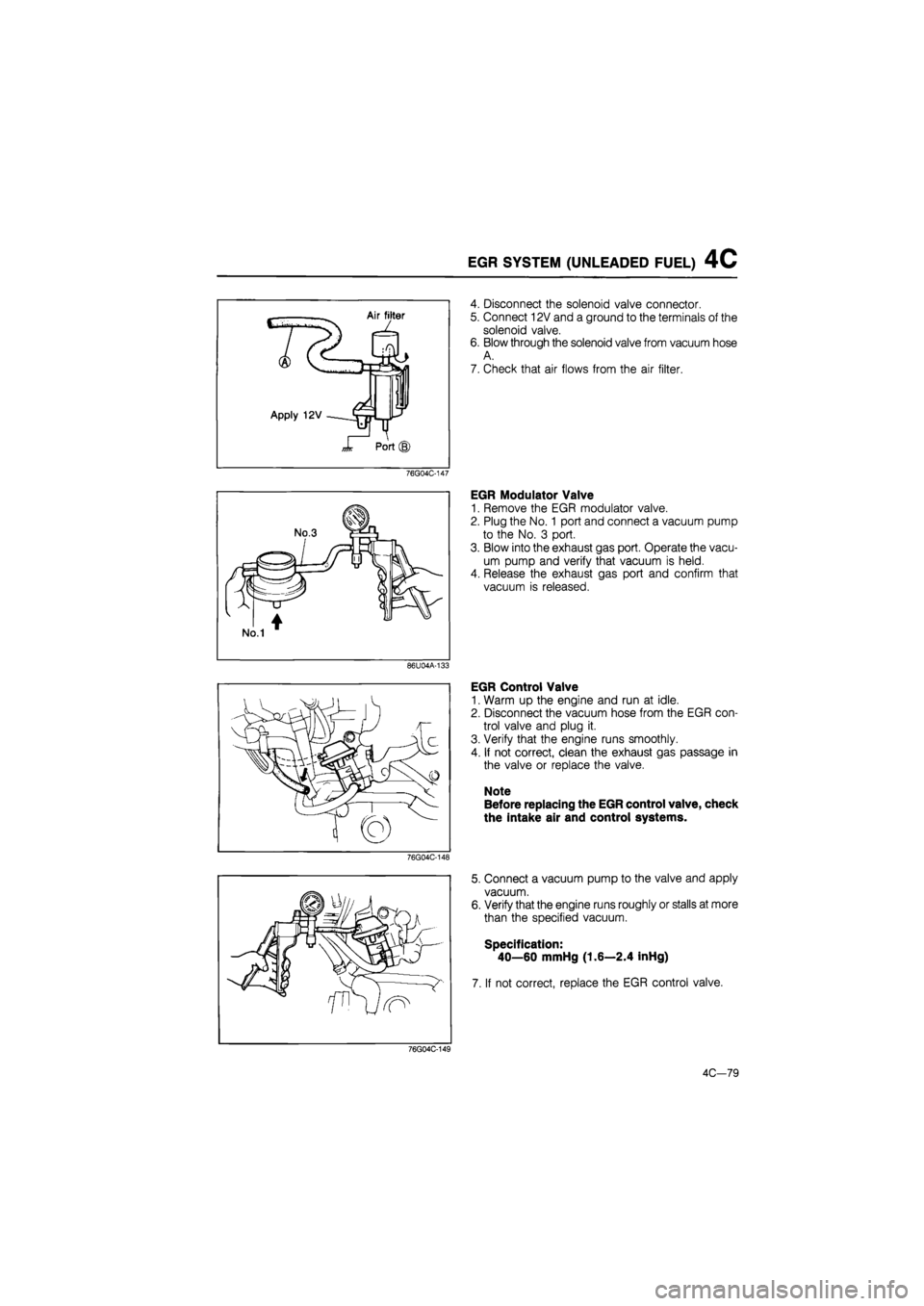
4. Disconnect the solenoid valve connector.
5. Connect 12V and a ground to the terminals of the
solenoid valve.
6. Blow through the solenoid valve from vacuum hose
A.
7. Check that air flows from the air filter.
EGR Modulator Valve
1. Remove the EGR modulator valve.
2. Plug the No. 1 port and connect a vacuum pump
to the No. 3 port.
3. Blow into the exhaust gas port. Operate the vacu-
um pump and verify that vacuum is held.
4. Release the exhaust gas port and confirm that
vacuum is released.
EGR Control Valve
1. Warm up the engine and run at idle.
2. Disconnect the vacuum hose from the EGR con-
trol valve and plug it.
3. Verify that the engine runs smoothly.
4. If not correct, clean the exhaust gas passage in
the valve or replace the valve.
Note
Before replacing the EGR control valve, check
the intake air and control systems.
5. Connect a vacuum pump to the valve and apply
vacuum.
6. Verify that the engine runs roughly or stalls at more
than the specified vacuum.
Specification:
40—60 mmHg (1.6—2.4 inHg)
7. If not correct, replace the EGR control valve.
76G04C-149
4C-79
Page 641 of 1865
4C EEC SYSTEM
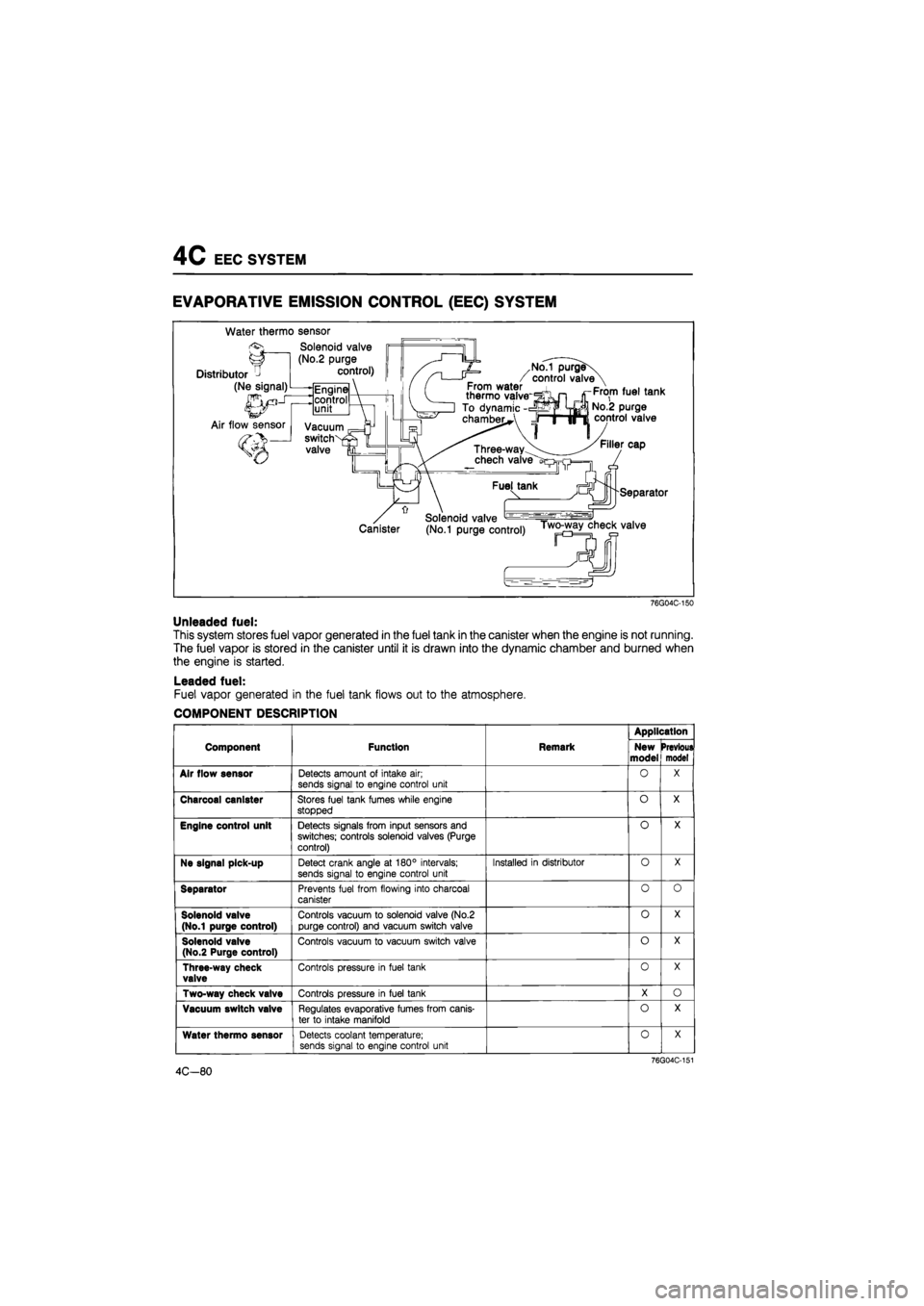
EVAPORATIVE EMISSION CONTROL
(EEC)
SYSTEM
Water thermo sensor
76G04C-150
Unleaded fuel:
This system stores fuel vapor generated in the fuel tank in the canister when the engine is not running.
The fuel vapor is stored in the canister until it is drawn into the dynamic chamber and burned when
the engine is started.
Leaded fuel:
Fuel vapor generated in the fuel tank flows out to the atmosphere.
COMPONENT DESCRIPTION
Application
Component Function Remark New
model Prevtoui model
Air flow sensor Detects amount of intake air; sends signal to engine control unit
O X
Charcoal canister Stores fuel tank fumes while engine stopped
o X
Engine control unit Detects signals from input sensors and
switches; controls solenoid valves (Purge
control)
o X
Ne signal pick-up Detect crank angle at 180° intervals; sends signal to engine control unit
Installed in distributor o X
Separator Prevents fuel from flowing into charcoal canister
o o
Solenoid valve
(No.1 purge control)
Controls vacuum to solenoid valve (No.2
purge control) and vacuum switch valve
0 X
Solenoid valve (No.2 Purge control)
Controls vacuum to vacuum switch valve o X
Three-way check valve Controls pressure in fuel tank o X
Two-way check valve Controls pressure in fuel tank X o
Vacuum switch valve Regulates evaporative fumes from canis-ter to intake manifold
o X
Water thermo sensor Detects coolant temperature; sends signal to engine control unit
0 X
76G04C-151
4C-80
Page 642 of 1865
EEC SYSTEM
4C
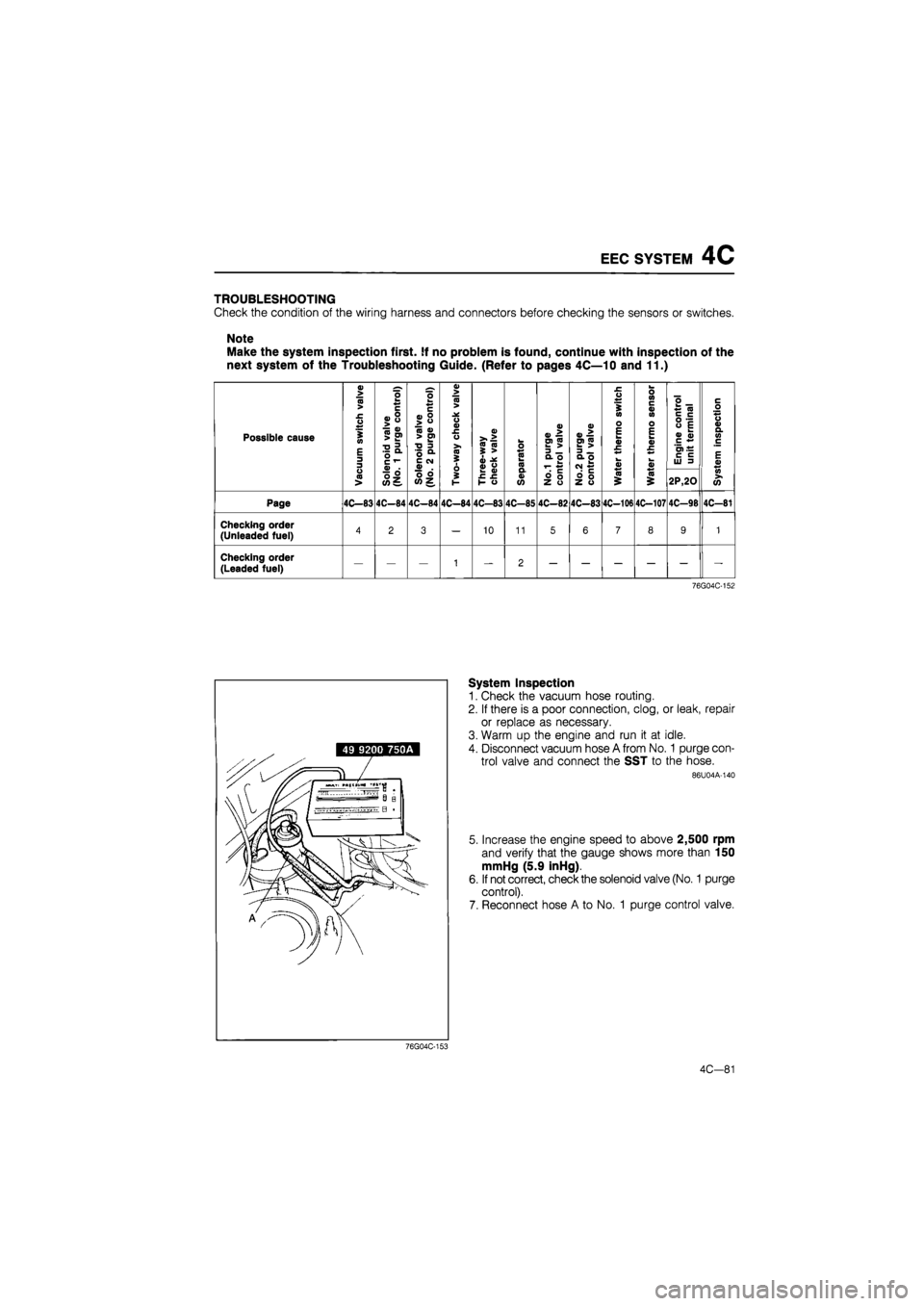
TROUBLESHOOTING
Check
the
condition
of the
wiring harness
and
connectors before checking
the
sensors
or
switches.
Note
Make
the
system inspection first.
If no
problem
is
found, continue with inspection
of the
next system
of the
Troubleshooting Guide. (Refer
to
pages 4C—10
and 11.)
Possible cause
« > (0 >
£ O
S in
E 3 3
Solenoid
valve
(No.
1 purge
control)
Solenoid
valve
(No.
2 purge
control)
Two-way
check
valve
a>
>. >
i
S
i
^
3>
o
o CO k n
V
*
£
3
_
a
o
k. T-
a>
E»S 3
_
a
o
CM
£
£ O
S in o E tm a> £
w V
o ID C a> in o E k a> £ **
a>
Engine
control
unit
terminal
c o +s o a> a. w c
E a> O <0 >
Solenoid
valve
(No.
1 purge
control)
Solenoid
valve
(No.
2 purge
control)
Two-way
check
valve
>-
0)
£
£
1-
o
Q. d) o
fe
Z
o
ofe Z
O
(0 (0 $ 2P,20
in
(O
Page 4C—83 4C-84 4C-84 4C—84 4C-83 4C-85 4C-82 4C-83 4C-106 4C-107 4C—98 4C-81
Checking order (Unleaded fuel) 4 2 3 — 10 11 5 6 7 8 9 1
Checking order
(Leaded fuel) — — — 1 — 2
76G04C-152
System Inspection
1. Check
the
vacuum hose routing.
2. If there
is a
poor connection, clog,
or
leak, repair
or replace
as
necessary.
3. Warm
up the
engine
and run it at
idle.
4. Disconnect vacuum hose
A
from
No. 1
purge con-
trol valve
and
connect
the SST to the
hose.
86U04A-140
5. Increase
the
engine speed
to
above 2,500
rpm
and verify that
the
gauge shows more than
150
mmHg
(5.9
inHg).
6. If not correct, check the solenoid valve (No.
1
purge
control).
7. Reconnect hose
A to No. 1
purge control valve.
4C-81
76G04C-153
Page 645 of 1865

4C EEC SYSTEM
Solenoid Valve
1. Remove the solenoid valve.
76G04C-159
2. Connect vacuum hoses to the valve as shown in
the figure.
3. Blow air through the valve from hose A and check
that air comes out of the valve air filter.
4. Apply 12V and ground the solenoid valve with jum-
per wires.
5. Blow air through the valve from hose A and check
that the air comes out of port B.
6. Replace, if necessary.
86U04A-151
Two-way check valve
Inspection
1. Remove the two-way check valve.
76G04C-160
4C-84
Connect a pressure gauge to the passage that nor-
mally is connected to the fuel tank.
Blow through the valve from port A. Verify that the
valve opens at 2.94 kPa (0.03 kg/cm2,0.43 psi).
Remove the pressure gauge and connect
it
to the
passage to atmosphere.
Blow through the valve from port B. Verify that the
valve opens at 0.98 kPa (0.01 kg/cm2,0.14 psi).
Page 646 of 1865

EEC SYSTEM 4C
®(
Atomosphere
side Fuel tank side
76G04C-212
Replacement
1. Remove the two-way check valve.
2. Install a new valve so that the arrow on the valve
faces atmosphere side.
— - ...
h§§
IB// i \
1 S LCD \
1
J M
J k
Separator
^ X
IB// i \
1 S LCD \
1
J M
J k ==J/
J——K
1
Separator
1. Remove the separator.
2. Visually check the separator for damage.
3. Replace, if necessary.
86U04A-154
4C—85
Page 648 of 1865

EXHAUST SYSTEM (UNLEADED FUEL) 4C
EXHAUST SYSTEM (UNLEADED FUEL)
Exhaust manifold
Catalytic converter
Main silencer
Middle pipe
76G04C-163
The catalytic converter is used to reduce CO and HC. The converter contains a compound of plati-
num and rhodium. It is a two-way catalyst type with a volume of 2,300 cc (140 cu in).
4C—87
Page 649 of 1865

4C EXHAUST SYSTEM (UNLEADED FUEL)
REMOVAL AND INSTALLATION
1. Remove in the sequence shown in the figure.
2. Install in the reverse order of removal.
Torque Specifications
86U04A-159
4. Catalytic converter
5. Bracket
6. Front pipe
INSPECTION
1. Check the catalytic converter and exhaust pipe for
deterioration or restriction.
2. Check the insulation covers welded onto the cata-
lytic converter for damage.
Note
If the insulation cover is touching the catalytic
converter housing, excessive heat at the floor
will occur.
19—26 N-m (1.9—2.6 m-kg, 14—19 tt-lb)
29—39 N-m (3.0—4.0 m-kg, 22—29 ft-lb)
34—49 N-m (3.5—5.0 m-kg, 26—36 ft-lb)
39—57 N-m (4.0-5.8 m-kg, 29—42 ft-lb)
37—52 N m (3.8—5.3 m-kg, 27—38 ft-lb) 8—11 N-m 8—1.1 m-kg, 69—95 In-lb)
N-m .3 m-kg, 38 ft-lb)
1. Main silencer
2. Middle pipe
3. Pre-silencer
86U04A-160
4C—88
Page 650 of 1865

EXHAUST SYSTEM (LEADED FUEL) 4C
EXHAUST SYSTEM (LEADED FUEL)
Pre silencer (No.1)
Main silencer
Middle pipe
76G04C-164
4C-89
Page 651 of 1865

4C EXHAUST SYSTEM (LEADED FUEL)
REMOVAL AND INSTALLATION
1. Remove in the sequence shown in the figure.
2. Install in the reverse order of removal.
Torque Specifications
1. Main silencer
2. Middle pipe
3. No. 2 pre-silencer
76G04C-165
4. No. 1 pre-silencer
5. Bracket
6. Front pipe
4C—90