coolant level MAZDA 626 1987 User Guide
[x] Cancel search | Manufacturer: MAZDA, Model Year: 1987, Model line: 626, Model: MAZDA 626 1987Pages: 1865, PDF Size: 94.35 MB
Page 218 of 1865
1C TUNE-UP PROCEDURE
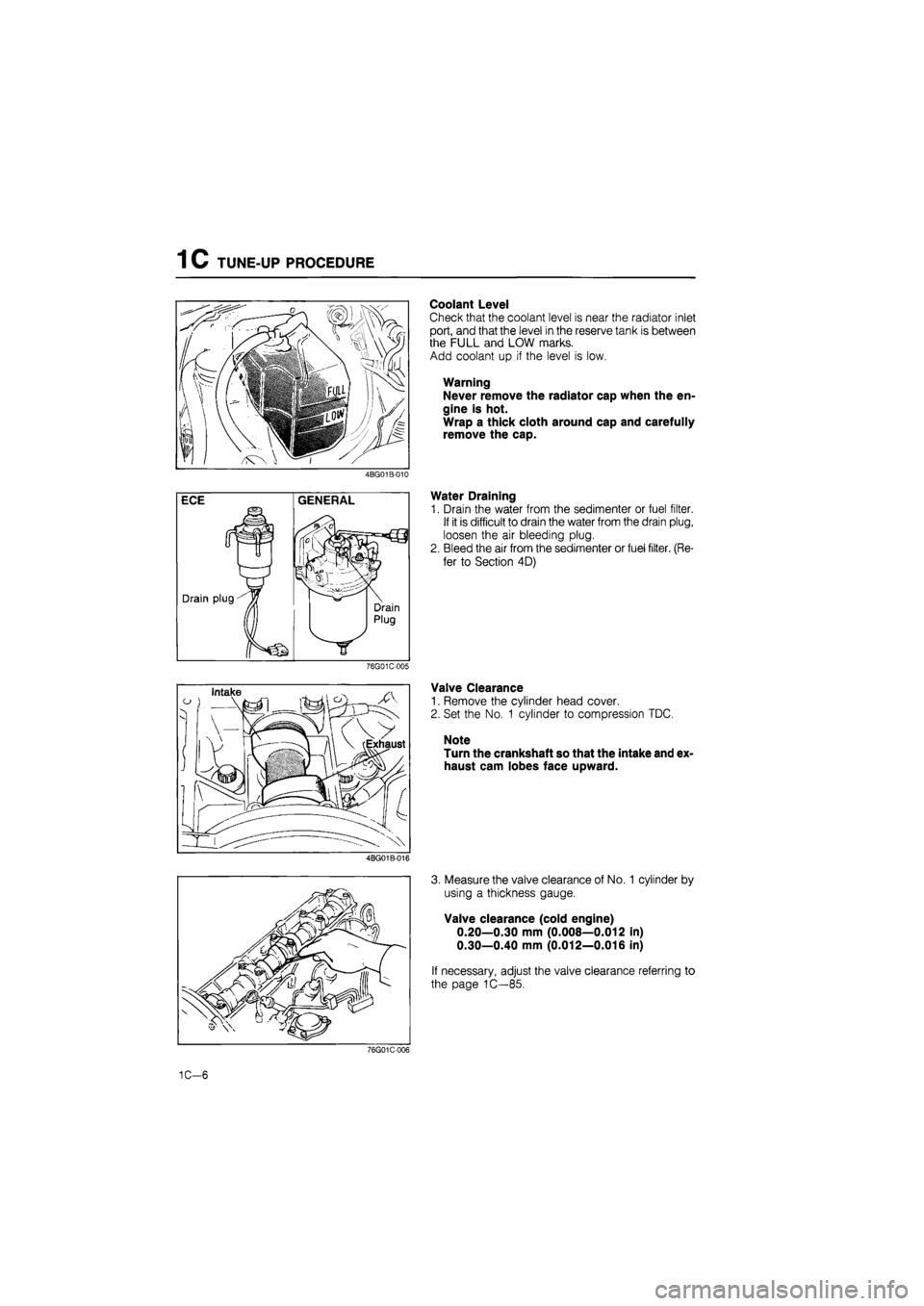
Coolant Level
Check that the coolant level is near the radiator inlet
port, and that the level in the reserve tank is between
the FULL and LOW marks.
Add coolant up if the level is low.
Warning
Never remove the radiator cap when the en-
gine is hot.
Wrap a thick cloth around cap and carefully
remove the cap.
4BG01B-010
Water Draining
1. Drain the water from the sedimenter or fuel filter.
If it is difficult to drain the water from the drain plug,
loosen the air bleeding plug.
2. Bleed the air from the sedimenter or fuel filter. (Re-
fer to Section 4D)
76G01C-005
Valve Clearance
1. Remove the cylinder head cover.
2. Set the No. 1 cylinder to compression TDC.
Note
Turn the crankshaft so that the intake and ex-
haust cam lobes face upward.
4BG01B-016
3. Measure the valve clearance of No. 1 cylinder by
using a thickness gauge.
Valve clearance (cold engine)
0.20—0.30 mm (0.008—0.012 in)
0.30—0.40 mm (0.012—0.016 in)
If necessary, adjust the valve clearance referring to
the page 1C—85.
76G01C-006
1C-6
Page 228 of 1865

1 C ON-VEHICLE MAINTENANCE (CYLINDER HEAD)
CYLINDER HEAD
Removal
1. Disconnect the negative battery cable.
2. Drain the engine coolant.
3. Remove in the sequence shown in the figure referring to the removal note for specially marked parts.
76G01C-031
1. Accelerator cable
2. Air cleaner
3. Brake vacuum pipe
4. Intercooler pipe and hose*
5. Drive belt cover
6. Vacuum pump drive belt
7. Fuel hose
8. Water temperature switch
connector
9. Glow plug connector
10. Water thermo switch con-
nector
11. Heat gauge unit connector
12. Boost air temperature sen-
sor connector*
13. Injection pipes
14. Upper radiator hose
15. Water hose
(thermostat—FIR)
16. Oil level gauge and stay
bolt
17. Oil pipe bolt
18. Timing belt (Refer to page
1C—11)
19. Cylinder head cover
20. Camshaft pulley
21. Rear camshaft pulley
76G01C-032
22. Injection pump pulley
23. Seal plate
24. Water hose and pipe
25. Comprex supercharger
drive belt*
26. Heat insulator*
27. Exhaust manifold stay
28. Front exhaust pipe
29. Cylinder head bolt
30. Cylinder head
31. Cylinder head gasket
32. Comprex supercharger*
33. Exhaust manifold
34. Intake manifold
Note
* marked parts are equipped only for the RF-CX.
1C-16
Page 311 of 1865
INSTALLATION 1C
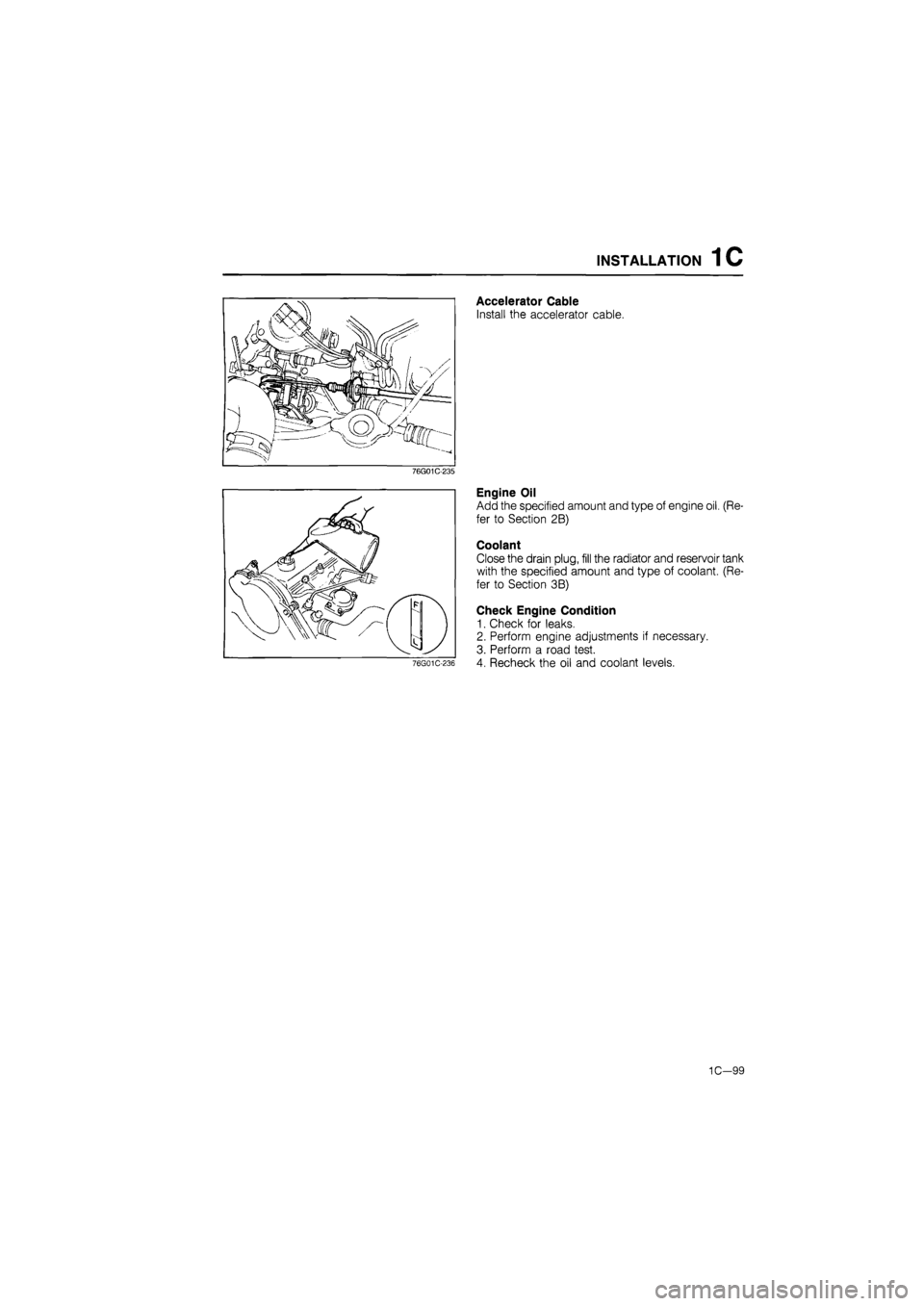
Accelerator Cable
Install the accelerator cable.
76G01C-235
76G01C-236
Engine Oil
Add the specified amount and type of engine oil. (Re-
fer to Section 2B)
Coolant
Close the drain plug, fill the radiator and reservoir tank
with the specified amount and type of coolant. (Re-
fer to Section 3B)
Check Engine Condition
1. Check for leaks.
2. Perform engine adjustments if necessary.
3. Perform a road test.
4. Recheck the oil and coolant levels.
1C—99
Page 344 of 1865

COOLANT 3A
76G03A-016
69G03A-006
COOLANT
INSPECTION
Coolant Level (Engine cold)
1. Check that the coolant level is near the radiator inlet
port.
2. Check that the coolant level in the coolant reser-
voir is between the FULL and LOW marks.
Add coolant if necessary.
Warning
a) Never remove the radiator cap while the en-
gine is hot.
b)Wrap a thick cloth around the cap when
removing it.
Coolant Quality
1. Check that there is no build-up of rust or scales
around the radiator cap or radiator filler neck.
2. Check that coolant is free from oil.
3. Replace the coolant, if necessary.
Coolant Leakage
1. Connect a tester and SST to the radiator inlet port.
2. Apply 103 kPa (1.05 kg/cm2, 15 psi) pressure
to the system.
3. Check that the pressure is held.
If not, check for coolant leakage.
Warning
When removing either the radiator cap or the
tester, loosen it slowly until the pressure in
the radiator is released, and then remove it.
86U03X-005
REPLACEMENT
1. Remove the radiator cap and loosen the drain plug.
2. Drain the coolant into a suitable container.
Warning
a) Never open the radiator cap while the en-
gine is hot.
b)Wrap a thick cloth around the cap when
loosening.
c) Use caution when draining hot coolant.
86U03X-006
3A-5
Page 357 of 1865

3B COOLANT
86U03X-004
69G03A-006
COOLANT
INSPECTION
Coolant Level (Engine cold)
1. Check that the coolant level is near the radiator inlet
port.
2. Check that the coolant level in the coolant reser-
voir is between the FULL and Low marks.
Add coolant if necessary.
Warning
a) Never remove the radiator cap while the en-
gine is hot.
b)Wrap a thick cloth around the cap when
removing it.
Coolant Quality
1. Check that there is no build-up of rust or scales
around the radiator cap or radiator filler neck.
2. Check that coolant is free from oil.
3. Replace the coolant, if necessary.
Coolant Leakage
1. Connect a tester and SST to the radiator inlet port.
2. Apply 103 kPa (1.05 kg/cm2, 15 psi) pressure
to the system.
3. Check that the pressure is held.
If not, check for coolant leakage.
Warning
When removing either the radiator cap or the
tester, loosen it slowly until the pressure in
the radiator is released, and then remove it.
86U03X-005
REPLACEMENT
1. Remove the radiator cap and loosen the drain plug.
2. Drain the coolant into a suitable container.
Warning
a) Never open the radiator cap while the en-
gine is hot.
b)Wrap a thick cloth around the cap when
loosening.
c) Use caution when draining hot coolant.
86U03X-006
3B—4
Page 359 of 1865

3B RADIATOR
Note
a) Position the hose clamp in the original location on the hose.
b) Squeeze the clamp lightly with large pliers to ensure a good fit. 86U03X-010
RADIATOR
REMOVAL AND INSTALLATION
1. Drain the engine coolant.
2. Remove in the sequence shown in the figure.
3. Install in the reverse order of removal.
1. Coolant reservoir hose
2. Fast idle solenoid
3. Coolant level sensor connector
4. Cooling fan connector
76G03B-005
5. Upper and lower radiator hose
6. Cooling fan and radiator assembly
7. Cooling fan
INSPECTION
Check the following points. Repair or replace if
necessary.
1. Cracks, damage, or water leakage
2. Bent fins (Repair with a screwdriver)
3. Distorted or bent radiator inlet
86U03X-012
3B-6
Page 406 of 1865

AUTO-RETURN CHOKE SYSTEM 4A
Choke Magnet
1. Remove the under dash cover.
2. Disconnect the choke magnet connector.
3. Turn the ignition switch on and check the resistance
using an ohmmeter.
Resistance: Approx. 3512
4. If it is not within the specification, the choke mag-
net is malfunction.
76G04A-069
76G04A-070
Water thermo switch
1. Remove the switch from the intake manifold.
2. Place the switch in a container of water with a ther-
mometer.
3. Connect an ohmmeter to the switch.
4. Heat the water slowly and check that the switch
has continuity at 67°C (152°F).
5. Replace if necessary.
Note
a) Apply sealing tape to the threads of the
switch.
b) After installing, check the coolant level and
check for leaks.
4A—41
Page 460 of 1865

CONTROL SYSTEM 4A
WATER THERMO SWITCH (RADIATOR)
Inspection
1. Remove the switch from the radiator.
2. Place the switch in water with a thermometer and
gradually heat the water.
3. Check for continuity of the switch with an
ohmmeter.
Coolant temp. Continuity
More than approx.
17°C (63°F)
Yes
Less than approx.
17°C (63°F)
No
76G04A-183
4. If not as specified, replace the water thermo switch.
Note
a) Apply sealing tape to the threads of the
switch before installing it.
b) After installation, check the coolant level
and check for leaks.
76g04a-184
WATER THERMO SWITCH (INTAKE MANIFOLD)
Inspection
1. Remove the switch from the intake manifold.
2. Place the switch in water with a thermometer and
gradually heat the water.
3. Check for continuity of the switch with an
ohmmeter.
Coolant temp. Continuity
More than approx.
72°C (162°F)
Yes
Less than approx.
72°C (162°F)
No
76G04A-185 4. If not as specified, replace the water thermo switch.
Note
a) Apply sealing tape to the threads of the
switch before installing it.
b)
After installation, check the coolant level
and check for leaks.
76G04A-186
4A-95
Page 551 of 1865

CONTROL SYSTEM 4B
Terminal Input Output Connection to Voltage (After warming-up) Remarks Terminal Input Output Connection to IGN: ON Idle Remarks
1P — — — — —
1Q — — — — —
1R — — — — —
1S o Air bypass solenoid valve (Idle-up C) and P/S pressure switch
Battery voltage While solenoid ON (Refer to page 4B—35): below 1.5V
1T — — — — —
1U — — — — —
1V 0 MTX
Neutral and clutch switch
In-gear condition Clutch pedal depressed: battery voltage Clutch pedal released: below 1,5V
Neutral: constant battery voltage
1W O Test connector Test connector grounded: below 1,5V Test connector not grounded: battery voltage Green connector, 1-pin
1X — — — — —
2A o V ref 4.5—5.5V
2B 0 Air flow meter (Vc) 6-10V
2C — — Ground (E2) Approx. OV
2D o Oxygen sensor OV 0-1.OV • Cold engine: 0V at idle • After warming-up: Increase engine speed: 0.5—1.0V Deceleration: 0—0.4V
2E 0 Air flow meter (Vs) Approx. 1.7V Approx. 3—5V Increase engine speed:
voltage increases
2F — -— — —
2G 0 Throttle sensor Accelerator pedal released:
0.4—0.6 V
2H 0 Atmospheric pres-sure sensor At sea level: approx. 4.0V
21 0 Water thermo sensor 0.3—0.6 V Engine coolant temp. 20°C (68°F): approx. 2.5V
2J o Air flow meter (In-
take air thermo
sensor)
Approx. 2.3V at 20°C (68°F)
2K o Solenoid valve (Pres-
sure regulator
control)
For 120 sec. after ignition switch OFF - ON: below 1.5V
For 120 sec. after
starting: below 1.5V
Hot condition: Cool-ant temp, above 70°C (158°F) Intake air temp, above 10°C (50°F)
2K o Solenoid valve (Pres-
sure regulator
control)
Battery voltage Other conditions
2L — — — — —
2M — — —
4B-89
Page 611 of 1865

4C FUEL SYSTEM
COMPONENT DESCRIPTION
Component Function Remark
Air flow sensor Detects amount of intake air;
sends signal to engine control unit
Clutch switch Detects in-gear condition; sends signal to engine control unit Switch ON when clutch pedal released
Engine control unit Detects signals from input sensors and switches; controls injector and fuel pump operations
Fuel filter Filters fuel
Fuel pump Provides fuel to injectors • Operates while engine running
• Installed in fuel tank
Fuel pump control unit (4WS) Monitors fuel level in left section; controls transfer pump operation
G signal pick-up Detects No.1 cylinder TDC; sends signal to engine control unit Installed in distributor
Idle switch Detects when throttle valve fully closed; sends signal to engine control unit Installed on throttle body
Ignition switch (ST position) Sends engine cranking signal to engine control unit
Injector Injects fuel into intake port • Controlled by signals from engine control unit • High-ohmic injector
Intake air thermo sensor Detects intake air temperature; send signal to engine control unit
Control relay Supplies electric current to injectors fuel pump and engine control unit
Ne signal pick-up Detects crank angle at 180° intervals; sends signal to engine control unit Installed in distributor
Neutral switch Detects in-gear condition; sends signal to engine control unit
Switch ON when in gear
Oxygen sensor (Unleaded fuel) Detects oxygen concentration; sends signal to engine control unit
• Zirconia ceramic and platinum coating • Integrated heater coil
Pressure regulator Adjusts fuel pressure supplied to injectors
Pulsation damper Absorbs fuel pulsation
Throttle sensor Detects throttle valve opening angle;
sends signal to engine control unit
Installed on throttle body
Transfer pump (4WS) Pumps fuel from the left to the right side Controlled by fuel pump control unit
Transfer pump switch (4WS) Detects fuel level in left section;
sends signal to control unit
Water thermo sensor Detects coolant temperature; sends signal to engine control unit
Water thermo switch (Unleaded fuel) Detects radiator coolant temperature; sends signal to engine control unit ON: above 17°C (63°F)
76G04C-088
4C-50