oil temperature MAZDA 626 1987 Owner's Manual
[x] Cancel search | Manufacturer: MAZDA, Model Year: 1987, Model line: 626, Model: MAZDA 626 1987Pages: 1865, PDF Size: 94.35 MB
Page 456 of 1865

CONTROL SYSTEM 4 A
Terminal (Wire color) Connected to Condition Voltage
0 (BY)
Ignition switch*
(START position) Ignition switch
ON
Below 1.5V 0 (BY)
Ignition switch*
(START position) Cranking Battery voltage
P
(LW) Solenoid valve (A/C) A/C switch
ON
and engine speed below approx.
2,300
rpm
Below 1,5V
Others Battery voltage
Q (YW) Idle-up solenoid valve Headlight switch ON, rear defroster switch ON,
fan
speed control switch
is
3rd
or
4th position, A/C oper-ated,
or
engine coolant temperature below 72°C (162°F)
Below 1,5V
Others Battery voltage
R
(LB)
Fan speed control switch Fan speed control switch
in
3rd
or
4th position Below 1,5V R
(LB) Fan speed control switch OFF Battery voltage
*
Not
used
76G04A-173
{
Q
0
><
K
X
G E C A
^
R P
R X
J H F D B
FE 8Valve — Unleaded Fuel
Terminal (Wire color) Connected to Condition Voltage
A
(L)
Coast enrichment solenoid valve Engine speed approx. 1,500—2,300 rpm and idle switch
ON
Below 1,5V A
(L)
Coast enrichment solenoid valve
Others Battery voltage
B
(B)
Ground
—
Below 1,5V
C (LB)
Air bypass solenoid valve Engine speed above approx. 3,500 rpm and idle
switch
ON
Below 1,5V C (LB)
Air bypass solenoid valve
Others Battery voltage
D
(YL)
Ignition coil Ignition switch
ON or
engine running Battery voltage
E
— — —
F
(BW)
Ignition switch Ignition switch
ON
Battery voltage
G (YW) Slow fuel cut solenoid valve Engine speed above approx. 2,300 rpm and idle
switch
ON
Battery voltage G (YW) Slow fuel cut solenoid valve
Others Below 1.5V
H
(LW) A/C switch A/C operated and engine speed above approx.
1,500 rpm
Battery voltage H
(LW) A/C switch
A/C not operated
or
engine speed below approx.
1,500 rpm
Below 1,5V
4A—91
Page 505 of 1865
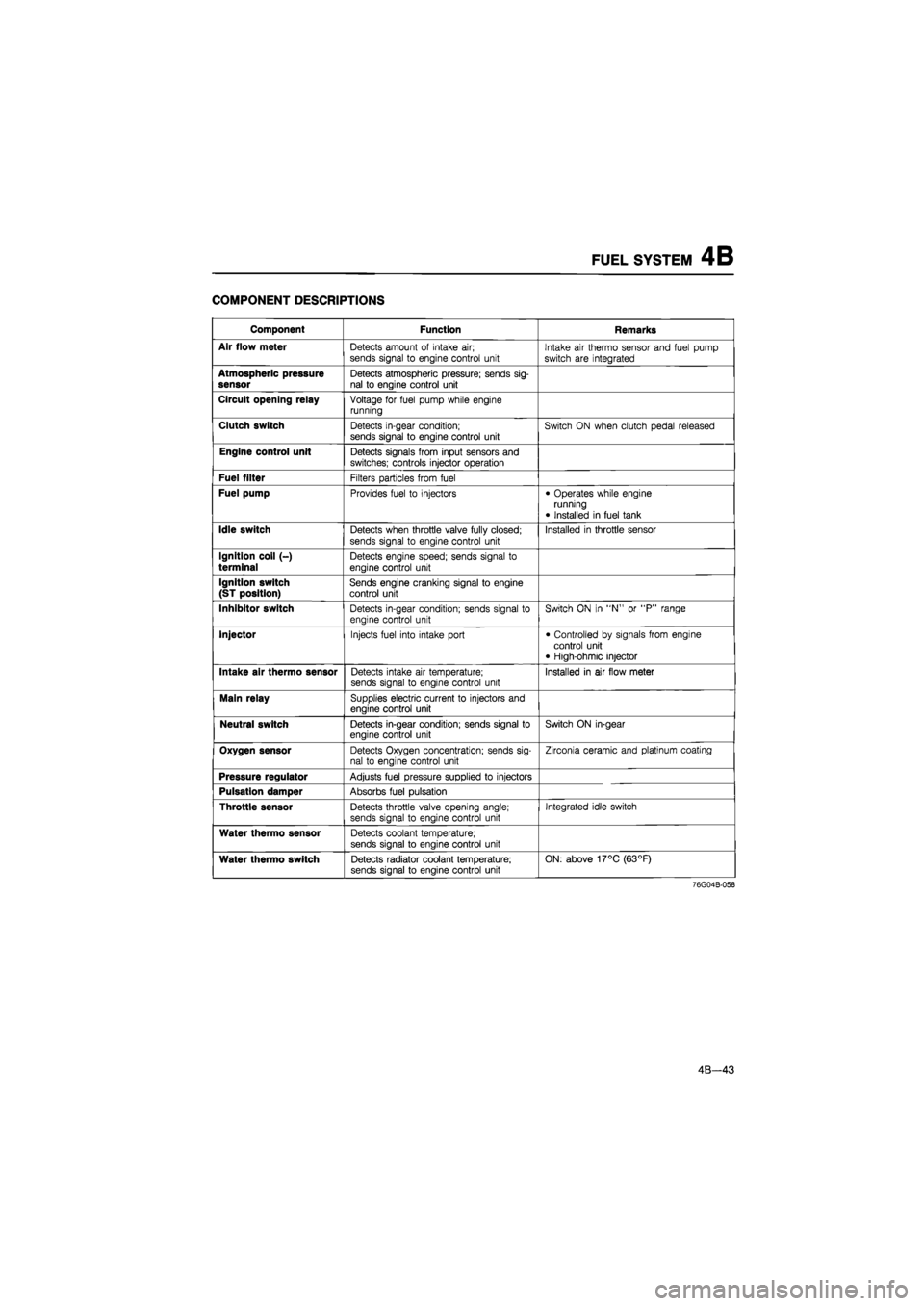
FUEL SYSTEM 4B
COMPONENT DESCRIPTIONS
Component Function Remarks
Air flow meter
Detects amount
of
intake
air;
sends signal
to
engine control unit Intake
air
thermo sensor and fuel pump
switch
are
integrated
Atmospheric pressure sensor
Detects atmospheric pressure; sends sig-nal
to
engine control unit
Circuit opening relay
Voltage
for
fuel pump while engine running
Clutch switch
Detects in-gear condition; sends signal
to
engine control unit Switch
ON
when clutch pedal released
Engine control unit
Detects signals from input sensors and switches; controls injector operation
Fuel filter
Filters particles from fuel
Fuel pump
Provides fuel
to
injectors • Operates while engine running
• Installed
in
fuel tank
Idle switch
Detects when throttle valve fully closed;
sends signal
to
engine control unit
Installed
in
throttle sensor
Ignition coil (-) terminal
Detects engine speed; sends signal
to
engine control unit
Ignition switch (ST position)
Sends engine cranking signal
to
engine control unit
Inhibitor switch
Detects in-gear condition; sends signal
to
engine control unit
Switch
ON in "N" or "P"
range
Injector
Injects fuel into intake port • Controlled
by
signals from engine control unit • High-ohmic injector
Intake air thermo sensor
Detects intake
air
temperature;
sends signal
to
engine control unit Installed
in air
flow meter
Main relay
Supplies electric current
to
injectors and engine control unit
Neutral switch
Detects in-gear condition; sends signal
to
engine control unit
Switch
ON
in-gear
Oxygen sensor
Detects Oxygen concentration; sends sig-nal
to
engine control unit
Zirconia ceramic and platinum coating
Pressure regulator
Adjusts fuel pressure supplied
to
injectors
Pulsation damper
Absorbs fuel pulsation
Throttle sensor
Detects throttle valve opening angle; sends signal
to
engine control unit
Integrated idle switch
Water thermo sensor
Detects coolant temperature;
sends signal
to
engine control unit
Water thermo switch
Detects radiator coolant temperature; sends signal
to
engine control unit ON: above 17°C (63°F)
76G04B-058
4B—43
Page 516 of 1865
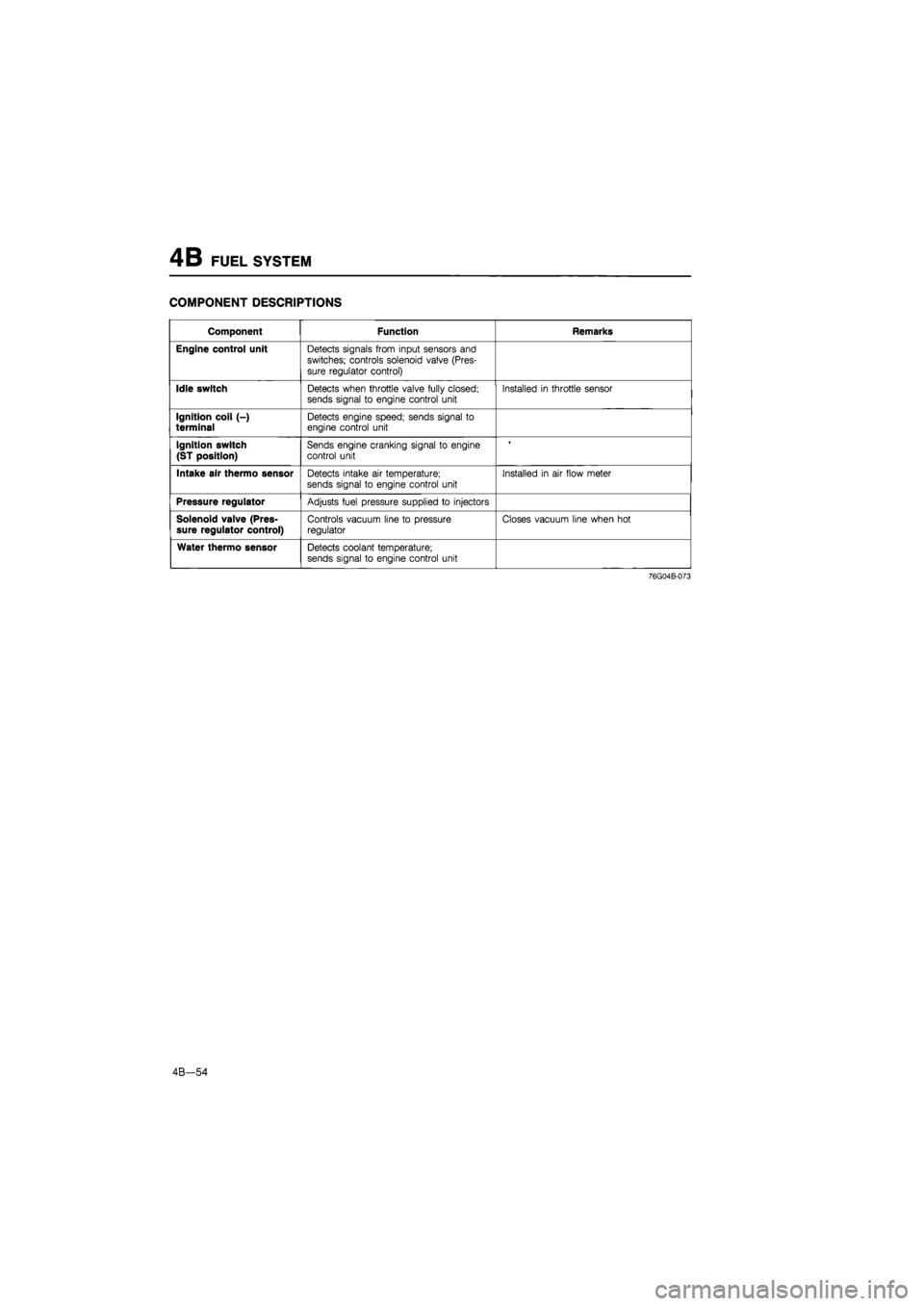
4B FUEL SYSTEM
COMPONENT DESCRIPTIONS
Component Function Remarks
Engine control unit Detects signals from input sensors and
switches; controls solenoid valve (Pres-
sure regulator control)
Idle switch Detects when throttle valve fully closed; sends signal to engine control unit Installed in throttle sensor
Ignition coil (-) terminal Detects engine speed; sends signal to engine control unit
Ignition switch
(ST position)
Sends engine cranking signal to engine control unit
Intake air thermo sensor Detects intake air temperature; sends signal to engine control unit
Installed in air flow meter
Pressure regulator Adjusts fuel pressure supplied to injectors
Solenoid valve (Pres-sure regulator control) Controls vacuum line to pressure regulator Closes vacuum line when hot
Water thermo sensor Detects coolant temperature; sends signal to engine control unit
76G04B-073
4B—54
Page 527 of 1865

DECELERATION CONTROL SYSTEM 4B
COMPONENT DESCRIPTIONS
Component Function Remarks
Brake light switch Detects braking operation (deceleration);
sends signal to engine control unit
Clutch switch Detects in-gear condition;
sends signal to engine control unit Switch ON when clutch pedal released
Dashpot (MTX) Prevents sudden closing of throttle valve during deceleration or shifting Adjustment speed: 1,900—2,100 rpm
Engine control unit Detects signals from input sensors and switches; cuts fuel injection
Idle switch Detects when throttle valve fully closed; sends signal to engine control unit Installed in throttle sensor
Ignition coil (-) terminal Detects engine speed; sends signal to engine control unit
Neutral switch Detects in-gear condition; sends signal to engine control unit Switch ON when in-gear
Water thermo sensor Detects coolant temperature; sends signal to engine control unit
Water thermo switch Detects radiator coolant temperature; sends signal to engine control unit ON: above 17°C (63°F)
76G04B-089
4B—65
Page 533 of 1865

EGR SYSTEM 4B
EXHAUST GAS RECIRCULATION
(EGR)
SYSTEM
EGR modulator valve Solenoid valve (EGR)
86U04A-127
This system introduces exhaust gas into the intake manifold to reduce NOx in the exhaust gas. It oper-
ates depending on the engine load, engine speed (above 1,500 rpm), engine coolant temperature
(above 70°C, 158°F), and radiator coolant temperature (above 17°C, 63°F).
COMPONENT DESCRIPTIONS
Component Function Remarks
EGR control valve Recirculates portion of exhaust gas
EGR modulator valve Controls vacuum acting on EGR control
valve
Engine control unit Detects signals from input sensors and switches; controls solenoid valve (EGR)
Ignition coil (-) terminal Detects engine speed; sends signal to engine control unit
Solenoid valve (EGR) Controls vacuum line to EGR control
valve
Throttle sensor Detects throttle valve opening angle; sends signal to engine control unit Integrated idle switch
Water thermo sensor Detects coolant temperature; sends signal to engine control unit
Water thermo switch Detects radiator coolant temperature; sends signal to engine control unit
ON: above 17°C (63°F)
76G04B-102
4B-71
Page 536 of 1865
4B EEC SYSTEM
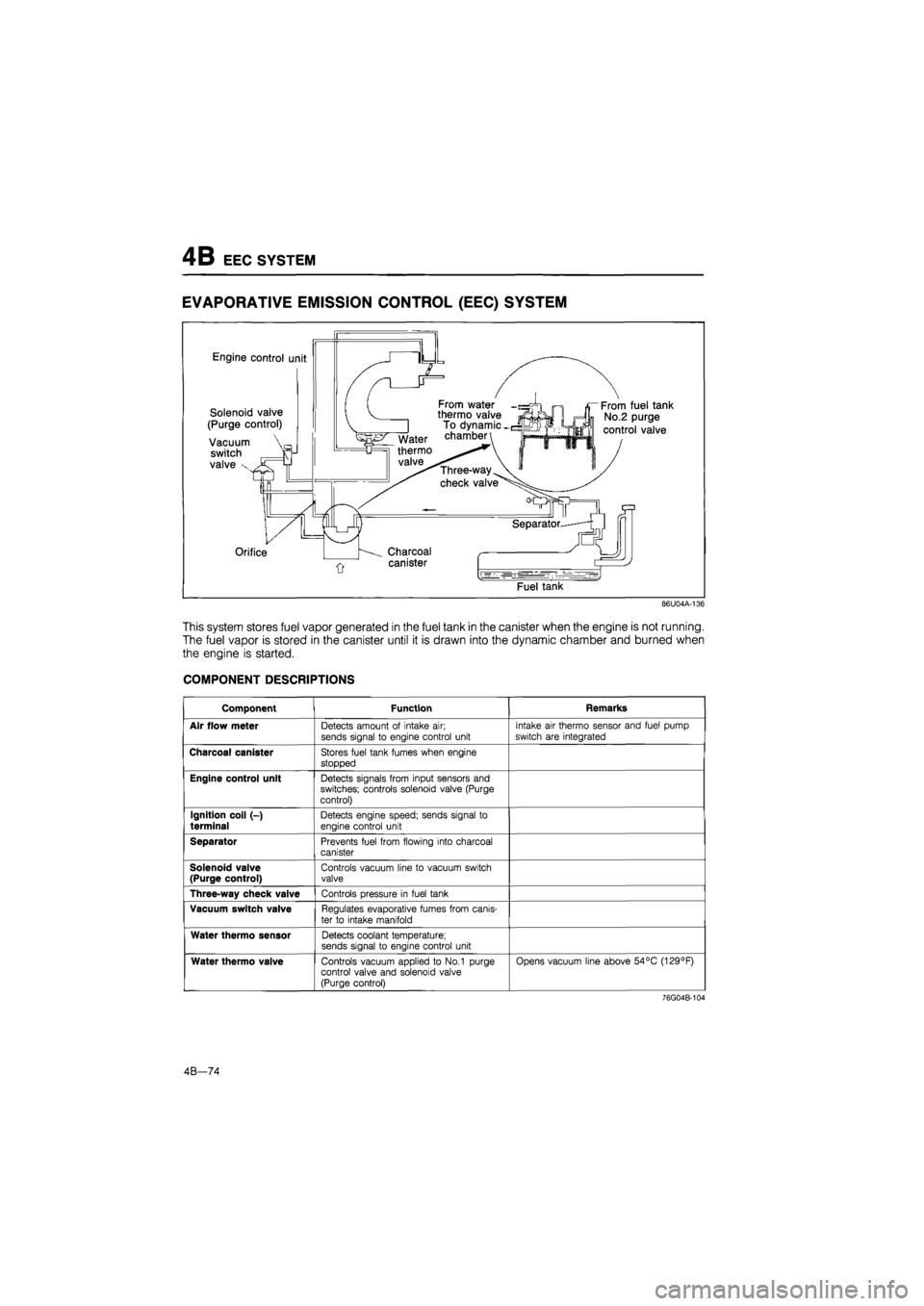
EVAPORATIVE EMISSION CONTROL
(EEC)
SYSTEM
Engine control unit
Solenoid valve
(Purge control)
Vacuum
switch
valve x
From water thermo valve To dynamic -chamber
Three-way
check valve
Orifice Charcoal
canister
From fuel tank
No.2 purge
control valve
Fuel tank
86U04A-136
This system stores fuel vapor generated in the fuel tank in the canister when the engine is not running.
The fuel vapor is stored in the canister until it is drawn into the dynamic chamber and burned when
the engine is started.
COMPONENT DESCRIPTIONS
Component Function Remarks
Air flow meter Detects amount of intake air; sends signal to engine control unit
Intake air thermo sensor and fuel pump
switch are integrated
Charcoal canister Stores fuel tank fumes when engine
stopped
Engine control unit Detects signals from input sensors and switches; controls solenoid valve (Purge control)
Ignition coil (-)
terminal Detects engine speed; sends signal to
engine control unit
Separator Prevents fuel from flowing into charcoal canister
Solenoid valve (Purge control) Controls vacuum line to vacuum switch valve
Three-way check valve Controls pressure in fuel tank
Vacuum switch valve Regulates evaporative fumes from canis-
ter to intake manifold
Water thermo sensor Detects coolant temperature; sends signal to engine control unit
Water thermo valve Controls vacuum applied to No.1 purge control valve and solenoid valve (Purge control)
Opens vacuum line above 54°C (129°F)
76G04B-104
4B—74
Page 611 of 1865

4C FUEL SYSTEM
COMPONENT DESCRIPTION
Component Function Remark
Air flow sensor Detects amount of intake air;
sends signal to engine control unit
Clutch switch Detects in-gear condition; sends signal to engine control unit Switch ON when clutch pedal released
Engine control unit Detects signals from input sensors and switches; controls injector and fuel pump operations
Fuel filter Filters fuel
Fuel pump Provides fuel to injectors • Operates while engine running
• Installed in fuel tank
Fuel pump control unit (4WS) Monitors fuel level in left section; controls transfer pump operation
G signal pick-up Detects No.1 cylinder TDC; sends signal to engine control unit Installed in distributor
Idle switch Detects when throttle valve fully closed; sends signal to engine control unit Installed on throttle body
Ignition switch (ST position) Sends engine cranking signal to engine control unit
Injector Injects fuel into intake port • Controlled by signals from engine control unit • High-ohmic injector
Intake air thermo sensor Detects intake air temperature; send signal to engine control unit
Control relay Supplies electric current to injectors fuel pump and engine control unit
Ne signal pick-up Detects crank angle at 180° intervals; sends signal to engine control unit Installed in distributor
Neutral switch Detects in-gear condition; sends signal to engine control unit
Switch ON when in gear
Oxygen sensor (Unleaded fuel) Detects oxygen concentration; sends signal to engine control unit
• Zirconia ceramic and platinum coating • Integrated heater coil
Pressure regulator Adjusts fuel pressure supplied to injectors
Pulsation damper Absorbs fuel pulsation
Throttle sensor Detects throttle valve opening angle;
sends signal to engine control unit
Installed on throttle body
Transfer pump (4WS) Pumps fuel from the left to the right side Controlled by fuel pump control unit
Transfer pump switch (4WS) Detects fuel level in left section;
sends signal to control unit
Water thermo sensor Detects coolant temperature; sends signal to engine control unit
Water thermo switch (Unleaded fuel) Detects radiator coolant temperature; sends signal to engine control unit ON: above 17°C (63°F)
76G04C-088
4C-50
Page 688 of 1865

4D SUPERCHARGING SYSTEM (RF-CX)
BOOST AIR TEMPERATURE SENSOR
Removal
Remove the boost air temperature sensor from the
compressed air funnel.
76G04D-039
Thermometer
Inspection
1. Place the boost air temperature sensor in oil.
2. Heat the oil and check continuity of the sensor with
an ohmmeter. Replace if necessary.
Continuity : over 150°C (302°F)
No continuity: below 143°C (289°F)
76G04D-040
Installation
Install the boost air temperature sensor in the com-
pressed air funnel.
Tightening torque:
29—39 N m (3.0—4.0 m-kg, 22—29 ft-lb)
76G04D-041
4D—17
Page 707 of 1865

5
ENGINE ELECTRICAL SYSTEM
OUTLINE 5— 2
STRUCTURAL VIEW 5— 2
SPECIFICATIONS 5— 5
TROUBLESHOOTING 5— 7
BATTERY 5— 8
INSPECTION 5— 8
RECHARGE. 5— 8
SPARK PLUG 5— 9
REMOVAL AND INSTALLATION 5— 9
INSPECTION 5— 9
IGNITION COIL 5—10
INSPECTION 5—10
HIGH-TENSION LEAD 5—10
INSPECTION 5—10
DISTRIBUTOR 5—11
SPARK TEST 5—11
IGNITION TIMING 5—11
SPARK CONTROL 5—12
REMOVAL 5—14
DISASSEMBLY 5—15
INSPECTION 5—16
ASSEMBLY 5—17
INSTALLATION 5—18
H.E.I. TROUBLESHOOTING 5—19
IGNITER (FE DOHC) 5—20
INSPECTION 5—20
ALTERNATOR 5—21
CROSS SECTIONAL VIEW 5—21
CHARGING SYSTEM 5—22
TROUBLESHOOTING 5—23
REMOVAL 5—27
DISASSEMBLY 5—28
INSPECTION 5—32
ASSEMBLY 5—35
INSTALLATION 5—36
V-BELT TENSION 5—37
STARTER (GASOLINE ENGINE
0.85, 0.95 KW TYPE) 5—38
STARTING SYSTEM CIRCUIT 5—38
ON-VEHICLE INSPECTION 5—38
REMOVAL AND INSTALLATION 5—39
DISASSEMBLY AND ASSEMBLY 5—39
INSPECTION 5—40
PERFORMANCE INSPECTION 5—43
STARTER
(GASOLINE ENGINE, 1.4 KW TYPE) 5—45
STARTING SYSTEM 5—45
ON-VEHICLE UNSPECTION 5—45
REMOVAL 5—46
DISASSEMBLY 5—46
INSPECTION 5—49
ASSEMBLY 5—53
CHECKING OPERATION 5—54
INSTALLATION 5—55
STARTER
(DIESEL ENGINE, 2.0 kW TYPE) .... 5—56
STARTING SYSTEM CIRCUIT 5—56
ON-VEHICLE INSPECTION 5—56
REMOVAL AND INSTALLATION 5—57
DISASSEMBLY AND ASSEMBLY 5—57
INSPECTION 5—61
PERFORMANCE INSPECTION 5—64
STARTER
(DIESEL ENGINE, 2.2 kW TYPE).... 5—66
STARTING SYSTEM CIRCUIT 5—66
ON-VEHICLE INSPECTION 5—66
REMOVAL AND INSTALLATION 5—67
DISASSEMBLY AND ASSEMBLY 5—67
INSPECTION 5—71
PERFORMANCE INSPECTION 5—74
QUICK START SYSTEM (QSS) 5-76
COMPONENT LOCATION 5—76
CIRCUIT DIAGRAM 5—76
SYSTEM OPERATION 5—77
TROUBLESHOOTING GUIDE 5—78
CONTROL UNIT 5—79
GLOW PLUG RELAY 5—80
BLOW PLUG 5—80
WATER TEMPERATURE SWITCH.... 5—80
76g05x-001
Page 713 of 1865

TROUBLESHOOTING GUIDE 5
TROUBLESHOOTING GUIDE
Problem Possible cause Remedy Page
Starter does not turn at all, or Its turning speed Is too slow to start the engine.
Battery and related parts Poor contact of battery terminals Poor grounding of negative cable Voltage drop caused by discharged battery Insufficient voltage caused by battery malfunction
Clean and tighten Clean and repair Recharge Replace
5- 8
5- 8 5- 8
Ignition switch and related parts Poor contact of ignition switch Loose ignition switch wiring or connector Broken wire between ignition switch and magnetic switch
Replace Repair Repair or replace 5-38,45,56,66
Magnetic switch and related parts Loose wiring and/or connectors Burnt magnetic switch contact plate or improper contact Broken wire in magnetic switch pull-in coil Broken wire magnetic switch holding coil
Repair Replace
Replace Replace
5-38,45,56,66 5-43,54,64,74
5-43,54,64,74 5-43,54.64,74
Starter Poor contact of brushes
Fatigued brush spring Poor grounding of field coil Poor soldering of field coil Commutator mulfunction Grounded armature Worn parts
Adjust contact or replace Replace Replace Repair Repair or Replace Replace Replace
5-43,54,64,74
Starting problem Gasoline engine Insufficient battery capacity Malfunction of spark plug (s)
Loose positive terminal Damaged distributor cap or rotor Ignition coil malfunction laniter malfunction
Recharge Clean, adjust or replace Tighten Replace Replace Renlane
5— 8 5— 9
5—16 5—10 5-16,20
Diesel engine Insufficient battery capacity QSS svstem malfunction Recharge ReDlace 5— 8 5-76
Starter turns but pinion gear does not mesh with ring gear
Starter Tip of overrunning clutch pinion is worn Weakened overrunning clutch drive spring Worn overrunning clutch Improper sliding of spline
Worn bushing Worn ring gear
Replace Replace Replace Adjust contact and repair, or replace Replace ReDlace
5-40,54,70
Starter turns continuously (does not stop) Magnetic switch Sticking contact place of magnetic switch Layer shorting coil of magnetic switch Ignition switch does not return
Replace Replace Rfinlanfi
5-43,54,64,74 5-43,54,64,74
Misfiring Dirty or damaged spark plug (s) Malfunction of wiring, or open circuit Damaged distributor cap
Clean or replace Repair or Replace Replace
5- 9 5—10 5—16
Discharging of battery Alternator Loose drive belt Grounded or broken stator coil Broken rotor coil Poor contact of brush and slip ring
Malfunction of rectifier Malfunction of IC regulator Battery and related parts Insufficient or unsuitable battery electrolyte Malfunction of battery electrode (internal short-circuit) Poor contact of battery terminal (s) Excessive electric load
Adjust Replace Replace Clean, repair or replace Replace Replace
Adjust Replace
Clean and tighten Check power consump-tion and short circuit
5-37 5-32 5-32 5-32
5-34
5— 8 5- 8
5— 8
Overcharging of battery IC regulator malfunction Operating in extremely high temperature Replace Reoair
Poor acceleration Mis-adjusted ignition timing Distributor malfunction Adjust Repair or replace 5—11 5—11
Knocking Mis-adjusted ignition timing | Distributor malfunction Adjust Repair or replace 5—11 5—11
76G05X-003
5-7