service MAZDA 626 1987 Owner's Guide
[x] Cancel search | Manufacturer: MAZDA, Model Year: 1987, Model line: 626, Model: MAZDA 626 1987Pages: 1865, PDF Size: 94.35 MB
Page 1567 of 1865

1 4 FRONT DOORS
86U14X-060
86U14X-040
86U14X-041
6. Remove the beltline molding. (Refer to page
14-39)
7. Remove the door glass upward.
8. Remove the mounting bolts, and remove the regu-
lator through the service hole.
9. Remove the window motor mounting bolt, and re-
move the motor from the regulator (power window).
Removal of Outer Handle and Key Cylinder
1. Disconnect the rod from the outer handle.
69G14X-036
14—16
Page 1571 of 1865

1 4 REAR DOORS
86U14X-047
86U14X-048
86U14X-049
REMOVAL
Rear Door Glass and Regulator
1. Lower the door glass the way.
2. Remove the clip. (Manual type)
3. Remove the regulator handle. (Manual type)
4. Remove the inner handle cover.
5. Remove the door trim.
Note
For vehicles with power windows, disconnect
the connectors.
6. Remove the door screen.
Caution
Remove the screen carefully so that it may be
reused.
7. Position the door glass so that the mounting bolts
can be removed from the service hole.
8. Remove the mounting bolts.
86U14X-050
14—20
Page 1572 of 1865

REAR DOORS 1 4
9. Remove the door glass upward.
86U14X-051
Remove the mounting bolts, and remove the win-
dow regulator through the service hole.
Remove the window motor mounting bolts, then
remove the motor from the regulator (power
window).
86U14X052
INSTALLATION
Install in the reverse order of removal, noting the fol-
lowing.
Tightening torque:
Nm (m-kg, ft-lb)
Door lock assembly 4.22-6 18 (0 43-0 63, 3,10—4.54)
Outer handle 8.8-13 (0.9-1.3. 6.5-9.4)
Glass Quide 7.8—11 (0.8—1.1, 5.8—8.0)
Regulator Nut 8 8—13 (0.9—1.3, 6.5—9.4) Regulator Bolt 7.8-11 (0.8-1.1. 5.8-8.0)
Door lock striker 18-26 (1.8-2.7, 13-20)
Before installing the motor, connect the leads to a bat-
tery and run regulator down to the position shown.
14—21
Page 1601 of 1865

14 WINDSHIELD GLASS
Repair seal
Dam
_5 mm
.(0.19
11 mm
(0.43 in)
6. Prepare the nozzle of the sealant gun so that it has
a flange that can run along the edge of the glass,
and a V from which the sealant can flow. Once the
primer is dry, apply the sealant around the entire
circumference to fill the gap between the dam and
the edge of the glass with a ridge of sealant 11
mm (0.43 in) high.
Keep the bead of sealant smooth and even,
reshaping it where necessary with a spatula.
86U14X-11E
7BU14X-026
76G14X-044
Replenished section
with sealing agent
— Glass
7. Lift the glass into place. Push it in lightly toward
the vehicle to compress the sealant.
Caution
Open the windows to prevent the glass from
being pushed out by air pressure if a door is
closed.
Hardening time of repair seal
Temperature Surface hardening
time
Time required until car
can be put in service
5°C (41 °F) Approx. 1.5 hrs 12 hrs
20°C (68°F) Approx. 1 hr 4 hrs
35°C (95°F) Approx. 10 min. 2 hrs
8. Use a scraper to smooth away any sealant that
oozes out. Add more sealant to any points of poor
contact.
9. Check for water leaks. If a leak is found, wipe the
water off well and add repair seal (B001 77 739)
where needed.
Spacer
86U14X-120
14-50
Page 1608 of 1865

REAR WINDOW GLASS 1 4
86U14X-135
63U14X-069
Replenished section
with sealing agent
-Glass
Spacer
63U14X-070
7. Attach the back door glass to the body.
Caution
Keep the door glass open until the repair seal
hardens to some degree to prevent pressure
from being exerted on the rear glass, if the
door is closed quickly.
Hardening time of repair seal
Tem-
perature Surface hardening
time
Time required until car
can be put in service
5°C
(41
°F) Approx. 1.5 hrs 12 hrs
20°C (68°F) Approx. 1 hr 4 hrs
35°C (95°F) Approx. 10 min 2 hrs
8. Remove any excess or add repair seal where
necessary.
9. Check for water leaks. If a leak is found, wipe the
water off well and add repair seal (B001 77 739).
10. After checking for water leakage, install the mold-
ing and trim.
11. Connect the defogger connector.
86U14X-136
14—57
Page 1612 of 1865

REAR HATCH GLASS 1 4
8. Keep the door glass open until the repair seal
hardens to some degree to prevent pressure from
being exerted on the rear hatch glass.
If the door is closed quickly etc.
Hardening time of repair seal
Tem-
perature Surface hardening time Time required until car
can be put in service
5°C
(41
°F) Approx. 1.5 hrs 12 hrs
20°C (68°F) Approx. 1 hr 4 hrs
35°C (95°F) Approx. 10 min 2 hrs
86U14X-144
Replenished section
r with sealing agent
^ \ ^Glass
Spacer
10. Check for water leaks. If a leak is found, wipe the
water off well and add repair seal (B001 77 739).
86U14X-146
After checking for water leakage, install the mold.
Install the wiper arm, door trim, and defogger con-
nector.
86U14X-147
14—61
Page 1643 of 1865

1 4 WINDSHIELD WIPER
86U14X-168
86U14X-169
86U14X-170
REMOVAL
1. Disconnect the negative battery cable.
2. Remove the wiper arms.
3. Remove the lower molding.
4. Remove the cover.
5. Disconnect the wiper link from the motor.
Caution
Do not remove the motor arm unless neces-
sary. The motor arm position on the motor
shaft decides the automatic stop position,
(lowest position of the wiper arm)
6. Disconnect the connector.
7. Remove the wiper motor.
8. Remove the wiper link assembly mounting bolts.
9. Lift the wiper link assembly out from the left side
(driver's side) service hole.
86U14X-171
14—92
Page 1749 of 1865
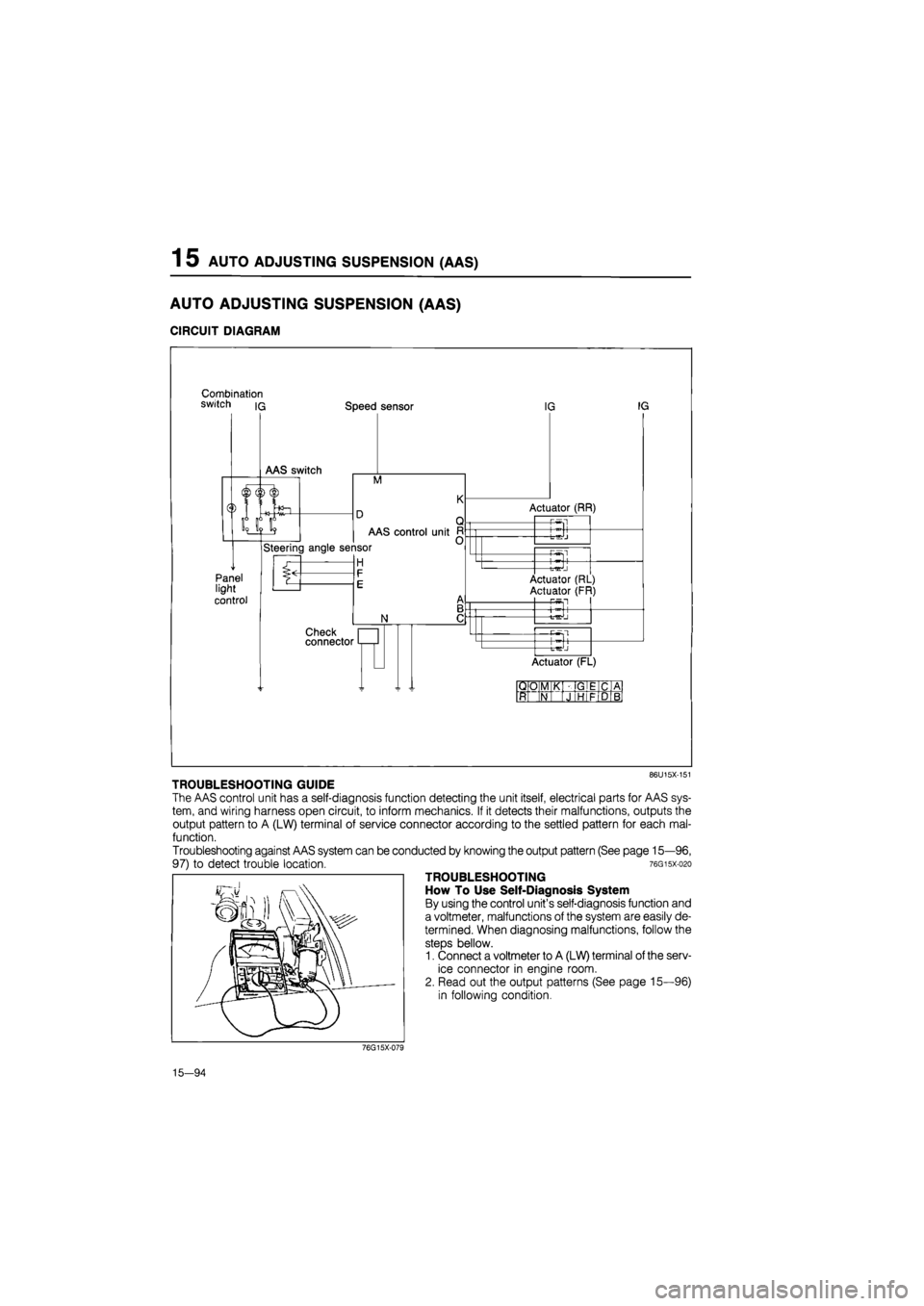
1 5 AUTO ADJUSTING SUSPENSION (AAS)
AUTO ADJUSTING SUSPENSION (AAS)
CIRCUIT DIAGRAM
Combination switch iq Speed sensor
M
Panel light
control
AAS control unit
Steering angle sensor
H
N
Check connector
IG IG
Actuator (RR)
-P-Sl
-t-^J
—Pwsl
Actuator (RL)
Actuator (FR) P5fl
+
Actuator (FL)
QO M K GIE C A
ft N J HI F D B
86U15X-151
TROUBLESHOOTING GUIDE
The AAS control unit has a self-diagnosis function detecting the unit itself, electrical parts for AAS sys-
tem, and wiring harness open circuit, to inform mechanics. If it detects their malfunctions, outputs the
output pattern to A (LW) terminal of service connector according to the settled pattern for each mal-
function.
Troubleshooting against AAS system can be conducted by knowing the output pattern (See page 15—96,
97) to detect trouble location. 76gisx-o2o
TROUBLESHOOTING
How To Use Self-Diagnosis System
By using the control unit's self-diagnosis function and
a voltmeter, malfunctions of the system are easily de-
termined. When diagnosing malfunctions, follow the
steps bellow.
1. Connect a voltmeter to A (LW) terminal of the serv-
ice connector in engine room.
2. Read out the output patterns (See page 15—96)
in following condition.
76G15X-079
15—94
Page 1787 of 1865
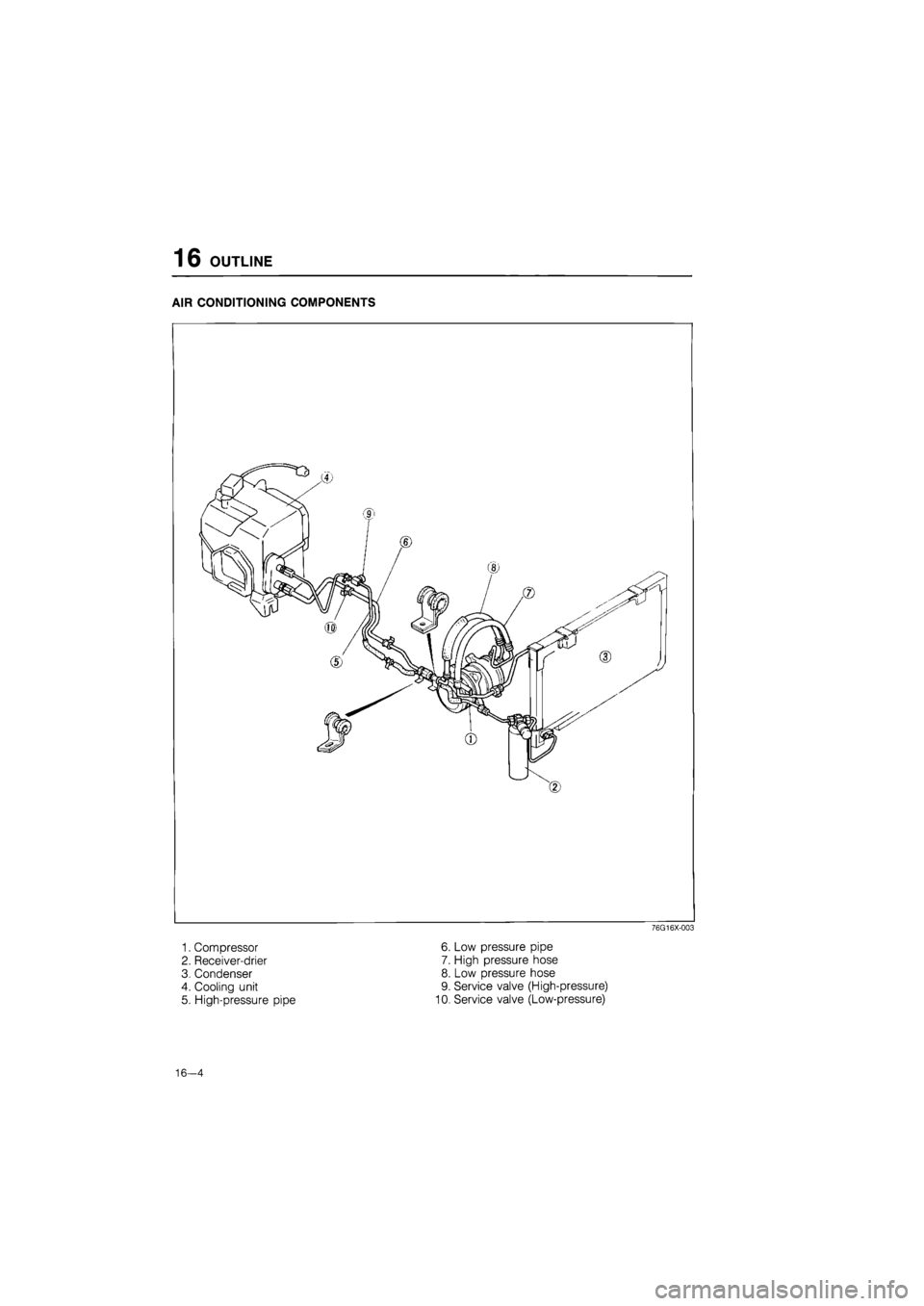
16 OUTLINE
AIR CONDITIONING COMPONENTS
76G16X-003
1. Compressor 6. Low pressure pipe
2. Receiver-drier 7. High pressure hose
3. Condenser 8. Low pressure hose
4. Cooling unit 9. Service valve (High-pressure)
5. High-pressure pipe 10. Service valve (Low-pressure)
16—4
Page 1793 of 1865

16 OUTLINE
Safety Precautions
1. The R-12 liquid refrigerant is highly volatile. A drop
of it on the skin of your hand could result in local-
ized frostbite. When handling the refrigerant, be
sure to wear gloves.
2. If the refrigerant splashes into your eyes, wash
them with clean water immediately. It is standard
practice to wear goggles or glasses to protect your
eyes, and gloves to protect your hands.
3. The R-12 container is a highly pressurized vessel.
Never leave it in a hot place, and check to be sure
that the temperature where it is stored is below
52°C (126°F).
4. A halide leak detector is often used to check the
system for refrigerant leakage. Remember that
R-12, upon coming into contact with flame (this de-
tector burns like propane to produce a small flame),
produces phosgene, a toxic gas.
69G16X020
V/^V
Connection
LZl
jvmi
Refrigerant Container Service Valve
1. Before connecting the valve to the refrigerant con-
tainer, turn the handle fully counterclockwise.
2. Turn the disc counterclockwise until it reaches its
highest position.
3. Connect the center hose to the valve fitting. Turn
the disc fully clockwise by hand.
4. Turn the handle clockwise to make a hole in the
sealed tap.
5. Turn the handle fully counterclockwise to fill the
center hose with air. Do not open the high- and
low-pressure manual valves.
6. Loosen the center hose nut connected to the cen-
ter fitting of the manifold gauge.
Allow air to escape for a few seconds, then tight-
en the nut.
69G16X-021
16-10