trailer MAZDA CX90 2024 User Guide
[x] Cancel search | Manufacturer: MAZDA, Model Year: 2024, Model line: CX90, Model: MAZDA CX90 2024Pages: 687, PDF Size: 15.46 MB
Page 339 of 687

Lane-keep Assist System(LAS)
*
The LAS is a system to help the driver
stay within the vehicle lane if the
vehicle might be deviating.
If your vehicle may be deviating from
the vehicle lane, the LAS provides
steering assistance to avoid departure
from the lane.
Warnings and Cautions
for Using the Lane-keep Assist System (LAS)
WARNING
Do not rely completely on the LAS.
The LAS is not an automated driving
system. Over reliance on the system
could lead to an accident.
The functions of the LAS have
limitations. Do not rely completely
on the system and always stay on
course using the steering wheel.
Do not use the LAS under the
following conditions. Otherwise, it
may result in an accident.
The vehicle is driven on slippery
roads such as icy roads,
snow-covered roads, and unpaved
roads.
Tires other than the specified size are
used, such as when tire chains or
temporary spare tires are used.
Tires with insufficient tread are used.
The tire pressures are not adjusted to
the specified pressure.
The vehicle is towing a camping
trailer or boat trailer.
The vehicle is driven on roads other
than expressways or highways with
white (yellow) lines.
CAUTION
Heed the following cautions so that
the LAS can operate normally.
Do not modify the vehicle's
suspensions.
Driving
Lane-keep Assist System (LAS)
5-188*Some models.
CX-90_8KG7-EA-22L_Edition1_new 2022-11-17 16:05:04
Page 351 of 687
Refer to Cameras on page 5-137.
Always check the surrounding area
visually.
The operation of the SBS has certain
limitations. Always confirm the safety
around the vehicle visually when
driving.
CAUTION
If any of the following conditions is
met, turn the SBS
off to prevent a
mis-operation.
A trailer is pulled or an accessory
such as a bicycle carrier is installed
to the rear of the vehicle.
The vehicle is driven on rough
roads such as in areas where there
is grass and foliage or off-road.
Always use tires of the specified size
and the same manufacturer, brand,
and tread pattern on all 4 wheels. In
addition, do not use tires with
significantly different wear patterns
on the same vehicle. If such
improper tires are used, the SBS may
not operate normally.
How to Use the Smart
Brake Support (SBS)
NOTE
During the SBS brake control, the
brake pedal may move rearward or
become stiff. The brakes are operating,
but continue to depress the brake
pedal.
When the forward detection function
operates*
The forward detection function
operates when all of the following
conditions are met.
(If an object is a vehicle ahead)
The vehicle speed is about 4 km/h
(3 mph) or faster.
(If an object is a bicycle/pedestrian)
The vehicle speed is about 10
km/h to 80 km/h (6.3 mph to 49
mph).
The DSC does not operate.The system determines that there is a
possibility of a collision with an
object ahead.
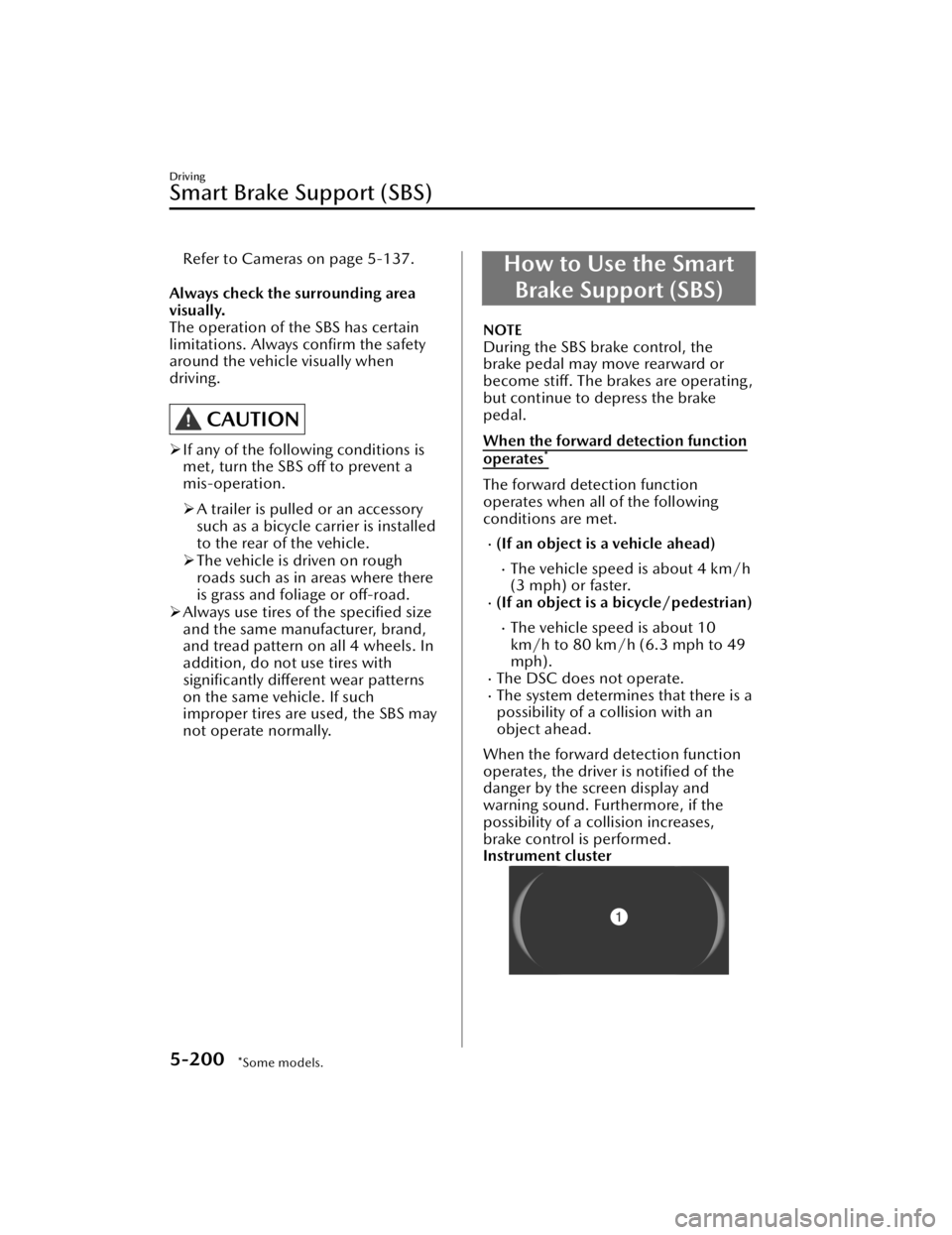
When the forward detection function
operates, the driver is notified of the
danger by the screen display and
warning sound. Furthermore, if the
possibility of a collision increases,
brake control is performed.
Instrument cluster
Driving
Smart Brake Support (SBS)
5-200*Some models.
CX-90_8KG7-EA-22L_Edition1_new 2022-11-17 16:05:04
Page 486 of 687

To w i n g
Your Mazda was designed and built
primarily to carry passengers and
cargo.
If you tow a trailer, follow these
instructions because driver and
passenger safety depends on proper
equipment and safe driving habits.
Towing a trailer will affect handling,
braking , durability, performance, and
economy.
Never overload vehicle or trailer.
Consult an Authorized Mazda Dealer if
you need further details.
NOTE
Your vehicle is equipped with a
Trailer Stability Control (TSC)
mechanism, which enhances vehicle
stability when towing a trailer.
Refer to Trailer Stability Control
(TSC) on page 5-90.
When towing a trailer, do not use the
following safety systems (If a Mazda
genuine trailer hitch is used, these
systems are automatically turned off
when the trailer's electrical
connector is connected):
Blind Spot Monitoring (BSM)Rear Cross Traffic Alert (RCTA)Smart Brake Support (SBS) reverse
drive detection
Parking Sensor System (Rear)Emergency Lane Keeping (ELK)
Blind Spot Assist
Emergency Lane Keeping (ELK)
Head-on traffic avoidance assist
Turn off the aforementioned safety
systems when towing a trailer
without a genuine Mazda trailer
hitch.
Your vehicle is equipped with a
Mazda intelligent Drive Select
(Mi-Drive) towing mode which
enhances vehicle stability when
towing a trailer.
Refer to Mazda intelligent Drive
Select (Mi-Drive) on page 5-96.
Other Equipment
Towing (U.S.A. and Canada)
7-59
CX-90_8KG7-EA-22L_Edition1_new 2022-11-17 16:05:04
Page 487 of 687

Warnings and Cautionsfor Using the Towing
WARNING
Always keep tow loads within
specified limits as indicated in the
Trailer Towing-Load Table:
Attempting to tow loads greater than
those specified is dangerous as it may
cause serious handling and
performance problems that could
result in personal injury or vehicle
damage, or both.
Load your trailer with the weight
about 60 % toward the front and
40 % toward the rear:
Loading the trailer with more weight in
the rear than in the front is dangerous.
Doing so could cause you to lose
control. The trailer tongue load must
be 10 % ―15 % of the total trailer load
(sum of the weights of the trailer and
cargo).
Always have the total trailer weight
and tongue load determined prior to
departure:
Attempting to tow loads without
determining the total trailer weight and
tongue load is dangerous. Trailer sway
from crosswinds, rough roads or other
causes could result in loss of control
and a serious accident.
Always make sure the trailer hitch is
securely attached before departure:
An unsecured trailer hitch is dangerous
as it causes greater trailer sway from
crosswinds, rough roads or other
causes, resulting in loss of control and
a serious accident.
Examine all trailer-hitch mounting
bolts regularly and tighten any that are
loose. If the hitch is removed, seal any
open mounting holes to prevent
exhaust, dust, water, dirt and other
foreign elements from filtering in,
possibly endangering personal safety
and damaging your vehicle.
Do not install a hitch that stiffens the
bumper as it will reduce the bumper's
performance.
Make sure there are no exhaust gas
leaks into the passenger compartment
if any mounting bolts are connected
to the body:
Modifying your vehicle exhaust system
is dangerous. Exhaust gas entering the
vehicle could cause loss of
consciousness or even death.
When mounting the trailer hitch, make
no modifications to the vehicle exhaust
system.
Never use the temporary spare tire
when towing:
Using the temporary spare tire on your
vehicle when towing a trailer is
dangerous as it could result in tire
failure, loss of control, and injury to
vehicle occupants.
Make sure the safety chain is securely
attached to both the trailer and the
vehicle prior to departure:
Towing a trailer without using a safety
chain securely attached to both the
trailer and the vehicle is dangerous. If
damage occurs to the coupling unit or
hitch ball, the trailer could wander into
another lane and cause a collision.
Other Equipment
Towing (U.S.A. and Canada)
7-60
CX-90_8KG7-EA-22L_Edition1_new 2022-11-17 16:05:04
Page 488 of 687

Do not connect a hydraulic
trailer-brake system to your vehicle's
brake system:
Connecting a hydraulic trailer-brake
system directly to the vehicle brake
system is dangerous and will result in
inadequate braking and possible injury.
Always use lower gears to reduce
speed:
Holding the brake pedal down too
long or too frequently is dangerous as
it could cause the brakes to overheat
and lose power, resulting in loss of
control and a serious accident. Use
lower gears to help reduce speed. Pull
off the road and allow brakes to cool
down whenever braking performance
feels reduced.
CAUTION
Do not tow a trailer during the first
1,000 km (600 miles) of your new
Mazda. If you do, you may damage
the engine, transmission, differential,
wheel bearings, and other
power-train components.
Be aware of the towing load weight
differences when towing at high
altitudes. For altitudes exceeding
1,000 meter (3,280 ft 10 in), always
reduce the towing load by 10 % for
every 1,000 meter (3,280 ft 10 in)
increase in altitude from the load
indicated under the maximum
GCWR heading in the trailer
towing-load table. If the determined
maximum total towing load weight is
exceeded, the engine and other
power-train parts may be damaged.
The total trailer weight and tongue
load can be determined by weighing
the trailer on platform scales at a
highway weight station or a trucking
company.
Make all hitch adjustments with
actual loads. Do not load and
unload vehicle while adjusting hitch.
This action will change the vehicle
height.
Do not use an axle-mounted hitch.
This may damage the axle and
related parts.
If the vehicle exceeds 100 km/h (62
mph) with a trailer in tow, the
vehicle could be damaged.
Do not connect a trailer lighting
system directly to the lighting system
of your Mazda. This may damage
your vehicle's electrical system and
lighting systems. Have a recreational
vehicle dealer or trailer rental agency
connect the system, and inspect the
brake lights and turn signals yourself
before each trip.
Other Equipment
Towing (U.S.A. and Canada)
7-61
CX-90_8KG7-EA-22L_Edition1_new 2022-11-17 16:05:04
Page 489 of 687

How to Use the Towing
NOTE
The three main causes of vehicle-trailer accidents are driver error, excessive speed,
and improper trailer loading.
Trailer towing causes higher fuel consumption.The extra weight of the trailer may strain the engine on hot days and on long or
steep upgrades. If the temperature gauge indicates overheating, turn off the air
conditioner, drive safely to the side of the road, park off the right-of-way and wait
for engine to cool.
Verify that your Mazda maintains a near-normal attitude when a loaded or
unloaded trailer is connected. Do not drive if it has an abnormal front-up or
front-down position. Inspect for incorrec t tongue load, worn suspension parts,
and trailer overloading.
Make sure the trailer is properly loaded and the cargo is secure to prevent it from
shifting.
Make sure the mirrors conform to all govern ment regulations. If they do not, install
required rear view mirrors appropriate for towing purposes.
Trailer towing-load table
Because vehicle weights vary, adjustments must be made to meet the requirements
in this table.
(U.S.A.)
Limitation items Limit values
19 inch wheel ve- hicle 21 inch wheel ve-
hicle
MAX. TTW
1,588 kg (3,500 lb)
MAX. GCWR
4,150 kg (9,148 lb)
MAX. GAWR
Front 1,320 kg (2,910 lb) 1,313 kg (2,895 lb)
Rear 1,855 kg (4,090 lb) 1,797 kg (3,962 lb)
MAX. GVWR
3,109 kg (6,854 lb)
Other Equipment
Towing (U.S.A. and Canada)
7-62
CX-90_8KG7-EA-22L_Edition1_new 2022-11-17 16:05:04
Page 490 of 687

Limitation itemsLimit values
19 inch wheel ve- hicle 21 inch wheel ve-
hicle
TRAILER-TONGUE
LOAD To n g u e l o a d
Tongue load/Trailer load × 100 = 10 %
to 15 %
Trailer load
DISTRIBUTION OF
TRAILER LOADFront 60 %
Rear 40 %
(Canada)
Limitation items Limit values
19 inch wheel ve- hicle 21 inch wheel ve-
hicle
MAX. TTW
1,588 kg (3,500 lb)
MAX. GCWR
4,116 kg (9,073 lb)
MAX. GAWR
Front 1,320 kg (2,910 lb) 1,313 kg (2,895 lb)
Rear 1,855 kg (4,090 lb) 1,797 kg (3,962 lb)
MAX. GVWR
3,109 kg (6,854 lb)
TRAILER-TONGUE
LOAD To n g u e l o a d
Tongue load/Trailer load × 100 = 10 %
to 15 %
Trailer load
DISTRIBUTION OF
TRAILER LOADFront 60 %
Rear 40 %
Other Equipment
Towing (U.S.A. and Canada)
7-63
CX-90_8KG7-EA-22L_Edition1_new 2022-11-17 16:05:04
Page 491 of 687

TTW and GCWR
The total trailer weight (TTW), gross combination weight rating (GCWR), gross axle
weight rating (GAWR), trailer load, and trailer tongue load must be within the
prescribed limits.
The total trailer weight (TTW) is the sum of the weights of the trailer load (trailer
weight plus cargo). Never allow the total trailer weight (TTW) to exceed specifications in the Trailer towing-load table.
The maximum GCWR is the combination weight of the trailer and load plus the
towing vehicle (including trailer hitch, vehicle passengers, and load). It must not
exceed the specifications in the load table.
GAWR and GVWR
Do not exceed front and rear GAWR (gross axle weight rating) and GVWR (gross
vehicle weight rating). If you do, vehicle handling , braking , and performance will be
affected. These values are also on the Motor Vehicle Safety Standard Label posted
on the driver's door frame.
Trailer frontal area table
Frontal area is the total area that a moving vehicle and trailer exposes to air
resistance. Exceeding this limit may reduce the performance of your towing vehicle.
(U.S.A. and Canada)
Limitation items Limit values
MAX. FRONTAL AREA
2.79 m2 (30 ft2)
Before driving
Have your cooling and braking system checked by an Authorized Mazda Dealer.Before starting out, inspect the operation of all vehicle and trailer lights and all
vehicle-to-trailer connections. Stop and re-inspect all lights and connections after
driving a short distance.
Trailer hitch
Use only a hitch ball recommended by the trailer manufacturer that conforms to the
gross trailer weight requirement.
When not towing a trailer, remove the trailer hitch (if detachable) to reduce the
possibility of damage as a result of the vehicle being rear-ended.
Tires
When towing a trailer, make sure that the tire pressures of the rear tires are at 20
kPa (0.2 bar, 2.9 psi) higher than the recommended tire pressures indicated on
the tire pressure chart on the driver's door frame.
Other Equipment
Towing (U.S.A. and Canada)
7-64
CX-90_8KG7-EA-22L_Edition1_new 2022-11-17 16:05:04
Page 492 of 687

Trailer tire size, load rating, and inflation pressures should conform to tire
manufacturer specifications.
Do not exceed 100 km/h (62 mph) with a trailer in tow. If the local legal
maximum speed with a trailer in tow is less than 100 km/h (62 mph), do not
exceed the legal speed.
Safety chains
Safety chains must be used as a precautionary measure should the trailer become
unintentionally unhitched. They should cross under the trailer tongue and attach to
the hitch. Leave enough slack to allow full turns. Consult literature published by your
trailer or hitch manufacturer for more details.
Tra i l e r l i g h t s
Trailer lights must comply with all federal, state, and local regulations. Equip your
trailer as required before towing it day or night.
Trailer brakes
If the total trailer weight exceeds 450 kg (1,000 lb), trailer brakes are required. If
your trailer has brakes, make sure they comply with all federal, state, and local
regulations.
Driving
Your Mazda will handle differently with a trailer in tow, so practice turning ,
backing , and stopping in a traffic-free area.
Take time to get accustomed to the extra weight and length.Allow more room between your vehicle and the one in front because braking
distance increases with a trailer. For each 16 km/h (10 mph) of speed, allow at
least one vehicle and trailer length between your Mazda and the vehicle ahead.
Avoid jerky starts or sudden acceleration.Avoid sudden braking. It may cause loss of control and result in
jackknifing,
especially so on wet or slippery roads.
Shift the selector lever to the D position when towing a trailer in hilly terrain or
when heavily loaded.
The D position will allow operating the vehicle without frequent shifting.
Lane changes and turning
Avoid quick lane changes, sudden turns, and tight turns. Slow down before turning
to avoid the need of sudden braking.
A turning trailer will make a tighter arc than the tow vehicle. Compensate with turns
that are larger than normal.
Pa s s i n g
Plan well ahead to pass other vehicles, and provide plenty of room before changing
lanes. Crosswinds from passing vehicles, especially larger ones, and the effects of
rough roads will affect handling.
Other Equipment
Towing (U.S.A. and Canada)
7-65
CX-90_8KG7-EA-22L_Edition1_new
2022-11-17 16:05:04
Page 493 of 687

If swaying occurs, firmly grip the steering wheel and reduce speed immediately, but
gradually.
Steer straight ahead. If no extreme correction of steering or braking is made, the
combination of less speed and firm steering will result in stability.
Backing up
Backing a vehicle with a trailer requires practice and patience. Back slowly, and have
a helper outside at the rear of the trailer to reduce the risk of an accident.
To turn the trailer, place your hand at th e bottom of the steering wheel and turn it in
the direction you want the trailer to go. Make only slight movements to prevent
sharp or prolonged turning.
Ascending a hill
Shift into a lower gear to reduce the poss ibility of overloading or overheating the
engine, or both.
Descending a hill
Shift into a lower gear and use engine compression as a braking effect.
Pa r k i n g
Always make sure the tires of the trailer and the tow vehicle are blocked while
parked.
Apply the parking brake firmly and put the transmission in P.
Avoid parking on an incline, but if you must, follow these instructions:
1. Depress and hold down the brake pedal.
2. Have a helper put wheel blocks against the downhill side of all vehicle and trailer tires.
3. Then release the brake pedal slowly until the blocks bear the load.
If the grade is downhill, turn the steering wheel so that the front of the front
tires face the curb.
If it is uphill, face the rear of the front tires against the curb.
4. Firmly apply the parking brake.
5. Shift the transmission into P, and stop the engine.
To restart after parking on an incline:
1. With the transmission in P, start the engine. (Be sure to depress and hold the brake pedal.)
2. Shift into gear.
3. Release the parking brake (also the foot brake) and pull away from the wheel blocks. Stop; apply the parking brake and shift into P.
4. Have a helper retrieve the wheel blocks.
Maintenance
If you tow a trailer frequently, have your vehicle serviced as shown in Scheduled
Maintenance (page 9-4).
Other Equipment
Towing (U.S.A. and Canada)
7-66
CX-90_8KG7-EA-22L_Edition1_new 2022-11-17 16:05:04