ven MAZDA MAZDA 2023 Owner's Guide
[x] Cancel search | Manufacturer: MAZDA, Model Year: 2023, Model line: MAZDA, Model: MAZDA MAZDA 2023Pages: 623, PDF Size: 15.08 MB
Page 73 of 623
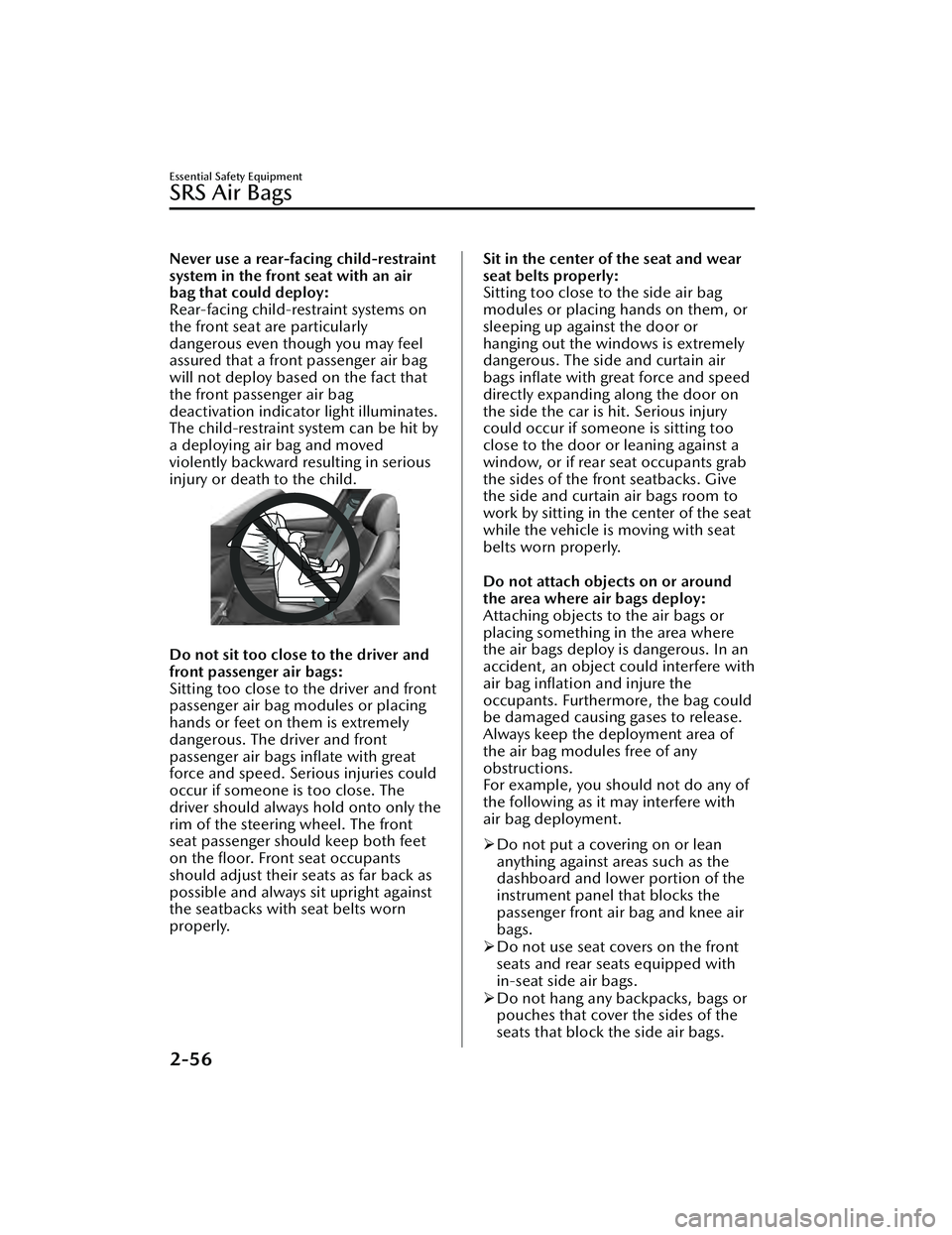
Never use a rear-facing child-restraint
system in the front seat with an air
bag that could deploy:
Rear-facing child-restraint systems on
the front seat are particularly
dangerous even though you may feel
assured that a front passenger air bag
will not deploy based on the fact that
the front passenger air bag
deactivation indicator light illuminates.
The child-restraint system can be hit by
a deploying air bag and moved
violently backward resulting in serious
injury or death to the child.
Do not sit too close to the driver and
front passenger air bags:
Sitting too close to the driver and front
passenger air bag modules or placing
hands or feet on them is extremely
dangerous. The driver and front
passenger air bags inflate with great
force and speed. Serious injuries could
occur if someone is too close. The
driver should always hold onto only the
rim of the steering wheel. The front
seat passenger should keep both feet
on the floor. Front seat occupants
should adjust their seats as far back as
possible and always sit upright against
the seatbacks with seat belts worn
properly.
Sit in the center of the seat and wear
seat belts properly:
Sitting too close to the side air bag
modules or placing hands on them, or
sleeping up against the door or
hanging out the windows is extremely
dangerous. The side and curtain air
bags inflate with great force and speed
directly expanding along the door on
the side the car is hit. Serious injury
could occur if someone is sitting too
close to the door or leaning against a
window, or if rear seat occupants grab
the sides of the front seatbacks. Give
the side and curtain air bags room to
work by sitting in the center of the seat
while the vehicle is moving with seat
belts worn properly.
Do not attach objects on or around
the area where air bags deploy:
Attaching objects to the air bags or
placing something in the area where
the air bags deploy is dangerous. In an
accident, an object could interfere with
air bag inflation and injure the
occupants. Furthermore, the bag could
be damaged causing gases to release.
Always keep the deployment area of
the air bag modules free of any
obstructions.
For example, you should not do any of
the following as it may interfere with
air bag deployment.
Do not put a covering on or lean
anything against areas such as the
dashboard and lower portion of the
instrument panel that blocks the
passenger front air bag and knee air
bags.
Do not use seat covers on the front
seats and rear seats equipped with
in-seat side air bags.
Do not hang any backpacks, bags or
pouches that cover the sides of the
seats that block the side air bags.
Essential Safety Equipment
SRS Air Bags
2-56
Mazda3_8LC2-EA-22G_Edition1_new 2022-5-20 11:26:10
Page 74 of 623
Do not place any objects on the
assist grips. Only hang clothes
directly on the coat hooks.
Do not touch the components of the
supplemental restraint system after
the air bags have inflated:
Touching the components of the
supplemental restraint system after the
air bags have inflated is dangerous.
Immediately after inflation, they are
very hot. You could get burned.
Never install any front-end equipment
to your vehicle:
Installation of front-end equipment,
such as frontal protection bar
(kangaroo bar, bull bar, push bar, or
other similar devices), snowplow, or
winches, is dangerous. The air bag
crash sensor system could be affected.
This could cause air bags to inflate
unexpectedly, or it could prevent the
air bags from inflating during an
accident. Front occupants could be
seriously injured.
Do not modify the suspension:
Modifying the vehicle suspension is
dangerous. If the vehicle's height or
the suspension is modified, the vehicle
will be unable to accurately detect a
collision or roll-over accident resulting
in incorrect or unexpected air bag
deployment and the possibility of
serious injuries.To prevent false detection by the air
bag sensor system, heed the
following:
Do not use tires or wheels other than
those specified for your Mazda:
Use of any tire or wheel other than
those
specified for your Mazda (page
9-10) is dangerous. Use of such
wheels will prevent the vehicle's
accident detections system from
accurately detecting a collision or
roll-over accident resulting in
incorrect or unexpected air bag
deployment and the possibility of
serious injuries.
Do not overload your vehicle:
Overloading your vehicle is
dangerous as it could prevent the air
bag crash sensor system from
accurately detecting a collision or
roll-over accident resulting in
incorrect or unexpected air bag
deployment and the possibility of
serious injuries. The gross axle
weight rating (GAWR) and the gross
vehicle weight rating (GVWR) for
your vehicle are on the Motor
Vehicle Safety Standard Label on the
driver's door frame. Do not exceed
these ratings.
Do not drive the vehicle off-road:
Driving your Mazda
off-road is
dangerous because the vehicle has
not been designed to do so. Driving
the vehicle off-road could prevent
the air bag crash sensor system from
accurately detecting a collision or
roll-over accident resulting in
incorrect or unexpected air bag
deployment and the possibility of
serious injuries.
Essential Safety Equipment
SRS Air Bags
2-57
Mazda3_8LC2-EA-22G_Edition1_new 2022-5-20 11:26:10
Page 75 of 623
Do not modify a front door or leave
any damage unrepaired. Always have
an Authorized Mazda Dealer inspect a
damaged front door:
Modifying a front door or leaving any
damage unrepaired is dangerous. Each
front door has a side crash sensor as a
component of the supplemental
restraint system. If holes are drilled in a
front door, a door speaker is left
removed, or a damaged door is left
unrepaired, the sensor could be
adversely affected causing it to not
detect the pressure of an impact
correctly during a side collision. If a
sensor does not detect a side impact
correctly, the side and curtain air bags
and the seat belt pretensioner may not
operate normally which could result in
serious injury to occupants.
Do not modify the supplemental
restraint system:
Modifying the components or wiring of
the supplemental restraint system is
dangerous. You could accidentally
activate it or make it inoperable. Do
not make any modifications to the
supplemental restraint system. This
includes installing trim, badges, or
anything else over the air bag modules.
It also includes installing extra
electrical equipment on or near system
components or wiring. An Authorized
Mazda Dealer can provide the special
care needed in the removal and
installation of front seats. It is
important to protect the air bag wiring
and connections to assure that the
bags do not accidentally deploy, and
that the front passenger occupant
classification system and the seats
retain an undamaged air bag
connection.Do not place luggage or other objects
under the front seats:
Placing luggage or other objects under
the front seats is dangerous. The
components essential to the
supplemental restraint system could be
damaged, and in the event of a side
collision, the appropriate air bags may
not deploy, which could result in death
or serious injury. To prevent damage to
the components essential to the
supplemental restraint system, do not
place luggage or other objects under
the front seats.
Do not operate a vehicle with
damaged air bag/seat belt
pretensioner system components:
Expended or damaged air bag/seat
belt pretensioner system components
must be replaced after any collision
which caused them to deploy or
damage them. Only a trained
Authorized Mazda Dealer can fully
evaluate these systems to see that they
will work in any subsequent accident.
Driving with an expended or damaged
air bag or pretensioner unit will not
afford you the necessary protection in
the event of any subsequent accident
which could result in serious injury or
death.
Do not remove interior air bag parts:
Removing any components such as the
front seats, front dashboard, the
steering wheel or parts on the front
and rear window pillars and along the
roof edge, containing air bag parts or
sensors is dangerous. These parts
contain essential ai r bag components.
The air bag could accidentally activate
and cause serious injuries. Always have
an Authorized Mazda Dealer remove
these parts.
Essential Safety Equipment
SRS Air Bags
2-58
Mazda3_8LC2-EA-22G_Edition1_new 2022-5-20 11:26:10
Page 87 of 623
▼Front Passenger Seat Weight
Sensors
Your vehicle is equipped with a front
passenger seat weight sensors as a part
of the supplemental restraint system.
These sensors are located under both
of the front passenger seat rails. These
sensors determine the total seated
weight on the front passenger seat and
monitor the seat belt buckle for the
front passenger seat. The SAS unit is
designed to prevent the front
passenger front and side air bags and
knee air bags, and seat belt
pretensioner system from deploying if
the front passenger air bag
deactivation indicator light illuminates.
To reduce the chance of injuries
caused by deployment of the front
passenger air bag, the system
deactivates the front passenger front
and side air bags and knee air bags,
and also the seat belt pretensioner
system when the front passenger air
bag deactivation indicator light
illuminates. Refer to the following
table for the front passenger air bag
deactivation indicator light
illumination conditions.
This system shuts off the front
passenger front and side air bags and
knee air bags, and seat belt
pretensioner system, so make sure the
front passenger air bag deactivation
indicator light illuminates according to
the following table.
The air bag/ seat belt pretensioner
system warning light flashes and the
front passenger air bag deactivation
indicator light illuminates if the sensors
have a possible malfunction. If this
happens, the front passenger front and
side air bags and knee air bags, and
seat belt pretension
er system will not
deploy.
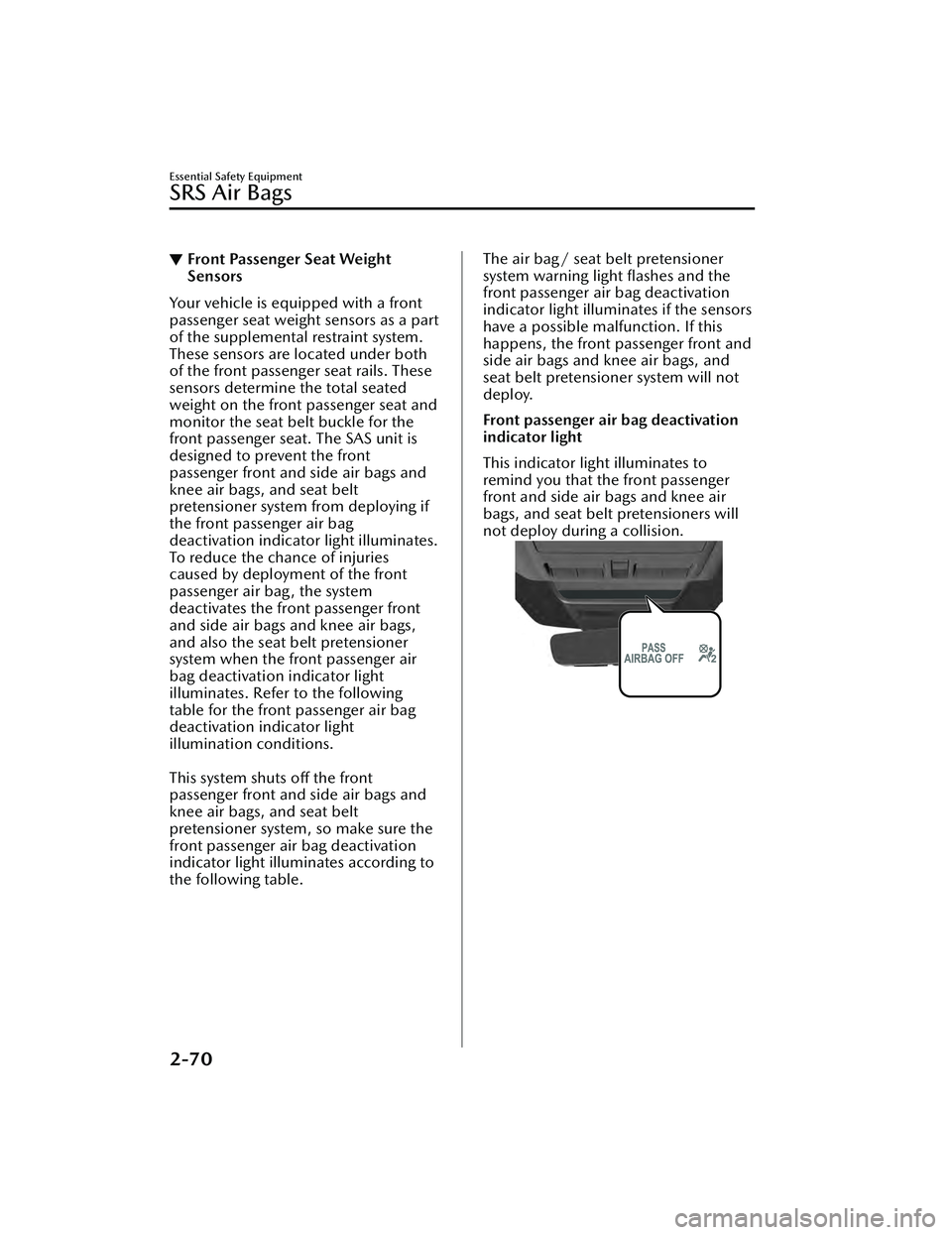
Front passenger air bag deactivation
indicator light
This indicator light illuminates to
remind you that the front passenger
front and side air bags and knee air
bags, and seat belt pretensioners will
not deploy during a collision.
Essential Safety Equipment
SRS Air Bags
2-70
Mazda3_8LC2-EA-22G_Edition1_new 2022-5-20 11:26:10
Page 90 of 623
A rear passenger steps on the front
passenger seat rails with their feet.
Luggage or other items are placed on
the seatback or hung on the head
restraint.
Heavy items are placed in the
seatback map pocket.
The seat is washed.
Liquids are spilled on the seat.
The front passenger seat is moved
backward, pushing into luggage or
other items placed behind it.
The front passenger seatback
contacts the rear seat.
Luggage or other items are placed
between the front passenger seat
and driver seat.
Any accessories which might increase
the total seated weight on the front
passenger seat are attached to the
front passenger seat.
CAUTION
To assure proper deployment of the
front air bag and to prevent damage
to the sensors in the front seat
bottoms:
Do not place sharp objects on the
front seat bottoms or leave heavy
luggage on them.
Do not spill any liquids on the
front seats or under the front seats.
To allow the sensors to function
properly, always perform the
following:
Adjust the front seats as far back as
possible and always sit upright
against the seatbacks with seat
belts worn properly.
If you place your child on the front
passenger seat, secure the
child-restraint system properly and
slide the front passenger seat as far
back as possible (page 2-46).
NOTE
The system requires about 10
seconds to alternate between turning
the front passenger front and side air
bags and knee air bags, and seat belt
pretensioner system on or off.
The front passenger air bag
deactivation indicator light may
illuminate repeatedly if luggage or
other items are put on the front
passenger seat, or if the temperature
of the vehicle's interior changes
suddenly.
The front passenger air bag
deactivation indicator light may
illuminate for 10 seconds if the total
seated weight on the front passenger
seat changes.
The air bag/seat belt pretensioner
system warning light might illuminate
if the front passenger seat receives a
severe impact.
If the front passenger air bag
deactivation indicator light does not
illuminate after installing a
child-restraint system on the front
passenger seat, first, re-install your
child-restraint system according to
the procedure in this owner's
manual. Then, if the front passenger
air bag deactivation indicator light
still does not illuminate, install the
child-restraint system on the rear seat
and consult an Authorized Mazda
Dealer as soon as possible.
Essential Safety Equipment
SRS Air Bags
2-73
Mazda3_8LC2-EA-22G_Edition1_new 2022-5-20 11:26:10
Page 91 of 623
If the front passenger air bag
deactivation indicator light
illuminates when an adult is seated
in the front passenger seat, have the
passenger re-adjust their posture by
sitting with their feet on the floor,
and then re-fastening the seat belt. If
the front passenger air bag
deactivation indicator light still
illuminates, move the passenger to
the rear seat. If sitting in the rear seat
is not possible, slide the front
passenger seat as far back as
possible. Consult an Authorized
Mazda Dealer as soon as possible.
▼Driver and Front Passenger Buckle
Switches
The buckle switches on the front seat
belts detect whether or not the front
seat belts are securely fastened and
further control the deployment of the
air bags.
Constant Monitoring
▼ Constant Monitoring
The following components of the air
bag systems are monitored by a
diagnostic system:
Front air bag sensorsCrash sensors, and diagnostic
module (SAS unit)
Side crash sensorsAir bag modulesSeat belt pretensionersAir bag/Seat belt pretensioner
system warning light
Related wiring
(With Driver and Front Passenger
Occupant Classification System)
Driver seat slide position sensorFront passenger occupant
classification sensor
Front passenger occupantclassification module
Front passenger air bag deactivation
indicator light
Front passenger seat belt buckle
switch
The diagnostic module continuously
monitors the system's readiness. This
begins when the ignition is switched
ON and continues while the vehicle is
being driven.
Essential Safety Equipment
SRS Air Bags
2-74
Mazda3_8LC2-EA-22G_Edition1_new 2022-5-20 11:26:10
Page 92 of 623
3Before Driving
Use of various features, including keys, doors, mirrors and
windows.
Keys........................................ 3-2 Keys...................................... 3-2
Keyless Entry System...............3-4
Advanced Keyless Entry
System.....................................3-9 Advanced Keyless Entry
System
*................................. 3-9
Operational Range...............3-10
Doors and Locks..................... 3-11 Door Locks.......................... 3-11
Liftgate/Trunk Lid.................3-20
Inside Trunk Release Lever (4-
door)
*................................. 3-24
Fuel and Emission................... 3-26 Fuel and Engine Exhaust
Precautions......................... 3-26
Fuel-Filler Lid and Cap..........3-28
Mirrors.................................. 3-31 Mirrors................................3-31
Windows............................... 3-35 Power Windows...................3-35
Moonroof*.......................... 3-38
Security System.......................3-42 Modification and Add-
On Equipment..................... 3-42
Immobilizer System..............3-42
Theft-Deterrent System
*........3-44
Driving Tips............................ 3-46 Break-In Period.................... 3-46
Saving Fuel and Protection of the
Environment........................ 3-46
Hazardous Driving............... 3-47
Floor Mat............................ 3-48
Rocking the Vehicle..............3-48
Winter Driving..................... 3-49
Driving In Flooded Area........3-51
Overloading........................ 3-51
Driving on Uneven Road.......3-52
Turbocharger Information
(SKYACTIV-G 2.5T).............. 3-52
Towing.................................. 3-53 Trailer Towing...................... 3-53
Recreational Towing............. 3-53
*Some models.3-1
Mazda3_8LC2-EA-22G_Edition1_new 2022-5-20 11:26:10
Page 93 of 623
Keys
▼Keys
WARNING
Do not leave the key in your vehicle
with children and keep them in a
place where your children will not
find or play with them:
Leaving children in a vehicle with the
key is dangerous. This could result in
someone being badly injured or even
killed. Children may find these keys to
be an interesting toy to play with and
could cause the power windows or
other controls to operate, or even
make the vehicle move.
CAUTION
Because the key (transmitter) uses
low-intensity radio waves, it may not
function correctly under the
following conditions:
The key (transmitter) is carried with
communication devices such as
cellular phones.
The key (transmitter) contacts or is
covered by a metal object.
The key (transmitter) is near
electronic devices such as personal
computers.
Non-Mazda genuine electronic
equipment is installed in the
vehicle.
There is equipment which
discharges radio waves near the
vehicle.
The key (transmitter) may consume
battery power excessively if it
receives high-intensity radio waves.
Do not place the key (transmitter)
near electronic devices such as
televisions or personal computers.
To avoid damage to the key
(transmitter), DO NOT:
Drop the key (transmitter).
Get the key (transmitter) wet.
Disassemble the key (transmitter).
Expose the key (transmitter) to
high temperatures on places such
as the dashboard, under direct
sunlight.
Expose the key (transmitter) to any
kind of magnetic field.
Place heavy objects on the key
(transmitter).
Put the key (transmitter) in an
ultrasonic cleaner.
Put any magnetized objects close
to the key (transmitter).
NOTE
The driver must carry the key
(transmitter) to ensure the system
functions properly.
If the key (transmitter) does not
function normally, make sure that the
power saving function of the key
(transmitter) is not on. If it is on,
switch the function to off.
Refer to Transmitter on page 3-5.
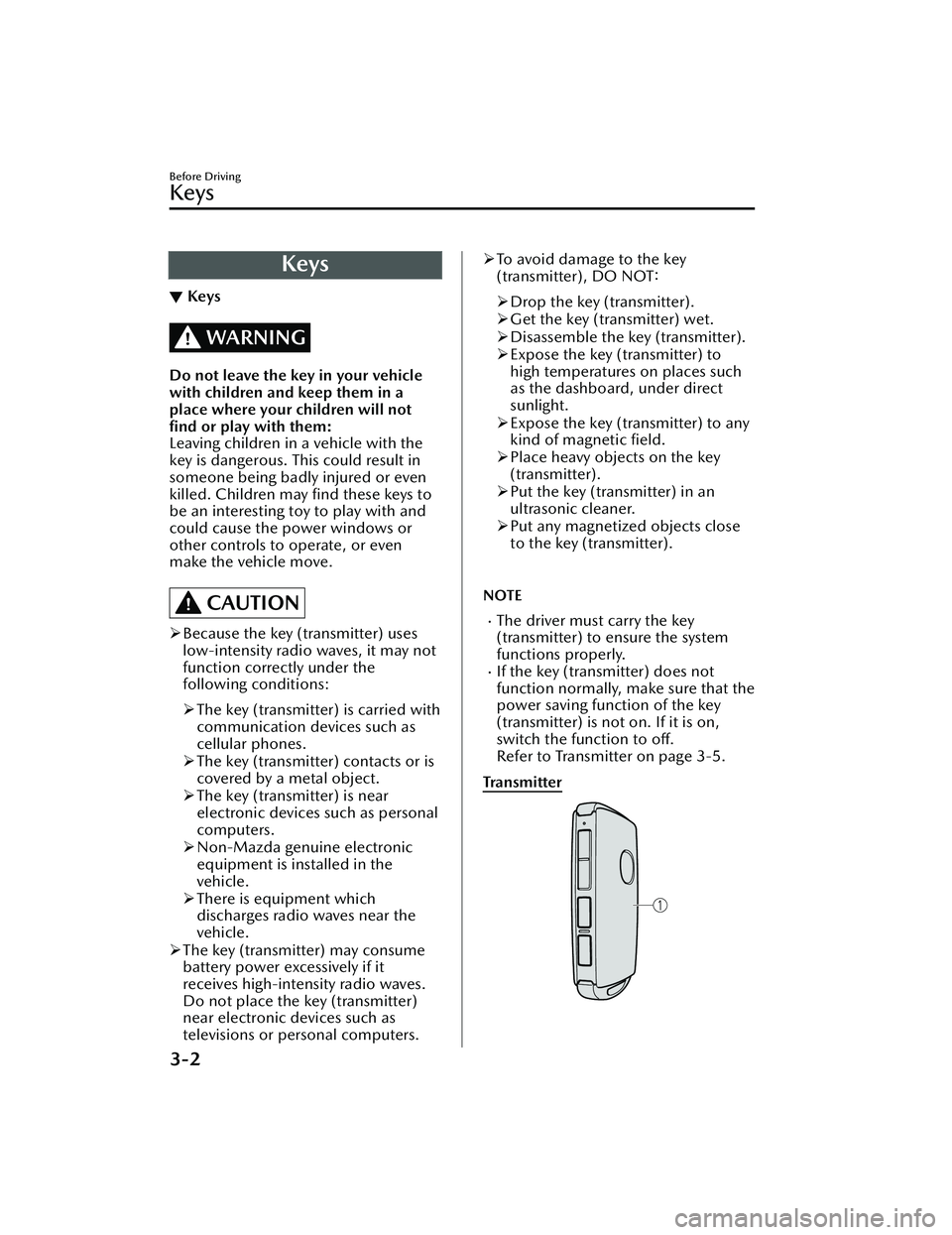
Tra n s m i t te r
Before Driving
Keys
3-2
Mazda3_8LC2-EA-22G_Edition1_new 2022-5-20 11:26:10
Page 94 of 623
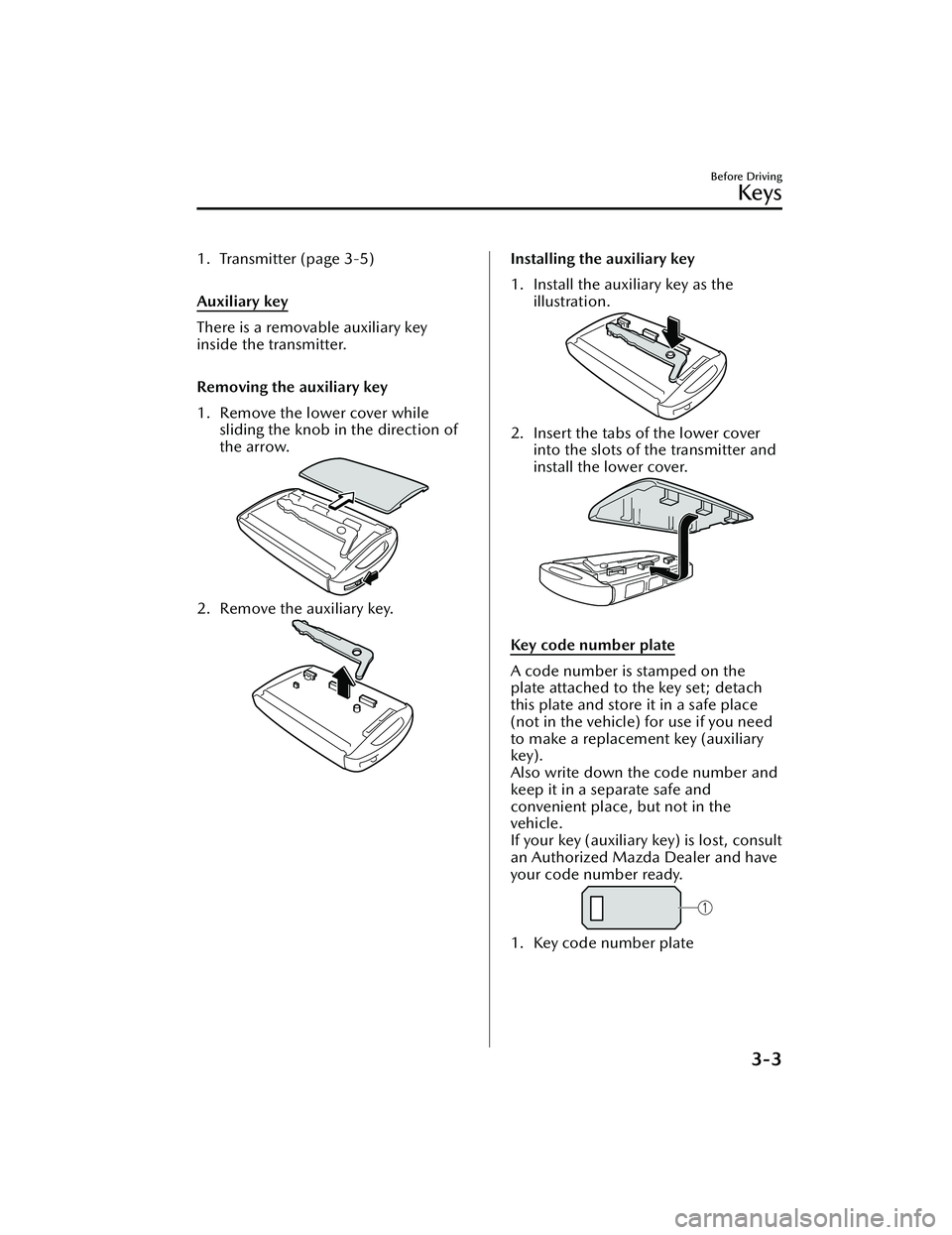
1. Transmitter (page 3-5)
Auxiliary key
There is a removable auxiliary key
inside the transmitter.
Removing the auxiliary key
1. Remove the lower cover whilesliding the knob in the direction of
the arrow.
2. Remove the auxiliary key.
Installing the auxiliary key
1. Install the auxiliary key as the
illustration.
2. Insert the tabs of the lower coverinto the slots of the transmitter and
install the lower cover.
Key code number plate
A code number is stamped on the
plate attached to the key set; detach
this plate and store it in a safe place
(not in the vehicle) for use if you need
to make a replacement key (auxiliary
key).
Also write down the code number and
keep it in a separate safe and
convenient place, but not in the
vehicle.
If your key (auxiliary key) is lost, consult
an Authorized Mazda Dealer and have
your code number ready.
1. Key code number plate
Before Driving
Keys
3-3
Mazda3_8LC2-EA-22G_Edition1_new 2022-5-20 11:26:10
Page 96 of 623
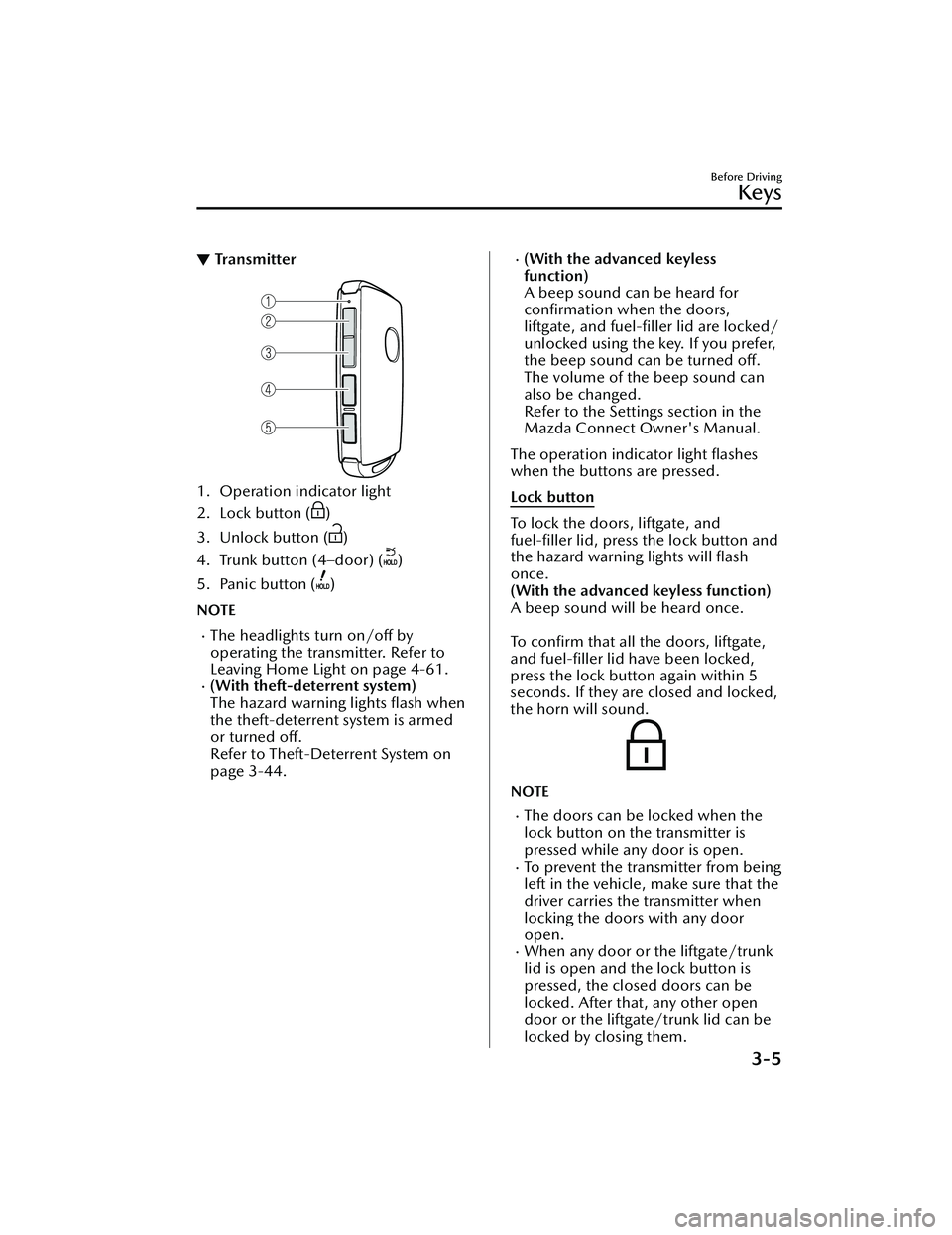
▼Transmitter
1. Operation indicator light
2. Lock button (
)
3. Unlock button (
)
4. Trunk button (4–door) (
)
5. Panic button (
)
NOTE
The headlights turn on/off by
operating the transmitter. Refer to
Leaving Home Light on page 4-61.
(With theft-deterrent system)
The hazard warning lights flash when
the theft-deterrent system is armed
or turned off.
Refer to Theft-Deterrent System on
page 3-44.
(With the advanced keyless
function)
A beep sound can be heard for
confirmation when the doors,
liftgate, and fuel-filler lid are locked/
unlocked using the key. If you prefer,
the beep sound can be turned off.
The volume of the beep sound can
also be changed.
Refer to the Settings section in the
Mazda Connect Owner's Manual.
The operation indicator light flashes
when the buttons are pressed.
Lock button
To lock the doors, liftgate, and
fuel-filler lid, press the lock button and
the hazard warning lights will flash
once.
(With the advanced keyless function)
A beep sound will be heard once.
To confirm that all the doors, liftgate,
and fuel-filler lid have been locked,
press the lock button again within 5
seconds. If they are closed and locked,
the horn will sound.
NOTE
The doors can be locked when the
lock button on the transmitter is
pressed while any door is open.
To prevent the transmitter from being
left in the vehicle, make sure that the
driver carries the transmitter when
locking the doors with any door
open.
When any door or the liftgate/trunk
lid is open and the lock button is
pressed, the closed doors can be
locked. After that, any other open
door or the liftgate/trunk lid can be
locked by closing them.
Before Driving
Keys
3-5
Mazda3_8LC2-EA-22G_Edition1_new 2022-5-20 11:26:10