Direct Mode MAZDA MAZDA 2023 Owners Manual
[x] Cancel search | Manufacturer: MAZDA, Model Year: 2023, Model line: MAZDA, Model: MAZDA MAZDA 2023Pages: 623, PDF Size: 15.08 MB
Page 72 of 623
If your vehicle is also equipped with a
front passenger occupant
classification system, refer to the Front
Passenger Occupant Classification
System (page 2-69) for details.
If your vehicle is equipped with a front
passenger occupant classification
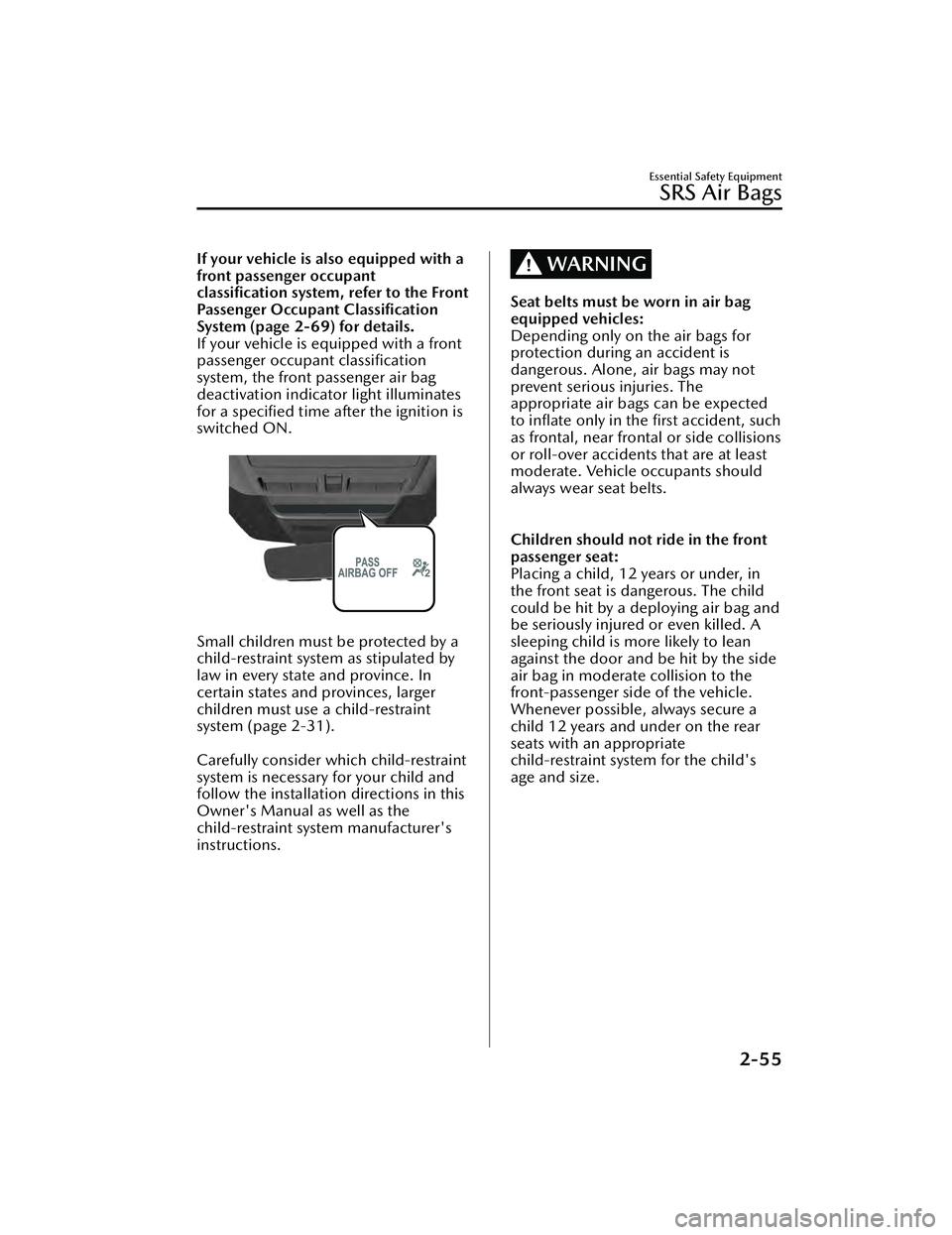
system, the front passenger air bag
deactivation indicator light illuminates
for a specified time after the ignition is
switched ON.
Small children must be protected by a
child-restraint system as stipulated by
law in every state and province. In
certain states and provinces, larger
children must use a child-restraint
system (page 2-31).
Carefully consider which child-restraint
system is necessary for your child and
follow the installation directions in this
Owner's Manual as well as the
child-restraint system manufacturer's
instructions.
WARNING
Seat belts must be worn in air bag
equipped vehicles:
Depending only on the air bags for
protection during an accident is
dangerous. Alone, air bags may not
prevent serious injuries. The
appropriate air bags can be expected
to inflate only in the first accident, such
as frontal, near frontal or side collisions
or roll-over accidents that are at least
moderate. Vehicle occupants should
always wear seat belts.
Children should not ride in the front
passenger seat:
Placing a child, 12 years or under, in
the front seat is dangerous. The child
could be hit by a deploying air bag and
be seriously injured or even killed. A
sleeping child is more likely to lean
against the door and be hit by the side
air bag in moderate collision to the
front-passenger side of the vehicle.
Whenever possible, always secure a
child 12 years and under on the rear
seats with an appropriate
child-restraint system for the child's
age and size.
Essential Safety Equipment
SRS Air Bags
2-55
Mazda3_8LC2-EA-22G_Edition1_new2022-5-20 11:26:10
Page 79 of 623
How the SRS Air BagsWork
▼How the SRS Air Bags Work
Your Mazda is equipped with the
following types of SRS air bags. SRS air
bags are designed to work together
with the seat belts to help to reduce
injuries during an accident.
The SRS air bags are designed to
provide further protection for
passengers in addition to the seat belt
functions. Be sure to wear seat belts
properly.
▼Seat Belt Pretensioners
The pretensioners operate differently
depending on what types of air bags
are equipped. For more details about
seat belt pretensioner operation, refer
to the SRS Air Bag Deployment Criteria
(page 2-66).
Front
The front seat belt pretensioners are
designed to deploy in moderate or
severe frontal, near frontal collisions.
In addition, the pretensioners operate
when a side collision or a roll-over
accident (with roll-over sensor) is
detected.
Rear Outboard
*
The rear outboard seat belt
pretensioners are designed to deploy
in moderate or severe frontal, near
frontal collisions.
In addition, the pretensioners operate
when a side collision or a roll-over
accident is detected.
▼
Driver Air Bag
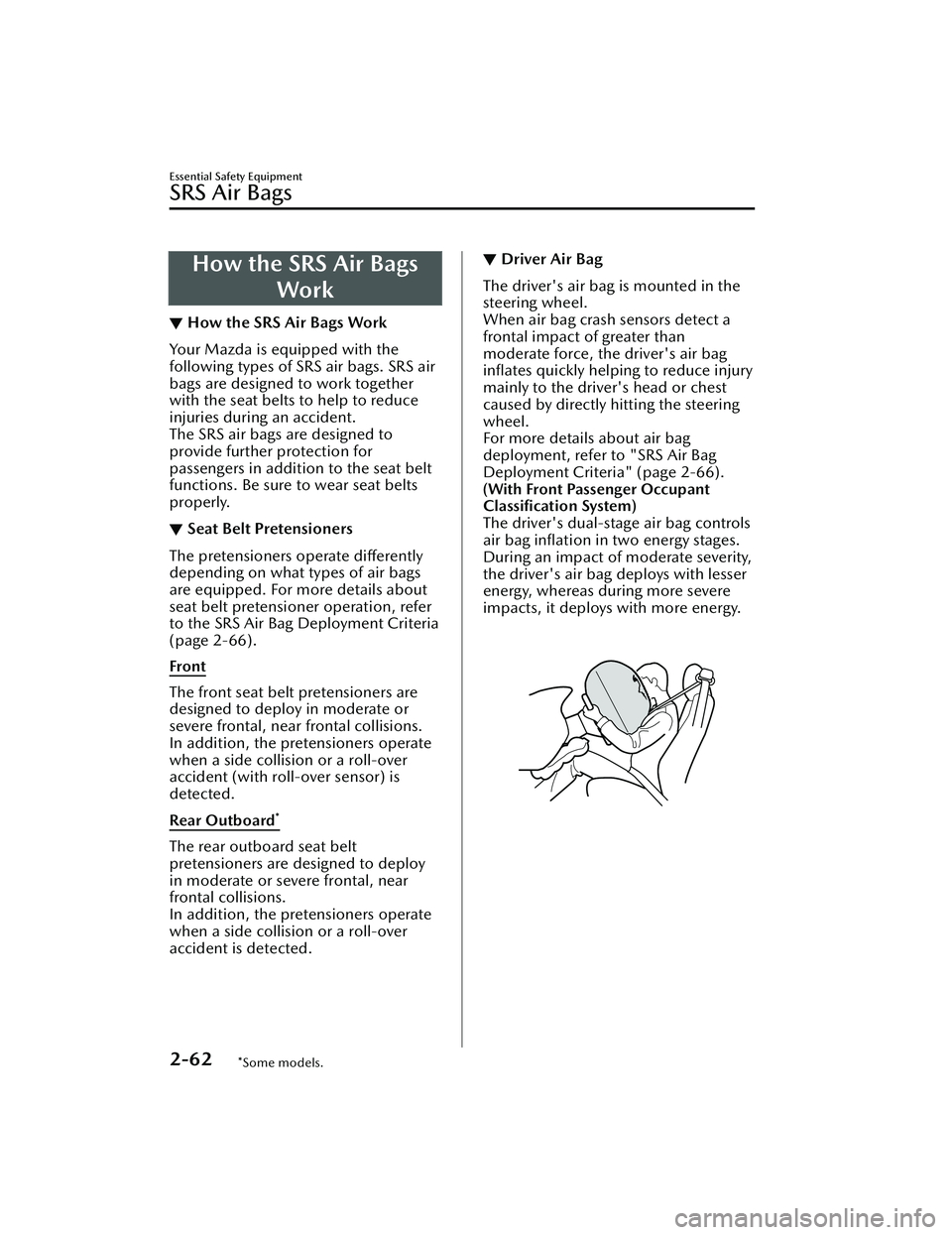
The driver's air bag is mounted in the
steering wheel.
When air bag crash sensors detect a
frontal impact of greater than
moderate force, the driver's air bag
inflates quickly helping to reduce injury
mainly to the driver's head or chest
caused by directly hitting the steering
wheel.
For more details about air bag
deployment, refer to "SRS Air Bag
Deployment Criteria" (page 2-66).
(With Front Passenger Occupant
Classification System)
The driver's dual-stage air bag controls
air bag inflation in two energy stages.
During an impact of moderate severity,
the driver's air bag deploys with lesser
energy, whereas during more severe
impacts, it deploys with more energy.
Essential Safety Equipment
SRS Air Bags
2-62*Some models.
Mazda3_8LC2-EA-22G_Edition1_new
2022-5-20 11:26:10
Page 81 of 623
▼Side Air Bags
There are 2 types of side air bags
including the side
air bags for the
driver and front passenger and rear
passengers.
Front seat side air bags
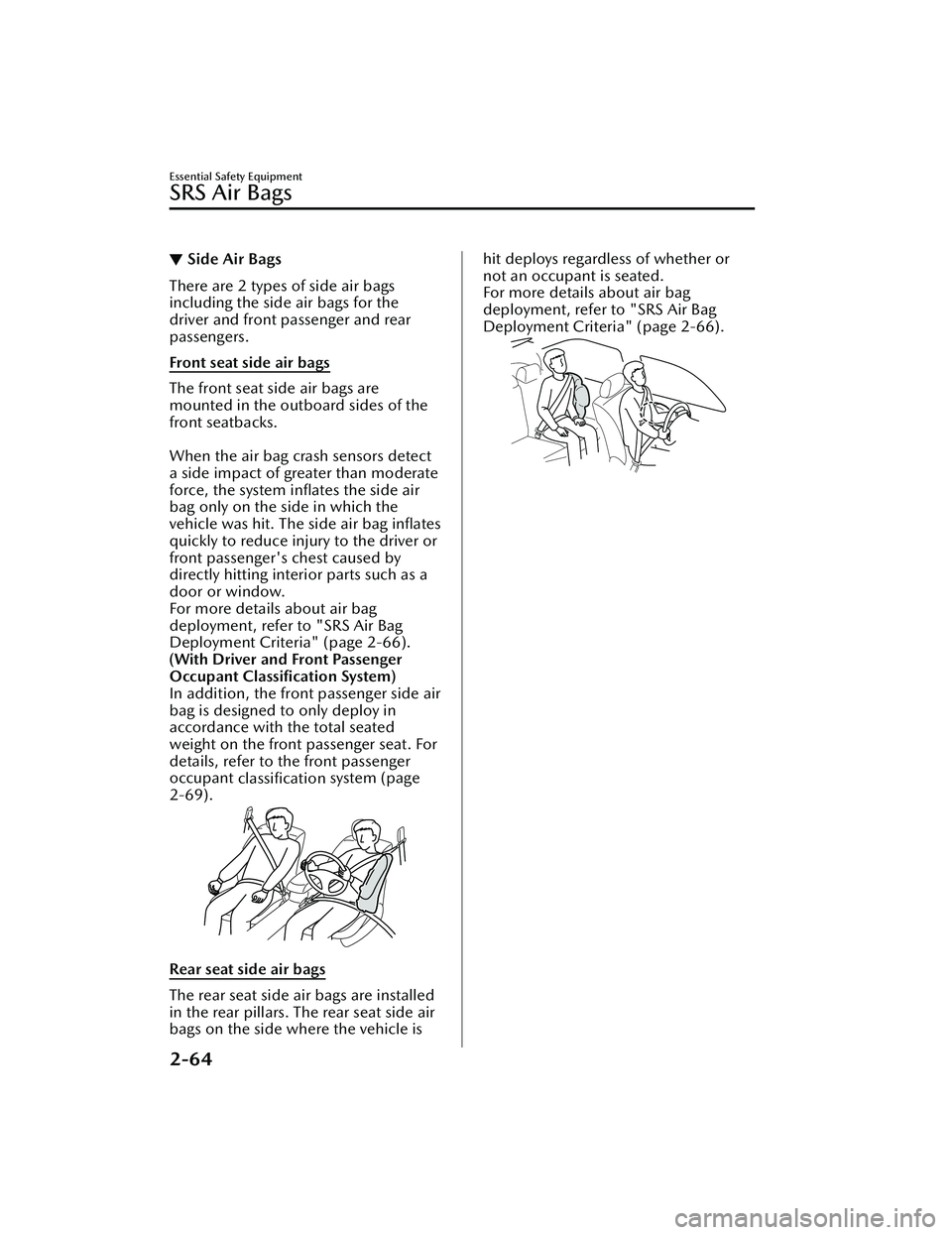
The front seat side air bags are
mounted in the outboard sides of the
front seatbacks.
When the air bag crash sensors detect
a side impact of greater than moderate
force, the system inflates the side air
bag only on the side in which the
vehicle was hit. The side air bag inflates
quickly to reduce injury to the driver or
front passenger's chest caused by
directly hitting interior parts such as a
door or window.
For more details about air bag
deployment, refer to "SRS Air Bag
Deployment Criteria" (page 2-66).
(With Driver and Front Passenger
Occupant Classification System)
In addition, the front passenger side air
bag is designed to only deploy in
accordance with the total seated
weight on the front passenger seat. For
details, refer to the front passenger
occupant classification system (page
2-69).
Rear seat side air bags
The rear seat side air bags are installed
in the rear pillars. The rear seat side air
bags on the side where the vehicle is
hit deploys regardless of whether or
not an occupant is seated.
For more details about air bag
deployment, refer to "SRS Air Bag
Deployment Criteria" (page 2-66).
Essential Safety Equipment
SRS Air Bags
2-64
Mazda3_8LC2-EA-22G_Edition1_new 2022-5-20 11:26:10
Page 82 of 623
▼Curtain Air Bags
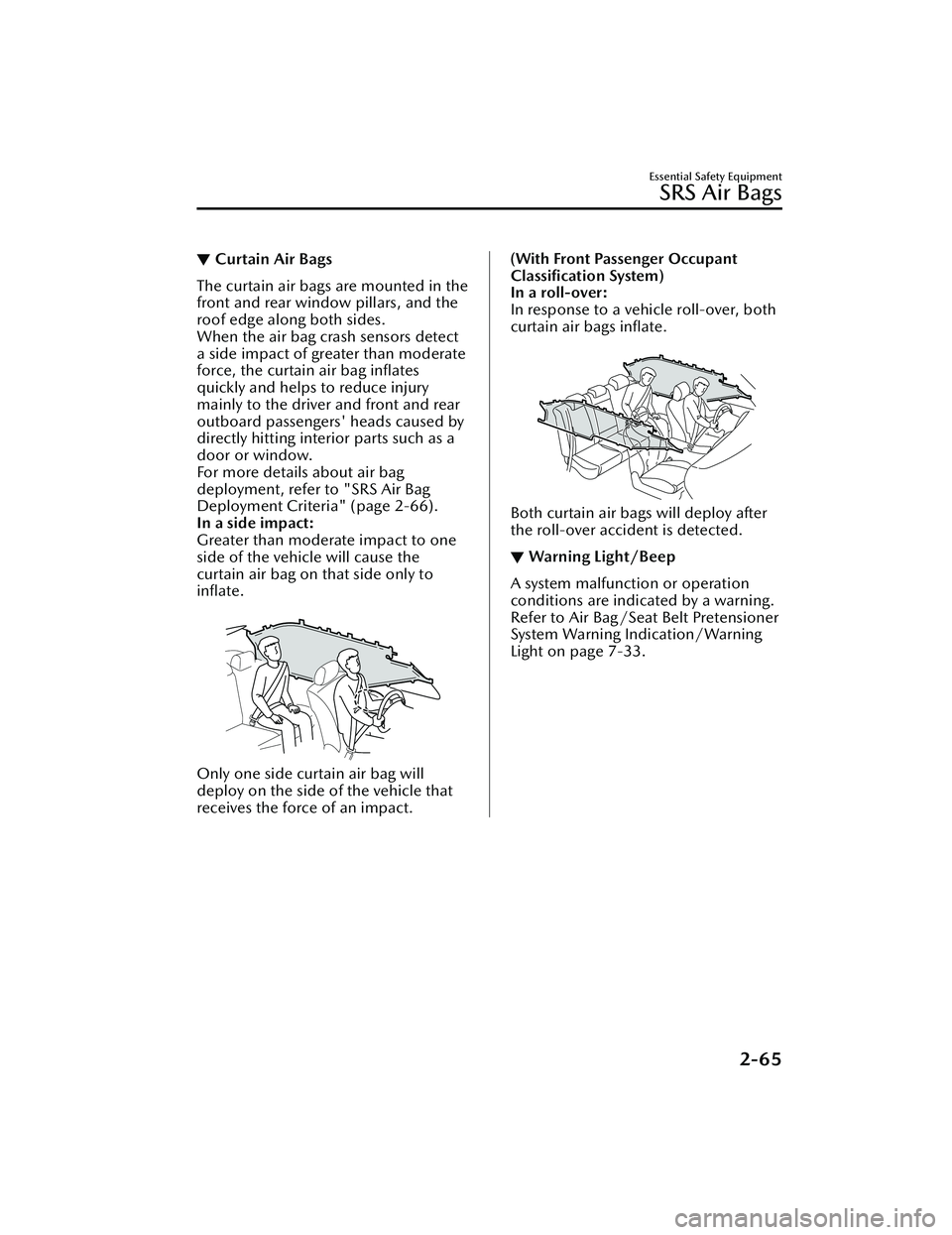
The curtain air bags are mounted in the
front and rear window pillars, and the
roof edge along both sides.
When the air bag crash sensors detect
a side impact of greater than moderate
force, the curtain air bag inflates
quickly and helps to reduce injury
mainly to the driver and front and rear
outboard passengers' heads caused by
directly hitting interior parts such as a
door or window.
For more details about air bag
deployment, refer to "SRS Air Bag
Deployment Criteria" (page 2-66).
In a side impact:
Greater than moderate impact to one
side of the vehicle will cause the
curtain air bag on that side only to
inflate.
Only one side curtain air bag will
deploy on the side of the vehicle that
receives the force of an impact.
(With Front Passenger Occupant
Classification System)
In a roll-over:
In response to a vehicle roll-over, both
curtain air bags inflate.
Both curtain air bags will deploy after
the roll-over accident is detected.
▼Warning Light/Beep
A system malfunction or operation
conditions are indicated by a warning.
Refer to Air Bag/Seat Belt Pretensioner
System Warning Indication/Warning
Light on page 7-33.
Essential Safety Equipment
SRS Air Bags
2-65
Mazda3_8LC2-EA-22G_Edition1_new
2022-5-20 11:26:10
Page 84 of 623
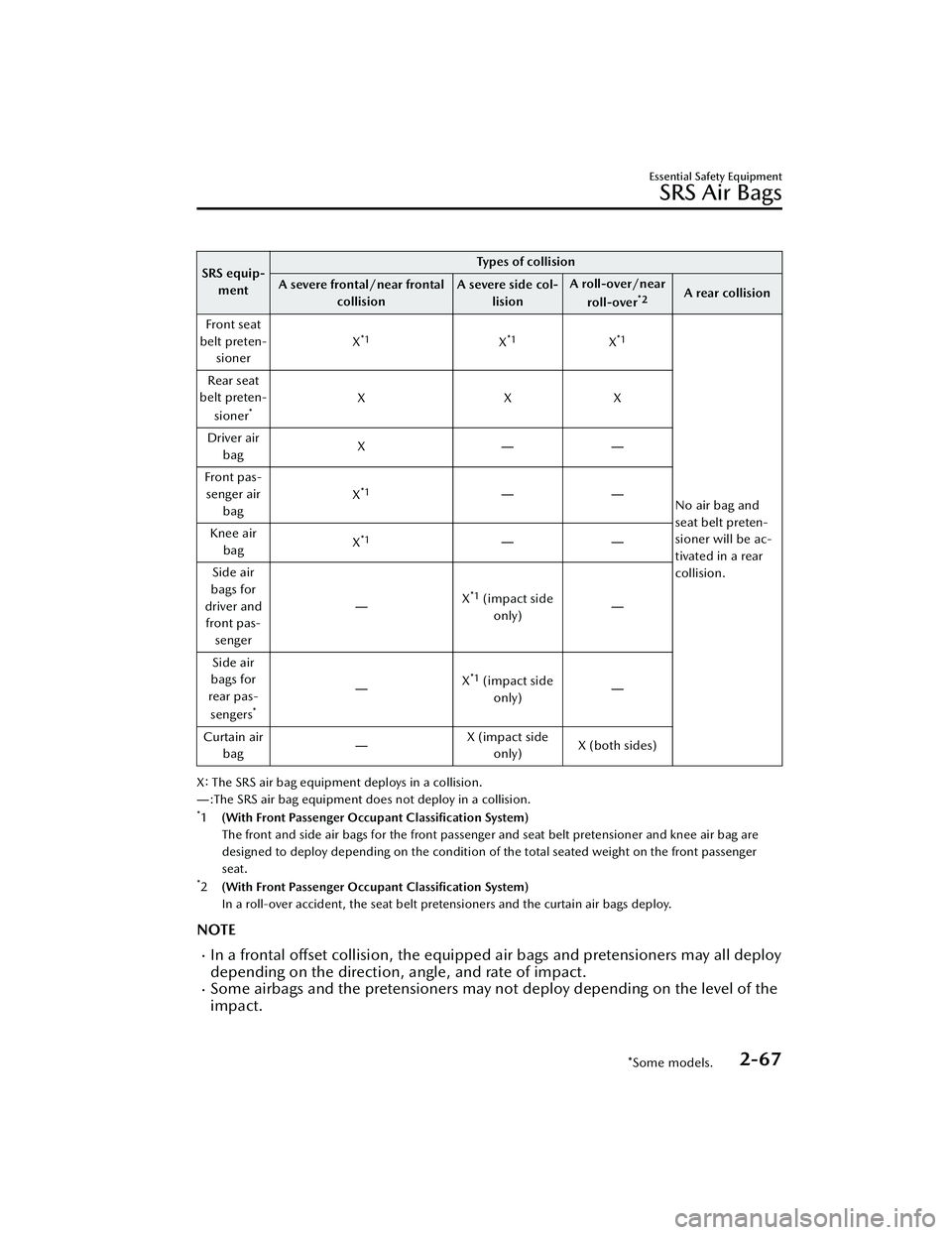
SRS equip-ment Types of collision
A severe frontal/near frontal collision A severe side col-
lision A roll-over/near
roll-over
*2A rear collision
Front seat
belt preten- sioner X
*1X*1X*1
No air bag and
seat belt preten-
sioner will be ac-
tivated in a rear
collision.
Rear seat
belt preten-
sioner
*XXX
Driver air bag X
――
Front pas- senger air bag X
*1――
Knee air bag X
*1――
Side air
bags for
driver and front pas- senger ―
X
*1 (impact side
only) ―
Side air
bags for
rear pas-
sengers
*
― X*1 (impact side
only) ―
Curtain air bag ―X (impact side
only) X (both sides)
X:
The SRS air bag equipment deploys in a collision.
― :The SRS air bag equipment does not deploy in a collision.
*1 (With Front Passenger Occupant Classification System)
The front and side air bags for the front passenger and seat belt pretensioner and knee air bag are
designed to deploy depending on the condition of the total seated weight on the front passenger
seat.
*2(With Front Passenger Occupant
Classification System)
In a roll-over accident, the seat belt pretensioners and the curtain air bags deploy.
NOTE
In a frontal offset collision, the equipped air bags and pretensioners may all deploy
depending on the direction, angle, and rate of impact.
Some airbags and the pretensioners may no t deploy depending on the level of the
impact.
Essential Safety Equipment
SRS Air Bags
*Some models.2-67
Mazda3_8LC2-EA-22G_Edition1_new 2022-5-20 11:26:10
Page 146 of 623
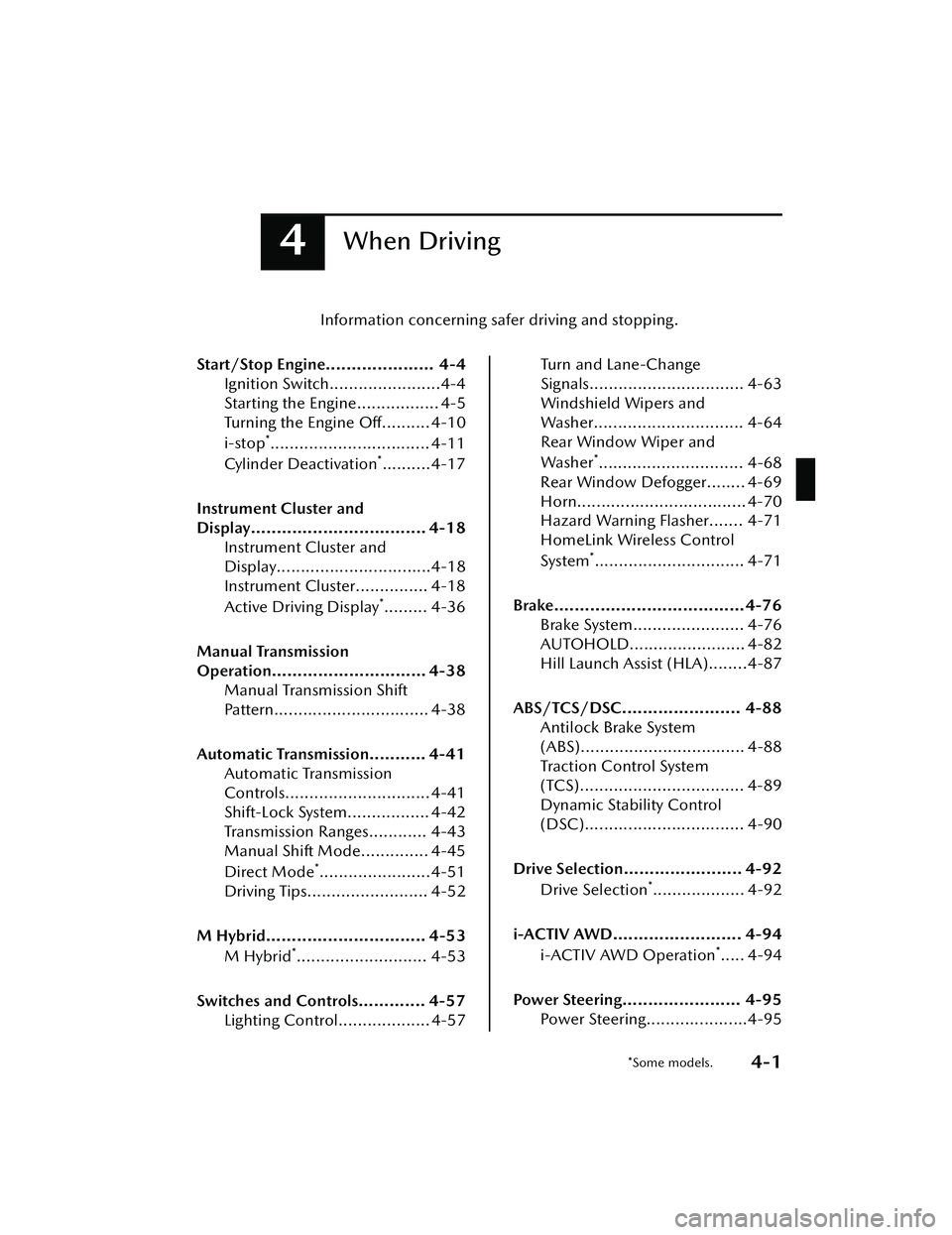
4When Driving
Information concerning safer driving and stopping.
Start/Stop Engine..................... 4-4 Ignition Switch.......................4-4
Starting the Engine................. 4-5
Turning the Engine Off.......... 4-10
i-stop
*................................. 4-11
Cylinder Deact ivat ion
*..........4-17
Instrument Cluster and
Display.................................. 4-18 Instrument Cluster and
Display................................4-18
Instrument Cluster............... 4-18
Active Driving Display
*......... 4-36
Manual Transmission
Operation.............................. 4-38 Manual Transmission Shift
Pattern................................ 4-38
Automatic Transmission........... 4-41 Automatic Transmission
Controls.............................. 4-41
Shift-Lock System................. 4-42
Transmission Ranges............ 4-43
Manual Shift Mode.............. 4-45
Direct Mode
*.......................4-51
Driving Tips......................... 4-52
M Hybrid............................... 4-53 M Hybrid
*........................... 4-53
Switches and Controls............. 4-57 Lighting Control................... 4-57
Turn and Lane-Change
Signals................................ 4-63
Windshield Wipers and
Washer............................... 4-64
Rear Window Wiper and
Washer
*.............................. 4-68
Rear Window Defogger........ 4-69
Horn................................... 4-70
Hazard Warning Flasher....... 4-71
HomeLink Wireless Control
System
*............................... 4-71
Brake.....................................4-76 Brake System....................... 4-76
AUTOHOLD........................ 4-82
Hill Launch Assist (HLA)........4-87
ABS/TCS/DSC....................... 4-88 Antilock Brake System
(ABS).................................. 4-88
Tra c t i o n C o n t r o l Sy s t e m
(TCS).................................. 4-89
Dynamic Stability Control
(DSC)................................. 4-90
Drive Selection....................... 4-92 Drive Selection
*................... 4-92
i-ACTIV AWD......................... 4-94 i-ACTIV AWD Operation
*..... 4-94
Power Steering....................... 4-95 Power Steering.....................4-95
*Some models.4-1
Mazda3_8LC2-EA-22G_Edition1_new 2022-5-20 11:26:10
Page 173 of 623
Refer to Mazda Radar Cruise Control
with Stop & Go function (MRCC
with Stop & Go function) on page
4-142.
Refer to Traffic Jam Assist (TJA) on
page 4-154.
Refer to Lane-keep Assist System
(LAS) on page 4-167.
Refer to Smart Brake Support (SBS)
on page 4-168.
Refer to Cruise Control on page
4-225.
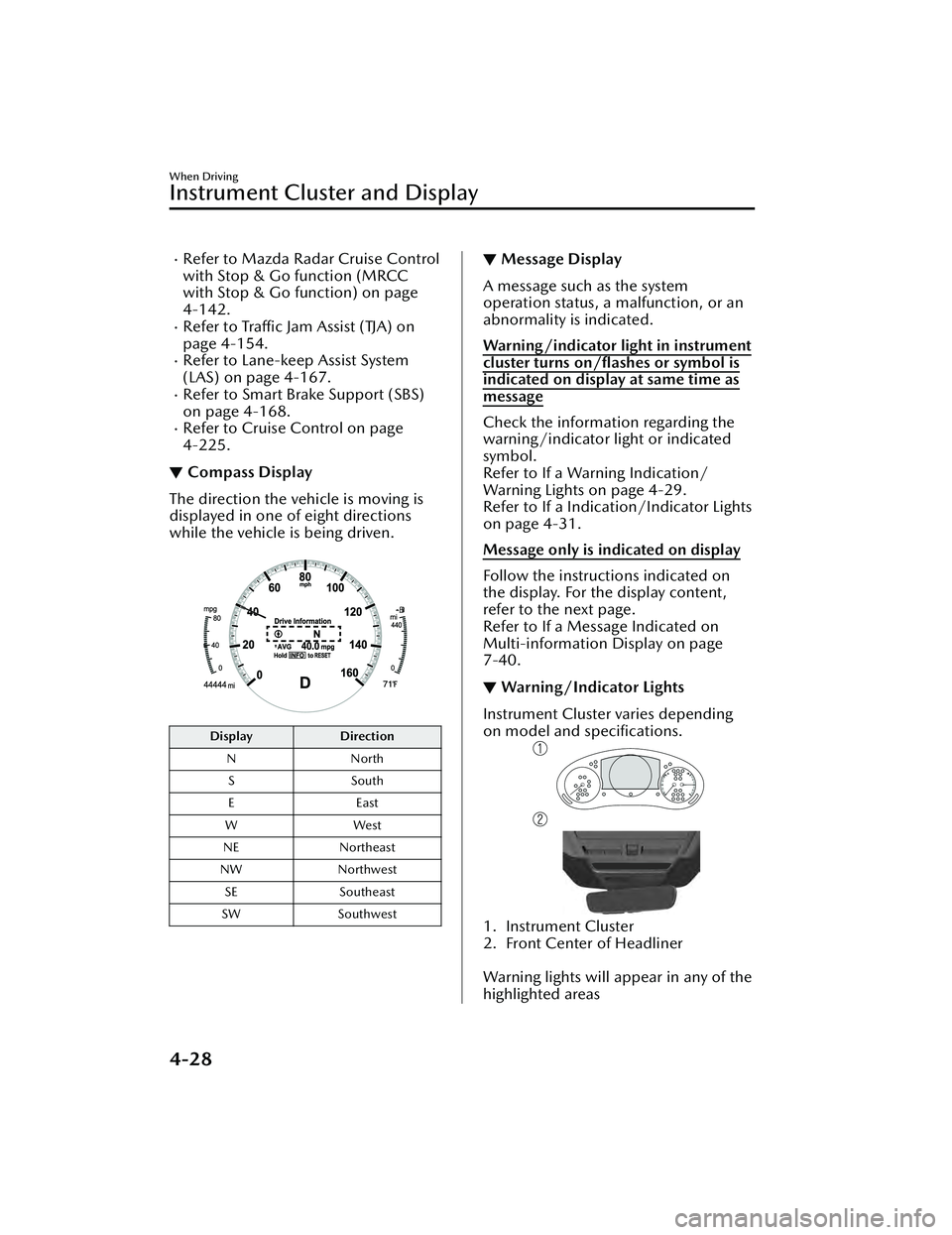
▼ Compass Display
The direction the vehicle is moving is
displayed in one of eight directions
while the vehicle is being driven.
Display
Direction
N North
SS outh
EE ast
WW est
NE Northeast
NW Northwest
SE Southeast
SW Southwest
▼Message Display
A message such as the system
operation status, a malfunction, or an
abnormality is indicated.
Warning/indicator light in instrument
cluster turns on/flashes or symbol is
indicated on display at same time as
message
Check the information regarding the
warning/indicator light or indicated
symbol.
Refer to If a Warning Indication/
Warning Lights on page 4-29.
Refer to If a Indication/Indicator Lights
on page 4-31.
Message only is indicated on display
Follow the instructions indicated on
the display. For the display content,
refer to the next page.
Refer to If a Me
ssage Indicated on
Multi-information Display on page
7-40.
▼ Warning/Indicator Lights
Instrument Cluster varies depending
on model and specifications.
1. Instrument Cluster
2. Front Center of Headliner
Warning lights will appear in any of the
highlighted areas
When Driving
Instrument Cluster and Display
4-28
Mazda3_8LC2-EA-22G_Edition1_new
2022-5-20 11:26:10
Page 196 of 623
Direct Mode*
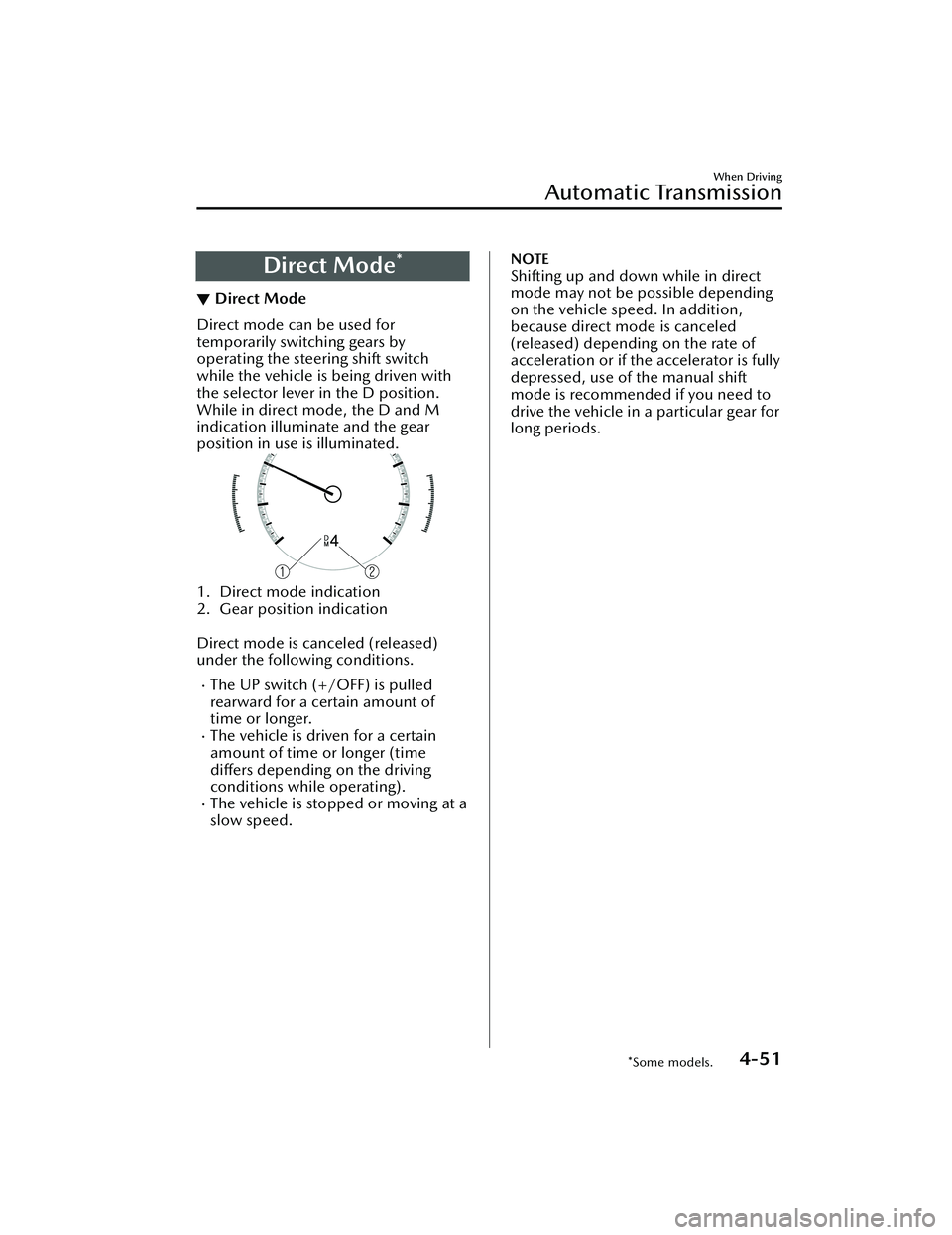
▼Direct Mode
Direct mode can be used for
temporarily switching gears by
operating the steering shift switch
while the vehicle is being driven with
the selector lever in the D position.
While in direct mode, the D and M
indication illuminate and the gear
position in use is illuminated.
1. Direct mode indication
2. Gear position indication
Direct mode is canceled (released)
under the following conditions.
The UP switch (+/OFF) is pulled
rearward for a certain amount of
time or longer.
The vehicle is driven for a certain
amount of time or longer (time
differs
depending on the driving
conditions while operating).
The vehicle is stopped or moving at a
slow speed.
NOTE
Shifting up and down while in direct
mode may not be possible depending
on the vehicle speed. In addition,
because direct mode is canceled
(released) depending on the rate of
acceleration or if the accelerator is fully
depressed, use of the manual shift
mode is recommended if you need to
drive the vehicle in a particular gear for
long periods.
When Driving
Automatic Transmission
*Some models.4-51
Mazda3_8LC2-EA-22G_Edition1_new 2022-5-20 11:26:10
Page 197 of 623
Driving Tips
▼Driving Tips
WARNING
Do not let the vehicle move in a
direction opposite to the direction
selected by the selector lever:
Do not let the vehicle move backward
with the selector lever in a forward
position, or do not let the vehicle
move forward with the selector lever in
the reverse position. Otherwise, the
engine may stop, causing the loss of
the power brake and power steering
functions, and make it difficult to
control the vehicle which could result
in an accident.
Pa s s i n g
For extra power when passing another
vehicle or climbing steep grades,
depress the accelerator fully. The
transmission will shift to a lower gear,
depending on vehicle speed.
NOTE
The accelerator pedal may initially
feel heavy as it is being depressed,
then feel lighter as it is depressed
further. This change in pedal force
aids the engine control system in
determining how much the
accelerator pedal has been
depressed for performing kickdown,
and functions to control whether or
not kickdown should be performed.
The manual shift mode does not
switch to automatic shift mode while
the DSC is turned off when the
selector lever is in the M position.
Shift the selector lever.
Climbing steep grades from a stop
To climb a steep grade from a stopped
position:
1. Depress the brake pedal.
2. Shift to D or M1, depending on the
load weight and grade steepness.
3. Release the brake pedal while
gradually accelerating.
Descending steep grades
When descending a steep grade, shift
to lower gears, depending on load
weight and grade steepness. Descend
slowly, using the brakes only
occasionally to prevent them from
overheating.
When Driving
Automatic Transmission
4-52
Mazda3_8LC2-EA-22G_Edition1_new 2022-5-20 11:26:10
Page 210 of 623
Switch Posi-tion Wiper operation
MIST Operation while pulling up lev-
er
OFF Stop
INT Intermittent LO Low speedHI High speed
Variable-speed intermittent wipers
Set the lever to the intermittent
position and choose the interval timing
by rotating the switch.
Rotate the switch upward (FAST
direction) to shorten the interval time
of the wiper operation, and rotate the
switch downward (SLOW direction) to
lengthen it.
1. Switch
With auto-wiper control
1. Indicator light
Switch Posi- tion Wiper operation
MIST Operation while pulling up lev-
er
OFF Stop
AUTO
*1Auto control
LO Low speed HI High speed
*1 When the wiper lever is switched to the AUTO position, the indicator light turns on.
Auto-wiper control*
When the wiper lever is in the AUTO
position, the rain sensor senses the
amount of rainfall on the windshield
and turns the wipers on or off
automatically (off ―intermittent―low
speed ―high speed).
The sensitivity of the rain sensor can be
adjusted by turning the switch on the
wiper lever.
From the center position (normal),
rotate the switch upward (+ direction)
for higher sensitivity (faster response)
or rotate it downward (- direction) for
less sensitivity (slower response).
1. Switch
2. Higher sensitivity
3. Center position
4. Less sensitivity
When Driving
Switches and Controls
*Some models.4-65
Mazda3_8LC2-EA-22G_Edition1_new 2022-5-20 11:26:10