tow MAZDA MODEL 3 4-DOOR 2017 Owner's Manual
[x] Cancel search | Manufacturer: MAZDA, Model Year: 2017, Model line: MODEL 3 4-DOOR, Model: MAZDA MODEL 3 4-DOOR 2017Pages: 612
Page 490 of 612
7–2
If Trouble Arises
Parking in an Emergency
Parking in an Emergency
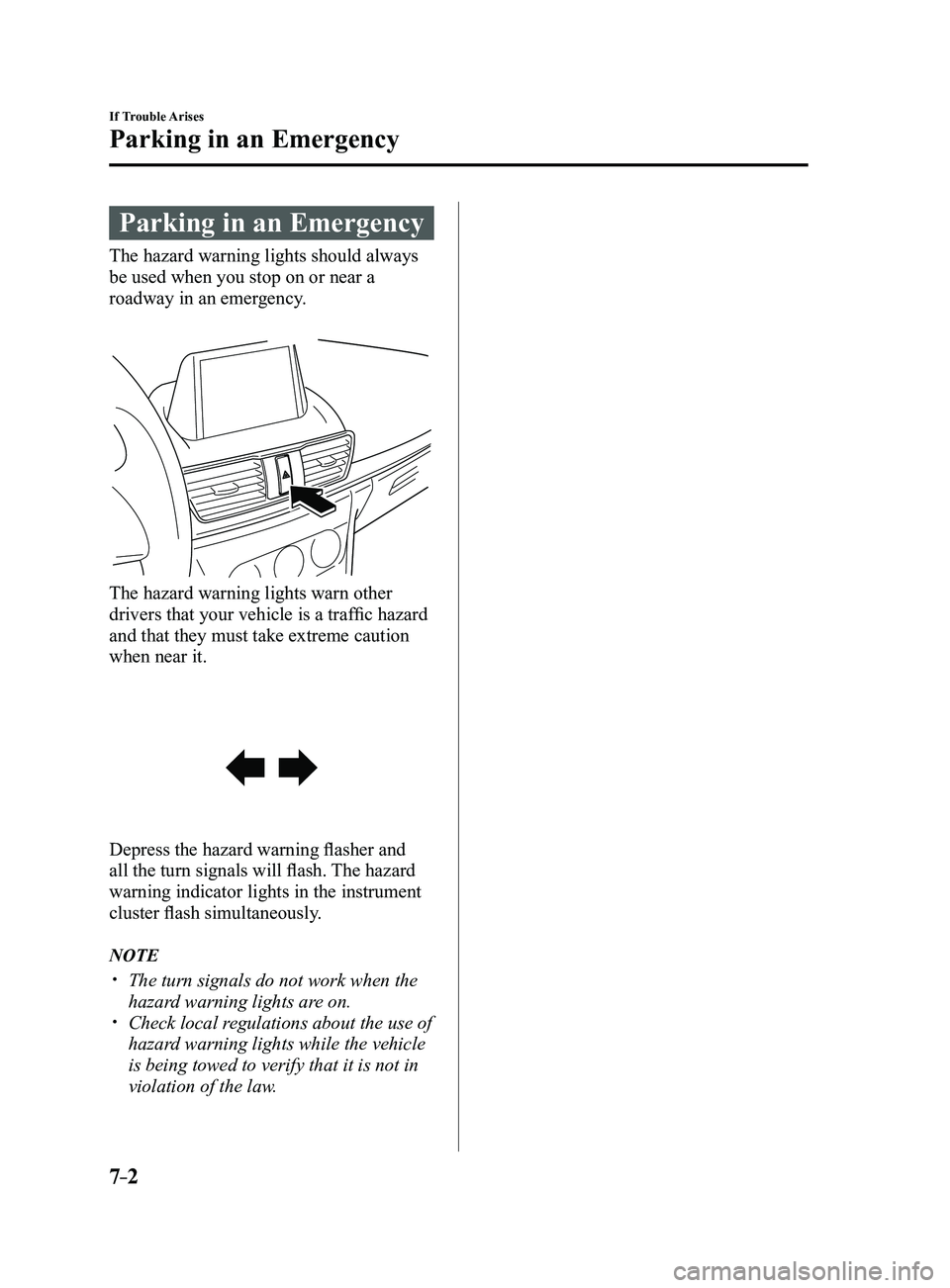
The hazard warning lights should always
be used when you stop on or near a
roadway in an emergency.
The hazard warning lights warn other
drivers that your vehicle is a traffic hazard
and that they must take extreme caution
when near it.
Depress the hazard warning flasher and
all the turn signals will flash. The hazard
warning indicator lights in the instrument
cluster flash simultaneously.
NOTE
The turn signals do not work when the
hazard warning lights are on. Check local regulations about the use of
hazard warning lights while the vehicle
is being towed to verify that it is not in
violation of the law.
Mazda3_8FL6-EA-16F_Edition2.indb 22016/08/10 17:39:08
Page 501 of 612
7–13
If Trouble Arises
Flat Tire
6. Remove the belt for securing the flat
tire.
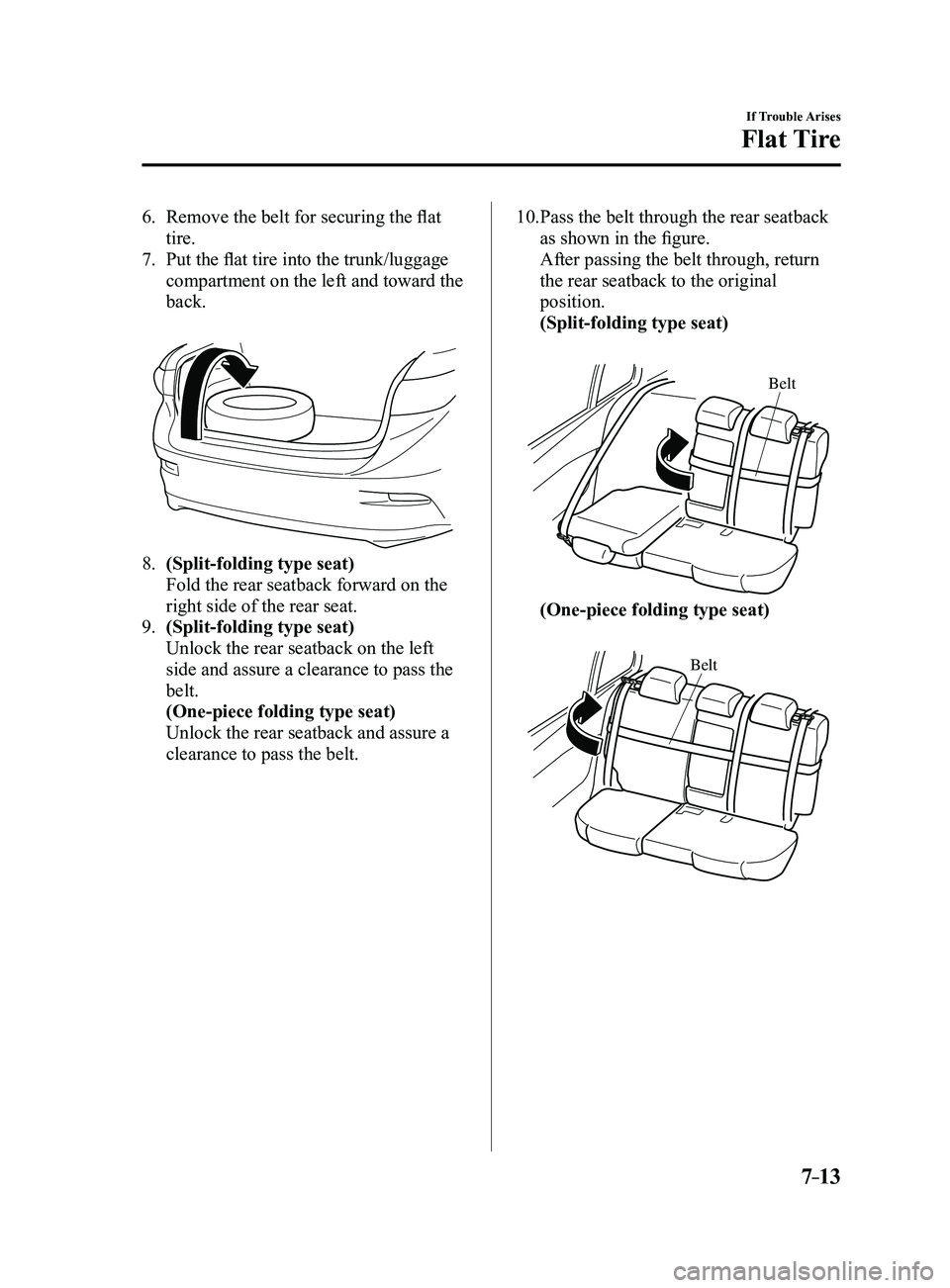
7. Put the flat tire into the trunk/luggage
compartment on the left and toward the
back.
8. (Split-folding type seat)
Fold the rear seatback forward on the
right side of the rear seat.
9. (Split-folding type seat)
Unlock the rear seatback on the left
side and assure a clearance to pass the
belt.
(One-piece folding type seat)
Unlock the rear seatback and assure a
clearance to pass the belt.
10. Pass the belt through the rear seatback
as shown in the figure.
After passing the belt through, return
the rear seatback to the original
position.
(Split-folding type seat)
Belt
(One-piece folding type seat)
Belt
Mazda3_8FL6-EA-16F_Edition2.indb 132016/08/10 17:39:15
Page 507 of 612
7–19
If Trouble Arises
Emergency Starting
Starting a Flooded Engine
If the engine fails to start, it may be
flooded (excessive fuel in the engine).
Follow this procedure:
1. If the engine does not start within
five seconds on the first try, wait ten
seconds and try again.
2. Make sure the parking brake is on.
3. Depress the accelerator all the way and
hold it there.
4. Depress the clutch pedal (Manual
transaxle) or the brake pedal
(Automatic transaxle), then press the
push button start. If the engine starts,
release the accelerator immediately
because the engine will suddenly rev
up.
5. If the engine fails to start, crank it
without depressing the accelerator.
If the engine still does not start using the
previous procedure, have your vehicle
inspected by an Authorized Mazda Dealer.
Push-Starting
Do not push-start your Mazda.
WARNING
Never tow a vehicle to start it:
Towing a vehicle to start it is
dangerous. The vehicle being towed
could surge forward when its engine
starts, causing the two vehicles to
collide. The occupants could be injured.
CAUTION
Do not push-start a vehicle that has a
manual transaxle. It can damage the
emission control system.
NOTE
You cannot start a vehicle with an
automatic transaxle by pushing it.
Mazda3_8FL6-EA-16F_Edition2.indb 192016/08/10 17:39:18
Page 510 of 612
7–22
If Trouble Arises
Emergency Towing
Towing Description
We recommend that towing be done only
by an Authorized Mazda Dealer or a
commercial tow-truck service.
Proper lifting and towing are necessary
to prevent damage to the vehicle.
Government and local laws must be
followed.
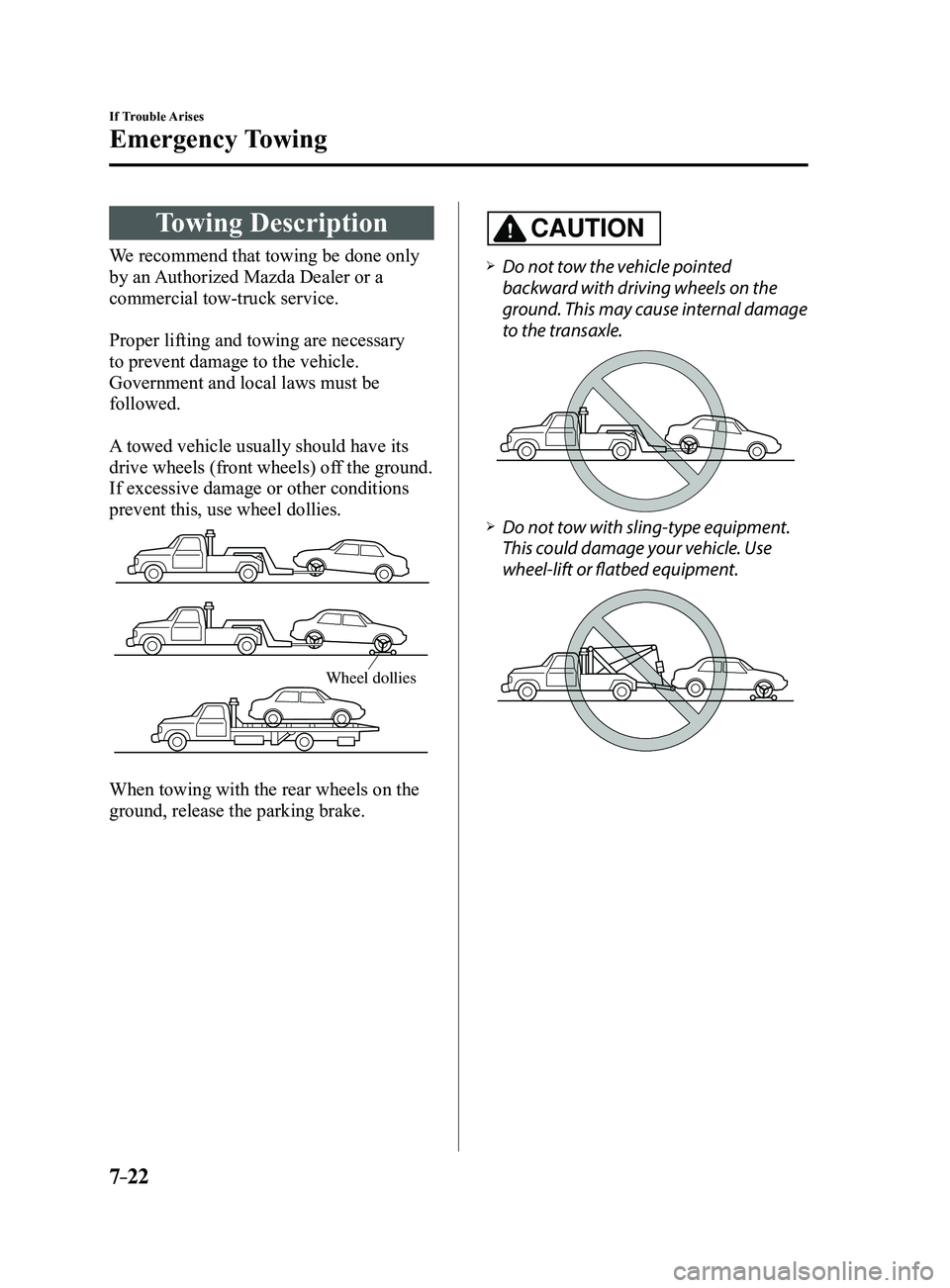
A towed vehicle usually should have its
drive wheels (front wheels) off the ground.
If excessive damage or other conditions
prevent this, use wheel dollies.
Wheel dollies
When towing with the rear wheels on the
ground, release the parking brake.
CAUTION
Do not tow the vehicle pointed
backward with driving wheels on the
ground. This may cause internal damage
to the transaxle.
Do not tow with sling-type equipment.
This could damage your vehicle. Use
wheel-lift or flatbed equipment.
Mazda3_8FL6-EA-16F_Edition2.indb 222016/08/10 17:39:19
Page 511 of 612
7–23
If Trouble Arises
Emergency Towing
*Some models.
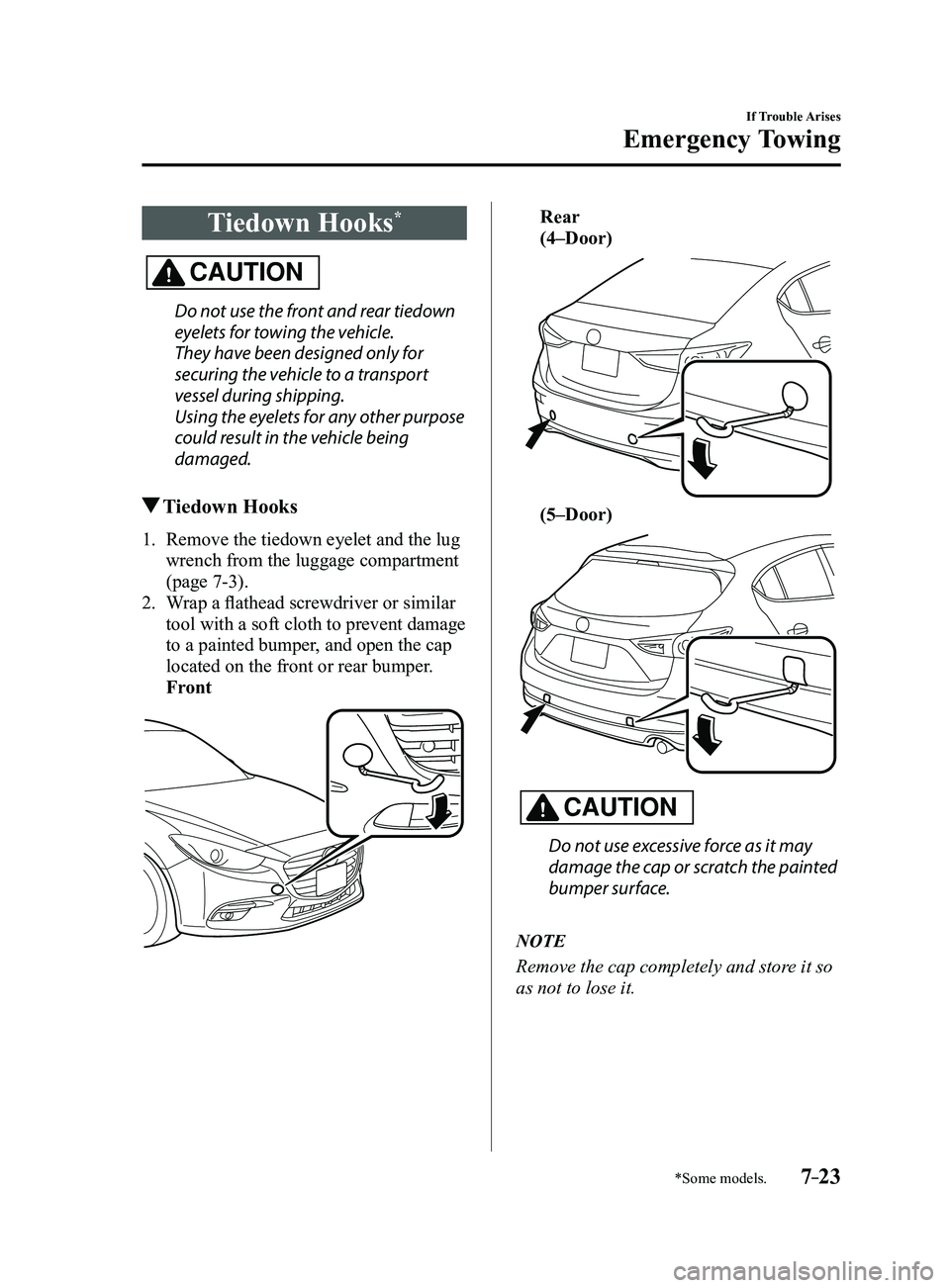
Tiedown Hooks*
CAUTION
Do not use the front and rear tiedown
eyelets for towing the vehicle.
They have been designed only for
securing the vehicle to a transport
vessel during shipping.
Using the eyelets for any other purpose
could result in the vehicle being
damaged.
Tiedown Hooks
1. Remove the tiedown eyelet and the lug
wrench from the luggage compartment
(page
7-3).
2. Wrap a flathead screwdriver or similar
tool with a soft cloth to prevent damage
to a painted bumper, and open the cap
located on the front or rear bumper.
Front
Rear
(4–Door)
(5–Door)
CAUTION
Do not use excessive force as it may
damage the cap or scratch the painted
bumper surface.
NOTE
Remove the cap completely and store it so
as not to lose it.
Mazda3_8FL6-EA-16F_Edition2.indb 232016/08/10 17:39:20
Page 512 of 612
7–24
If Trouble Arises
Emergency Towing
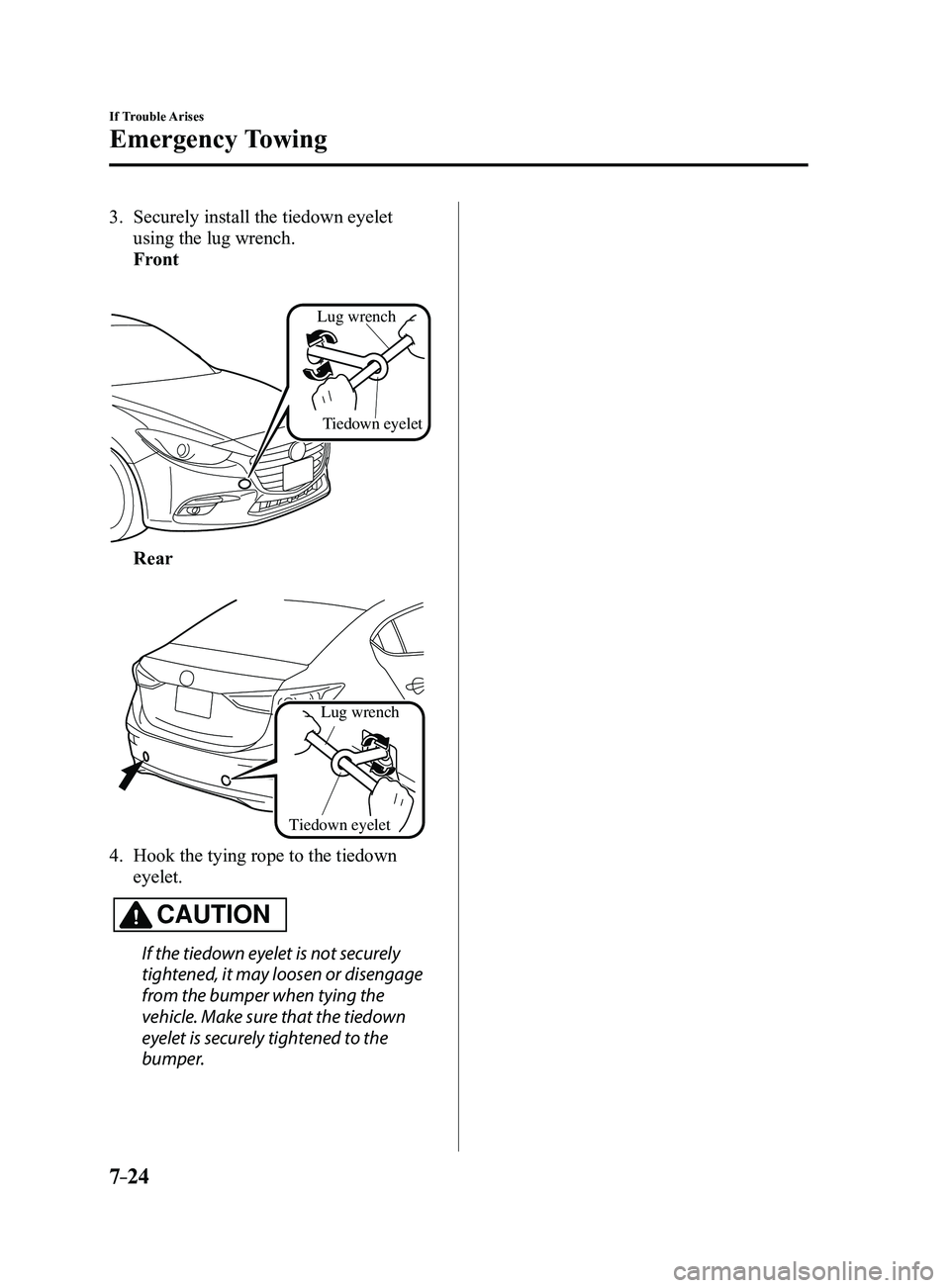
3. Securely install the tiedown eyelet
using the lug wrench.
Front
Tiedown eyelet
Lug wrench
Rear
Lug wrench
Tiedown eyelet
4. Hook the tying rope to the tiedown
eyelet.
CAUTION
If the tiedown eyelet is not securely
tightened, it may loosen or disengage
from the bumper when tying the
vehicle. Make sure that the tiedown
eyelet is securely tightened to the
bumper.
Mazda3_8FL6-EA-16F_Edition2.indb 242016/08/10 17:39:21
Page 515 of 612
7–27
If Trouble Arises
Warning/Indicator Lights and Warning Sounds
SignalWarning
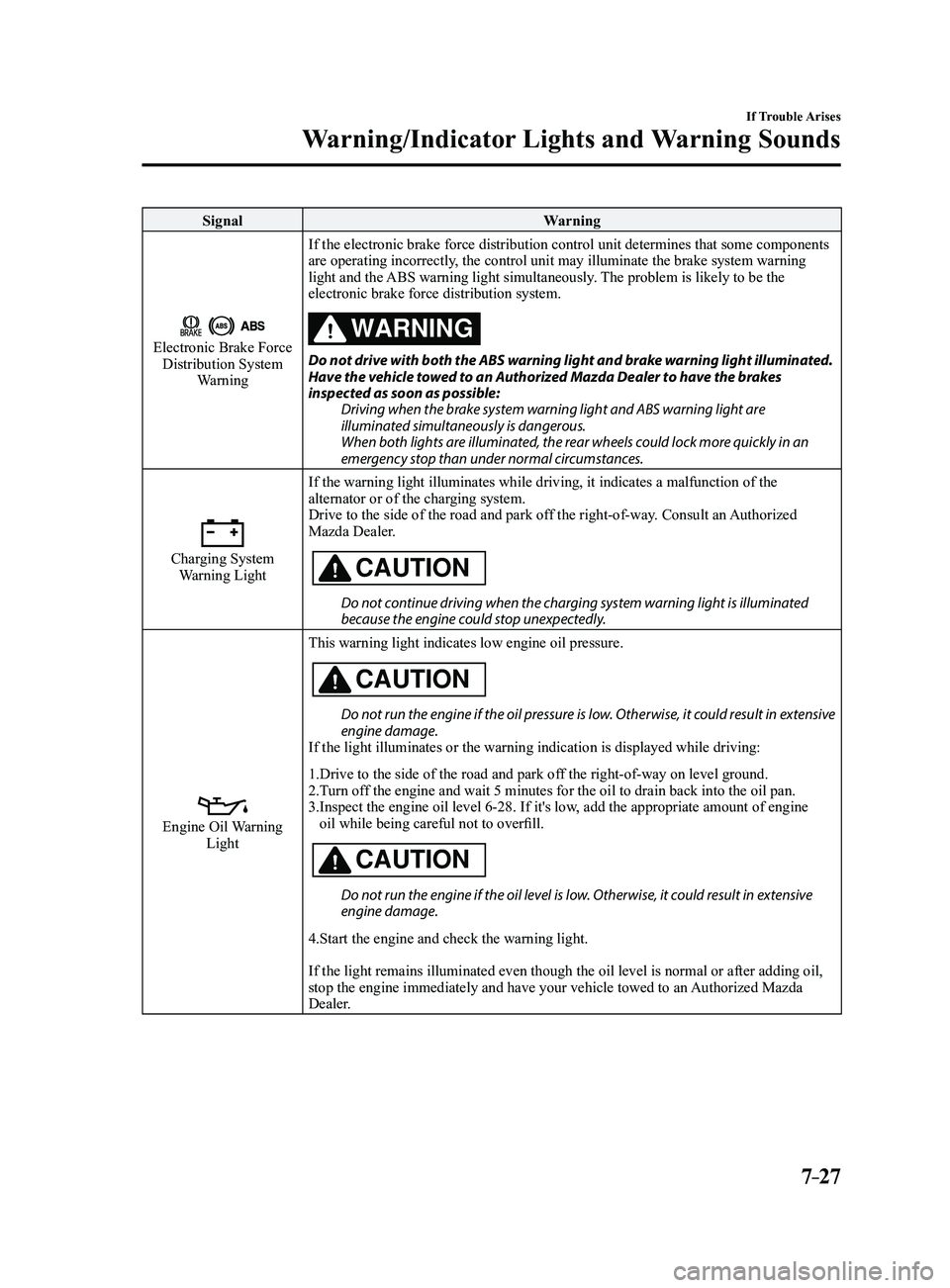
Electronic Brake Force Distribution System
Warning If the electronic brake force distribution control unit determines that \
some components
are operating incorrectly, the control unit may illuminate the brake system warning
light and the ABS warning light simultaneously. The problem is likely to be the
electronic brake force distribution system.
WARNING
Do not drive with both the ABS warning light and brake warning light illuminated. Have the vehicle towed to an Authorized Mazda Dealer to have the brakes
inspected as soon as possible:
Driving when the brake system warning light and ABS warning light are
illuminated simultaneously is dangerous.
When both lights are illuminated, the rear wheels could lock more quickly in an
emergency stop than under normal circumstances.
Charging System Warning Light If the warning light illuminates while driving, it indicates a malfuncti\
on of the
alternator or of the charging system.
Drive to the side of the road and park off the right-of-way. Consult an Authorized
Mazda Dealer.CAUTION
Do not continue driving when the charging system warning light is illuminated because the engine could stop unexpectedly.
Engine Oil Warning LightThis warning light indicates low engine oil pressure.
CAUTION
Do not run the engine if the oil pressure is low. Otherwise, it could result in extensive engine damage.
If the light illuminates or the warning indication is displayed while dr\
iving:
1.Drive to the side of the road and park off the right-of-way on level ground.
2.Turn off the engine and wait 5 minutes for the oil to drain back into the oil p\
an.
3. Inspect the engine oil level 6-28. If it's low, add the appropriate amount of engine
oil while being careful not to overfill.
CAUTION
Do not run the engine if the oil level is low. Otherwise, it could result in extensive engine damage.
4.Start the engine and check the warning light.
If the light remains illuminated even though the oil level is normal or \
after adding oil,
stop the engine immediately and have your vehicle towed to an Authorized Mazda
Dealer.
Mazda3_8FL6-EA-16F_Edition2.indb 272016/08/10 17:39:23
Page 549 of 612
8–15
Customer Information and Reporting Safety Defects
Reporting Safety Defects
Reporting Safety Defects (Canada)
Canadian customers who wish to report a safety-related defect to Transport Canada, Defect
Investigations and Recalls, may telephone the toll free hotline 1-800-333-0510, or contact
Transport Canada by mail at: Transport Canada, ASFAD, Place de Ville Tower C, 330
Sparks Street, Ottawa ON K1A 0N5.
For additional road safety information, please visit the Road Safety website at:
http://www.tc.gc.ca/roadsafety/menu.htm
Mazda3_8FL6-EA-16F_Edition2.indb 152016/08/10 17:39:39
Page 569 of 612

Safety Practices
The way you drive has a great deal to do with your tire mileage and safe\
ty. So cultivate good
d")
8–35
Customer Information and Reporting Safety Defects
Tire Information (U.S.A.)
Safety Practices
The way you drive has a great deal to do with your tire mileage and safe\
ty. So cultivate good
driving habits for your own benefit.
Observe posted speed limits and drive at speeds that are safe for the ex\
isting weather
conditions Avoid fast starts, stops and turns Avoid potholes and objects on the road Do not run over curbs or hit the tire against the curb when parking
CAUTION
If you feel a sudden vibration or ride disturbance while driving or you suspect your tire
or vehicle has been damaged, immediately reduce your speed. Drive with caution until
you can safely pull off the road. Stop and inspect the tire for damage. If the tire is under-
inflated or damaged, deflate it, remove the tire and rim and replace it with your spare tire.
If you cannot detect a cause, have the vehicle towed to the nearest vehicle or tire dealer to
have the vehicle inspected.
Mazda3_8FL6-EA-16F_Edition2.indb 352016/08/10 17:39:43
Page 570 of 612
8–36
Customer Information and Reporting Safety Defects
Tire Information (U.S.A.)
Vehicle Loading
WARNING
Do not tow a trailer with this vehicle:
Towing a trailer with this vehicle is dangerous because it has not been designed to tow a
trailer and doing so will affect the drive system which could result in vehicle damage.
This section will guide you in the proper loading of your vehicle, to ke\
ep your loaded
vehicle weight within its design rating capability. Properly loading your vehicle will provide
maximum return of vehicle design performance. Before loading your vehicle, familiarize
yourself with the following terms for determining your vehicle's weight \
ratings, from the
vehicle's Safety Certification Label and Tire and Load Information Label:
WARNING
Overloaded Vehicle:
Overloading a vehicle is dangerous. The results of overloading can have serious
consequences in terms of passenger safety. Too much weight on a vehicle's suspension
system can cause spring or shock absorber failure, brake failure, handling or steering
problems, irregular tire wear, tire failure or other damage.
Overloading makes a vehicle harder to drive and control. It also increases the distance
required for stopping. In cases of serious overloading, brakes can fail completely,
particularly on steep grades. The load a tire will carry safely is a combination of the size of
the tire, its load range, and corresponding inflation pressure.
Never overload the vehicle and always observe the vehicle's weight ratings from the
vehicle's Safety Certification and Tire and Load Information labels.
Mazda3_8FL6-EA-16F_Edition2.indb 362016/08/10 17:39:43