ignition MAZDA MODEL 3 4-DOOR 2017 Owners Manual
[x] Cancel search | Manufacturer: MAZDA, Model Year: 2017, Model line: MODEL 3 4-DOOR, Model: MAZDA MODEL 3 4-DOOR 2017Pages: 612
Page 21 of 612
2–7
Essential Safety Equipment
Seats
*Some models.
Seat Warmer*
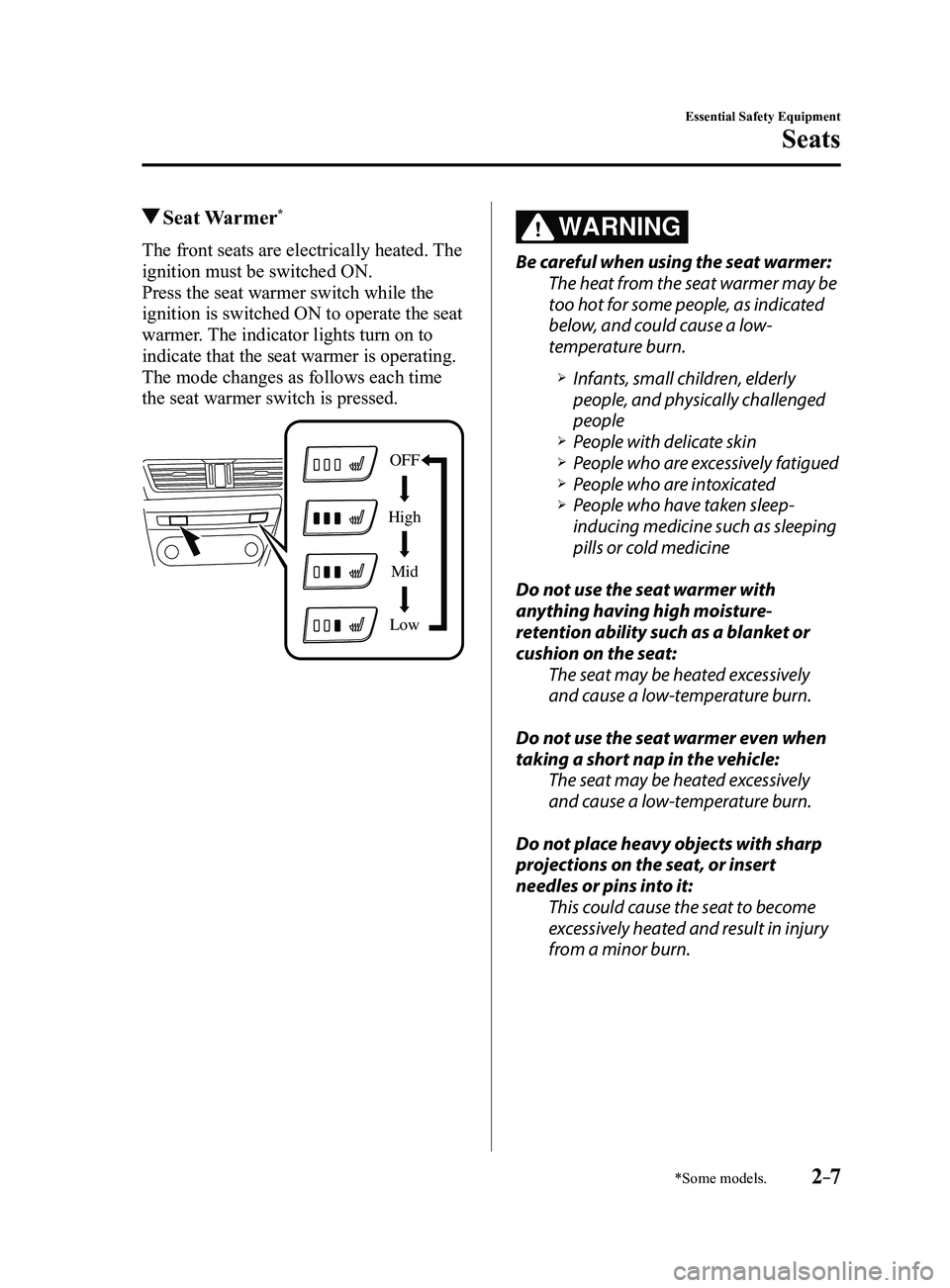
The front seats are electrically heated. The
ignition must be switched ON.
Press the seat warmer switch while the
ignition is switched ON to operate the seat
warmer. The indicator lights turn on to
indicate that the seat warmer is operating.
The mode changes as follows each time
the seat warmer switch is pressed.
OFF
High Mid
Low
WARNING
Be careful when using the seat warmer:
The heat from the seat warmer may be
too hot for some people, as indicated
below, and could cause a low-
temperature burn.
Infants, small children, elderly
people, and physically challenged
people
People with delicate skin People who are excessively fatigued People who are intoxicated People who have taken sleep-
inducing medicine such as sleeping
pills or cold medicine
Do not use the seat warmer with
anything having high moisture-
retention ability such as a blanket or
cushion on the seat: The seat may be heated excessively
and cause a low-temperature burn.
Do not use the seat warmer even when
taking a short nap in the vehicle: The seat may be heated excessively
and cause a low-temperature burn.
Do not place heavy objects with sharp
projections on the seat, or insert
needles or pins into it: This could cause the seat to become
excessively heated and result in injury
from a minor burn.
Mazda3_8FL6-EA-16F_Edition2.indb 72016/08/10 17:34:52
Page 22 of 612
2–8
Essential Safety Equipment
Seats
CAUTION
Do not use organic solvents to clean
the seat. It may damage the seat
surface and the heater.
NOTE
If the ignition is switched off while the
seat warmer is operating (High, Mid or
Low) and then switched ON again, the
seat warmer will automatically operate
at the temperature set before switching
off the ignition.
Use the seat warmer when the engine
is running. Leaving the seat warmer
on for long periods with the engine not
running could cause the battery power
to be depleted.
The temperature of the seat warmer
cannot be adjusted beyond High, Mid
and Low because the seat warmer is
controlled by a thermostat.
Rear Seat
Split/One-piece Folding the
Seatback
By lowering the rear seatback(s) the
luggage compartment space can be
expanded.
Mazda3_8FL6-EA-16F_Edition2.indb 82016/08/10 17:34:53
Page 48 of 612
2–34
Essential Safety Equipment
Child-Restraint
Never use a rear-facing child-restraint
system in the front seat with an air bag
that could deploy:Rear-facing child-restraint systems
on the front seat are particularly
dangerous.
Even in a moderate collision, the
child-restraint system can be hit
by a deploying air bag and moved
violently backward resulting in
serious injury or death to the child.
Even though you may feel assured
that the front passenger air bag will
not deploy based on the fact that the
front passenger air bag deactivation
indicator light illuminates, you should
not use a rear-facing child-restraint
system in the front seat.
Do not allow a child or anyone to lean
over or against the side window of a
vehicle with side and curtain air bags: It is dangerous to allow anyone to lean
over or against the side window, the
area of the front passenger seat, the
front and rear window pillars and the
roof edge along both sides from which
the side and curtain air bags deploy,
even if a child-restraint system is used.
The impact of inflation from a side or
curtain air bag could cause serious
injury or death to an out of position
child. Furthermore, leaning over or
against the front door could block the
side and curtain air bags and eliminate
the advantages of supplemental
protection. With the front air bag and
the additional side air bag that comes
out of the front seat, the rear seat is
always a better location for children.
Take special care not to allow a child to
lean over or against the side window,
even if the child is seated in a child-
restraint system.Front Passenger's Seat Child-Restraint
System Installation (With Front
Passenger Occupant Classification
System)
1. Make sure the ignition is switched of f.
2. Slide the seat as far back as possible.
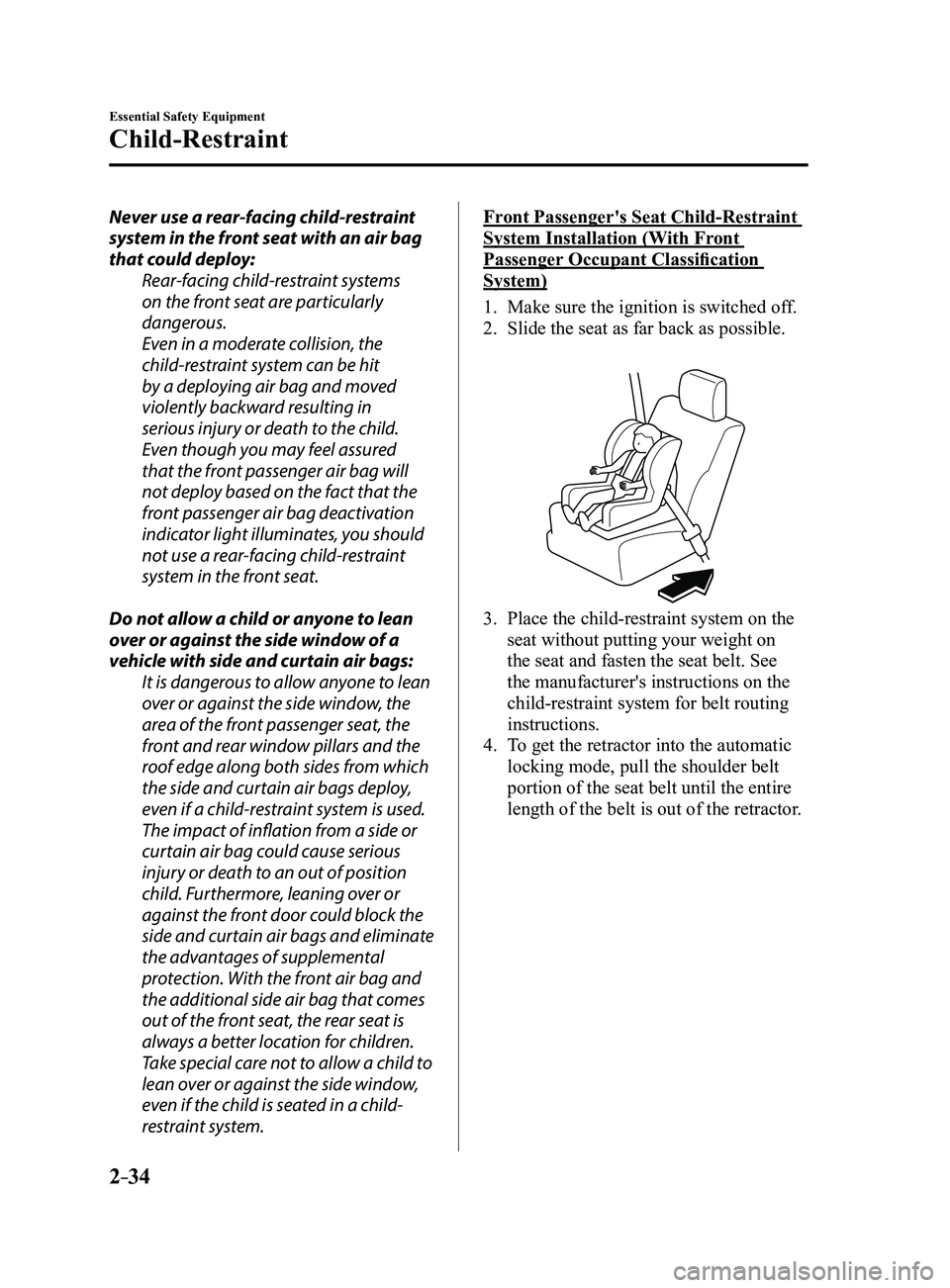
3. Place the child-restraint system on the
seat without putting your weight on
the seat and fasten the seat belt. See
the manufacturer's instructions on the
child-restraint system for belt routing
instructions.
4. To get the retractor into the automatic
locking mode, pull the shoulder belt
portion of the seat belt until the entire
length of the belt is out of the retractor.
Mazda3_8FL6-EA-16F_Edition2.indb 342016/08/10 17:35:04
Page 49 of 612
2–35
Essential Safety Equipment
Child-Restraint
5. Push the child-restraint system firmly
into the vehicle seat. Be sure the
belt retracts as snugly as possible. A
clicking noise from the retractor will
be heard during retraction if the system
is in automatic locking mode. If the
belt does not lock the seat down tight,
repeat the previous step and also this
one.
NOTE
Inspect this function before each use of
the child-restraint system. You should
not be able to pull the shoulder belt
out of the retractor while the system is
in the automatic locking mode. When
you remove the child-restraint system,
be sure the belt fully retracts to return
the system to emergency locking mode
before occupants use the seat belts.
Follow the child-restraint system
manufacturer's instructions carefully.
Depending on the type of child-r estraint
system, it may not employ seat belts
which are in automatic locking mode.
6. Seat your child safely in the child-
restraint system and secure the child
according to the instructions from the
child-restraint system manufacturer.
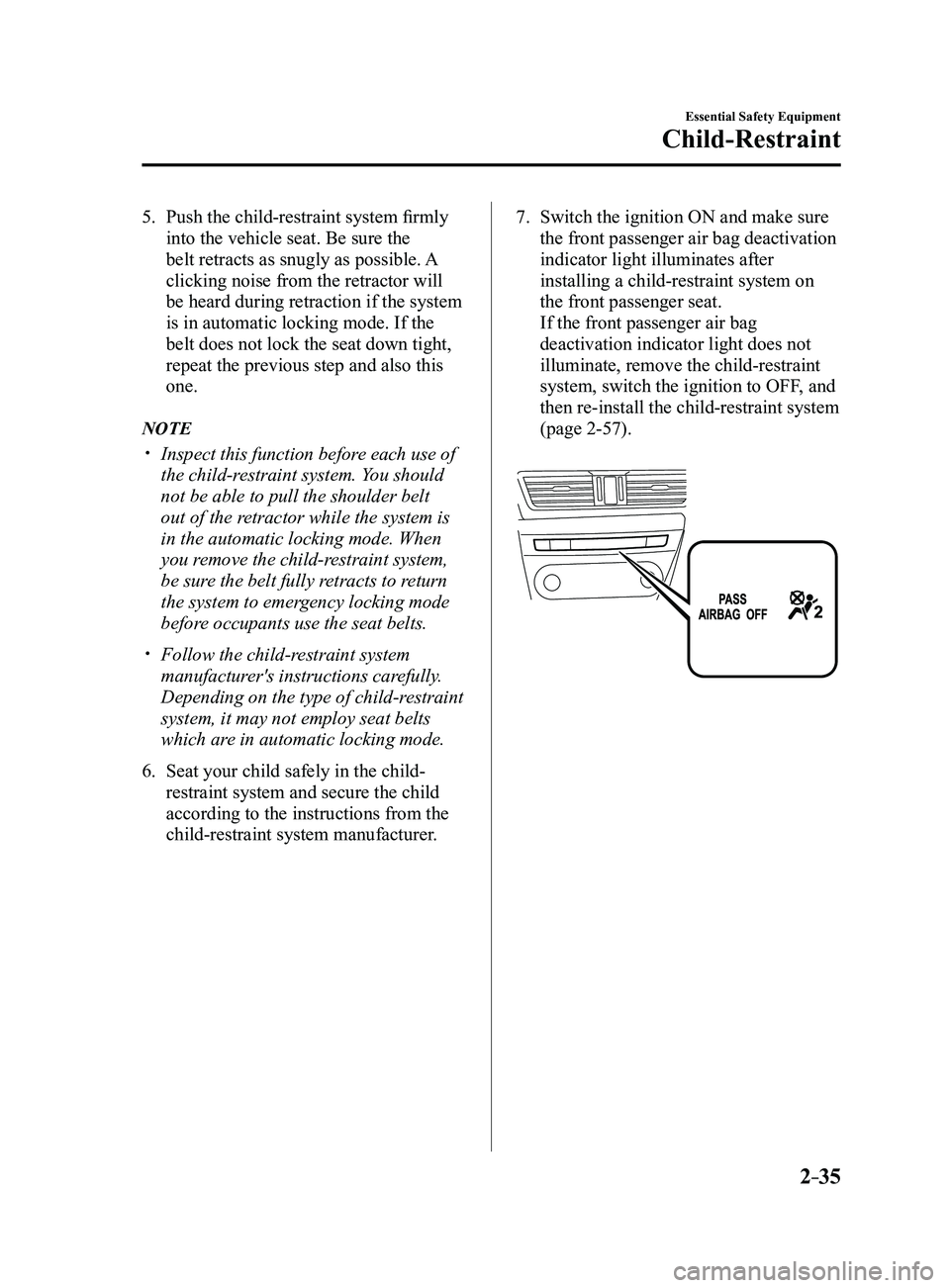
7. Switch the ignition ON and make sure
the front passenger air bag deactivation
indicator light illuminates after
installing a child-restraint system on
the front passenger seat.
If the front passenger air bag
deactivation indicator light does not
illuminate, remove the child-restraint
system, switch the ignition to OFF, and
then re-install the child-restraint system
(page
2-57).
Mazda3_8FL6-EA-16F_Edition2.indb 352016/08/10 17:35:04
Page 56 of 612
2–42
Essential Safety Equipment
SRS Air Bags
If your vehicle is also equipped with a front passenger occupant classification system,
refer to the Front Passenger Occupant Classification System (page
2-57) for details.
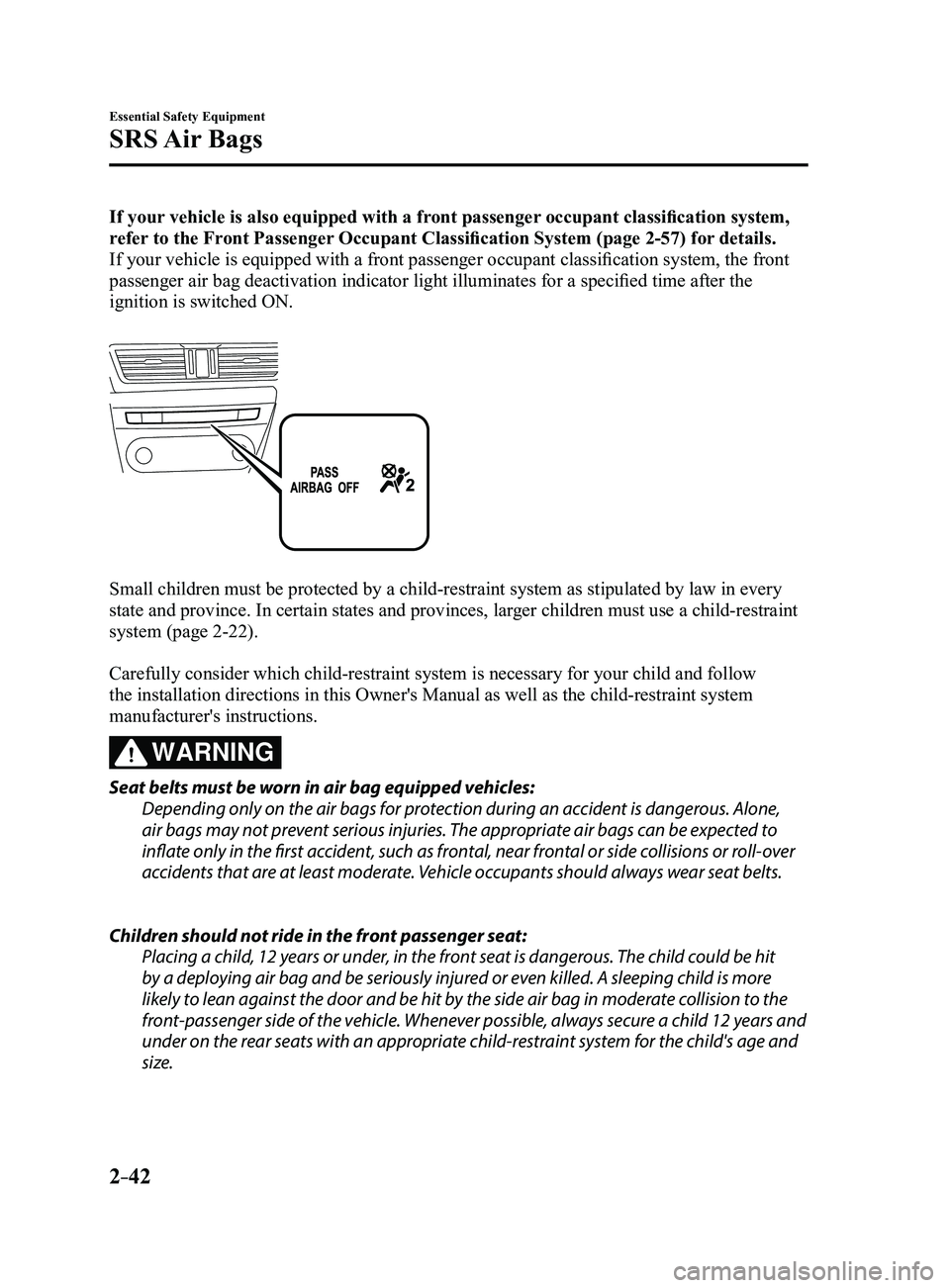
If your vehicle is equipped with a front passenger occupant classification system, the front
passenger air bag deactivation indicator light illuminates for a specified time after the
ignition is switched ON.
Small children must be protected by a child-restraint system as stipulat\
ed by law in every
state and province. In certain states and provinces, larger children must use a child-restraint
system (page
2-22).
Carefully consider which child-restraint system is necessary for your ch\
ild and follow
the installation directions in this Owner's Manual as well as the child-\
restraint system
manufacturer's instructions.
WARNING
Seat belts must be worn in air bag equipped vehicles:
Depending only on the air bags for protection during an accident is dangerous. Alone,
air bags may not prevent serious injuries. The appropriate air bags can be expected to
inflate only in the first accident, such as frontal, near frontal or side collisions or roll-over
accidents that are at least moderate. Vehicle occupants should always wear seat belts.
Children should not ride in the front passenger seat: Placing a child, 12 years or under, in the front seat is dangerous. The child could be hit
by a deploying air bag and be seriously injured or even killed. A sleeping child is more
likely to lean against the door and be hit by the side air bag in moderate collision to the
front-passenger side of the vehicle. Whenever possible, always secure a child 12 years and
under on the rear seats with an appropriate child-restraint system for the child's age and
size.
Mazda3_8FL6-EA-16F_Edition2.indb 422016/08/10 17:35:06
Page 71 of 612
2–57
Essential Safety Equipment
SRS Air Bags
*Some models.
Front Passenger Occupant Classification System*
First, please read "Supplemental Restraint System (SRS) Precautions" (page 2-41)
carefully.
Front Passenger Occupant Classification Sensor
Your vehicle is equipped with a front passenger occupant classification sensor as a part
of the supplemental restraint system. This sensor is equipped in the front passenger's seat
cushion. This sensor measures the electrostatic capacity of the front passenger's\
seat. The
SAS unit is designed to prevent the front passenger front and side air b\
ags and seat belt
pretensioner system from deploying if the front passenger air bag deacti\
vation indicator
light turns on.
To reduce the chance of injuries caused by deployment of the front passen\
ger air bag,
the system deactivates the front passenger front and side air bags and a\
lso the seat belt
pretensioner system when the front passenger air bag deactivation indica\
tor light turns
on. Refer to the following table for the front passenger air bag deactivation indicator light
illumination conditions.
This system shuts off the front passenger front and side air bags and seat belt pretensioner\
system, so make sure the front passenger air bag deactivation indicator \
light turns on
according to the following table.
The air bag/front seat belt pretensioner system warning light flashes and the front passenger
air bag deactivation indicator light illuminates if the sensors have a p\
ossible malfunction.
If this happens, the front passenger front and side air bags and seat be\
lt pretensioner system
will not deploy.
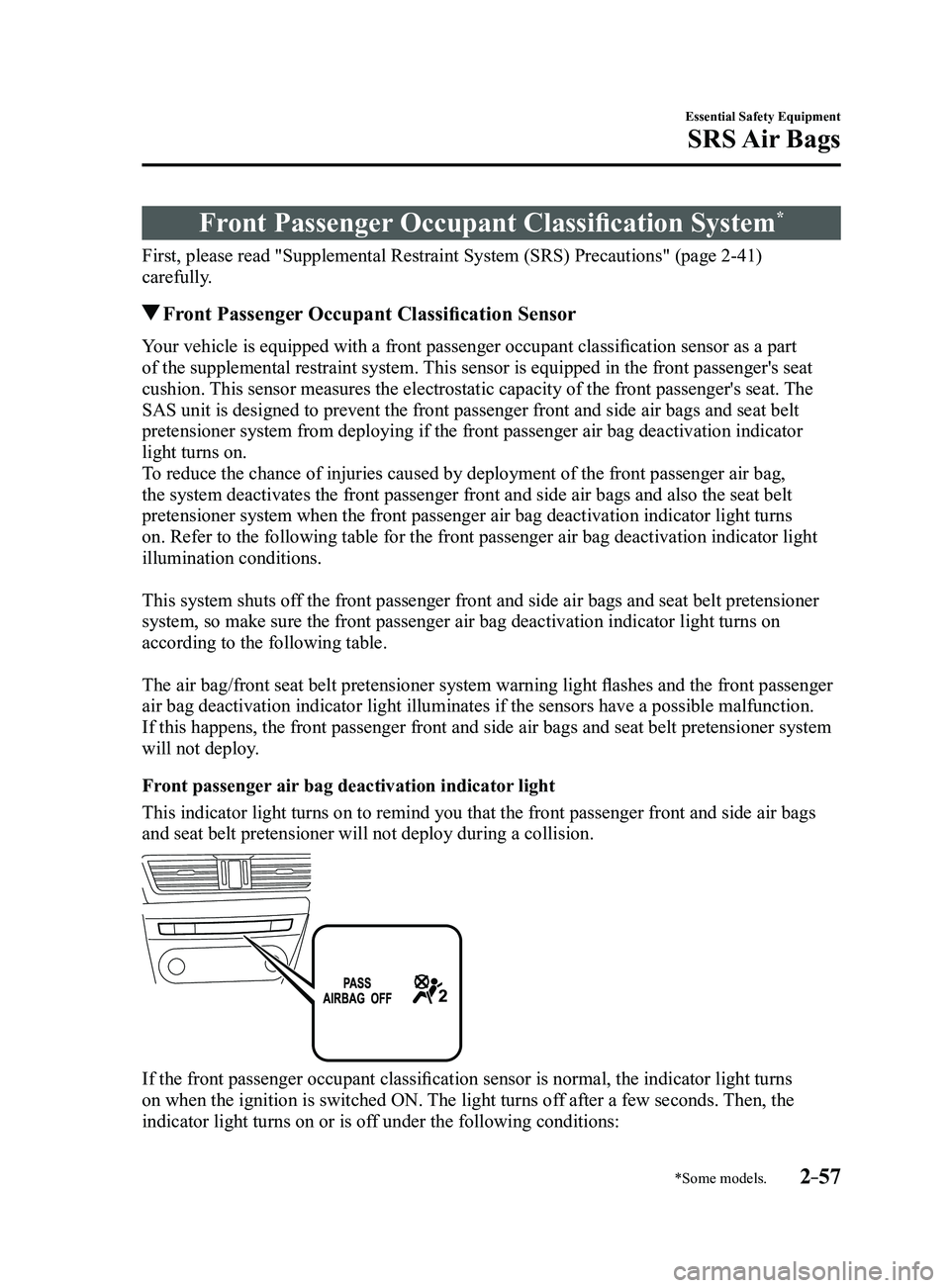
Front passenger air bag deactivation indicator light
This indicator light turns on to remind you that the front passenger fro\
nt and side air bags
and seat belt pretensioner will not deploy during a collision.
If the front passenger occupant classification sensor is normal, the indicator light turns
on when the ignition is switched ON. The light turns off after a few seconds. Then, the
indicator light turns on or is off under the following conditions:
Mazda3_8FL6-EA-16F_Edition2.indb 572016/08/10 17:35:13
Page 72 of 612
2–58
Essential Safety Equipment
SRS Air Bags
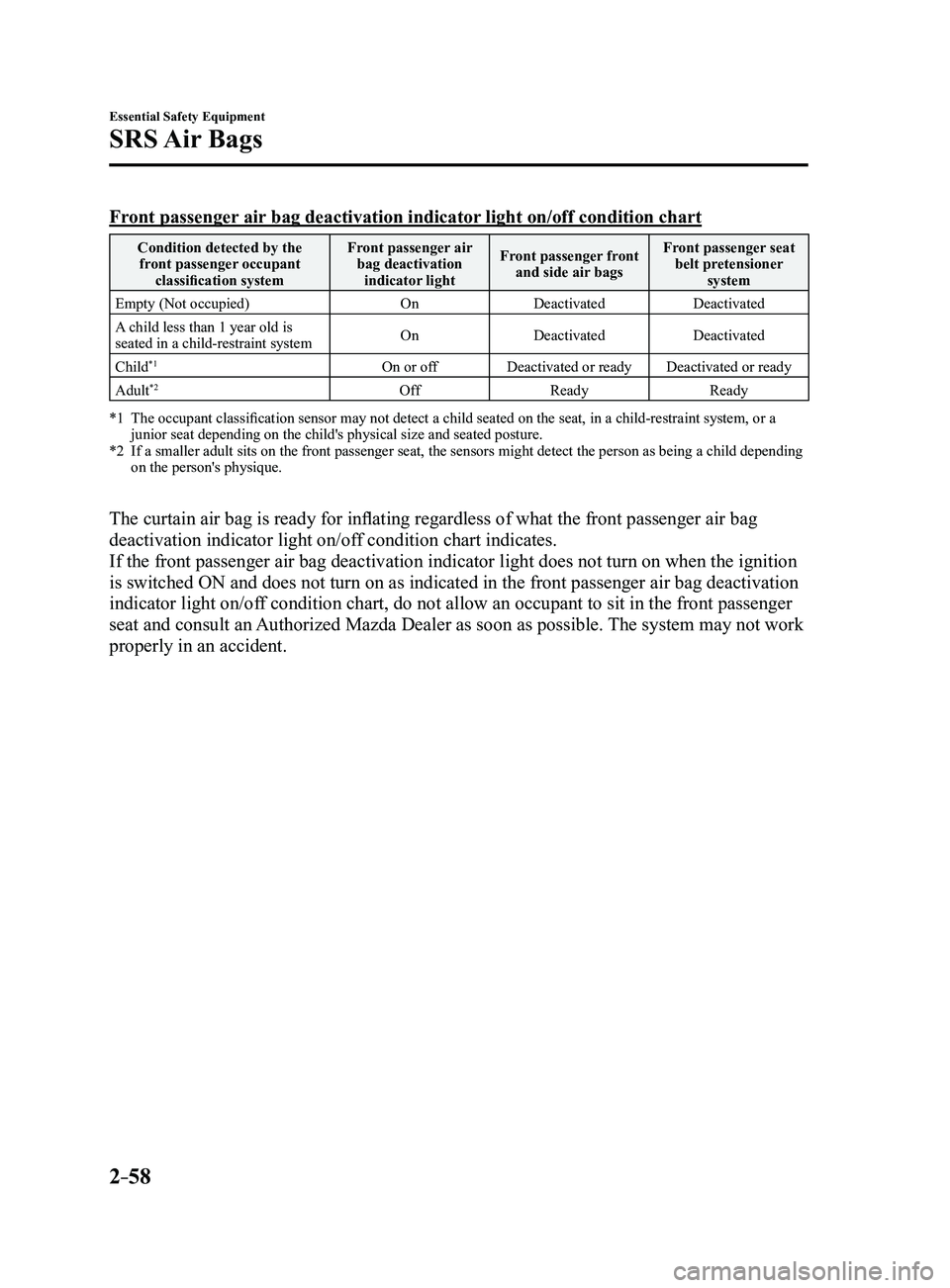
Front passenger air bag deactivation indicator light on/off condition chart
Condition detected by the front passenger occupant classification system Front passenger air
bag deactivation indicator light Front passenger front
and side air bags Front passenger seat
belt pretensioner system
Empty (Not occupied) OnDeactivated Deactivated
A child less than 1 year old is
seated in a child-restraint system On
Deactivated Deactivated
Child
*1On or off Deactivated or ready Deactivated or ready
Adult*2Off Ready Ready
*1 The occupant classification sensor may not detect a child seated on the seat, in a child-restraint system, or a junior seat depending on the child's physical size and seated posture.*2 If a smaller adult sits on the front passenger seat, the sensors might d\
etect the person as being a child depending on the person's physique.
The curtain air bag is ready for inflating regardless of what the front passenger air bag
deactivation indicator light on/off condition chart indicates.
If the front passenger air bag deactivation indicator light does not tur\
n on when the ignition
is switched ON and does not turn on as indicated in the front passenger air bag deactivation
indicator light on/off condition chart, do not allow an occupant to sit in the front passenge\
r
seat and consult an Authorized Mazda Dealer as soon as possible. The system may not work
properly in an accident.
Mazda3_8FL6-EA-16F_Edition2.indb 582016/08/10 17:35:14
Page 76 of 612

2–62
Essential Safety Equipment
SRS Air Bags
Constant Monitoring
The following components of the air bag systems are monitored by a diagn\
ostic system:
Crash sensors, and diagnostic module (SAS unit) Front air bag sensors Air bag modules Side crash sensors Air bag/Front seat belt pretensioner system warning light Front seat belt pretensioners Related wiring
(With Front Passenger Occupant Classification System)
Front passenger air bag deactivation indicator light Front passenger occupant classification sensor Front passenger occupant classification module
The diagnostic module continuously monitors the system's readiness. This begins when the
ignition is switched ON and continues while the vehicle is being driven.
Mazda3_8FL6-EA-16F_Edition2.indb 622016/08/10 17:35:14
Page 79 of 612
3–3
Before Driving
Keys
A code number is stamped on the plate
attached to the key set; detach this plate
and store it in a safe place (not in the
vehicle) for use if you need to make a
replacement key (auxiliary key).
Also write down the code number and
keep it in a separate safe and convenient
place, but not in the vehicle.
If your key (auxiliary key) is lost, consult
your Authorized Mazda Dealer and have
your code number ready.
NOTE
The driver must carry the key to ensure the
system functions properly.
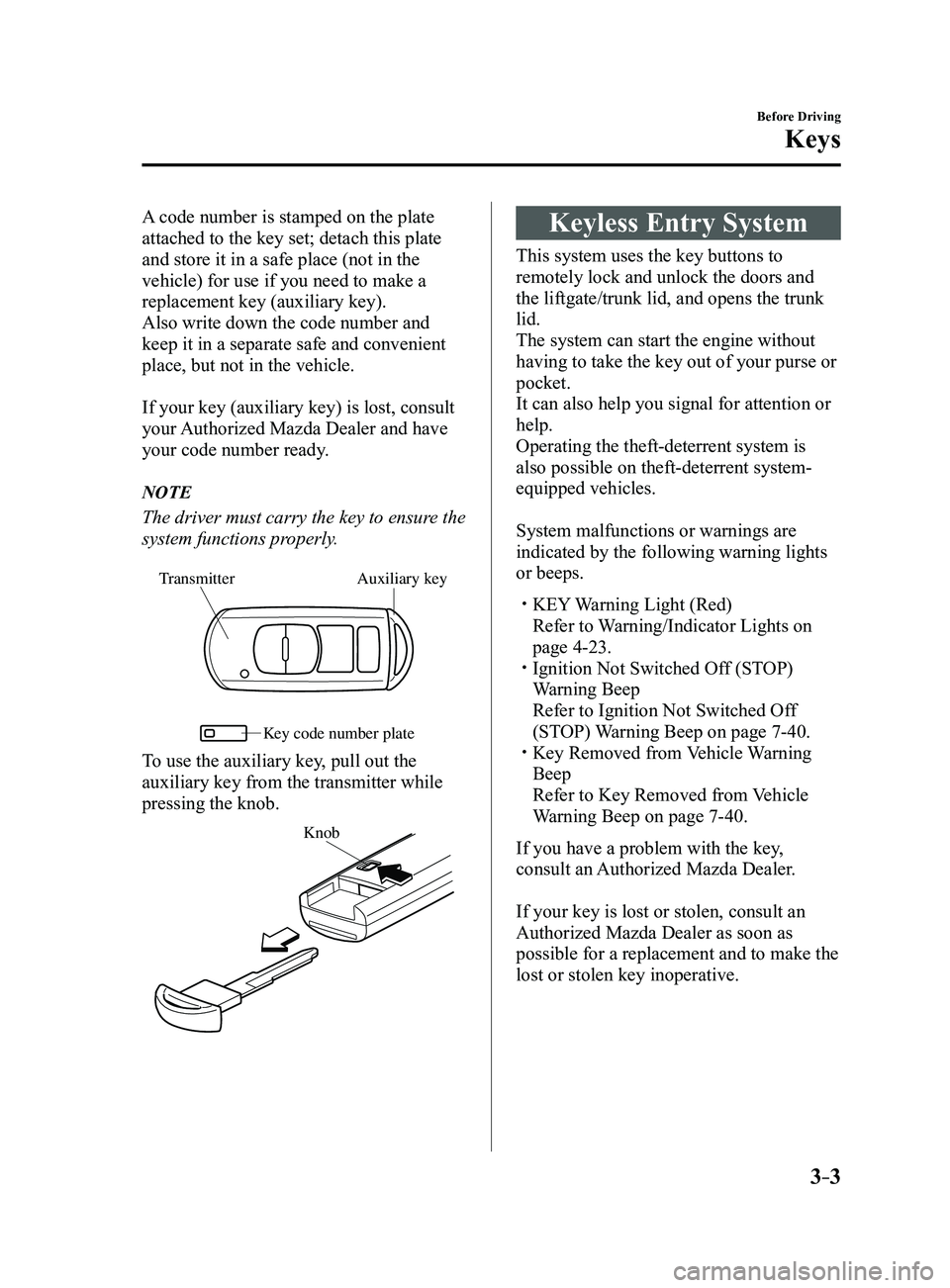
Auxiliary key
Transmitter
Ke y code number plate
To use the auxiliary key, pull out the
auxiliary key from the transmitter while
pressing the knob.
Knob
Keyless Entry System
This system uses the key buttons to
remotely lock and unlock the doors and
the liftgate/trunk lid, and opens the trunk
lid.
The system can start the engine without
having to take the key out of your purse or
pocket.
It can also help you signal for attention or
help.
Operating the theft-deterrent system is
also possible on theft-deterrent system-
equipped vehicles.
System malfunctions or warnings are
indicated by the following warning lights
or beeps.
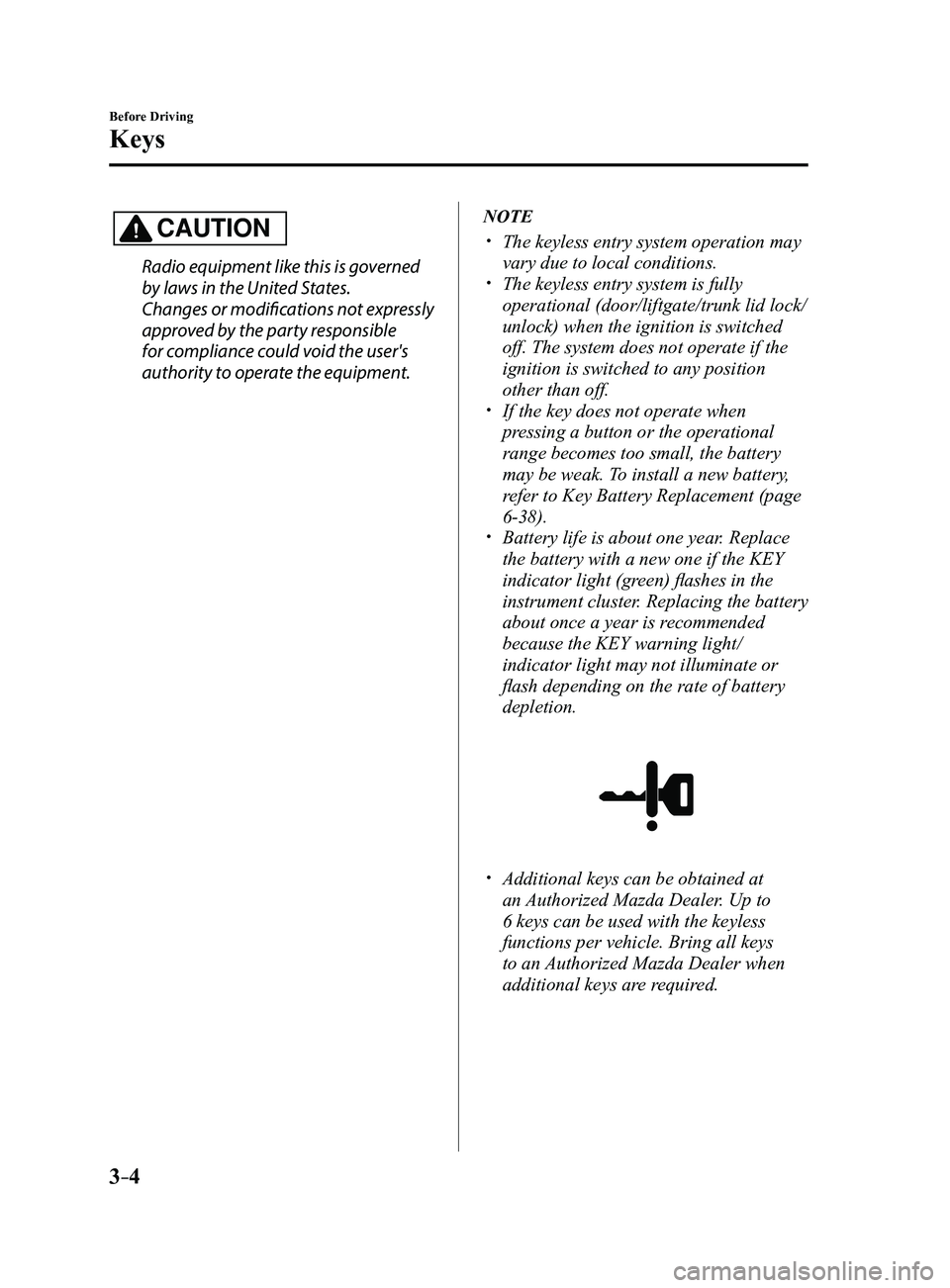
KEY Warning Light (Red)
Refer to Warning/Indicator Lights on
page 4-23. Ignition Not Switched Of f (STOP)
Warning Beep
Refer to Ignition Not Switched Of f
(STOP) Warning Beep on page 7-40. Key Removed from Vehicle Warning
Beep
Refer to Key Removed from Vehicle
Warning Beep on page 7-40.
If you have a problem with the key,
consult an Authorized Mazda Dealer.
If your key is lost or stolen, consult an
Authorized Mazda Dealer as soon as
possible for a replacement and to make the
lost or stolen key inoperative.
Mazda3_8FL6-EA-16F_Edition2.indb 32016/08/10 17:35:16
Page 80 of 612
3–4
Before Driving
Keys
CAUTION
Radio equipment like this is governed
by laws in the United States.
Changes or modifications not expressly
approved by the party responsible
for compliance could void the user's
authority to operate the equipment.
NOTE
The keyless entry system operation may
vary due to local conditions. The keyless entry system is fully
operational (door/liftgate/trunk lid lock/
unlock) when the ignition is switched
off. The system does not operate if the
ignition is switched to any position
other than off.
If the key does not operate when
pressing a button or the operational
range becomes too small, the battery
may be weak. To install a new battery,
refer to Key Battery Replacement (page
6-38). Battery life is about one year. Replace
the battery with a new one if the KEY
indicator light (green) flashes in the
instrument cluster. Replacing the battery
about once a year is recommended
because the KEY warning light/
indicator light may not illuminate or
flash depending on the rate of battery
depletion.
Additional keys can be obtained at
an Authorized Mazda Dealer. Up to
6 keys can be used with the keyless
functions per vehicle. Bring all keys
to an Authorized Mazda Dealer when
additional keys are required.
Mazda3_8FL6-EA-16F_Edition2.indb 42016/08/10 17:35:16