radiator MAZDA MODEL 3 4-DOOR 2017 Owners Manual
[x] Cancel search | Manufacturer: MAZDA, Model Year: 2017, Model line: MODEL 3 4-DOOR, Model: MAZDA MODEL 3 4-DOOR 2017Pages: 612
Page 125 of 612
3–49
Before Driving
Driving Tips
Winter Driving
Carry emergency gear, including tire
chains, window scraper, flares, a small
shovel, jumper cables, and a small bag of
sand or salt.
Ask an Authorized Mazda Dealer to check
the following:
Have the proper ratio of antifreeze in the
radiator.
Refer to Engine Coolant on page
6-28. Inspect the battery and its cables. Cold
reduces battery capacity. Use an engine oil appropriate for the
lowest ambient temperatures that the
vehicle will be driven in (page
6-25). Inspect the ignition system for damage
and loose connections. Use washer fluid made with antifreeze—
but do not use engine coolant antifreeze
for washer fluid (page
6-30).
NOTE
(Without electric parking brake)
Do not use the parking brake in freezing
weather as it may freeze. Instead, shift
to P with an automatic transaxle and to
1 or R with a manual transaxle. Block
the rear wheels.
Remove snow before driving. Snow left
on the windshield is dangerous as it
could obstruct vision.
Do not apply excessive for ce to a
window scraper when removing ice or
frozen snow on the mirror glass and
windshield.
Never use warm or hot water for
removing snow or ice from windows and
mirrors as it could result in the glass
cracking.
Drive slowly. Braking performance
can be adversely affected if snow or
ice adheres to the brake components. If
this situation occurs, drive the vehicle
slowly, releasing the accelerator pedal
and lightly applying the brakes several
times until the brake performance
returns to normal.
Snow Tires
Use snow tires on all four wheels
Do not go faster than 120 km/h (75 mph)
while driving with snow tires. Inflate snow
tires 30 kPa (0.3 kgf/cm
2, 4.3 psi) more
than recommended on the tire pressure
label (driver's door frame), but never
more than the maximum cold-tire pressure
shown on the tires.
Mazda3_8FL6-EA-16F_Edition2.indb 492016/08/10 17:35:38
Page 180 of 612
4–50
When Driving
Switches and Controls
Windshield Wipers and
Washer
The ignition must be switched ON to use
the wipers.
WARNING
Use only windshield washer fluid or
plain water in the reservoir:Using radiator antifreeze as washer
fluid is dangerous. If sprayed on the
windshield, it will dirty the windshield,
affect your visibility, and could result in
an accident.
Only use windshield washer fluid mixed
with anti-freeze protection in freezing
weather conditions: Using windshield washer fluid without
anti-freeze protection in freezing
weather conditions is dangerous as
it could freeze on the windshield and
block your vision which could cause
an accident. In addition, make sure
the windshield is sufficiently warmed
using the defroster before spraying the
washer fluid.
NOTE
If the windshield wipers are operated
under cold weather conditions or
during snowfall, they could stop due to
accumulated snow on the windshield. If the
windshield wipers stop due to accumulated
snow on the windshield, park the vehicle in
a safe place, turn the wiper switch off, and
then remove the accumulated snow. If the
wiper switch is turned to another position
other than OFF, the wipers will operate. If
the wipers do not operate even though the
wiper switch is turned to a position other
than OFF, consult an Authorized Mazda
Dealer as soon as possible.
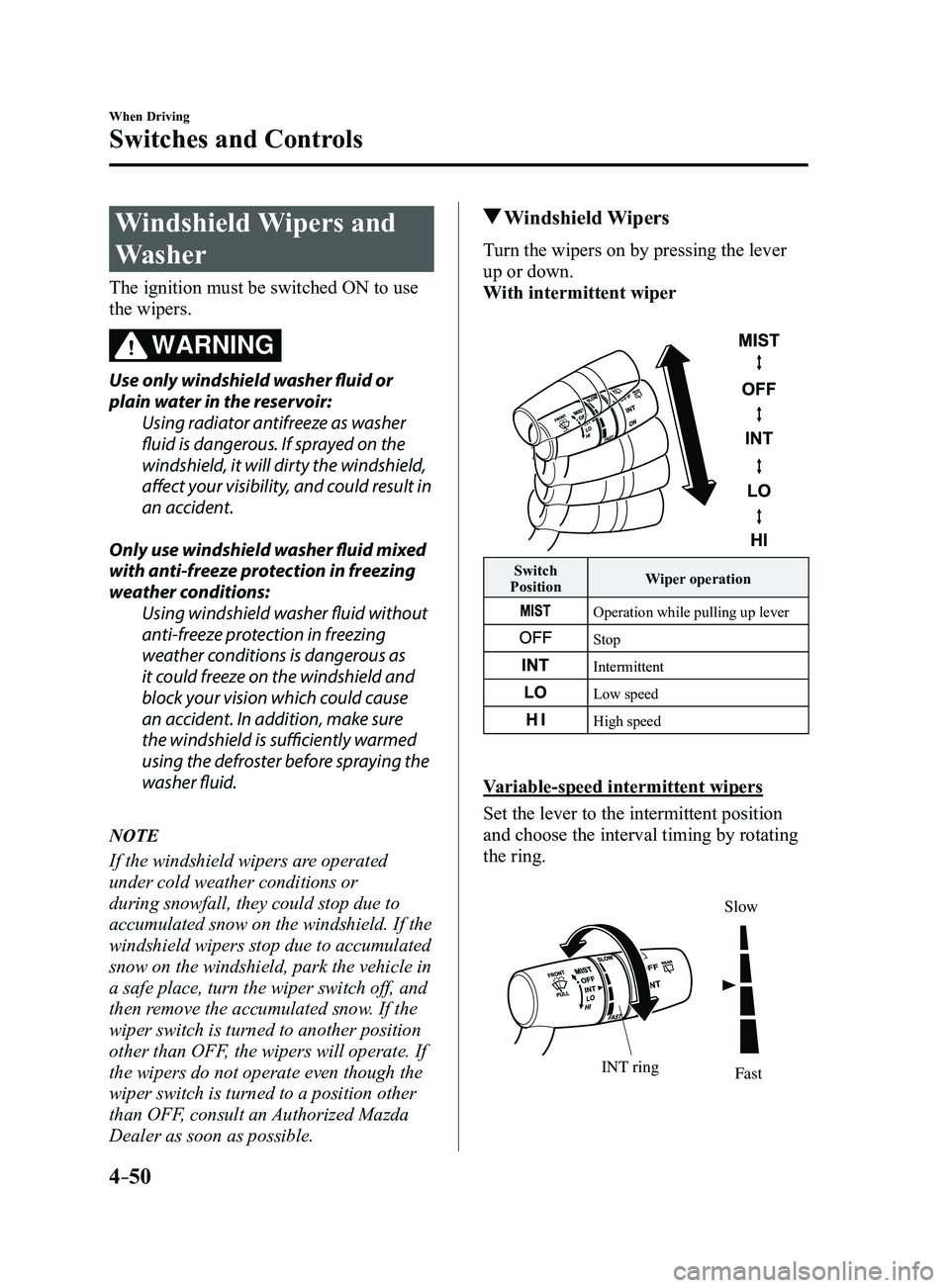
Windshield Wipers
Turn the wipers on by pressing the lever
up or down.
With intermittent wiper
Switch
Position Wiper operation
Operation while pulling up lever
Stop
Intermittent
Low speed
High speed
Variable-speed intermittent wipers
Set the lever to the intermittent position
and choose the interval timing by rotating
the ring.
INT ringFast
Slow
Mazda3_8FL6-EA-16F_Edition2.indb 502016/08/10 17:36:20
Page 212 of 612

4–82
When Driving
i-ACTIVSENSE
Pre-Crash Safety Technology
Pre-crash safety technology is designed to assist the driver in averting\
collisions or reduce
their severity in situations where they cannot be avoided.
Collision damage reduction in low vehicle speed range
Forward driving
Smart City Brake Support (SCBS)
........................................................................\
...........4-128
Collision damage reduction in medium/high speed range
Smart Brake Support (SBS)
........................................................................\
......................4-133
Camera and Sensors
Forward Sensing Camera (FSC)
The Forward Sensing Camera (FSC) detects lane indications and recogniz\
es headlights,
taillights and city lights during nighttime driving. In addition, it als\
o detects the vehicle
ahead, pedestrians, or obstructions. The following systems also use the Forward Sensing
Camera (FSC).
High Beam Control system (HBC) Lane-keep Assist System (LAS) & Lane Departure Warning System (LDWS) Traffic Sign Recognition System (TSR) Smart City Brake Support (SCBS) Smart Brake Support (SBS)
The Forward Sensing Camera (FSC) is installed at the top of the windsh\
ield near the
rearview mirror.
Refer to Forward Sensing Camera (FSC) on page
4-136.
Radar sensor (front)
The radar sensor (front) functions by detecting the radio waves reflected off a vehicle ahead
sent from the radar sensor. The following systems also use the radar sensor (front).
Mazda Radar Cruise Control (MRCC) Distance Recognition Support System (DRSS) Smart Brake Support (SBS)
The radar sensor (front) is mounted behind the radiator grille.
Refer to Radar Sensor (Front) on page
4-141.
Mazda3_8FL6-EA-16F_Edition2.indb 822016/08/10 17:36:36
Page 243 of 612
4–113
When Driving
i-ACTIVSENSE
(Automatic transaxle)
The selector lever is shifted to park (P),
neutral (N) or reverse (R). (Manual transaxle)
The shift lever is in the reverse (R)
position .
In the following cases, the “Mazda
Radar Cruise Control Canceled”
indication is displayed and the beep
sounds one time.
The vehicle speed decreases to less
than 25 km (16 mph). The DSC has operated. The TCS has operated for a certain
period of time. The Smart City Brake Support (SCBS)
has operated. The Smart Brake Support (SBS) has
operated. When traveling on a down slope for a
long period of time. There is a problem with the system. Any door is opened. The driver's seat belt is unfastened.
(Manual transaxle)
The shift lever is shifted to neutral
(N) for a certain period of time. The clutch is depressed for a certain
period of time. The engine stalls.
NOTE
The Mazda Radar Cruise Control
(MRCC) system may be canceled during
rain, fog, snow or other inclement
weather conditions, or the front surface
of the radiator grille is dirty.
If you have temporarily canceled the
Mazda Radar Cruise Control (MRCC),
you can return to your previously set
speed by pressing the RES switch and
after all of the operation conditions
have been met.
If the Mazda Radar Cruise Contr ol
(MRCC) system is deactivated, the
system does not return to the previously
set speed even if the RES switch is
pressed.
Mazda3_8FL6-EA-16F_Edition2.indb 1132016/08/10 17:36:50
Page 272 of 612
4–142
When Driving
i-ACTIVSENSE
CAUTION
Heed the following precautions to assure correct operation of each system.
Do not adhere stickers (including transparent stickers) to the surface of the radiator
grille and front emblem in and around the radar sensor (front), and do not replace
the radiator grille and front emblem with any product that is not a genuine product
designed for use with the radar sensor (front).
The radar sensor (front) includes a function for detecting soiling of the radar sensor's
front surface and informing the driver, however, depending on the conditions, it may
require time to detect or it may not detect plastic shopping bags, ice or snow. If this
occurs, the system may not operate correctly, therefore always keep the radar sensor
(front) clean.
Do not install a grille guard. If the front part of the vehicle has been damaged in a vehicle accident, the position of
the radar sensor (front) may have moved. Stop the system immediately and always
have the vehicle inspected at an Authorized Mazda Dealer.
Do not use the front bumper to push other vehicles or obstructions such as when
pulling out of a parking space. Otherwise, the radar sensor (front) could be hit and its
position deviated.
Do not remove, disassemble, or modify the radar sensor (front). For repairs, replacement or paint work around the radar sensor (front), consult an
Authorized Mazda Dealer. Do not modify the suspension. If the suspension are modified, the vehicle's posture
could change and the radar sensor (front) may not be able to correctly detect a vehicle
ahead or an obstruction.
Mazda3_8FL6-EA-16F_Edition2.indb 1422016/08/10 17:37:00
Page 440 of 612
6–28
Maintenance and Care
Owner Maintenance
Inspecting Engine Oil Level
1. Be sure the vehicle is on a level
surface.
2. Warm up the engine to normal
operating temperature.
3. Turn it off and wait at least 5 minutes
for the oil to return to the oil pan.
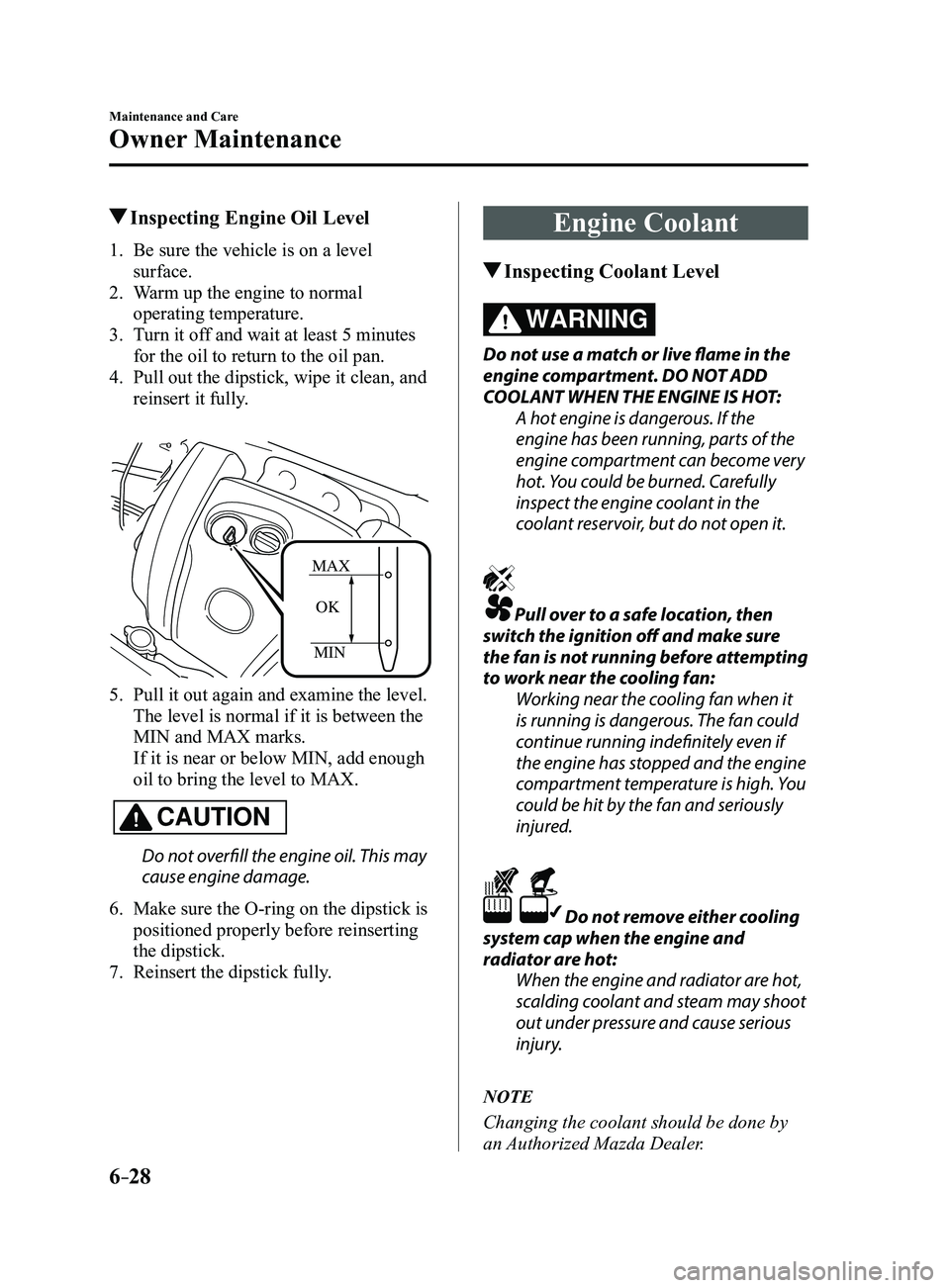
4. Pull out the dipstick, wipe it clean, and
reinsert it fully.
MAXOK
MIN
5. Pull it out again and examine the level.
The level is normal if it is between the
MIN and MAX marks.
If it is near or below MIN, add enough
oil to bring the level to MAX.
CAUTION
Do not overfill the engine oil. This may
cause engine damage.
6. Make sure the O-ring on the dipstick is
positioned properly before reinserting
the dipstick.
7. Reinsert the dipstick fully .
Engine Coolant
Inspecting Coolant Level
WARNING
Do not use a match or live flame in the
engine compartment. DO NOT ADD
COOLANT WHEN THE ENGINE IS HOT:
A hot engine is dangerous. If the
engine has been running, parts of the
engine compartment can become very
hot. You could be burned. Carefully
inspect the engine coolant in the
coolant reservoir, but do not open it.
Pull over to a safe location, then
switch the ignition off and make sure
the fan is not running before attempting
to work near the cooling fan:Working near the cooling fan when it
is running is dangerous. The fan could
continue running indefinitely even if
the engine has stopped and the engine
compartment temperature is high. You
could be hit by the fan and seriously
injured.
Do not remove either cooling
system cap when the engine and
radiator are hot:When the engine and radiator are hot,
scalding coolant and steam may shoot
out under pressure and cause serious
injury.
NOTE
Changing the coolant should be done by
an Authorized Mazda Dealer.
Mazda3_8FL6-EA-16F_Edition2.indb 282016/08/10 17:38:38
Page 441 of 612
6–29
Maintenance and Care
Owner Maintenance
Inspect the antifreeze protection and
coolant level in the coolant reservoir at
least once a year—at the beginning of the
winter season—and before traveling where
temperatures may drop below freezing.
Inspect the condition and connections of
all cooling system and heater hoses.
Replace any that are swollen or
deteriorated.
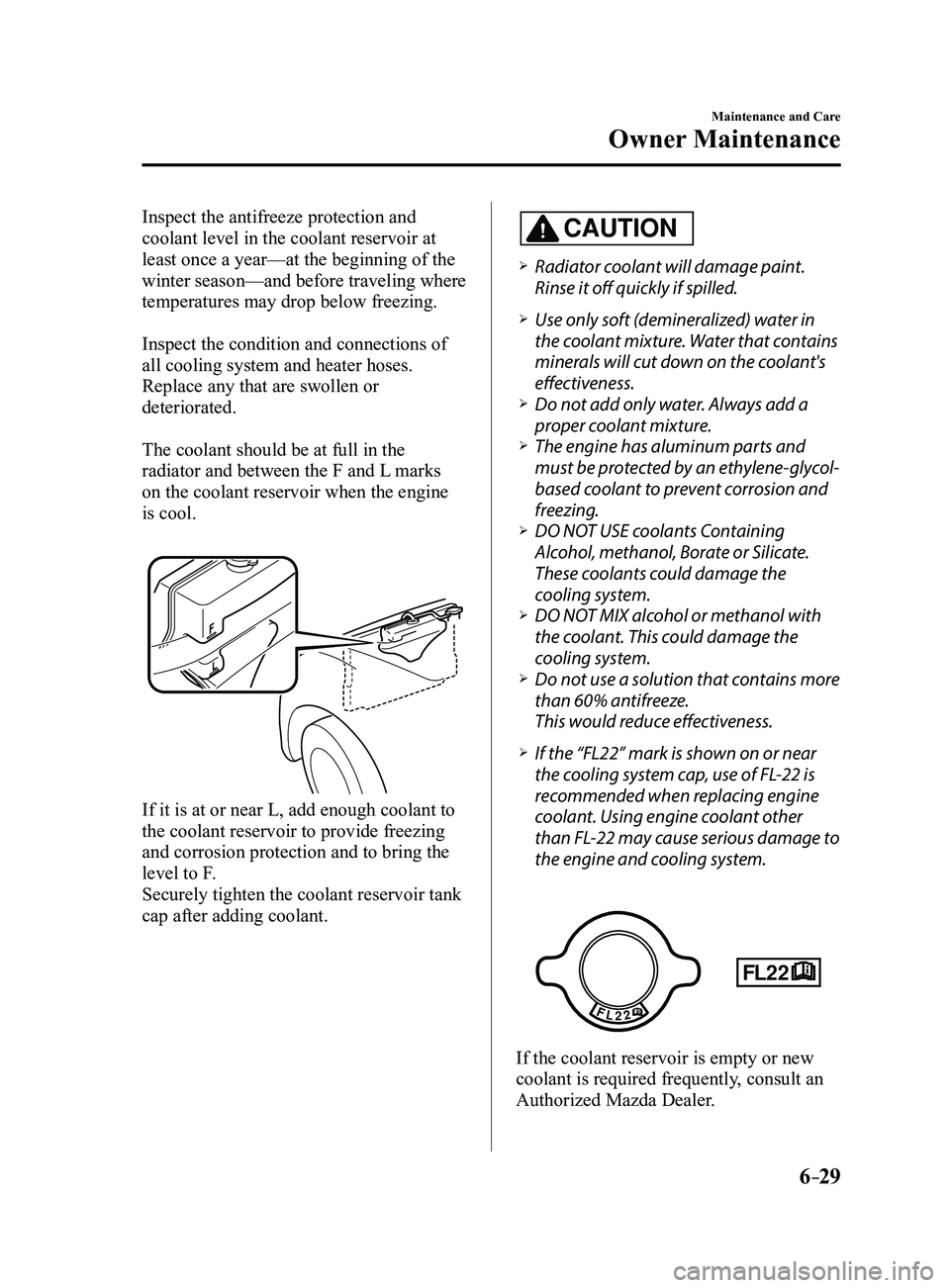
The coolant should be at full in the
radiator and between the F and L marks
on the coolant reservoir when the engine
is cool.
If it is at or near L, add enough coolant to
the coolant reservoir to provide freezing
and corrosion protection and to bring the
level to F.
Securely tighten the coolant reservoir tank
cap after adding coolant.
CAUTION
Radiator coolant will damage paint.
Rinse it off quickly if spilled.
Use only soft (demineralized) water in
the coolant mixture. Water that contains
minerals will cut down on the coolant's
effectiveness.
Do not add only water. Always add a
proper coolant mixture. The engine has aluminum parts and
must be protected by an ethylene-glycol-
based coolant to prevent corrosion and
freezing.
DO NOT USE coolants Containing
Alcohol, methanol, Borate or Silicate.
These coolants could damage the
cooling system. DO NOT MIX alcohol or methanol with
the coolant. This could damage the
cooling system.
Do not use a solution that contains more
than 60% antifreeze.
This would reduce effectiveness.
If the “FL22” mark is shown on or near
the cooling system cap, use of FL-22 is
recommended when replacing engine
coolant. Using engine coolant other
than FL-22 may cause serious damage to
the engine and cooling system.
If the coolant reservoir is empty or new
coolant is required frequently, consult an
Authorized Mazda Dealer.
Mazda3_8FL6-EA-16F_Edition2.indb 292016/08/10 17:38:39
Page 442 of 612
6–30
Maintenance and Care
Owner Maintenance
Brake/Clutch Fluid
Inspecting Brake/Clutch Fluid
Level
WARNING
If the brake/clutch fluid level is low, have
the brakes inspected:A low brake/clutch fluid level is
dangerous.
A low level could indicate brake lining
wear or a brake system leak which
could cause the brakes to fail and lead
to an accident.
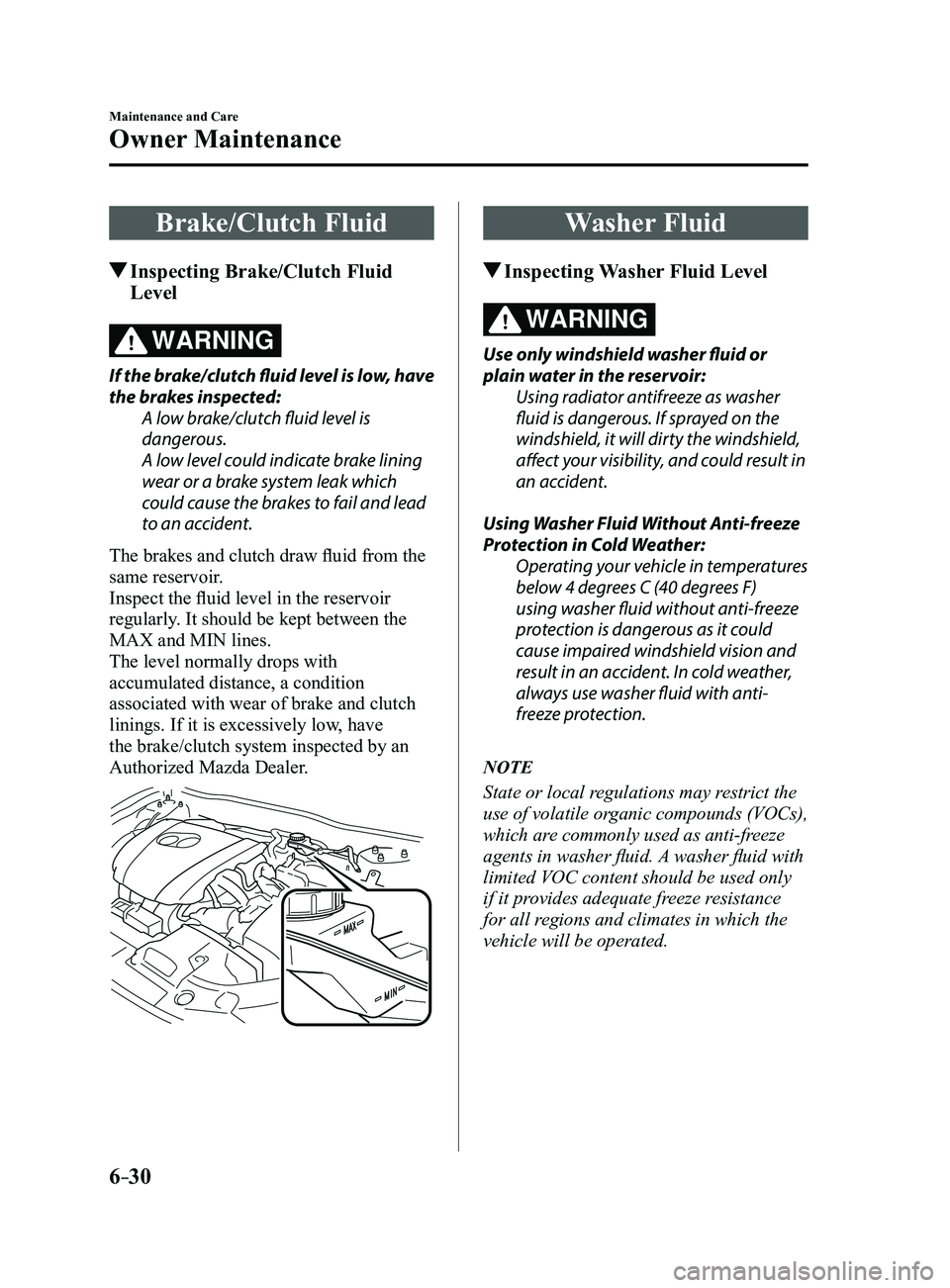
The brakes and clutch draw fluid from the
same reservoir.
Inspect the fluid level in the reservoir
regularly. It should be kept between the
MAX and MIN lines.
The level normally drops with
accumulated distance, a condition
associated with wear of brake and clutch
linings. If it is excessively low, have
the brake/clutch system inspected by an
Authorized Mazda Dealer.
Washer Fluid
Inspecting Washer Fluid Level
WARNING
Use only windshield washer fluid or
plain water in the reservoir: Using radiator antifreeze as washer
fluid is dangerous. If sprayed on the
windshield, it will dirty the windshield,
affect your visibility, and could result in
an accident.
Using Washer Fluid Without Anti-freeze
Protection in Cold Weather: Operating your vehicle in temperatures
below 4 degrees C (40 degrees F)
using washer fluid without anti-freeze
protection is dangerous as it could
cause impaired windshield vision and
result in an accident. In cold weather,
always use washer fluid with anti-
freeze protection.
NOTE
State or local regulations may restrict the
use of volatile organic compounds (VOCs),
which are commonly used as anti-freeze
agents in washer fluid. A washer fluid with
limited VOC content should be used only
if it provides adequate freeze resistance
for all regions and climates in which the
vehicle will be operated.
Mazda3_8FL6-EA-16F_Edition2.indb 302016/08/10 17:38:40
Page 508 of 612
7–20
If Trouble Arises
Overheating
Overheating
If the high engine coolant temperature
warning light turns on, the vehicle loses
power, or you hear a loud knocking or
pinging noise, the engine is probably too
hot.
WARNING
Pull over to a safe location, then
switch the ignition off and make sure
the fan is not running before attempting
to work near the cooling fan:Working near the cooling fan when it
is running is dangerous. The fan could
continue running indefinitely even if
the engine has stopped and the engine
compartment temperature is high. You
could be hit by the fan and seriously
injured.
Do not remove either cooling
system cap when the engine and
radiator are hot:When the engine and radiator are hot,
scalding coolant and steam may shoot
out under pressure and cause serious
injury.
Open the hood ONLY after steam is no
longer escaping from the engine: Steam from an overheated engine is
dangerous. The escaping steam could
seriously burn you.
If the high engine coolant temperature
warning light turns on:
1. Drive safely to the side of the road and
park off the right-of-way.
2. Put a vehicle with an automatic
transaxle in park (P), a manual
transaxle in neutral.
3. Apply the parking brake.
4. Turn off the air conditioner.
5. Check whether coolant or steam is
escaping from the engine compartment.
If steam is coming from the engine
compartment:
Do not go near the front of the vehicle.
Stop the engine.
Wait until the steam dissipates, then
open the hood and start the engine.
If neither coolant nor steam is
escaping:
Open the hood and idle the engine until
it cools.
CAUTION
If the cooling fan does not operate
while the engine is running, the engine
temperature will increase. Stop the
engine and call an Authorized Mazda
Dealer.
6. Make sure the cooling fan is operating,
then turn off the engine after the
temperature has decreased.
7. When cool, check the coolant level.
If it is low , look for coolant leaks from
the radiator and hoses.
Mazda3_8FL6-EA-16F_Edition2.indb 202016/08/10 17:39:18