i stop MAZDA MODEL 5 2012 Owners Manual
[x] Cancel search | Manufacturer: MAZDA, Model Year: 2012, Model line: MODEL 5, Model: MAZDA MODEL 5 2012Pages: 440, PDF Size: 5.51 MB
Page 14 of 440
Black plate (14,1)
Front Seats
WARNING
Do not modify or replace the front
seats:Modifying or replacing the front seats
such as replacing the upholstery or
loosening any bolts is dangerous. The
front seats contain air bag
components essential to the
supplemental restraint system. Such
modifications could damage the
supplemental restraint system and
result in serious injury. Consult an
Authorized Mazda Dealer if there is
any need to remove or reinstall the
front seats.
Do not drive with damaged front seats: Driving with damaged front seats is
dangerous. A collision, even one not
strong enough to inflate the air bags,
could damage the front seats which
contain essential air bag
components. If there was a
subsequent collision, an air bag may
not deploy which could lead to
injuries. Always have an Authorized
Mazda Dealer inspect the front seats,
front seat belt pretensioners and air
bags after a collision.
Make sure the adjustable components
of a seat are locked in place: Adjustable seats and seatbacks that
are not securely locked are
dangerous. In a sudden stop or
collision, the seat or seatback could
move, causing injury. Make sure the
adjustable components of the seat
are locked in place by attempting to
slide the seat forward and backward
and rocking the seatback. Adjust the driver's seat only when the
vehicle is stopped:
Adjusting the driver's seat while the
vehicle is moving is dangerous. The
driver could lose control of the vehicle
and have an accident.
CAUTION
Be careful not to place your hands
and fingers around moving parts of
the front seat when adjusting the
seat positions to prevent injury.
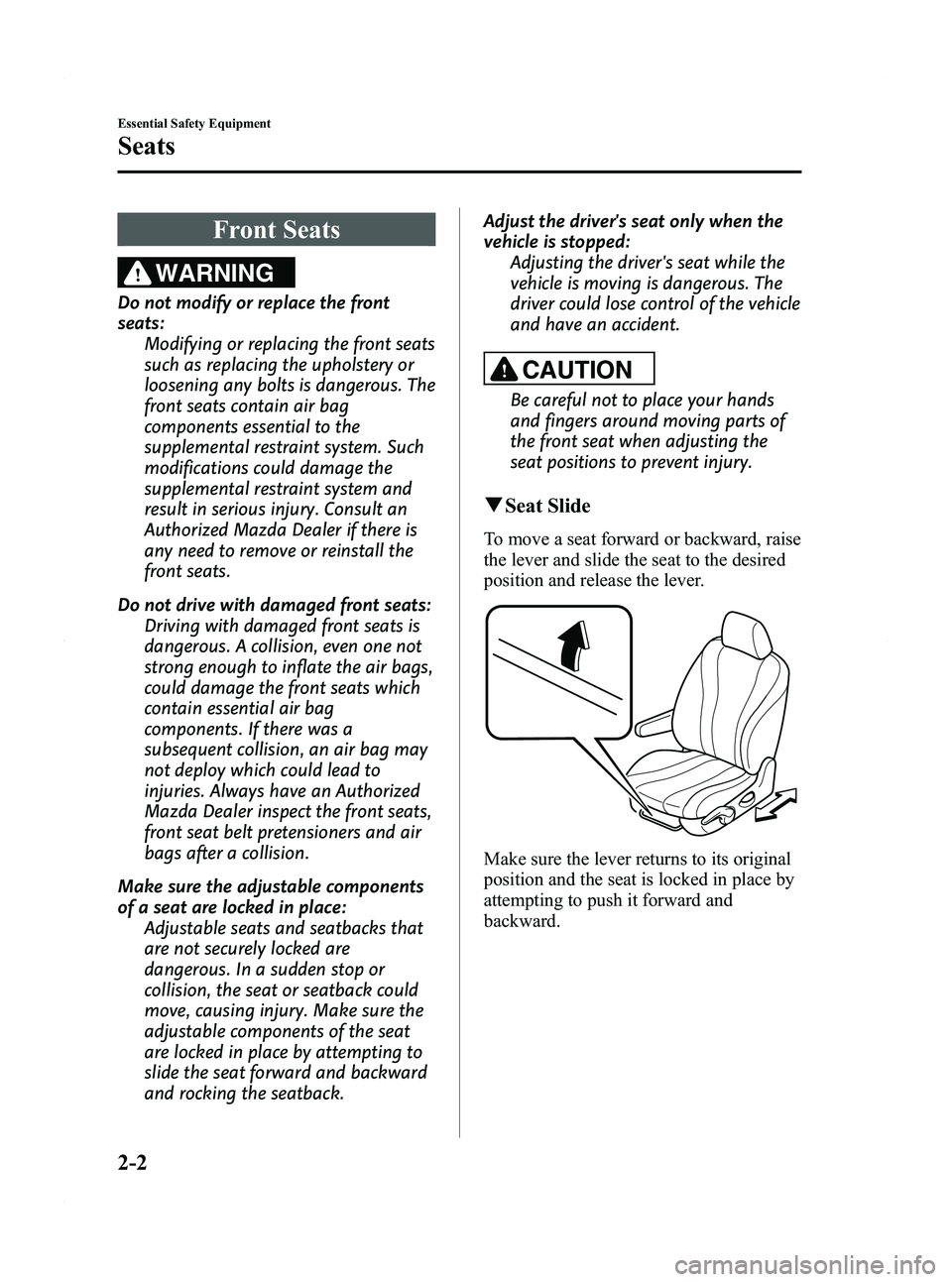
qSeat Slide
To move a seat forward or backward, raise
the lever and slide the seat to the desired
position and release the lever.
Make sure the lever returns to its original
position and the seat is locked in place by
attempting to push it forward and
backward.
2-2
Essential Safety Equipment
Seats
Mazda5_8BR9-EA-10J_Edition3 Page14
Monday, February 21 2011 1:43 PM
Form No.8BR9-EA-10J
Page 15 of 440

Black plate (15,1)
qSeat Recline
WARNING
Do not drive with either front seat
reclined:
Sitting in a reclined position while the
vehicle is moving is dangerous
because you do not get the full
protection from seat belts. During
sudden braking or a collision, you
can slide under the lap belt and
suffer serious internal injuries. For
maximum protection, sit well back
and upright.
Always sit in the front passenger seat
properly with the seatback upright and
feet on the floor (With Driver and Front
Passenger Occupant Classification
System): Your front passenger seat has weight
sensors, sitting in the front passenger
seat improperly out of position or
with the seatback reclined too far
while the vehicle is moving is
dangerous as it can take off weight
from the seat bottom and affect the
weight determination of the front
passenger sensing system. As a result
the front passenger will not have the
supplementary protection of the air
bag and seat belt pretensioner, which
could result in serious injury. Always
sit upright against the seatback with
your feet on the floor. Do not drive with the seatback
unlocked:
All of the seatbacks play an
important role in your protection in a
vehicle. Leaving the seatback
unlocked is dangerous as it can allow
passengers to be ejected or thrown
around and baggage to strike
occupants in a sudden stop or
collision, resulting in severe injury.
After adjusting the seatback at any
time, even when there are no other
passengers, rock the seatback to
make sure it is locked in place.
To change the seatback angle, lean
forward slightly while raising the lever.
Then lean back to the desired position and
release the lever.
Make sure the lever returns to its original
position and the seatback is locked in
place by attempting to push it forward and
backward.
Essential Safety Equipment
Seats
2-3
Mazda5_8BR9-EA-10J_Edition3 Page15
Monday, February 21 2011 1:44 PM
Form No.8BR9-EA-10J
Page 17 of 440
Black plate (17,1)
Second-Row Seats
WARNING
Do not stack cargo higher than the
seatbacks:Stacking luggage or other cargo
higher than the seatbacks is
dangerous. During a sudden stop or
collision, objects can fly around and
become projectiles that could hit and
injure passengers.
Make sure luggage and cargo are
secured before driving: Not securing cargo while driving is
dangerous as it could move or be
crushed during sudden braking or a
collision and cause injury.
Make sure the adjustable components
of a seat are locked in place by
attempting to slide the seat forward
and backward and rocking the
seatback: Adjustable seats that are not securely
latched are dangerous. In a sudden
stop or collision, the seat or seatback
could move, causing injury.
Adjust the seat only when the vehicle is
stopped: Adjusting the seat while the vehicle is
moving is dangerous. Sudden
braking or a collision could cause
serious injury. Do not drive with the seatback
unlocked:
All of the seatbacks play an
important role in your protection in a
vehicle. Leaving the seatback
unlocked is dangerous as it can allow
passengers to be ejected or thrown
around and baggage to strike
occupants in a sudden stop or
collision, resulting in severe injury.
After adjusting the seatback at any
time, even when there are no other
passengers, rock the seatback to
make sure it is locked in place.
Never allow a passenger to sit or stand
on the folded seatback while the
vehicle is moving: Driving with a passenger on the
folded seatback is dangerous.
Allowing a child to sit up on the
folded seatback while the vehicle is
moving is particularly dangerous. In
a sudden stop or even a minor
collision, a child not in a proper seat
or child-restraint system and seat
belt could be thrown forward, back
or even out of the vehicle resulting in
serious injuries or death. The child in
the baggage area could be thrown
into other occupants and cause
serious injury.
CAUTION
Be careful not to place your hands
and fingers around moving parts of
the second-row seat when adjusting
the seat positions to prevent injury.
NOTE
The second-row seats cannot be removed.
Essential Safety Equipment
Seats
2-5
Mazda5_8BR9-EA-10J_Edition3 Page17
Monday, February 21 2011 1:44 PM
Form No.8BR9-EA-10J
Page 22 of 440
Black plate (22,1)
Third-Row Seat
WARNING
Do not stack cargo higher than the
seatbacks:Stacking luggage or other cargo
higher than the seatbacks is
dangerous. During a sudden stop or
collision, objects can fly around and
become projectiles that could hit and
injure passengers.
Make sure luggage and cargo are
secured before driving: Not securing cargo while driving is
dangerous as it could move or be
crushed during sudden braking or a
collision and cause injury.
Do not drive with the seatback
unlocked: All of the seatbacks play an
important role in your protection in a
vehicle. Leaving the seatback
unlocked is dangerous as it can allow
passengers to be ejected or thrown
around and baggage to strike
occupants in a sudden stop or
collision, resulting in severe injury.
After returning the seatback at any
time, even when there are no other
passengers, rock the seatback to
make sure it is locked in place. Never allow a passenger to sit or stand
on the folded seatback while the
vehicle is moving:
Driving with a passenger on the
folded seatback is dangerous.
Allowing a child to sit up on the
folded seatback while the vehicle is
moving is particularly dangerous. In
a sudden stop or even a minor
collision, a child not in a proper seat
or child-restraint system and seat
belt could be thrown forward, back
or even out of the vehicle resulting in
serious injuries or death. The child in
the baggage area could be thrown
into other occupants and cause
serious injury.
NOTE
The third-row seat cannot be removed.
q Folding the Third-Row Seat
To create a flat luggage compartment
space, fold the seatbacks forward.
To fold third-row seat
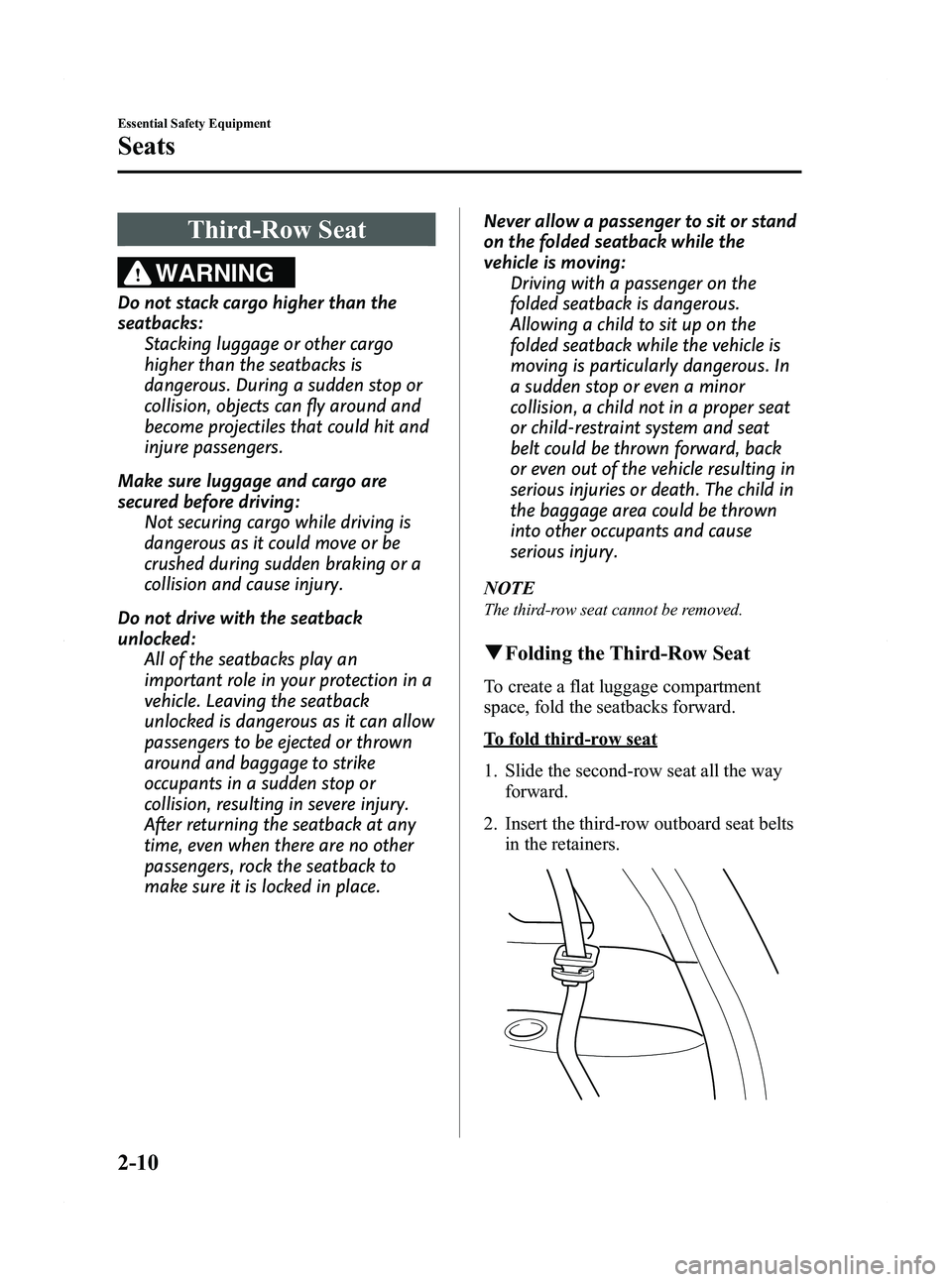
1. Slide the second-row seat all the way
forward.
2. Insert the third-row outboard seat belts in the retainers.
2-10
Essential Safety Equipment
Seats
Mazda5_8BR9-EA-10J_Edition3 Page22
Monday, February 21 2011 1:44 PM
Form No.8BR9-EA-10J
Page 24 of 440
Black plate (24,1)
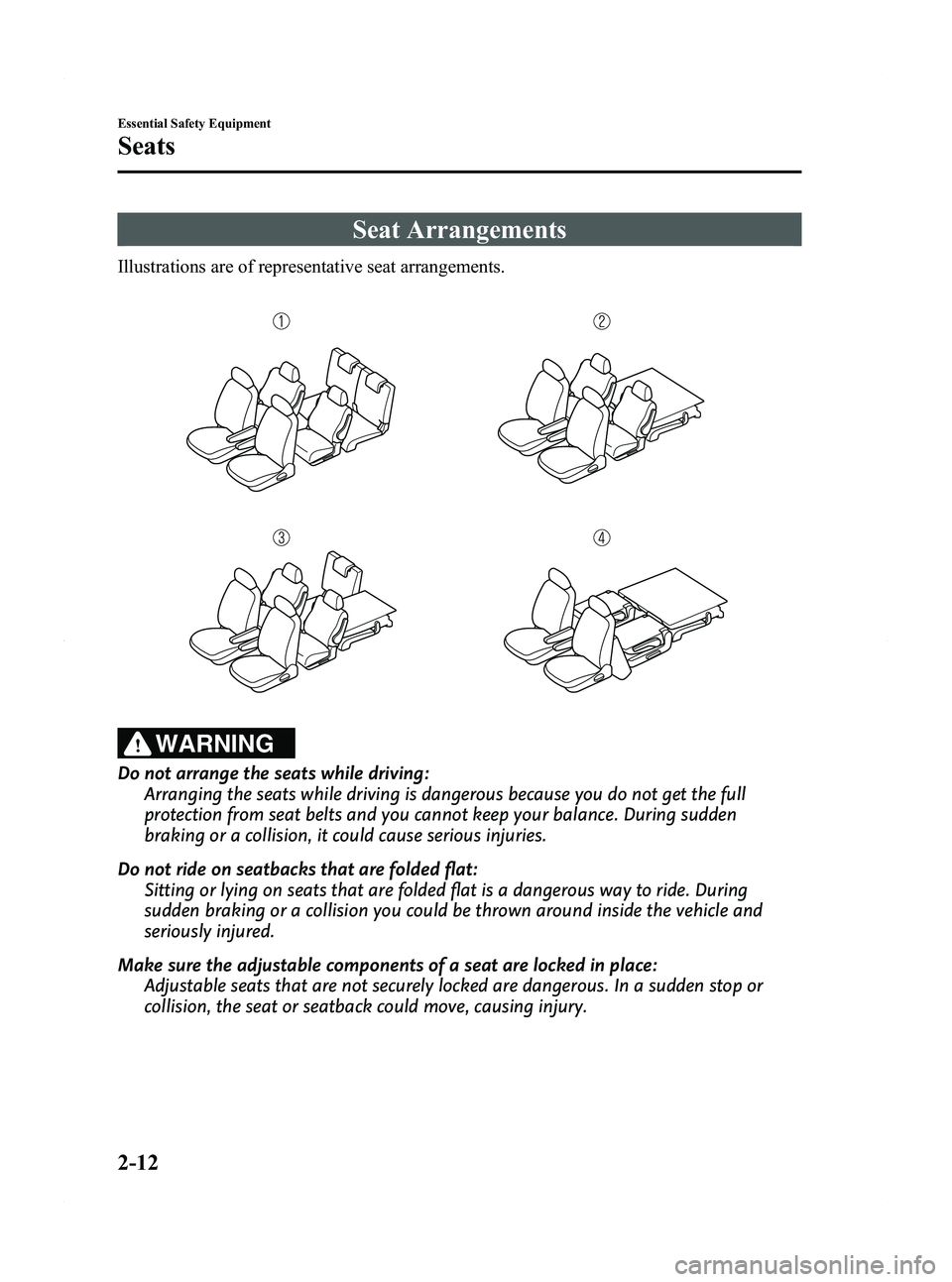
Seat Arrangements
Illustrations are of representative seat arrangements.
WARNING
Do not arrange the seats while driving:Arranging the seats while driving is dangerous because you do not get the full
protection from seat belts and you cannot keep your balance. During sudden
braking or a collision, it could cause serious injuries.
Do not ride on seatbacks that are folded flat: Sitting or lying on seats that are folded flat is a dangerous way to ride. During
sudden braking or a collision you could be thrown around inside the vehicle and
seriously injured.
Make sure the adjustable components of a seat are locked in place: Adjustable seats that are not securely locked are dangerous. In a sudden stop or
collision, the seat or seatback could move, causing injury.
2-12
Essential Safety Equipment
Seats
Mazda5_8BR9-EA-10J_Edition3 Page24
Monday, February 21 2011 1:44 PM
Form No.8BR9-EA-10J
Page 26 of 440
Black plate (26,1)
2. Fold the second-row seats.Refer toFolding the Second-Row Seats on page
2-8.
To return the seats to their road positions,
reverse the procedures above.Head Restraints
Your vehicle is equipped with head
restraints on all outboard seats. The head
restraints are intended to help protect you
and the passengers from neck injury.
WARNING
Always drive with the head restraints
installed when seats are being used
and make sure they are properly
adjusted. In addition, always raise the
head restraints on all second-row and
third-row seats when they are being
used: Driving with the head restraints
adjusted too low or removed is
dangerous. With no support behind
your head, your neck could be
seriously injured in a collision.
Height adjustment
To raise a head restraint, pull it up to the
desired position.
To lower the head restraint, press the stop-
catch release, then push the head restraint
down.
Adjust the head restraint so that the top is
even with the top of the passenger's ears,
never the passenger's neck to prevent
injury.
NOTE
The second-row outboard head restraints are
non-adjustable.
2-14
Essential Safety Equipment
Seats
Mazda5_8BR9-EA-10J_Edition3 Page26
Monday, February 21 2011 1:44 PM
Form No.8BR9-EA-10J
Page 27 of 440
Black plate (27,1)
Front outboard seat
Third-Row outboard seat
Removal/Installation
To remove the head restraint, pull it up
while pressing the stop-catch.
To install the head restraint, press the
uprights into the holes while pressing the
stop-catch.
WARNING
Always drive with the head restraints
set up when seats are being used and
make sure they are properly set up:Driving with the head restraints not
set up is dangerous. With no support
behind your head, your neck could be
seriously injured in a collision.
Folding down/up
The second-row seats are equipped with
foldable head restraints.
To fold the head restraint, pull the strap
and fold the head restraint downward. To
return the head restraint to its upright
position, lift it upward.
WARNING
Always drive with the head restraints in
their upright positions when the
second-row seats are occupied, and
make sure they are securely locked in
place:
Driving with the head restraints
folded down is dangerous. With no
support behind your head, your neck
could be seriously injured in a
collision.
Essential Safety Equipment
Seats
2-15
Mazda5_8BR9-EA-10J_Edition3 Page27
Monday, February 21 2011 1:44 PM
Form No.8BR9-EA-10J
Page 30 of 440
Black plate (30,1)
Seat Belt Precautions
Seat belts help to decrease the possibility of severe injury during accidents and sudden
stops. Mazda recommends that the driver and all passengers always wear seat belts.
Your vehicle has the following types of seat belts.
With Driver and Front Passenger Occupant Classification System model
Seating PositionTypes of seat belt
Front seat Driver side 3-point type seat belt with emergency locking mode retractor
Passenger side 3-point type seat belt with emergency locking mode
retractor/automatic locking mode retractor
Second-row seat
Third-row seat
Except above
Seating Position Types of seat belt
Front seat Driver side
3-point type seat belt with emergency looking mode retractor
Passenger side
Second-row seat 3-point type seat belt with emergency looking mode
retractor/automatic locking mode retractor
Third-row seat
3-point type seat belt with emergency locking mode retractor
This belt has retractors with an inertia lock that keep the belt retracted when not in use.
The lock allows the belt to remain comfortable on the user, but it will lock in position
during a collision.
Refer to Emergency Locking Mode on page 2-20.
3-point type seat belt with emergency locking mode retractor/automatic locking mode
retractor
In addition to the emergency locking mode function, this belt has retractors that operate in
another mode, the automatic locking mode, for the child-restraint system.
Refer to Automatic Locking Mode on page 2-21.
Refer to Installing Child-Restraint Systems on page 2-36.
We recommend you put all children in the rear seats, if you must use the front passenger
seat for a child, slide the front passenger seat as far back as possible and make sure any
child-restraint system is secured properly.
2-18
Essential Safety Equipment
Seat Belt Systems
Mazda5_8BR9-EA-10J_Edition3 Page30
Monday, February 21 2011 1:44 PM
Form No.8BR9-EA-10J
Page 32 of 440
Black plate (32,1)
CAUTION
Belt retraction may become difficult if the belts and rings are soiled, so try to keep
them clean. For more details about cleaning the seat belts, refer to“Cleaning the
Lap/Shoulder Belt Webbing ”(page 8-60).
q Pregnant Women and Persons with Serious Medical Conditions
Pregnant women should always wear seat belts. Ask your doctor for specific
recommendations.
The lap belt should be worn SNUGLY AND AS LOW AS POSSIBLE OVER THE HIPS.
The shoulder belt should be worn across your shoulder properly, but never across the
stomach area.
Persons with serious medical conditions also should wear seat belts. Check with your
doctor for any special instructions regarding specific medical conditions.
qEmergency Locking Mode
In the emergency locking mode, the belt remains comfortable on the occupant and the
retractor will lock in position during a collision. When the seat belt is fastened, it will
always be in the emergency locking mode until it is switched to automatic locking mode by
pulling it all the way out to its full length. If the belt feels tight and hinders comfortable
movement while the vehicle is stopped or in motion, it may be in the automatic locking
mode because the belt has been pulled too far out. To return the belt to the more
comfortable emergency locking mode, wait until the vehicle has stopped in a safe, level
area, retract the belt fully to convert it back to emergency locking mode and then extend it
around you again.
If the belt is locked and cannot be pulled out, retract the belt once, and then try pulling it
out slowly. If this fails, pull the belt strongly one time and loosen, then pull it out again
slowly.
2-20
Essential Safety Equipment
Seat Belt Systems
Mazda5_8BR9-EA-10J_Edition3 Page32
Monday, February 21 2011 1:44 PM
Form No.8BR9-EA-10J
Page 41 of 440
Black plate (41,1)
Seat Belt Reminder
NOTE
Consult an Authorized Mazda Dealer to
deactivate or restore the belt reminder. Though
the belt reminder can be deactivated, doing so
will defeat the purpose of the system to warn
the driver and the front passenger in the event
that their seat belts are not fastened. For the
safety of the driver and front passenger, Mazda
recommends not deactivating the belt
reminder.
If the vehicle is driven with the driver or
front passenger's seat belt unfastened, the
seat belt warning light illuminates and a
warning chime sounds.
NOTE
Some models do not have the seat belt
reminder function for the front passenger's
seat.
If the driver or front passenger's seat belt
is unfastened (only when the front
passenger seat is occupied) and the
vehicle is driven at a speed faster than
about 20 km/h (12 mph), the warning
light will flash and a beep sound will be
heard. After a short time, the warning
light stops flashing, but remains
illuminated, and the beep sound stops.
Until a seat belt is fastened or a given
period of time has elapsed, the beep sound
will not stop even if the vehicle speed
falls below 20 km/h (12 mph).NOTE
lThe warning light flashes and a beep sound
will be heard for about 6 seconds if the
driver's seat belt is not fastened when the
ignition is switched ON.
lPlacing heavy items on the front passenger
seat may cause the front passenger seat belt
warning function to operate depending on
the weight of the item.
lTo allow the front passenger seat weight
sensor to function properly, do not place
and sit on an additional seat cushion on the
front passenger seat. The sensor may not
function properly because the additional
seat cushion could cause sensor
interference.
lWhen a small child sits on the front
passenger seat, it is possible that the
warning light will not operate.
Essential Safety Equipment
Seat Belt Systems
2-29
Mazda5_8BR9-EA-10J_Edition3 Page41
Monday, February 21 2011 1:44 PM
Form No.8BR9-EA-10J