brakes MAZDA MODEL 6 2009 (in English) Owner's Manual
[x] Cancel search | Manufacturer: MAZDA, Model Year: 2009, Model line: MODEL 6, Model: MAZDA MODEL 6 2009Pages: 464, PDF Size: 4.61 MB
Page 364 of 464

Black plate (364,1)
CAUTION
ØRadiator coolant will damage
paint.
Rinse it off quickly if spilled.
Ø Use only soft (demineralized)
water in the coolant mixture.
Water that contains minerals will
cut down on the coolant's
effectiveness.
Ø Don't add only water. Always add
a proper coolant mixture.
Ø The engine has aluminum parts
and must be protected by an
ethylene-glycol-based coolant to
prevent corrosion and freezing.
Ø DO NOT USE coolants Containing
Alcohol, methanol, Borate or
Silicate.
These coolants could damage the
cooling system.
Ø DO NOT MIX alcohol or methanol
with the coolant. This could
damage the cooling system.
Ø Don't use a solution that contains
more than 60% antifreeze.
This would reduce effectiveness.
If the coolant reservoir is empty or new
coolant is required frequently, consult an
Authorized Mazda Dealer.
Brake/Clutch Fluid
qInspecting Brake/Clutch Fluid Level
The brakes and clutch draw fluid from the
same reservoir.
Inspect the fluid level in the reservoir
regularly. It should be kept at MAX.
The level normally drops with
accumulated distance, a condition
associated with wear of brake and clutch
linings. If it is excessively low, have the
brake/clutch system inspected by an
Authorized Mazda Dealer.
2.5-liter engine
3.7-liter engine
8-22
Maintenance and Care
Owner Maintenance
Mazda6_8Z64-EA-08H_Edition1 Page364
Wednesday, June 25 2008 10:5 AM
Form No.8Z64-EA-08H
Page 365 of 464

Black plate (365,1)
qAdding Brake/Clutch Fluid
WARNING
Be careful not to spill brake fluid on
yourself or on the engine:
Spilled brake fluid is dangerous. If it
gets in your eyes, they could be
seriously injured. If this happens,
immediately flush your eyes with
water and get medical attention.
Brake fluid spilled on a hot engine
could cause a fire.
If the brake/clutch fluid level is low,
have the brakes and clutch inspected: Low brake/clutch fluid levels are
dangerous. Low levels could signal
brake lining wear or a brake system
leak. Your brakes could fail and
cause an accident.
If the fluid level is low, add fluid until it
reaches MAX.
Before adding fluid, thoroughly clean the
area around the cap.
CAUTION
Ø Brake and clutch fluid will
damage painted surfaces. If brake
or clutch fluid does get on a
painted surface, wash it off with
water immediately.
Ø Using nonspecified brake and
clutch fluids (page 10-4) will
damage the systems. Mixing
different fluids will also damage
them.
If the brake/clutch system
frequently requires new fluid,
consult an Authorized Mazda
Dealer.
Power Steering Fluid
qInspecting Power Steering Fluid
Level
CAUTION
To avoid damage to the power
steering pump, don't operate the
vehicle for long periods when the
power steering fluid level is low.
NOTE
Use specified power steering fluid (page 10-4).
Inspect the fluid level in the reservoir at
each engine oil change with the engine off
and cold. Add fluid if necessary; it does
not require periodic changing.
2.5-liter engine
3.7-liter engine
Maintenance and Care
Owner Maintenance
8-23
Mazda6_8Z64-EA-08H_Edition1 Page365
Wednesday, June 25 2008 10:5 AM
Form No.8Z64-EA-08H
Page 397 of 464

Black plate (397,1)
Pay special attention to removing salt,
dirt, mud, and other foreign material from
the underside of the fenders, and make
sure the drain holes in the lower edges of
the doors and rocker panels are clean.
Insects, tar, tree sap, bird droppings,
industrial fallout, and similar deposits can
damage the finish if not removed
immediately. When prompt washing with
plain water is ineffective, use a mild soap
made for use on vehicles.
Thoroughly rinse off all soap with
lukewarm or cold water. Don't allow soap
to dry on the finish.
After washing the vehicle, dry it with a
clean chamois to prevent water spots from
forming.
WARNING
Dry wet brakes by driving very slowly
and applying the brakes lightly until
brake performance is normal:Driving with wet brakes is
dangerous. Increased stopping
distance or the vehicle pulling to one
side when braking could result in a
serious accident. Light braking will
indicate whether the brakes have
been affected.
Waxing
Your vehicle needs to be waxed when
water no longer beads on the finish.
Always wash and dry the vehicle before
waxing it. In addition to the vehicle body,
wax the metal trim to maintain its luster.
1. Use wax which contains no abrasives.Waxes containing abrasive will remove
paint and could damage bright metal
parts. 2. Use a good grade of natural wax for
metallic, mica, and solid colors.
3. When waxing, coat evenly with the sponge supplied or a soft cloth.
4. Wipe off the wax with a soft cloth.
NOTE
A spot remover to remove oil, tar, and similar
materials will usually also take off the wax.
Rewax these areas even if the rest of the
vehicle doesn't need it.
q Repairing Damage to the Finish
Deep scratches or chips on the finish
should be repaired promptly. Exposed
metal quickly rusts and can lead to major
repairs.
CAUTION
If your Mazda is damaged and needs
metal parts repaired or replaced,
make sure the body shop applies
anti-corrosion materials to all parts,
both repaired and new. This will
prevent them from rusting.
qBright-Metal Maintenance
lUse tar remover to remove road tar and
insects. Never do this with a knife or
similar tool.
lTo prevent corrosion on bright-metal
surfaces, apply wax or chrome
preservative and rub it to a high luster.
lDuring cold weather or in coastal areas,
cover bright-metal parts with a coating
of wax or preservative heavier than
usual. It would also help to coat them
with noncorrosive petroleum jelly or
some other protective compound.
Maintenance and Care
Appearance Care
8-55
Mazda6_8Z64-EA-08H_Edition1 Page397
Wednesday, June 25 2008 10:5 AM
Form No.8Z64-EA-08H
Page 398 of 464

Black plate (398,1)
CAUTION
Don't use steel wool, abrasive
cleaners, or strong detergents
containing highly alkaline or caustic
agents on chrome-plated or anodized
aluminum parts. This may result in
damage to the protective coating and
cause discoloration or paint
deterioration.
qUnderbody Maintenance
Road chemicals and salt used for ice and
snow removal and solvents used for dust
control may collect on the underbody. If
not removed, they will speed up rusting
and deterioration of such underbody parts
as fuel lines, frame, floor pan, and exhaust
system, even though these parts may be
coated with anti-corrosive material.
Thoroughly flush the underbody and
wheel housings with lukewarm or cold
water at the end of each winter. Try also
to do this every month.
Pay special attention to these areas
because they easily hide mud and dirt. It
will do more harm than good to wet
down the road grime without removing
it.
The lower edges of doors, rocker panels,
and frame members have drain holes that
should not be clogged. Water trapped
there will cause rusting.
WARNING
Dry wet brakes by driving very slowly
and applying the brakes lightly until
brake performance is normal: Driving with wet brakes is
dangerous. Increased stopping
distance or the vehicle pulling to one
side when braking could result in a
serious accident. Light braking will
indicate whether the brakes have
been affected.
qAluminum Wheel Maintenanceí
A protective coating is provided over the
aluminum wheels. Special care is needed
to protect this coating.
NOTE
lDo not use a wire brush or any abrasive
cleaner, polishing compound, or solvent on
aluminum wheels. They may damage the
coating.
lOnly use a mild soap or neutral detergent
and always use a sponge or soft cloth to
clean the wheels.
Rinse thoroughly with lukewarm or cold
water. Also, be sure to clean the wheels
after driving on dusty or salted roads. This
helps prevent corrosion.
lAvoid washing your vehicle in an automatic
car wash that uses high-speed or hard
brushes.
lIf your aluminum wheels lose luster, wax
the wheels.
(With Tire Pressure Monitoring System)
Check special requirements for Tire Pressure
Monitoring System.
Refer to Tires and Wheels on page 5-31.
8-56
Maintenance and Care
íSome models.
Appearance Care
Mazda6_8Z64-EA-08H_Edition1 Page398
Wednesday, June 25 2008 10:5 AM
Form No.8Z64-EA-08H
Page 432 of 464
Black plate (432,1)
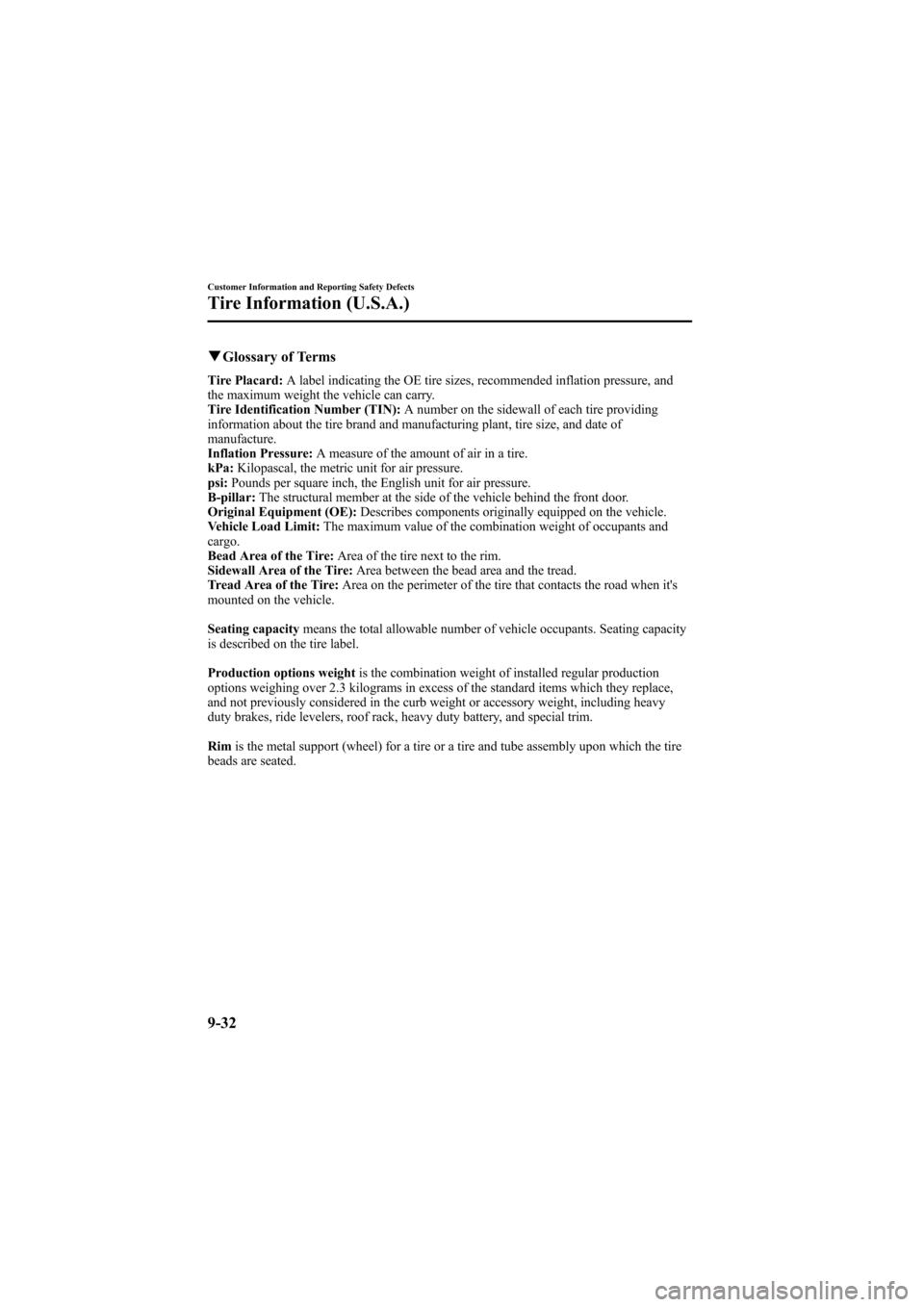
qGlossary of Terms
Tire Placard: A label indicating the OE tire sizes, recommended inflation pressure, and
the maximum weight the vehicle can carry.
Tire Identification Number (TIN): A number on the sidewall of each tire providing
information about the tire brand and manufacturing plant, tire size, and date of
manufacture.
Inflation Pressure: A measure of the amount of air in a tire.
kPa: Kilopascal, the metric unit for air pressure.
psi: Pounds per square inch, the English unit for air pressure.
B-pillar: The structural member at the side of the vehicle behind the front door.
Original Equipment (OE): Describes components originally equipped on the vehicle.
Vehicle Load Limit: The maximum value of the combination weight of occupants and
cargo.
Bead Area of the Tire: Area of the tire next to the rim.
Sidewall Area of the Tire: Area between the bead area and the tread.
Tread Area of the Tire: Area on the perimeter of the tire that contacts the road when it's
mounted on the vehicle.
Seating capacity means the total allowable number of vehicle occupants. Seating capacity
is described on the tire label.
Production options weight is the combination weight of installed regular production
options weighing over 2.3 kilograms in excess of the standard items which they replace,
and not previously considered in the curb weight or accessory weight, including heavy
duty brakes, ride levelers, roof rack, heavy duty battery, and special trim.
Rim is the metal support (wheel) for a tire or a tire and tube assembly upon which the tire
beads are seated.
9-32
Customer Information and Reporting Safety Defects
Tire Information (U.S.A.)
Mazda6_8Z64-EA-08H_Edition1 Page432
Wednesday, June 25 2008 10:6 AM
Form No.8Z64-EA-08H
Page 436 of 464

Black plate (436,1)
Vehicle Loading
WARNING
Do not tow a trailer with this vehicle:Towing a trailer with this vehicle is dangerous because it has not been designed to
tow a trailer and doing so will affect the drive system which could result in vehicle
damage.
This section will guide you in the proper loading of your vehicle, to keep your loaded
vehicle weight within its design rating capability. Properly loading your vehicle will
provide maximum return of vehicle design performance. Before loading your vehicle,
familiarize yourself with the following terms for determining your vehicle's weight ratings,
from the vehicle's Safety Certification Label and Tire and Load Information Label:
WARNING
Overloaded Vehicle: Overloading a vehicle is dangerous. The results of overloading can have serious
consequences in terms of passenger safety. Too much weight on a vehicle's
suspension system can cause spring or shock absorber failure, brake failure,
handling or steering problems, irregular tire wear, tire failure or other damage.
Overloading makes a vehicle harder to drive and control. It also increases the
distance required for stopping. In cases of serious overloading, brakes can fail
completely, particularly on steep grades. The load a tire will carry safely is a
combination of the size of the tire, its load range, and corresponding inflation
pressure.
Never overload the vehicle and always observe the vehicle's weight ratings from the
vehicle's Safety Certification and Tire and Load Information labels.
9-36
Customer Information and Reporting Safety Defects
Tire Information (U.S.A.)
Mazda6_8Z64-EA-08H_Edition1 Page436
Wednesday, June 25 2008 10:6 AM
Form No.8Z64-EA-08H
Page 459 of 464

Black plate (459,1)
B
BrakesAnti-lock brake system (ABS) ..... 5-7
Brakes assist ................................. 5-9
Foot brake .................................... 5-5
Pad wear indicator ........................ 5-9
Parking brake ............................... 5-6
Warning light ............................... 5-7
Break-In Period ................................... 4-6
Bulb Replacement ............................. 8-37
C
Capacities .......................................... 10-5
Carbon Monoxide ............................... 4-4
Catalytic Converter ............................. 4-3
Cell Phones ....................................... 9-19
Center Console ................................ 6-103
Child Restraint Child restraint precautions ......... 2-27
Installing child-restraint
systems ....................................... 2-31
LATCH child-restraint
systems ....................................... 2-37
Child Safety Locks for Rear Doors ... 3-32
Climate Control System ...................... 6-2 Gas specifications ...................... 10-6
Clock ................................................. 6-97
Courtesy Lights ................................. 6-95
Cruise Control ................................... 5-19
Cup Holder ...................................... 6-100
Customer Assistance ........................... 9-2
D
Dashboard Illumination .................... 5-41
Daytime Running Lights ................... 5-62
D
Defroster Mirror ......................................... 5-69
Rear window .............................. 5-68
Dimensions ....................................... 10-5
Door Locks ....................................... 3-29
Driving In Flooded Area ..................... 4-9
Driving on Uneven Road .................. 4-11
Driving Tips ........................................ 4-6 Automatic transaxle ................... 5-18
Break-in period ............................ 4-6
Driving in flooded area ................ 4-9
Driving on uneven road .............. 4-11
Hazardous driving ........................ 4-7
Money-saving suggestions ........... 4-6
Rocking the vehicle ...................... 4-8
Winter driving .............................. 4-8
Dynamic Stability Control (DSC) ..... 5-25 DSC OFF indicator light ............ 5-26
DSC OFF switch ........................ 5-26
TCS/DSC indicator light ............ 5-25
E
Emergency Starting ........................... 7-13Flooded engine ........................... 7-13
Jump-starting .............................. 7-14
Push-starting .............................. 7-16
Emergency Towing ........................... 7-17
Emission Control System .................... 4-3
Engine Coolant ....................................... 8-21
Exhaust gas .................................. 4-4
Hood release .............................. 3-46
Oil .............................................. 8-19
Overheating ................................ 7-11
Starting ......................................... 5-4
Engine Compartment Overview ........ 8-18
Index
11-3
Mazda6_8Z64-EA-08H_Edition1 Page459
Wednesday, June 25 2008 10:6 AM
Form No.8Z64-EA-08H