weight MAZDA MODEL 6 2009 (in English) Owner's Manual
[x] Cancel search | Manufacturer: MAZDA, Model Year: 2009, Model line: MODEL 6, Model: MAZDA MODEL 6 2009Pages: 464, PDF Size: 4.61 MB
Page 142 of 464

Black plate (142,1)
Overloading
WARNING
Be careful not to overload your vehicle:The gross axle weight rating (GAWR)
and the gross vehicle weight rating
(GVWR) of your vehicle are on the
Motor Vehicle Safety Standard Label
on the driver's door frame. Exceeding
these ratings can cause an accident
or vehicle damage. You can estimate
the weight of your load by weighing
the items (or people) before putting
them in the vehicle.
4-10
Before Driving Your Mazda
Driving Tips
Mazda6_8Z64-EA-08H_Edition1 Page142
Wednesday, June 25 2008 10:3 AM
Form No.8Z64-EA-08H
Page 162 of 464
Black plate (162,1)
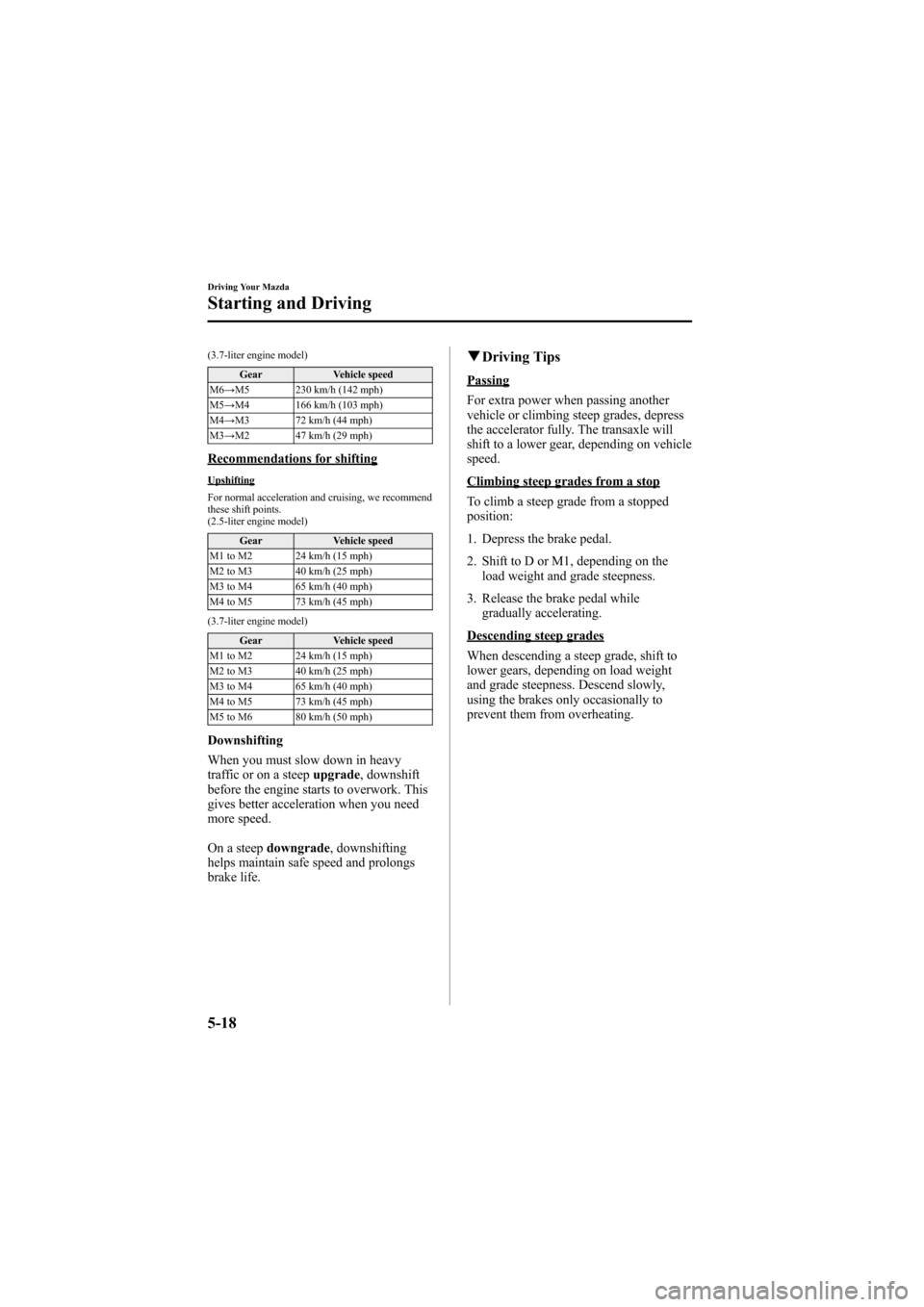
(3.7-liter engine model)Gear Vehicle speed
M6 →M5 230 km/h (142 mph)
M5 →M4 166 km/h (103 mph)
M4 →M3 72 km/h (44 mph)
M3 →M2 47 km/h (29 mph)
Recommendations for shifting
Upshifting
For normal acceleration and cruising, we recommend
these shift points.
(2.5-liter engine model)
Gear Vehicle speed
M1 to M2 24 km/h (15 mph)
M2 to M3 40 km/h (25 mph)
M3 to M4 65 km/h (40 mph)
M4 to M5 73 km/h (45 mph)
(3.7-liter engine model) Gear Vehicle speed
M1 to M2 24 km/h (15 mph)
M2 to M3 40 km/h (25 mph)
M3 to M4 65 km/h (40 mph)
M4 to M5 73 km/h (45 mph)
M5 to M6 80 km/h (50 mph)
Downshifting
When you must slow down in heavy
traffic or on a steep upgrade, downshift
before the engine starts to overwork. This
gives better acceleration when you need
more speed.
On a steep downgrade , downshifting
helps maintain safe speed and prolongs
brake life.
q Driving Tips
Passing
For extra power when passing another
vehicle or climbing steep grades, depress
the accelerator fully. The transaxle will
shift to a lower gear, depending on vehicle
speed.
Climbing steep grades from a stop
To climb a steep grade from a stopped
position:
1. Depress the brake pedal.
2. Shift to D or M1, depending on the
load weight and grade steepness.
3. Release the brake pedal while gradually accelerating.
Descending steep grades
When descending a steep grade, shift to
lower gears, depending on load weight
and grade steepness. Descend slowly,
using the brakes only occasionally to
prevent them from overheating.
5-18
Driving Your Mazda
Starting and Driving
Mazda6_8Z64-EA-08H_Edition1 Page162
Wednesday, June 25 2008 10:4 AM
Form No.8Z64-EA-08H
Page 194 of 464

Black plate (194,1)
Driver seated/Front passenger not
seated
The belt minder is a supplemental
warning to the seat belt warning function.
If the driver's seat belt is not fastened
when the ignition is switched ON, the
warning light/beep operates to give you
further reminders according to the chart
below.
ConditionVehicle speed
Between 0 ―20
km/h
(0 ― 12 mph) 20 km/h
(12 mph) or more
Seat belt
Indicator
Beep
: Fastened: Unfastened: Illuminated: Flashing: Beep
Once the beep sound is heard, it continues
sounding even if the vehicle speed lowers
to 20 km/h (12 mph) or less until the
seatbelt is fastened or the beep sound
period has passed. Driver seated/Front passenger seated
The seat belt warning function reminds
the front passenger to fasten the seat belt
according to the chart below.
Condition
Vehicle speed
Between 0 ―20
km/h
(0 ― 12 mph) 20 km/h
(12 mph) or more
Seat belt
(Driver)
Seat belt
(Passenger)
Indicator
Beep
: Fastened: Unfastened: Illuminated: Flashing: Beep
Placing heavy items on the front
passenger seat may cause the front
passenger seat belt warning function to
operate depending on the weight of the
item.
Once the beep sound is heard, it continues
sounding even if the vehicle speed lowers
to 20 km/h (12 mph) or less until the
seatbelt is fastened or the beep sound
period has passed.
NOTE
lTo allow the front passenger seat weight
sensor to function properly, do not place
and sit on an additional seat cushion on the
front passenger seat. The sensor may not
function properly because the additional
seat cushion could cause sensor
interference.
lWhen a small child sits on the front
passenger seat, it is possible that neither
the warning light nor the warning beep
operate.
5-50
Driving Your Mazda
Warning/Indicator Lights and Beep Sounds
Mazda6_8Z64-EA-08H_Edition1 Page194
Wednesday, June 25 2008 10:4 AM
Form No.8Z64-EA-08H
Page 206 of 464

Black plate (206,1)
qHeadlight High-Low Beam
Push the lever forward for high beam.
Pull back to original position for low
beam.
High beam
Low beam
q Flashing the Headlights
To flash the headlights, pull the lever fully
toward you. The headlight switch does
not need to be on, and the lever will return
to the normal position when released.
qHeadlight Levelingí
The number of passengers and weight of
cargo in the luggage compartment change
the angle of the headlights.
The headlight leveling switch adjusts this
angle.
Select the proper setting from the following chart.
Front seat Rear
seat LoadSwitch
Position
Driver Passenger
× ――― 0
×× ――0
××× ―1
××××2
× ―― ×3
×: Yes
― :No
qDaytime Running Lights (Canada)
In Canada, vehicles must be driven with
the headlights on during daytime
operation.
For that reason, the daytime running lights
automatically turn on when the ignition is
switched ON.
NOTE
The Daytime Running Lights turn off when the
parking brake is applied.
5-62
Driving Your Mazda
íSome models.
Switches and Controls
Mazda6_8Z64-EA-08H_Edition1 Page206
Wednesday, June 25 2008 10:4 AM
Form No.8Z64-EA-08H
Page 322 of 464

Black plate (322,1)
When storing the armrest, press and hold
the button while pulling the armrest back,
and remove your hand once it is in its
stored position.
qShopping Bag Hook
The shopping bag hook can be used for
hanging shopping bags.
CAUTION
Do not hang excessive weight on the
shopping bag hook as it could be
damaged.
Shopping bag hook
(tensile strength: 5.0
kg (11 lb))
qRear Coat Hooks
WARNING
Never hang heavy or sharp objects on
the assist grips and coat hooks:
Hanging heavy or sharp-ended
objects such as a coat hanger from
the assist grips or coat hooks is
dangerous as they can fly off and hit
an occupant in the cabin if a curtain
air bag was to deploy, which could
result in serious injury or death.
Always hang clothes on the coat hooks
and the assist grips without hangers.
Coat hook
6-104
Interior Comfort
Interior Equipment
Mazda6_8Z64-EA-08H_Edition1 Page322
Wednesday, June 25 2008 10:5 AM
Form No.8Z64-EA-08H
Page 374 of 464
Black plate (374,1)
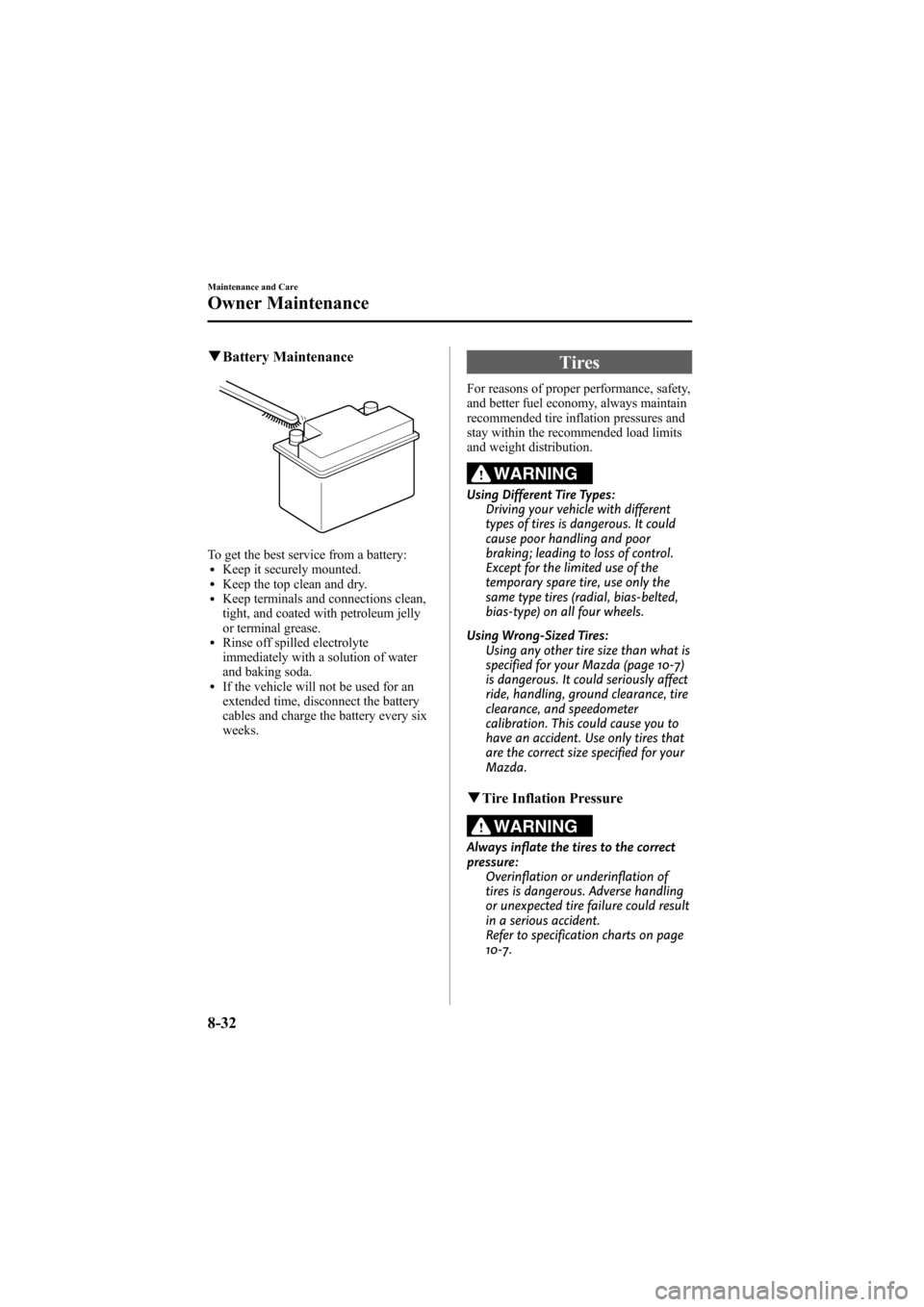
qBattery Maintenance
To get the best service from a battery:lKeep it securely mounted.lKeep the top clean and dry.lKeep terminals and connections clean,
tight, and coated with petroleum jelly
or terminal grease.
lRinse off spilled electrolyte
immediately with a solution of water
and baking soda.
lIf the vehicle will not be used for an
extended time, disconnect the battery
cables and charge the battery every six
weeks.
Tires
For reasons of proper performance, safety,
and better fuel economy, always maintain
recommended tire inflation pressures and
stay within the recommended load limits
and weight distribution.
WARNING
Using Different Tire Types:
Driving your vehicle with different
types of tires is dangerous. It could
cause poor handling and poor
braking; leading to loss of control.
Except for the limited use of the
temporary spare tire, use only the
same type tires (radial, bias-belted,
bias-type) on all four wheels.
Using Wrong-Sized Tires: Using any other tire size than what is
specified for your Mazda (page 10-7)
is dangerous. It could seriously affect
ride, handling, ground clearance, tire
clearance, and speedometer
calibration. This could cause you to
have an accident. Use only tires that
are the correct size specified for your
Mazda.
qTire Inflation Pressure
WARNING
Always inflate the tires to the correct
pressure:
Overinflation or underinflation of
tires is dangerous. Adverse handling
or unexpected tire failure could result
in a serious accident.
Refer to specification charts on page
10-7.
8-32
Maintenance and Care
Owner Maintenance
Mazda6_8Z64-EA-08H_Edition1 Page374
Wednesday, June 25 2008 10:5 AM
Form No.8Z64-EA-08H
Page 425 of 464
Black plate (425,1)
11. Tread wear, traction and temperature grades
12. Max. permissible inflation pressure
13. SAFETY WARNING
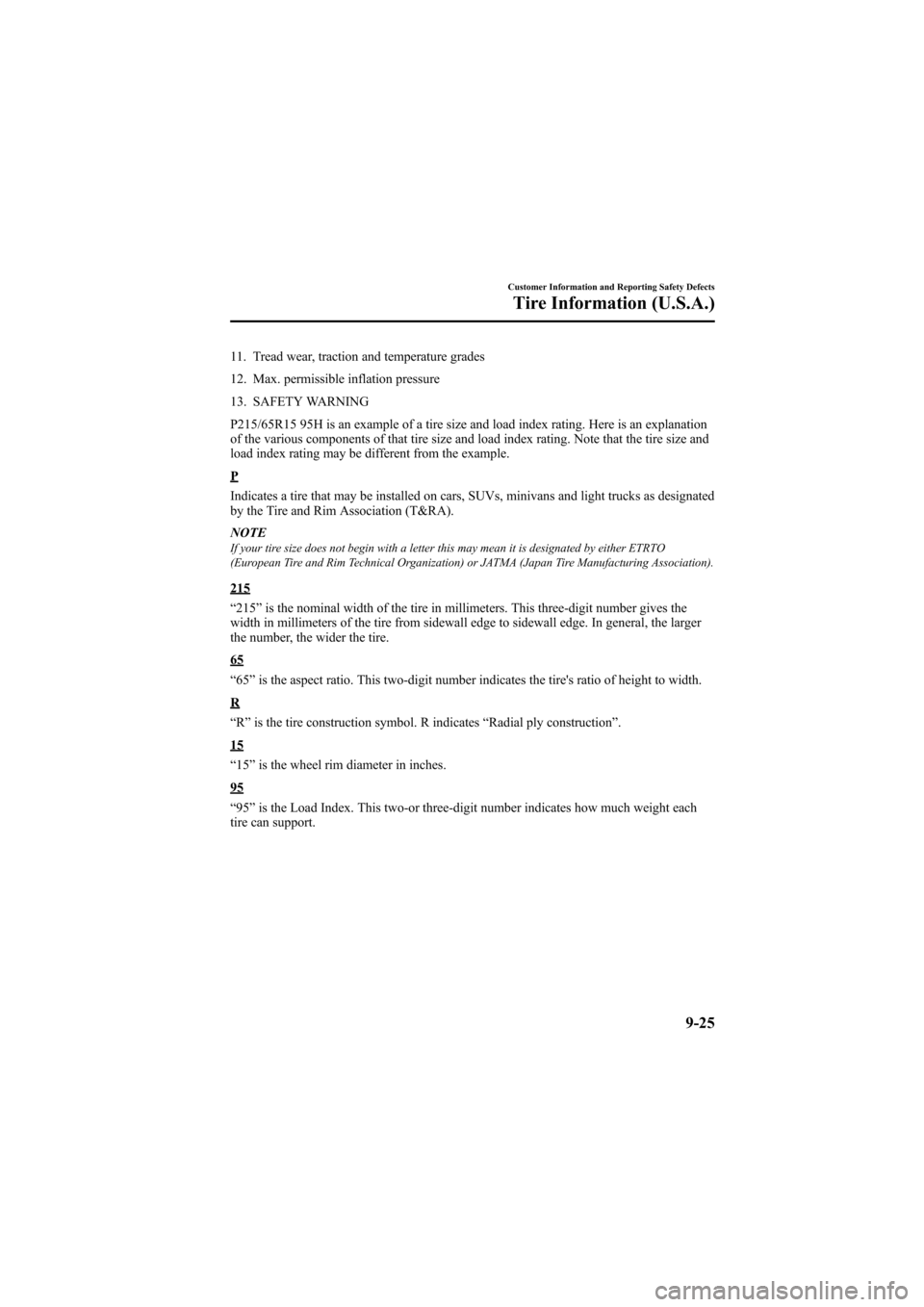
P215/65R15 95H is an example of a tire size and load index rating. Here is an explanation
of the various components of that tire size and load index rating. Note that the tire size and
load index rating may be different from the example.
P
Indicates a tire that may be installed on cars, SUVs, minivans and light trucks as designated
by the Tire and Rim Association (T&RA).
NOTE
If your tire size does not begin with a letter this may mean it is designated by either ETRTO
(European Tire and Rim Technical Organization) or JATMA (Japan Tire Manufacturing Association).
215
“215 ”is the nominal width of the tire in millimeters. This three-digit number gives the
width in millimeters of the tire from sidewall edge to sidewall edge. In general, the larger
the number, the wider the tire.
65
“ 65 ”is the aspect ratio. This two-digit number indicates the tire's ratio of height to width.
R
“R” is the tire construction symbol. R indicates “Radial ply construction ”.
15
“15 ”is the wheel rim diameter in inches.
95
“95 ”is the Load Index. This two-or three-digit number indicates how much weight each
tire can support.
Customer Information and Reporting Safety Defects
Tire Information (U.S.A.)
9-25
Mazda6_8Z64-EA-08H_Edition1 Page425
Wednesday, June 25 2008 10:6 AM
Form No.8Z64-EA-08H
Page 426 of 464

Black plate (426,1)
H
“H ”is the speed rating. The speed rating denotes the maximum speed for which the use of
the tire is rated.
Letter Rating Speed Rating
Q 99 mph
R 106 mph
S 112 mph
T 118 mph
U 124 mph
H 130 mph
V 149 mph
W 168
*mph
Y 186*mph
* For tires with a maximum speed capability over 149 mph, tire manufacturers sometimes use the letters ZR. For tires with a maximum speed capability over 186 mph, tire manufacturers always use the letters ZR.
M+S or M/S: Mud and Snow
AT: All Terrain.
AS: All Season. The “M+S ”or “M/S ”indicates that the tire has some functional use in
mud and snow.
U.S. DOT Tire Identification Number (TIN)
This begins with the letters “DOT ”which indicates the tire meets all federal standards. The
next two numbers or letters are the plant code where it was manufactured, and the last four
numbers represent the week and year the tire was manufactured. For example, the numbers
457 means the 45st week of 1997. After 2000 the numbers go to four digits. For example,
the number 2102 means the 21th week of 2002. The other numbers are marketing codes
used at the manufacturer's discretion. This information is used to contact consumers if a tire
defect requires a recall.
Tire Ply Composition and Materials Used
The number of plies indicates the number of layers of rubber-coated fabric in the tire. In
general, the greater the number of plies, the more weight a tire can support. Tire
manufacturers also must indicate the tire materials, which include steel, nylon, polyester,
and other.
Maximum Load Rating
This number indicates the maximum load in kilograms and pounds that can be carried by
the tire.
Maximum Permissible Inflation Pressure
This number is the greatest amount of air pressure that should ever be put in the tire under
normal driving conditions.
9-26
Customer Information and Reporting Safety Defects
Tire Information (U.S.A.)
Mazda6_8Z64-EA-08H_Edition1 Page426
Wednesday, June 25 2008 10:6 AM
Form No.8Z64-EA-08H
Page 429 of 464

Black plate (429,1)
70
“70 ”is the aspect ratio. This two-digit number indicates the tire's ratio of height to width.
D
“D ”is the tire construction symbol. D indicates “diagonal ply construction ”.
16
“16 ”is the wheel rim diameter in inches.
90
“90 ”is the Load Index. This two-or three-digit number indicates how much weight each
tire can support.
M
“ M ”is the speed rating. The speed rating denotes the maximum speed for which the use of
the tire is rated.
Letter Rating Speed Rating
M 81 mph
Customer Information and Reporting Safety Defects
Tire Information (U.S.A.)
9-29
Mazda6_8Z64-EA-08H_Edition1 Page429
Wednesday, June 25 2008 10:6 AM
Form No.8Z64-EA-08H
Page 432 of 464
Black plate (432,1)
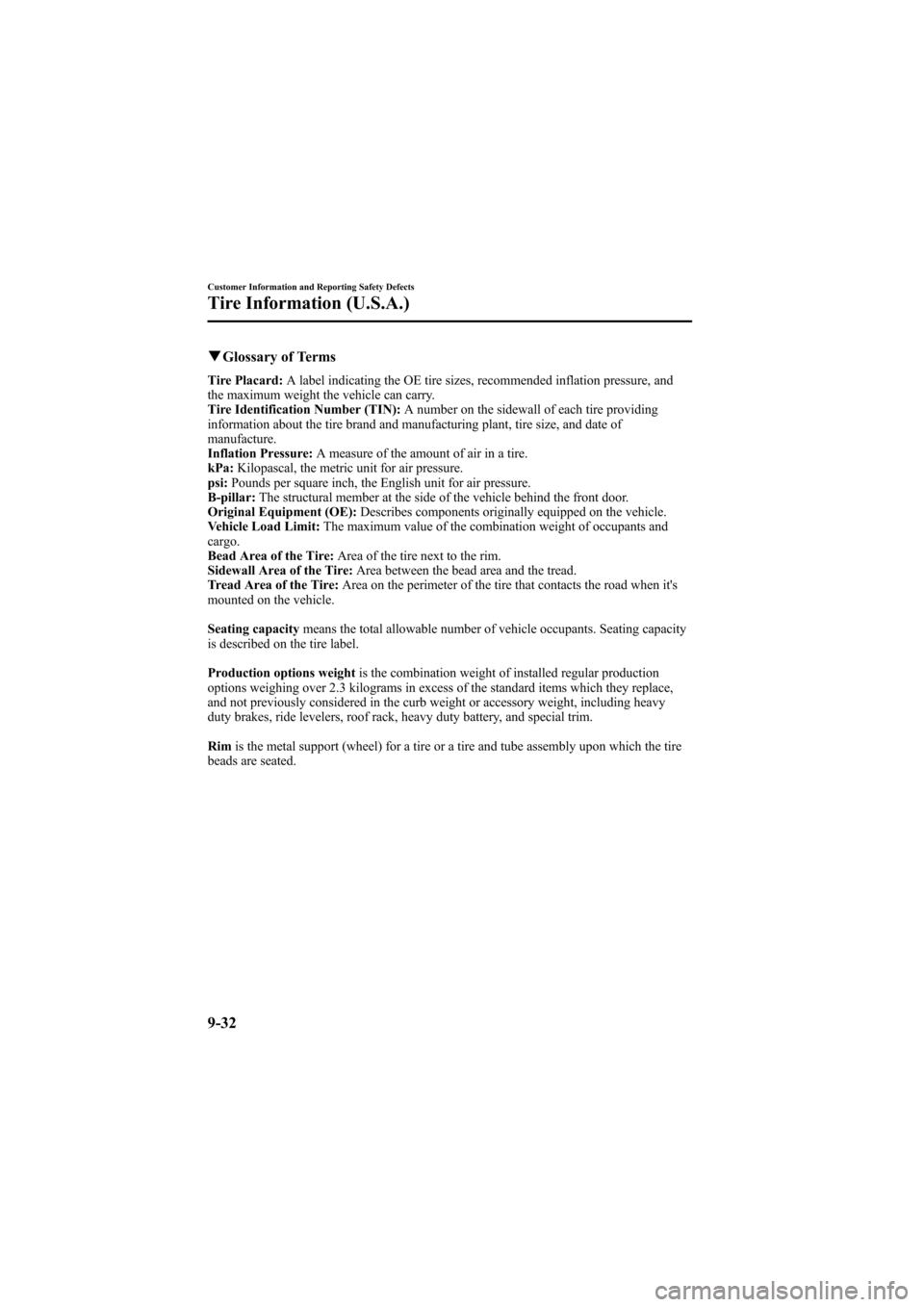
qGlossary of Terms
Tire Placard: A label indicating the OE tire sizes, recommended inflation pressure, and
the maximum weight the vehicle can carry.
Tire Identification Number (TIN): A number on the sidewall of each tire providing
information about the tire brand and manufacturing plant, tire size, and date of
manufacture.
Inflation Pressure: A measure of the amount of air in a tire.
kPa: Kilopascal, the metric unit for air pressure.
psi: Pounds per square inch, the English unit for air pressure.
B-pillar: The structural member at the side of the vehicle behind the front door.
Original Equipment (OE): Describes components originally equipped on the vehicle.
Vehicle Load Limit: The maximum value of the combination weight of occupants and
cargo.
Bead Area of the Tire: Area of the tire next to the rim.
Sidewall Area of the Tire: Area between the bead area and the tread.
Tread Area of the Tire: Area on the perimeter of the tire that contacts the road when it's
mounted on the vehicle.
Seating capacity means the total allowable number of vehicle occupants. Seating capacity
is described on the tire label.
Production options weight is the combination weight of installed regular production
options weighing over 2.3 kilograms in excess of the standard items which they replace,
and not previously considered in the curb weight or accessory weight, including heavy
duty brakes, ride levelers, roof rack, heavy duty battery, and special trim.
Rim is the metal support (wheel) for a tire or a tire and tube assembly upon which the tire
beads are seated.
9-32
Customer Information and Reporting Safety Defects
Tire Information (U.S.A.)
Mazda6_8Z64-EA-08H_Edition1 Page432
Wednesday, June 25 2008 10:6 AM
Form No.8Z64-EA-08H