seats MAZDA MODEL 6 2017 (in English) User Guide
[x] Cancel search | Manufacturer: MAZDA, Model Year: 2017, Model line: MODEL 6, Model: MAZDA MODEL 6 2017Pages: 578, PDF Size: 54.72 MB
Page 22 of 578
2–10
Essential Safety Equipment
Seats
(Using a programmed key)
1. Unlock the doors by pressing a request
switch or the key
button.
2. After unlocking the doors, the seat
position adjustment begins within 40
seconds of opening the driver's door,
and a beep sounds when the operation
is finished.
3. Make sure the parking brake is on.
4. (Automatic transaxle)
Make sure the selector lever is in the P
position.
5. Start the engine.
6. The active driving display adjustment
begins.
NOTE
If there is no driving position movement,
a beep is not heard.
The driving position adjustment is
canceled in the following cases:
Any of the seat adjustment switches
is operated.
The SET button is pressed. Programming button 1 or 2 is
pressed.
The key button or button is
operated.
The vehicle starts moving. The active driving display is
adjusted.
Erasing programmed driving positions
(Erasing the driving positions
programmed to the key)
1. Switch the ignition OFF.
2. Press the SET button on the side of the
seat until a beep sound is heard one
time.
3. After the beep sounds, press the key
button within 5 seconds until a beep
sound is heard one time.
NOTE
If a beep sound is heard three times, the
operation is canceled.
Mazda6_8FH2-EA-16F_Edition2.indb 102016/07/07 13:44:11
Page 23 of 578
2–11
Essential Safety Equipment
Seats
Rear Seat
Split Folding
By lowering the rear seatbacks the luggage
compartment space can be expanded.
WARNING
Do not drive the vehicle with occupants
on folded down seatbacks or in the
luggage compartment.Putting occupants in the luggage
compartment is dangerous because
seat belts cannot be fastened which
could lead to serious injury or death
during sudden braking or a collision.
Do not allow children to play inside the
vehicle with the seatbacks lowered. Allowing children to play in the
vehicle with the seatbacks folded
down is dangerous. If a child enters
the luggage compartment and the
seatbacks were raised back up, the
child may become trapped in the
luggage compartment which could
lead to an accident.
Tightly secure cargo in the luggage
compartment when it is transported
with the seatbacks folded down. Driving without tightly securing cargo
and luggage is dangerous as it could
move and become an obstruction to
driving during emergency braking or
a collision resulting in an unexpected
accident.
When transporting cargo, do not allow
the cargo to exceed the height of the
seatbacks. Transporting cargo stacked higher
than the seatbacks is dangerous as
visibility to the rear and sides of the
vehicle is reduced which could interfere
with driving operations and lead to an
accident.
Mazda6_8FH2-EA-16F_Edition2.indb 112016/07/07 13:44:11
Page 24 of 578
2–12
Essential Safety Equipment
Seats
Lowering the seatbacks
CAUTION
Check the position of a front seat
before folding a rear seatback.
Depending on the position of a front
seat, it may not be possible to fold
a rear seatback all the way down
because it may hit the seatback of
the front seat which could scratch or
damage the front seat or its pocket.
Lower or remove the head restraint on
the rear outboard seat if necessary.
1. (With rear seat warmer)
Turn the rear seat warmer switch off.
Refer to Seat Warmer on page 2-7.
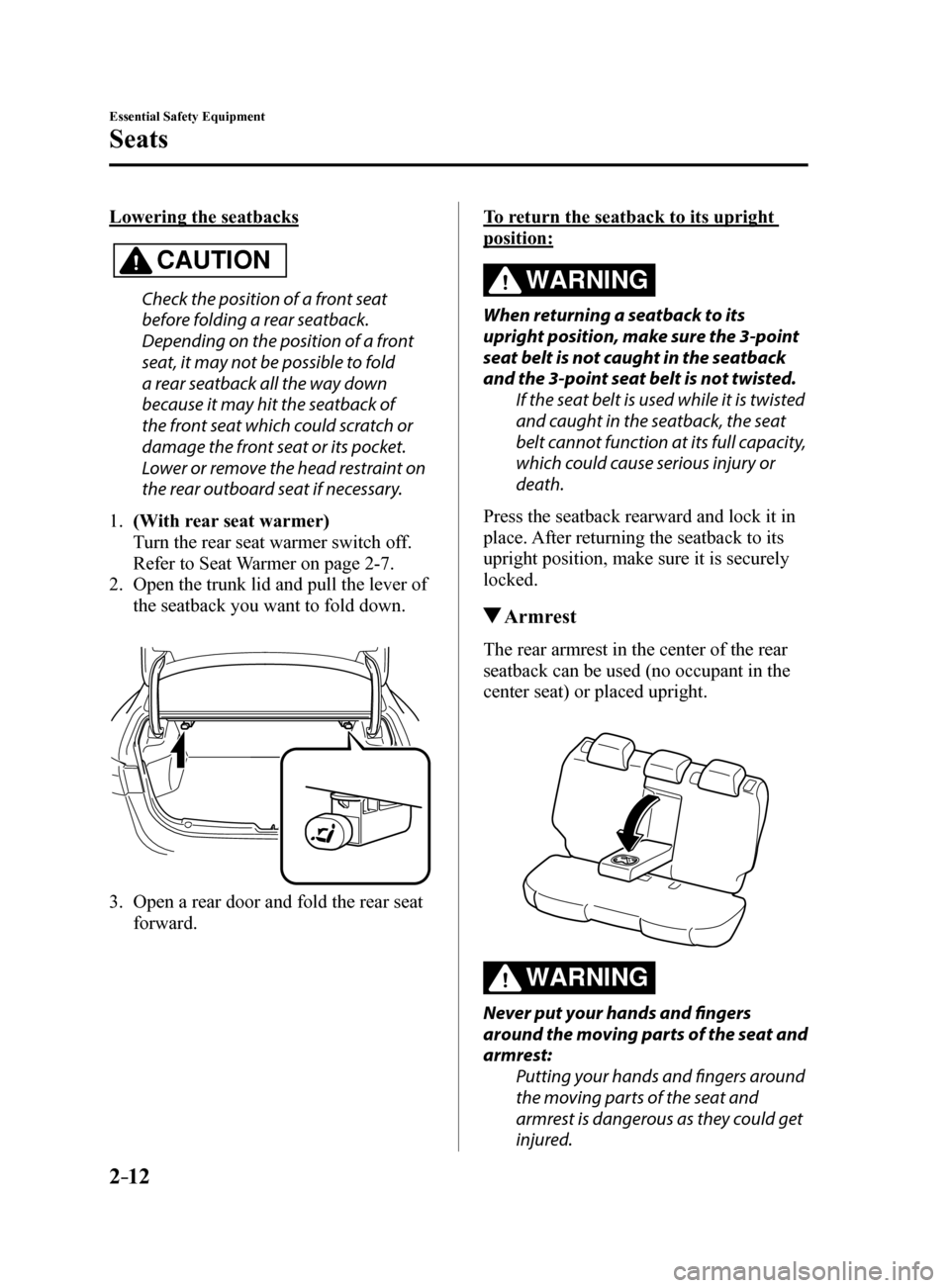
2. Open the trunk lid and pull the lever of
the seatback you want to fold down.
3. Open a rear door and fold the rear seat
forward.
To return the seatback to its upright
position:
WARNING
When returning a seatback to its
upright position, make sure the 3-point
seat belt is not caught in the seatback
and the 3-point seat belt is not twisted.
If the seat belt is used while it is twisted
and caught in the seatback, the seat
belt cannot function at its full capacity,
which could cause serious injury or
death.
Press the seatback rearward and lock it in
place. After returning the seatback to its
upright position, make sure it is securely
locked.
Armrest
The rear armrest in the center of the rear
seatback can be used (no occupant in the
center seat) or placed upright.
WARNING
Never put your hands and fingers
around the moving parts of the seat and
armrest: Putting your hands and fingers around
the moving parts of the seat and
armrest is dangerous as they could get
injured.
Mazda6_8FH2-EA-16F_Edition2.indb 122016/07/07 13:44:11
Page 25 of 578
2–13
Essential Safety Equipment
Seats
Head Restraints
Your vehicle is equipped with head
restraints on all outboard seats and the
rear center seat. The head restraints are
intended to help protect you and the
passengers from neck injury.
WARNING
Always drive with the head restraints
installed when seats are being used and
make sure they are properly adjusted:Driving with the head restraints
adjusted too low or removed is
dangerous. With no support behind
your head, your neck could be seriously
injured in a collision.
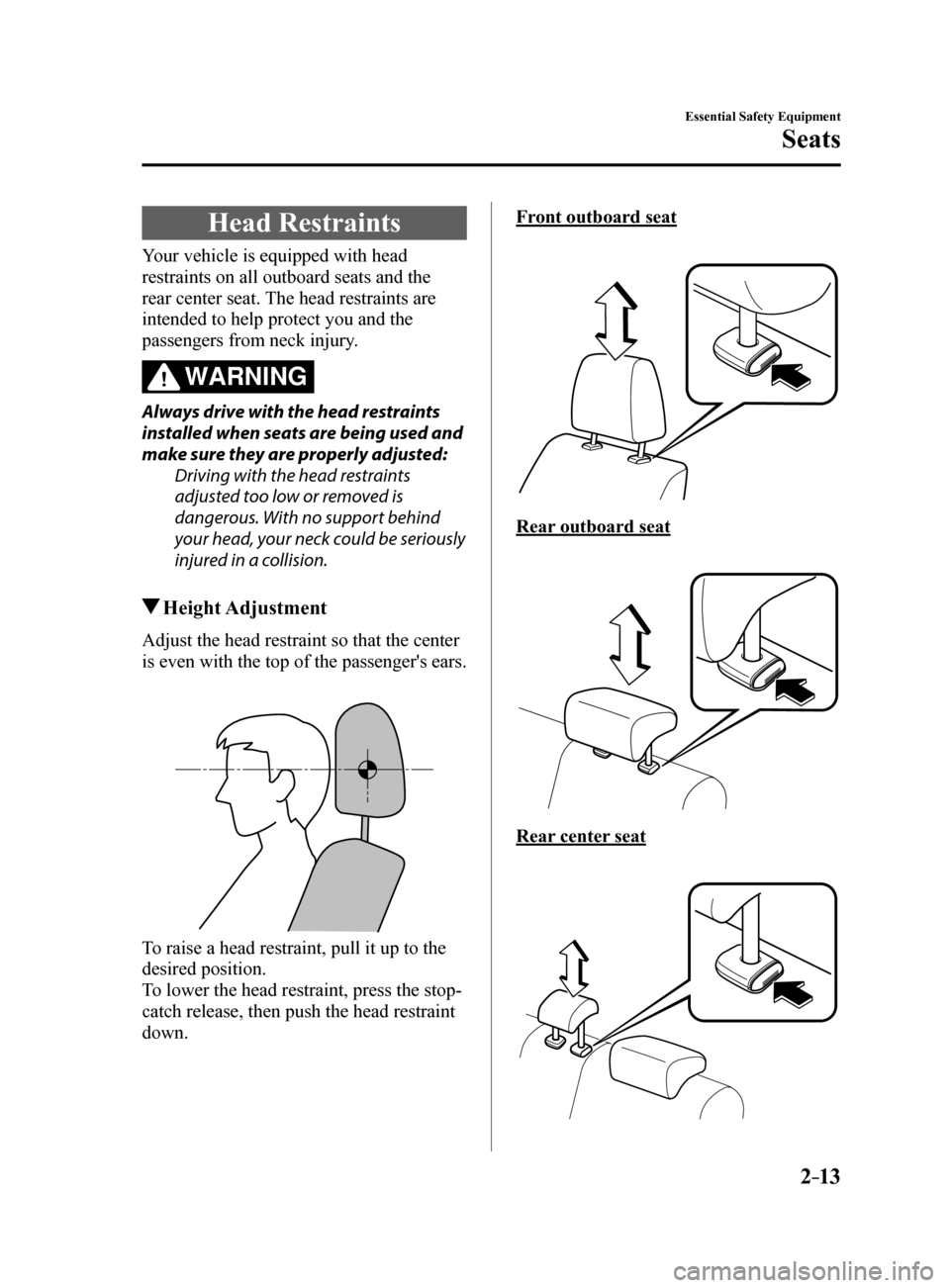
Height Adjustment
Adjust the head restraint so that the center
is even with the top of the passenger's ears.
To raise a head restraint, pull it up to the
desired position.
To lower the head restraint, press the stop-
catch release, then push the head restraint
down.
Front outboard seat
Rear outboard seat
Rear center seat
Mazda6_8FH2-EA-16F_Edition2.indb 132016/07/07 13:44:12
Page 26 of 578
2–14
Essential Safety Equipment
Seats
Removal/Installation
To remove the head restraint, pull it up
while pressing the stop-catch.
To install the head restraint, insert the legs
into the holes while pressing the stop-
catch.
WARNING
Always drive with the head restraints
installed when seats are being used and
make sure they are properly installed:Driving with the head restraints not
installed is dangerous. With no support
behind your head, your neck could be
seriously injured in a collision.
After installing a head restraint, try
lifting it to make sure that it does not
pull out: Driving with an unsecured head
restraint is dangerous as the
effectiveness of the head restraint will
be compromised which could cause it
to unexpectedly detach from the seat.
CAUTION
When installing a head restraint, make
sure that it is installed correctly with
the front of the head restraint facing
forward. If the head restraint is installed
incorrectly, it could detach from the seat
during a collision and result in injury.
The head restraints on each of the front
and rear seats are specialized to each
seat. Do not switch around the head
restraint positions. If a head restraint is
not installed to its correct seat position,
the effectiveness of the head restraint
during a collision will be compromised
which could cause injury.
Mazda6_8FH2-EA-16F_Edition2.indb 142016/07/07 13:44:12
Page 27 of 578
 User Guide 2–15
Essential Safety Equipment
Seat Belt Systems
Seat Belt Precautions
Seat belts help to decrease the possibility of severe injury during acci\
dents and sudden
stops. Mazda recommends that the d")
2–15
Essential Safety Equipment
Seat Belt Systems
Seat Belt Precautions
Seat belts help to decrease the possibility of severe injury during acci\
dents and sudden
stops. Mazda recommends that the driver and all passengers always wear s\
eat belts.
(U.S.A. and Canada)
All of the seat belt retractors are designed to keep the lap/shoulder be\
lts out of the way when
not in use.
The driver's seat belt has no provisions for child-restraint systems and\
has only an
emergency locking mode. The driver may wear it comfortably, and it will lock during a
collision.
However, the front passenger's seat and all rear lap/shoulder belt retractors o\
perate in
two modes: emergency locking mode, and for child-restraint systems, automatic locking
mode. While we recommend you put all children in the rear seats, if you must u\
se the front
passenger seat for a child, slide the front passenger seat as far back a\
s possible and make
sure any child-restraint system is secured properly.
WARNING
Always wear your seat belt and make sure all occupants are properly restrained:Not wearing a seat belt is extremely dangerous. During a collision, occupants not
wearing seat belts could hit someone or things inside the vehicle or even be thrown out of
the vehicle. They could be seriously injured or even killed. In the same collision, occupants
wearing seat belts would be much safer.
Do not wear twisted seat belts: Twisted seat belts are dangerous. In a collision, the full width of the belt is not available to
absorb the impact. This puts more force on the bones beneath the belt, which could cause
serious injury or death. So, if your seat belt is twisted, you must straighten the seat belt to
remove any twists and to allow the full width of the belt to be used.
Never use one seat belt on more than one person at a time: Using one seat belt for more than one person at a time is dangerous. A seat belt used
in this way cannot spread the impact forces properly and the two passengers could
be crushed together and seriously injured or even killed. Never use one belt for more
than one person at a time and always operate the vehicle with each occupant properly
restrained.
Do not operate a vehicle with a damaged seat belt: Using a damaged seat belt is dangerous. An accident could damage the belt webbing
of the seat belt in use. A damaged seat belt cannot provide adequate protection in a
collision. Have an Authorized Mazda Dealer inspect all seat belt systems in use during an
accident before they are used again.
Mazda6_8FH2-EA-16F_Edition2.indb 152016/07/07 13:44:12
Page 35 of 578
 User Guide 2–23
Essential Safety Equipment
Child Restraint
Child-Restraint Precautions
Mazda strongly urges the use of child-restraint systems for children small enough to use \
them.
You are required by law")
2–23
Essential Safety Equipment
Child Restraint
Child-Restraint Precautions
Mazda strongly urges the use of child-restraint systems for children small enough to use \
them.
You are required by law to use a child-restraint system for children in the U.S. and Canada.
Check your local and state or provincial laws for specific requirements regarding the safety
of children riding in your vehicle.
Whatever child-restraint system you consider, please pick the appropriate one for the age
and size of the child, obey the law and follow the instructions that com\
e with the individual
child-restraint system.
A child who has outgrown child-restraint systems should sit in the rear a\
nd use seat belts,
both lap and shoulder. If the shoulder belt crosses the neck or face, move the child closer
to the center of the vehicle in the outboard seats, and towards the buck\
le on the right if the
child is seated on the center seat.
Statistics confirm that the rear seat is the best place for all children up to 12 years of age,
and more so with a supplemental restraint system (air bags).
A rear-facing child-restraint system should NEVER be used on the front seat with the air
bag system activated. The front passenger's seat is also the least preferred seat for other
child-restraint systems.
(With Front Passenger Occupant Classification System)
To reduce the chance of injuries caused by deployment of the front passen\
ger air bag, the
front passenger occupant classification sensor works as a part of the supplemental restraint
system. This system deactivates the front passenger front and side air bags and \
also the
front passenger seat belt pretensioner system when the front passenger a\
ir bag deactivation
indicator light illuminates.
When an infant or small child sits on the front passenger seat, the syst\
em shuts off the front
passenger front and side air bags and seat belt pretensioner system, so \
make sure the front
passenger air bag deactivation indicator light illuminates.
Even if the front passenger air bag is shut off, Mazda strongly recommends that children be
properly restrained and child-restraint systems of all kinds are properl\
y secured on the rear
seats which are the best place for children.
For more details, refer to "Front passenger occupant classification sensor" (page 2-56).
Mazda6_8FH2-EA-16F_Edition2.indb 232016/07/07 13:44:13
Page 38 of 578
2–26
Essential Safety Equipment
Child Restraint
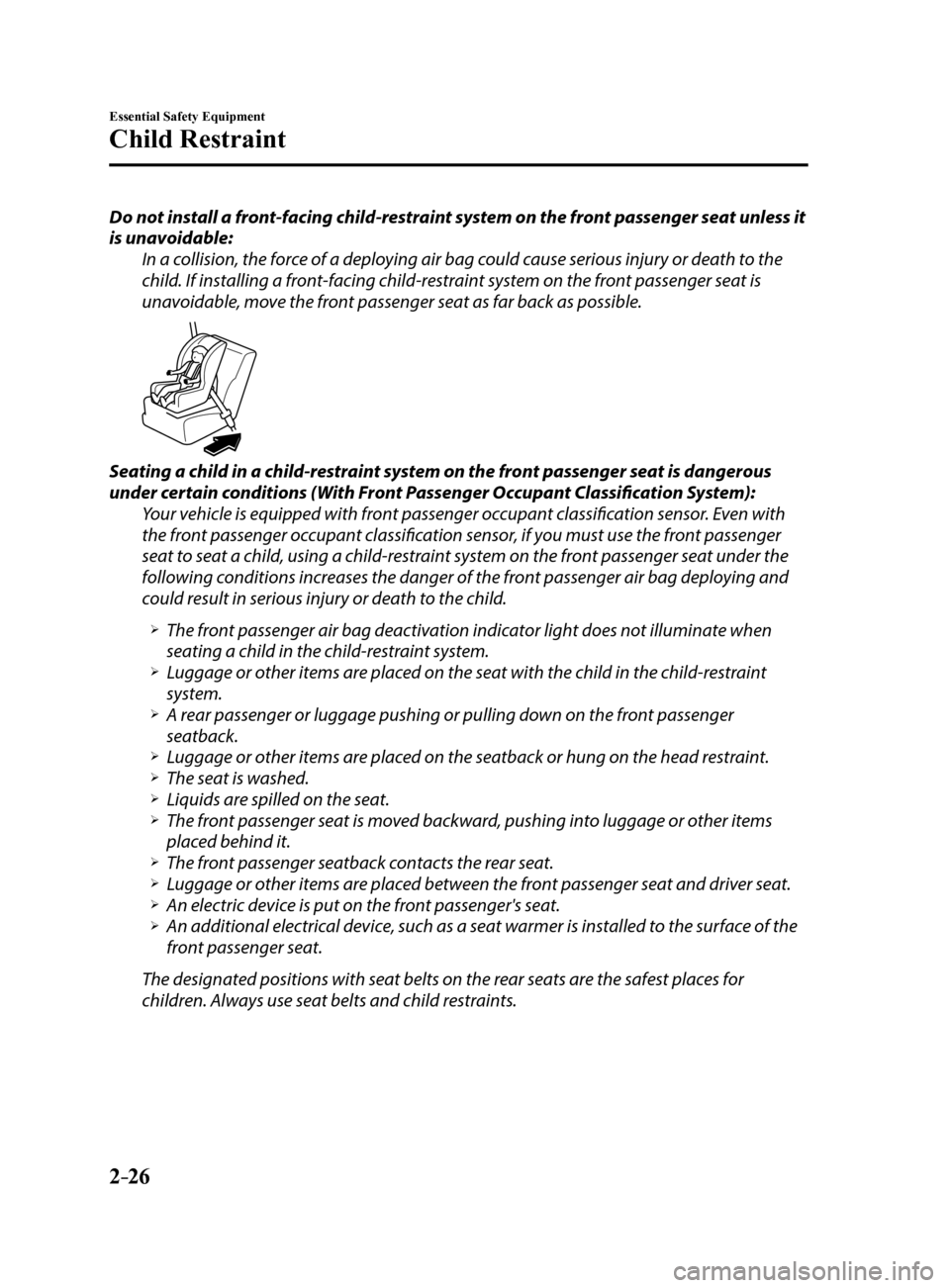
Do not install a front-facing child-restraint system on the front passenger seat unless it
is unavoidable:In a collision, the force of a deploying air bag could cause serious injury or death to the
child. If installing a front-facing child-restraint system on the front passenger seat is
unavoidable, move the front passenger seat as far back as possible.
Seating a child in a child-restraint system on the front passenger seat is dangerous
under certain conditions (With Front Passenger Occupant Classification System):Your vehicle is equipped with front passenger occupant classification sensor. Even with
the front passenger occupant classification sensor, if you must use the front passenger
seat to seat a child, using a child-restraint system on the front passenger seat under the
following conditions increases the danger of the front passenger air bag deploying and
could result in serious injury or death to the child.
The front passenger air bag deactivation indicator light does not illuminate when
seating a child in the child-restraint system.
Luggage or other items are placed on the seat with the child in the child-restraint
system.
A rear passenger or luggage pushing or pulling down on the front passenger
seatback.
Luggage or other items are placed on the seatback or hung on the head restraint. The seat is washed. Liquids are spilled on the seat. The front passenger seat is moved backward, pushing into luggage or other items
placed behind it.
The front passenger seatback contacts the rear seat. Luggage or other items are placed between the front passenger seat and driver seat. An electric device is put on the front passenger's seat. An additional electrical device, such as a seat warmer is installed to the surface of the
front passenger seat.
The designated positions with seat belts on the rear seats are the safest places for
children. Always use seat belts and child restraints.
Mazda6_8FH2-EA-16F_Edition2.indb 262016/07/07 13:44:14
Page 39 of 578
2–27
Essential Safety Equipment
Child Restraint
Do not allow a child or anyone to lean over or against the side window of a vehicle with
side and curtain air bags:It is dangerous to allow anyone to lean over or against the side window, the area of the
front passenger seat, the front and rear window pillars and the roof edge along both
sides from which the side and curtain air bags deploy, even if a child-restraint system
is used. The impact of inflation from a side or curtain air bag could cause serious injury
or death to an out of position child. Furthermore, leaning over or against the front door
could block the side and curtain air bags and eliminate the advantages of supplemental
protection. With the front air bag and the additional side air bag that comes out of the
front seat, the rear seat is always a better location for children. Take special care not to
allow a child to lean over or against the side window, even if the child is seated in a child-
restraint system.
Never use one seat belt on more than one person at a time: Using one seat belt for more than one person at a time is dangerous. A seat belt used
in this way cannot spread the impact forces properly and the two passengers could
be crushed together and seriously injured or even killed. Never use one belt for more
than one person at a time and always operate the vehicle with each occupant properly
restrained.
Always remove the child-restraint system from the rear seat before operating the
remote handle levers for the rear seat: Operating the remote handle levers while a rear-facing child-restraint system is in the
rear seat is dangerous. It could cause injury to a child seated in the child-restraint system
when the seatback suddenly flips forward.
CAUTION
A seat belt or child-restraint system can become very hot in a closed vehicle during warm
weather. To avoid burning yourself or a child, check them before you or your child touches
them.
NOTE
Your Mazda is equipped with LATCH lower anchors for attachment of specially designed
LATCH child-restraint systems in the rear seats. When using these anchors to secure a
child-restraint system, refer to "Using LATCH Lower Anchor" (page 2-36).
Mazda6_8FH2-EA-16F_Edition2.indb 272016/07/07 13:44:14
Page 40 of 578
2–28
Essential Safety Equipment
Child Restraint
Child-Restraint System
Installation
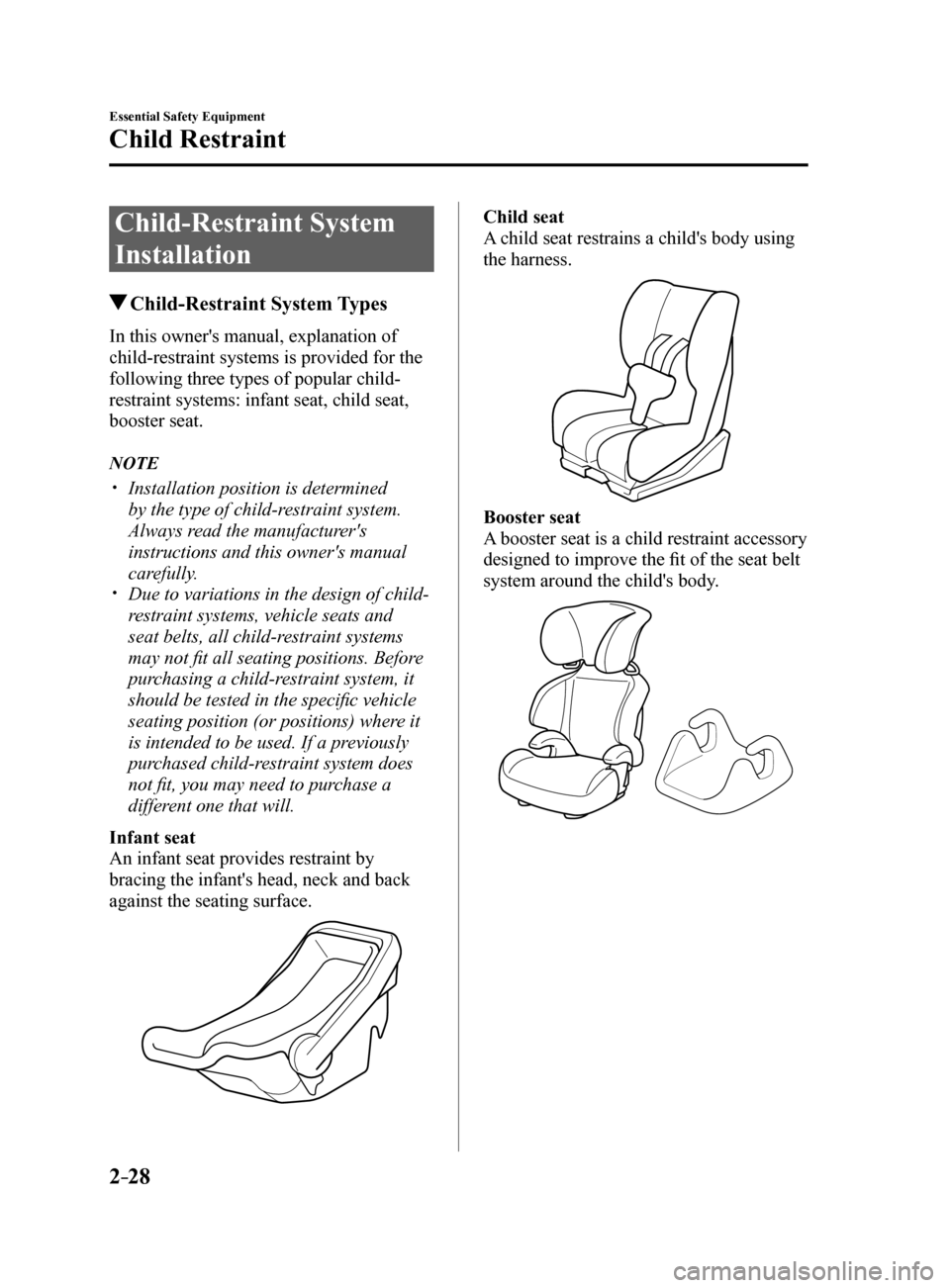
Child-Restraint System Types
In this owner's manual, explanation of
child-restraint systems is provided for the
following three types of popular child-
restraint systems: infant seat, child seat,
booster seat.
NOTE
Installation position is determined
by the type of child-restraint system.
Always read the manufacturer's
instructions and this owner's manual
carefully.
Due to variations in the design of child-
restraint systems, vehicle seats and
seat belts, all child-restraint systems
may not fit all seating positions. Before
purchasing a child-restraint system, it
should be tested in the specific vehicle
seating position (or positions) where it
is intended to be used. If a previously
purchased child-restraint system does
not fit, you may need to purchase a
different one that will.
Infant seat
An infant seat provides restraint by
bracing the infant's head, neck and back
against the seating surface.
Child seat
A child seat restrains a child's body using
the harness.
Booster seat
A booster seat is a child restraint accessory
designed to improve the fit of the seat belt
system around the child's body.
Mazda6_8FH2-EA-16F_Edition2.indb 282016/07/07 13:44:14