battery MAZDA MODEL 6 2017 (in English) Workshop Manual
[x] Cancel search | Manufacturer: MAZDA, Model Year: 2017, Model line: MODEL 6, Model: MAZDA MODEL 6 2017Pages: 578, PDF Size: 54.72 MB
Page 422 of 578
6–36
Maintenance and Care
Owner Maintenance
Keep all flames, including cigarettes, and sparks away from open battery cells:
Flames and sparks near open battery cells are dangerous. Hydrogen gas, produced
during normal battery operation, could ignite and cause the battery to explode. An
exploding battery can cause serious burns and injuries.
NOTE
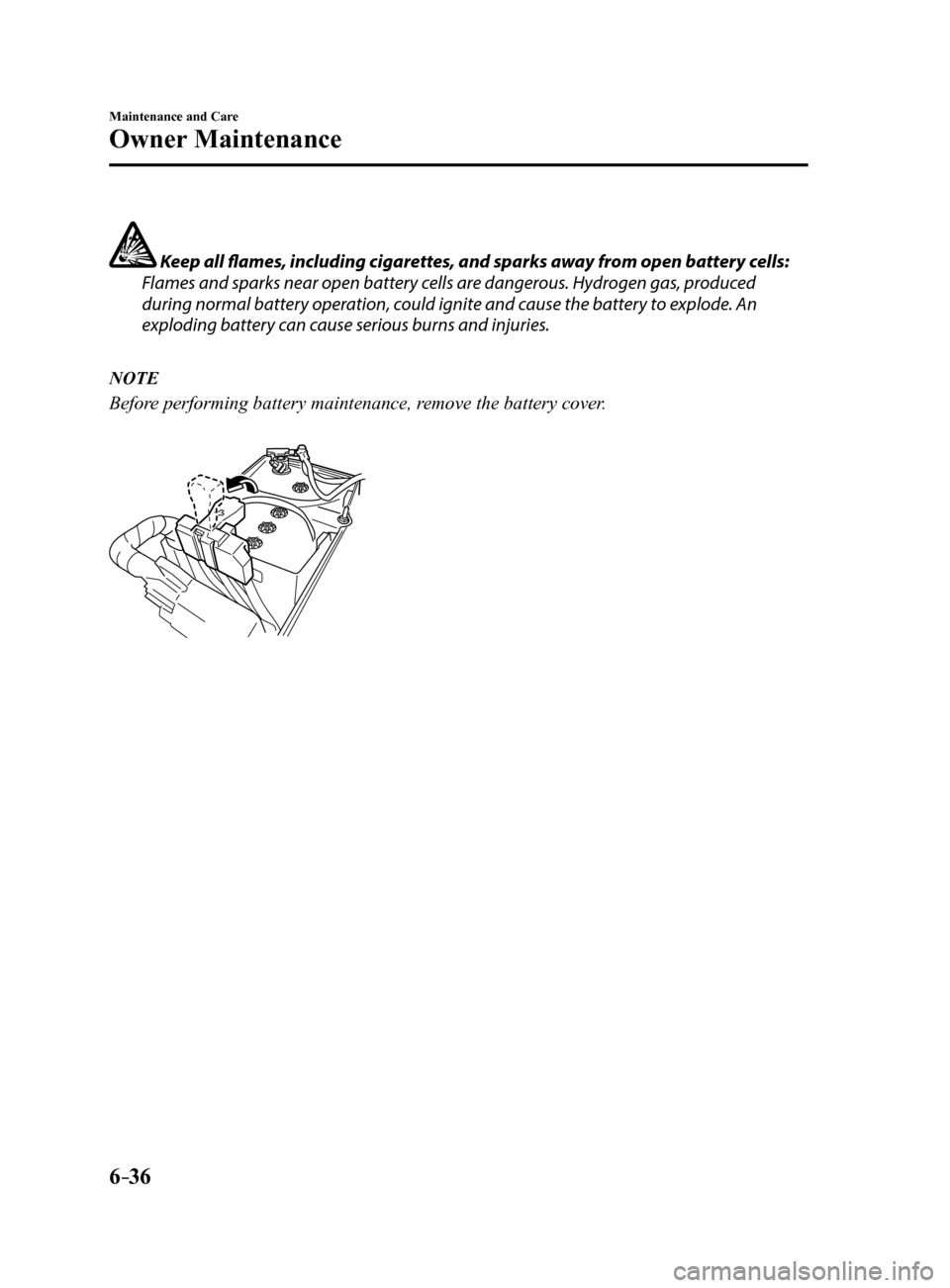
Before performing battery maintenance, remove the battery cover.
Mazda6_8FH2-EA-16F_Edition2.indb 362016/07/07 13:46:12
Page 423 of 578
6–37
Maintenance and Care
Owner Maintenance
Battery Maintenance
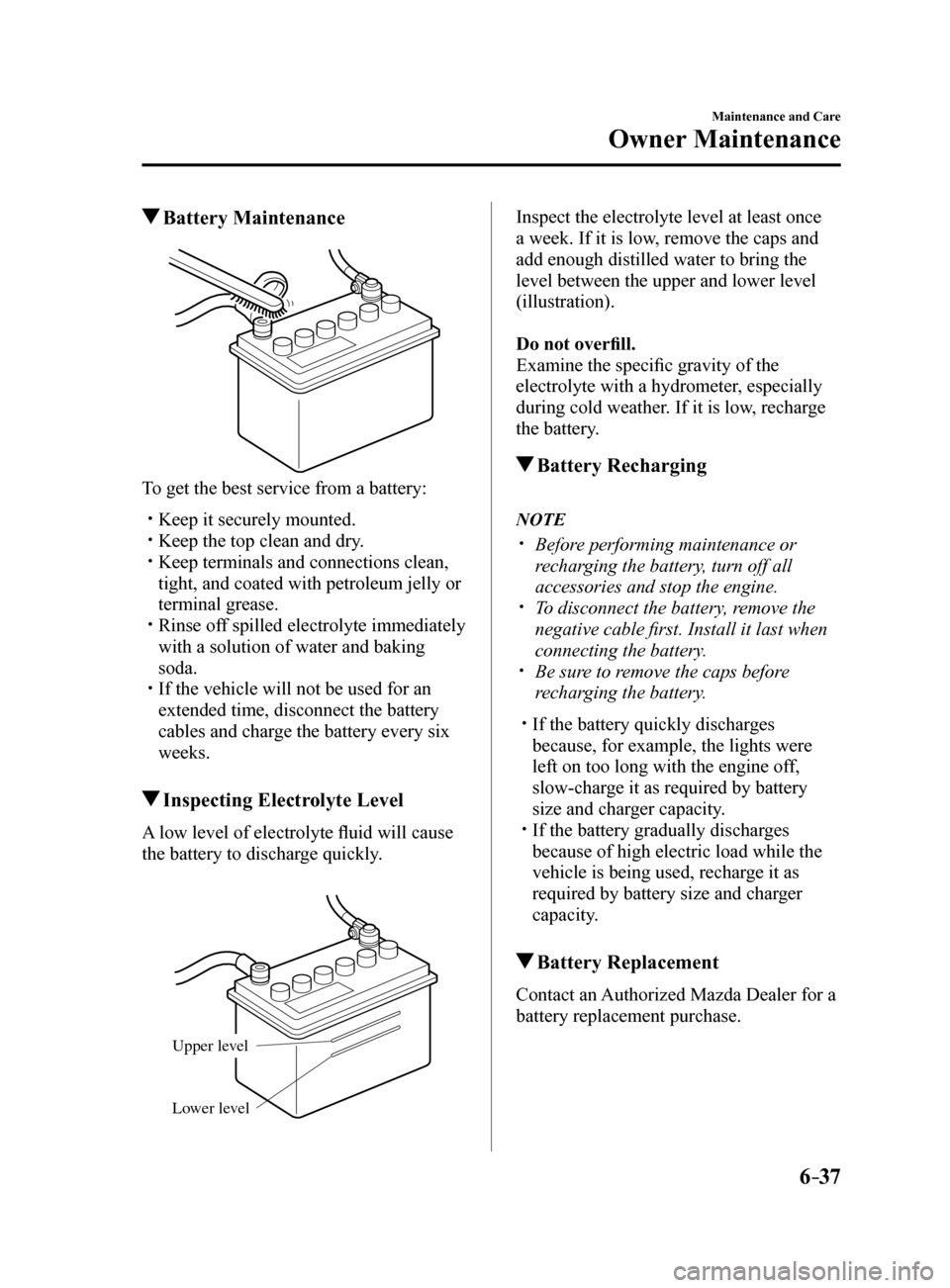
To get the best service from a battery:
Keep it securely mounted. Keep the top clean and dry. Keep terminals and connections clean,
tight, and coated with petroleum jelly or
terminal grease.
Rinse off spilled electrolyte immediately
with a solution of water and baking
soda.
If the vehicle will not be used for an
extended time, disconnect the battery
cables and charge the battery every six
weeks.
Inspecting Electrolyte Level
A low level of electrolyte fluid will cause
the battery to discharge quickly.
Upper le vel
Lo wer le vel
Inspect the electrolyte level at least once
a week. If it is low, remove the caps and
add enough distilled water to bring the
level between the upper and lower level
(illustration).
Do not overfill.
Examine the specific gravity of the
electrolyte with a hydrometer, especially
during cold weather. If it is low, recharge
the battery.
Battery Recharging
NOTE
Before performing maintenance or
recharging the battery, turn off all
accessories and stop the engine.
To disconnect the battery, remove the
negative cable first. Install it last when
connecting the battery.
Be sure to remove the caps before
recharging the battery.
If the battery quickly discharges
because, for example, the lights were
left on too long with the engine off,
slow-charge it as required by battery
size and charger capacity.
If the battery gradually discharges
because of high electric load while the
vehicle is being used, recharge it as
required by battery size and charger
capacity.
Battery Replacement
Contact an Authorized Mazda Dealer for a
battery replacement purchase.
Mazda6_8FH2-EA-16F_Edition2.indb 372016/07/07 13:46:13
Page 424 of 578
6–38
Maintenance and Care
Owner Maintenance
Key Battery Replacement
If the buttons on the transmitter are
inoperable and the operation indicator
light does not flash, the battery may be
dead.
Replace with a new battery before the
transmitter becomes unusable.
CAUTION
Make sure the battery is installed
correctly. Battery leakage could occur if it
is not installed correctly.
When replacing the battery, be careful
not to touch any of the internal circuitry
and electrical terminals, bend the
electrical terminals, or get dirt in the
transmitter as the transmitter could be
damaged.
There is the danger of explosion if the
battery is not correctly replaced.
Dispose of used batteries according to
the following instructions.
Insulate the plus and minus terminals
of the battery using cellophane or
equivalent tape.
Never disassemble. Never throw the battery into fire or
water.
Never deform or crush.
Replace only with the same type battery
(CR2025 or equivalent).
The following conditions indicate that the
battery power is low:
The KEY indicator light (green) flashes
in the instrument cluster for about 30
seconds after the engine is turned off
(for vehicles with a type A instrument
cluster (page 4-32), messages are
displayed in the instrument cluster).
The system does not operate and
the operation indicator light on the
transmitter does not flash when the
buttons are pressed.
The system's operational range is
reduced.
Replacing the battery at an Authorized
Mazda Dealer is recommended to prevent
damage to the key. If replacing the battery
by yourself, follow the instruction.
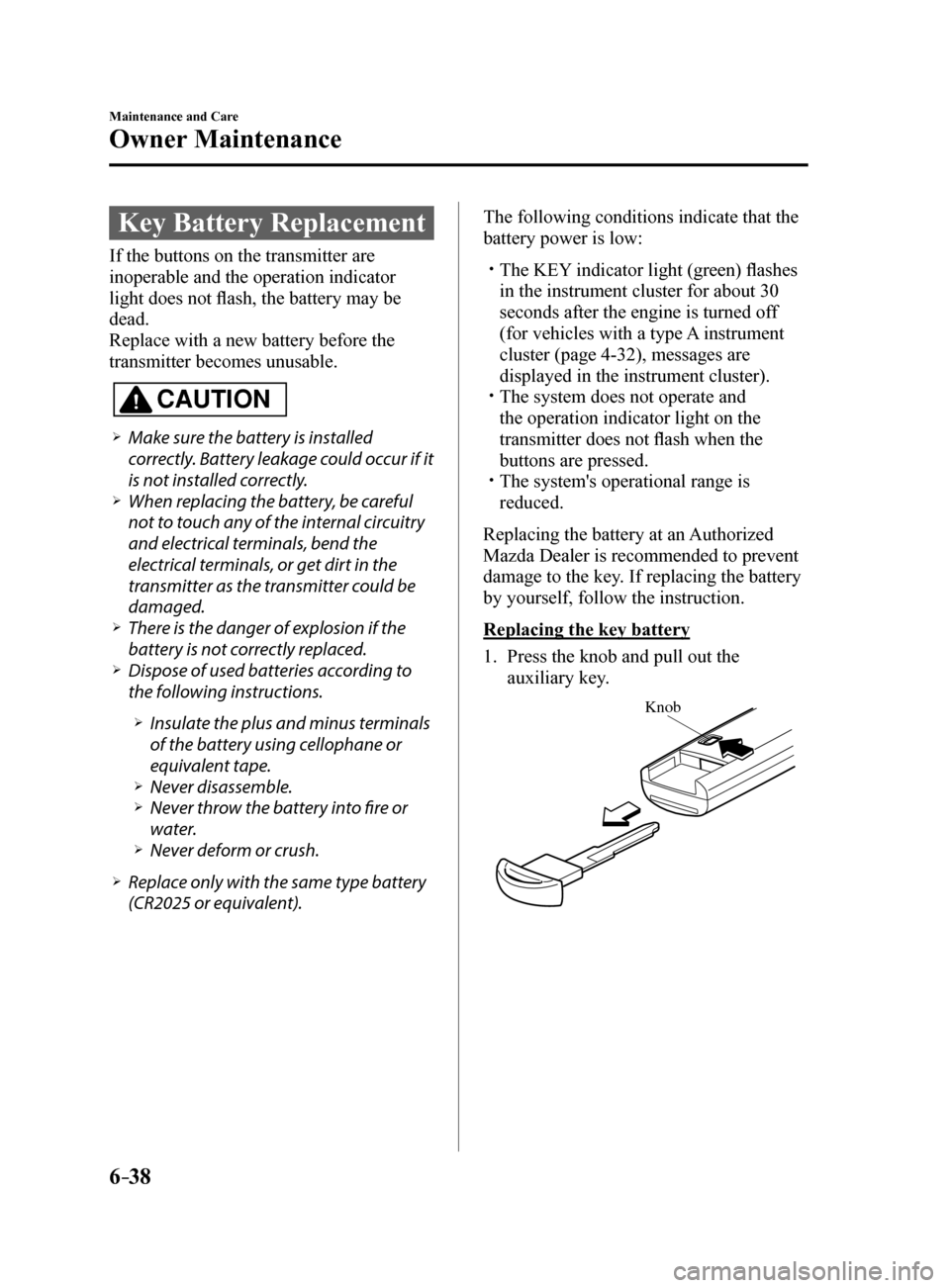
Replacing the key battery
1. Press the knob and pull out the
auxiliary key.
Knob
Mazda6_8FH2-EA-16F_Edition2.indb 382016/07/07 13:46:13
Page 425 of 578
6–39
Maintenance and Care
Owner Maintenance
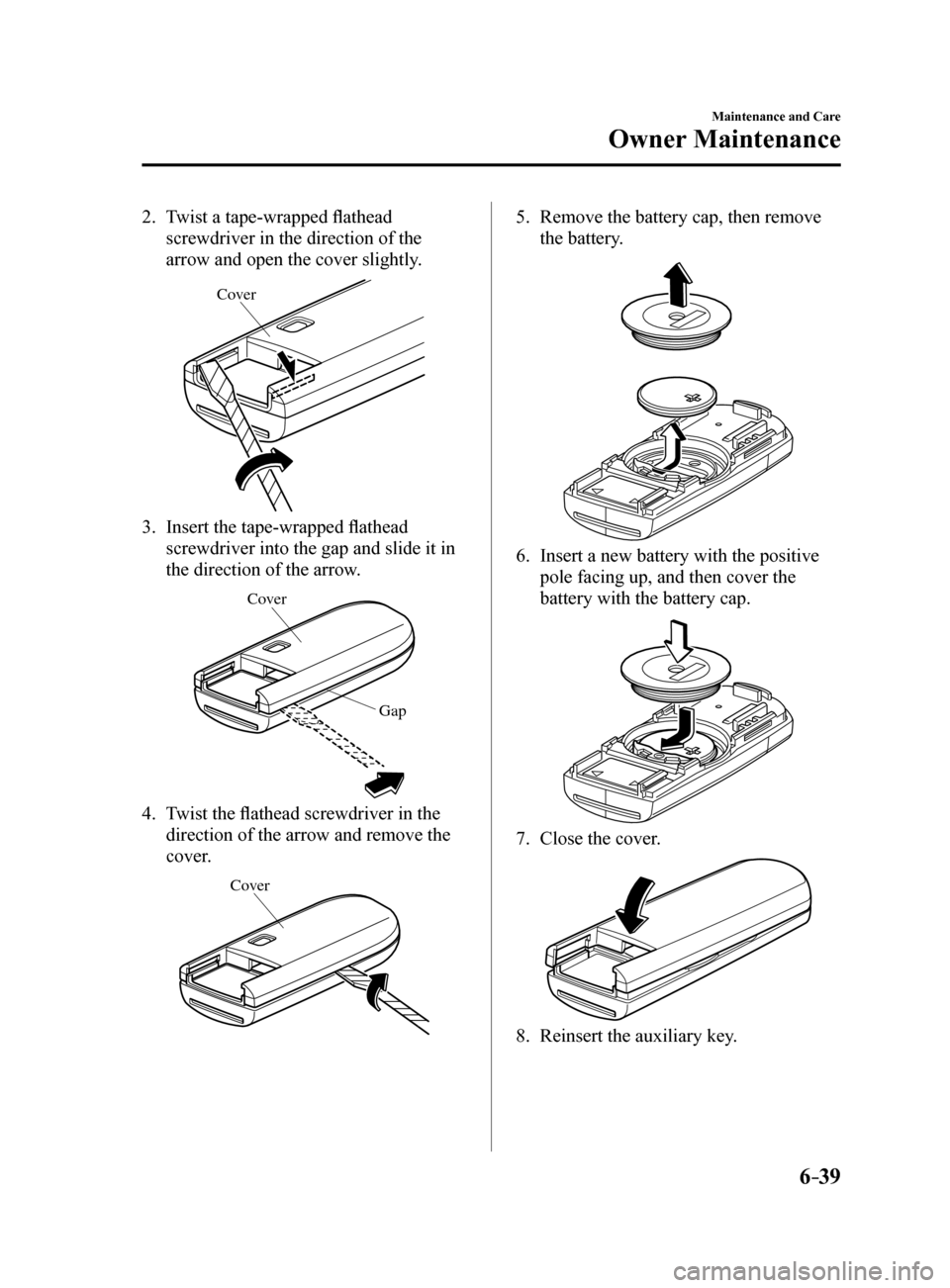
2. Twist a tape-wrapped flathead
screwdriver in the direction of the
arrow and open the cover slightly.
Cove r
3. Insert the tape-wrapped flathead
screwdriver into the gap and slide it in
the direction of the arrow.
Cove r
Gap
4. Twist the flathead screwdriver in the
direction of the arrow and remove the
cover.
Cove r
5. Remove the battery cap, then remove
the battery.
6. Insert a new battery with the positive
pole facing up, and then cover the
battery with the battery cap.
7. Close the cover.
8. Reinsert the auxiliary key.
Mazda6_8FH2-EA-16F_Edition2.indb 392016/07/07 13:46:14
Page 426 of 578
6–40
Maintenance and Care
Owner Maintenance
CAUTION
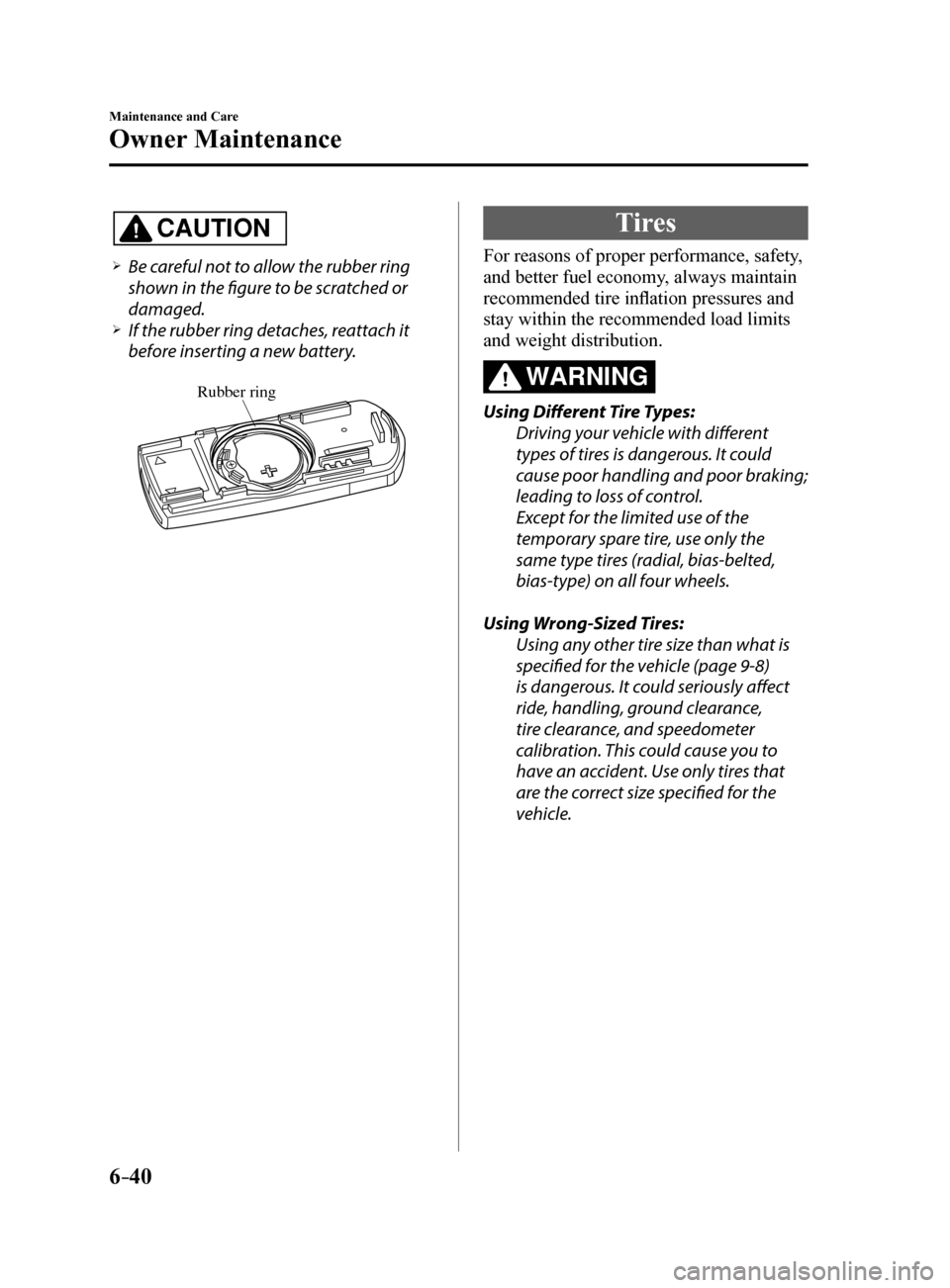
Be careful not to allow the rubber ring
shown in the figure to be scratched or
damaged.
If the rubber ring detaches, reattach it
before inserting a new battery.
Rubber ring
Tires
For reasons of proper performance, safety,
and better fuel economy, always maintain
recommended tire inflation pressures and
stay within the recommended load limits
and weight distribution.
WARNING
Using Different Tire Types:
Driving your vehicle with different
types of tires is dangerous. It could
cause poor handling and poor braking;
leading to loss of control.
Except for the limited use of the
temporary spare tire, use only the
same type tires (radial, bias-belted,
bias-type) on all four wheels.
Using Wrong-Sized Tires: Using any other tire size than what is
specified for the vehicle (page 9-8)
is dangerous. It could seriously affect
ride, handling, ground clearance,
tire clearance, and speedometer
calibration. This could cause you to
have an accident. Use only tires that
are the correct size specified for the
vehicle.
Mazda6_8FH2-EA-16F_Edition2.indb 402016/07/07 13:46:14
Page 455 of 578
6–69
Maintenance and Care
Appearance Care
WARNING
Dry off brakes that have become
wet by driving slowly, releasing the
accelerator pedal and lightly applying
the brakes several times until the brake
performance returns to normal:Driving with wet brakes is dangerous.
Increased stopping distance or the
vehicle pulling to one side when
braking could result in a serious
accident. Light braking will indicate
whether the brakes have been affected.
Aluminum Wheel Maintenance
A protective coating is provided over the
aluminum wheels. Special care is needed
to protect this coating.
CAUTION
Do not use any detergent other than
mild detergent. Before using any
detergent, verify the ingredients.
Otherwise, the product could discolor
or stain the aluminum wheels.
NOTE
Do not use a wire brush or any abrasive
cleaner, polishing compound, or solvent
on aluminum wheels. They may damage
the coating.
Always use a sponge or soft cloth to
clean the wheels.
Rinse the wheels thoroughly with
lukewarm or cold water. Also, be sure
to clean the wheels after driving on
dusty or salted roads to help prevent
corrosion.
Avoid washing your vehicle in an
automatic car wash that uses high-
speed or hard brushes.
Plastic Part Maintenance
When cleaning the plastic lenses of the
lights, do not use gasoline, kerosene,
rectified spirit, paint, thinner, highly
acidic detergents, or strongly alkaline
detergents. Otherwise, these chemical
agents can discolor or damage the
surfaces resulting in a significant loss
in functionality. If plastic parts become
inadvertently exposed to any of these
chemical agents, flush with water
immediately.
If plastic parts such as the bumpers
become inadvertently exposed to
chemical agents or fluids such as
gasoline, oil, engine coolant, or battery
fluid, it could cause discoloration,
staining, or paint peeling. Wipe off any
such chemical agents or fluids using a
soft cloth immediately.
High water temperature and high water
pressure car washers are available
depending on the type of high pressure
car washer device. If the car washer
nozzle is put too close to the vehicle or
aimed at one area for an extended period
of time, it could deform plastic parts or
damage the paint.
Do not use wax containing compounds
(polish). Otherwise, it could result in
paint damage.
In addition, do not use an electrical or
air tool to apply wax. Otherwise, the
frictional heat generated could result
in deformation of plastic parts or paint
damage.
Mazda6_8FH2-EA-16F_Edition2.indb 692016/07/07 13:46:23
Page 461 of 578
7–1*Some models.
7If Trouble Arises
Helpful information on what to do if a problem arises with the vehicle.
Parking in an Emergency .................................................................. 7-2
Parking in an Emergency .............................................................. 7-2
Flat Tire........................................................................\
....................... 7-3
Spare Tire and Tool Storage .......................................................... 7-3
Changing a Flat Tire ...................................................................... 7-6
Battery Runs Out ........................................................................\
..... 7-13
Jump-Starting ........................................................................\
...... 7-13
Emergency Starting ........................................................................\
. 7-16
Starting a Flooded Engine ........................................................... 7-16
Push-Starting ........................................................................\
....... 7-16
Overheating ........................................................................\
.............. 7-17
Overheating ........................................................................\
......... 7-17
Emergency Towing ........................................................................\
... 7-19
Towing Description ..................................................................... 7-19
Tiedown Hooks
* ........................................................................\
.. 7-20
Warning/Indicator Lights and Warning Sounds ........................... 7-22
If a Warning Light Turns On or Flashes ......................................7-22
Message Indicated on Display .................................................... 7-33
Message Indicated in Multi-information Display
* ...................... 7-35
Warning Sound is Activated ........................................................ 7-36
When Trunk Lid Cannot be Opened .............................................. 7-40
When Trunk Lid Cannot be Opened ........................................... 7-40
Active Driving Display Does Not Operate ..................................... 7-41
If the Active Driving Display does not operate .......................... 7-41
Mazda6_8FH2-EA-16F_Edition2.indb 12016/07/07 13:46:23
Page 473 of 578
7–13
If Trouble Arises
Battery Runs Out
Jump-Starting
Jump-starting is dangerous if done incorrectly. So follow the procedure carefully. If you
feel unsure about jump-starting, we strongly recommend that you have a c\
ompetent service
technician do the work.
WARNING
Follow These Precautions Carefully:
To ensure safe and correct handling of the battery, read the following precautions
carefully before using the battery or inspecting it.
Do not allow the positive () terminal to contact any other metal object that
could cause sparks: Flames and sparks near open battery cells are dangerous. Hydrogen gas, produced
during normal battery operation, could ignite and cause the battery to explode. An
exploding battery can cause serious burns and injuries. When working near a battery, do
not allow metal tools to contact the positive (
) or negative () terminal of the battery.
Keep all flames, including cigarettes, and sparks away from open battery cells:
Flames and sparks near open battery cells are dangerous. Hydrogen gas, produced
during normal battery operation, could ignite and cause the battery to explode. An
exploding battery can cause serious burns and injuries.
Do not jump-start a frozen battery or one with a low fluid level: Jump-starting a frozen battery or one with a low fluid level is dangerous. It may rupture
or explode, causing serious injury.
Connect the negative cable to a good ground point away from the battery: Connecting the end of the second jumper cable to the negative (
) terminal of the
discharged battery is dangerous.
A spark could cause the gas around the battery to explode and injure someone.
Route the jumper cables away from parts that will be moving: Connecting a jumper cable near or to moving parts (cooling fans, belts) is dangerous. The
cable could get caught when the engine starts and cause serious injury.
Mazda6_8FH2-EA-16F_Edition2.indb 132016/07/07 13:46:28
Page 474 of 578
7–14
If Trouble Arises
Battery Runs Out
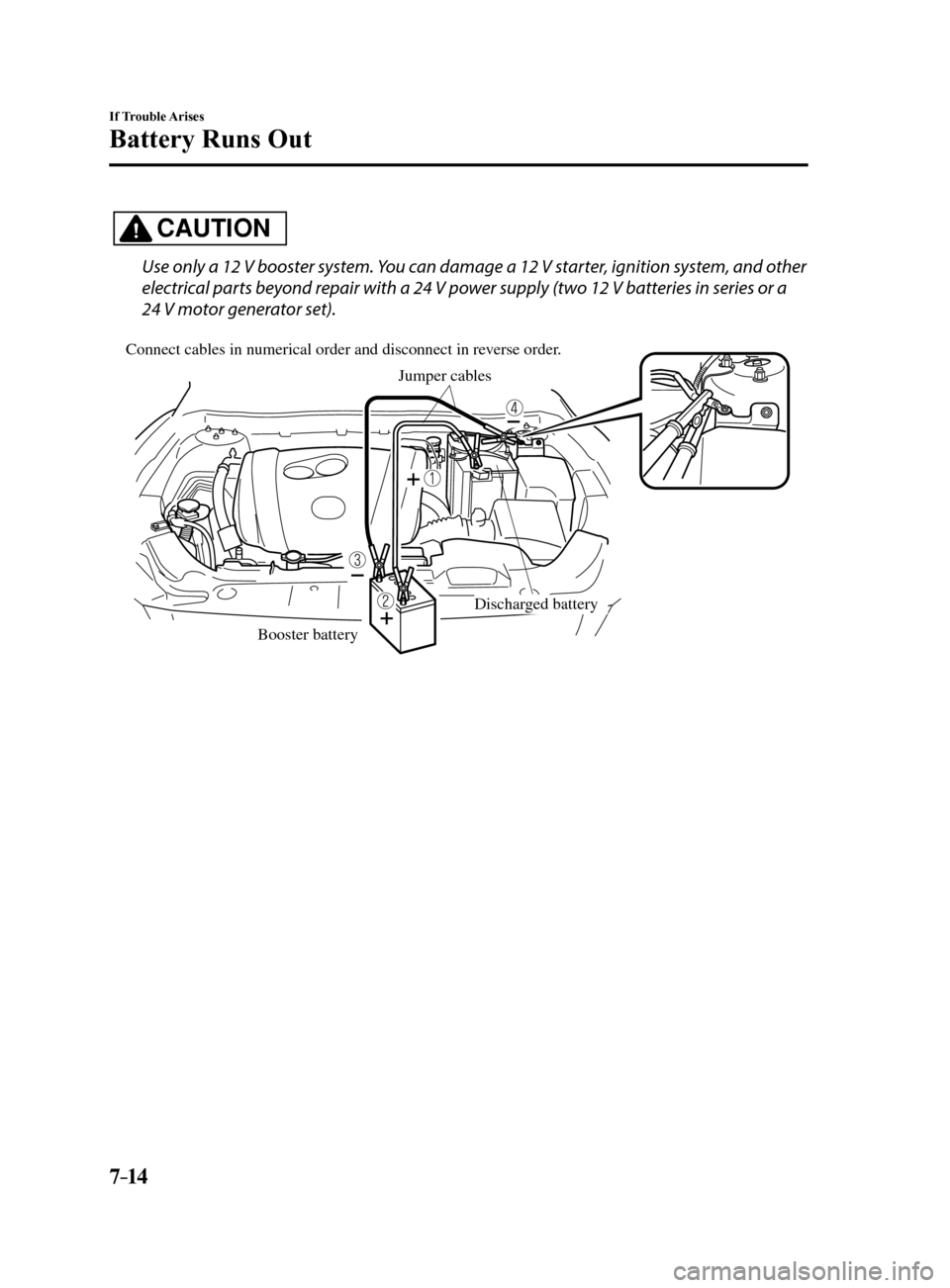
CAUTION
Use only a 12 V booster system. You can damage a 12 V starter, ignition system, and other
electrical parts beyond repair with a 24 V power supply (two 12 V batteries in series or a
24 V motor generator set).
Connect cables in numerical order and disconnect in reverse order .
Jumper cables
Booster battery
Dischar ged battery
Mazda6_8FH2-EA-16F_Edition2.indb 142016/07/07 13:46:28
Page 475 of 578
7–15
If Trouble Arises
Battery Runs Out
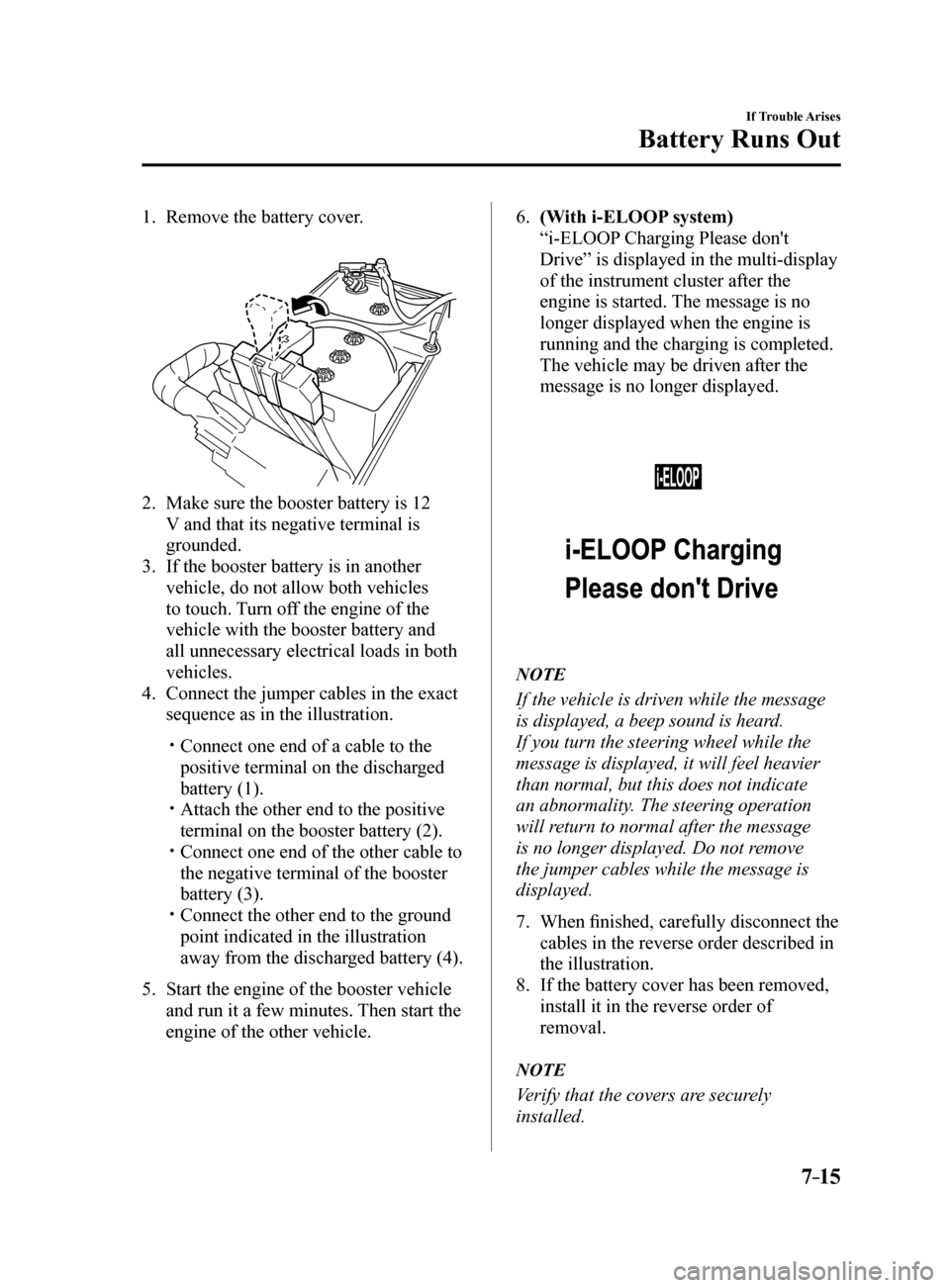
1. Remove the battery cover.
2. Make sure the booster battery is 12
V and that its negative terminal is
grounded.
3. If the booster battery is in another
vehicle, do not allow both vehicles
to touch. Turn off the engine of the
vehicle with the booster battery and
all unnecessary electrical loads in both
vehicles.
4. Connect the jumper cables in the exact
sequence as in the illustration.
Connect one end of a cable to the
positive terminal on the discharged
battery (1).
Attach the other end to the positive
terminal on the booster battery (2).
Connect one end of the other cable to
the negative terminal of the booster
battery (3).
Connect the other end to the ground
point indicated in the illustration
away from the discharged battery (4).
5. Start the engine of the booster vehicle
and run it a few minutes. Then start the
engine of the other vehicle. 6.
(With i-ELOOP system)
“i-ELOOP Charging Please don't
Drive” is displayed in the multi-display
of the instrument cluster after the
engine is started. The message is no
longer displayed when the engine is
running and the charging is completed.
The vehicle may be driven after the
message is no longer displayed.
NOTE
If the vehicle is driven while the message
is displayed, a beep sound is heard.
If you turn the steering wheel while the
message is displayed, it will feel heavier
than normal, but this does not indicate
an abnormality. The steering operation
will return to normal after the message
is no longer displayed. Do not remove
the jumper cables while the message is
displayed.
7. When finished, carefully disconnect the
cables in the reverse order described in
the illustration.
8. If the battery cover has been removed,
install it in the reverse order of
removal.
NOTE
Verify that the covers are securely
installed.
Mazda6_8FH2-EA-16F_Edition2.indb 152016/07/07 13:46:29