towing MAZDA MODEL CX-5 2016 (in English) Owner's Manual
[x] Cancel search | Manufacturer: MAZDA, Model Year: 2016, Model line: MODEL CX-5, Model: MAZDA MODEL CX-5 2016Pages: 626, PDF Size: 13.81 MB
Page 449 of 626

Black plate (449,1)
Maintenance IntervalNumber of months or kilometers, whichever comes first
Months 3 6 9 12 15 18 21 24 27 30 33 36
×1000 km 5 10 15 20 25 30 35 40 45 50 55 60
AIR CONDITIONER SYSTEM
Cabin air filter R R R
Chart symbols:
I:Inspect: Inspect and clean, repair, adjust, fill up, or replace if necessary.
R:Replace
L:Lubricate
C:Clean
T:Tighten
Remarks:
*1 Use of FL-22 is recommended when replacing engine coolant. Using engine coolant other than FL-22 may
cause serious damage to the engine and cooling system.
*2 According to state/provincial and federal regulations, failure to perform maintenance on these items will not
void your emissions warranties. However, Mazda recommends that all maintenance services be performed at
the recommended time or kilometer period to ensure long-term reliability.
*3 The Tire Pressure Monitoring System (TPMS) initialization must be performed so that the system operates
normally (if equipped).
*4 If the vehicle is operated primarily under any of the following conditions, replace the rear differential oil at
every 45,000 km.
a) Towing a trailer or using a car-top carrier
b) Driving in dusty, sandy or wet conditions
c) Extended periods of idling or low speed operation
d) Repeated short trips of less than 16 km
*5 If this component has been submerged in water, the oil should be replaced.
Maintenance and Care
Scheduled Maintenance
6-17
CX-5_8DV2-EA-14K_Edition3 Page449
Thursday, February 26 2015 5:34 PM
Form No.8DV2-EA-14K
Page 451 of 626

Black plate (451,1)
Maintenance IntervalNumber of months or kilometers, whichever comes first
Months 39 42 45 48 51 54 57 60 63 66 69 72
×1000 km 65 70 75 80 85 90 95 100 105 110 115 120
AIR CONDITIONER SYSTEM
Cabin air filter R R R
Chart symbols:
I:Inspect: Inspect and clean, repair, adjust, fill up, or replace if necessary.
R:Replace
L:Lubricate
C:Clean
T:Tighten
Remarks:
*1 Use of FL-22 is recommended when replacing engine coolant. Using engine coolant other than FL-22 may
cause serious damage to the engine and cooling system.
*2 According to state/provincial and federal regulations, failure to perform maintenance on these items will not
void your emissions warranties. However, Mazda recommends that all maintenance services be performed at
the recommended time or kilometer period to ensure long-term reliability.
*3 The Tire Pressure Monitoring System (TPMS) initialization must be performed so that the system operates
normally (if equipped).
*4 If the vehicle is operated primarily under any of the following conditions, replace the rear differential oil at
every 45,000 km.
a) Towing a trailer or using a car-top carrier
b) Driving in dusty, sandy or wet conditions
c) Extended periods of idling or low speed operation
d) Repeated short trips of less than 16 km
*5 If this component has been submerged in water, the oil should be replaced.
Maintenance and Care
Scheduled Maintenance
6-19
CX-5_8DV2-EA-14K_Edition3 Page451
Thursday, February 26 2015 5:34 PM
Form No.8DV2-EA-14K
Page 503 of 626

Black plate (503,1)
7If Trouble Arises
Helpful information on what to do if a problem arises with the vehicle.
Parking in an Emergency ............................................................. 7-2
Parking in an Emergency .......................................................... 7-2
Flat Tire ......................................................................................... 7-3
Spare Tire and Tool Storage ...................................................... 7-3
Changing a Flat Tire ................................................................. 7-7
Battery Runs Out ........................................................................ 7-14
Jump-Starting .......................................................................... 7-14
Emergency Starting .................................................................... 7-17
Starting a Flooded Engine ....................................................... 7-17
Push-Starting ........................................................................... 7-17
Overheating ................................................................................. 7-18
Overheating ............................................................................. 7-18
Emergency Towing ..................................................................... 7-20
Towing Description ................................................................. 7-20
Tiedown Hooks
í.................................................................... 7-21
Warning/Indicator Lights and Warning Sounds ..................... 7-23
When Warning/Indicator Lights Illuminate/Flash ................... 7-23
Warning Sound is Activated ................................................... 7-34
When Liftgate Cannot be Opened ............................................. 7-39
When Liftgate Cannot be Opened ........................................... 7-39
7-1íSome models.
CX-5_8DV2-EA-14K_Edition3 Page503
Thursday, February 26 2015 5:35 PM
Form No.8DV2-EA-14K
Page 519 of 626
Black plate (519,1)
Starting a Flooded Engine
If the engine fails to start, it may be
flooded (excessive fuel in the engine).
Follow this procedure:
1. If the engine does not start within five
seconds on the first try, wait ten
seconds and try again.
2. Make sure the parking brake is on.
3. Depress the accelerator all the way and
hold it there.
4. Depress the clutch pedal (Manual
transaxle) or the brake pedal
(Automatic transaxle), then press the
push button start. If the engine starts,
release the accelerator immediately
because the engine will suddenly rev
up.
5. If the engine fails to start, crank it
without depressing the accelerator.
If the engine still does not start using the
above procedure, have your vehicle
inspected by an Authorized Mazda
Dealer.
Push-Starting
Do not push-start your Mazda.
WARNING
Never tow a vehicle to start it:
Towing a vehicle to start it is
dangerous. The vehicle being towed
could surge forward when its engine
starts, causing the two vehicles to
collide. The occupants could be
injured.
CAUTION
Do not push-start a vehicle that has
a manual transaxle. It can damage
the emission control system.
NOTE
You cannot start a vehicle with an automatic
transaxle by pushing it.
If Trouble Arises
Emergency Starting
7-17
CX-5_8DV2-EA-14K_Edition3 Page519
Thursday, February 26 2015 5:35 PM
Form No.8DV2-EA-14K
Page 522 of 626
Black plate (522,1)
Towing Description
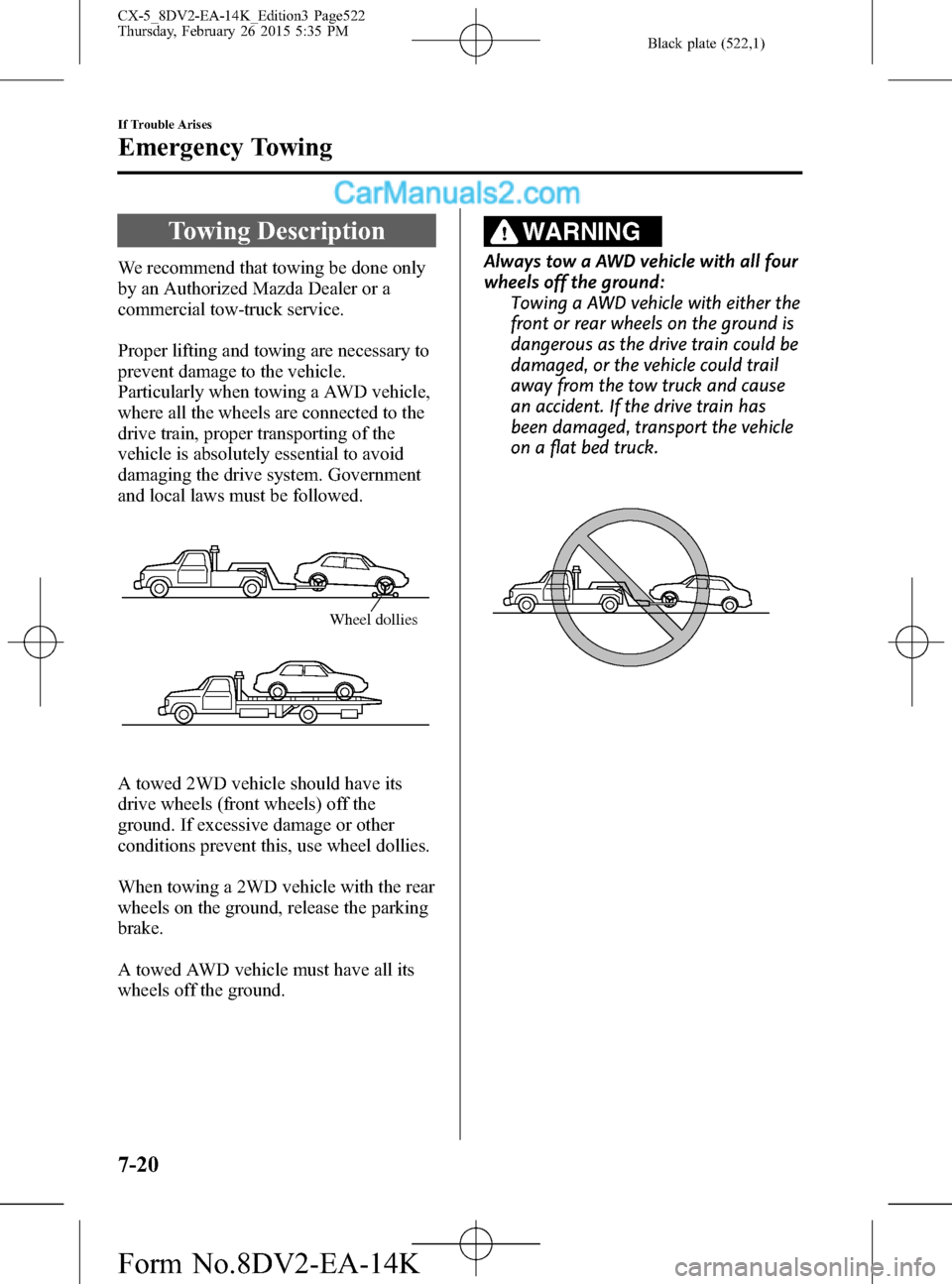
We recommend that towing be done only
by an Authorized Mazda Dealer or a
commercial tow-truck service.
Proper lifting and towing are necessary to
prevent damage to the vehicle.
Particularly when towing a AWD vehicle,
where all the wheels are connected to the
drive train, proper transporting of the
vehicle is absolutely essential to avoid
damaging the drive system. Government
and local laws must be followed.
Wheel dollies
A towed 2WD vehicle should have its
drive wheels (front wheels) off the
ground. If excessive damage or other
conditions prevent this, use wheel dollies.
When towing a 2WD vehicle with the rear
wheels on the ground, release the parking
brake.
A towed AWD vehicle must have all its
wheels off the ground.
WARNING
Always tow a AWD vehicle with all four
wheels off the ground:
Towing a AWD vehicle with either the
front or rear wheels on the ground is
dangerous as the drive train could be
damaged, or the vehicle could trail
away from the tow truck and cause
an accident. If the drive train has
been damaged, transport the vehicle
on a flat bed truck.
7-20
If Trouble Arises
Emergency Towing
CX-5_8DV2-EA-14K_Edition3 Page522
Thursday, February 26 2015 5:35 PM
Form No.8DV2-EA-14K
Page 523 of 626
Black plate (523,1)
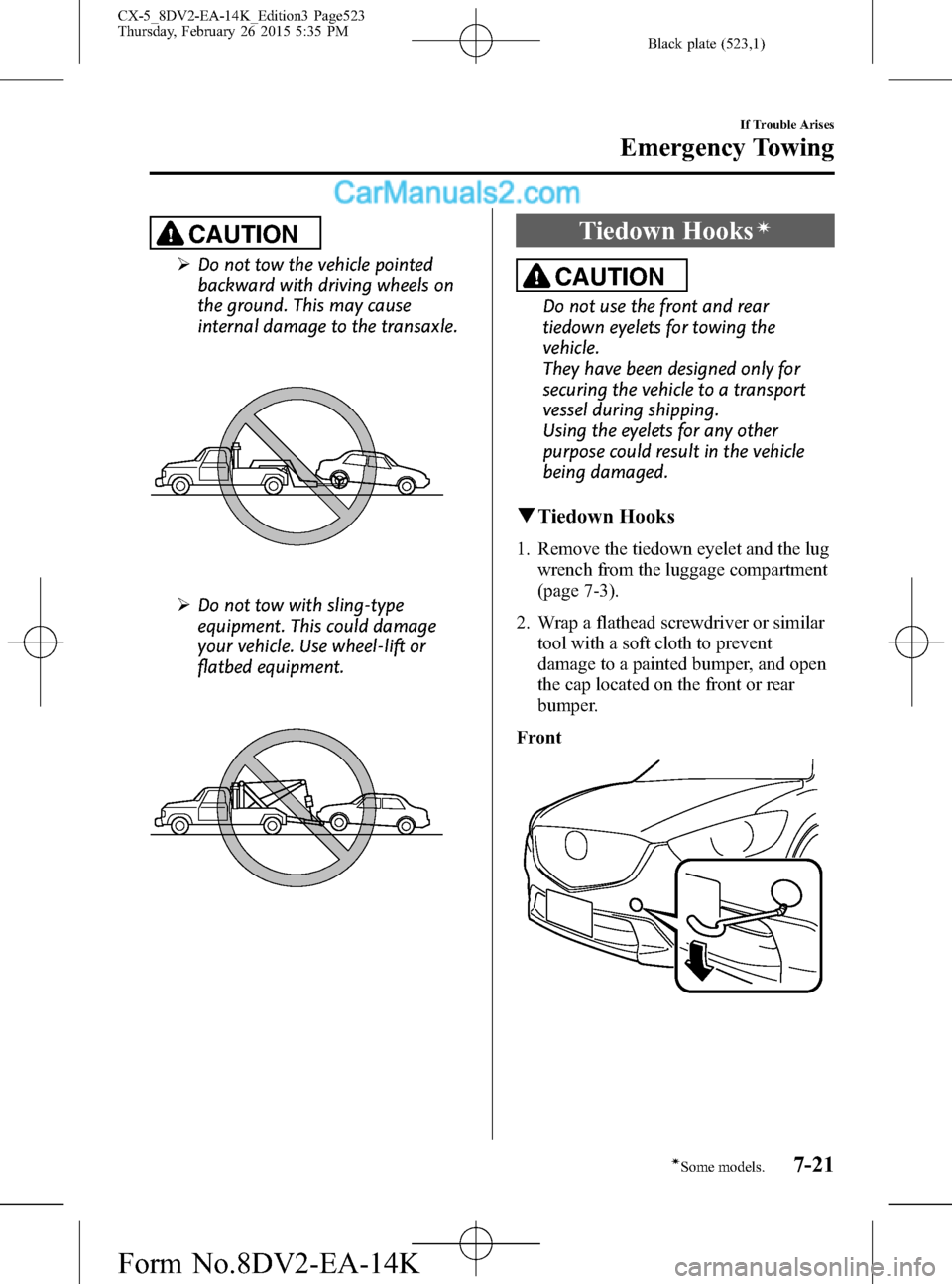
CAUTION
ØDo not tow the vehicle pointed
backward with driving wheels on
the ground. This may cause
internal damage to the transaxle.
ØDo not tow with sling-type
equipment. This could damage
your vehicle. Use wheel-lift or
flatbed equipment.
Tiedown Hooksí
CAUTION
Do not use the front and rear
tiedown eyelets for towing the
vehicle.
They have been designed only for
securing the vehicle to a transport
vessel during shipping.
Using the eyelets for any other
purpose could result in the vehicle
being damaged.
qTiedown Hooks
1. Remove the tiedown eyelet and the lug
wrench from the luggage compartment
(page 7-3).
2. Wrap a flathead screwdriver or similar
tool with a soft cloth to prevent
damage to a painted bumper, and open
the cap located on the front or rear
bumper.
Front
If Trouble Arises
Emergency Towing
7-21íSome models. CX-5_8DV2-EA-14K_Edition3 Page523
Thursday, February 26 2015 5:35 PM
Form No.8DV2-EA-14K
Page 524 of 626
Black plate (524,1)
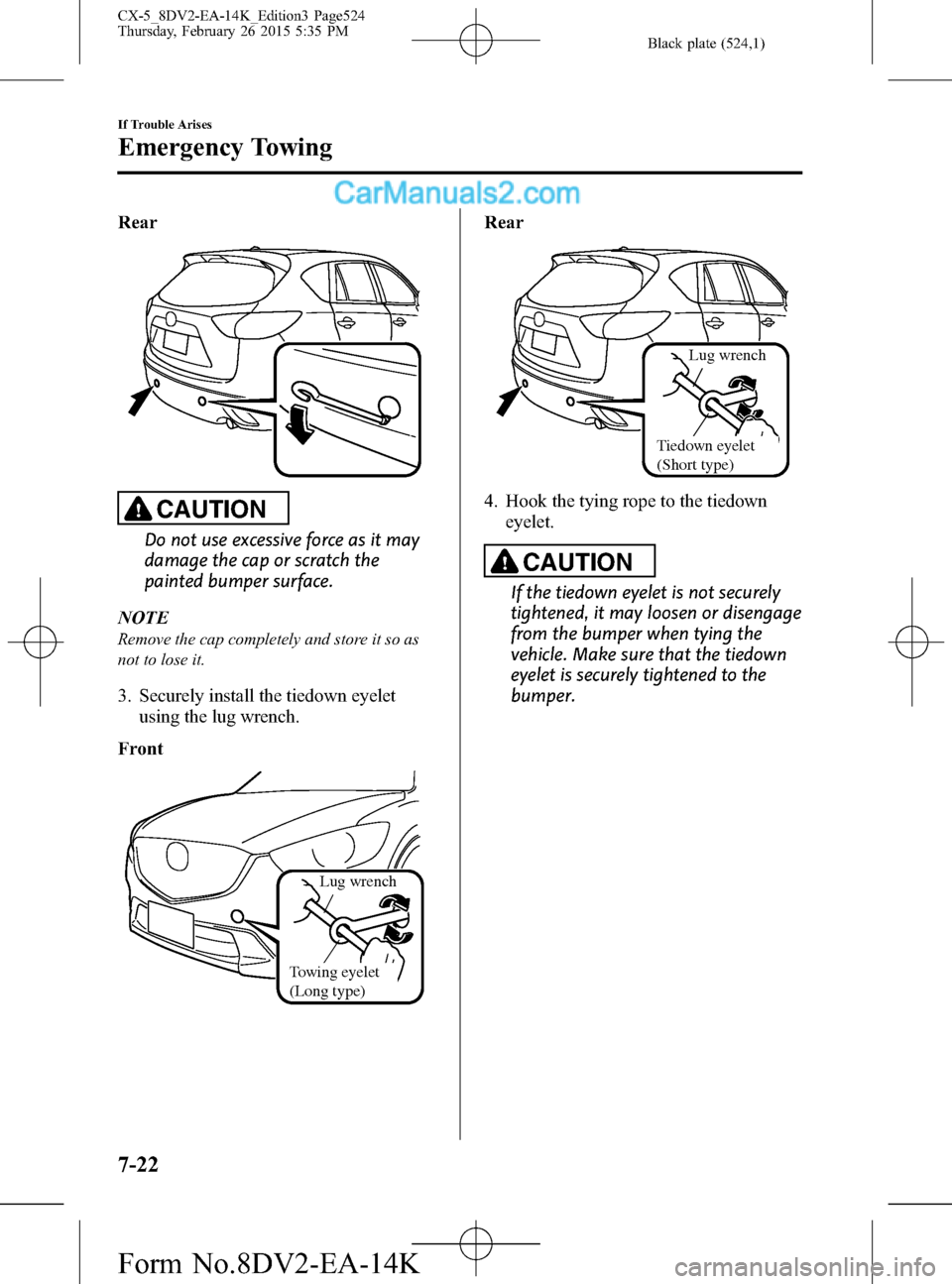
Rear
CAUTION
Do not use excessive force as it may
damage the cap or scratch the
painted bumper surface.
NOTE
Remove the cap completely and store it so as
not to lose it.
3. Securely install the tiedown eyelet
using the lug wrench.
Front
Towing eyelet
(Long type)
Lug wrench
Rear
Tiedown eyelet
(Short type)
Lug wrench
4. Hook the tying rope to the tiedown
eyelet.
CAUTION
If the tiedown eyelet is not securely
tightened, it may loosen or disengage
from the bumper when tying the
vehicle. Make sure that the tiedown
eyelet is securely tightened to the
bumper.
7-22
If Trouble Arises
Emergency Towing
CX-5_8DV2-EA-14K_Edition3 Page524
Thursday, February 26 2015 5:35 PM
Form No.8DV2-EA-14K
Page 581 of 626
Black plate (581,1)
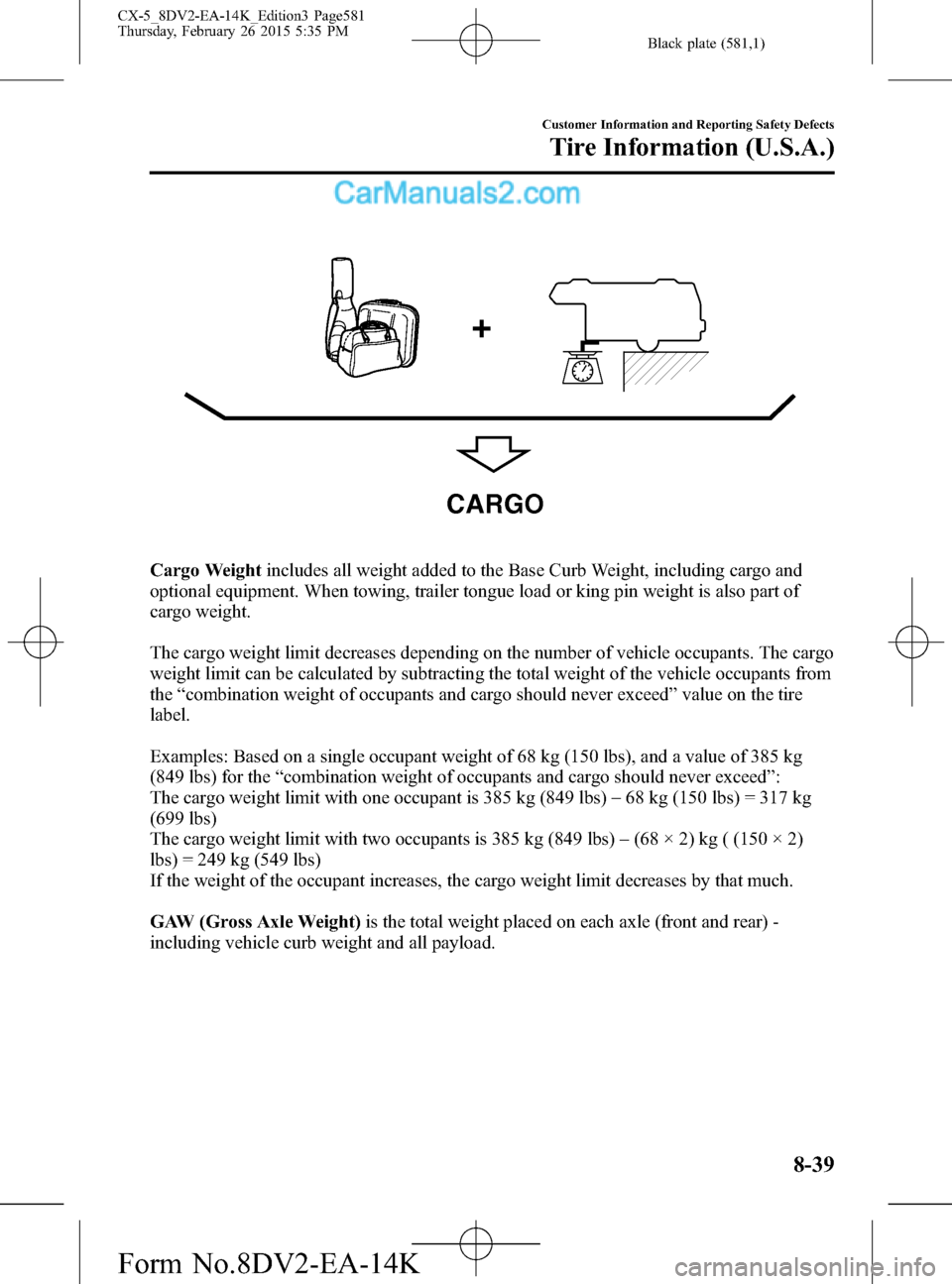
CARGO
Cargo Weightincludes all weight added to the Base Curb Weight, including cargo and
optional equipment. When towing, trailer tongue load or king pin weight is also part of
cargo weight.
The cargo weight limit decreases depending on the number of vehicle occupants. The cargo
weight limit can be calculated by subtracting the total weight of the vehicle occupants from
the“combination weight of occupants and cargo should never exceed”value on the tire
label.
Examples: Based on a single occupant weight of 68 kg (150 lbs), and a value of 385 kg
(849 lbs) for the“combination weight of occupants and cargo should never exceed”:
The cargo weight limit with one occupant is 385 kg (849 lbs)_
68 kg (150 lbs) = 317 kg
(699 lbs)
The cargo weight limit with two occupants is 385 kg (849 lbs)_
(68 × 2) kg ( (150 × 2)
lbs) = 249 kg (549 lbs)
If the weight of the occupant increases, the cargo weight limit decreases by that much.
GAW (Gross Axle Weight)is the total weight placed on each axle (front and rear) -
including vehicle curb weight and all payload.
Customer Information and Reporting Safety Defects
Tire Information (U.S.A.)
8-39
CX-5_8DV2-EA-14K_Edition3 Page581
Thursday, February 26 2015 5:35 PM
Form No.8DV2-EA-14K
Page 584 of 626
Black plate (584,1)
GCW (Gross Combination Weight)is the weight of the loaded vehicle (GVW) plus the
weight of the fully loaded trailer.
GCWR (Gross Combination Weight Rating)is the maximum allowable weight of the
vehicle and the loaded trailer - including all cargo and passengers - that the vehicle can
handle without risking damage. (Important: The towing vehicle's braking system is rated
for operation at GVWR, not at GCWR. Separate functional brakes should be used for safe
control of towed vehicles and for trailers weighing more than 1,500 lbs).The GCW must
never exceed the GCWR.
Maximum Loaded Trailer Weightis the highest possible weight of a fully loaded trailer
the vehicle can tow. It assumes a vehicle with only mandatory options, no cargo (internal or
external), a tongue load of 10_
15% (conventional trailer) or king pin weight of 15_
25%
(fifth-wheel trailer), and driver only (150 lbs).Consult your dealership (or the RV and
Trailer Towing Guide provided by your dealership) for more detailed information.
Tongue Load or Fifth-Wheel King Pin Weightrefers to the amount of the weight that a
trailer pushes down on a trailer hitch.
Examples:For a 5000 lb conventional trailer, multiply 5000 by 0.10 and 0.15 to obtain a
proper tongue load range of 500 to 750 lbs. For an 11,500 lb fifth-wheel trailer, multiply by
0.15 and 0.25 to obtain a proper king pin load range of 1,725 to 2,875 lbs.
WARNING
Exceeding GVWR or GAWR Specifications:
Exceeding the GVWR or the GAWR specified on the certification label is dangerous.
Exceeding any vehicle rating limitation could result in a serious accident, injury, or
damage to the vehicle.
Do not use replacement tires with lower load carrying capacities than the originals
because they may lower the vehicle's GVWR and GAWR limitations. Replacement
tires with a higher limit than the originals do not increase the GVWR and GAWR
limitations.
Never exceed the GVWR or the GAWR specified on the certification label.
8-42
Customer Information and Reporting Safety Defects
Tire Information (U.S.A.)
CX-5_8DV2-EA-14K_Edition3 Page584
Thursday, February 26 2015 5:35 PM
Form No.8DV2-EA-14K
Page 585 of 626

Black plate (585,1)
Steps for Determining the Correct Load Limit
Steps for Determining Correct Load Limit-
(1) Locate the statement“The combined weight of occupants and cargo should
never exceed XXX kg or XXX lbs.”on your vehicle's placard.
(2) Determine the combined weight of the driver and passengers that will be
riding in your vehicle.
(3) Subtract the combined weight of the driver and passengers from XXX kg
or XXX lbs.
(4) The resulting figure equals the available amount of cargo and luggage load
capacity. For example, if the“XXX”amount equals 1400 lbs. and there
will be five 150 lb passengers in your vehicle, the amount of available
cargo and luggage load capacity is 650 lbs. (1400_
750 (5 × 150) = 650
lbs.)
(5) Determine the combined weight of luggage and cargo being loaded on the
vehicle. That weight may not safely exceed the available cargo and luggage
load capacity calculated in Step 4.
(6) If your vehicle will be towing a trailer, load from your trailer will be
transferred to your vehicle. Consult this manual to determine how this
reduces the available cargo and luggage load capacity of your vehicle.
Customer Information and Reporting Safety Defects
Tire Information (U.S.A.)
8-43
CX-5_8DV2-EA-14K_Edition3 Page585
Thursday, February 26 2015 5:35 PM
Form No.8DV2-EA-14K