lock MAZDA MODEL CX-9 2018 (in English) User Guide
[x] Cancel search | Manufacturer: MAZDA, Model Year: 2018, Model line: MODEL CX-9, Model: MAZDA MODEL CX-9 2018Pages: 640
Page 27 of 640
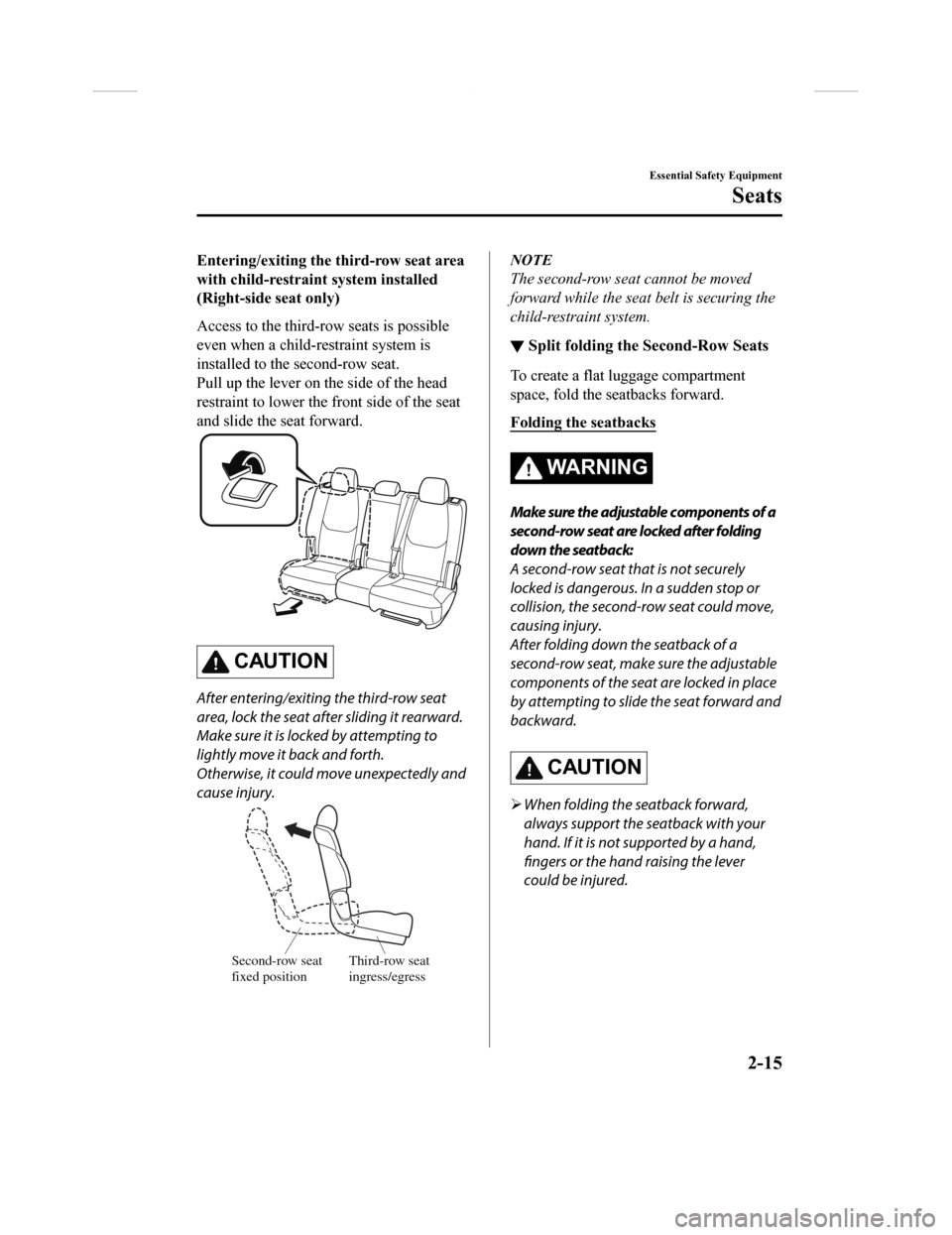
Entering/exiting the third-row seat area
with child-restraint system installed
(Right-side seat only)
Access to the third-row seats is possible
even when a child-restraint system is
installed to the second-row seat.
Pull up the lever on the side of the head
restraint to lower the front side of the seat
and slide the seat forward.
CAUTION
After entering/exiting the third-row seat
area, lock the seat after sliding it rearward.
Make sure it is locked by attempting to
lightly move it back and forth.
Otherwise, it could move unexpectedly and
cause injury.
Second-row seat
fixed position Third-row seat
ingress/egress
NOTE
The second-row seat cannot be moved
forward while the seat belt is securing the
child-restraint system.
▼
Split folding the Second-Row Seats
To create a flat luggage compartment
space, fold the seatbacks forward.
Folding the seatbacks
WA R N I N G
Make sure the adjustable components of a
second-row seat are locked after folding
down the seatback:
A second-row seat that is not securely
locked is dangerous. In a sudden stop or
collision, the second-row seat could move,
causing injury.
After folding down the seatback of a
second-row seat, make sure the adjustable
components of the seat are locked in place
by attempting to slide the seat forward and
backward.
CAUTION
When folding the seatback forward,
always support the seatback with your
hand. If it is not supported by a hand,
fingers or the hand raising the lever
could be injured.
Essential Safety Equipment
Seats
2-15
CX-9_8GC3-EA-17G_Edition1 2017-5-29 10:13:38
Page 28 of 640
Check the position of a front seat before
folding a second-row seatback.
Depending on the position of a front
seat, it may not be possible to fold a
second-row seatback all the way down
because it may hit the seatback of the
front seat which could scratch or
damage the front seat or its pocket.
Remove the head restraint on the
second-row outboard seat if necessary.
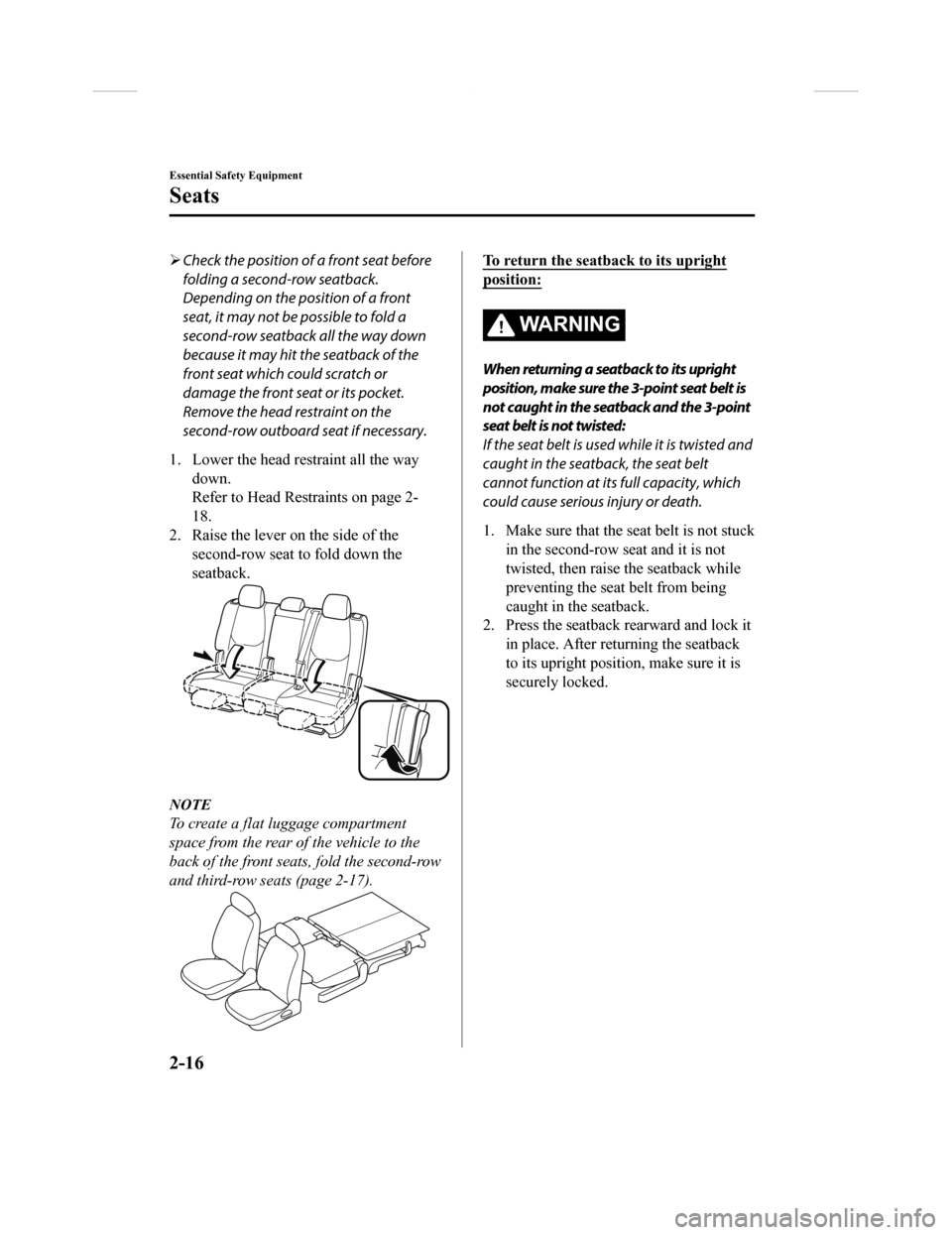
1. Lower the head restraint all the way down.
Refer to Head Rest raints on page 2-
18.
2. Raise the lever on the side of the
second-row seat to fold down the
seatback.
NOTE
To create a flat luggage compartment
space from the rear of the vehicle to the
back of the front seats, fold the second-row
and third-row seats (page 2-17).
To return the seatback to its upright
position:
WA R N I N G
When returning a seatback to its upright
position, make sure the 3-point seat belt is
not caught in the seatback and the 3-point
seat belt is not twisted:
If the seat belt is used while it is twisted and
caught in the seatback, the seat belt
cannot function at its full capacity, which
could cause serious injury or death.
1. Make sure that the seat belt is not stuck
in the second-row seat and it is not
twisted, then raise the seatback while
preventing the seat belt from being
caught in the seatback.
2. Press the seatback rearward and lock it
in place. After returning the seatback
to its upright position, make sure it is
securely locked.
Essential Safety Equipment
Seats
2-16
CX-9_8GC3-EA-17G_Edition1 2017-5-29 10:13:38
Page 32 of 640
CAUTION
When installing a head restraint, make
sure that it is installed correctly with the
front of the head restraint facing
forward. If the head restraint is installed
incorrectly, it could detach from the seat
during a collision and result in injury.
The head restraints on each of the front
and rear seats are specialized to each
seat. Do not switch around the head
restraint positions. If a head restraint is
not installed to its correct seat position,
the effectiveness of the head restraint
during a collision will be compromised
which could cause injury.
▼ Foldable Head Restraints
The third-row seats are equipped with
foldable head restraints.
NOTE
The foldable head restraints cannot be
adjusted or removed.
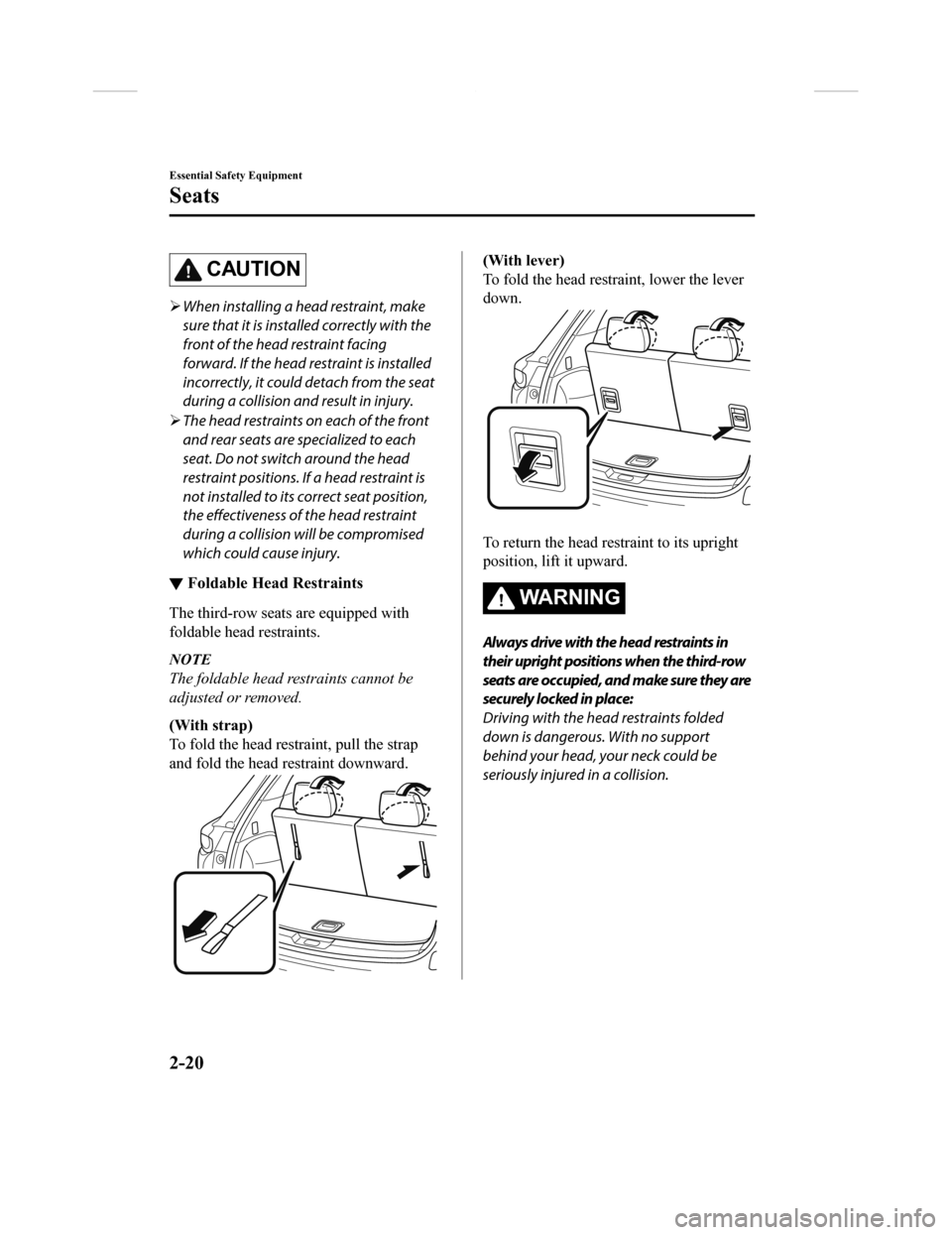
(With strap)
To fold the head restra
int, pull the strap
and fold the head restraint downward.
(With lever)
To fold the head restraint, lower the lever
down.
To return the head res traint to its upright
position, lift it upward.
WA R N I N G
Always drive with the head restraints in
their upright positions when the third-row
seats are occupied, and make sure they are
securely locked in place:
Driving with the head restraints folded
down is dangerous. With no support
behind your head, your neck could be
seriously injured in a collision.
Essential Safety Equipment
Seats
2-20
CX-9_8GC3-EA-17G_Edition1 2017-5-29 10:13:38
Page 33 of 640
Seat Belt Precautions
Seat belts help to decrease the possibility of severe injury during accidents and sudden
stops. Mazda recommends that the driver and all passengers alwa ys wear seat belts.
(Except Mexico)
All of the seat belt retractors are designed to keep the lap/sh oulder belts out of the way when
not in use.
The driver's seat belt has no pr ovisions for child-restraint systems and has only an
emergency locking mode. The driver may wear it comfortably, and it will lock during a
collision.
However, the front passenger's s eat and all rear lap/shoulder belt retractors operate in two
modes: emergency locking mode, and for child-restraint systems, automatic locking mode.
While we recommend you put all children in the rear seats, if y ou must use the front
passenger seat for a child, slide the front passenger seat as far back as possible and make
sure any child-restraint sy stem is secured properly.
(Mexico)
All the seats have lap/shoulder belts. These belts have retract ors with inertia locks that keep
them out of the way when not in use. The locks allow the belts to remain comfortable on
users, but they will lock in position during a collision.
WA R N I N G
Always wear your seat belt and make sure all occupants are properly restrained:
Not wearing a seat belt is extremely dangerou s. During a collision, occupants not wearing
seat belts could hit someone or things inside the vehicle or even be thrown out of the vehicle.
They could be seriously injured or even killed. In the same collision, occupants wearing seat
belts would be much safer.
Do not wear twisted seat belts:
Twisted seat belts are dangerous. In a collision, the full width of the belt is not available to
absorb the impact. This puts more force on the bones beneath the belt, which could cause
serious injury or death. So, if your seat belt is twisted, you must straighten the seat belt to
remove any twists and to allow the fu ll width of the belt to be used.
Never use one seat belt on more than one person at a time:
Using one seat belt for more than one person at a time is dangerous. A seat belt used in this
way cannot spread the impact forces properly and the two passengers could be crushed
together and seriously injured or even killed. Ne ver use one belt for more than one person at a
time and always operate the vehicle wi th each occupant properly restrained.
Essential Safety Equipment
Seat Belt Systems
2-21
CX-9_8GC3-EA-17G_Edition1 2017-5-29 10:13:38
Page 35 of 640
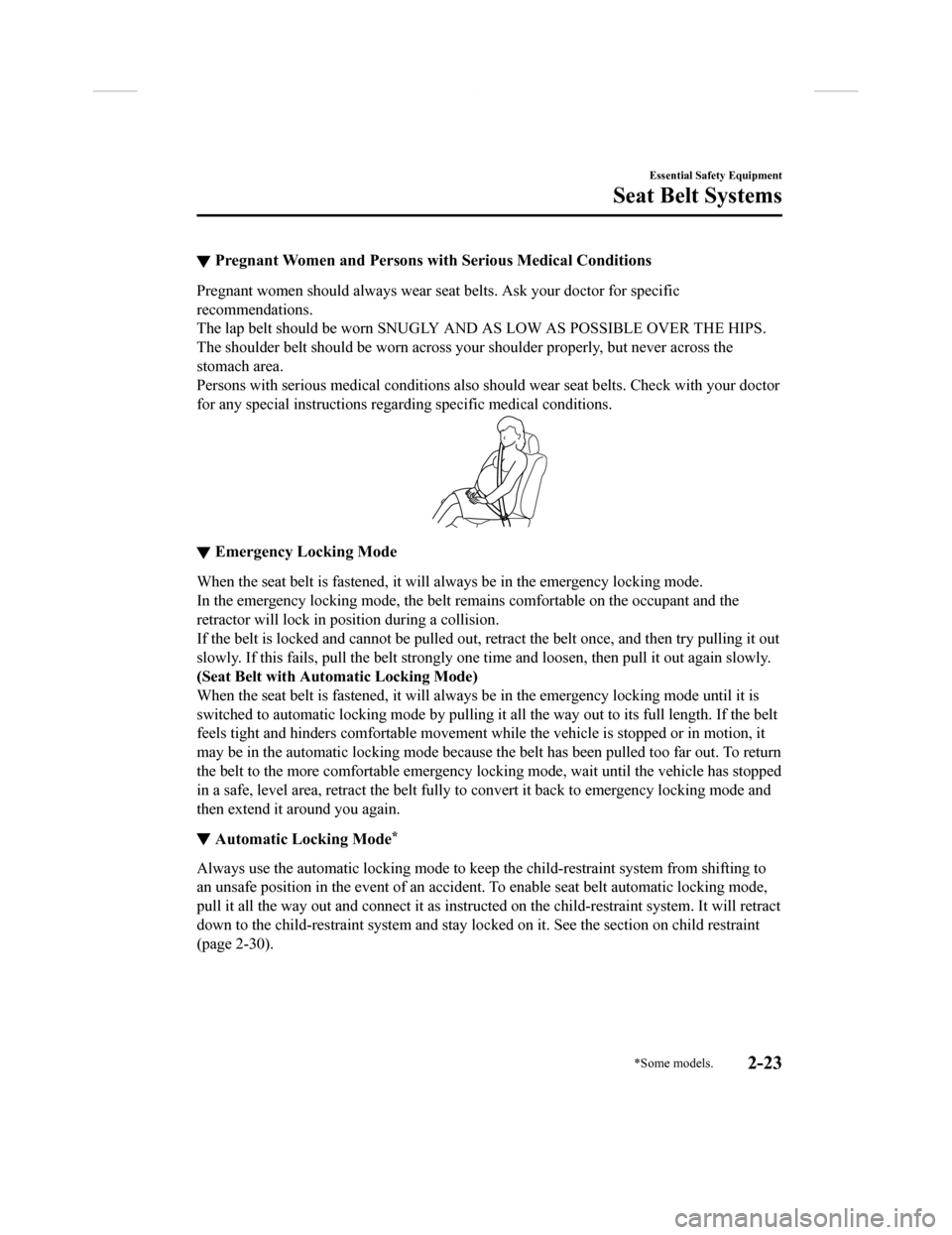
▼Pregnant Women and Persons wi
th Serious Medical Conditions
Pregnant women should always wear seat belts. Ask your doctor f or specific
recommendations.
The lap belt should be worn SNUGL Y AND AS LOW AS POSSIBLE OVER THE HIPS.
The shoulder belt should be worn across your shoulder properly, but never across the
stomach area.
Persons with serious medical conditions also should wear seat b elts. Check with your doctor
for any special instructions regarding specific medical conditi ons.
▼Emergency Locking Mode
When the seat belt is fastened,
it will always be in the emergency locking mode.
In the emergency locking mode, the belt remains comfortable on the occupant and the
retractor will lock in position during a collision.
If the belt is locked and cannot be pulled out, retract the belt once, and then try pulling it out
slowly. If this fails, pull the belt strongly one time and loos en, then pull it out again slowly.
(Seat Belt with Auto matic Locking Mode)
When the seat belt is fastened, it will always be in the emergency locking mode until it is
switched to automatic locking mode by pulling it all the way ou t to its full length. If the belt
feels tight and hinders comfortabl e movement while the vehicle is stopped or in motion, it
may be in the automatic locking mode because the belt has been pulled too far out. To return
the belt to the more c omfortable emergency locking mode, wait until the vehicle has stopped
in a safe, level area, retract the belt fully to convert it bac k to emergency locking mode and
then extend it around you again.
▼ Automatic Locking Mode*
Always use the automatic locking mode to keep the child-restrai
nt system from shifting to
an unsafe position in the event of an accident. To enable seat belt automatic locking mode,
pull it all the way out and connect it as instructed on the chi ld-restraint system. It will retract
down to the child-res traint system and stay locked on it. See t he section on child restraint
(page 2-30).
Essential Safety Equipment
Seat Belt Systems
*Some models.2-23
CX-9_8GC3-EA-17G_Edition1 2017-5-29 10:13:38
Page 37 of 640
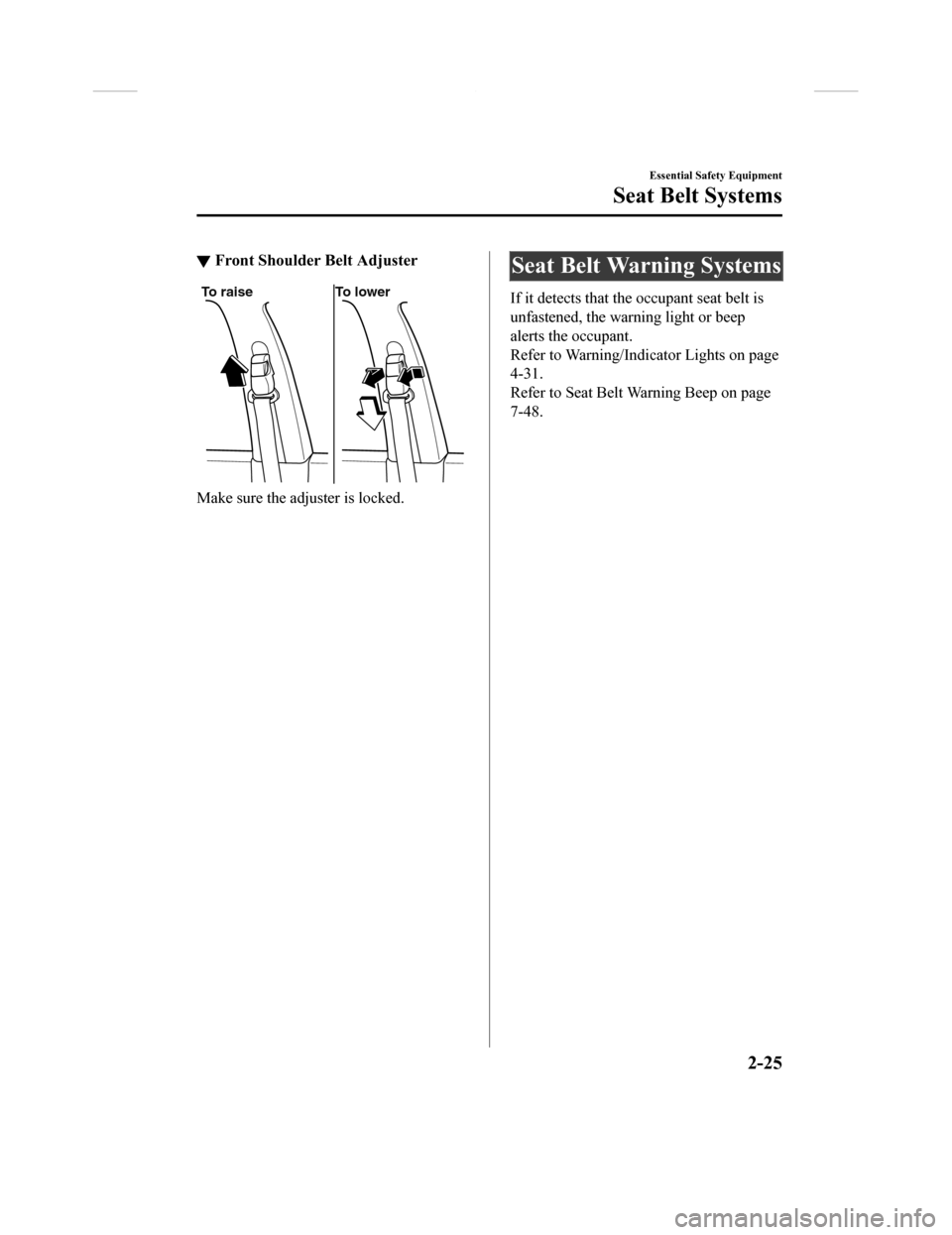
▼Front Shoulder Belt Adjuster
To raise
To lower
Make sure the adjuster is locked.
Seat Belt Warning Systems
If it detects that the occupant seat belt is
unfastened, the warning light or beep
alerts the occupant.
Refer to Warning/Indicator Lights on page
4-31.
Refer to Seat Belt Warning Beep on page
7-48.
Essential Safety Equipment
Seat Belt Systems
2-25
CX-9_8GC3-EA-17G_Edition1 2017-5-29 10:13:38
Page 45 of 640

Seating a child in a child-restraint system on the front passenger seat is dangerous under
certain conditions (With Front Passenger Occupant Classification System):
Your vehicle is equipped with front passenger occupant classification sensor. Even with the
front passenger occupant classification sensor, if you must use the front passenger seat to
seat a child, using a child-restraint system on the front passenger seat under the following
conditions increases the danger of the front passenger air bag deploying and could result in
serious injury or death to the child.
The front passenger air bag deactivation indicator light does not illuminate when seating a
child in the child-restraint system.
Luggage or other items are placed on the seat with the child in the child-restraint system.
A rear passenger or luggage pushing or pulling down on the front passenger seatback.
Luggage or other items are placed on the seatback or hung on the head restraint.
The seat is washed.
Liquids are spilled on the seat.
The front passenger seat is moved backward, pushing into luggage or other items placed
behind it.
The front passenger seatback contacts the rear seat.
Luggage or other items are placed between the front passenger seat and driver seat.
An electric device is put on the front passenger's seat.
An additional electrical device, such as a seat warmer is installed to the surface of the front
passenger seat.
The designated positions with seat belts on the rear seats are the safest places for children.
Always use seat belts and child restraints.
Do not allow a child or anyone to lean over or against the side window of a vehicle with side
and curtain air bags:
It is dangerous to allow anyone to lean over or against the side window, the area of the front
passenger seat, the front and rear window pillar s and the roof edge along both sides from
which the side and curtain air bags deploy, even if a child-restraint system is used. The impact
of inflation from a side or curtain air bag could cause serious injury or death to an out of
position child. Furthermore, le aning over or against the front door could block the side and
curtain air bags and eliminate th e advantages of supplemental protection. With the front air
bag and the additional side air bag that comes out of the front seat, the rear seat is always a
better location for children. Take special care not to allow a child to lean over or against the
side window, even if the child is seated in a child-restraint system.
Essential Safety Equipment
Child Restraint
2-33
CX-9_8GC3-EA-17G_Edition1 2017-5-29 10:13:38
Page 56 of 640

Only use a tether anchor designed for the
second-row seats:
Using a third-row seat tether anchor on the
second-row seat is dangerous. The
child-restraint system cannot be installed
correctly which may result in death or
injury to the child in a collision.
Tether strap
Third-row seatSecond-row
outboard/center
Always route the tether straps to the sides
of the head restraint (Third-row seat):
Routing the tether straps on top of the
head restraint is dangerous. In a collision
the tether straps could slide
off the head
restraint and loosen the child-restraint
system. The child-restraint system could
move which may result in death or injury to
the child.
Tether strap
ForwardThird-row seat
▼Using Automatic Locking Mode*
Follow these instructions when using a
child-restraint system, unless you are
attaching a LATCH-equipped
child-restraint syst
em to the rear LATCH
lower anchors. Refer to “Using LATCH
Lower Anchor” (page 2-52).
NOTE
Follow the child- restraint system
manufacturer's instructions carefully. If
you are not sure whether you have a
LATCH system or tether, check in the
child-restraint system manufacturer's
instructions and follow them accordingly.
Depending on the type of child-restraint
system, it may use LATCH system instead
of seat belts or if the belt goes across the
child's chest, may recommend against
using automatic locking mode.
1. (Second-row seat)
Adjust the second-row seat position
using the following procedure.
Fold the second-row seatback
forward.
Raise the second-row seatback until
a click sound is heard and it is locked
in place.
2. Make sure the seatback is securely
latched by pushing it back until it is
fully locked.
Essential Safety Equipment
Child Restraint
2-44*Some models.
CX-9_8GC3-EA-17G_Edition1 2017-5-29 10:13:38
Page 57 of 640
3.(Second-row seat)
Remove the head restraint. However,
when installing a backless booster seat,
always install the vehicle head restraint
to the seat where the backless booster
seat is installed.
Refer to Head Restraints on page 2-18.
4. Secure the child-restraint system with the lap portion of the lap/shoulder belt.
See the manufacturer's instructions on
the child-restraint system for belt
routing instructions.
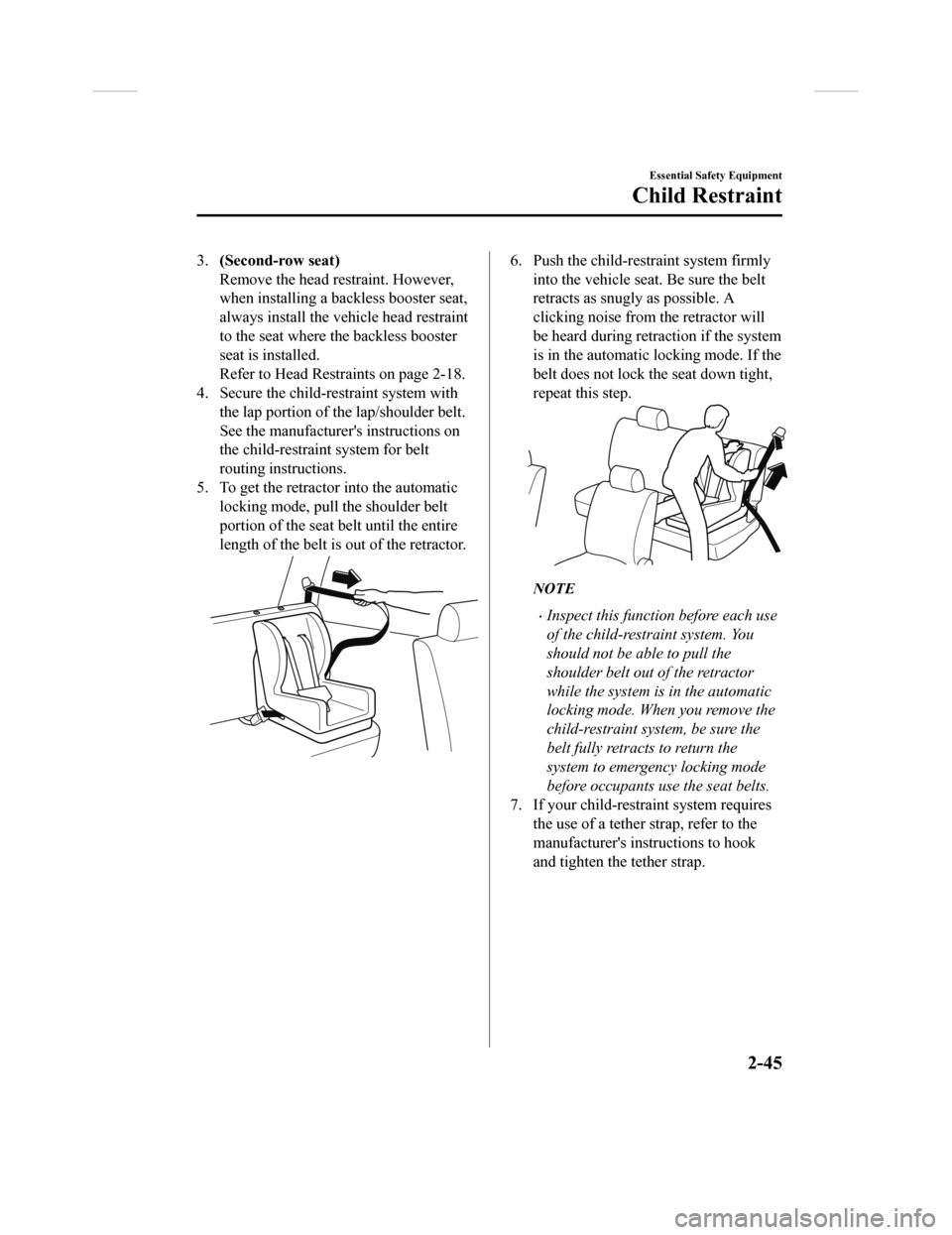
5. To get the retractor into the automatic locking mode, pull the shoulder belt
portion of the seat belt until the entire
length of the belt is out of the retractor.6. Push the child-restraint system firmly
into the vehicle seat. Be sure the belt
retracts as snugly as possible. A
clicking noise from the retractor will
be heard during retraction if the system
is in the automatic locking mode. If the
belt does not lock the seat down tight,
repeat this step.
NOTE
•Inspect this function before each use
of the child-restraint system. You
should not be able to pull the
shoulder belt out of the retractor
while the system is in the automatic
locking mode. When you remove the
child-restraint system, be sure the
belt fully retracts to return the
system to emergency locking mode
before occupants use the seat belts.
7. If your child-restraint system requires the use of a tether strap, refer to the
manufacturer's instructions to hook
and tighten the tether strap.
Essential Safety Equipment
Child Restraint
2-45
CX-9_8GC3-EA-17G_Edition1 2017-5-29 10:13:38
Page 60 of 640
NOTE
•To check if your front seats have side air
bags:
Mazda vehicles equipped with side air
bag will have a "SRS AIRBAG" tag on
the outboard shoulder of the front seats.
•To check if your vehicle has curtain air
bags:
Mazda vehicles equipped with curtain
air bag will have an "SRS AIRBAG"
marking on the window pillars along the
roof edge.
WA R N I N G
Always move the front passenger seat as
far back as possible if installing a
front-facing child-restraint system on it is
unavoidable:
As your vehicle has front air bags and
doubly so because your vehicle has side air
bags, a front-facing child-restraint system
should be put on the front passenger seat
only when it is unavoidable.
Even if the front passenger air bag
deactivation indicator light illuminates,
always move the seat as far back as
possible, because the force of a deploying
air bag could cause serious injury or death
to the child.
Never use a rear-facing child-restraint
system in the front seat with an air bag
that could deploy:
Rear-facing child-restraint systems on the
front seat are particularly dangerous.
Even in a moderate collision, the
child-restraint system can be hit by a
deploying air bag and moved violently
backward resulting in serious injury or
death to the child. Even though you may
feel assured that the front passenger air
bag will not deploy based on the fact that
the front passenger air bag deactivation
indicator light illuminates, you should not
use a rear-facing child-restraint system in
the front seat.
Do not allow a child or anyone to lean over
or against the side window of a vehicle
with side and curtain air bags:
It is dangerous to allow anyone to lean
over or against the side window, the area
of the front passenger seat, the front and
rear window pillars and the roof edge
along both sides from which the side and
curtain air bags deploy, even if a
child-restraint system is used. The impact
of inflation from a side or curtain air bag
could cause serious injury or death to an
out of position child. Furthermore, leaning
over or against the front door could block
the side and curtain air bags and eliminate
the advantages of supplemental
protection. With the front air bag and the
additional side air bag that comes out of
the front seat, the rear seat is always a
better location for children. Take special
care not to allow a child to lean over or
against the side window, even if the child is
seated in a child-restraint system.
Essential Safety Equipment
Child Restraint
2-48
CX-9_8GC3-EA-17G_Edition1 2017-5-29 10:13:38