trailer MAZDA MODEL CX-9 2019 (in English) Owner's Manual
[x] Cancel search | Manufacturer: MAZDA, Model Year: 2019, Model line: MODEL CX-9, Model: MAZDA MODEL CX-9 2019Pages: 692
Page 355 of 692

The surroundings are dark such as during the night, early evening, or early morning, or
in a tunnel or indoor parking lot.
The illumination brightness of the headlights is reduced or the headlight illumination is
weakened due to dirt or a deviated optical axis.
The target object enters the blind spot of the Forward Sensing Camera (FSC).
A person or object bursts onto the road from the shoulder or cuts right in front of you.
You change lanes and approach a vehicle ahead.
When driving extremely close to the target object.
Tire chains or a temporary spare tire is installed.
The vehicle ahead has a special shape. For example, a vehicle towing a trailer house or
a boat, or a vehicle carrier carrying a vehicle with its front pointed rearward.
If the Forward Sensing Camera (FSC) cannot operate normally due to backlight or fog,
the system functions related to the Forward Sensing Camera (FSC) are temporarily
stopped and the following warning lights turn on. However, this does not indicate a
malfunction.
High Beam Control System (HBC) warning light (amber)
Lane-keep Assist System (LAS) & Lane Departure Warning System (LDWS) warning
indication
Mazda Radar Cruise Control with Stop & Go function (MRCC with Stop & Go
function) warning indication
Smart Brake Support/Smart City Brake Support (SBS/SCBS) warning indication
(amber)
If the Forward Sensing Camera (FSC) cannot operate normally due to high temperatures,
the system functions related to the Forward Sensing Camera (FSC) are temporarily
stopped and the following warning lights turn on. However, this does not indicate a
malfunction. Cool down the area around the Forward Sensing Camera (FSC) such as by
turning on the air conditioner.
High Beam Control System (HBC) warning light (amber)
Lane-keep Assist System (LAS) & Lane Departure Warning System (LDWS) warning
indication
Mazda Radar Cruise Control with Stop & Go function (MRCC with Stop & Go
function) warning indication
Smart Brake Support/Smart City Brake Support (SBS/SCBS) warning indication
(amber)
When Driving
i-ACTIVSENSE
4-195
CX-9_8HB2-EA-18G_Edition1 2018-5-11 13:09:27
Page 358 of 692

Do not use the front bumper to push other vehi cles or obstructions such as when pulling
out of a parking space. Otherwise, the radar sensor (front) could be hit and its position
deviated.
Do not remove, disassemble, or modify the radar sensor (front).
For repairs, replacement or paint work around the radar sensor (front), consult an
Authorized Mazda Dealer.
Do not modify the suspension. If the suspensi on are modified, the vehicle's posture could
change and the radar sensor (front) may not be able to correctly detect a vehicle ahead or
an obstruction.
NOTE
Under the following conditions, the radar sensor (front) may not be able to detect vehicles
ahead or obstructions correctly and each system may not operate normally.
The rear surface of a vehicle ahead does not reflect radio waves effectively, such as an
unloaded trailer or an automobile with a loading platform covered by a soft top,
vehicles with a hard plastic tailgate, and round-shaped vehicles.
Vehicles ahead with low vehicle height and thus less area for reflecting radio waves.
Visibility is reduced due to a vehicle ahead ca sting off water, snow, or sand from its tires
and onto your windshield.
The luggage compartment is loaded with heavy objects or the rear passenger seats are
occupied.
Ice, snow, or soiling is on the front surface of the front emblem.
During inclement weather such as rain, snow, or sand storms.
When driving near facilities or objects emitting strong radio waves.
Under the following conditions, the radar sensor (front) may not be able to detect vehicles
ahead or obstructions.
The beginning and end of a curve.
Roads with continuous curves.
Narrow lane roads due to road construction or lane closures.
The vehicle ahead enters the radar sensor's blind spot.
The vehicle ahead is running abnormally due to accident or vehicle damage.
Roads with repeated up and down slopes
Driving on poor roads or unpaved roads.
The distance between your vehicle and the vehicle ahead is extremely short.
A vehicle suddenly comes close such as by cutting into the lane.
To prevent incorrect operation of the system, use tires of the same specified size,
manufacturer, brand, and tread pattern on all four wheels. In addition, do not use tires
with significantly different wear patterns or tire pressures on the same vehicle (Including
the temporary spare tire).
If the battery power is weak, the system may not operate correctly.
When Driving
i-ACTIVSENSE
4-198
CX-9_8HB2-EA-18G_Edition1 2018-5-11 13:09:27
Page 361 of 692

Vehicle shapes which do not reflect radar waves well such as empty trailers with a low
vehicle height and sports cars.
Vehicles are shipped with the direction of the radar sensors (rear) adjusted for each
vehicle to a loaded vehicle condition so that the radar sensors (rear) detect approaching
vehicles correctly. If the direction of the radar sensors (rear) has deviated for some
reason, have the vehicle inspected at an Authorized Mazda Dealer.
For repairs or replacement of the radar sensors (rear), or bumper repairs, paintwork, and
replacement near the radar sensors, consult an Authorized Mazda Dealer.
Turn off the system while pulling a trailer or while an accessory such as a bicycle carrier
is installed to the rear of the vehicle. Otherwise, the radio waves emitted by the radar will
be blocked causing the system to not operate normally.
The radar sensors are regulated by the relevant radio wave laws of the country in which
the vehicle is driven. If the vehicle is driven abroad, authorization from the country in
which the vehicle is driven may be required.
When Driving
i-ACTIVSENSE
4-201
CX-9_8HB2-EA-18G_Edition1 2018-5-11 13:09:27
Page 381 of 692
The vehicle is driven on bumps, inclines, gravel, or grass covered roads.
Anything which generates ultrasound is near the vehicle, such as another vehicle's
horn, the engine sound of a motorcycle, the air brake sound of a large-sized vehicle, or
another vehicle's sensors.
The vehicle is driven in heavy rain or in road conditions causing water-splash.
A commercially-available fender pole or an antenna for a radio transmitter is installed
to the vehicle.
The vehicle is moving towards a tall or square curbstone.
An obstruction is too close to the sensor.
Obstructions under the bumper may not be detected. Obstructions that are lower than the
bumper or thin which may have been initially detected may no longer be detected as the
vehicle approaches more closely to the obstruction.
The following types of obstructions may not be detected:
Thin objects such as wire or rope
Things which absorb sonic waves easily such as cotton or snow
Angular shaped objects
Very tall objects, and those which are wide at the top
Small, short objects
Always have the system inspected at an Authorized Mazda Dealer if any shock is applied
to the bumpers, even in a minor accident. If the sensors are deviated, they cannot detect
obstructions.
(With front sensor and front corner sensor)
The system may have a malfunction if the beep does not operate or the indicator light
does not illuminate when the park assist sensors switch is turned on. Consult an
Authorized Mazda Dealer.
(Without front sensor an d front corner sensor)
The system may have a malfunction if the be ep does not operate. Consult an Authorized
Mazda Dealer.
(With front sensor and front corner sensor)
The system may have a malfunction if the beep sound which indicates a system
malfunction is heard and the i ndicator light flashes. Consult an Authorized Mazda Dealer.
The beeper which indicates a system malf unction may not be heard if the ambient
temperature is extremely cold, or mud, ice, or snow adheres to the sensor area. Remove
any foreign material from the sensor area.
When installing a trailer hitch, consult an Authorized Mazda Dealer.
When Driving
Parking Sensor System
4-221
CX-9_8HB2-EA-18G_Edition1 2018-5-11 13:09:27
Page 549 of 692

Fuse block (Left side)
DESCRIPTIONFUSE
RATING PROTECTED COMPONENT
1 P.SEAT D 30 A Power seat
*
2 P.WINDOW3 30 A Power windows
3 R.OUTLET3 15 A Accessory sockets
4 P.WINDOW2 25 A Power windows
5PLG 2 0 A
Power liftgate
*
6 D.LOCK 25 A Power door locks
7 SEAT WARM 20 A Seat warmer
*
8 SRS2/ESCL 15 ATrailer hitch*
9 SUNROOF 10 AMoonroof*
10 INTERIOR2 15 A Audio system
11 ENG+BB 7.5 A Engine control system
12 MIRROR 7.5 A Power control mirror
13 AT IND 7.5 A AT shift indicator
14 F.OUTLET 15 A Accessory sockets
15 R.OUTLET1 15 A Accessory sockets
*
16― ― ―
Maintenance and Care
Owner Maintenance
*Some models.6-55
CX-9_8HB2-EA-18G_Edition1 2018-5-11 13:09:27
Page 648 of 692
Ve h i c l e L o a d i n g
This section will guide you in the proper loading of your vehicle and/or trailer, to keep your
loaded vehicle weigh t within its design rating capability, with or without a trailer. Properly
loading your vehicle will provide maximum return of vehicle des ign performance. Before
loading your vehicle, familiarize yourself with the following t erms for determining your
vehicle's weight ratings, with o r without a trailer, from the vehicle's Safety Certification
Label and Tire and Load Information Label:
WA R N I N G
Overloaded Vehicle:
Overloading a vehicle is dangerous. The results of overloading can have serious consequences
in terms of passenger safety. Too much weight on a vehicle's suspension system can cause
spring or shock absorber failure, brake failu re, handling or steering problems, irregular tire
wear, tire failure or other damage.
Overloading makes a vehicle harder to drive an d control. It also increases the distance
required for stopping. In cases of serious overloading, brakes can fail completely, particularly
on steep grades. The load a tire will carry safely is a combination of the size of the tire, its load
range, and corresponding inflation pressure.
Never overload the vehicle and always observe th e vehicle's weight ratings from the vehicle's
Safety Certification and Tire and Load Information labels.
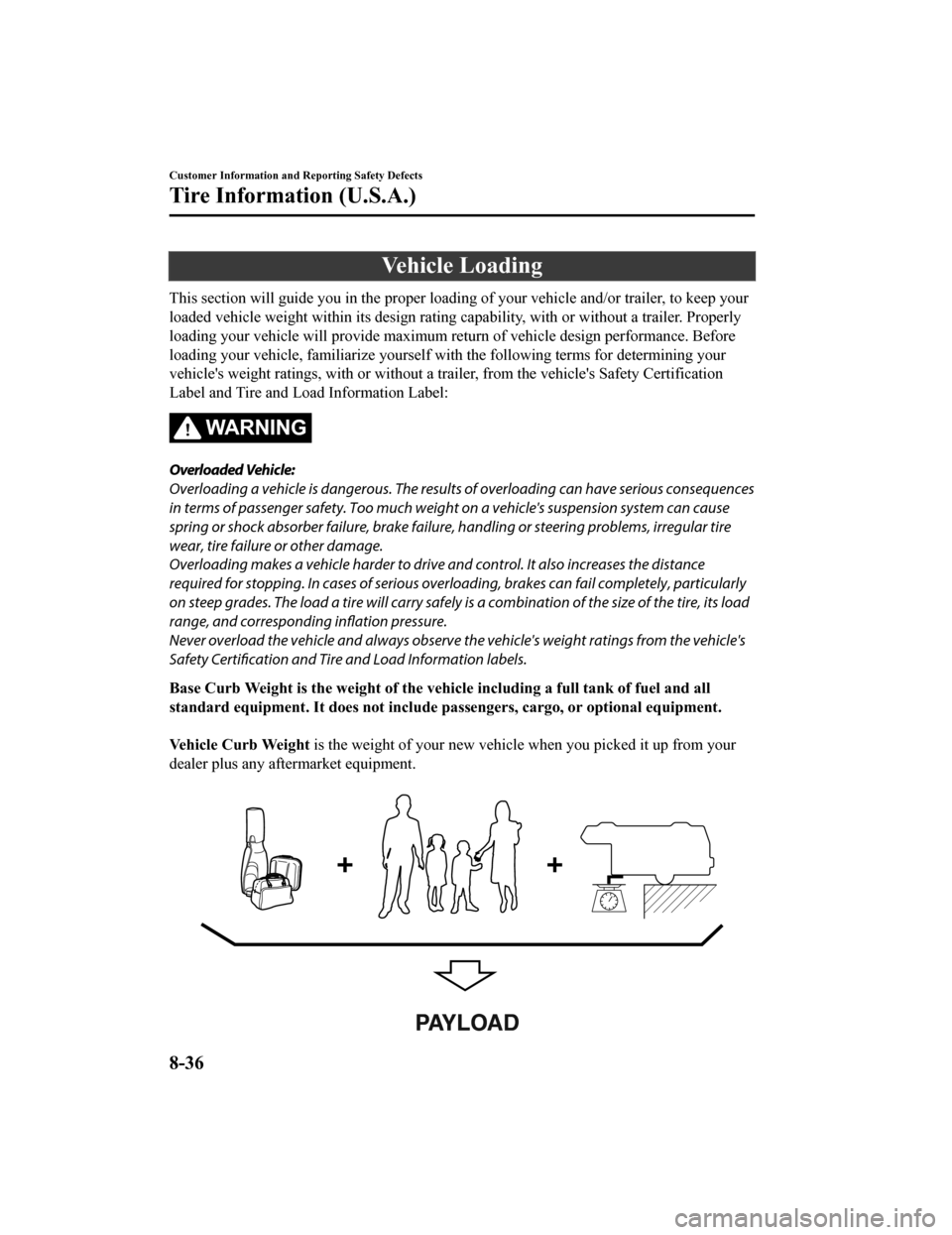
Base Curb Weight is the weight o f the vehicle including a full tank of fuel and all
standard equipment. It does not i nclude passengers, cargo, or optional equipment.
Vehicle Curb Weight is the weight of your new vehicle when you picked it up from y our
dealer plus any aftermarket equipment.
PAYLOAD
Customer Information and Reporting Safety Defects
Tire Information (U.S.A.)
8-36
CX-9_8HB2-EA-18G_Edition1 2018-5-11 13:09:27
Page 650 of 692

Cargo Weight includes all weight added to the Base Curb Weight, including c argo and
optional equipment. When towing, trailer tongue load or king pi n weight is also part of
cargo weight.
The cargo weight limit decreases depending on the number of veh icle occupants. The cargo
weight limit can be calculated by subtracting the total weight of the vehicle occupants from
the “combination weight of occupants and cargo should never exc eed” value on the tire
label.
Examples: Based on a single occupant weight of 68 kg (150 lbs), and a value of 385 kg (849
lbs) for the “combination weight of occupants and cargo should never exceed”:
The cargo weight limit with one occupant is 385 kg (849 lbs) - 68 kg (150 lbs) = 317 kg
(699 lbs)
The cargo weight limit with two occupants is 385 kg (849 lbs) - (68 × 2) kg ( (150 × 2)
lbs) = 249 kg (549 lbs)
If the weight of the occupant increases, the cargo weight limit decreases by that much.
GAW (Gross Axle Weight) is the total weight placed on each axle (front and rear) -
including vehicle curb weight and all payload.
GAWR (Gross Axle Weight Rating) is the maximum allowable weight that can be carried
by a single axle (front or rear). These numbers are shown on the Safety Compliance
Certification Label located on the driver's door frame or door pillar. The total load on
each axle must never exceed its GAWR.
GVW
GVW (Gross Vehicle Weight) is the Vehicle Curb Weight cargo passengers.
Customer Information and Reporting Safety Defects
Tire Information (U.S.A.)
8-38
CX-9_8HB2-EA-18G_Edition1 2018-5-11 13:09:27
Page 652 of 692

Always keep the vehicle within the axle weight rating limits.
GCW
GCW (Gross Combination Weight) is the weight of the loaded vehicle (GVW) plus the
weight of the fu lly loaded trailer.
GCWR (Gross Combination Weight Rating) is the maximum allowable weight of the
vehicle and the loaded trailer - including all cargo and passen gers - that the vehicle can
handle without risking damage. (Important: The towing vehicle's braking system is rated for
operation at GVWR, not at GCWR. Separate functional brakes shou ld be used for safe
control of towed vehicles and for trailers weighing more than 1,500 lbs). The GCW must
never exceed the GCWR.
Maximum Loaded Trailer Weight is the highest possible weight of a fully loaded trailer
the vehicle can tow. It assumes a vehicle with only mandatory o ptions, no cargo (internal or
external), a tongue load of 10 -15% (conventional trailer) or king pin weight of 15-25%
(fifth-wheel trailer), and driver only (150 lbs). Consult your dealership (or the RV and
Trailer Towing Guide provided by your dealership) for more detailed information.
Tongue Load or Fifth-Wheel King Pin Weight refers to the amount of the weight that a
trailer pushes down on a trailer hitch.
Examples: For a 5000 lb conventional trailer, multiply 5000 by 0.10 and 0.15 to obtain a
proper tongue load range of 500 to 750 lbs. For an 11,500 lb fi fth-wheel trailer, multiply by
0.15 and 0.25 to obtain a proper king pin load range of 1,725 t o 2,875 lbs.
Customer Information and Reporting Safety Defects
Tire Information (U.S.A.)
8-40
CX-9_8HB2-EA-18G_Edition1 2018-5-11 13:09:27
Page 654 of 692

Steps for Determining the Correct Load Limit
Steps for Determining Correct Load Limit-
(1) Locate the statement “The combined weight of occupants and cargo should never
exceed XXX kg or XXX lbs.” on your vehicle's placard.
(2) Determine the combined weight of the driver and passengers t hat will be riding in your
vehicle.
(3) Subtract the combined weight of the driver and passengers from XXX kg or XXX lbs.
(4) The resulting figure equals the available amount of cargo an d luggage load capacity. For
example, if the “XXX” amount equ als 1400 lbs. and there will be five 150 lb passengers
in your vehicle, the amount of available cargo and luggage load capacity is 650 lbs.
(1400 - 750 (5 × 150) = 650 lbs.)
(5) Determine the combined weight of luggage and cargo being loa ded on the vehicle. That
weight may not safely exceed the available cargo and luggage lo ad capacity calculated
in Step 4.
(6) If your vehicle will be towi ng a trailer, load from your trailer will be transferred to your
vehicle. Consult this manual to determine how this reduces the available cargo and
luggage load capacity of your vehicle.
Customer Information and Reporting Safety Defects
Tire Information (U.S.A.)
8-42
CX-9_8HB2-EA-18G_Edition1 2018-5-11 13:09:27
Page 689 of 692

Index
Front passenger occupant
classification system.................... 2-78
How the SRS air bags work........ 2-71
Limitations to SRS air bag.......... 2-76
Monitoring................................... 2-83
SRS air bag deployment
criteria.......................................... 2-75
Supplemental restraint system
components.................................. 2-69
Starting the Engine..............................4-5
Steering Wheel
Heated steering wh eel................. 2-26
Horn............................................. 4-80
Storage Compartments.................... 5-101 Armrest box............................... 5-102
Center console........................... 5-102
Glove compartment................... 5-101
Luggage Compartment.............. 5-103
Overhead console...................... 5-101
Rear coat hooks......................... 5-105
Shopping bag hook....................5-105
Sunshade............................................3-42
Sunshade (Rear door window)........ 5-106
Sunvisors........................................... 5-92
T
Theft-Deterrent System ..................... 3-45
Third-Row Seat................................. 2-20
Three-flash Turn Signal.................... 4-74
Tires................................................... 6-38 Flat tire.......................................... 7-3
Replacing a tire........................... 6-40
Replacing a wheel....................... 6-41
Snow tires.................................... 3-50
Specifications.................................9-8
Temporary spare tire....................6-40
Tire chains................................... 3-51
Tire inflation pressure................. 6-38
Tire rotation................................. 6-39
Uniform tire quality grading system
(UTQGS)..................................... 8-23
Tire Inflation Pressure Warning
Beep...................................................7-49
Tire Information................................ 8-25
Tire Pressure Monitoring System.... 4-208
To w i n g
Hook............................................ 7-26
Recreational towing.....................3-63
Trailer towing (U.S.A. and
Canada)........................................ 3-55
Towing Description........................... 7-25
Traction Control System (TCS)........ 4-95
TCS OFF Indicator Light............ 4-96
TCS OFF Switch......................... 4-96
TCS/DSC indicator light............. 4-95
Traffic Sign Recognition System
(TSR)............................................... 4-120
Trailer Stability Control (TSC)......... 4-98
Transmitter.......................................... 3-4
Trouble Battery runs out........................... 7-19
Emergency starting...................... 7-22
Emergency towing....................... 7-25
Flat tire.......................................... 7-3
Overheating................................. 7-23
Parking in an emergency............... 7-2
When Liftgate Cannot be
Opened......................................... 7-51
Turn Signals...................................... 4-73
U
USB Power Outlet............................ 5-98
V
Vanity Mirrors................................... 5-92
Vehicle Information Labels................. 9-2
W
Warning Sound is Activated............. 7-46
10-9
CX-9_8HB2-EA-18G_Edition1 2018-5-11 13:09:27