steering MAZDA MODEL MX-30 EV 2022 User Guide
[x] Cancel search | Manufacturer: MAZDA, Model Year: 2022, Model line: MODEL MX-30 EV, Model: MAZDA MODEL MX-30 EV 2022Pages: 547, PDF Size: 79.35 MB
Page 69 of 547
Supplemental Restraint
System (SRS) Precautions
▼ Supplemental Restraint System
(SRS) Precautions
The front and side supplemental
restraint systems (SRS) include
different
types of air bags. Please verify the
di fferent types of air bags which are
equipped on your vehicle by locating
the “SRS AIRBAG” location indicators.
These indicators are visible in the area
where the air bags are installed.
The air bags are installed in the
following locations:
The steering wheel hub (driver air
bag)
The front passenger dashboard (front
passenger air bag)
Under the instrument panel (driver
and front passenger knee air bags)
The outboard sides of the front
seatbacks (side air bags)
The front and rear window pillars,
and the roof edge along both sides
(curtain air bags)
The air bag supplemental restraint
systems are designed to provide
supplemental protection in certain
situations so seat belts are always
important in the following ways:
Without seat belt usage, the air bags
cannot provide adequate protection
during an accident. Seat belt usage is
necessary to:
Keep the occupant from being
thrown into an inflating air bag.
Reduce the possibility of injuries
during an accident that is not
designed for air bag in
flation, such as
rear impact.
Reduce the possibility of injuries in
frontal, near frontal or side collisions
or roll-over accidents that are not
severe enough to activate the air
bags.
Reduce the possibility of being
thrown from your vehicle.
Reduce the possibility of injuries to
lower body and legs during an
accident.
Hold the driver in a position which
allows better control of the vehicle.
Refer to the Front Passenger Occupant
Classi fication System (page 2-64) for
details.
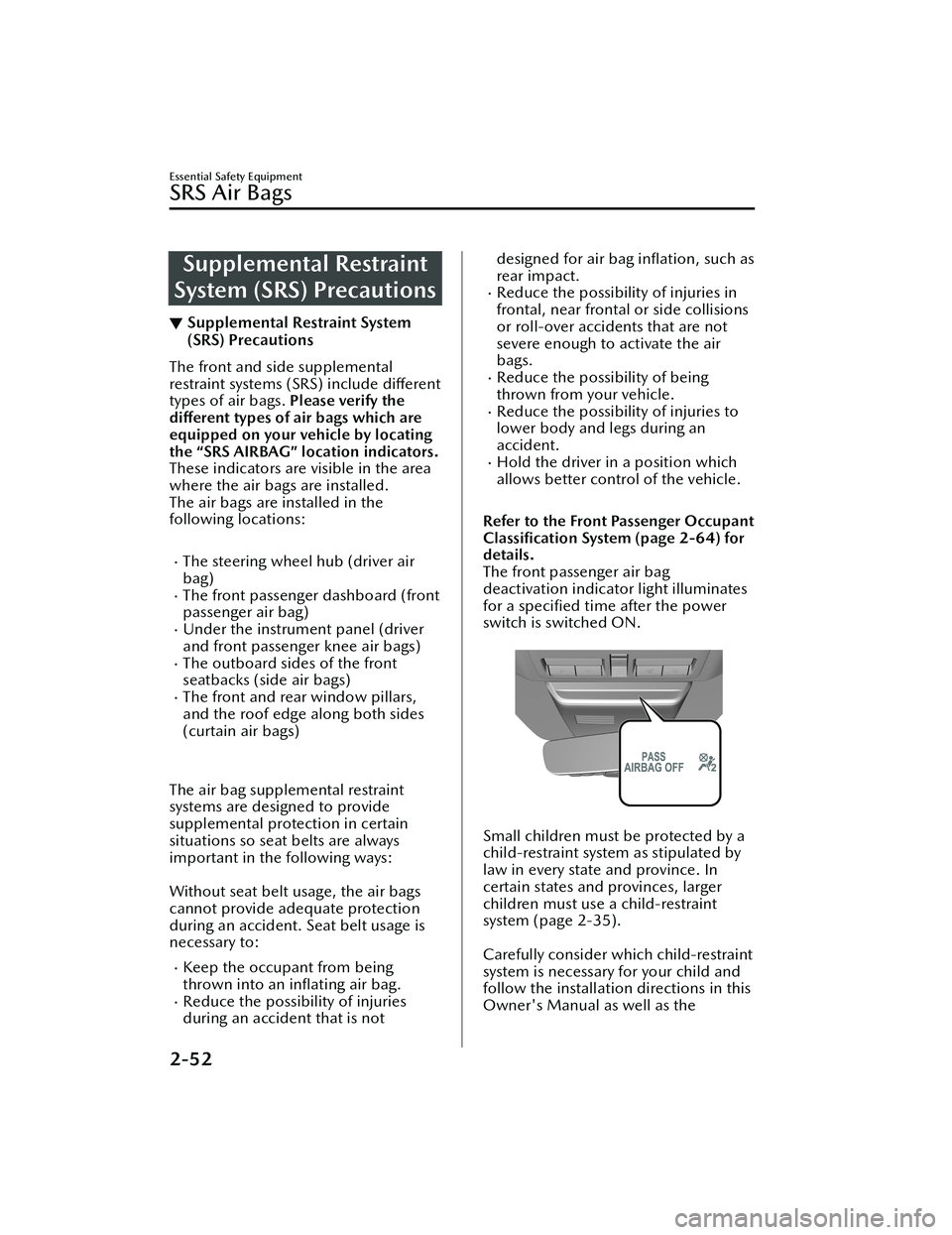
The front passenger air bag
deactivation indicator light illuminates
for a speci fied time after the power
switch is switched ON.
Small children must be protected by a
child-restraint system as stipulated by
law in every state and province. In
certain states and provinces, larger
children must use a child-restraint
system (page 2-35).
Carefully consider which child-restraint
system is necessary for your child and
follow the installation directions in this
Owner's Manual as well as the
Essential Safety Equipment
SRS Air Bags
2-52
MX -30_8JD4-EA -21G_Edition2_new 2021-5-18 14:38:07
Page 70 of 547

child-restraint system manufacturer's
instructions.
WARNING
Seat belts must be worn in air bag
equipped vehicles:
Depending only on the air bags for
protection during an accident is
dangerous. Alone, air bags may not
prevent serious injuries. The
appropriate air bags can be expected
to inflate only in the first accident, such
as frontal, near frontal or side collisions
or roll-over accidents that are at least
moderate. Vehicle occupants should
always wear seat belts.
Children should not ride in the front
passenger seat:
Placing a child, 12 years or under, in
the front seat is dangerous. The child
could be hit by a deploying air bag and
be seriously injured or even killed. A
sleeping child is more likely to lean
against the door and be hit by the side
air bag in moderate collision to the
front-passenger side of the vehicle.
Whenever possible, always secure a
child 12 years and under on the rear
seats with an appropriate
child-restraint system for the child's
age and size.
Never use a rear-facing child-restraint
system in the front seat with an air
bag that could deploy:
Rear-facing child-restraint systems on
the front seat are particularly
dangerous even though you may feel
assured that a front passenger air bag
will not deploy based on the fact that
the front passenger air bag
deactivation indicator light illuminates.
The child-restraint system can be hit by
a deploying air bag and moved
violently backward resulting in serious
injury or death to the child.
Do not sit too close to the driver and
front passenger air bags:
Sitting too close to the driver and front
passenger air bag modules or placing
hands or feet on them is extremely
dangerous. The driver and front
passenger air bags inflate with great
force and speed. Serious injuries could
occur if someone is too close. The
driver should always hold onto only the
rim of the steering wheel. The front
seat passenger should keep both feet
on the floor. Front seat occupants
should adjust their seats as far back as
possible and always sit upright against
the seatbacks with seat belts worn
properly.
Essential Safety Equipment
SRS Air Bags
2-53
MX -30_8JD4-EA -21G_Edition2_new 2021-5-18 14:38:07
Page 73 of 547
Do not place luggage or other objects
under the front seats:
Placing luggage or other objects under
the front seats is dangerous. The
components essential to the
supplemental restraint system could be
damaged, and in the event of a side
collision, the appropriate air bags may
not deploy, which could result in death
or serious injury. To prevent damage to
the components essential to the
supplemental restraint system, do not
place luggage or other objects under
the front seats.
Do not operate a vehicle with
damaged air bag/seat belt
pretensioner system components:
Expended or damaged air bag/seat
belt pretensioner system components
must be replaced after any collision
which caused them to deploy or
damage them. Only a trained
Authorized Mazda Dealer can fully
evaluate these systems to see that they
will work in any subsequent accident.
Driving with an expended or damaged
air bag or pretensioner unit will not
aff ord you the necessary protection in
the event of any subsequent accident
which could result in serious injury or
death.
Do not remove interior air bag parts:
Removing any components such as the
front seats, front dashboard, the
steering wheel or parts on the front
and rear window pillars and along the
roof edge, containing air bag parts or
sensors is dangerous. These parts
contain essential air bag components.
The air bag could accidentally activate
and cause serious injuries. Always have
an Authorized Mazda Dealer remove
these parts.Properly dispose of the air bag
system:
Improper disposal of an air bag or a
vehicle with live air bags in it can be
extremely dangerous. Unless all safety
procedures are followed, injury could
result. Have an Authorized Mazda
Dealer safely dispose of the air bag
system or scrap an air bag equipped
vehicle.
NOTE
If it becomes necessary to have the
components or wiring system for the
supplementary restraint system modi fied to accommodate a person
with certain medical conditions in
accordance with a certi fied
physician, contact an Authorized
Mazda Dealer, refer to “Customer
Assistance (U.S.A.)” (page 8-2).
When an air bag deploys, a loud in flation noise can be heard and
some smoke will be released.
Neither is likely to cause injury,
however, the texture of the air bags
may cause light skin injuries on body
parts not covered with clothing
through friction.
Should you sell your Mazda, we urge
you to tell the new owner of its air
bag systems and that familiarization
with all instructions about them,
from the Owner's Manual, is
important.
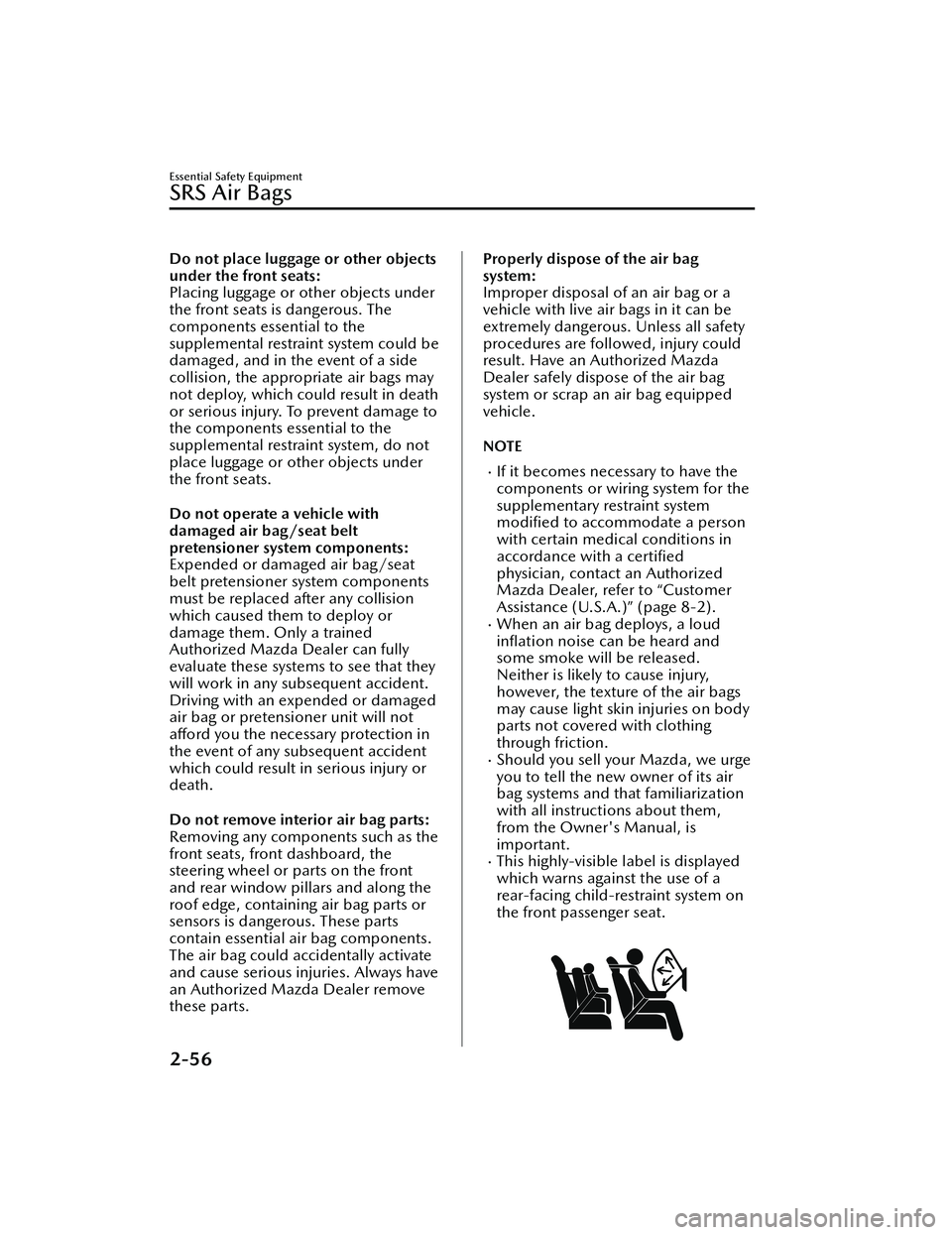
This highly-visible label is displayed
which warns against the use of a
rear-facing child-restraint system on
the front passenger seat.
Essential Safety Equipment
SRS Air Bags
2-56
MX -30_8JD4-EA -21G_Edition2_new 2021-5-18 14:38:07
Page 75 of 547

How the SRS Air BagsWork
▼How the SRS Air Bags Work
Your Mazda is equipped with the
following types of SRS air bags. SRS air
bags are designed to work together
with the seat belts to help to reduce
injuries during an accident.
The SRS air bags are designed to
provide further protection for
passengers in addition to the seat belt
functions. Be sure to wear seat belts
properly.
▼Front Seat Belt Pretensioners
The front seat belt pretensioners are
designed to deploy in moderate or
severe frontal, near frontal collisions.
In addition, the pretensioners operate
when a side collision or a roll-over
accident is detected. The pretensioners
operate
differently depending on what
types of air bags are equipped. For
more details about seat belt
pretensioner operation, refer to the
SRS Air Bag Deployment Criteria (page
2-61).
▼ Driver Air Bag
The driver's air bag is mounted in the
steering wheel.
When air bag crash sensors detect a
frontal impact of greater than
moderate force, the driver's air bag
in
flates quickly helping to reduce injury
mainly to the driver's head or chest
caused by directly hitting the steering
wheel.
For more details about air bag
deployment, refer to "SRS Air Bag
Deployment Criteria" (page 2-61).
The driver's dual-stage air bag controls
air bag in flation in two energy stages.
During an impact of moderate severity,
the driver's air bag deploys with lesser
energy, whereas during more severe
impacts, it deploys with more energy.
▼ Front Passenger Air Bag
The front passenger air bag is mounted
in the front passenger dashboard.
The
inflation mechanism for the front
passenger air bag is the same as the
driver's air bag.
For more details about air bag
deployment, refer to "SRS Air Bag
Deployment Criteria" (page 2-61).
In addition, the front passenger air bag
is designed to only deploy in
accordance with the total seated
weight on the front passenger seat. For
details, refer to the driver and front
passenger occupant classi fication
system (page 2-64).
▼ Driver and Front Passenger Knee
Air Bags
The knee air bags are equipped under
the instrument panel.
Essential Safety Equipment
SRS Air Bags
2-58
MX
-30_8JD4-EA -21G_Edition2_new 2021-5-18 14:38:07
Page 81 of 547

not be detected as severe enough to
deploy the SRS air bag equipment.
Side impacts involving trees or poles
Side impacts with two-wheeled
vehicles
Limitations to roll-over detection:
The following illustration is an example
of an accident that may not be
detected as a roll-over accident.
Therefore, the front seat belt
pretensioners and curtain air bags may
not deploy.
Pitch end over end
Driver and Front
Pa s s e n g e r O cc u p a n t
Classi fication System
▼Driver and Front Passenger
Occupant
Classification System
First, please read "Supplemental
Restraint System (SRS) Precautions"
(page 2-52) carefully.
▼Driver Seat Slide Position Sensor
Your vehicle is equipped with a driver
seat slide position sensor as a part of
the supplemental restraint system. The
sensor is located under the driver seat.
The sensor determines whether the
driver seat is fore or aft of a reference
position and sends the seat position to
the diagnostic module (SAS unit).
The SAS unit is designed to control the
deployment of the driver air bag
depending on how close the driver
seat is to the steering wheel.
The air bag/front seat belt
pretensioner system warning light
fl
ashes if the sensor has a possible
malfunction (page 2-60).
▼ Front Passenger Seat Weight
Sensors
Your vehicle is equipped with a front
passenger seat weight
sensors as a part
of the supplemental restraint system.
These sensors are located under both
of the front passenger seat rails. These
sensors determine the total seated
weight on the front passenger seat and
monitor the seat belt buckle for the
front passenger seat. The SAS unit is
designed to prevent the front
passenger front and side air bags and
knee air bags, and seat belt
pretensioner system from deploying if
Essential Safety Equipment
SRS Air Bags
2-64
MX -30_8JD4-EA -21G_Edition2_new 2021-5-18 14:38:07
Page 89 of 547

Electric Vehicles
▼Electric Vehicles
Electric vehicles are driven by motor power using the electrical power stored in the
high voltage battery. This vehicle is an
eco-friendly vehicle which emits no exhaust
gas because fuel is not used.
1. Motor, Regenerative braking
2. High voltage battery
3. Approaching vehicle audible system
Motor
The motor transmits the motor power to the wheels using the electrical power of the
high voltage battery.
Regenerative braking
Regenerative braking uses the motor to decelerate the vehicle. Power is generated
by the wheels rotating the motor while decelerating and the generated power
charges the high voltage battery.
Refer to Steering Wheel Paddle on page 3-7.
High voltage battery
The high voltage battery is a large-capacity battery and stores the charged power and
the electrical power generated by regenerative braking.
Before Driving
Electric Vehicles
3-2
MX -30_8JD4-EA -21G_Edition2_new 2021-5-18 14:38:07
Page 93 of 547
Vibration of the brake pedal might
be felt under the following
conditions:
The power switch is switched ON.The brake pedal is operated.
High voltage battery level and
temperature
If the high voltage battery level is low
or the high voltage battery temperature
is low, the vehicle speed may not
increase even if the accelerator pedal is
depressed because the motor output is
restricted. Drive the vehicle following
the instructions displayed on the
multi-information display.
To Extend Cruising Distance
The electrical power consumption
while driving can be reduced and the
cruising distance can be extended by
doing the following operations.
With the charging connector
connected, turn on the climate
control system to provide a
comfortable temperature in the
cabin before driving.
When driving during cold
temperatures, use the seat warmer
or steering warmer instead of the
climate control system.
Adjust the climate control system
to a moderate airflow and
temperature setting.
Refrain from using the defogger
under conditions other than when
a window is fogged or frozen.
Unload unnecessary cargo to
reduce the vehicle weight.
Avoid unnecessary sudden
acceleration, rapid acceleration,
and rapid deceleration. Instead,
perform smooth starts,
acceleration, and deceleration.
Try to drive maintaining a constant
speed and avoid speeding.
Inspect the tire pressures regularly
and always adjust the tire pressures
to the speci fied inflation pressure.
By maintaining a su fficient distance
between vehicles and using the
regenerative braking well, more
electrical power can be charged to
the high voltage battery.
Pointers for Maintaining Long Battery
Life
The high voltage battery life changes
depending on the vehicle conditions or
charging method.
For maintaining a long high voltage
battery life, be careful of the following:
Charging the high voltage battery
Avoid unnecessary, frequent
charging.
Charge the battery normally and
avoid quick charging as much as
possible.
Only charge the battery with as much
power as needed, and do not always
fully charge the battery. The
maximum charge limit can be set.
Refer to Charging Settings on page
3-21.
Pa r k i n g t h e v e h i c l e
Do not park the vehicle in a place
where the ambient temperature is
extremely high or low.
Do not leave the vehicle while the
remaining high voltage battery power
is extremely low.
If the Excessive Battery Temperature noti fication is displayed on the
center display after driving the
vehicle, select Start.
Before Driving
Electric Vehicles
3-6
MX -30_8JD4-EA -21G_Edition2_new 2021-5-18 14:38:07
Page 94 of 547

▼Steering Wheel Paddle
The steering wheel paddle is a function that makes it easy to adjust the vehicle
speed according to the accelerator pedal operation.
Acceleration/deceleration is possible according to the various driving conditions
such as on an up or down slope, during traffi
c jams, or high-speed driving.
WARNING
Avoid using the steering wheel paddles when driving on wet roads, snow-covered
roads, or icy roads:
Otherwise, the tires will slip which could lead to an accident.
Setting
By operating the plus switch (+/OFF), the regenerative braking force is decreased
when releasing the accelerator pedal, and the vehicle accelerates quickly when
depressing the accelerator pedal.
1. Plus switch (+/OFF)
By operating the minus switch (–), the regenerative braking force is increased when
releasing the accelerator pedal, and the vehicle accelerates slowly when depressing
the accelerator pedal.
1. Minus switch (–)
Before Driving
Electric Vehicles
3-7
MX-30_8JD4-EA -21G_Edition2_new 2021-5-18 14:38:07
Page 95 of 547

NOTE
When the cruise control and the Mazda Radar Cruise Control with Stop & Go
function (MRCC with Stop & Go function), or the Traffic Jam Assist (TJA) is
operating, the steering wheel paddle setting cannot be changed.
When performing the following operations , the steering wheel paddle returns to
the default setting.
Plus switch (+/OFF) is kept pull ed for a certain period of timeSelector lever is shifted to any position from DPower switch is switched OFF
Indication
The operation condition of the steering wheel paddle is displayed on the
multi-information display.
1. Steering wheel paddle display
Indication Switch operation
Regenerative
braking force Acceleration
Plus switch (+/
OFF) Minus switch (–)
-Weak
Quickly
Slightly weak Slightly quick
Normal Normal
Slightly strong Slightly slow
- Strong Slowly
Before Driving
Electric Vehicles
3-8
MX-30_8JD4-EA -21G_Edition2_new 2021-5-18 14:38:07
Page 150 of 547
4When Driving
Information concerning safer driving and stopping.
Starting and Stopping the EV
System.....................................4-4 Power Switch Position............ 4-4
Starting the EV System............ 4-5
Stopping the EV System.......... 4-8
Instrument Cluster and
Display.................................... 4-9 Instrument Cluster and
Display................................. 4-9
Instrument Cluster................. 4-9
Active Driving Display.......... 4-24
Selector Lever Position
Functions............................... 4-26 Selector Lever Position
Functions............................ 4-26
Selector Lever Operation...... 4-28
Shift-Lock System................. 4-32
Driving Tips......................... 4-32
Switches and Controls............. 4-35 Lighting Control................... 4-35
Turn and Lane-Change
Signals................................ 4-39
Windshield Wipers and
Washer............................... 4-40
Rear Window Wiper and
Washer............................... 4-44
Rear Window Defogger........ 4-45
Horn................................... 4-46
Hazard Warning Flasher....... 4-47
HomeLink Wireless Control
System
*............................... 4-47
Brake.....................................4-52Brake System....................... 4-52
AUTOHOLD........................ 4-57
Emergency Stop Signal
System................................ 4-61
Hill Launch Assist (HLA)........4-61
ABS/TCS/DSC....................... 4-63 Antilock Brake System
(ABS).................................. 4-63
Tra c t i o n C o n t r o l Sy s t e m
(TCS).................................. 4-64
Dynamic Stability Control
(DSC)................................. 4-66
Power Steering....................... 4-67 Power Steering.....................4-67
i-ACTIVSENSE......................... 4-68 i-ACTIVSENSE......................4-68
Forward Sensing Camera
(FSC)
*................................. 4-71
Front Radar Sensor
*.............. 4-75
Front Side Radar Sensor
*.......4-77
Rear Side Radar Sensor
*....... 4-79
Rear Ultrasonic Sensor
*........ 4-80
Front Camera/Side Cameras/
Rear Camera
*...................... 4-81
Driver Monitoring Camera
*..........
.......................................... 4-81
Adaptive Front Lighting System
(AFS)
*................................. 4-82
High Beam Control System
(HBC)
*................................ 4-83
*Some models.4-1
MX -30_8JD4-EA -21G_Edition2_new 2021-5-18 14:38:07