power MAZDA MODEL MX-30 EV 2022 Owner's Manual
[x] Cancel search | Manufacturer: MAZDA, Model Year: 2022, Model line: MODEL MX-30 EV, Model: MAZDA MODEL MX-30 EV 2022Pages: 547, PDF Size: 79.35 MB
Page 86 of 547

Constant Monitoring
▼Constant Monitoring
The following components of the air
bag systems are monitored by a
diagnostic system:
Front air bag sensorsCrash sensors, and diagnostic
module (SAS unit)
Side crash sensorsAir bag modulesFront seat belt pretensionersAir bag/Front seat belt pretensioner
system warning light
Related wiring
Driver seat slide position sensorFront passenger occupant
classi
fication sensor
Front passenger occupant
classification module
Front passenger air bag deactivation
indicator light
Front passenger seat belt buckle
switch
The diagnostic module continuously
monitors the system's readiness. This
begins when the power switch is
switched ON and continues while the
vehicle is being driven.
Essential Safety Equipment
SRS Air Bags
2-69
MX -30_8JD4-EA -21G_Edition2_new 2021-5-18 14:38:07
Page 88 of 547
3Before Driving
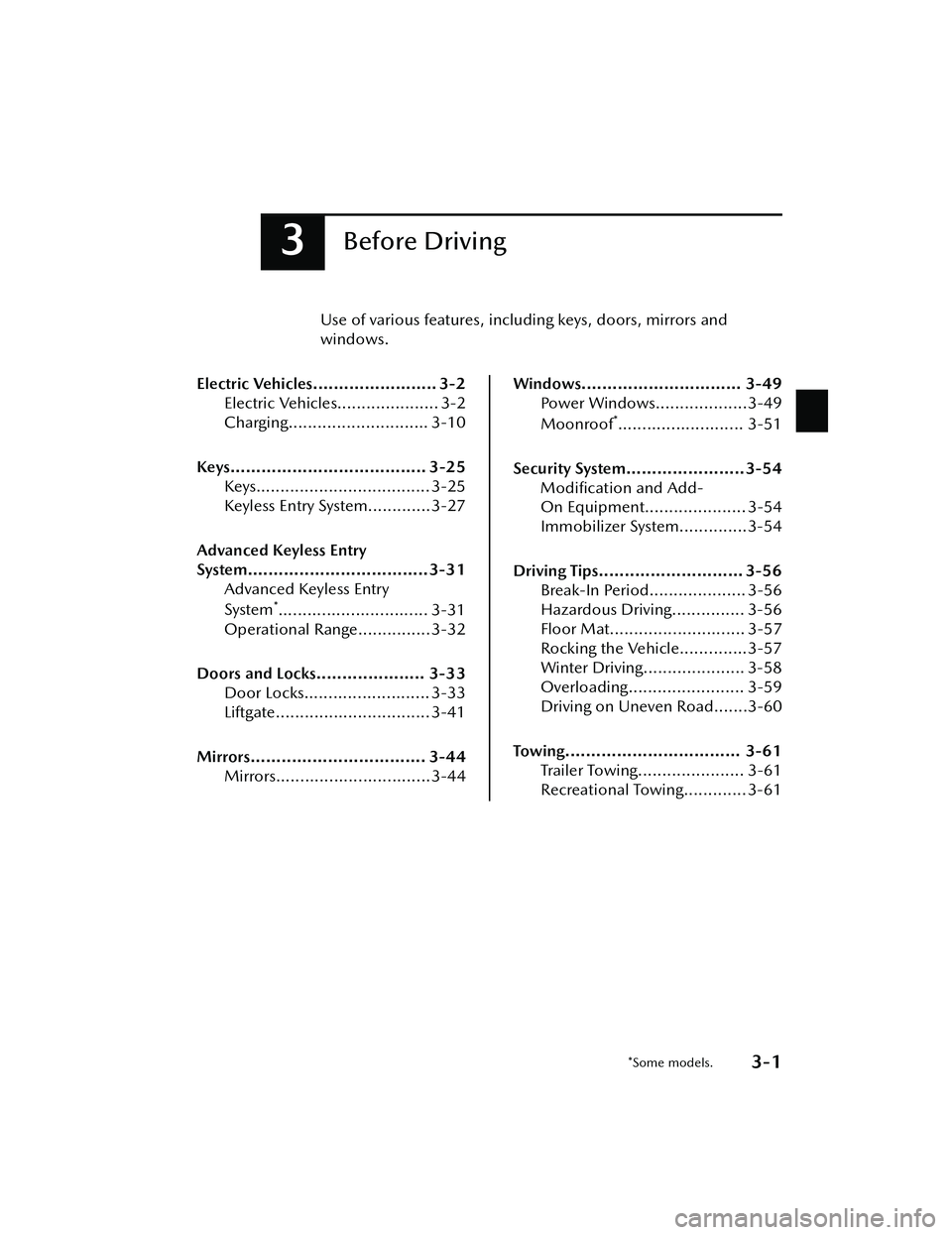
Use of various features, including keys, doors, mirrors and
windows.
Electric Vehicles........................ 3-2 Electric Vehicles..................... 3-2
Charging............................. 3-10
Keys...................................... 3-25 Keys.................................... 3-25
Keyless Entry System.............3-27
Advanced Keyless Entry
System...................................3-31 Advanced Keyless Entry
System
*............................... 3-31
Operational Range...............3-32
Doors and Locks..................... 3-33 Door Locks.......................... 3-33
Liftgate................................ 3-41
Mirrors.................................. 3-44 Mirrors................................3-44
Windows............................... 3-49Power Windows...................3-49
Moonroof
*.......................... 3-51
Security System.......................3-54 Modi fication and Add-
On Equipment..................... 3-54
Immobilizer System..............3-54
Driving Tips............................ 3-56 Break-In Period.................... 3-56
Hazardous Driving............... 3-56
Floor Mat............................ 3-57
Rocking the Vehicle..............3-57
Winter Driving..................... 3-58
Overloading........................ 3-59
Driving on Uneven Road.......3-60
Towing.................................. 3-61 Trailer Towing...................... 3-61
Recreational Towing............. 3-61
*Some models.3-1
MX-30_8JD4-EA -21G_Edition2_new 2021-5-18 14:38:07
Page 89 of 547

Electric Vehicles
▼Electric Vehicles
Electric vehicles are driven by motor power using the electrical power stored in the
high voltage battery. This vehicle is an
eco-friendly vehicle which emits no exhaust
gas because fuel is not used.
1. Motor, Regenerative braking
2. High voltage battery
3. Approaching vehicle audible system
Motor
The motor transmits the motor power to the wheels using the electrical power of the
high voltage battery.
Regenerative braking
Regenerative braking uses the motor to decelerate the vehicle. Power is generated
by the wheels rotating the motor while decelerating and the generated power
charges the high voltage battery.
Refer to Steering Wheel Paddle on page 3-7.
High voltage battery
The high voltage battery is a large-capacity battery and stores the charged power and
the electrical power generated by regenerative braking.
Before Driving
Electric Vehicles
3-2
MX -30_8JD4-EA -21G_Edition2_new 2021-5-18 14:38:07
Page 92 of 547
cooperate in ensuring that the vehicle's
high voltage battery is collected.
WARNING
Appropriate disposal of the high
voltage battery:
If the high voltage battery is not
collected and disposed of
appropriately, such as by leaving it
unattended or illegally abandoning it,
some other person may touch it which
could cause an electrical shock
accident leading to serious injury.
▼Accident Occurs
If the vehicle receives an impact of a
certain level or greater in a collision,
the EV system stops. In this case, the
EV system malfunction warning
indication/warning light displays/turns
on and the EV system may not start.
Contact an Authorized Mazda Dealer
immediately.
WARNING
Never touch electrical wiring that may
be protruding into or outside of the
cabin:
Otherwise, it could result in electrical
shock and serious injury.
Never touch any area where
electrolyte is visible or electrolyte is
leaking from the area:
If any electrolyte from the high voltage
battery gets in the eyes or on the skin,
it could cause loss
of vision or skin
reactions. In the unlikely event that
electrolyte comes into contact with the
eyes or skin, flush with large quantities
of water immediately and seek
immediate medical attention.
Never approach objects that are on
fi re or extremely hot:
Electrolyte in the high voltage battery
may cause a fire.
If the vehicle catches fire, extinguish
the fire using a fire extinguisher (type
ABC, BC, or C).
Only extinguish a fire with water when
a large amount of water is available
such as from a fire hydrant. Otherwise,
it could lead to an accident.
▼ Advice for Using Electric Vehicles
Unique sound and vibration occurring
with electric vehicles
Electric vehicles have a unique sound
and vibration which di
ffer from
non-electric vehicles. The following
sounds or vibration may occur,
however, this is unique to electric
vehicles and it does not indicate a
problem.
Motor operation sound.Operation sound of coolant pump
and cooling fan while charging.
Operation sound of regenerative
braking.
Relay operation sound when EV
system is started or stopped.
Brake system operation sound and
vibration.
Operation sound of brake system
Sound can be heard from the front of
the vehicle under the following
conditions:
The driver's door is opened.The power switch is switched ON.The brake pedal is operated.The brake system operates
automatically.
Several minutes have passed since
the EV system was stopped.
Vibration of brake pedal
Before Driving
Electric Vehicles
3-5
MX -30_8JD4-EA -21G_Edition2_new 2021-5-18 14:38:07
Page 93 of 547
Vibration of the brake pedal might
be felt under the following
conditions:
The power switch is switched ON.The brake pedal is operated.
High voltage battery level and
temperature
If the high voltage battery level is low
or the high voltage battery temperature
is low, the vehicle speed may not
increase even if the accelerator pedal is
depressed because the motor output is
restricted. Drive the vehicle following
the instructions displayed on the
multi-information display.
To Extend Cruising Distance
The electrical power consumption
while driving can be reduced and the
cruising distance can be extended by
doing the following operations.
With the charging connector
connected, turn on the climate
control system to provide a
comfortable temperature in the
cabin before driving.
When driving during cold
temperatures, use the seat warmer
or steering warmer instead of the
climate control system.
Adjust the climate control system
to a moderate airflow and
temperature setting.
Refrain from using the defogger
under conditions other than when
a window is fogged or frozen.
Unload unnecessary cargo to
reduce the vehicle weight.
Avoid unnecessary sudden
acceleration, rapid acceleration,
and rapid deceleration. Instead,
perform smooth starts,
acceleration, and deceleration.
Try to drive maintaining a constant
speed and avoid speeding.
Inspect the tire pressures regularly
and always adjust the tire pressures
to the speci fied inflation pressure.
By maintaining a su fficient distance
between vehicles and using the
regenerative braking well, more
electrical power can be charged to
the high voltage battery.
Pointers for Maintaining Long Battery
Life
The high voltage battery life changes
depending on the vehicle conditions or
charging method.
For maintaining a long high voltage
battery life, be careful of the following:
Charging the high voltage battery
Avoid unnecessary, frequent
charging.
Charge the battery normally and
avoid quick charging as much as
possible.
Only charge the battery with as much
power as needed, and do not always
fully charge the battery. The
maximum charge limit can be set.
Refer to Charging Settings on page
3-21.
Pa r k i n g t h e v e h i c l e
Do not park the vehicle in a place
where the ambient temperature is
extremely high or low.
Do not leave the vehicle while the
remaining high voltage battery power
is extremely low.
If the Excessive Battery Temperature noti fication is displayed on the
center display after driving the
vehicle, select Start.
Before Driving
Electric Vehicles
3-6
MX -30_8JD4-EA -21G_Edition2_new 2021-5-18 14:38:07
Page 95 of 547

NOTE
When the cruise control and the Mazda Radar Cruise Control with Stop & Go
function (MRCC with Stop & Go function), or the Traffic Jam Assist (TJA) is
operating, the steering wheel paddle setting cannot be changed.
When performing the following operations , the steering wheel paddle returns to
the default setting.
Plus switch (+/OFF) is kept pull ed for a certain period of timeSelector lever is shifted to any position from DPower switch is switched OFF
Indication
The operation condition of the steering wheel paddle is displayed on the
multi-information display.
1. Steering wheel paddle display
Indication Switch operation
Regenerative
braking force Acceleration
Plus switch (+/
OFF) Minus switch (–)
-Weak
Quickly
Slightly weak Slightly quick
Normal Normal
Slightly strong Slightly slow
- Strong Slowly
Before Driving
Electric Vehicles
3-8
MX-30_8JD4-EA -21G_Edition2_new 2021-5-18 14:38:07
Page 97 of 547
Charging
▼Cautions Concerning Charging
WARNING
For occupants who use any medical
device such as an implanted-type
heart pacer or
defibrillator, ask a
doctor or manufacturer of the device
about how the medical device may be
a ff ected by the charging operation:
Otherwise, the operation of the
medical device could be a ffected
resulting in an accident.
For occupants who use any medical
device such as an implanted-type
heart pacer or de fibrillator, do not
enter the cabin including the luggage
compartment while charging:
Otherwise, the operation of the
medical device could be a ffected
resulting in an accident.
Do not disassemble or modify the
charge port and the charge cable:
Otherwise, it could lead to an
electrical shock resulting in an
accident.
Always heed the following when
charging:
Otherwise, it could lead to an
electrical shock resulting in an
accident.
Never allow children to charge the
high voltage battery.
Do not charge the high voltage
battery while the vehicle is covered
with a car cover.
Always heed the following when
charging in the rain or snow:
Otherwise, it could lead to an
electrical shock resulting in an
accident.
Do not charge the high voltage
battery outside if there is the
possibility of heavy rain, strong
winds, or lightning.
Remove water with a clean cloth if
the charge connector or charge plug
is wet.
Do not touch the charge port or
charge cable with wet hands.
If the outlet is covered with snow
while charging, turn o ff the power
such as turning o ff the breaker,
remove the snow, and then remove
the charge plug.
Do not use the charge cable if it has
any of the following malfunctions:
Otherwise, it could lead to an
electrical shock resulting in an
accident.
The charge connector is rusted or
corroded.
The charge connector is damaged or
foreign matter penetrates the charge
connector.
Refer to the instruction manual
accompanying the charge cable and
use the charge cable correctly:
If you handle the charge cable
incorrectly, it could result in an
unexpected accident.
Always heed the following when
using the charge cable:
Otherwise, the charge cable could be
damaged resulting in an accident.
Do not pull out or bend the charge
cable excessively.
Before Driving
Electric Vehicles
3-10
MX -30_8JD4-EA -21G_Edition2_new 2021-5-18 14:38:07
Page 98 of 547
Do not step on the charge cable or
drag it on the ground.
When inserting/pulling out the
charge connector and the charge
plug, do not twist them excessively.
Do not apply excessive force to the
connected charge connector such as
by applying your weight.
Keep objects which generate intense
heat (such as a heater or cigarette)
away from the charge cable.
Do not apply organic solvents, acid
or alkaline agents to the charge
cable.
CAUTION
Do not connect the booster cable to
the lead-acid battery or remove the
lead-acid battery while charging the
high voltage battery. Otherwise, the
vehicle or charging device could be
damaged.
If the charge connector is removed
after the charging is
finished, close
the charge port cap immediately. If
the charging lid is closed with the
charge port cap open, water or
foreign matter may enter the charge
port causing a malfunction.
Always make sure that the charge
cable is not connected to the vehicle
before driving. Because the vehicle
can be driven even while the charge
connector is not connected
completely, it could result in an
accident.
If the charge port is frozen shut,
defrost the inlet using a hair dryer. If
the charge cable is inserted/pulled
out with the charge port frozen, it
could cause damage.
NOTE
Normal charging and quick charging
cannot be performed at the same
time.
The navigation system and the
climate control system can be used
even while charging. However, the
charging time increases because
electrical power is consumed. In
some cases, power consumption
may exceed the charged amount and
charging may not finish.
If a power outage occurs while
charging, remove the plug and the
charge connector and start charging
from the beginning again.
Make sure that no water has
accumulated in the charge connector
and the charge port before charging.
If any foreign matter enters the
charge connector or the charge port,
do not start charging and consult an
Authorized Mazda Dealer.
▼Preparation Before Charging
This vehicle is driven by consuming the
electrical power stored in the high
voltage battery. Therefore, it is
necessary to charge the high voltage
battery.
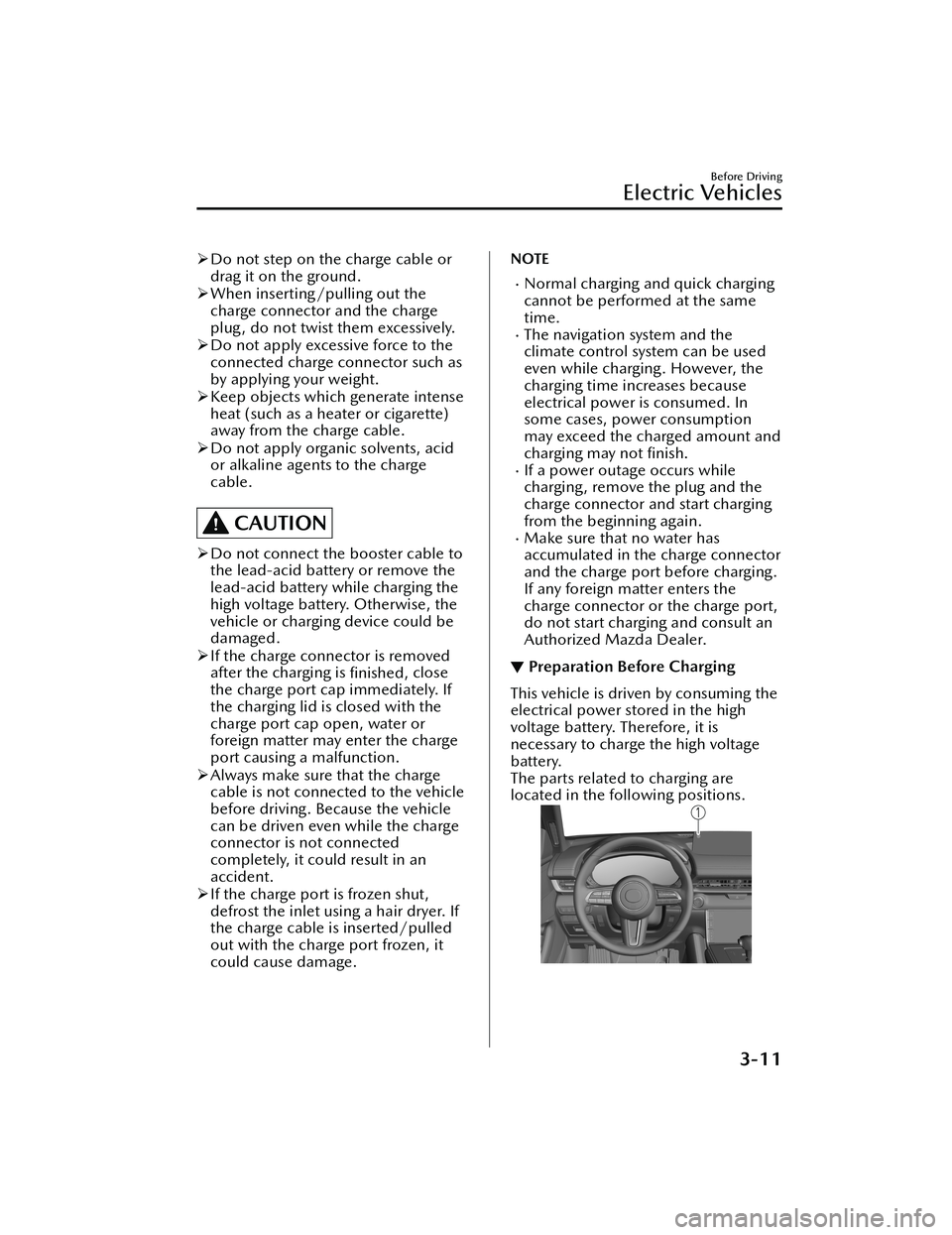
The parts related to charging are
located in the following positions.
Before Driving
Electric Vehicles
3-11
MX
-30_8JD4-EA -21G_Edition2_new 2021-5-18 14:38:07
Page 99 of 547
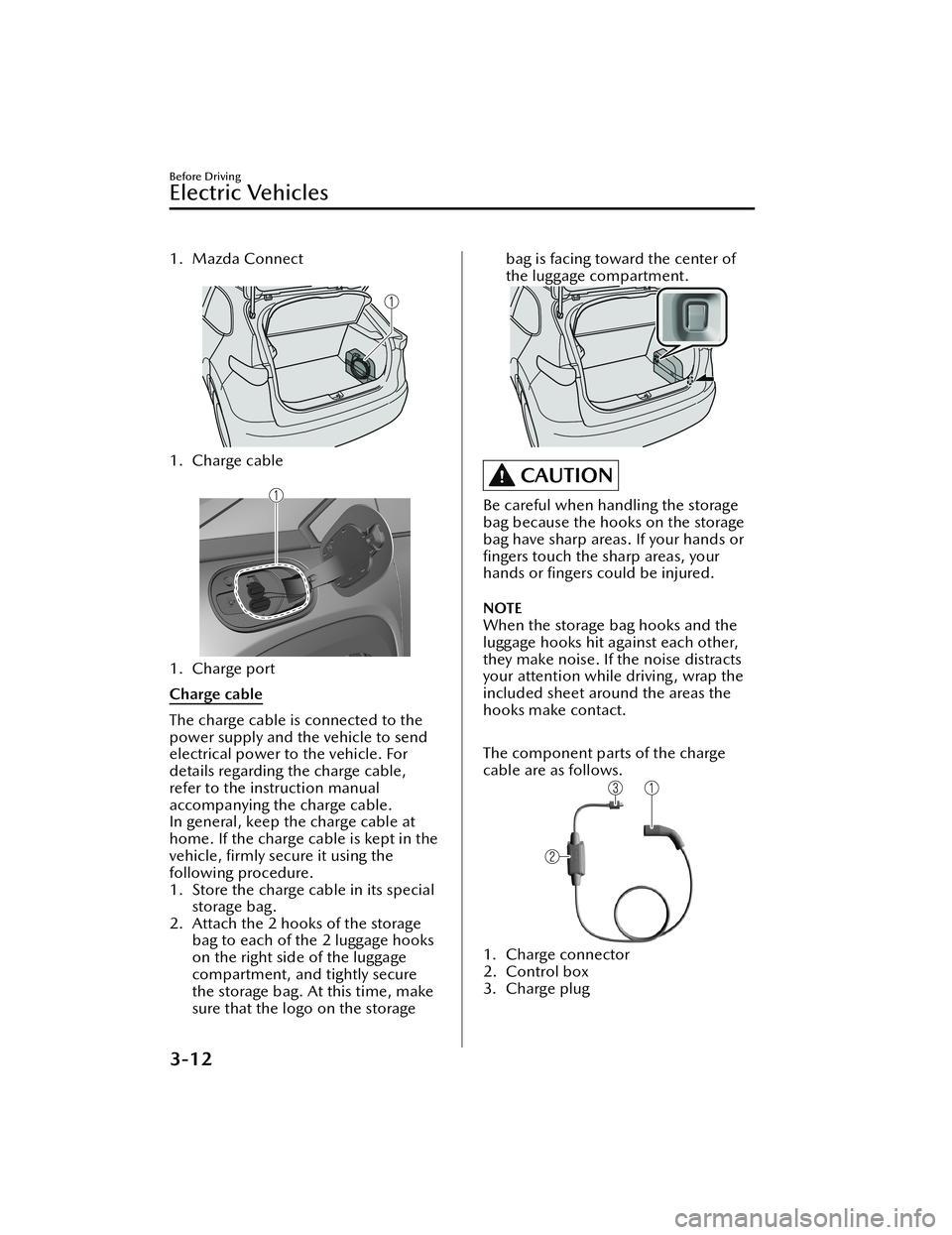
1. Mazda Connect
1. Charge cable
1. Charge port
Charge cable
The charge cable is connected to the
power supply and the vehicle to send
electrical power to the vehicle. For
details regarding the charge cable,
refer to the instruction manual
accompanying the charge cable.
In general, keep the charge cable at
home. If the charge cable is kept in the
vehicle, firmly secure it using the
following procedure.
1. Store the charge cable in its special storage bag.
2. Attach the 2 hooks of the storage bag to each of the 2 luggage hooks
on the right side of the luggage
compartment, and tightly secure
the storage bag. At this time, make
sure that the logo on the storage
bag is facing toward the center of
the luggage compartment.
CAUTION
Be careful when handling the storage
bag because the hooks on the storage
bag have sharp areas. If your hands or
fingers touch the sharp areas, your
hands or fingers could be injured.
NOTE
When the storage bag hooks and the
luggage hooks hit against each other,
they make noise. If the noise distracts
your attention while driving, wrap the
included sheet around the areas the
hooks make contact.
The component parts of the charge
cable are as follows.
1. Charge connector
2. Control box
3. Charge plug
Before Driving
Electric Vehicles
3-12
MX-30_8JD4-EA -21G_Edition2_new 2021-5-18 14:38:07
Page 100 of 547
Charge connector
The charge connector is used for
connecting to the normal charge port.
When the charge connector is
connected to the normal charge port,
a vehicle system locks the charge
connector.
When the charge connector is locked
by the vehicle system, it unlocks when
the driver’s door is unlocked.
If the charge connector locked by the
vehicle system is not unlocked even
though the driver’s door is unlocked,
consult an Authorized Mazda Dealer.
The conditions for locking the system
on the vehicle side can be changed.
For the procedure to change the
conditions, refer to Charging Settings
on page 3-21.
Control box
The control box indicates the charge
status by turning on/flashing the
indicator light.
For the indicator light illumination/
fl ash pattern, refer to the instruction
manual accompanying the charge
cable.
Charge plug
The charge plug is the part for
connecting to the power supply.
Charge port
The charge port refers to the area
where the charge connector is
connected.
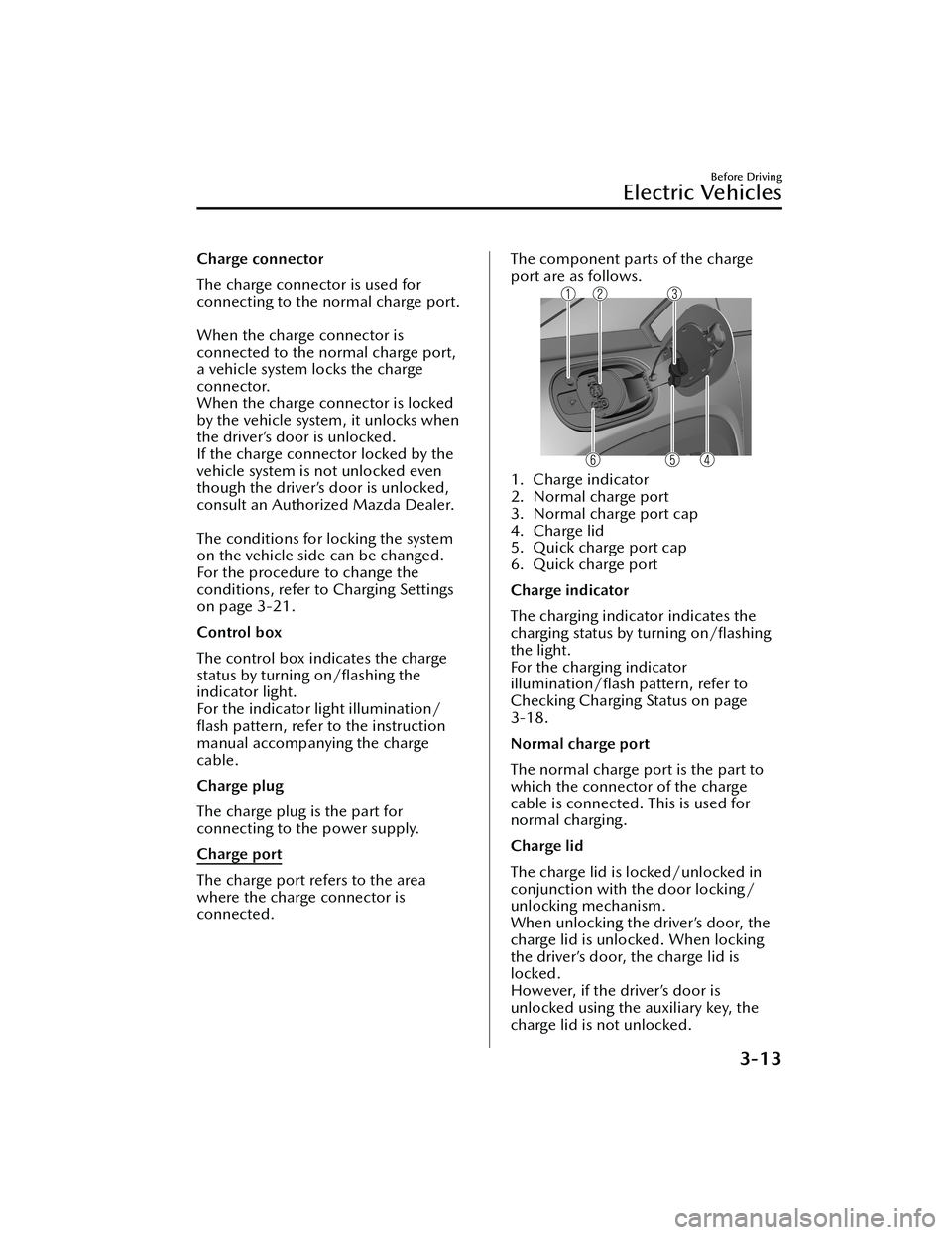
The component parts of the charge
port are as follows.
1. Charge indicator
2. Normal charge port
3. Normal charge port cap
4. Charge lid
5. Quick charge port cap
6. Quick charge port
Charge indicator
The charging indicator indicates the
charging status by turning on/flashing
the light.
For the charging indicator
illumination/ flash pattern, refer to
Checking Charging Status on page
3-18.
Normal charge port
The normal charge port is the part to
which the connector of the charge
cable is connected. This is used for
normal charging.
Charge lid
The charge lid is locked/unlocked in
conjunction with the door locking/
unlocking mechanism.
When unlocking the driver’s door, the
charge lid is unlocked. When locking
the driver’s door, the charge lid is
locked.
However, if the driver’s door is
unlocked using the auxiliary key, the
charge lid is not unlocked.
Before Driving
Electric Vehicles
3-13
MX -30_8JD4-EA -21G_Edition2_new 2021-5-18 14:38:07