fuel pressure MAZDA MODEL MX-5 MIATA 2018 Owners Manual
[x] Cancel search | Manufacturer: MAZDA, Model Year: 2018, Model line: MODEL MX-5 MIATA, Model: MAZDA MODEL MX-5 MIATA 2018Pages: 576, PDF Size: 55.37 MB
Page 84 of 576
Fuel-Filler Lid and Cap
WA R N I N G
When removing the fuel-filler cap, loosen
the cap slightly and wait for any hissing to
stop, then remove it:
Fuel spray is dangerous. Fuel can burn skin
and eyes and cause illness if ingested. Fuel
spray is released when there is pressure in
the fuel tank and the fuel-filler cap is
removed too quickly.
Before refueling, stop the engine, and
always keep sparks and flames away from
the filler neck:
Fuel vapor is dangerous. It could be ignited
by sparks or flames causing serious burns
and injuries.
Additionally, use of the incorrect fuel-filler
cap or not using a fuel-filler cap may result
in a fuel leak, which could result in serious
burns or death in an accident.
Do not continue refueling after the fuel
pump nozzle shuts off automatically:
Continuing to add fuel after the fuel pump
nozzle has shut off automatically is
dangerous because overfilling the fuel tank
may cause fuel overflow or leakage. Fuel
overflow and leakage could damage the
vehicle and if the fuel ignites it could cause
a fire and explosion resulting in serious
injury or death.
CAUTION
Always use only a ge nuine Mazda fuel-filler
cap or an approved equivalent, available
at an Authorized Mazda Dealer. The wrong
cap can result in a serious malfunction of
the fuel and emission control systems. It
may also cause the check engine light in
the instrument cluster to illuminate.
▼ Refueling
Before refueling, close both the doors,
windows, and the trunk lid, and switch the
ignition OFF.
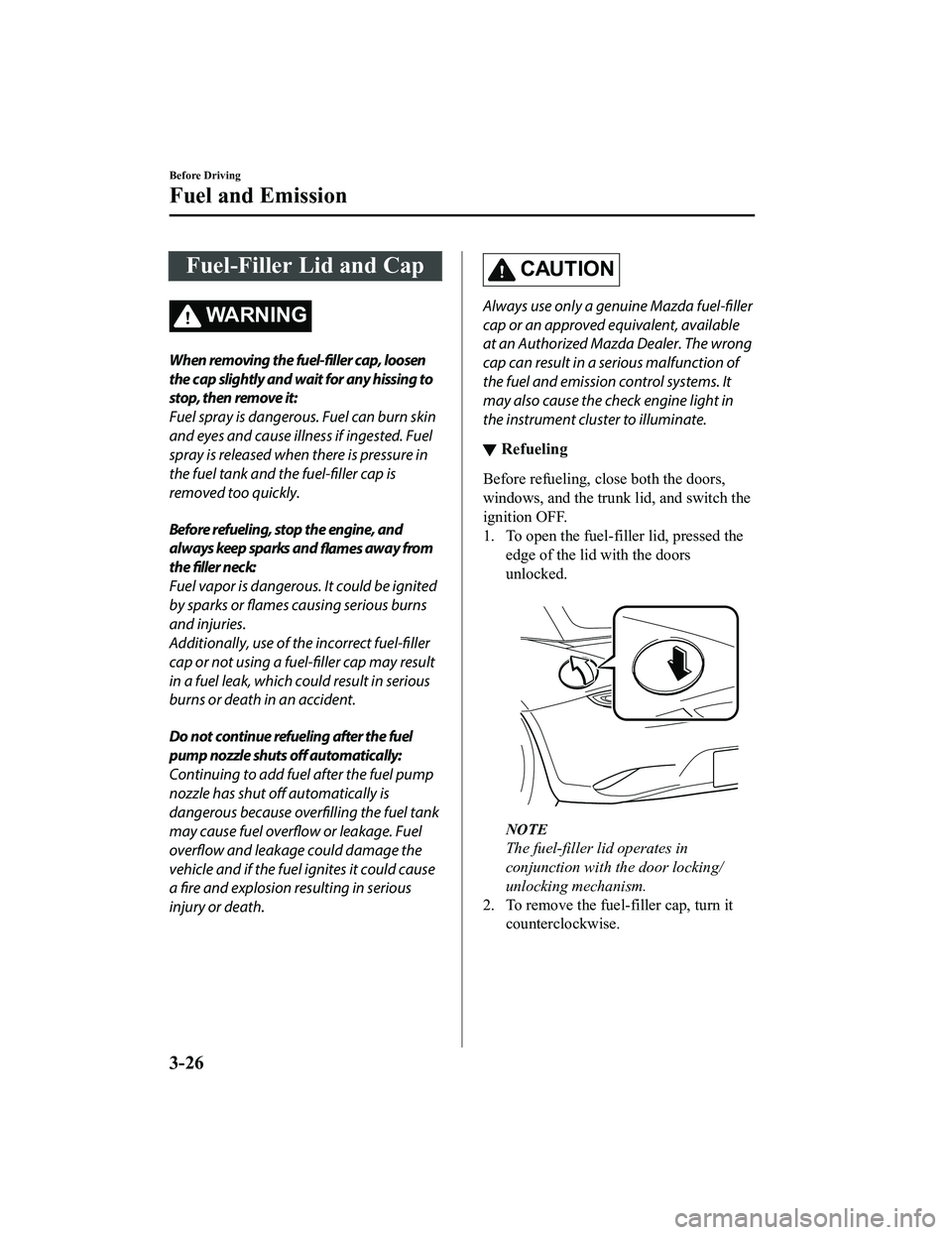
1. To open the fuel-filler lid, pressed the
edge of the lid with the doors
unlocked.
NOTE
The fuel-filler lid operates in
conjunction with the door locking/
unlocking mechanism.
2. To remove the fuel-filler cap, turn it counterclockwise.
Before Driving
Fuel and Emission
3-26
MX-5_8GF7-EA-17J_Edition2 2017-10-31 14:07:27
Page 220 of 576
As an added safety feature, your vehicle has been equipped with a tire pressure monitoring
system (TPMS) that illuminates a low tire pressure telltale when one or more of your tires is
significantly under-inflated. Accordingly, when the low tire pressure telltale illuminates, you
should stop and check your tires as soon as possible, and inflate them to the proper
pressure. Driving on a significantly under-inflated tire causes the tire to overheat and can
lead to tire failure. Under-infla tion also reduces fuel efficiency and tire tread life, and may
affect the vehicle's handlin g and stopping ability.
Please note that the TPMS is not a substitute for proper tire maintenance, and it is the
driver's responsibility to maintain correct ti re pressure, even if under-inflation has not
reached the level to trigger illumination of the TPMS low tire pressure telltale.
Your vehicle has also been eq uipped with a TPMS malfunction indicator to indicate when
the system is not operating properly.
The TPMS malfunction indicator is combined with the low tire pressure telltale. When the
system detects a malfunction, the telltale w ill flash for approximately one minute and then
remain continuously illuminated. This sequen ce will continue upon subsequent vehicle
start-ups as long as the malfunction exists. When the malfunction indicator is illuminated,
the system may not be able to detect or signal low tire pressure as intended. TPMS
malfunctions may occur for a variety of reaso ns, including the installation of replacement
or alternate tires or wheels on the vehicle th at prevent the TPMS from functioning properly.
Always check the TPMS malfunction telltale af ter replacing one or more tires or wheels on
your vehicle to ensure that the replacement or alternate tires and wheels allow the TPMS to
continue to function properly.
To avoid false readings, the system samples for a little while before indicating a problem. As
a result it will not instantaneously regis ter a rapid tire deflation or blow out.
▼System Error Activation
When the warning light flashes, there may
be a system malfunction. Consult an
Authorized Mazda Dealer.
A system error activation may occur in the
following cases:
When there is equipment or a device
near the vehicle using the same radio
frequency as that of the tire pressure
sensors.
When a metallic device such as a
non-genuine navigation system is
equipped near the center of the
dashboard, which may block radio
signals from the tire pressure sensor to
the receiver unit.
When using the following devices in the
vehicle that may cause radio
interference with the receiver unit.
A digital device such as a personal
computer.
A current converter device such as a
DC-AC converter.
When excess snow or ice adheres to the
vehicle, especially around the wheels.
When the tire pressure sensor batteries
are exhausted.
When using a wheel with no tire
pressure sensor installed.
When using tires with steel wire
reinforcement in the side walls.
When using tire chains.
When Driving
Tire Pressure Monitoring System
4-104
MX-5_8GF7-EA-17J_Edition2
2017-10-31 14:07:27
Page 376 of 576

Remarks:
*1 The engine oil and filter must be changed at least once a year or within 12,000 km (7,500 miles) since last
engine oil and filter change. Re set the engine oil data whenever replacing the engine oil regardless of the
message/wrench indicator light display.
*2 Use of FL-22 is recommended when replacing engine coolant. Using engine coolant other than FL-22 may
cause serious damage to the engine and cooling system.
*3 According to state/provincial and federal regulations, failure to perform maintenance on these items will not
void your emissions warranties. H owever, Mazda recommends that all maintenance services be performed at
the recommended time or mileage/kilometer period to ensure long -term reliability.
*4 If this component has been submerged in water, the oil should be replaced.*5 Check the tire repair fluid expiration date every year when performing the periodic maintenance. Replace the
tire repair fluid bottle with ne w one before the expiration dat e.
▼Schedule 2
U.S.A. and Puerto Rico residents - Severe driving conditions ma
intenance interval
Maintenance IntervalNumber of months or kilometers (miles), whichever comes first.
Months 6 1218243036424854606672
×1000 km 8 16 24 32 40 48 56 64 72 80 88 96
×1000 miles 5 10 15 20 25 30 35 40 45 50 55 60
Drive belts II
Engine oil & filter Flexible
*1Replace when wrench indicator light is ON. (Max interval: 12
months/12,000 km (7,500 miles))
Fixed RRRRRRRRRRRR
Engine coolant
*2Replace at first 192,000 km (120, 000 miles) or 10 years; after
that, every 96,000 km (60,000 miles) or 5 years.
Engine coolant level IIIIIIIIIIII
Air filter
*3Replace when any equivalent tim ing of replacing engine oil.
(Max interval: 36 months or 60,000 km (37,500 miles))
Fuel lines and hoses
*4III
Hoses and tubes for emission
*4I
Spark plugs Replace every 12 0,000 km (75,000 miles).
Function of all lights IIIIIIIIIIII
Brake lines, hoses and connections II I
Brake and clutch fluid level I I I I I I I I I I I I
Disc brakes IIIIII
Manual transmission oil Replace every 48,000 km (30,000 miles) o r 2 years.
Tire (Rotation) Rotate when any equivalent tim
ing of replacing engine oil.
(Max interval: 8,000 km (5,000 miles))
Tire inflation pressure and tire wear IIIIIIIIIIII
Steering operation and linkages II I
Maintenance and Care
Scheduled Maintenance
6-6
MX-5_8GF7-EA-17J_Edition2 2017-10-31 14:07:27
Page 378 of 576

Canada residents
Maintenance IntervalNumber of months or kilometers (miles), whichever comes first.
Months 6 1218243036424854606672
×1000 km 8 16 24 32 40 48 56 64 72 80 88 96
×1000 miles 5 10 15 20 25 30 35 40 45 50 55 60
Drive belts II
Engine oil & filter RRRRRRRRRRRR
Engine coolant
*1Replace at first 192,000 km (120, 000 miles) or 10 years; after
that, every 96,000 km (60,000 miles) or 5 years.
Engine coolant level IIIIIIIIIIII
Air filter IIIIIIIIIIII
Replace every 56,000 km (35 ,000 miles) or 3 years.
Fuel lines and hoses
*2III
Hoses and tubes for emission
*2I
Spark plugs Replace every 12 0,000 km (75,000 miles).
Function of all lights IIIIIIIIIIII
Brake lines, hoses and connections II I
Brake and clutch fluid level I I I I I I I I I I I I
Disc brakes Inspect every 24,000 km (15,000 miles) or 1 years.
Manual transmission oil Replace every 48,000 km (30,000 miles) o r 2 years.
Tire (Rotation) Rotate every 8,000 km (5,000 miles).
Tire inflation pressure and tire wear IIIIIIIIIIII
Steering operation and linkages II I
Front and rear suspensi on, ball joints and wheel
bearing axial play III
Rear differential oil
*3
Driveshaft dust boots II I
Bolts and nuts on chassis and body TTT
Exhaust system and heat shields Inspect every 72,000 km (45,000 miles) or 5 years.
All locks and hinges LLLLLLLLLLLL
Washer fluid level IIIIIIIIIIII
Emergency flat tire repair kit (if installed)
*4Inspect annually.
Chart symbols:
I: Inspect: Inspect and clean, r epair, adjust, fill up, or replac e if necessary.
R: Replace
L: Lubricate
C: Clean
T: Tighten
D: Drain
Maintenance and Care
Scheduled Maintenance
6-8
MX-5_8GF7-EA-17J_Edition2 2017-10-31 14:07:27
Page 382 of 576

▼Schedule 2
Maintenance Interval Number of months or kilometers, whichever comes first
Months 3 6 9 121518212427303336
×1000 km 5 10 15 20 25 30 35 40 45 50 55 60
Drive belts I
Engine oil & filter RRRRRRRRRRRR
Cooling system I
Engine coolant
*1Replace at first 200,000 km or 10 years; after that, every 100,000 km or 5 years
Engine coolant level IIIIIIIIIIII
Air filter CRCRCR
Fuel lines and hoses I
*2
Hoses and tubes for emissionI*2
Fuel filterReplace every 60,000 km
Spark plugs IIIIII
Replace every 120,000 km
Function of all lights IIIIIIIIIIII
Brake lines, hoses and connections II I
Brake and clutch fluid level I I II I
Brake fluid R
Disc brakes IIIIII
Manual transmission oil R
Tire (Rotation) Rotate every 10,000 km
Tire inflation pressure and tire wear IIIIII
Steering operation and linkages IIIIII
Front and rear suspensi on, ball joints and wheel
bearing axial play III
Rear differential oil
*3
Driveshaft dust boots II I
Bolts and nuts on chassis and body TTT
Exhaust system and heat shields II I
All locks and hinges LLLLLL
Washer fluid level IIIIII
Emergency flat tire repair kit (if installed)
*4Inspect annually.
Chart symbols:
I: Inspect: Inspect and clean, r epair, adjust, fill up, or replac e if necessary.
R: Replace
L: Lubricate
Maintenance and Care
Scheduled Maintenance
6-12
MX-5_8GF7-EA-17J_Edition2 2017-10-31 14:07:27
Page 383 of 576

C: Clean
T: Tighten
D: Drain
Remarks:
*1 Use of FL-22 is recommended wh en replacing engine coolant. Using engine coolant other than FL-22 may
cause serious damage to the engine and cooling system.
*2 According to state/provincial and federal regulations, failure to perform maintenance on these items will not void your emissions warranties. However, Mazda recommends that all maintenance services be performed at
the recommended time or kilomete r period to ensure long-term reliability.
*3 If this component has been subm erged in water, the oil should be replaced.*4 Check the tire repair fluid exp iration date every year when performing the periodic maintenance. Replace the
tire repair fluid bottle with new one before the expiration date.
(Cont.)
Maintenance Interval Number of months or kilometers, whichever comes first
Months 39 42 45 48 51 54 57 60 63 66 69 72
×1000 km 65 70 75 80 85 90 95 100 105 110 115 120
Drive belts II
Engine oil & filter R R R R R R R R R R R R
Cooling system II
Engine coolant
*1Replace at first 200,000 km or 10 years; after that, every 100,000 km or 5 years
Engine coolant level IIIIIIIIIIII
Air filter CRCRCR
Fuel lines and hoses I
*2I
Hoses and tubes for emission I
*2I
Fuel filter Replace every 60,000 km
Spark plugs IIIIII
Replace every 120,000 km
Function of all lights I I I I I I I I I I I I
Brake lines, hoses and connections III
Brake and clutch fluid level II I I
Brake fluid RR
Disc brakes IIIIII
Manual transmission oil RR
Tire (Rotation) Rotate every 10,000 km
Tire inflation pressure and tire wear IIIIII
Steering operation and linkages IIIIII
Front and rear suspension, ball joints and wheel
bearing axial play III
Maintenance and Care
Scheduled Maintenance
6-13
MX-5_8GF7-EA-17J_Edition2
2017-10-31 14:07:27
Page 387 of 576

Owner Maintenance Precautions
The owner or a qualified service technician should make these v ehicle inspections at the
indicated intervals to ensure safe and dependable operation.
Bring any problem to the attention of an Authorized Mazda Deale r or qualified service
technician as soon as possible.
When Refueling
Brake and clutch fluid level (page 6-26)
Engine coolant level (page 6-24)
Engine oil level (page 6-24)
Washer fluid lev el (page 6-26)
At Least Monthly
Tire inflation pressures (page 6-36)
At Least Twice a Year (For Example, Every Spring and Fall)
You can do the following scheduled maintenance items if you hav e some mechanical ability
and a few basic tools and if you closely follow the directions in this manual.
Engine coolant (page 6-24)
Engine oil (page 6-22)
Improper or incomplete service may result in problems. This sec tion gives instructions only
for items that are easy to perform.
As explained in the Introducti on (page 6-2), several procedures can be done only by a
qualified service technician with special tools.
Improper owner maintenance during the warranty period may affec t warranty coverage.
Refer to Introduction (page 6-2) for owner's responsibility in protecting your investment.
For details, read the separate Mazda Warranty statement provide d with the vehicle. If you
are unsure about any servicing or maintenance procedure, have it done by an Authorized
Mazda Dealer.
There are strict environmental laws regarding the disposal of waste oil and fluids. Please
dispose of your waste properly and with due regard to the envir onment.
We recommend that you entrust the oil and fluid changes of your vehicle to an Authorized
Mazda Dealer.
Maintenance and Care
Owner Maintenance
6-17
MX-5_8GF7-EA-17J_Edition2 2017-10-31 14:07:27
Page 406 of 576

Tires
For reasons of proper performance, safety,
and better fuel economy, always maintain
recommended tire inflation pressures and
stay within the recommended load limits
and weight distribution.
WA R N I N G
Using Different Tire Types:
Driving your vehicle with different types of
tires is dangerous. It could cause poor
handling and poor braking; leading to loss
of control.
Except for the limited use of the temporary
spare tire, use only the same type tires
(radial, bias-belted, bias-type) on all four
wheels.
Using Wrong-Sized Tires:
Using any other tire size than what is
specified for the vehicle (page 9-8) is
dangerous. It could seriously affect ride,
handling, ground clearance, tire clearance,
and speedometer calibration. This could
cause you to have an accident. Use only
tires that are the correct size specified for
the vehicle.
▼ Tire Inflation Pressure
WA R N I N G
Always
inflate the tires to the correct
pressure:
Overinflation or
underinflation of tires is
dangerous. Adverse handling or
unexpected tire failure could result in a
serious accident.
Refer to Tires on page 9-8.
Use only a Mazda-genuine tire valve cap:
Use of a non-genuine part is dangerous as
the correct tire air pressure cannot be
maintained if the tire valve becomes
damaged. If the vehicle is driven under this
condition, the tire air pressure will decrease
which could result in a serious accident. Do
not use any part for the tire valve cap that
is not a Mazda-genuine part.
Inspect all tire pressures monthly when the
tires are cold. Maintain recommended
pressures for the best ride, handling, and
minimum tire wear.
Refer to the specification charts (page 9-
8).
NOTE
Always check tire pressure when tires
are cold.
Warm tires normally exceed
recommended pressures. Do not release
air from warm tires to adjust the
pressure.
Underinflation can cause reduced fuel
economy, uneven and accelerated tire
wear, and poor sealing of the tire bead,
which will deform the wheel and cause
separation of tire from rim.
Maintenance and Care
Owner Maintenance
6-36
MX-5_8GF7-EA-17J_Edition2 2017-10-31 14:07:27
Page 426 of 576

Do not spray water in the engine
compartment. Otherwise, it could result
in engine-starting problems or damage
to electrical parts.
When washing and waxing the vehicle,
be careful not to apply excessive force to
any single area of the vehicle hood.
Otherwise, you could dent the vehicle.
Do not use automatic car washing
machines and car washing devices using
high water pressure.
Make sure that the fuel-filler lid is closed
and lock the doors. Otherwise, the
fuel-filler lid may be forcefully opened by
water pressure causing damage to the
vehicle or fuel-filler lid.
To help protect the finish from rust and
deterioration, wash your Mazda
thoroughly and frequently, at least once a
month, with lukewarm or cold water.
If the vehicle is washed improperly, the
paint surface could be scratched. Here are
some examples of how scratching could
occur.
Scratches occur on the paint surface when:
The vehicle is washed without first
rinsing off dirt and other foreign matter.
The vehicle is washed with a rough, dry,
or dirty cloth.
The vehicle is washed at a car wash that
uses brushes that ar e dirty or too stiff.
Cleansers or wax containing abrasives
are used.
NOTE
Mazda is not responsible for scratches
caused by automatic car washes or
improper washing.
Scratches are more noticeable on
vehicles with darker paint finishes.
To minimize scratche s on the vehicle's
paint finish:
Rinse off any dirt or other foreign matter
using lukewarm or cold water before
washing.
Use plenty of lukewarm or cold water
and a soft cloth when washing the
vehicle. Do not use a nylon cloth.
Rub gently when washing or drying the
vehicle.
Take your vehicle only to a car wash
that keeps its brush es well maintained.
Do not use abrasive cleansers or wax
that contain abrasives.
CAUTION
Do not use steel wool, abrasive cleaners,
or strong detergents containing highly
alkaline or caustic agents on
chrome-plated or anodized aluminum
parts. This may damage the protective
coating; also, cleaners and detergents
may discolor or deteriorate the paint.
Maintenance and Care
Appearance Care
6-56
MX-5_8GF7-EA-17J_Edition2 2017-10-31 14:07:27
Page 573 of 576

Index
Request Switch Inoperable Warning
Beep (With the advanced keyless
function)............................................ 7-51
Retractable hardtop warning beep..... 7-50
Rocking the Vehicle.......................... 3-52
S
Safety Defects, Reporting................. 8-14
Saving Fuel and Protection of the
Environment...................................... 3-50
Scheduled Maintenance...................... 6-4
Seat...................................................... 2-4
SeatsHead restraint........ ........................ 2-6
Seat warmer................................... 2-5
Seat Belt System Automatic locking......................... 2-9
Emergency locking........................ 2-9
Extender....................................... 2-13
Pregnant women............................ 2-9
Seat belt precautions ..................... 2-7
3-point type................................. 2-10
Seat Belt Warning Beep.................... 7-49
Seat Side Box..................................5-146
Security System Immobilizer system..................... 3-46
Theft-deterrent system................. 3-48
Specifications...................................... 9-4
Speedometer...................................... 4-12
SRS Air Bags How the SRS air bags work........ 2-34
Limitations to SRS air bag.......... 2-38
Monitoring................................... 2-44
Passenger occupant classification
system.......................................... 2-40
SRS air bag deployment
criteria.......................................... 2-37
Supplemental restraint system
components.................................. 2-32
Starting the Engine..............................4-5
Steering Wheel.................................. 3-28
Horn............................................. 4-55
Storage Compartments.................... 5-146 Back trim storage box............... 5-147
Console box............................... 5-146
Seat side box............................. 5-146
Sunvisors......................................... 5-139
T
Tachometer........................................ 4-13
Theft-Deterrent System ..................... 3-48
Tiedown Hook............................................ 7-31
Tires................................................... 6-36 Flat tire.......................................... 7-3
Replacing a tire........................... 6-38
Replacing a wheel....................... 6-39
Snow tires.................................... 3-53
Specifications.................................9-8
Tire chains................................... 3-54
Tire inflation pressure................. 6-36
Tire rotation................................. 6-37
Uniform tire quality grading system
(UTQGS)..................................... 8-23
Tire Inflation Pressure Warning
Beep...................................................7-52
Tire Information................................ 8-25
Tire Pressure Monitoring System.... 4-103
To w i n g Recreational towing.....................3-57
Trailer towing.............................. 3-57
Towing Description........................... 7-30
Traction Control System (TCS)........ 4-65 TCS/DSC indicator light............. 4-65
Transmitter.......................................... 3-4
Trip Computer................................... 4-16
Trip Meter......................................... 4-12
Trouble Battery runs out........................... 7-23
Emergency starting...................... 7-26
10-7
MX-5_8GF7-EA-17J_Edition2 2017-10-31 14:07:27