Port MAZDA MODEL MX-5 MIATA 2021 User Guide
[x] Cancel search | Manufacturer: MAZDA, Model Year: 2021, Model line: MODEL MX-5 MIATA, Model: MAZDA MODEL MX-5 MIATA 2021Pages: 499, PDF Size: 6.83 MB
Page 51 of 499

Supplemental Restraint System (SRS) Precautions
The front and side supplemental restraint systems (SRS) include different types of air bags.
Please verify which kinds of air bags are equipped on your vehi cle by locating the
“SRS AIRBAG” loca tion indicators. These indicators are visible in the area where the air
bags are installed.
The air bags are installed in the following locations:
The steering wheel h ub (driver air bag)
The passenger dashboard (passenger air bag)
The outboard sides of the seatbacks (side air bags)
The air bag supplemental restraint systems are designed to prov ide supplemental protection
in certain situations so seat bel ts are always important in the following ways:
Without seat belt usage, the air bags cannot provide adequate p rotection during an accident.
Seat belt usage is necessary to:
Keep the occupant from being thrown into an inflating air bag.
Reduce the possibility of injuries during an accident that is n ot designed for air bag
inflation, such as roll-over or rear impact.
Reduce the possibility of injuries in frontal, near frontal or side collisions that are not
severe enough to activate the air bags.
Reduce the possibility of being thrown from your vehicle.
Reduce the possibility of injurie s to lower body and legs during an accident because the
air bags provide no protection to these parts of the body.
Hold the driver in a position wh ich allows better control of the vehicle.
Refer to the Passenger Occupant Classification System (page 2-49) for details.
The passenger air bag deactivation indicator light illuminates for a specified time after the
ignition is switched ON.
Ty p e A
Essential Safety Equipment
SRS Air Bags
2-36
MX-5_8JS9-EA-20K_Edition1_old 2020-8-28 13:50:01
Page 53 of 499

Do not sit too close to the driver and passenger air bags:
Sitting too close to the driver and passenger air bag modules or placing hands or feet on them
is extremely dangerous. The driver and passeng er air bags inflate with great force and speed.
Serious injuries could occur if someone is too close. The driver should always hold onto only
the rim of the steering wheel. The passenger should keep both feet on the floor. Seat
occupants should adjust their seats as far back as possible and always sit upright against the
seatbacks with seat belts worn properly.
Do not sit too close to a door or lean against doors in vehicles with side air bags:
Sitting too close to the side air bag module s or placing hands on them is extremely
dangerous. A side air bag inflates with great force and speed directly out of the outboard
shoulder of the seat and expands along the door on the side the car is hit. Serious injury could
occur if someone is sitting too close to the d oor or leaning against a window in the seats.
Furthermore, sleeping up against the door or hanging out the driver-side window while
driving could block the side air bag and eliminate the advantages of supplemental
protection. Give the side air bags room to work by sitting in the center of the seat while the
vehicle is moving with seat belts worn properly.
Sit in the center of the seat and wear seat belts properly:
Sitting too close to the side air bag modules or placing hands on them, or sleeping up against
the door or hanging out the windows is extremely dangerous. The side air bags
inflate with
great force and speed directly expanding along th e door on the side the car is hit. Serious
injury could occur if someone is sitting too clos e to the door. Give the side air bags room to
work by sitting in the center of the seat while the vehicle is moving with seat belts worn
properly.
Do not attach objects on or around the area where air bags deploy:
Attaching objects to the air bags or placing something in the area where the air bags deploy
is dangerous. In an accident, an object coul d interfere with air bag inflation and injure the
occupants. Furthermore, the bag could be da maged causing gases to release. Always keep
the deployment area of the air bag modules free of any obstructions.
For example, you should not do any of the following as it may interfere with air bag
deployment.
Do not put a covering on or lean anything against areas such as the dashboard and lower
portion of the instrument panel that blocks the passenger front air bag and knee air bags.
Do not use seat covers on the front seats and rear seats equipped with in-seat side air bags.
Do not hang any backpacks, bags or pouches that cover the sides of the seats that block the
side air bags.
Do not place any objects on the assist grips. Only hang clothes directly on the coat hooks.
Essential Safety Equipment
SRS Air Bags
2-38
MX-5_8JS9-EA-20K_Edition1_old 2020-8-28 13:50:01
Page 54 of 499

Do not touch the components of the supplemental restraint system after the air bags have
inflated:
Touching the components of the supplemental restraint system after the air bags have
inflated is dangerous. Immediately after inflation , they are very hot. You could get burned.
Never install any front-end equipment to your vehicle:
Installation of front-end equipment, such as frontal protection bar (kangaroo bar, bull bar,
push bar, or other similar devices), snowplow , or winches, is dangerous. The air bag crash
sensor system could be affected. This could cause air bags to inflate unexpectedly, or it could
prevent the air bags from inflati ng during an accident. Occupants could be seriously injured.
Do not modify the suspension:
Modifying the vehicle suspension is dangerous. If the vehicle's height or the suspension is
modified, the vehicle will be unable to accura tely detect a collision resulting in incorrect or
unexpected air bag deployment and the possibility of serious injuries.
Do not modify a door or leave any damage unrepaired. Always have an Authorized Mazda
Dealer inspect a damaged door:
Modifying a door or leaving any damage unrepai red is dangerous. Each door has a side crash
sensor as a component of the supplemental restr aint system. If holes are drilled in a door, a
door speaker is left removed, or a damaged d oor is left unrepaired, the sensor could be
adversely affected causing it to not detect the pressure of an impact correctly during a side
collision. If a sensor does not detect a side impa ct correctly, the side air bags and the seat belt
pretensioner may not operate normally which could result in serious injury to occupants.
Do not modify the supplemental restraint system:
Modifying the components or wiri ng of the supplemental restraint system is dangerous. You
could accidentally activate it or make it inoperable. Do not make any modifications to the
supplemental restraint system. This includes inst alling trim, badges, or anything else over the
air bag modules. It also includes installing extra electrical equipment on or near system
components or wiring. An Authorized Mazda Dealer can provide the special care needed in
the removal and installation of seats. It is important to protect the air bag wiring and
connections to assure that the bags do not accidentally deploy, and that the passenger
occupant classification system and the seats retain an undamaged air bag connection.
Do not place luggage or other objects under the seats:
Placing luggage or other objects under the seats is dangerous. The components essential to
the supplemental restraint system could be damaged, and in the event of a side collision, the
appropriate air bags may not deploy, which could result in death or serious injury. To prevent
damage to the components essential to the supplemental restraint system, do not place
luggage or other objects under the seats.
Essential Safety Equipment
SRS Air Bags
2-39
MX-5_8JS9-EA-20K_Edition1_old 2020-8-28 13:50:01
Page 55 of 499

Do not operate a vehicle with damaged air bag/seat belt pretensioner system components:
Expended or damaged air bag/seat belt pretensioner system components must be replaced
after any collision which caused them to depl oy or damage them. Only a trained Authorized
Mazda Dealer can fully evaluate these systems to see that they will work in any subsequent
accident. Driving with an expended or damage d air bag or pretensioner unit will not afford
you the necessary protection in the event of any subsequent accident which could result in
serious injury or death.
Do not remove interior air bag parts:
Removing any components such as the seats, front dashboard, the steering wheel, containing
air bag parts or sensors is dangerous. These pa rts contain essential air bag components. The
air bag could accidentally activate and cause serious injuries. Always have an Authorized
Mazda Dealer remove these parts.
Properly dispose of the air bag system:
Improper disposal of an air bag or a vehicle with live air bags in it can be extremely
dangerous. Unless all safety procedures are foll owed, injury could result. Have an Authorized
Mazda Dealer safely dispose of the air bag sy stem or scrap an air bag equipped vehicle.
NOTE
If it becomes necessary to have the components or wiring system for the supplementary
restraint system modified to accommodate a person with certain medical conditions in
accordance with a certified physician, contact an Authorized Mazda Dealer, refer to
“Customer Assistance (U.S.A.)” (page 8-2).
When an air bag deploys, a loud inflation noise can be heard and some smoke will be
released. Neither is likely to cause injury, however, the text ure of the air bags may cause
light skin injuries on body parts not covered with clothing through friction.
Should you sell your Mazda, we urge you to tell the new owner of its air bag systems and
that familiarization with all instructions about them, from the Owner's Manual, is
important.
Vehicles with a passenger air bag have a warning label attached as shown in the
following.
Essential Safety Equipment
SRS Air Bags
2-40
MX-5_8JS9-EA-20K_Edition1_old 2020-8-28 13:50:01
Page 129 of 499

Traffic Sign Recognition System
(TSR)
*........................................ 4-90
Rear Cross Traffic Alert (RCTA)
*.....
.................................................... 4-96
Smart City Brake Support
(SCBS)
*...................................... 4-99
Forward Sensing Camera (FSC)
*......
.................................................. 4-103
Radar Sensors (Rear)
*.............. 4-107
Cruise Control............................... 4-109
Cruise Control
*.........................4-109
Tire Pressure Monitoring
System............................................. 4-114 Tire Pressure Monitoring
System...................................... 4-114
Rear View Monitor........................ 4-118 Rear View Monitor
*..................4-118
4-2*Some models.
MX-5_8JS9-EA-20K_Edition1_old 2020-8-28 13:50:01
Page 131 of 499

Ignition Switch
▼Push Button Start Positions
The system operates only when the key is
within operational range.
Each time the push button start is pressed,
the ignition switches
in the order of off,
ACC, and ON. Pressing the push button
start again from ON switches the ignition
off.
Indicator light
NOTE
The engine starts by pressing the push
button start while depressing the clutch
pedal (manual transmission) or the
brake pedal (automatic transmission).
To switch the ignition position, press the
push button start without depressing the
pedal.
Do not leave the ignition switched ON
while the engine is not running. Doing
so could result in the battery going
dead. If the ignition is left in ACC (For
automatic transmission, the selector
lever is in the P position, and the
ignition is in ACC), the ignition switches
off automatically af ter about 25 minutes.
Off
The power supply to electrical devices
turns off and the push button start
indicator light (amber) also turns off.
WA R N I N G
Before leaving the driver's seat, always
switch the ignition off, set the parking
brake, and make sure the selector lever is in
P (automatic transmission) position or in
1st gear or R (manual transmission):
Leaving the driver's seat without switching
the ignition off, setting the parking brake,
and shifting the selector lever to P
(automatic transmission) position or to 1st
gear or R (manual transmission) is
dangerous. Unexpected vehicle movement
could occur which could result in an
accident.
In addition, if your intention is to leave the
vehicle for even a short period, it is
important to switch the ignition off, as
leaving it in another position will disable
some of the vehicle's security systems and
run the battery down.
ACC (Accessory)
Some electrical accessories will operate
and the indicator light (amber) illuminates.
NOTE
The keyless entry system does not function
while the push button start has been
pressed to ACC, and the doors will not
lock/unlock even if they have been locked
manually.
When Driving
Start/Stop Engine
4-4
MX-5_8JS9-EA-20K_Edition1_old 2020-8-28 13:50:01
Page 155 of 499
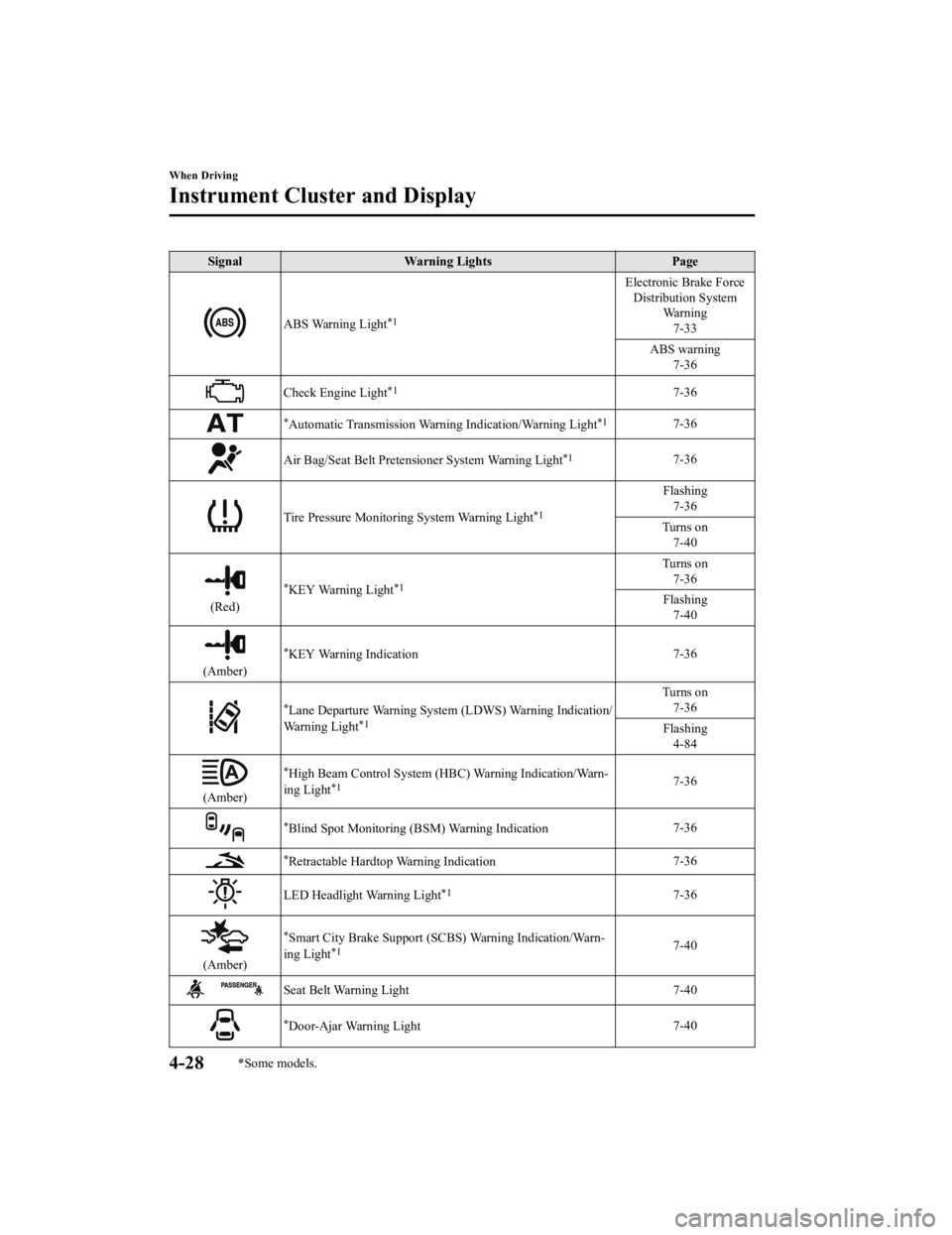
SignalWarning Lights Page
ABS Warning Light*1
Electronic Brake Force
Distribution System Wa r n i n g
7-33
ABS warning 7-36
Check Engine Light*17-36
*Automatic Transmission Warnin g Indication/Warning Light*17-36
Air Bag/Seat Belt Pretensioner System Warning Light*17-36
Tire Pressure Monitoring System Warning Light*1
Flashing
7-36
Turns on 7-40
(Red)
*KEY Warning Light*1
Turns on7-36
Flashing 7-40
(Amber)
*KEY Warning Indication 7-36
*Lane Departure Warning System (LDWS) Warning Indication/
Warning Light*1
Turns on 7-36
Flashing 4-84
(Amber)
*High Beam Control System (HBC) Warning Indication/Warn‐
ing Light*17-36
*Blind Spot Monitoring (BSM) Warning Indication 7-36
*Retractable Hardtop Warning Indication
7-36
LED Headlight Warning Light*17-36
(Amber)
*Smart City Brake Support (SCBS) Warning Indication/Warn‐
ing Light*17-40
Seat Belt Warning Light 7-40
*Door-Ajar Warning Light7-40
When Driving
Instrument Cluster and Display
4-28*Some models.
MX-5_8JS9-EA-20K_Edition1_old
2020-8-28 13:50:01
Page 157 of 499

SignalIndicator Lights Page
Lights-On Indicator Light 4-45
Headlight High-Beam Indicator LightHeadlight High-Low
Beam4-49
Flashing the Headlights 4-49
Turn Signal/Hazard Warning Indicator Lights Turn and Lane-Change
Signals4-51
Hazard Warning Flasher 4-58
TCS/DSC Indicator Light*1
Traction Control System(TCS)4-67
Dynamic Stability Con‐ trol (DSC)4-68
(Turns on) 7-36
DSC OFF Indicator Light*14-69
*Select Mode Indication 4-71
(Green)
*High Beam Control System (HBC) Indicator Light4-77
*Blind Spot Monitoring (BSM) OFF Indicator Light*14-89
*Lane Departure Warning System (LDWS) OFF Indicator
Light*14-82
*Smart City Brake Support (SCBS) Indication Smart City Brake Sup‐
port (SCBS)4-101
(Red)
*Smart City Brake Support (SCBS) Indicator Light Smart City Brake Sup‐
port (SCBS)
4-101
*Smart City Brake Support (SCBS) OFF Indicator Light*1Smart City Brake Sup‐
port (SCBS)4-102
When Driving
Instrument Cluster and Display
4-30*Some models.
MX-5_8JS9-EA-20K_Edition1_old 2020-8-28 13:50:01
Page 160 of 499

NOTE
A natural driving posture can be
realized by lightly gripping the shift
lever from the side without having to
rest your elbow on the center console
box.
If shifting to R is difficult, shift back into
neutral, release the clutch pedal, and try
again.
▼Gear Shift Indicator (GSI)
The GSI supports you to obtain optimum
fuel economy and smooth driving. It
displays the selected gear position in the
instrument cluster as well as notifies the
driver to change to the most suitable gear
position corresponding to the actual
driving condition.
Selected gear position Suitable gear position
Indication
Condition
Numeral The selected gear position is dis‐
played.
and numeral Shift up or down to the indicated
gear position is recommended.
CAUTION
Do not rely solely on the shift-up/
shift-down recommendations by
indications. The actual driving situation
might require shift
operations different
from indication. To avoid the risk of
accidents, the road and traffic conditions
have to be judged correctly by the driver
before shifting.
NOTE
The GSI turns off when the following
operations are performed.
The vehicle is stopped.
The vehicle is put in neutral.
The vehicle is driven in reverse.
The clutch is not fully engaged when
accelerating from a stop.
The clutch pedal remains depressed for
2 seconds or longer while driving.
▼ Recommendations for Shifting
Upshifting
For normal acceleration, Mazda
recommends these shift points:
Gear
Vehicle speed
1 to 2 23 km/h (14 mph)
2 to 3 39 km/h (24 mph)
3 to 4 53 km/h (33 mph)
4 to 5 61 km/h (38 mph)
5 to 6 77 km/h (48 mph)
When Driving
Manual Transmission Operation
4-33
MX-5_8JS9-EA-20K_Edition1_old 2020-8-28 13:50:01
Page 162 of 499

Automatic Transmission Controls
Lock-release button
Indicates the selector lever can be shifted freely into any position.
Indicates that you must hold in the lock-release button to shift. Indicates that you must depress the brake pedal and hold in the lock-release
button to shift (The ignition must be switched ON).
Various Lockouts:
NOTE
The Sport AT has an option that is not includ
ed in the traditional automatic transmission
that gives the driver the option of selecti ng each gear instead of leaving it to the
transmission to shift gears. Even if you intend to use the automatic transmission functions as
a traditional automatic, you should also be aware that you can inadvertently shift into
manual shift mode and an inappropriate gear may be retained as the vehicle speed
increases. If you notice the engine speed going higher or hear the engine racing, confirm
you have not accidentally slipped into manual shift mode (page 4-38).
When Driving
Automatic Transmission
4-35
MX-5_8JS9-EA-20K_Edition1_old 2020-8-28 13:50:01