ignition MAZDA MODEL RX 8 2011 (in English) Workshop Manual
[x] Cancel search | Manufacturer: MAZDA, Model Year: 2011, Model line: MODEL RX 8, Model: MAZDA MODEL RX 8 2011Pages: 442, PDF Size: 7.12 MB
Page 158 of 442

Black plate (158,1)
qActive Adaptive Shift (AAS)
Active Adaptive Shift (AAS)
automatically controls the transmission
shift points to best suit the road conditions
and driver input. This optimizes engine
performance and improves driving
comfort. When cornering the vehicle,
AAS mode will hold the transmission in
the gear the vehicle was in before entering
the curve, allowing the vehicle to be
accelerated from the same gear after
exiting the curve.
If the driver accelerates rapidly, or
accelerates and decelerates rapidly by
operating the accelerator and brake pedal
for a certain period of time while the
selector lever is in the D position, AAS
mode could activate. When this occurs,
AAS mode will maintain the transmission
in the optimum gear and the driver may
sense that the transmission is not shifting,
however this does not indicate an
abnormality.
qShift-Lock System
The shift-lock system prevents shifting
out of P unless the brake pedal is
depressed.
To shift from P:
1. Depress and hold the brake pedal.
2. Start the engine.
3. Move the shift lever.NOTE
lWhen the ignition switch is in the LOCK
position, the shift lever cannot be shifted
from P.
lTo be sure the vehicle is in park,the
ignition key cannot be removed unless the
shift lever is in P.
l(With Advanced Key)
The ignition cannot be switched from ACC
to OFF when the shift lever is not in P.
qManual Shift Mode
This mode gives you the feel of driving a
manual transmission vehicle by operating
the shift lever and allows you to control
engine rpm and torque to the rear wheels
much like a manual transmission when
more control is desired.
To change to manual shift mode, shift the
lever from D to M.
NOTE
Changing to manual shift mode while driving
will not damage the transmission.
To return to automatic shift mode, shift
the lever from M to D.
5-16
Driving Your Mazda
Starting and Driving
RX-8_8BQ7-EA-10H_Edition1 Page158
Wednesday, July 14 2010 11:50 AM
Form No.8BQ7-EA-10H
Page 164 of 442

Black plate (164,1)
Power Steering
Power steering is only operable when the
engine is running. If the engine is off or if
the power steering system is inoperable,
you can still steer, but it requires more
physical effort.
If the steering feels stiffer than usual
during normal driving, consult an
Authorized Mazda Dealer.
qPower Steering Malfunction
Indicator Light
This indicator light illuminates when the
ignition is switched ON, and turns off
when the engine is started.
If the light remains illuminated after the
engine is started, or illuminates while
driving, turn off the engine after parking
in a safe place, and then start the engine
again.
If the light does not illuminate after
restarting the engine, this indicates that
the power steering is restored and normal
steering is possible.
If the light remains illuminated, the power
steering is still inoperable. Consult an
Authorized Mazda Dealer.NOTE
lThe power steering system is inoperable
when the power steering malfunction
indicator light illuminates. Steering is
possible, but requires more physical effort.
lRepeatedly jerking the steering wheel left
and right while the vehicle is stopped or
moving extremely slowly will cause the
power steering system to go into protective
mode which will make the steering feel
heavy, but this does not indicate a
malfunction. If this occurs, park the vehicle
safely and wait a few minutes for the system
to return to normal.
5-22
Driving Your Mazda
Starting and Driving
RX-8_8BQ7-EA-10H_Edition1 Page164
Wednesday, July 14 2010 11:50 AM
Form No.8BQ7-EA-10H
Page 168 of 442

Black plate (168,1)
lPress the CANCEL switch.
The system turns off when the ignition is
off.
NOTE
Cruise control will cancel at about 15 km/h (9
mph) below the preset speed (such as may
happen when climbing a long, steep grade).
Traction Control System
(TCS)
í
The Traction Control System (TCS)
enhances traction and safety by
controlling engine torque and braking.
When the TCS detects driving wheel
slippage, it lowers engine torque and
operates the brakes to prevent loss of
traction.
This means that on a slick surface, the
engine adjusts automatically to provide
optimum power to the drive wheels,
limiting wheel spin and loss of traction.
WARNING
Do not rely on the traction control
system as a substitute for safe driving:
The traction control system (TCS)
cannot compensate for unsafe and
reckless driving, excessive speed,
tailgating (following another vehicle
too closely), and hydroplaning
(reduced tire friction and road
contact because of water on the road
surface). You can still have an
accident.
Use snow tires or tire chains and drive
at reduced speeds when roads are
covered with ice and/or snow:
Driving without proper traction
devices on snow and/or ice-covered
roads is dangerous. The traction
control system (TCS) alone cannot
provide adequate traction and you
could still have an accident.
NOTE
To turn off the TCS, press the DSC OFF switch
(page 5-29).
5-26
Driving Your Mazda
íSome models.
Starting and Driving
RX-8_8BQ7-EA-10H_Edition1 Page168
Wednesday, July 14 2010 11:50 AM
Form No.8BQ7-EA-10H
Page 169 of 442
Black plate (169,1)
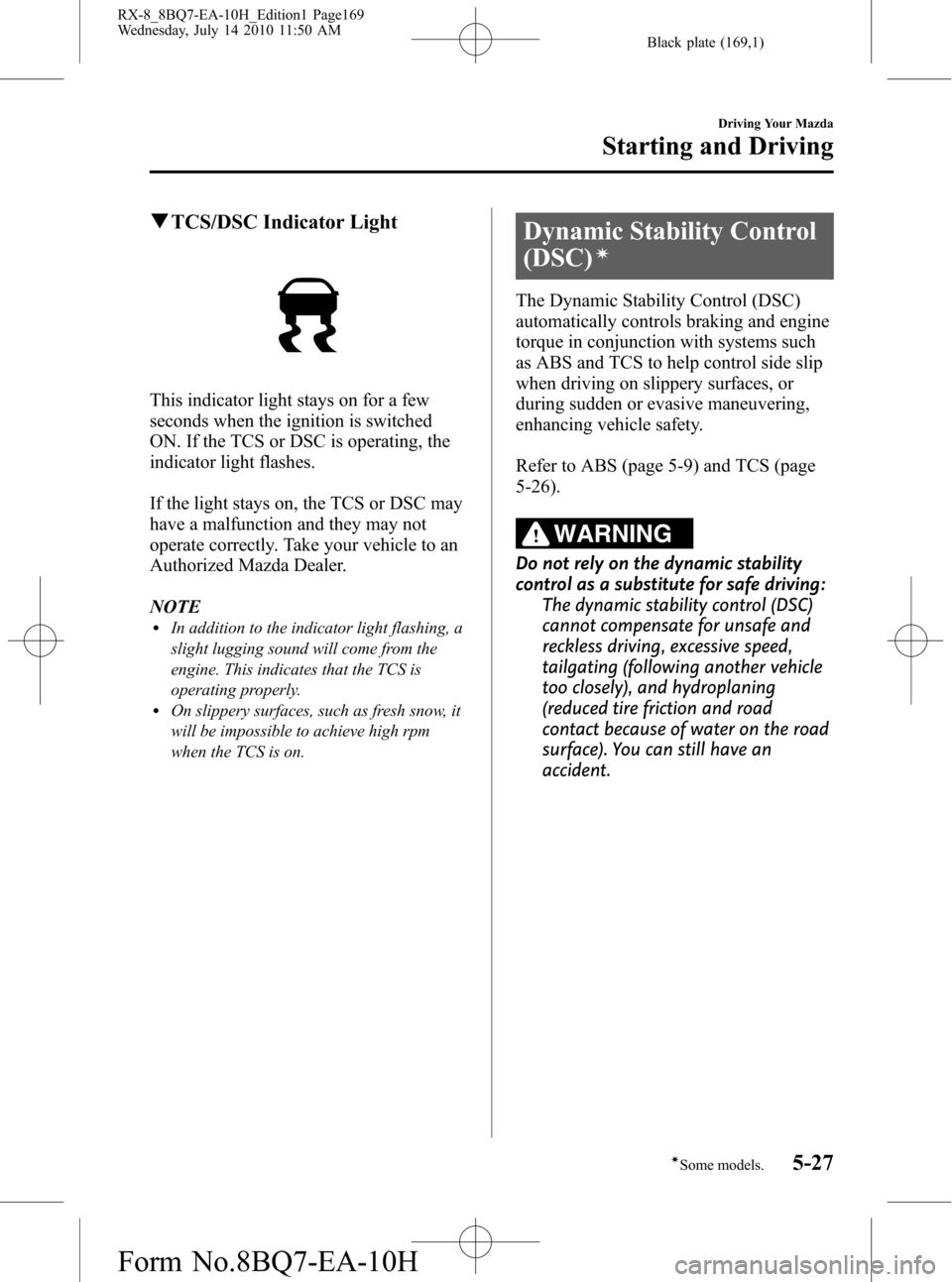
qTCS/DSC Indicator Light
This indicator light stays on for a few
seconds when the ignition is switched
ON. If the TCS or DSC is operating, the
indicator light flashes.
If the light stays on, the TCS or DSC may
have a malfunction and they may not
operate correctly. Take your vehicle to an
Authorized Mazda Dealer.
NOTE
lIn addition to the indicator light flashing, a
slight lugging sound will come from the
engine. This indicates that the TCS is
operating properly.
lOn slippery surfaces, such as fresh snow, it
will be impossible to achieve high rpm
when the TCS is on.
Dynamic Stability Control
(DSC)
í
The Dynamic Stability Control (DSC)
automatically controls braking and engine
torque in conjunction with systems such
as ABS and TCS to help control side slip
when driving on slippery surfaces, or
during sudden or evasive maneuvering,
enhancing vehicle safety.
Refer to ABS (page 5-9) and TCS (page
5-26).
WARNING
Do not rely on the dynamic stability
control as a substitute for safe driving:
The dynamic stability control (DSC)
cannot compensate for unsafe and
reckless driving, excessive speed,
tailgating (following another vehicle
too closely), and hydroplaning
(reduced tire friction and road
contact because of water on the road
surface). You can still have an
accident.
Driving Your Mazda
Starting and Driving
5-27íSome models. RX-8_8BQ7-EA-10H_Edition1 Page169
Wednesday, July 14 2010 11:50 AM
Form No.8BQ7-EA-10H
Page 170 of 442
Black plate (170,1)
CAUTION
ØThe DSC may not operate correctly
unless the following are observed:
ØUse tires of the correct size
specified for your Mazda on all
four wheels.
ØUse tires of the same
manufacturer, brand and tread
pattern on all four wheels.
ØDo not mix worn tires.
ØThe DSC may not operate correctly
when tire chains are used or a
temporary spare tire is installed
because the tire diameter changes.
ØIf repair or replacement of the
steering or other surrounding
equipment is necessary, have it
done at an Authorized Mazda
Dealer. If the center position of the
steering deviates, the DSC may not
operate correctly because there is
a sensor in the steering which
detects driving conditions.
qTCS/DSC Indicator Light
This indicator light stays on for a few
seconds when the ignition is switched
ON. If the TCS or DSC is operating, the
indicator light flashes.
If the light stays on, the TCS or DSC may
have a malfunction and they may not
operate correctly. Take your vehicle to an
Authorized Mazda Dealer.
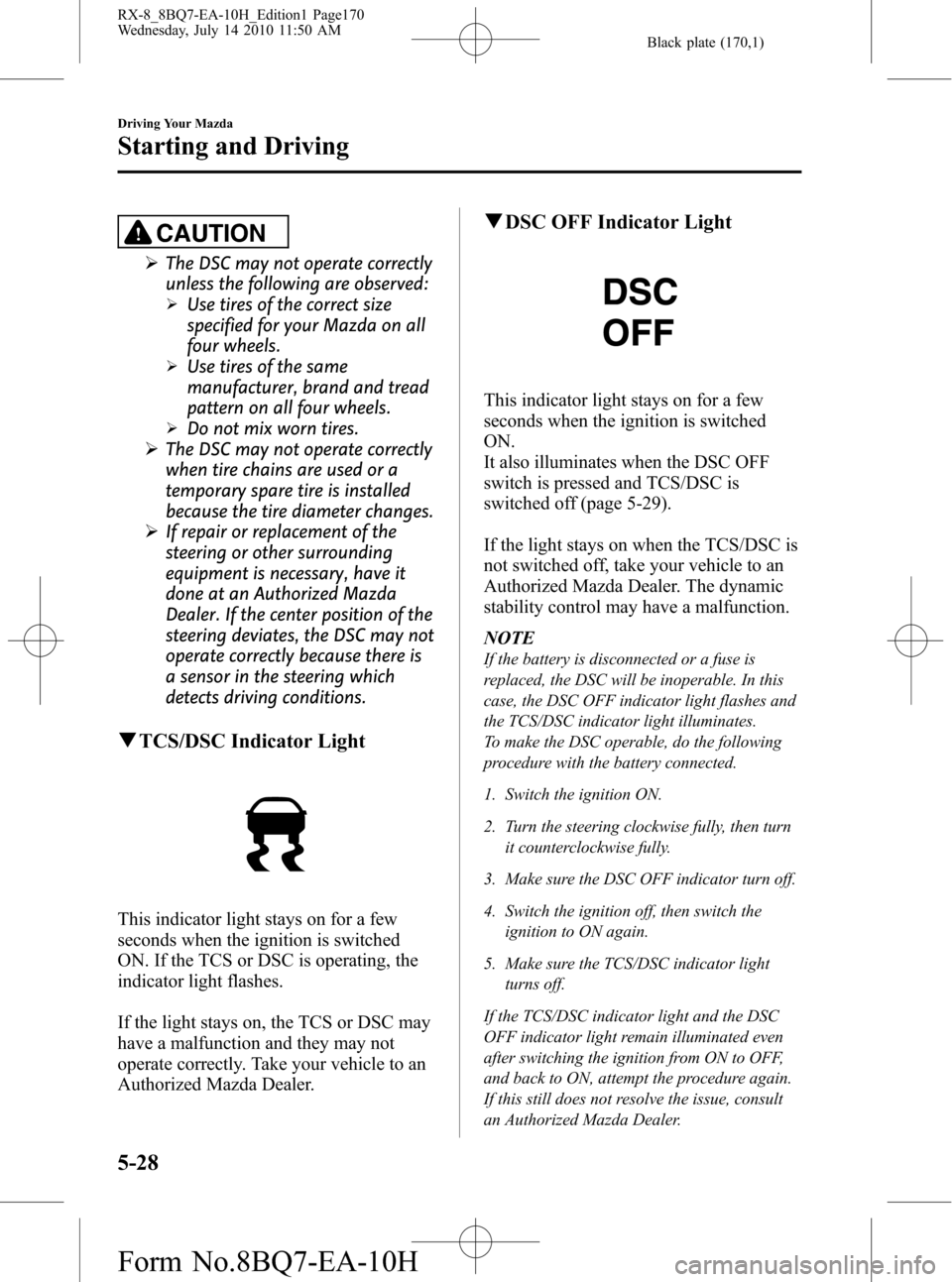
qDSC OFF Indicator Light
This indicator light stays on for a few
seconds when the ignition is switched
ON.
It also illuminates when the DSC OFF
switch is pressed and TCS/DSC is
switched off (page 5-29).
If the light stays on when the TCS/DSC is
not switched off, take your vehicle to an
Authorized Mazda Dealer. The dynamic
stability control may have a malfunction.
NOTE
If the battery is disconnected or a fuse is
replaced, the DSC will be inoperable. In this
case, the DSC OFF indicator light flashes and
the TCS/DSC indicator light illuminates.
To make the DSC operable, do the following
procedure with the battery connected.
1. Switch the ignition ON.
2. Turn the steering clockwise fully, then turn
it counterclockwise fully.
3. Make sure the DSC OFF indicator turn off.
4. Switch the ignition off, then switch the
ignition to ON again.
5. Make sure the TCS/DSC indicator light
turns off.
If the TCS/DSC indicator light and the DSC
OFF indicator light remain illuminated even
after switching the ignition from ON to OFF,
and back to ON, attempt the procedure again.
If this still does not resolve the issue, consult
an Authorized Mazda Dealer.
5-28
Driving Your Mazda
Starting and Driving
RX-8_8BQ7-EA-10H_Edition1 Page170
Wednesday, July 14 2010 11:50 AM
Form No.8BQ7-EA-10H
Page 171 of 442

Black plate (171,1)
qDSC OFF Switch
Press the DSC OFF switch to turn off the
TCS/DSC. The DSC OFF indicator light
will illuminate.
Press the switch again to turn the TCS/
DSC back on. The DSC OFF indicator
light will go out.NOTE
lWhen DSC is on and you attempt to free the
vehicle when it is stuck, or drive it out of
freshly fallen snow, the TCS (part of the
DSC system) will activate. Depressing the
accelerator will not increase engine power
and freeing the vehicle may be difficult.
When this happens, turn off the TCS/DSC.
lIf the TCS/DSC is off when the engine is
turned off, it automatically activates when
the ignition is switched ON.
lLeaving the TCS/DSC on will provide the
best stability. When the TCS/DSC is off, the
TCS/DSC does not activate but the brake
LSD (Limited Slip Differentials) function
remains.
lIf the DSC OFF switch is pressed and held
for a second or more, the TCS/DSC system
may become inoperative due to the system
detecting a switch problem. If the TCS/DSC
system becomes inoperative, the TCS/DSC
and the DSC OFF indicator lights
illuminate simultaneously. In this case, turn
off the engine and restart it to restore the
TCS/DSC.
Driving Your Mazda
Starting and Driving
5-29
RX-8_8BQ7-EA-10H_Edition1 Page171
Wednesday, July 14 2010 11:50 AM
Form No.8BQ7-EA-10H
Page 174 of 442

Black plate (174,1)
qTire Pressure Monitoring System
Warning Light
This warning light illuminates for a few
seconds when the ignition is switched
ON.
Thereafter, the warning light illuminates
and a beep is heard when tire pressure is
too low in one or more tires, and flashes
when there is a system malfunction.
WARNING
If the tire pressure monitoring system
warning light illuminates or flashes, or
the tire pressure warning beep sound is
heard, decrease vehicle speed
immediately and avoid sudden
maneuvering and braking:
If the tire pressure monitoring system
warning light illuminates or flashes,
or the tire pressure warning beep
sound is heard, it is dangerous to
drive the vehicle at high speeds, or
perform sudden maneuvering or
braking. Vehicle drivability could
worsen and result in an accident.
To determine if you have a slow leak
or a flat, pull over to a safe position
where you can check the visual
condition of the tire and determine if
you have enough air to proceed to a
place where air may be added and
the system monitored again by an
Authorized Mazda Dealer or a tire
repair station.
Do not ignore the TPMS Warning Light:
Ignoring the TPMS warning light is
dangerous, even if you know why it is
illuminated. Have the problem taken
care of as soon as possible before it
develops into a more serious
situation that could lead to tire
failure and a dangerous accident.
Warning light illuminates/Warning
beep sounds
When the warning light illuminates, and
the warning beep sound is heard (about 3
seconds), tire pressure is too low in one or
more tires.
5-32
Driving Your Mazda
Starting and Driving
RX-8_8BQ7-EA-10H_Edition1 Page174
Wednesday, July 14 2010 11:50 AM
Form No.8BQ7-EA-10H
Page 177 of 442

Black plate (177,1)
NOTE
Each tire pressure sensor has a unique ID
signal code. The signal code must be
registered with the TPMS before it can work.
The easiest way to do it is to have an
Authorized Mazda Dealer change your tire and
complete ID signal code registration.
When having tires changed at an
Authorized Mazda Dealer
When an Authorized Mazda Dealer
changes your vehicle's tires, they will
complete the tire pressure sensor ID signal
code registration.
When changing tires yourself
If you or someone else changes tires, you
or someone else can also undertake the
steps for the TPMS to complete the ID
signal code registration.
1. After tires have been changed, switch
the ignition ON, then back to ACC or
OFF.
2. Wait for about 15 minutes.
3. After about 15 minutes, drive the
vehicle at a speed of at least 25 km/h
(16 mph) for 10 minutes and the tire
pressure sensor ID signal code will be
registered automatically.
NOTE
If the vehicle is driven within about 15 minutes
of changing tires, the tire pressure monitoring
system warning light will flash because the
sensor ID signal code would not have been
registered. If this happens, park the vehicle for
about 15 minutes, after which the sensor ID
signal code will register upon driving the
vehicle for 10 minutes.
Replacing tires and wheels
CAUTION
ØWhen replacing/repairing the tires
or wheels or both, have the work
done by an Authorized Mazda
Dealer, or the tire pressure sensors
may be damaged.
ØThe wheels equipped on your
Mazda are specially designed for
installation of the tire pressure
sensors. Do not use non-genuine
wheels, otherwise it may not be
possible to install the tire pressure
sensors.
Be sure to have the tire pressure sensors
installed whenever tires or wheels are
replaced.
When having a tire or wheel or both
replaced, the following types of tire
pressure sensor installations are possible.
lThe tire pressure sensor is removed
from the old wheel and installed to the
new one.
lThe same tire pressure sensor is used
with the same wheel. Only the tire is
replaced.
lA new tire pressure sensor is installed
to a new wheel.
NOTE
lThe tire pressure sensor ID signal code
must be registered when a new tire pressure
sensor is purchased. For purchase of a tire
pressure sensor and registration of the tire
pressure sensor ID signal code, consult an
Authorized Mazda Dealer.
lWhen reinstalling a previously removed tire
pressure sensor to a wheel, replace the
grommet (seal between valve body/sensor
and wheel) for the tire pressure sensor.
Driving Your Mazda
Starting and Driving
5-35
RX-8_8BQ7-EA-10H_Edition1 Page177
Wednesday, July 14 2010 11:50 AM
Form No.8BQ7-EA-10H
Page 178 of 442

Black plate (178,1)
Meters and Gauges
Speedometer ...................................................................................................... page 5-37
Speed Unit Selector ........................................................................................... page 5-37
Odometer, Trip Meter and Trip Meter Selector .................................................. page 5-37
Tachometer ........................................................................................................ page 5-38
Engine Coolant Temperature Gauge .................................................................. page 5-39
Fuel Gauge ........................................................................................................ page 5-39
NOTE
When the ignition is switched ON, the dashboard gauges illuminate.
5-36
Driving Your Mazda
Instrument Cluster and Indicators
RX-8_8BQ7-EA-10H_Edition1 Page178
Wednesday, July 14 2010 11:50 AM
Form No.8BQ7-EA-10H
Page 180 of 442
Black plate (180,1)
NOTE
When the ignition is switched to ACC or the
ignition is switched off, the odometer or trip
meters cannot be displayed, however, pressing
the selector button can inadvertently switch the
trip meters or reset them during an
approximate ten-minute period in the following
cases:
lAfter the ignition is switched to ACC or the
ignition is switched off from ON.
lAfter the driver's door is opened.
Odometer
The odometer records the total distance
the vehicle has been driven.
Trip meter
The trip meter can record the total
distance of two trips. One is recorded in
trip meter A, and the other is recorded in
trip meter B.
For instance, trip meter A can record the
distance from the point of origin, and trip
meter B can record the distance from
where the fuel tank is filled.
When trip meter A is selected, pressing
the selector again within one second will
change to trip meter B mode.
When trip meter A is selected, TRIP A
will be displayed. When trip meter B is
selected, TRIP B will be displayed.
The trip meter records the total distance
the vehicle is driven until the meter is
again reset. Return it to“0.0”by holding
the selector depressed for 1 second or
more. Use this meter to measure trip
distances and to compute fuel
consumption.NOTE
lOnly the trip meters record tenths of
kilometers (miles).
lThe trip record will be erased when:lThe power supply is interrupted (blown
fuse or the battery is disconnected).
lThe vehicle is driven over 999.9 km
(mile).
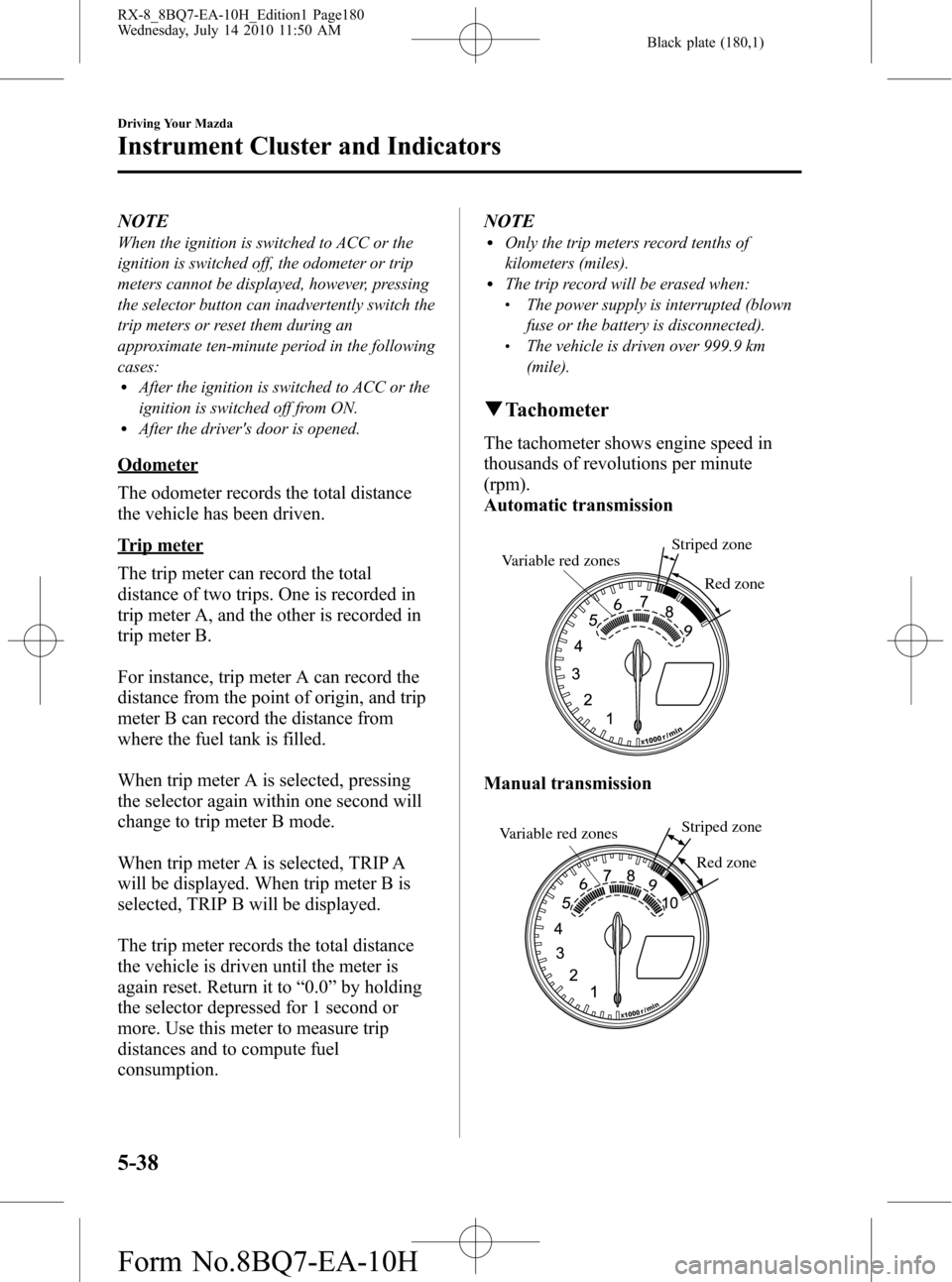
qTachometer
The tachometer shows engine speed in
thousands of revolutions per minute
(rpm).
Automatic transmission
Variable red zonesStriped zone
Red zone
Manual transmission
Variable red zonesStriped zone
Red zone
5-38
Driving Your Mazda
Instrument Cluster and Indicators
RX-8_8BQ7-EA-10H_Edition1 Page180
Wednesday, July 14 2010 11:50 AM
Form No.8BQ7-EA-10H