lock MAZDA MODEL TRIBUTE 2004 (in English) Repair Manual
[x] Cancel search | Manufacturer: MAZDA, Model Year: 2004, Model line: MODEL TRIBUTE, Model: MAZDA MODEL TRIBUTE 2004Pages: 256, PDF Size: 2.64 MB
Page 167 of 256

WARNING: Changing a tire is dangerous if not done properly.
The vehicle can slip off the jack and seriously injure you or
someone. Be sure to follow the directions for changing a tire,
and never get under a vehicle that is supported only by a jack.
1. Park on a level surface, activate
hazard flashers and place
gearshift lever in P (Park)
(automatic transmission) or R
(Reverse) (manual
transmission).
2. Set the parking brake and turn
engine OFF.
3. Block the diagonally opposite
wheel.
4. Lift the cargo cover and remove
the tool bag with jack handle,
lug nut wrench and long spare
tire rod and spare tire from the
wheel well.
Roadside Emergencies
167
Page 168 of 256

5. Loosen each wheel lug nut
one-half turn counterclockwise
but do not remove them until
the wheel is raised off the
ground.
Before placing the jack under the vehicle, NOTE the jack locations:
²Frontjacking notches are located
under the front suspension
arm.
²Rearjacking notches are located
under the rear trailing arm.
Roadside Emergencies
168
Page 169 of 256

6. Position the jack according to
the following guides and turn
the jack handle clockwise until
the tire is a maximum of 25 mm
(1 inch) off the ground.
Never use the differentials as a
jacking point. It is too easy for
the vehicle to tilt or fall and you
can be injured.
WARNING: To lessen the risk
of personal injury, do not put
any part of your body under
the vehicle while changing a
tire. Do not start the engine
when your vehicle is on the
jack. The jack is only meant
for changing the tire.
7. Remove the lug nuts with the lug nut wrench.
8. Replace the flat tire with the spare tire, making sure the valve stem
is facing outward. Reinstall lug nuts until the wheel is snug against
the hub. Do not fully tighten the lug nuts until the wheel has been
lowered.
9. Lower the wheel by turning the jack handle counterclockwise.
Roadside Emergencies
169
Page 170 of 256

10. Remove the jack and fully
tighten the lug nuts in the order
shown.
NOTE:To stow the full size flat tire
in the cargo floor, the long spare
tire rod in the tool bag needs to be
installed.
11. Using the lug wrench, remove
the spare tire rod from the
cargo floor and install the longer
spare tire rod.
12. Put flat tire and tool bag with
jack handle, lug nut wrench and
spare tire rod away. Make sure
jack is fastened so it does not
rattle when you drive.
NOTE:The cargo cover can not be
reattached to the back seat clips
when a full size tire is stowed.
13. Install cargo cover over the flat
tire and secure with the plastic
nut.
14. Unblock the wheels.1
4 3
2 5
Roadside Emergencies
170
Page 198 of 256

Maintenance ItemMaintenance Interval (Number of months or km (miles),
whichever comes first)
Months 6 12 18 24 30 36 42 48 54 60 66 72
x 1000 Km 12 24 36 48 60 72 84 96 108 120 132 144
(x 1000 Miles) (7.5) (15) (22.5) (30) (37.5) (45) (52.5) (60) (67.5) (75) (82.5) (90)
CHASSIS and BODY
Brake lines, hoses and
connectionsIII
Disc brakes I I I
Drum brakes I I I
Steering operation and linkages I I I
Rear differential oil
(for 4WD)*2 Replace every 160,000 km (100,000 miles)
Front and rear suspension ball
jointsIII
Driveshaft dust boots I I I
Bolts and nuts on chassis and
bodyIII
Exhaust system heat shields I I I
All locks and hinges LLLLLLLLLLLL
AIR CONDITIONER SYSTEM (if equipped)
Refrigerant amountIIIIII
Compressor operationIIIIII
*1 According to state and federal regulations, failure to perform
maintenance on these items will not void your emissions warranties.
However, Mazda recommends that all maintenance services be performed
at the recommended time or mileage (kilometrage) period to ensure
long-term reliability.
*2 If this component has been submerged in water, the oil should be
changed.
Maintenance and Specifications
198
Page 200 of 256

Maintenance ItemMaintenance Interval (Number of months or km (miles),
whichever comes first)
Months 4 8 12 16 20 24 28 32 36 40 44 48
x 1000 Km 8 16 24 32 40 48 56 64 72 80 88 96
(x 1000 Miles) (5) (10) (15) (20) (25) (30) (35) (40) (45) (50) (55) (60)
Engine coolant (yellow) Replace at first 160,000 km (100,000 miles) or 60
months; after that, every 80,000 km (50,000 miles)
or 36 months
Engine coolant level IIIIIIIIIII I
ELECTRICAL SYSTEM
Function of all lights IIIIIIIIIII I
CHASSIS and BODY
Brake lines, hoses and connections I I
Brake fluid level IIIIIIIIIII I
Disc brakes I I I I
Drum brakes I I
Tire inflation pressure and tire wear IIIIIIIIIII I
Steering operation and linkages I I
Power steering fluid level IIIIIIIIIII I
Manual transaxle oil Replace every 48,000 km (30,000 miles)
Automatic transaxle fluid Replace every 48,000 km (30,000 miles)
Rear differential oil (for 4WD) *2 Replace every 160,000 km (100,000 miles)
Transfer oil (for 4WD) *2 Replace every 48,000 km (30,000 miles)
Front and rear suspension ball joints I I
Driveshaft dust boots I I
Bolts and nuts on chassis and body I I I I
Exhaust system heat shields I I
All locks and hinges LLLLLLLLLLL L
Washer fluid level IIIIIIIIIII I
AIR CONDITIONER SYSTEM (if equipped)
Refrigerant amount I I I I
Compressor operation I I I I
*1 According to state and federal regulations, failure to perform
maintenance on these items will not void your emissions warranties.
However, Mazda recommends that all maintenance services be performed
Maintenance and Specifications
200
Page 202 of 256

PRECAUTIONS WHEN SERVICING YOUR VEHICLE
WARNING: A hot engine is dangerous. If the engine has been
running, parts of the engine compartment can become very hot.
You could be burned. Don't inspect the coolant system or add
coolant when the engine is hot.
²Do not work on a hot engine.
²Make sure that nothing gets caught in moving parts.
²Do not work on a vehicle with the engine running in an enclosed
space, unless you are sure you have enough ventilation.
²Keep all open flames and other lit material away from the battery and
all fuel related parts.
Working with the engine off
²Automatic transmission:
1. Set the parking brake and shift to P (Park).
2. Turn off the engine and remove the key.
3. Block the wheels.
²Manual transmission:
1. Set the parking brake, depress the clutch and place the gearshift in 1
(First).
2. Turn off the engine and remove the key.
3. Block the wheels.
Working with the engine on
²Automatic transmission:
1. Set the parking brake and shift to P (Park).
2. Block the wheels.
²Manual transmission:
1. Set the parking brake, depress the clutch and place the gearshift in
N (Neutral).
2. Block the wheels.
Note:Do not start your engine with the air cleaner removed and do not
remove it while the engine is running.
Maintenance and Specifications
202
Page 209 of 256
5. Fully install the engine oil filler cap by turning the filler cap
clockwise 1/4 of a turn until it is seated.
To avoid possible oil loss, DO NOT operate the vehicle with the
engine oil level indicator and/or the engine oil filler cap removed.
Engine oil and filter recommendations
SAE 5W-20 engine oil is recommended
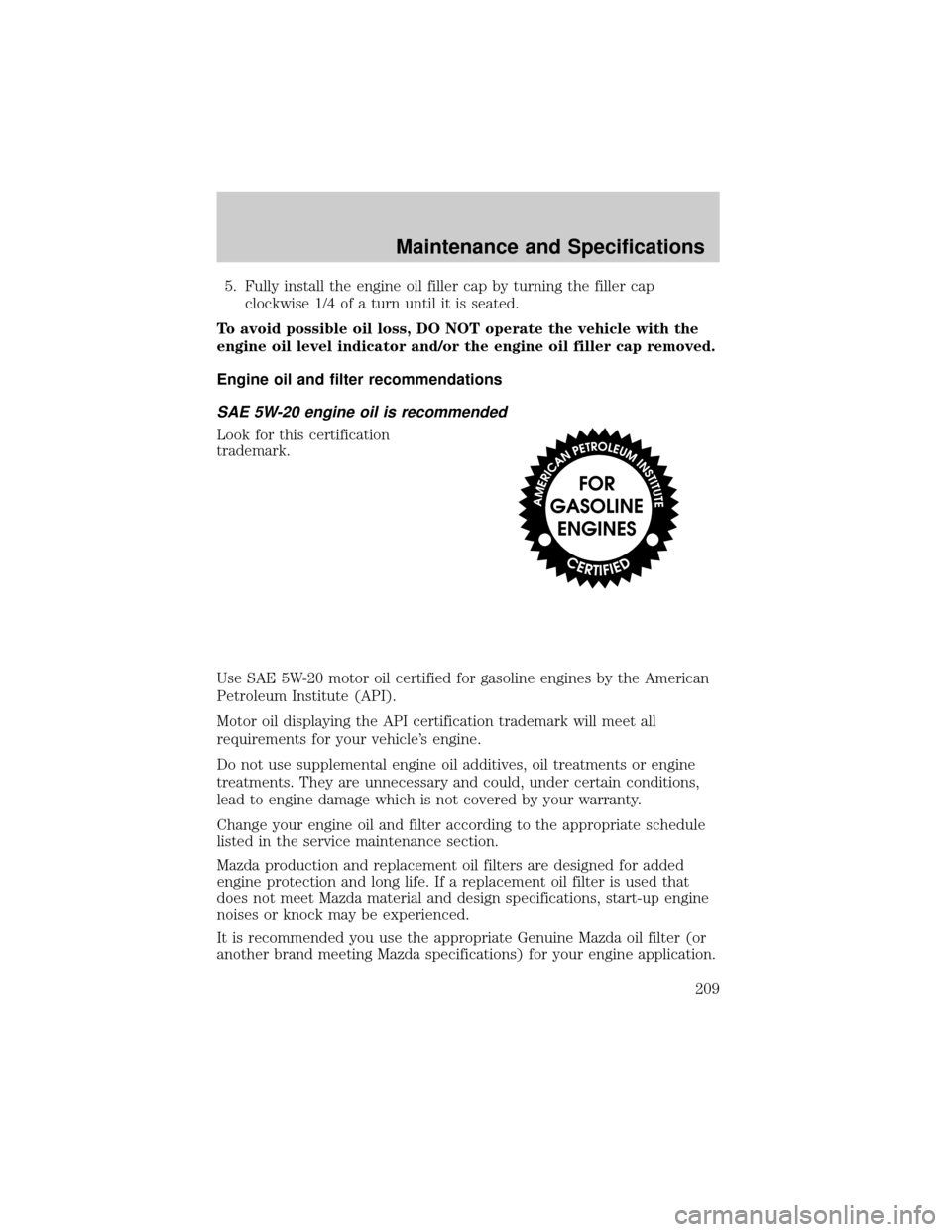
Look for this certification
trademark.
Use SAE 5W-20 motor oil certified for gasoline engines by the American
Petroleum Institute (API).
Motor oil displaying the API certification trademark will meet all
requirements for your vehicle's engine.
Do not use supplemental engine oil additives, oil treatments or engine
treatments. They are unnecessary and could, under certain conditions,
lead to engine damage which is not covered by your warranty.
Change your engine oil and filter according to the appropriate schedule
listed in the service maintenance section.
Mazda production and replacement oil filters are designed for added
engine protection and long life. If a replacement oil filter is used that
does not meet Mazda material and design specifications, start-up engine
noises or knock may be experienced.
It is recommended you use the appropriate Genuine Mazda oil filter (or
another brand meeting Mazda specifications) for your engine application.
Maintenance and Specifications
209
Page 212 of 256
transmission may shift firmly. This operation is considered normal and
will not affect function or durability of the transmission. Over time the
adaptive learning process will fully update transmission operation to its
optimum shift feel.
If the battery has been disconnected or a new battery has been installed,
the clock and the preset radio stations must be reset once the battery is
reconnected.
²Always dispose of automotive
batteries in a responsible manner.
Follow your local authorized
standards for disposal. Call your
local authorized recycling center
to find out more about recycling
automotive batteries.
ENGINE COOLANT
Checking engine coolant
The concentration and level of engine coolant should be checked at the
mileage intervals listed in the service maintenance section. The coolant
concentration should be maintained at 50/50 coolant and water, which
equates to a freeze point of -36É C (-34É F). Coolant concentration
testing is possible with a hydrometer or antifreeze tester (such as the
Rotunda Battery and Antifreeze Tester, 014±R1060). The level of coolant
should be maintained at the ªcold fullº of ªcold fill rangeº level in the
coolant reservoir. If the level falls below, add coolant per the instructions
in theAdding Engine Coolantsection.
Your vehicle was factory-filled with a 50/50 engine coolant and water
concentration. If the concentration of coolant falls below 40% or above
60%, the engine parts could become damaged or not work properly.A
50±50 mixture of coolant and water provides the following:
²freeze protection down to -36É C (-34É F).
²boiling protection up to 129É C (265É F).
²protection against rust and other forms of corrosion.
²an accurate temperature readout from the engine coolant
gauge.
LEAD
RETURN
RECYCLE
Maintenance and Specifications
212
Page 215 of 256
2. When the engine is cool, wrap a thick cloth around the coolant
pressure relief cap on the coolant reservoir (an opaque plastic
bottle). Slowly turn cap counterclockwise (left) until pressure begins
to release.
3. Step back while the pressure releases.
4. When you are sure that all the pressure has been released, use the
cloth to turn it counterclockwise and remove the cap.
5. Fill the coolant reservoir slowly with the proper coolant mixture (see
above), to within the ªcold fill rangeº or the ªcold fullº level on the
reservoir. If you removed the radiator cap in an overflow system, fill
the radiator until the coolant is visible and radiator is almost full.
6. Replace the cap. Turn until tightly installed. (Cap must be tightly
installed to prevent coolant loss.)
After any coolant has been added, run the engine for a few minutes to
mix the coolant. Check the coolant concentration. Make sure the engine
is off and cool before removing the coolant pressure relief cap (see
preceding steps on cap removal). Check the concentration per the
Checking Engine Coolantsection. If the concentration is not 50/50
(protection to ±34ÉF/±36ÉC), drain some coolant and adjust the
concentraction. It may take several drains and additions to obtain a 50/50
coolant concentration.
Whenever coolant has been added, the coolant level in the coolant
reservoir should be checked the next few times you drive the vehicle. If
necessary, add enough 50/50 concentration of engine coolant and
distilled water to bring the liquid level to the proper level.
If you have to add more than 1.0 liter (1.0 quart) of engine coolant per
month, have your dealer check the engine cooling system. Your cooling
system may have a leak. Operating an engine with a low level of coolant
can result in engine overheating and possible engine damage).
Recycled engine coolant
Not all coolant recycling processes produce coolant which meets
Mazda recommend coolants. Use of a recycled engine coolant
which does not meet the Mazda recommended coolant, may harm
engine and cooling system components.
Always dispose of used automotive fluids in a responsible manner.
Follow your community's regulations and standards for recycling and
disposing of automotive fluids.
Maintenance and Specifications
215