light MAZDA MODEL TRIBUTE 4WD 2001 Owner's Manual
[x] Cancel search | Manufacturer: MAZDA, Model Year: 2001, Model line: MODEL TRIBUTE 4WD, Model: MAZDA MODEL TRIBUTE 4WD 2001Pages: 232, PDF Size: 1.74 MB
Page 80 of 232
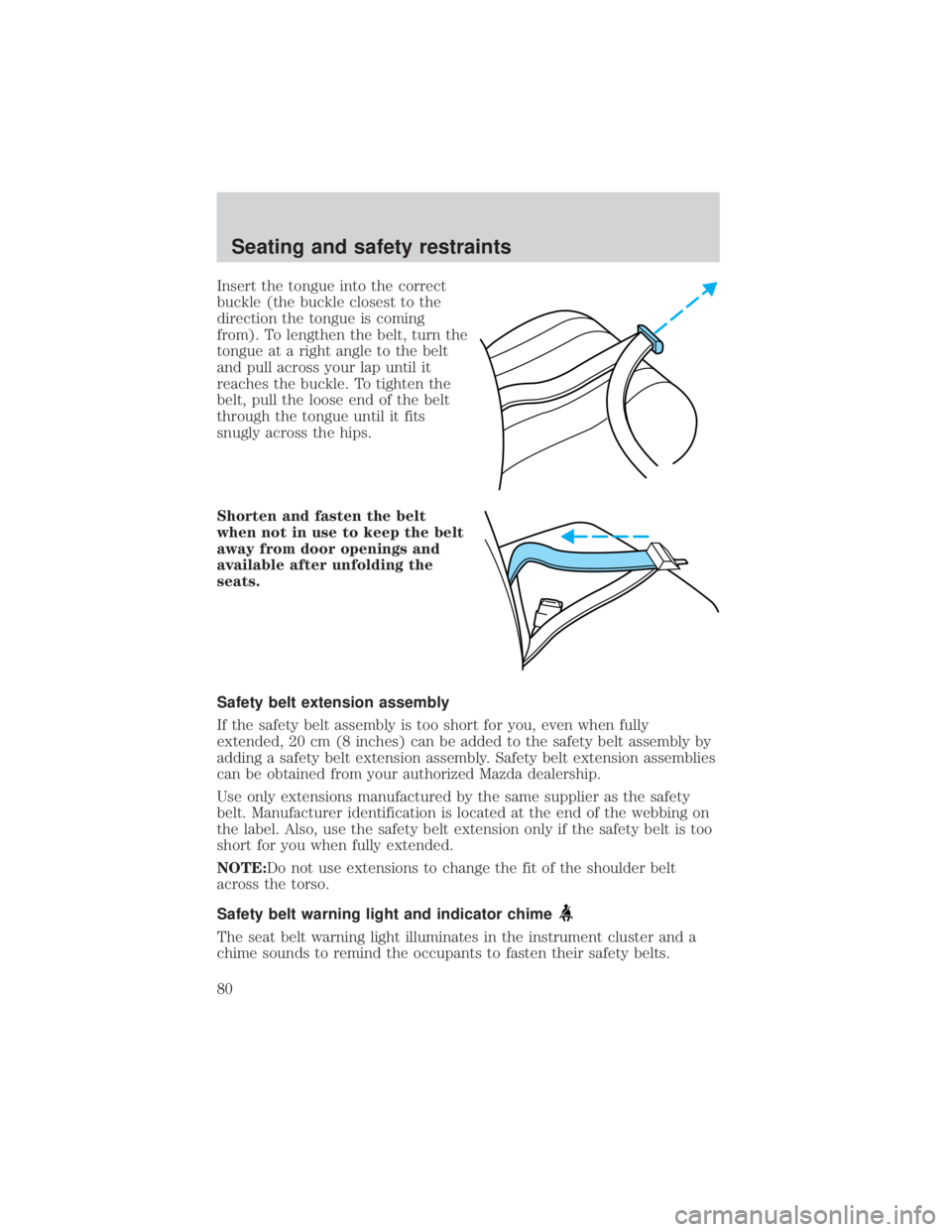
Insert the tongue into the correct
buckle (the buckle closest to the
direction the tongue is coming
from). To lengthen the belt, turn the
tongue at a right angle to the belt
and pull across your lap until it
reaches the buckle. To tighten the
belt, pull the loose end of the belt
through the tongue until it fits
snugly across the hips.
Shorten and fasten the belt
when not in use to keep the belt
away from door openings and
available after unfolding the
seats.
Safety belt extension assembly
If the safety belt assembly is too short for you, even when fully
extended, 20 cm (8 inches) can be added to the safety belt assembly by
adding a safety belt extension assembly. Safety belt extension assemblies
can be obtained from your authorized Mazda dealership.
Use only extensions manufactured by the same supplier as the safety
belt. Manufacturer identification is located at the end of the webbing on
the label. Also, use the safety belt extension only if the safety belt is too
short for you when fully extended.
NOTE:Do not use extensions to change the fit of the shoulder belt
across the torso.
Safety belt warning light and indicator chime
The seat belt warning light illuminates in the instrument cluster and a
chime sounds to remind the occupants to fasten their safety belts.
Seating and safety restraints
80
Page 81 of 232
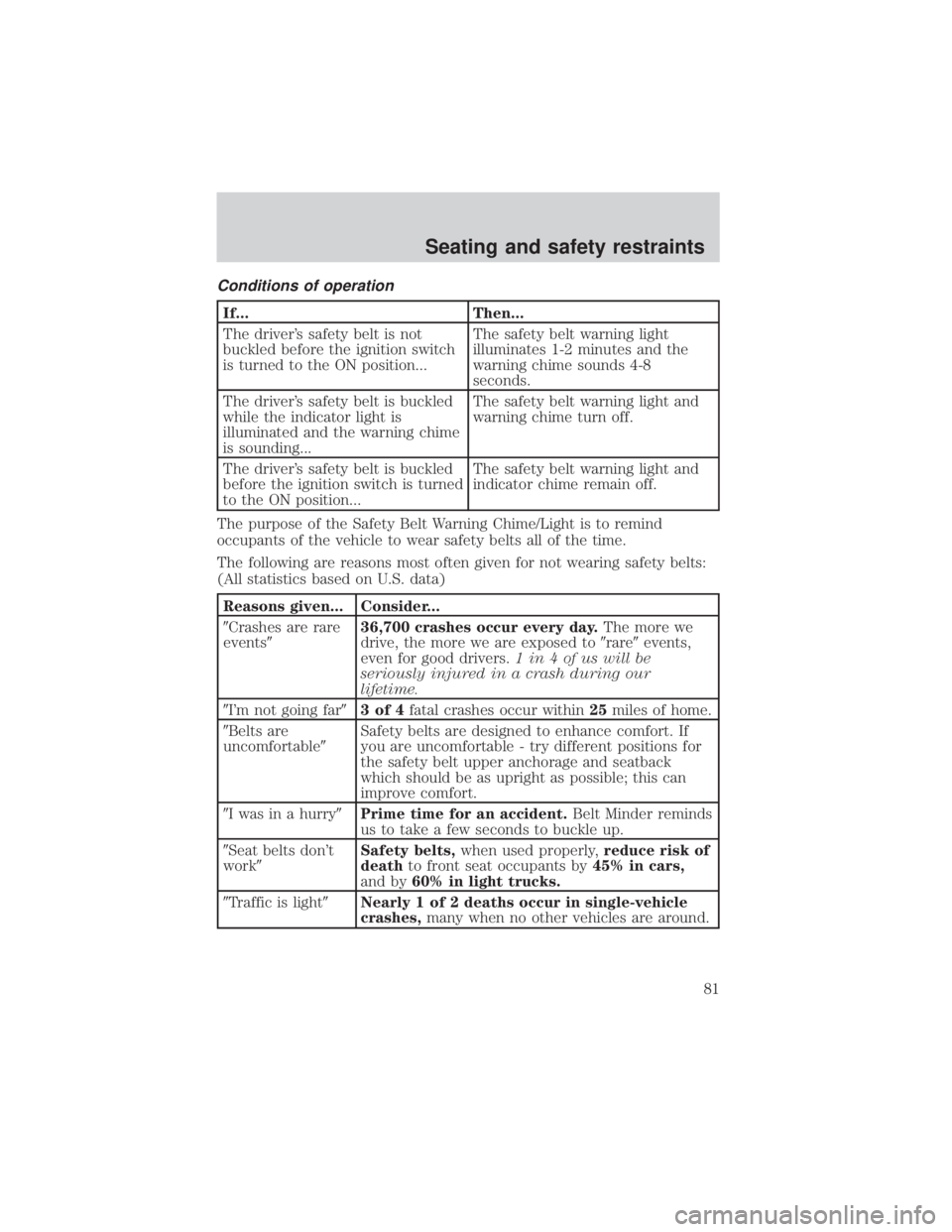
Conditions of operation
If...Then...
The driver's safety belt is not
buckled before the ignition switch
is turned to the ON position... The safety belt warning light
illuminates 1-2 minutes and the
warning chime sounds 4-8
seconds.
The driver's safety belt is buckled
while the indicator light is
illuminated and the warning chime
is sounding... The safety belt warning light and
warning chime turn off.
The driver's safety belt is buckled
before the ignition switch is turned
to the ON position... The safety belt warning light and
indicator chime remain off.
The purpose of the Safety Belt Warning Chime/Light is to remind
occupants of the vehicle to wear safety belts all of the time.
The following are reasons most often given for not wearing safety belts:
(All statistics based on U.S. data)
Reasons given... Consider...
9Crashes are rare
events9 36,700 crashes occur every day.
The more we
drive, the more we are exposed to 9rare9events,
even for good drivers. 1 in 4 of us will be
seriously injured in a crash during our
lifetime.
9I'm not going far 93of4fatal crashes occur within 25miles of home.
9Belts are
uncomfortable 9Safety belts are designed to enhance comfort. If
you are uncomfortable - try different positions for
the safety belt upper anchorage and seatback
which should be as upright as possible; this can
improve comfort.
9I was in a hurry 9Prime time for an accident. Belt Minder reminds
us to take a few seconds to buckle up.
9Seat belts don't
work9 Safety belts,
when used properly, reduce risk of
death to front seat occupants by 45% in cars,
and by 60% in light trucks.
9Traffic is light 9Nearly 1 of 2 deaths occur in single-vehicle
crashes, many when no other vehicles are around.
Seating and safety restraints
81
Page 82 of 232
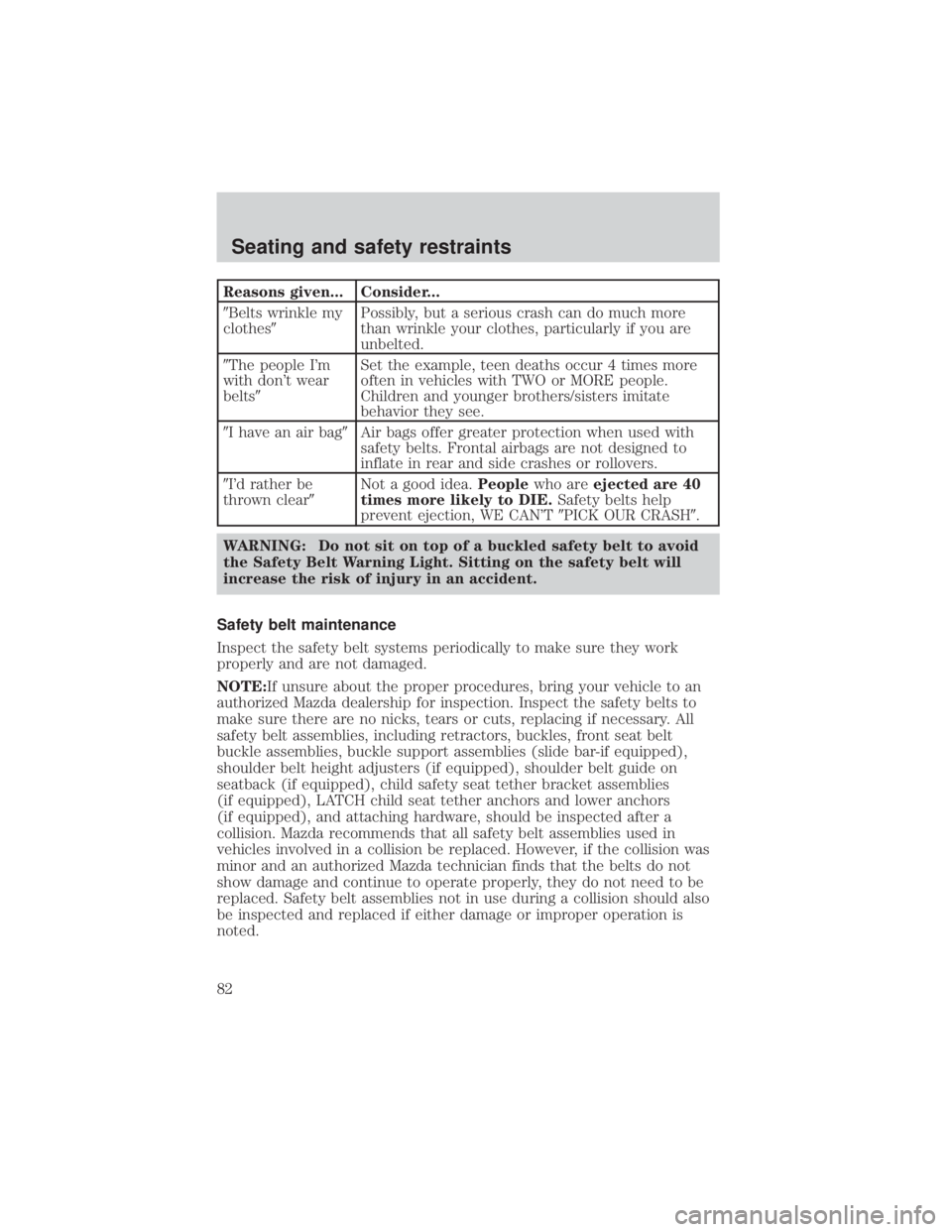
Reasons given... Consider...
9Belts wrinkle my
clothes9Possibly, but a serious crash can do much more
than wrinkle your clothes, particularly if you are
unbelted.
9The people I'm
with don't wear
belts9 Set the example, teen deaths occur 4 times more
often in vehicles with TWO or MORE people.
Children and younger brothers/sisters imitate
behavior they see.
9I have an air bag 9Air bags offer greater protection when used with
safety belts. Frontal airbags are not designed to
inflate in rear and side crashes or rollovers.
9I'd rather be
thrown clear 9Not a good idea.
Peoplewho are ejected are 40
times more likely to DIE. Safety belts help
prevent ejection, WE CAN'T 9PICK OUR CRASH9.
WARNING: Do not sit on top of a buckled safety belt to avoid
the Safety Belt Warning Light. Sitting on the safety belt will
increase the risk of injury in an accident.
Safety belt maintenance
Inspect the safety belt systems periodically to make sure they work
properly and are not damaged.
NOTE:If unsure about the proper procedures, bring your vehicle to an
authorized Mazda dealership for inspection. Inspect the safety belts to
make sure there are no nicks, tears or cuts, replacing if necessary. All
safety belt assemblies, including retractors, buckles, front seat belt
buckle assemblies, buckle support assemblies (slide bar-if equipped),
shoulder belt height adjusters (if equipped), shoulder belt guide on
seatback (if equipped), child safety seat tether bracket assemblies
(if equipped), LATCH child seat tether anchors and lower anchors
(if equipped), and attaching hardware, should be inspected after a
collision. Mazda recommends that all safety belt assemblies used in
vehicles involved in a collision be replaced. However, if the collision was
minor and an authorized Mazda technician finds that the belts do not
show damage and continue to operate properly, they do not need to be
replaced. Safety belt assemblies not in use during a collision should also
be inspected and replaced if either damage or improper operation is
noted.
Seating and safety restraints
82
Page 84 of 232
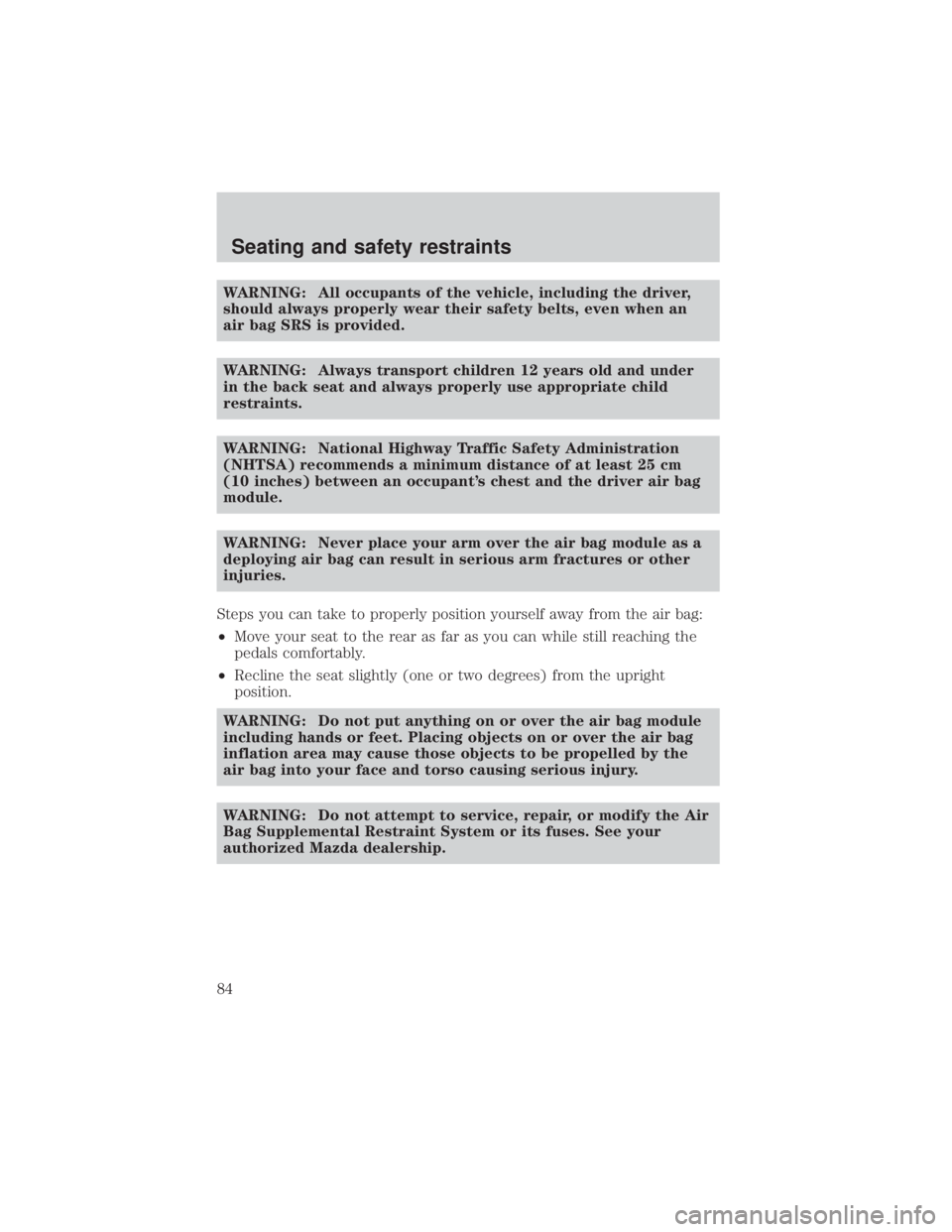
WARNING: All occupants of the vehicle, including the driver,
should always properly wear their safety belts, even when an
air bag SRS is provided.
WARNING: Always transport children 12 years old and under
in the back seat and always properly use appropriate child
restraints.
WARNING: National Highway Traffic Safety Administration
(NHTSA) recommends a minimum distance of at least 25 cm
(10 inches) between an occupant's chest and the driver air bag
module.
WARNING: Never place your arm over the air bag module as a
deploying air bag can result in serious arm fractures or other
injuries.
Steps you can take to properly position yourself away from the air bag:
² Move your seat to the rear as far as you can while still reaching the
pedals comfortably.
² Recline the seat slightly (one or two degrees) from the upright
position.
WARNING: Do not put anything on or over the air bag module
including hands or feet. Placing objects on or over the air bag
inflation area may cause those objects to be propelled by the
air bag into your face and torso causing serious injury.
WARNING: Do not attempt to service, repair, or modify the Air
Bag Supplemental Restraint System or its fuses. See your
authorized Mazda dealership.
Seating and safety restraints
84
Page 87 of 232
WARNING: Several air bag system components get hot after
inflation. Do not touch them after inflation or you may be
burned.
WARNING: If the air bag has deployed, the air bag will not
function again and must be replaced immediately. If the air bag
is not replaced, the unrepaired area will increase the risk of
injury in a collision.
The SRS consists of:
² driver and passenger air bag modules (which include the inflators and
air bags),
² one or more impact and safing sensors,
² a readiness light and tone
² diagnostic module
² and the electrical wiring which connects the components.
The diagnostic module monitors its own internal circuits and the
supplemental air bag electrical system warning (including the impact
sensors), the system wiring, the air bag system readiness light, the air
bag back up power and the air bag ignitors.
Determining if the system is operational
The SRS uses a readiness light in the instrument cluster or a tone to
indicate the condition of the system. Refer to the Air bag readiness
section in the Instrumentation chapter. Routine maintenance of the air
bag is not required.
A difficulty with the system is indicated by one or more of the following:
² The readiness light will either
flash or stay lit.
² The readiness light will not
illuminate immediately after
ignition is turned on.
² A series of five beeps will be heard. The tone pattern will repeat
periodically until the problem and/or light are repaired.
If any of these things happen, even intermittently, have the SRS serviced
at your authorized Mazda dealership immediately.
Seating and safety restraints
87
Page 90 of 232
How does the side air bag system work?
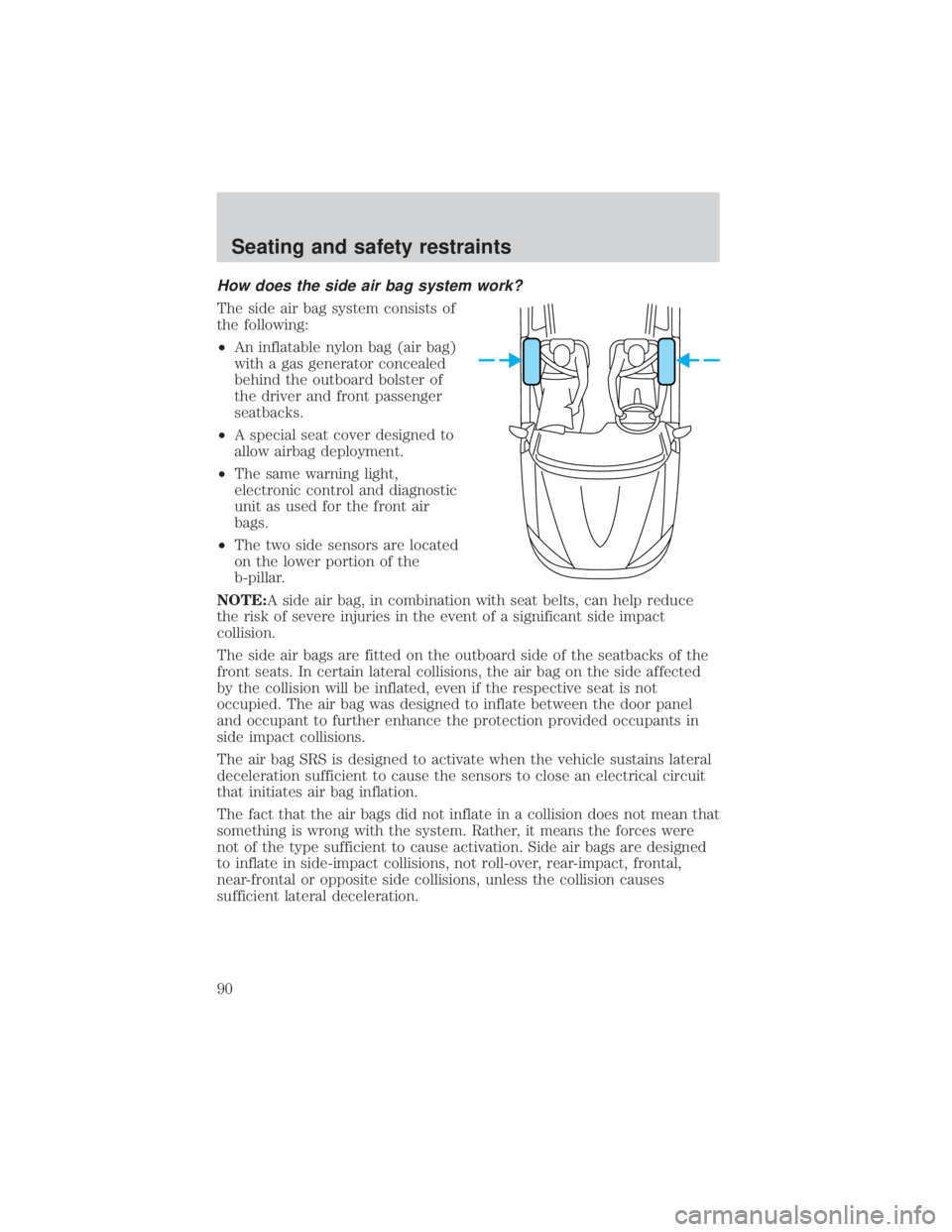
The side air bag system consists of
the following:
²An inflatable nylon bag (air bag)
with a gas generator concealed
behind the outboard bolster of
the driver and front passenger
seatbacks.
² A special seat cover designed to
allow airbag deployment.
² The same warning light,
electronic control and diagnostic
unit as used for the front air
bags.
² The two side sensors are located
on the lower portion of the
b-pillar.
NOTE:A side air bag, in combination with seat belts, can help reduce
the risk of severe injuries in the event of a significant side impact
collision.
The side air bags are fitted on the outboard side of the seatbacks of the
front seats. In certain lateral collisions, the air bag on the side affected
by the collision will be inflated, even if the respective seat is not
occupied. The air bag was designed to inflate between the door panel
and occupant to further enhance the protection provided occupants in
side impact collisions.
The air bag SRS is designed to activate when the vehicle sustains lateral
deceleration sufficient to cause the sensors to close an electrical circuit
that initiates air bag inflation.
The fact that the air bags did not inflate in a collision does not mean that
something is wrong with the system. Rather, it means the forces were
not of the type sufficient to cause activation. Side air bags are designed
to inflate in side-impact collisions, not roll-over, rear-impact, frontal,
near-frontal or opposite side collisions, unless the collision causes
sufficient lateral deceleration.
Seating and safety restraints
90
Page 91 of 232
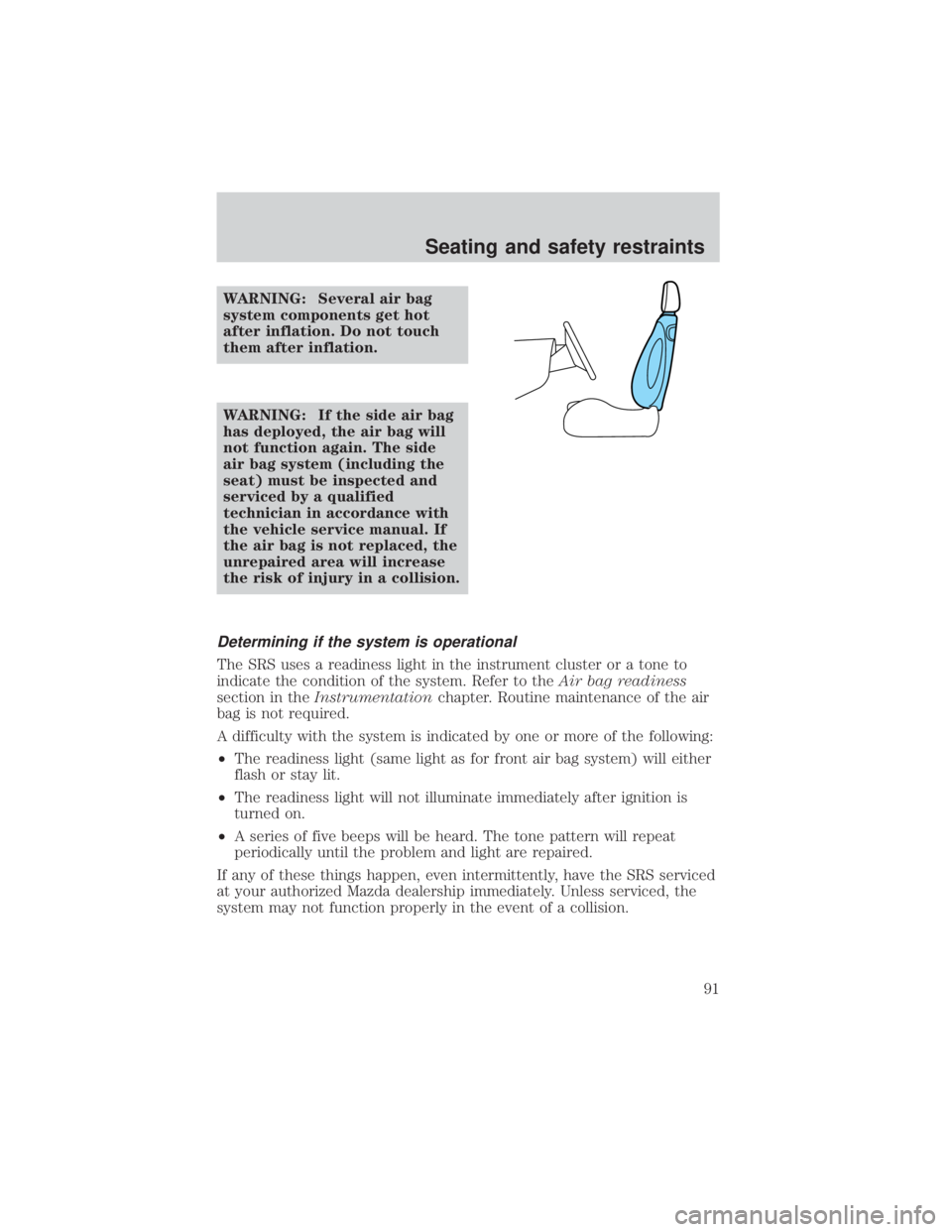
WARNING: Several air bag
system components get hot
after inflation. Do not touch
them after inflation.
WARNING: If the side air bag
has deployed, the air bag will
not function again. The side
air bag system (including the
seat) must be inspected and
serviced by a qualified
technician in accordance with
the vehicle service manual. If
the air bag is not replaced, the
unrepaired area will increase
the risk of injury in a collision.
Determining if the system is operational
The SRS uses a readiness light in the instrument cluster or a tone to
indicate the condition of the system. Refer to theAir bag readiness
section in the Instrumentation chapter. Routine maintenance of the air
bag is not required.
A difficulty with the system is indicated by one or more of the following:
² The readiness light (same light as for front air bag system) will either
flash or stay lit.
² The readiness light will not illuminate immediately after ignition is
turned on.
² A series of five beeps will be heard. The tone pattern will repeat
periodically until the problem and light are repaired.
If any of these things happen, even intermittently, have the SRS serviced
at your authorized Mazda dealership immediately. Unless serviced, the
system may not function properly in the event of a collision.
Seating and safety restraints
91
Page 104 of 232
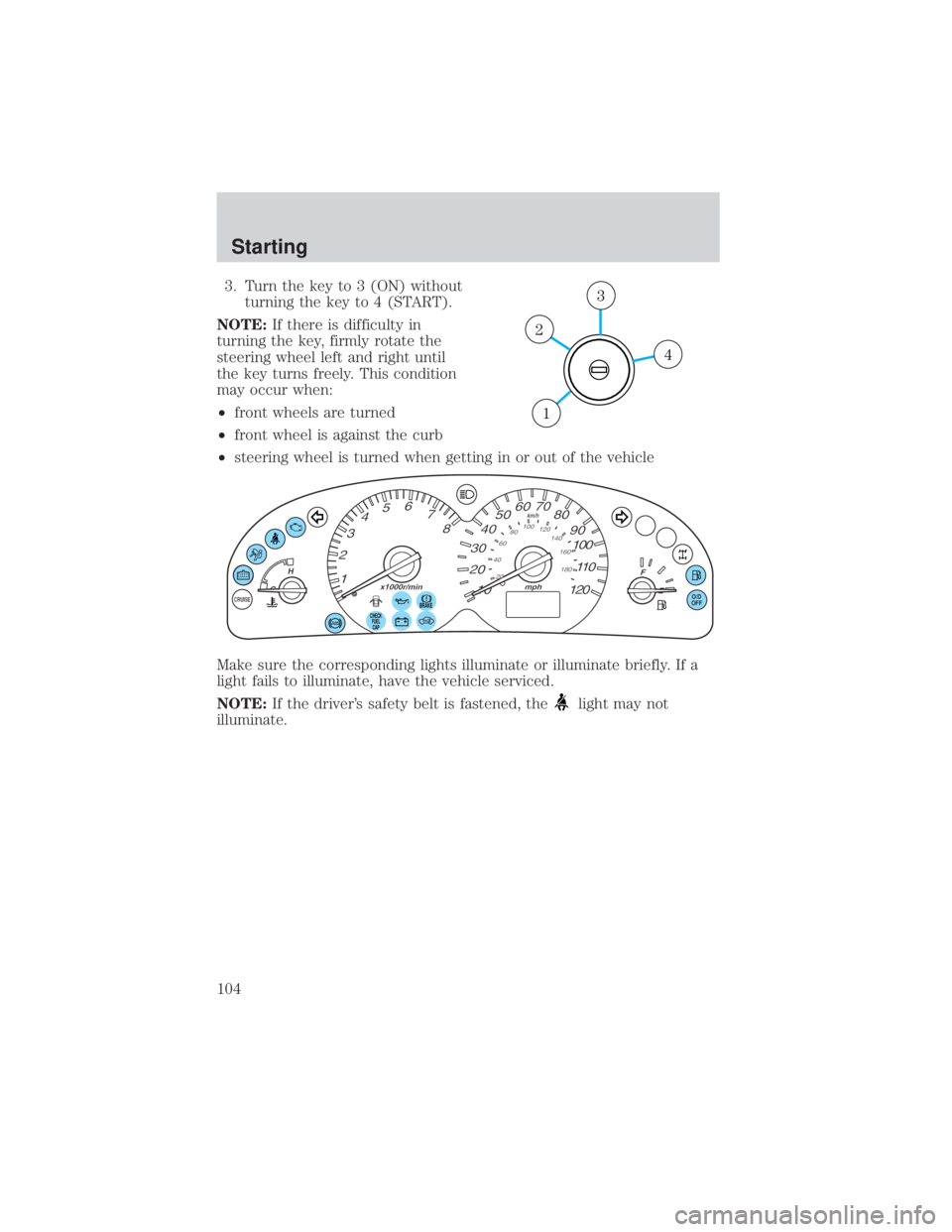
3. Turn the key to 3 (ON) withoutturning the key to 4 (START).
NOTE: If there is difficulty in
turning the key, firmly rotate the
steering wheel left and right until
the key turns freely. This condition
may occur when:
² front wheels are turned
² front wheel is against the curb
² steering wheel is turned when getting in or out of the vehicle
Make sure the corresponding lights illuminate or illuminate briefly. If a
light fails to illuminate, have the vehicle serviced.
NOTE: If the driver's safety belt is fastened, the
light may not
illuminate.
4
3
2
1
BRAKEO/D
OFF
CHECK FUELCAP
Starting
104
Page 107 of 232
BRAKES
Your service brakes are self-adjusting. Refer to the service maintenance
section for scheduled maintenance.
Occasional brake noise is normal and often does not indicate a
performance concern with the vehicle's brake system. In normal
operation, automotive brake systems may emit occasional or intermittent
squeal or groan noises when the brakes are applied. Such noises are
usually heard during the first few brake applications in the morning;
however, they may be heard at any time while braking and can be
aggravated by environmental conditions such as cold, heat, moisture,
road dust, salt or mud. If a ªmetal-to-metal,º ªcontinuous grindingº or
ªcontinuous squealº sound is present while braking, the brake linings
may be worn-out and should be inspected by an authorized Mazda
dealership.
Four-wheel anti-lock brake system (ABS) (if equipped)
If the vehicle is equipped with an anti-lock braking system (ABS), a
noise from the hydraulic pump motor and pulsation in the pedal may be
observed during ABS braking events. Pedal pulsation coupled with noise
while braking under panic conditions or on loose gravel, bumps, wet or
snowy roads is normal and indicates proper functioning of the vehicle's
anti-lock brake system.
NOTE:The ABS performs a self-check after you start the engine and
begin to drive away.
A brief mechanical noise may be heard during this test. This is normal. If
a malfunction is found, the ABS warning light will come on. If the vehicle
has continuous vibration or shudder in the steering wheel while braking,
the vehicle should be inspected by an authorized Mazda dealership.
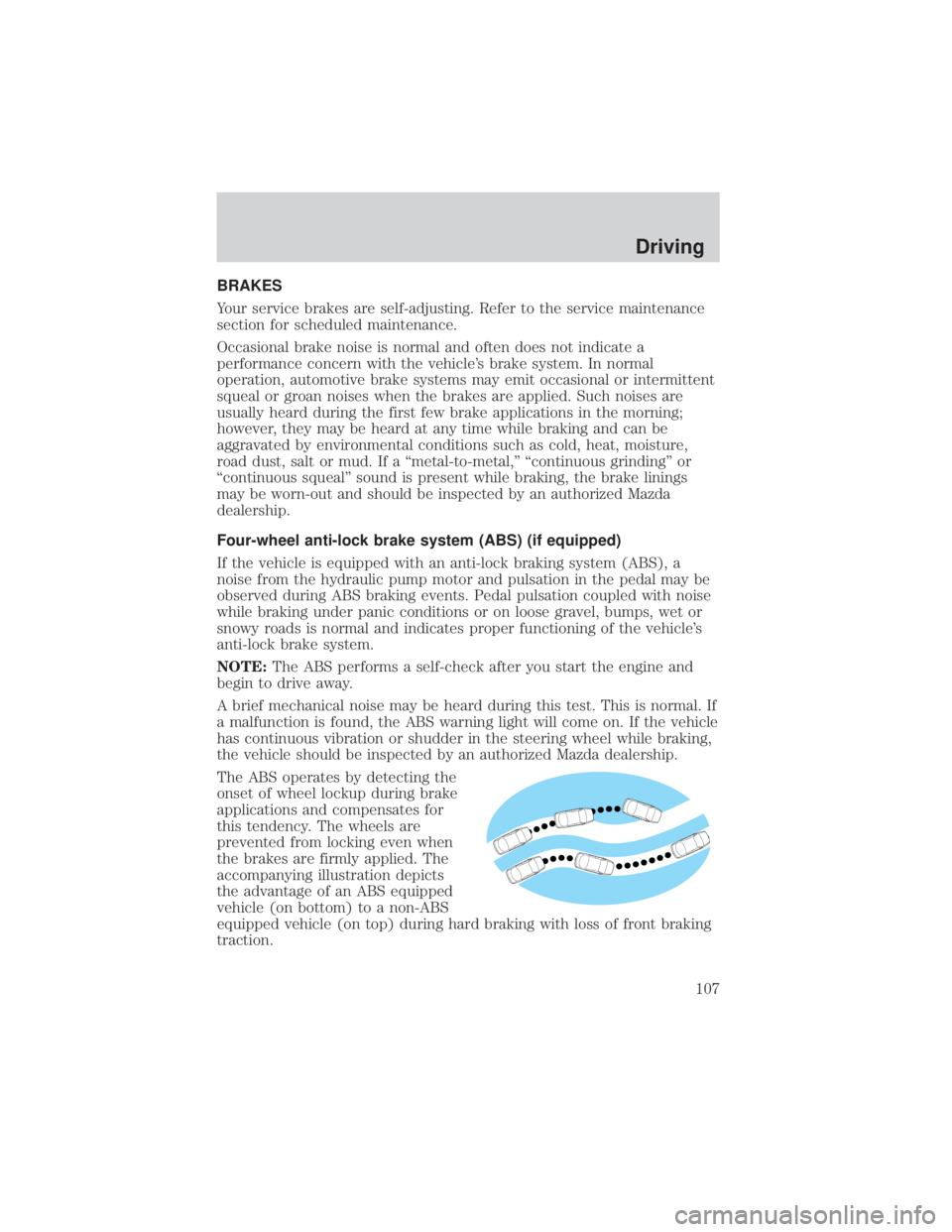
The ABS operates by detecting the
onset of wheel lockup during brake
applications and compensates for
this tendency. The wheels are
prevented from locking even when
the brakes are firmly applied. The
accompanying illustration depicts
the advantage of an ABS equipped
vehicle (on bottom) to a non-ABS
equipped vehicle (on top) during hard braking with loss of front braking
traction.
Driving
107
Page 108 of 232
WARNING: The Anti-Lock system does not decrease the time
necessary to apply the brakes or always reduce stopping
distance. Always leave enough room between your vehicle and
the vehicle in front of you to stop.
ABS warning lamp
ABS(if equipped)
The
ABSwarning lamp in the instrument cluster momentarily illuminates
when the ignition is turned to the ON position. If the light does not
illuminate momentarily at start up, remains on or continues to flash, the
ABS needs to be serviced.
With the ABS light on, the anti-lock
brake system is disabled and normal
braking is still effective unless the
brake warning light also remains
illuminated with parking brake released. (If your brake warning lamp
illuminates, have your vehicle serviced immediately by an authorized
Mazda dealership.)
Using four wheel ABS (if equipped)
² In an emergency or when maximum efficiency from the ABS is
required, apply continuous force on the brake. The ABS will be
activated immediately, thus allowing you to retain full steering control
of your vehicle and, providing there is sufficient space, will enable you
to avoid obstacles and bring the vehicle to a controlled stop.
WARNING: The Anti-Lock system does not decrease the time
necessary to apply the brakes or always reduce stopping
distance. Always leave enough room between your vehicle and
the vehicle in front of you to stop.
NOTE: We recommend that you familiarize yourself with this braking
technique. However, avoid taking any unnecessary risks.
Driving
108