light MAZDA MODEL TRIBUTE 4WD 2001 Owner's Guide
[x] Cancel search | Manufacturer: MAZDA, Model Year: 2001, Model line: MODEL TRIBUTE 4WD, Model: MAZDA MODEL TRIBUTE 4WD 2001Pages: 232, PDF Size: 1.74 MB
Page 109 of 232
Parking brake
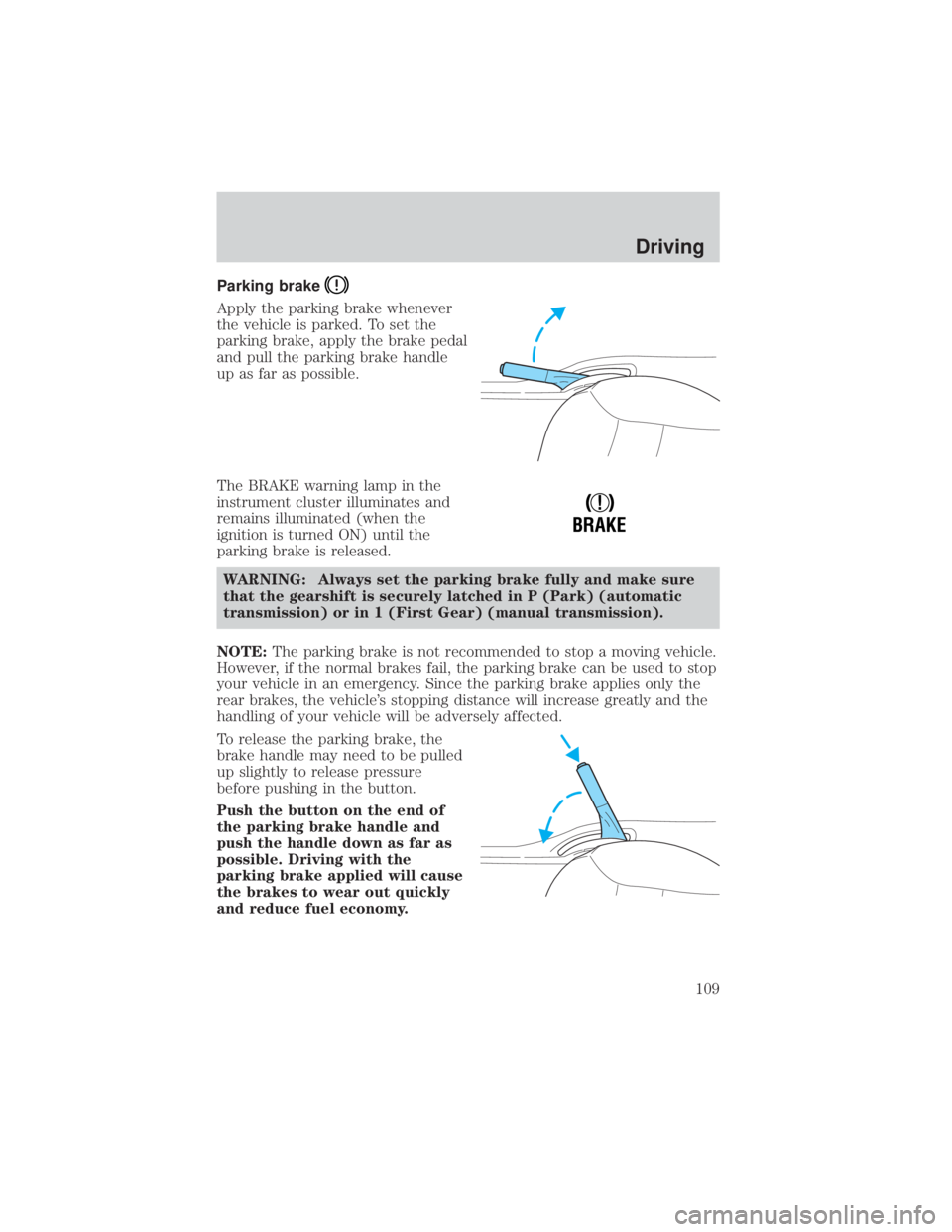
Apply the parking brake whenever
the vehicle is parked. To set the
parking brake, apply the brake pedal
and pull the parking brake handle
up as far as possible.
The BRAKE warning lamp in the
instrument cluster illuminates and
remains illuminated (when the
ignition is turned ON) until the
parking brake is released.WARNING: Always set the parking brake fully and make sure
that the gearshift is securely latched in P (Park) (automatic
transmission) or in 1 (First Gear) (manual transmission).
NOTE: The parking brake is not recommended to stop a moving vehicle.
However, if the normal brakes fail, the parking brake can be used to stop
your vehicle in an emergency. Since the parking brake applies only the
rear brakes, the vehicle's stopping distance will increase greatly and the
handling of your vehicle will be adversely affected.
To release the parking brake, the
brake handle may need to be pulled
up slightly to release pressure
before pushing in the button.
Push the button on the end of
the parking brake handle and
push the handle down as far as
possible. Driving with the
parking brake applied will cause
the brakes to wear out quickly
and reduce fuel economy.
!
BRAKE
Driving
109
Page 111 of 232
WARNING: Vehicles with a higher center of gravity such as
utility and four-wheel drive vehicles handle differently than
vehicles with a lower center of gravity. Utility and four-wheel
drive vehicles are not designed for cornering at speeds as high
as passenger cars any more than low-slung sports cars are
designed to perform satisfactorily under off-road conditions.
Avoid sharp turns, excessive speed and abrupt maneuvers in
these vehicles. Failure to drive cautiously could result in an
increased risk of vehicle rollover, personal injury and death.
WARNING: Loaded vehicles, with a higher center of gravity,
may handle differently than unloaded vehicles. Extra
precautions, such as slower speeds and increased stopping
distance, should be taken when driving a heavily loaded vehicle.
Your vehicle has the capability to haul more cargo and people than most
passenger cars. Depending upon the type and placement of the load,
hauling people and cargo may raise the center of gravity of the vehicle.
Use extra caution while becoming familiar with your vehicle. Know the
capabilities and limitations of both you as a driver and your vehicle.
AUTOMATIC TRANSAXLE OPERATION (IF EQUIPPED)
Brake-shift interlock
This vehicle is equipped with a brake-shift interlock feature that prevents
the gearshift lever from being moved from P (Park) unless the brake
pedal is depressed.
NOTE:If the gearshift lever cannot be moved from P (Park) with the
brake pedal depressed, it is possible that a fuse has blown or the
vehicle's brakelamps are not operating properly. Refer to Fuses and
relays in theRoadside emergencies chapter.
WARNING: Do not drive your vehicle until you verify that the
brakelamps are working. A rear end colission may result after
you brake.
If your vehicle gets stuck in mud or snow it may be rocked out by
shifting between forward and reverse gears, stopping between shifts, in a
steady pattern. Press lightly on the accelerator in each gear.
Driving
111
Page 114 of 232
N (Neutral)
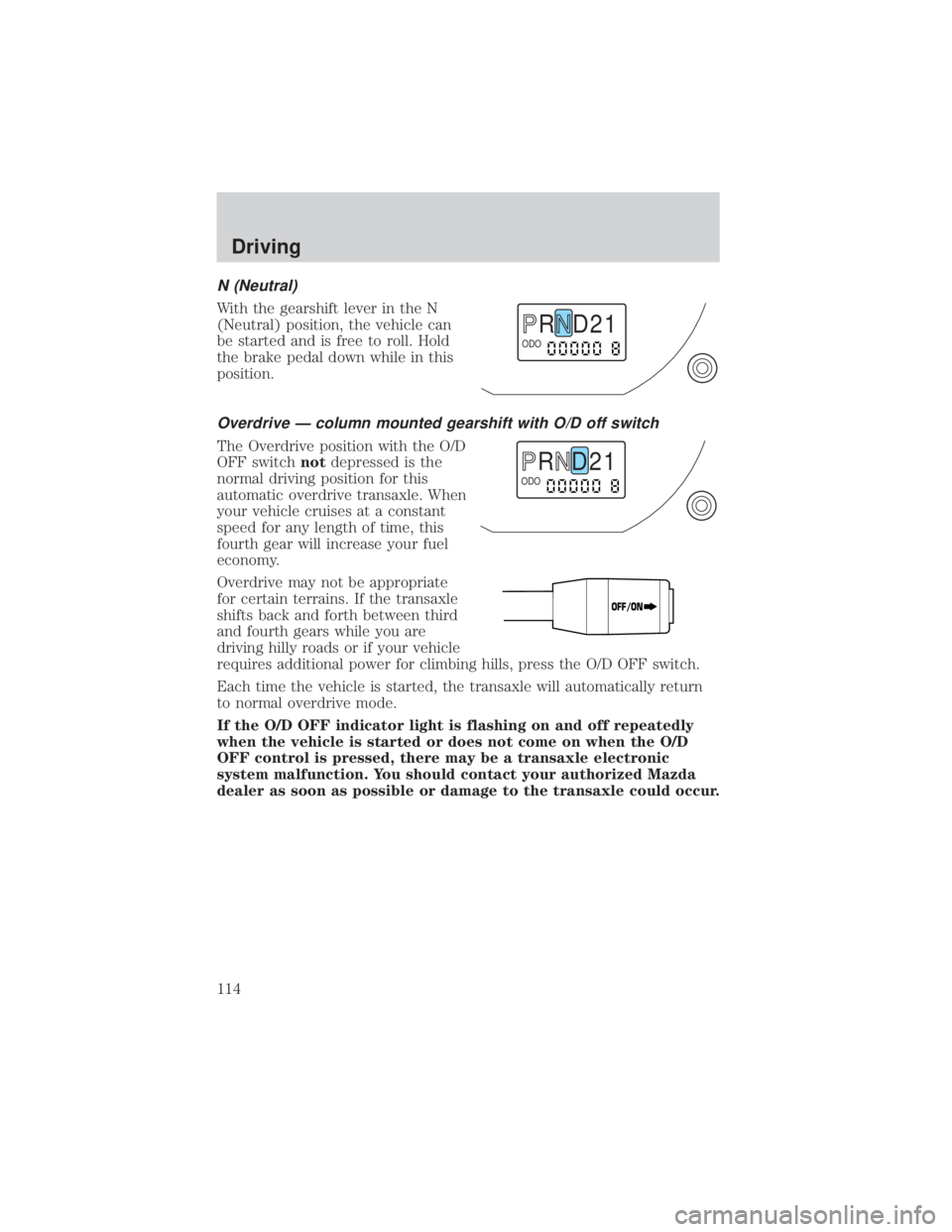
With the gearshift lever in the N
(Neutral) position, the vehicle can
be started and is free to roll. Hold
the brake pedal down while in this
position.
Overdrive Ð column mounted gearshift with O/D off switch
The Overdrive position with the O/D
OFF switchnotdepressed is the
normal driving position for this
automatic overdrive transaxle. When
your vehicle cruises at a constant
speed for any length of time, this
fourth gear will increase your fuel
economy.
Overdrive may not be appropriate
for certain terrains. If the transaxle
shifts back and forth between third
and fourth gears while you are
driving hilly roads or if your vehicle
requires additional power for climbing hills, press the O/D OFF switch.
Each time the vehicle is started, the transaxle will automatically return
to normal overdrive mode.
If the O/D OFF indicator light is flashing on and off repeatedly
when the vehicle is started or does not come on when the O/D
OFF control is pressed, there may be a transaxle electronic
system malfunction. You should contact your authorized Mazda
dealer as soon as possible or damage to the transaxle could occur.
R D 2 1ODO
R D 2 1ODO
OFF/ON
Driving
114
Page 115 of 232
When to use D (Drive) or press the O/D OFF switch
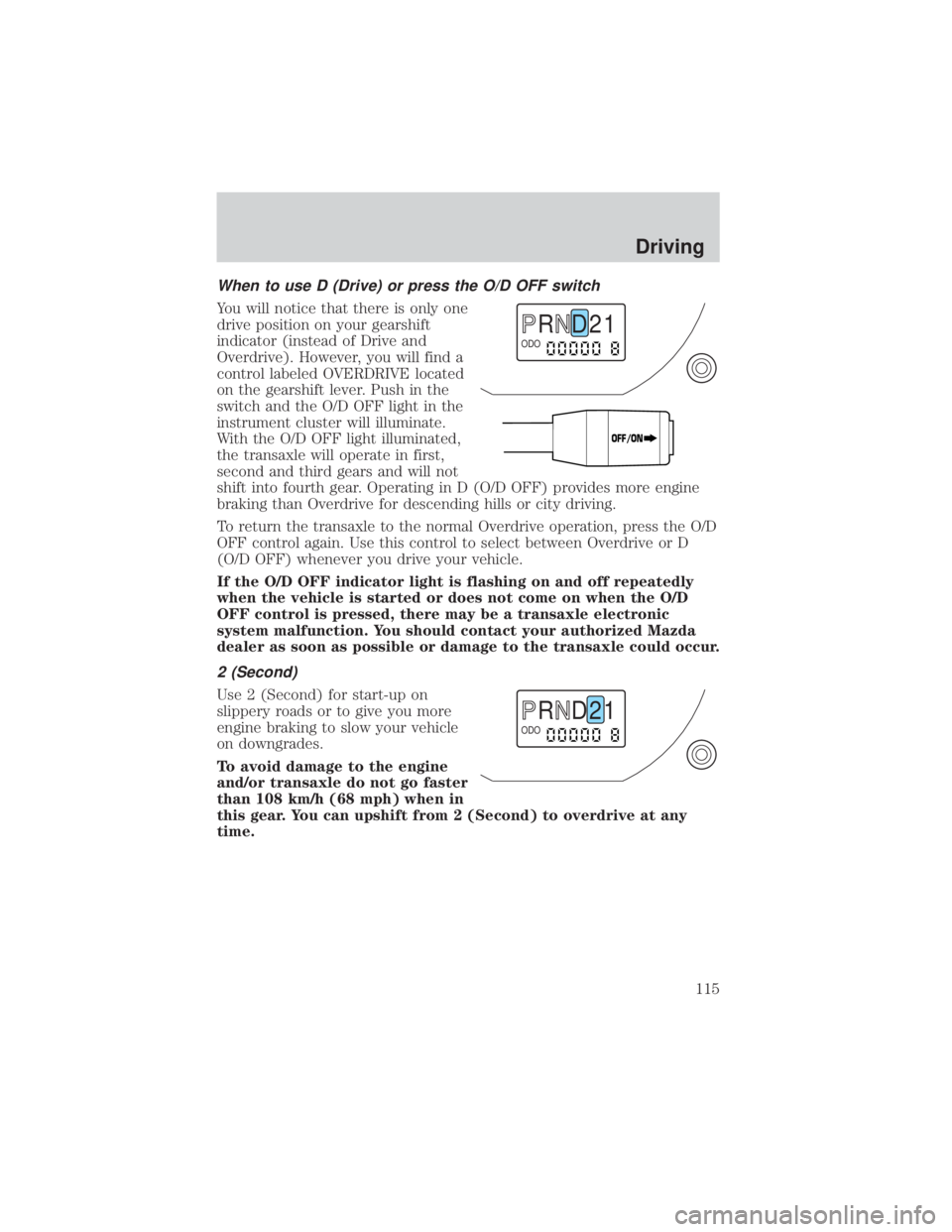
You will notice that there is only one
drive position on your gearshift
indicator (instead of Drive and
Overdrive). However, you will find a
control labeled OVERDRIVE located
on the gearshift lever. Push in the
switch and the O/D OFF light in the
instrument cluster will illuminate.
With the O/D OFF light illuminated,
the transaxle will operate in first,
second and third gears and will not
shift into fourth gear. Operating in D (O/D OFF) provides more engine
braking than Overdrive for descending hills or city driving.
To return the transaxle to the normal Overdrive operation, press the O/D
OFF control again. Use this control to select between Overdrive or D
(O/D OFF) whenever you drive your vehicle.
If the O/D OFF indicator light is flashing on and off repeatedly
when the vehicle is started or does not come on when the O/D
OFF control is pressed, there may be a transaxle electronic
system malfunction. You should contact your authorized Mazda
dealer as soon as possible or damage to the transaxle could occur.
2 (Second)
Use 2 (Second) for start-up on
slippery roads or to give you more
engine braking to slow your vehicle
on downgrades.
To avoid damage to the engine
and/or transaxle do not go faster
than 108 km/h (68 mph) when in
this gear. You can upshift from 2 (Second) to overdrive at any
time.
R D 2 1ODO
OFF/ON
R D 2 1ODO
Driving
115
Page 121 of 232
²The vehicle should not be operated in the 4x4 ON mode on dry
or merely wet pavement. Doing so will produce excessive noise,
increase tire wear and may damage driveline components. The
4x4 ON mode is intended for use only on consistently slippery
or loose surfaces.
² If your vehicle is equipped with this 4x4 system, a spare tire of
a different diameter than the road tires should never be used.
Such a tire could result in damage to driveline components and
make the vehicle difficult to control.
WARNING: Utility and four-wheel drive vehicles are not
designed for cornering at speeds as high as passenger cars any
more than low-slung sports cars are designed to perform
satisfactorily under off-road conditions. Avoid sharp turns or
abrupt maneuvers in these vehicles.
4x4 system indicator lights
The 4x4 mode indicator light illuminates only under the following
conditions. If the indicator light illuminates when driving in the 4x4
AUTO mode, contact your Mazda dealer as soon as possible.
The indicator light illuminates when the 4x4 ON mode is engaged.
Shifting between 4x4 Auto and ON modes
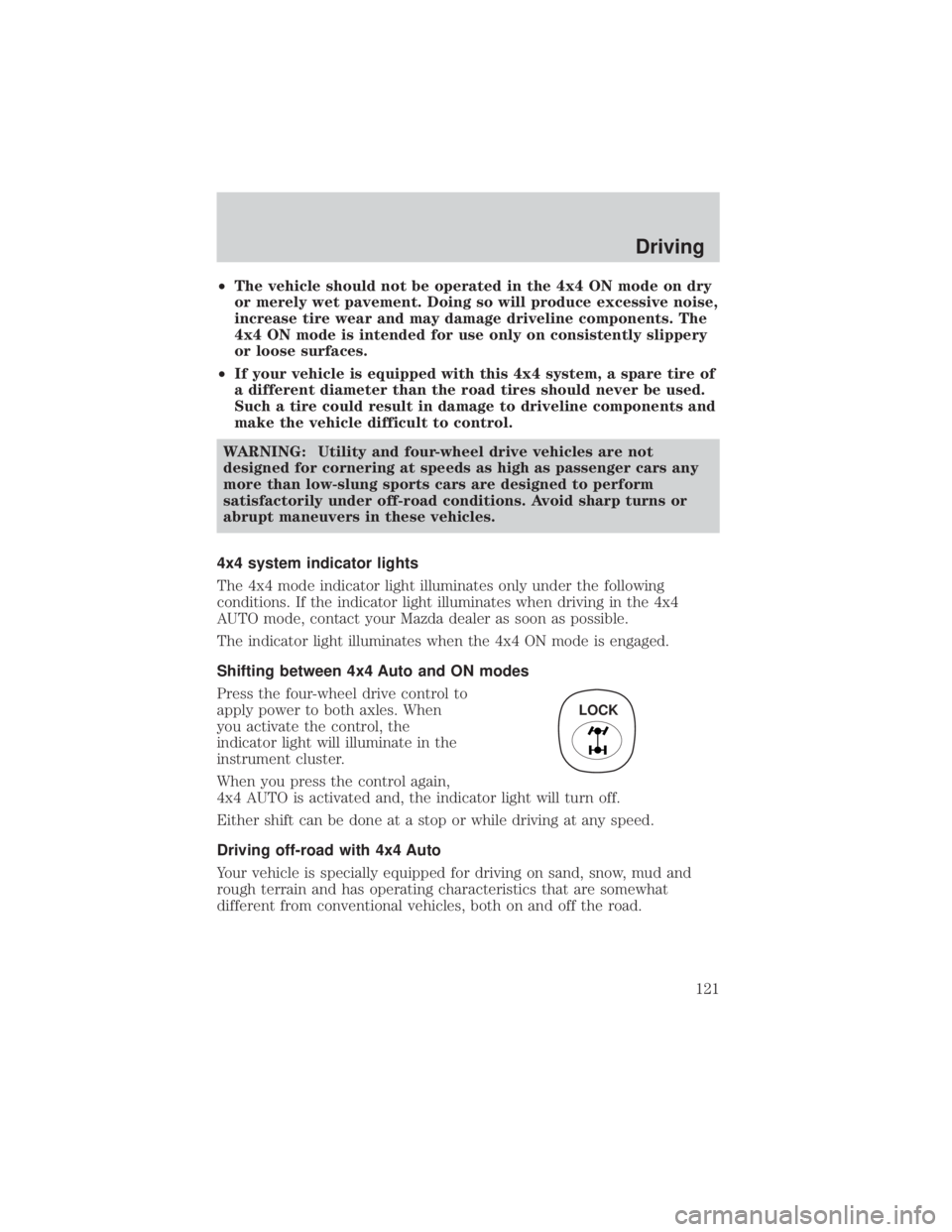
Press the four-wheel drive control to
apply power to both axles. When
you activate the control, the
indicator light will illuminate in the
instrument cluster.
When you press the control again,
4x4 AUTO is activated and, the indicator light will turn off.
Either shift can be done at a stop or while driving at any speed.
Driving off-road with 4x4 Auto
Your vehicle is specially equipped for driving on sand, snow, mud and
rough terrain and has operating characteristics that are somewhat
different from conventional vehicles, both on and off the road.
LOCK
Driving
121
Page 122 of 232
²Maintain steering wheel control at all times, especially in
rough terrain. Since sudden changes in terrain can result in
abrupt steering wheel motion, make sure you grip the steering
wheel from the outside. Do not grip the spokes.
² Drive cautiously to avoid vehicle damage from concealed
objects such as rocks and stumps.
You should either know the terrain or examine maps of the area before
driving. Map out your route before driving in the area.
If your vehicle gets stuck
If the vehicle is stuck in mud or snow select the 4x4 ON operating mode.
It may be rocked out by shifting from forward and reverse gears,
stopping between shifts, in a steady pattern. Press lightly on the
accelerator in each gear.
² Do not rock the vehicle if the engine is not at normal operating
temperature or damage to the transaxle may occur.
²
Do not rock the vehicle for more than a few minutes or damage
to the transaxle and tires may occur or the engine may overheat.
WARNING: Do not spin the wheels at over 56 km/h (35 mph).
The tires may fail and injure a passenger or bystander.
Sand
When driving over sand, try to keep all four wheels on the most solid
area of the trail. Do not reduce the tire pressures but shift to a lower
gear and drive steadily through the terrain. Apply the accelerator slowly
and avoid spinning the wheels.
Mud and water
NOTE:
² If you must drive through high water, drive slowly. Traction or brake
capability may be limited.
² When driving through water, determine the depth; avoid water higher
than the bottom of the hubs (if possible) and proceed slowly. If the
ignition system gets wet, the vehicle may stall.
² Once through water, always try the brakes. Wet brakes do not stop the
vehicle as effectively as dry brakes. Drying can be improved by moving
your vehicle slowly while applying light pressure on the brake pedal.
Driving
122
Page 127 of 232
If driving through deep or standing water is unavoidable, proceed very
slowly. Never drive through water that is higher than the bottom of the
hubs (for trucks) or the bottom of the wheel rims (for cars).
Once through the water, always try the brakes. Wet brakes do not stop
the vehicle as effectively as dry brakes. Drying can be improved by
moving your vehicle slowly while applying light pressure on the brake
pedal.
Driving through deep water where the transmission vent tube is
submerged may allow water into the transmission and cause
internal transmission damage.
TRAILER TOWING
Trailer towing with your vehicle may require the use of a trailer tow
option package.
Trailer towing puts additional loads on your vehicle's engine, transaxle,
axle, brakes, tires, and suspension. For your safety and to maximize
vehicle performance, be sure to use the proper equipment while towing.
Follow these guidelines to ensure safe towing procedure:
²Stay within your vehicle's load limits.
² Thoroughly prepare your vehicle for towing. Refer to Preparing to
tow in this chapter.
² Use extra caution when driving while trailer towing. Refer to Driving
while you tow in this chapter.
² Service your vehicle more frequently if you tow a trailer. Refer to the
ªScheduled Maintenanceº section of this manual.
² Do not tow a trailer until your vehicle has been driven at least 800 km
(500 miles).
² Refer to the instructions included with towing accessories for the
proper installation and adjustment specifications.
Do not exceed the maximum loads listed on the Certification label. For
load specification terms found on the label, refer to Vehicle loadingin
this chapter. Remember to figure in the tongue load of your loaded
vehicle when figuring the total weight.
Driving
127
Page 134 of 232
HAZARD FLASHER CONTROL
Use only in an emergency to warn traffic of vehicle breakdown,
approaching danger, etc. The hazard flashers can be operated when the
ignition is off.
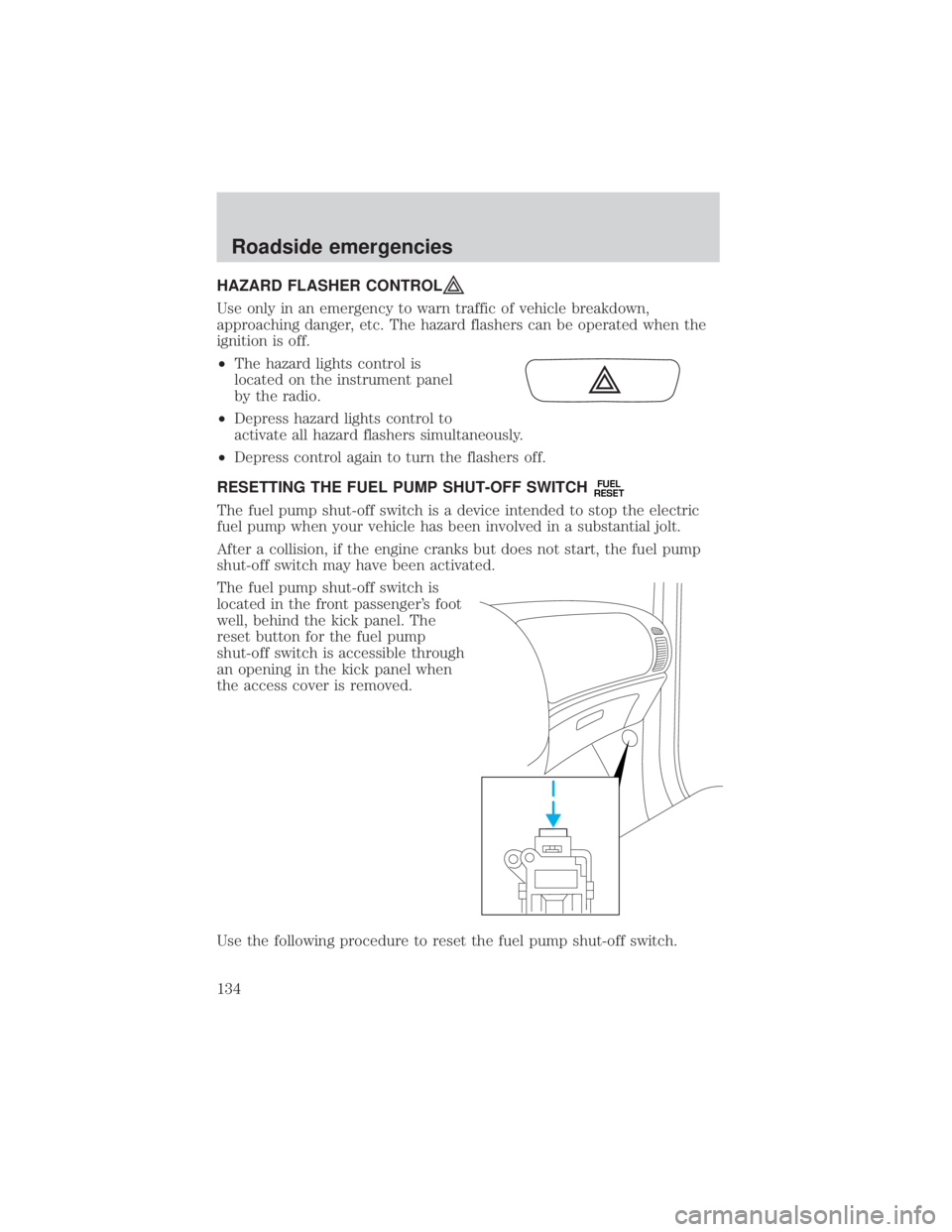
²The hazard lights control is
located on the instrument panel
by the radio.
² Depress hazard lights control to
activate all hazard flashers simultaneously.
² Depress control again to turn the flashers off.
RESETTING THE FUEL PUMP SHUT-OFF SWITCH
FUEL
RESET
The fuel pump shut-off switch is a device intended to stop the electric
fuel pump when your vehicle has been involved in a substantial jolt.
After a collision, if the engine cranks but does not start, the fuel pump
shut-off switch may have been activated.
The fuel pump shut-off switch is
located in the front passenger's foot
well, behind the kick panel. The
reset button for the fuel pump
shut-off switch is accessible through
an opening in the kick panel when
the access cover is removed.
Use the following procedure to reset the fuel pump shut-off switch.
Roadside emergencies
134
Page 138 of 232
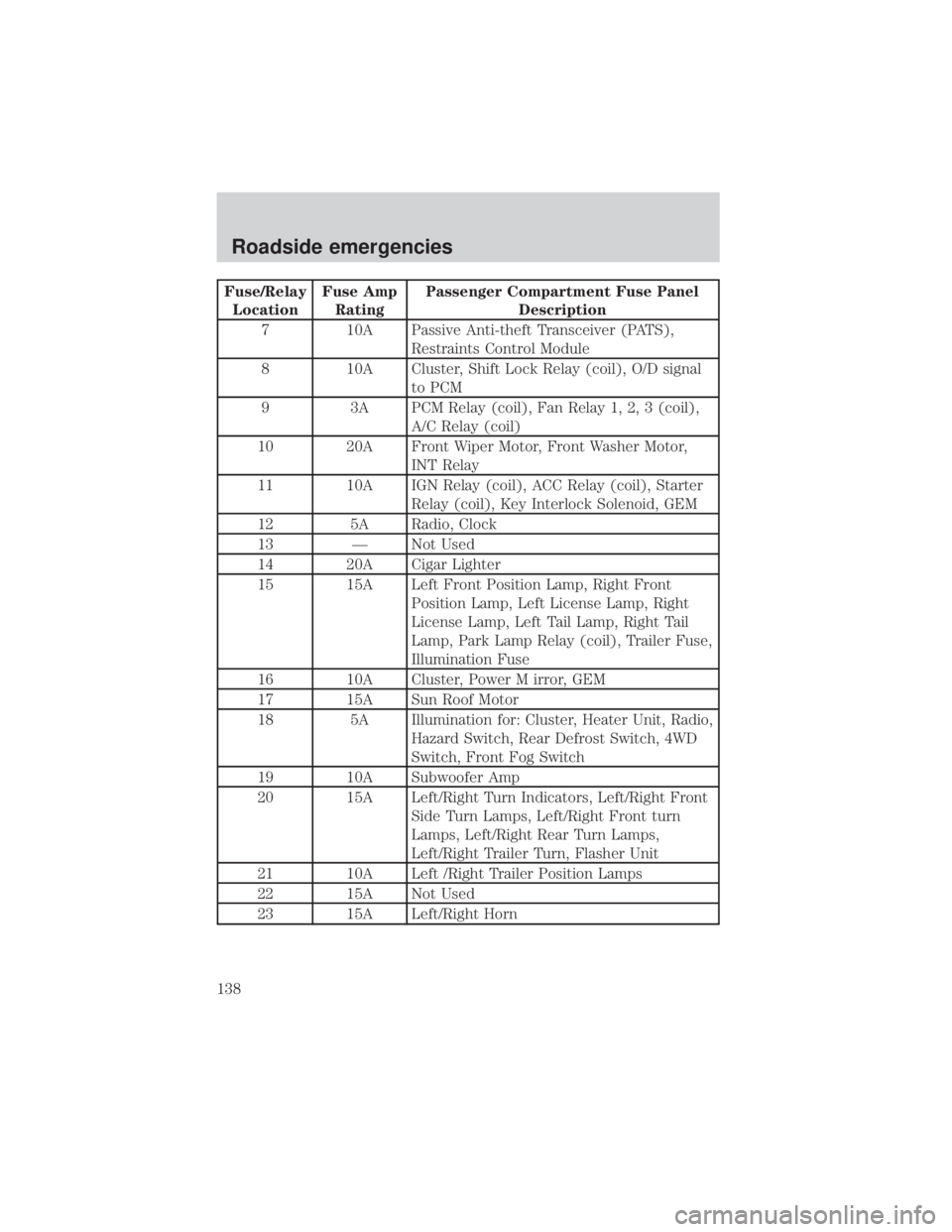
Fuse/RelayLocation Fuse Amp
Rating Passenger Compartment Fuse Panel
Description
7 10A Passive Anti-theft Transceiver (PATS), Restraints Control Module
8 10A Cluster, Shift Lock Relay (coil), O/D signal to PCM
9 3A PCM Relay (coil), Fan Relay 1, 2, 3 (coil), A/C Relay (coil)
10 20A Front Wiper Motor, Front Washer Motor, INT Relay
11 10A IGN Relay (coil), ACC Relay (coil), Starter Relay (coil), Key Interlock Solenoid, GEM
12 5A Radio, Clock
13 Ð Not Used
14 20A Cigar Lighter
15 15A Left Front Position Lamp, Right Front Position Lamp, Left License Lamp, Right
License Lamp, Left Tail Lamp, Right Tail
Lamp, Park Lamp Relay (coil), Trailer Fuse,
Illumination Fuse
16 10A Cluster, Power M irror, GEM
17 15A Sun Roof Motor
18 5A Illumination for: Cluster, Heater Unit, Radio, Hazard Switch, Rear Defrost Switch, 4WD
Switch, Front Fog Switch
19 10A Subwoofer Amp
20 15A Left/Right Turn Indicators, Left/Right Front Side Turn Lamps, Left/Right Front turn
Lamps, Left/Right Rear Turn Lamps,
Left/Right Trailer Turn, Flasher Unit
21 10A Left /Right Trailer Position Lamps
22 15A Not Used
23 15A Left/Right Horn
Roadside emergencies
138
Page 141 of 232
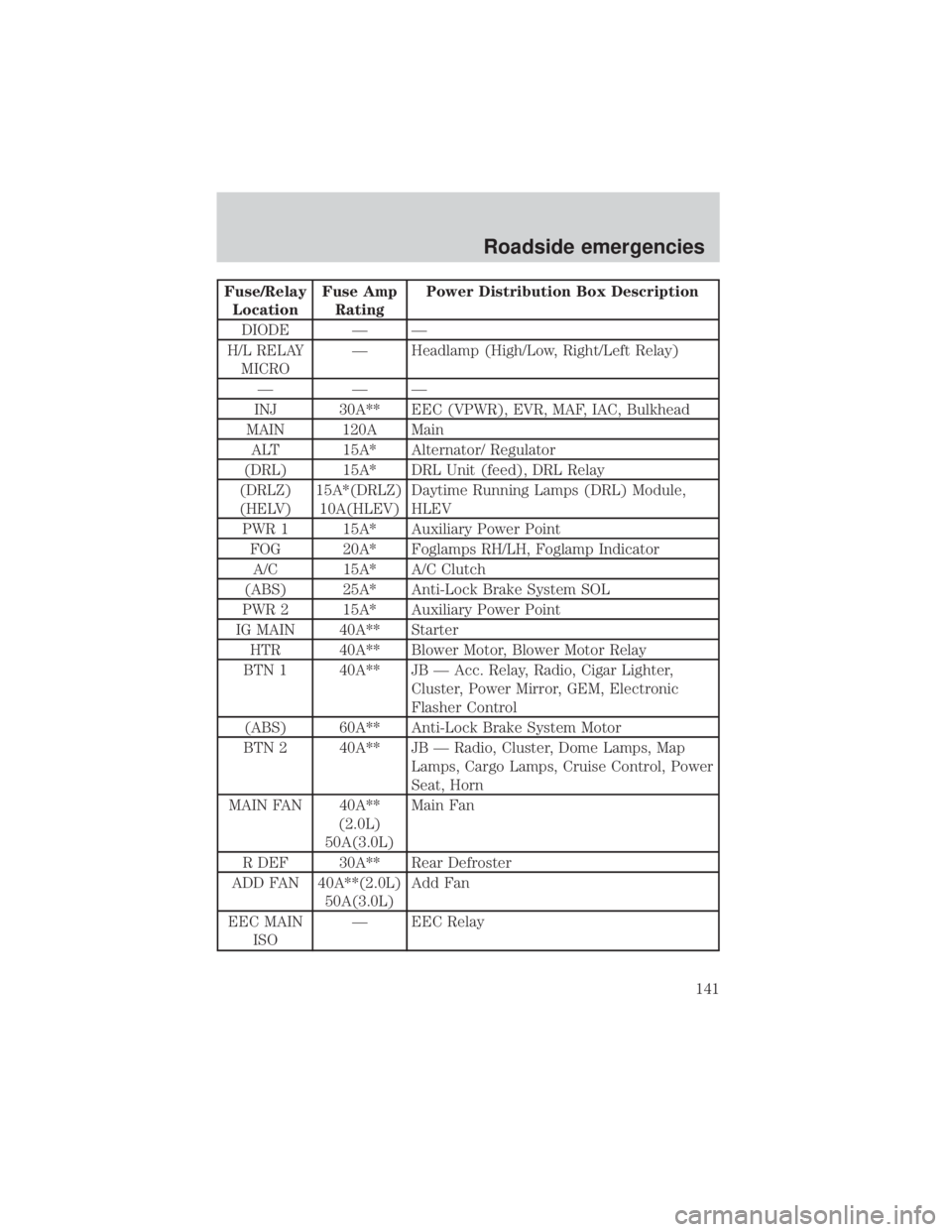
Fuse/RelayLocation Fuse Amp
Rating Power Distribution Box Description
DIODE Ð Ð
H/L RELAY MICRO Ð Headlamp (High/Low, Right/Left Relay)
ÐÐÐ
INJ 30A** EEC (VPWR), EVR, MAF, IAC, Bulkhead
MAIN 120A Main ALT 15A* Alternator/ Regulator
(DRL) 15A* DRL Unit (feed), DRL Relay
(DRLZ)
(HELV) 15A*(DRLZ)
10A(HLEV) Daytime Running Lamps (DRL) Module,
HLEV
PWR 1 15A* Auxiliary Power Point FOG 20A* Foglamps RH/LH, Foglamp IndicatorA/C 15A* A/C Clutch
(ABS) 25A* Anti-Lock Brake System SOL
PWR 2 15A* Auxiliary Power Point
IG MAIN 40A** Starter HTR 40A** Blower Motor, Blower Motor Relay
BTN 1 40A** JB Ð Acc. Relay, Radio, Cigar Lighter, Cluster, Power Mirror, GEM, Electronic
Flasher Control
(ABS) 60A** Anti-Lock Brake System Motor
BTN 2 40A** JB Ð Radio, Cluster, Dome Lamps, Map Lamps, Cargo Lamps, Cruise Control, Power
Seat, Horn
MAIN FAN 40A** (2.0L)
50A(3.0L) Main Fan
R DEF 30A** Rear Defroster
ADD FAN 40A**(2.0L) 50A(3.0L)Add Fan
EEC MAIN ISO Ð EEC Relay
Roadside emergencies
141