lock MAZDA MODEL TRIBUTE 4WD 2001 Workshop Manual
[x] Cancel search | Manufacturer: MAZDA, Model Year: 2001, Model line: MODEL TRIBUTE 4WD, Model: MAZDA MODEL TRIBUTE 4WD 2001Pages: 232, PDF Size: 1.74 MB
Page 138 of 232
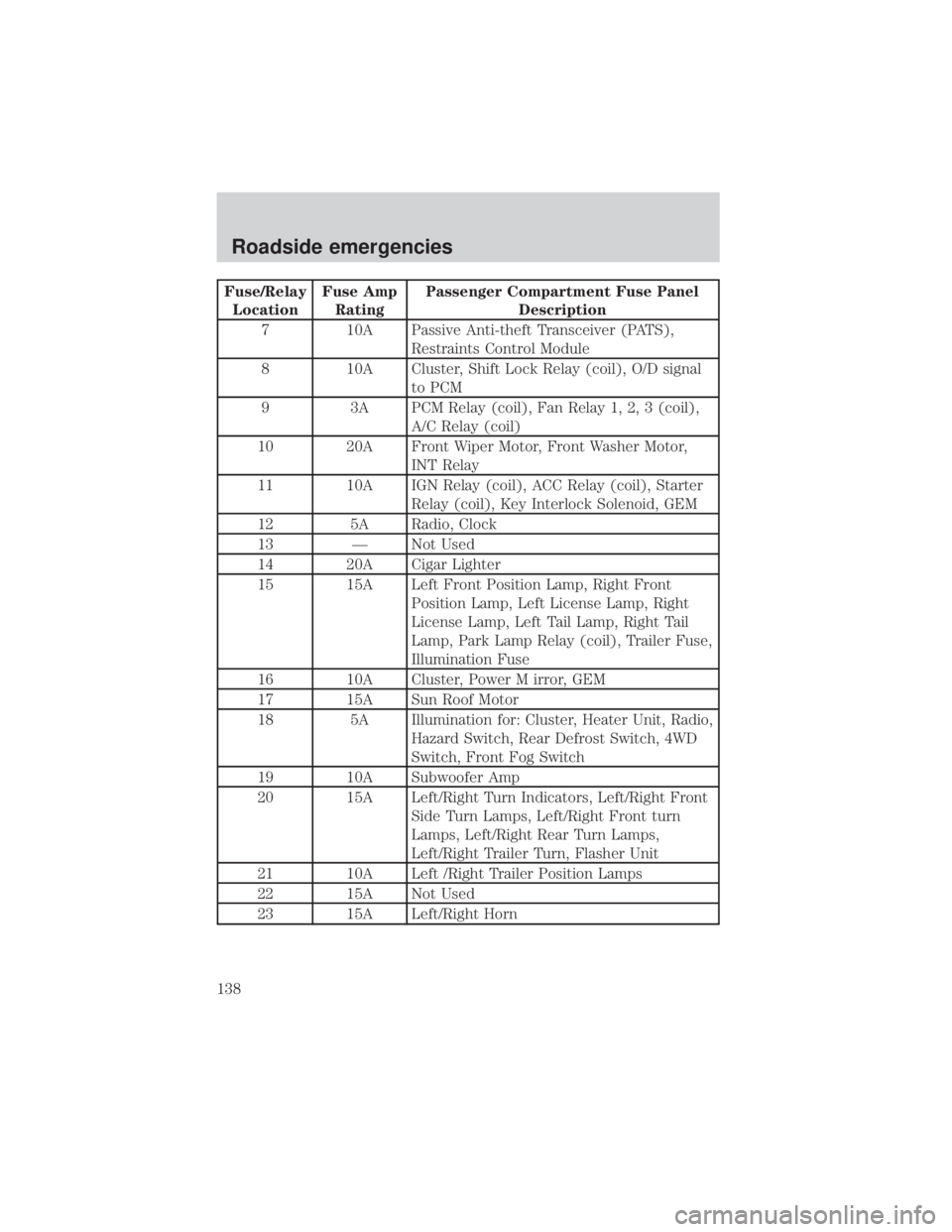
Fuse/RelayLocation Fuse Amp
Rating Passenger Compartment Fuse Panel
Description
7 10A Passive Anti-theft Transceiver (PATS), Restraints Control Module
8 10A Cluster, Shift Lock Relay (coil), O/D signal to PCM
9 3A PCM Relay (coil), Fan Relay 1, 2, 3 (coil), A/C Relay (coil)
10 20A Front Wiper Motor, Front Washer Motor, INT Relay
11 10A IGN Relay (coil), ACC Relay (coil), Starter Relay (coil), Key Interlock Solenoid, GEM
12 5A Radio, Clock
13 Ð Not Used
14 20A Cigar Lighter
15 15A Left Front Position Lamp, Right Front Position Lamp, Left License Lamp, Right
License Lamp, Left Tail Lamp, Right Tail
Lamp, Park Lamp Relay (coil), Trailer Fuse,
Illumination Fuse
16 10A Cluster, Power M irror, GEM
17 15A Sun Roof Motor
18 5A Illumination for: Cluster, Heater Unit, Radio, Hazard Switch, Rear Defrost Switch, 4WD
Switch, Front Fog Switch
19 10A Subwoofer Amp
20 15A Left/Right Turn Indicators, Left/Right Front Side Turn Lamps, Left/Right Front turn
Lamps, Left/Right Rear Turn Lamps,
Left/Right Trailer Turn, Flasher Unit
21 10A Left /Right Trailer Position Lamps
22 15A Not Used
23 15A Left/Right Horn
Roadside emergencies
138
Page 139 of 232
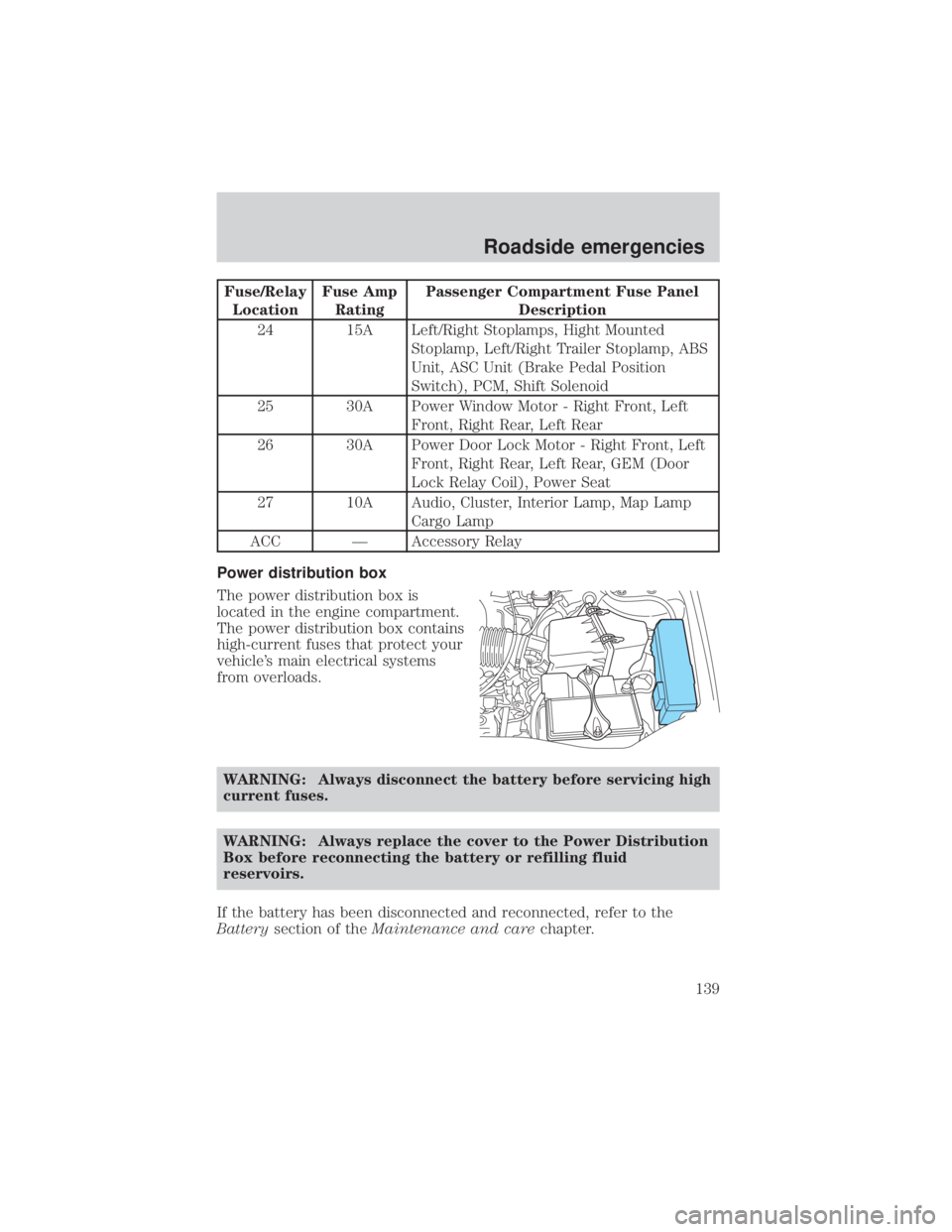
Fuse/RelayLocation Fuse Amp
Rating Passenger Compartment Fuse Panel
Description
24 15A Left/Right Stoplamps, Hight Mounted Stoplamp, Left/Right Trailer Stoplamp, ABS
Unit, ASC Unit (Brake Pedal Position
Switch), PCM, Shift Solenoid
25 30A Power Window Motor - Right Front, Left Front, Right Rear, Left Rear
26 30A Power Door Lock Motor - Right Front, Left Front, Right Rear, Left Rear, GEM (Door
Lock Relay Coil), Power Seat
27 10A Audio, Cluster, Interior Lamp, Map Lamp Cargo Lamp
ACC Ð Accessory Relay
Power distribution box
The power distribution box is
located in the engine compartment.
The power distribution box contains
high-current fuses that protect your
vehicle's main electrical systems
from overloads.
WARNING: Always disconnect the battery before servicing high
current fuses.
WARNING: Always replace the cover to the Power Distribution
Box before reconnecting the battery or refilling fluid
reservoirs.
If the battery has been disconnected and reconnected, refer to the
Battery section of the Maintenance and care chapter.
Roadside emergencies
139
Page 141 of 232
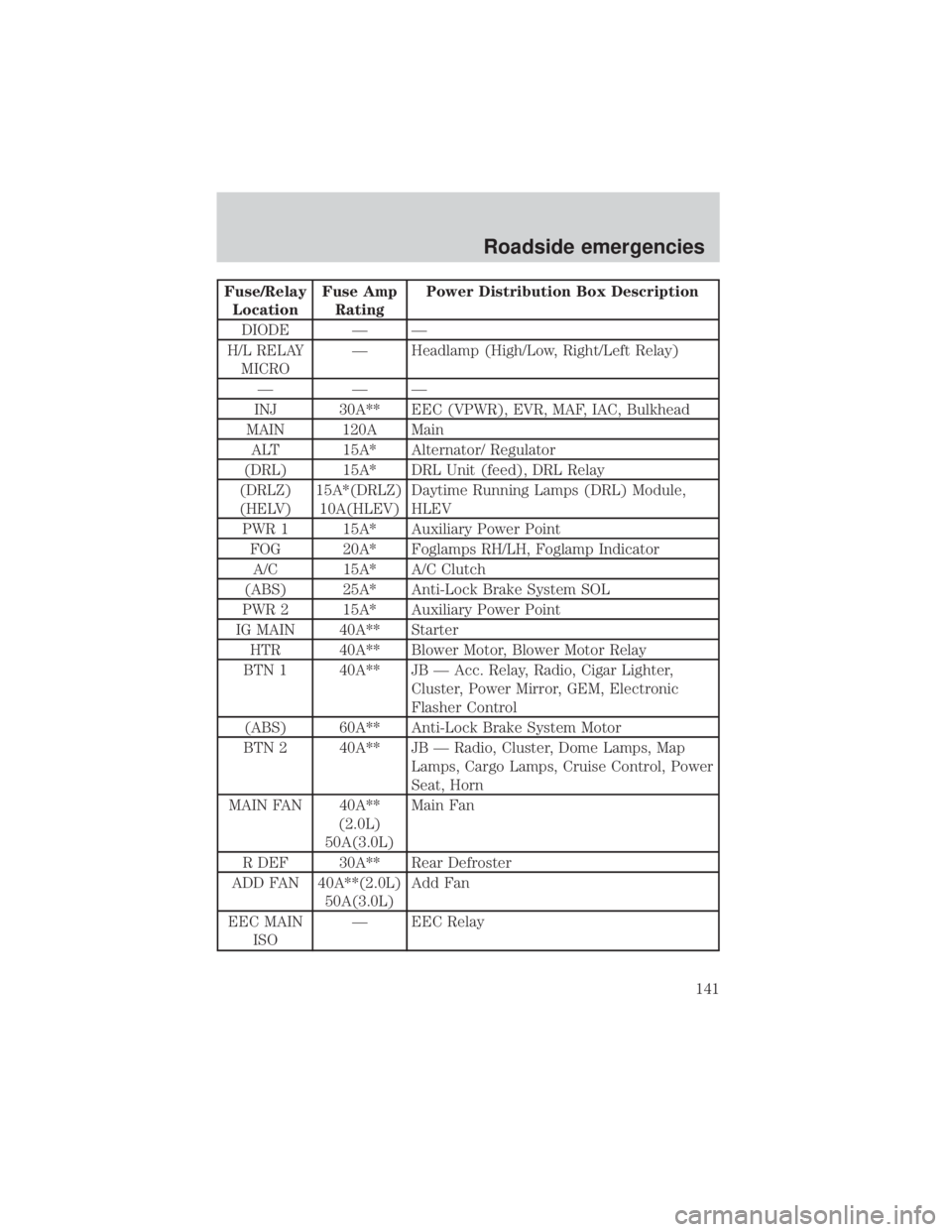
Fuse/RelayLocation Fuse Amp
Rating Power Distribution Box Description
DIODE Ð Ð
H/L RELAY MICRO Ð Headlamp (High/Low, Right/Left Relay)
ÐÐÐ
INJ 30A** EEC (VPWR), EVR, MAF, IAC, Bulkhead
MAIN 120A Main ALT 15A* Alternator/ Regulator
(DRL) 15A* DRL Unit (feed), DRL Relay
(DRLZ)
(HELV) 15A*(DRLZ)
10A(HLEV) Daytime Running Lamps (DRL) Module,
HLEV
PWR 1 15A* Auxiliary Power Point FOG 20A* Foglamps RH/LH, Foglamp IndicatorA/C 15A* A/C Clutch
(ABS) 25A* Anti-Lock Brake System SOL
PWR 2 15A* Auxiliary Power Point
IG MAIN 40A** Starter HTR 40A** Blower Motor, Blower Motor Relay
BTN 1 40A** JB Ð Acc. Relay, Radio, Cigar Lighter, Cluster, Power Mirror, GEM, Electronic
Flasher Control
(ABS) 60A** Anti-Lock Brake System Motor
BTN 2 40A** JB Ð Radio, Cluster, Dome Lamps, Map Lamps, Cargo Lamps, Cruise Control, Power
Seat, Horn
MAIN FAN 40A** (2.0L)
50A(3.0L) Main Fan
R DEF 30A** Rear Defroster
ADD FAN 40A**(2.0L) 50A(3.0L)Add Fan
EEC MAIN ISO Ð EEC Relay
Roadside emergencies
141
Page 143 of 232
It is not recommended that the vehicle be operated in 4WD modes with
a temporary spare. If 4WD operation is necessary, do not operate above
speeds of 16 km/h (10 mph) or for distances above 80 km (50 miles).WARNING: If you use the temporary spare tire continuously or
do not follow these precautions, the tire could fail, causing you
to lose control of the vehicle, possibly injuring yourself or
others.
When driving with the temporary spare tire do not:
² exceed 80 km/h (50 mph) under any circumstances
² load the vehicle beyond maximum vehicle load rating listed on the
Safety Compliance Label
² tow a trailer
² use tire chains
² drive through an automatic car wash, because of the vehicle's reduced
ground clearance
² try to repair the temporary spare tire or remove it from its wheel rim
² use the wheel for any other type of vehicle
Tire change procedure WARNING: When one of the front wheels is off the ground, the
transmission alone will not prevent the vehicle from moving or
slipping off the jack, even if the vehicle is in P (Park)
(automatic transaxle) or R (Reverse) (manual transaxle).
WARNING: To prevent the vehicle from moving when you
change a tire, be sure the parking brake is set, then block (in
both directions) the wheel that is diagonally opposite (other
side and end of the vehicle) to the tire being changed.
WARNING: If the vehicle slips off the jack, you or someone
else could be seriously injured.
Roadside emergencies
143
Page 144 of 232
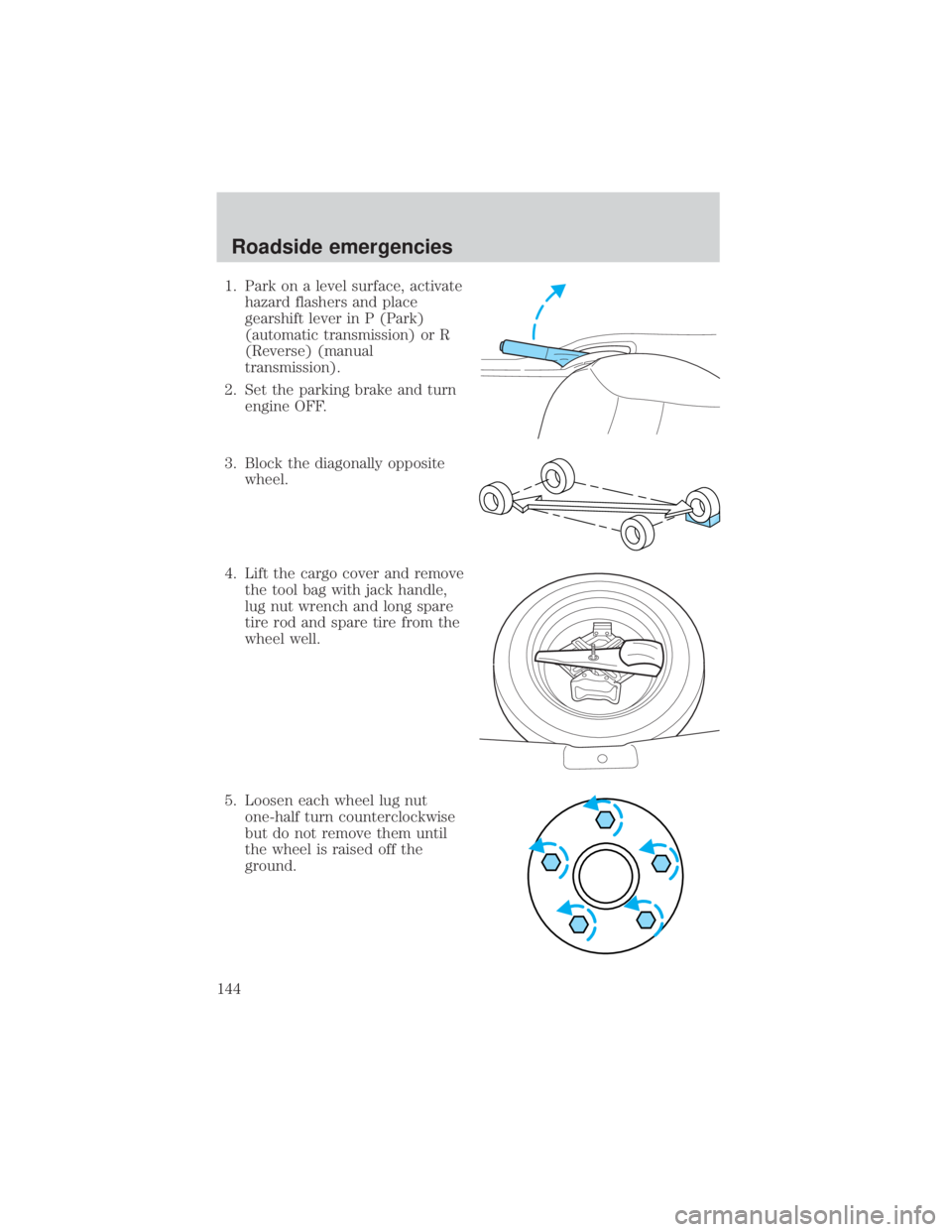
1. Park on a level surface, activatehazard flashers and place
gearshift lever in P (Park)
(automatic transmission) or R
(Reverse) (manual
transmission).
2. Set the parking brake and turn engine OFF.
3. Block the diagonally opposite wheel.
4. Lift the cargo cover and remove the tool bag with jack handle,
lug nut wrench and long spare
tire rod and spare tire from the
wheel well.
5. Loosen each wheel lug nut one-half turn counterclockwise
but do not remove them until
the wheel is raised off the
ground.
Roadside emergencies
144
Page 145 of 232
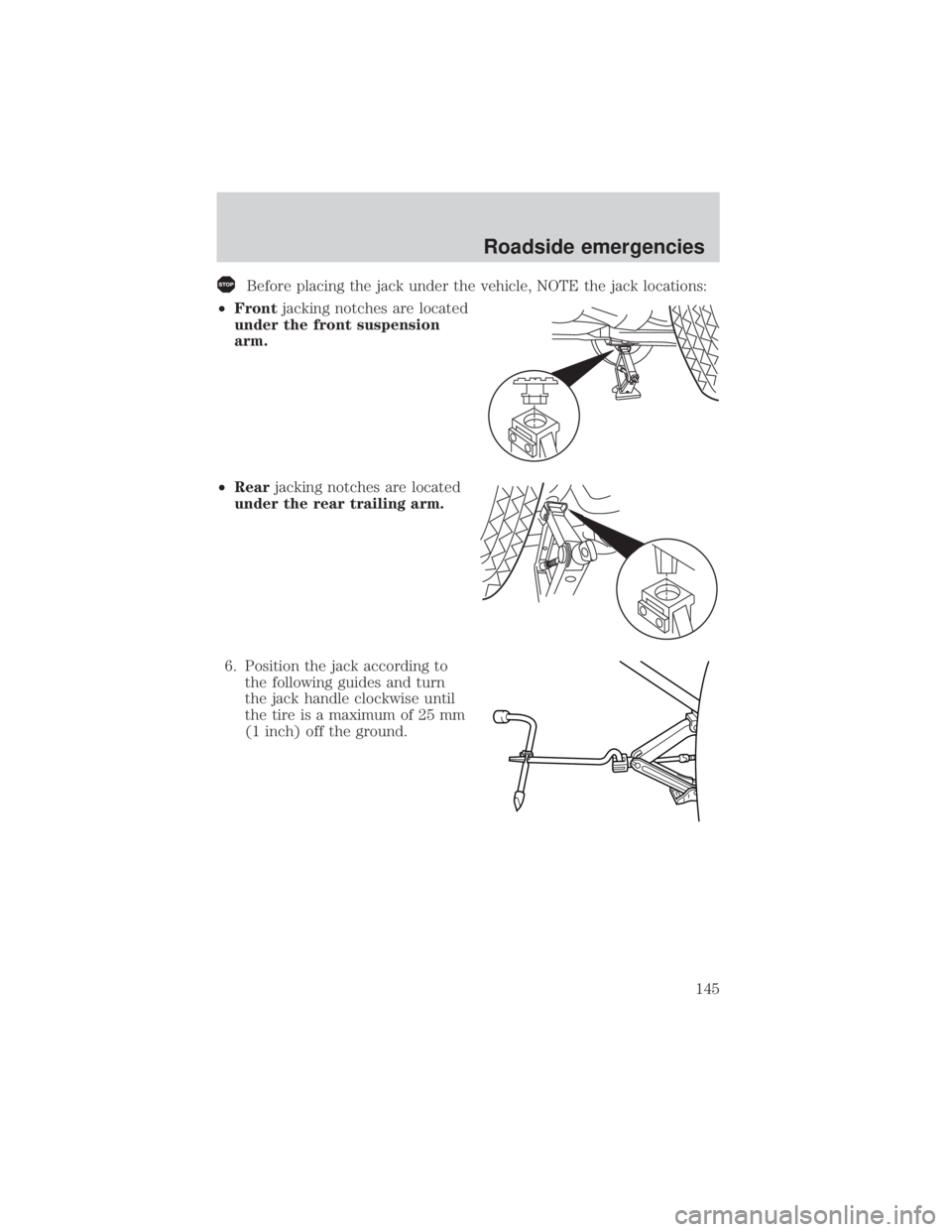
Before placing the jack under the vehicle, NOTE the jack locations:
² Front jacking notches are located
under the front suspension
arm.
² Rear jacking notches are located
under the rear trailing arm.
6. Position the jack according to the following guides and turn
the jack handle clockwise until
the tire is a maximum of 25 mm
(1 inch) off the ground.
Roadside emergencies
145
Page 146 of 232
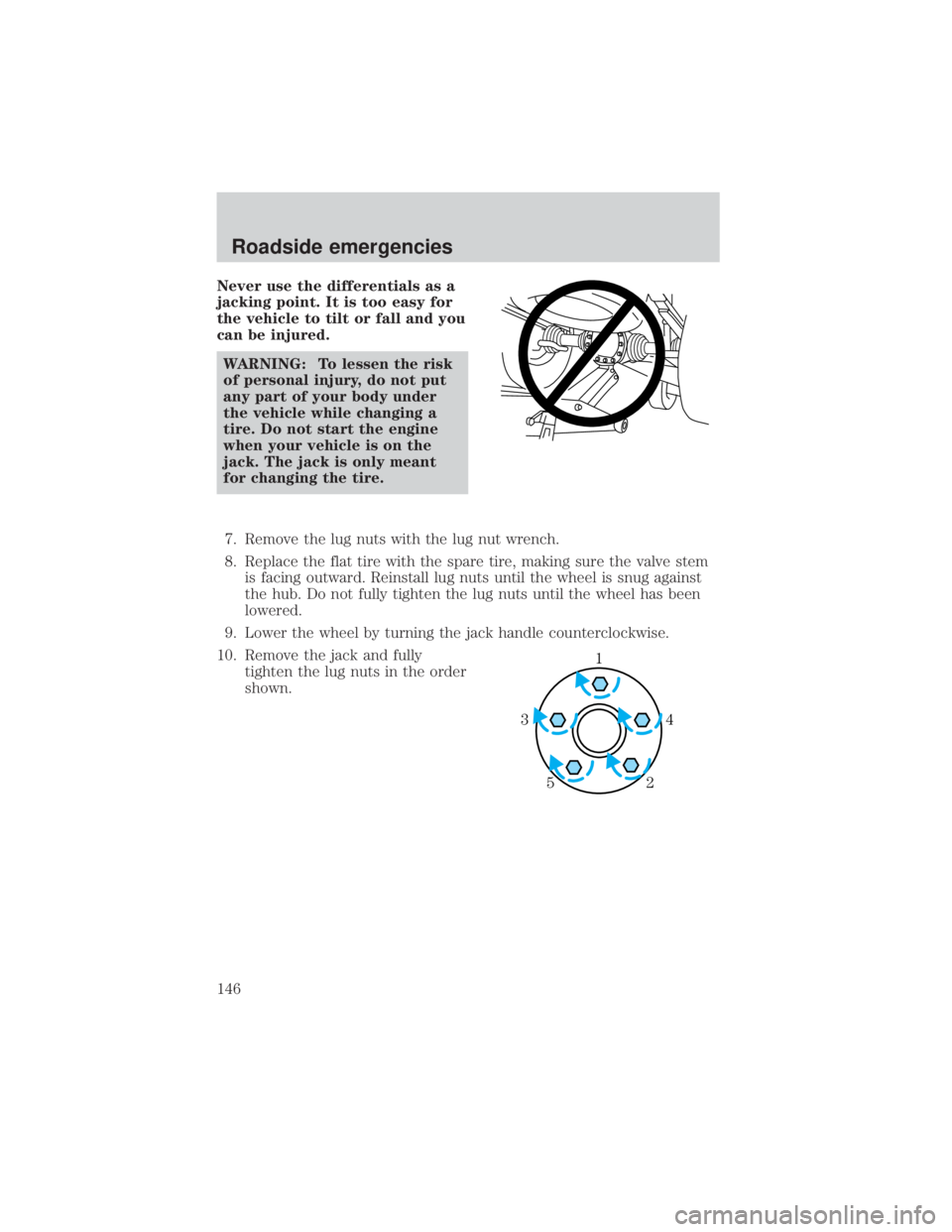
Never use the differentials as a
jacking point. It is too easy for
the vehicle to tilt or fall and you
can be injured.WARNING: To lessen the risk
of personal injury, do not put
any part of your body under
the vehicle while changing a
tire. Do not start the engine
when your vehicle is on the
jack. The jack is only meant
for changing the tire.
7. Remove the lug nuts with the lug nut wrench.
8. Replace the flat tire with the spare tire, making sure the valve stem is facing outward. Reinstall lug nuts until the wheel is snug against
the hub. Do not fully tighten the lug nuts until the wheel has been
lowered.
9. Lower the wheel by turning the jack handle counterclockwise.
10. Remove the jack and fully tighten the lug nuts in the order
shown.
1
4
3
2
5
Roadside emergencies
146
Page 147 of 232
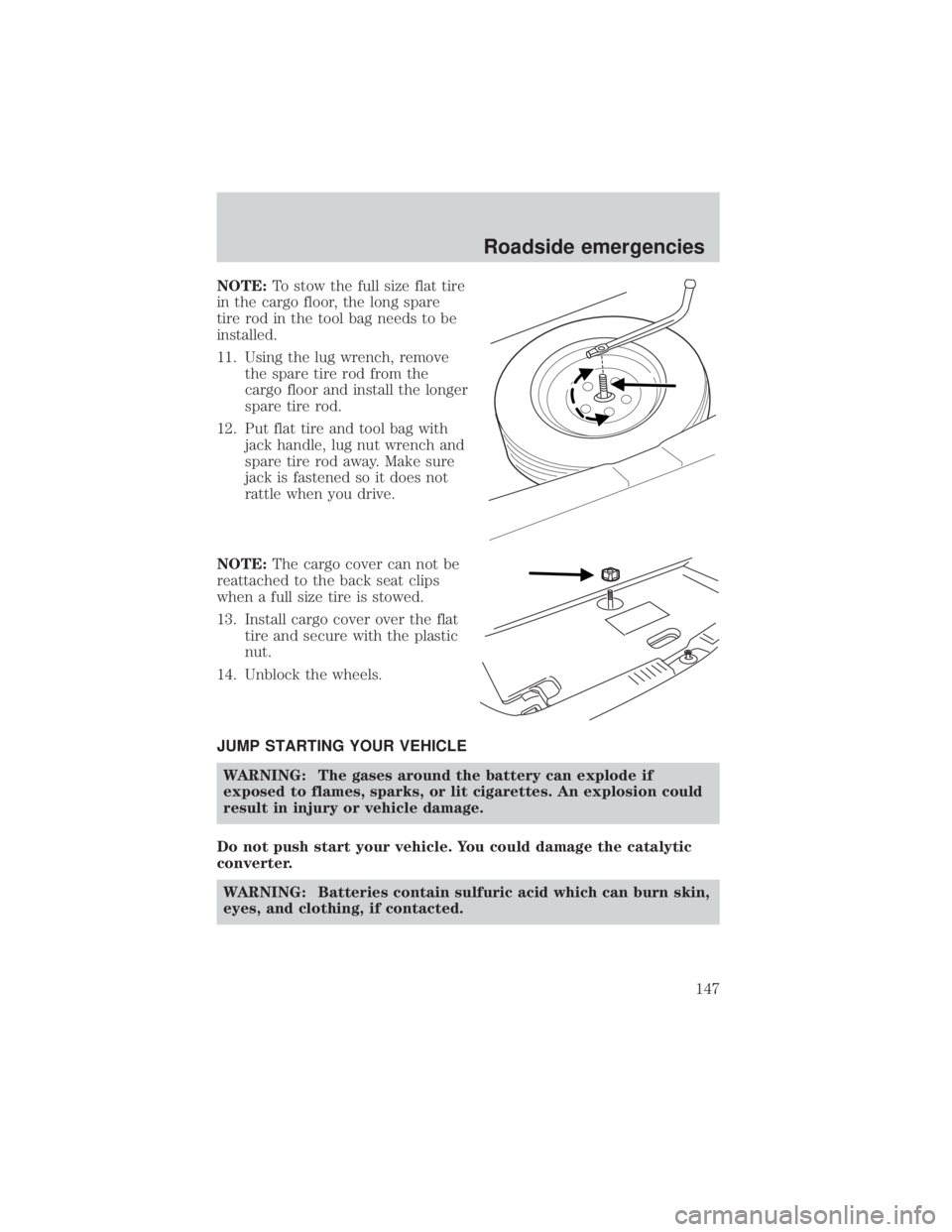
NOTE:To stow the full size flat tire
in the cargo floor, the long spare
tire rod in the tool bag needs to be
installed.
11. Using the lug wrench, remove the spare tire rod from the
cargo floor and install the longer
spare tire rod.
12. Put flat tire and tool bag with jack handle, lug nut wrench and
spare tire rod away. Make sure
jack is fastened so it does not
rattle when you drive.
NOTE: The cargo cover can not be
reattached to the back seat clips
when a full size tire is stowed.
13. Install cargo cover over the flat tire and secure with the plastic
nut.
14. Unblock the wheels.
JUMP STARTING YOUR VEHICLE
WARNING: The gases around the battery can explode if
exposed to flames, sparks, or lit cigarettes. An explosion could
result in injury or vehicle damage.
Do not push start your vehicle. You could damage the catalytic
converter. WARNING: Batteries contain sulfuric acid which can burn skin,
eyes, and clothing, if contacted.
Roadside emergencies
147
Page 157 of 232
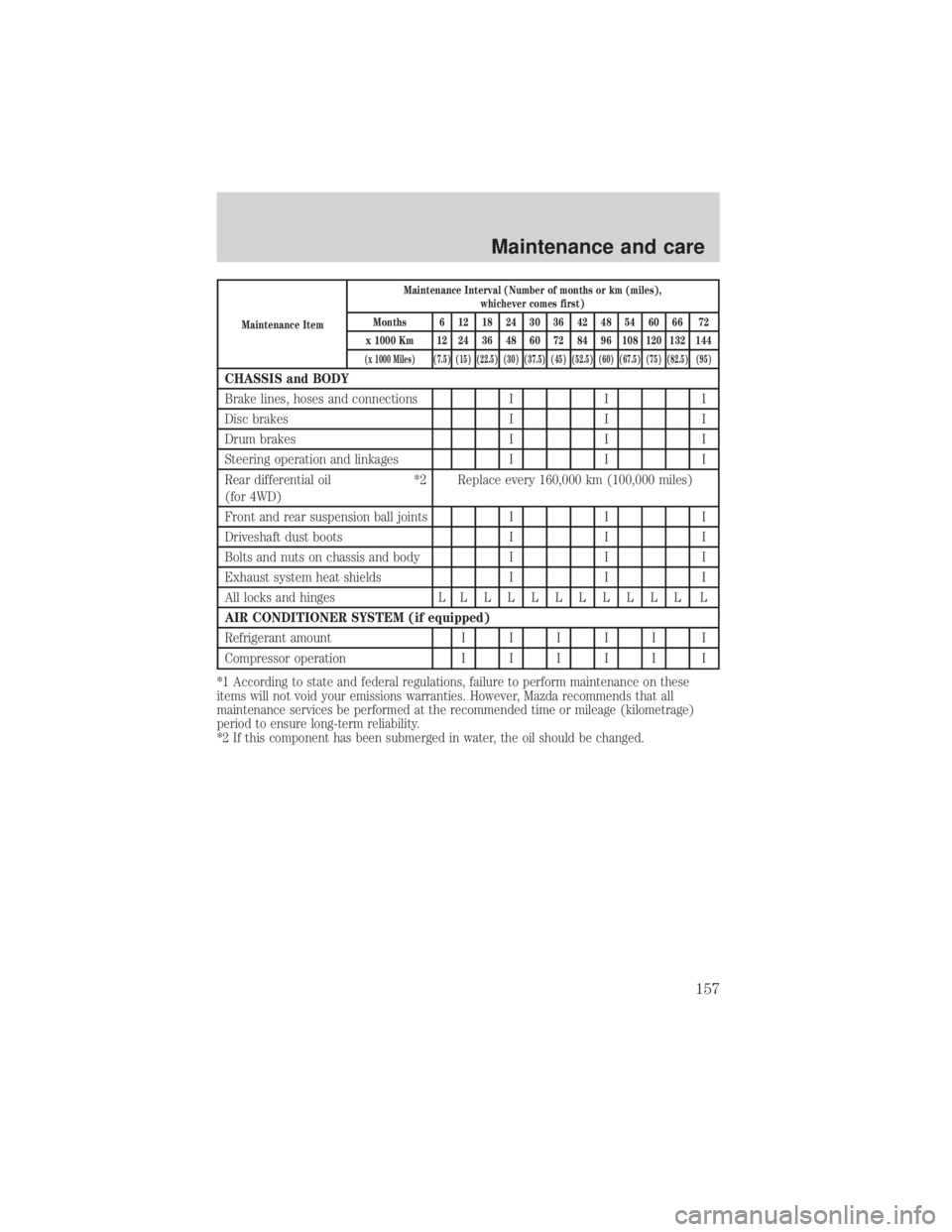
Maintenance ItemMaintenance Interval (Number of months or km (miles),
whichever comes first)
Months 6 12 18 24 30 36 42 48 54 60 66 72
x 1000 Km 12 24 36 48 60 72 84 96 108 120 132 144
(x 1000 Miles) (7.5) (15) (22.5) (30) (37.5) (45) (52.5) (60) (67.5) (75) (82.5) (95)
CHASSIS and BODY
Brake lines, hoses and connections II I
Disc brakes II I
Drum brakes II I
Steering operation and linkages II I
Rear differential oil
(for 4WD) *2 Replace every 160,000 km (100,000 miles)
Front and rear suspension ball joints II I
Driveshaft dust boots II I
Bolts and nuts on chassis and body II I
Exhaust system heat shields II I
All locks and hinges LLLLLLLLLLL L
AIR CONDITIONER SYSTEM (if equipped)
Refrigerant amount IIIII I
Compressor operation IIIII I
*1 According to state and federal regulations, failure to perform maintenance on these
items will not void your emissions warranties. However, Mazda recommends that all
maintenance services be performed at the recommended time or mileage (kilometrage)
period to ensure long-term reliability.
*2 If this component has been submerged in water, the oil should be changed.
Maintenance and care
157
Page 159 of 232
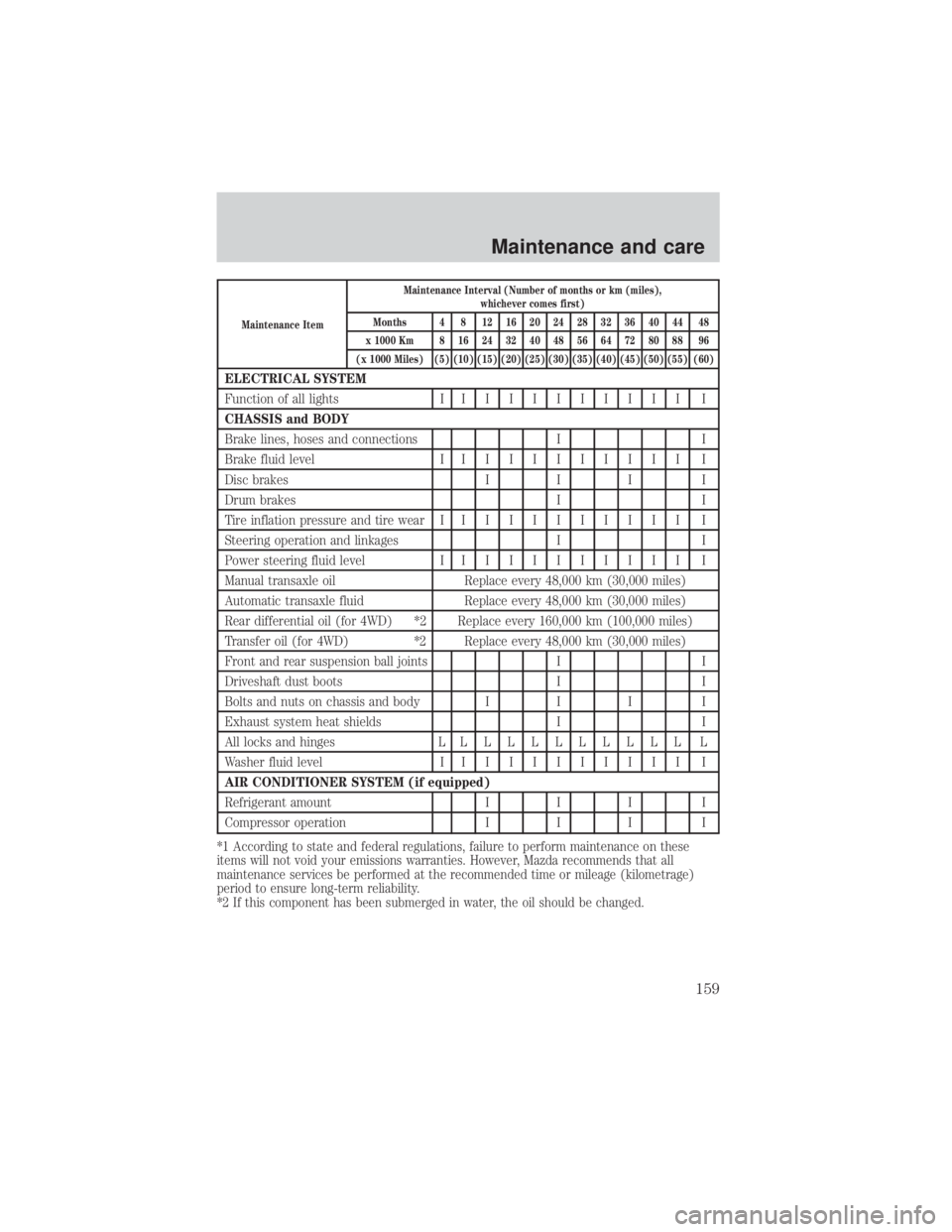
Maintenance ItemMaintenance Interval (Number of months or km (miles),
whichever comes first)
Months 4 8 12 16 20 24 28 32 36 40 44 48
x 1000 Km 8 16 24 32 40 48 56 64 72 80 88 96
(x 1000 Miles) (5) (10) (15) (20) (25) (30) (35) (40) (45) (50) (55) (60)
ELECTRICAL SYSTEM
Function of all lights IIIIIIIIIII I
CHASSIS and BODY
Brake lines, hoses and connections I I
Brake fluid level I IIIIIIIIII I
Disc brakes I I I I
Drum brakes I I
Tire inflation pressure and tire wear I IIIIIIIIII I
Steering operation and linkages I I
Power steering fluid level I IIIIIIIIII I
Manual transaxle oil Replace every 48,000 km (30,000 miles)
Automatic transaxle fluid Replace every 48,000 km (30,000 miles)
Rear differential oil (for 4WD) *2 Replace every 160,000 km (100,000 miles)
Transfer oil (for 4WD) *2 Replace every 48,000 km (30,000 miles)
Front and rear suspension ball joints I I
Driveshaft dust boots I I
Bolts and nuts on chassis and body I I I I
Exhaust system heat shields I I
All locks and hinges L LLLLLLLLLL L
Washer fluid level I IIIIIIIIII I
AIR CONDITIONER SYSTEM (if equipped)
Refrigerant amount I I I I
Compressor operation I I I I
*1 According to state and federal regulations, failure to perform maintenance on these
items will not void your emissions warranties. However, Mazda recommends that all
maintenance services be performed at the recommended time or mileage (kilometrage)
period to ensure long-term reliability.
*2 If this component has been submerged in water, the oil should be changed.
Maintenance and care
159