oil pressure MAZDA MX-5 1994 Repair Manual
[x] Cancel search | Manufacturer: MAZDA, Model Year: 1994, Model line: MX-5, Model: MAZDA MX-5 1994Pages: 1708, PDF Size: 82.34 MB
Page 505 of 1708
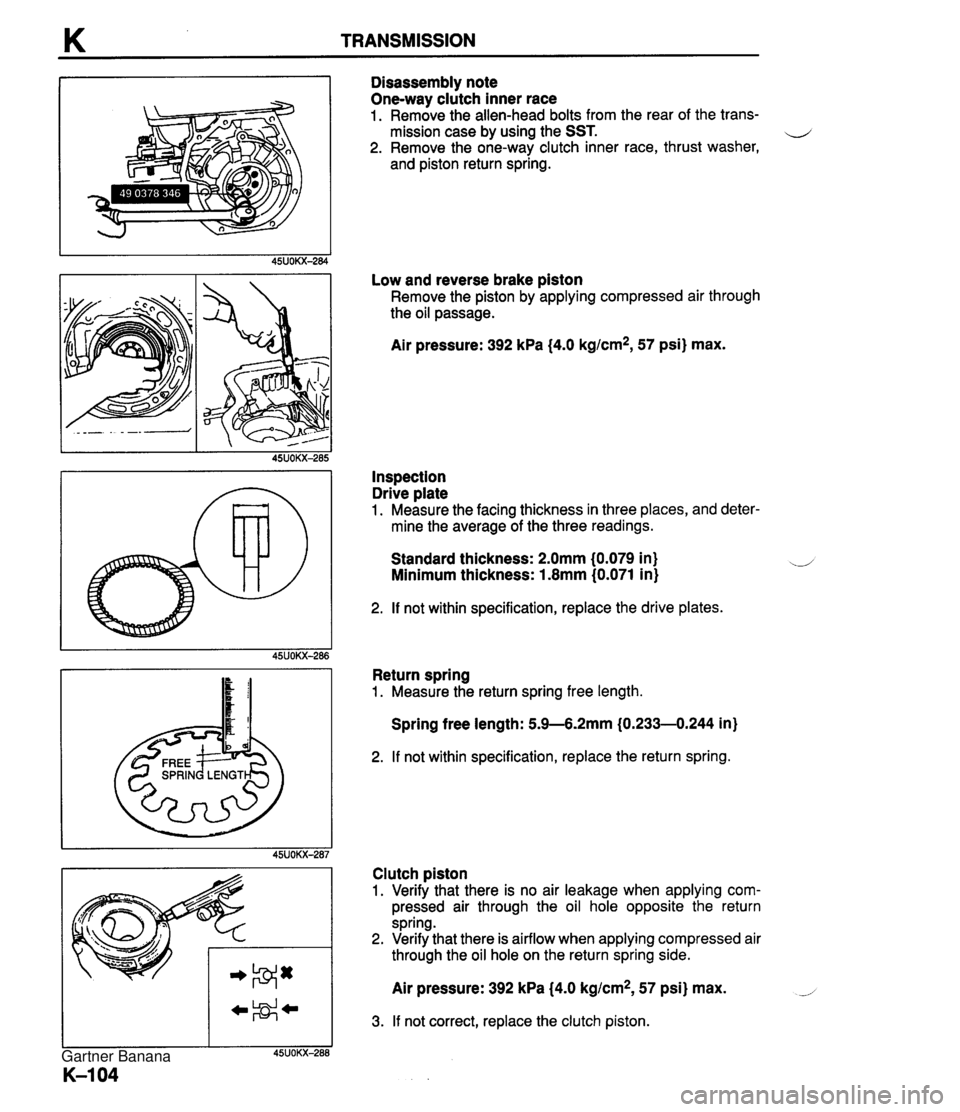
K TRANSMISSION Disassembly note One-way clutch inner race 1. Remove the allen-head bolts from the rear of the trans- mission case by using the SST. 4 2. Remove the one-wav clutch inner race, thrust washer, and piston return spring. Low and reverse brake &ton Remove the piston by gpplying compressed air through the oil passage. Air pressure: 392 kPa (4.0 kg/cm2, 57 psi) max. Inspection Drive plate 1. Measure the facing thickness in three places, and deter- mine the average of the three readings. Standard thickness: 2.0mm (0.079 in) Minimum thickness: 1.8mm (0.071 in) 2. If not within specification, replace the drive plates. Return spring 1. Measure the return spring free length. Spring free length: 5.9-6.2mm (0.233-0.244 in) 2. If not within specification, replace the return spring. Clutch piston 1. Verify that there is no air leakage when applying com- pressed air through the oil hole opposite the return spring. 2. Verify that there is airflow when applying compressed air through the oil hole on the return spring side. Air pressure: 392 kPa (4.0 kg/cm2, 57 psi) max. 3. If not correct, replace the clutch piston. Gartner Banana
Page 507 of 1708
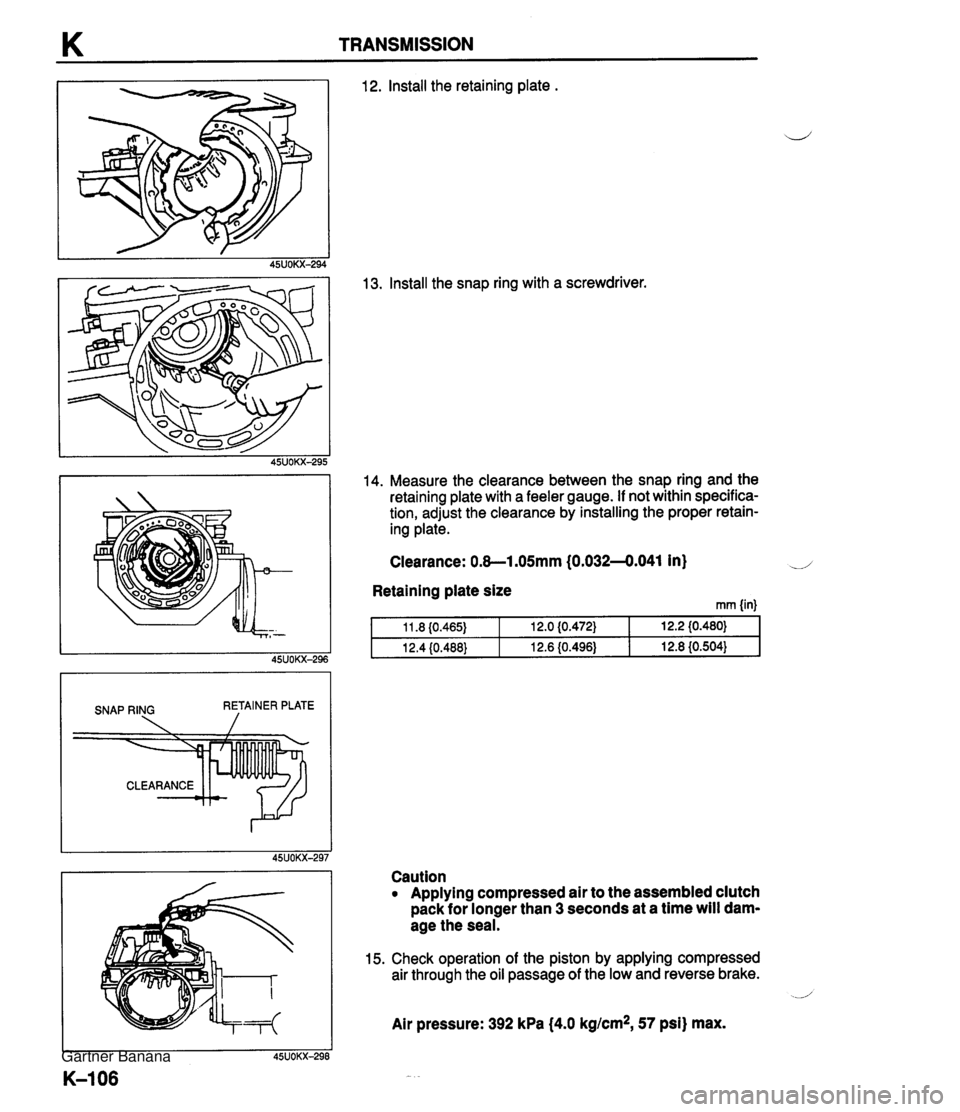
K TRANSMISSION SNAP RING RETAINER PLATE 12. lnstall the retaining plate . 13. Install the snap ring with a screwdriver. 14. Measure the clearance between the snap ring and the retaining plate with a feeler gauge. If not within specifica- tion, adjust the clearance by installing the proper retain- ing plate. Clearance: 0.8-1.05mm (0.032-4.041 in) d Retaining plate size rnrn {in) Caution Applying compressed air to the assembled clutch pack for longer than 3 seconds at a time will dam- age the seal. 15. Check operation of the piston by applying compressed air through the oil passage of the low and reverse brake. _i Air pressure: 392 kPa (4.0 kglcm*, 57 psi) max. Gartner Banana
Page 518 of 1708
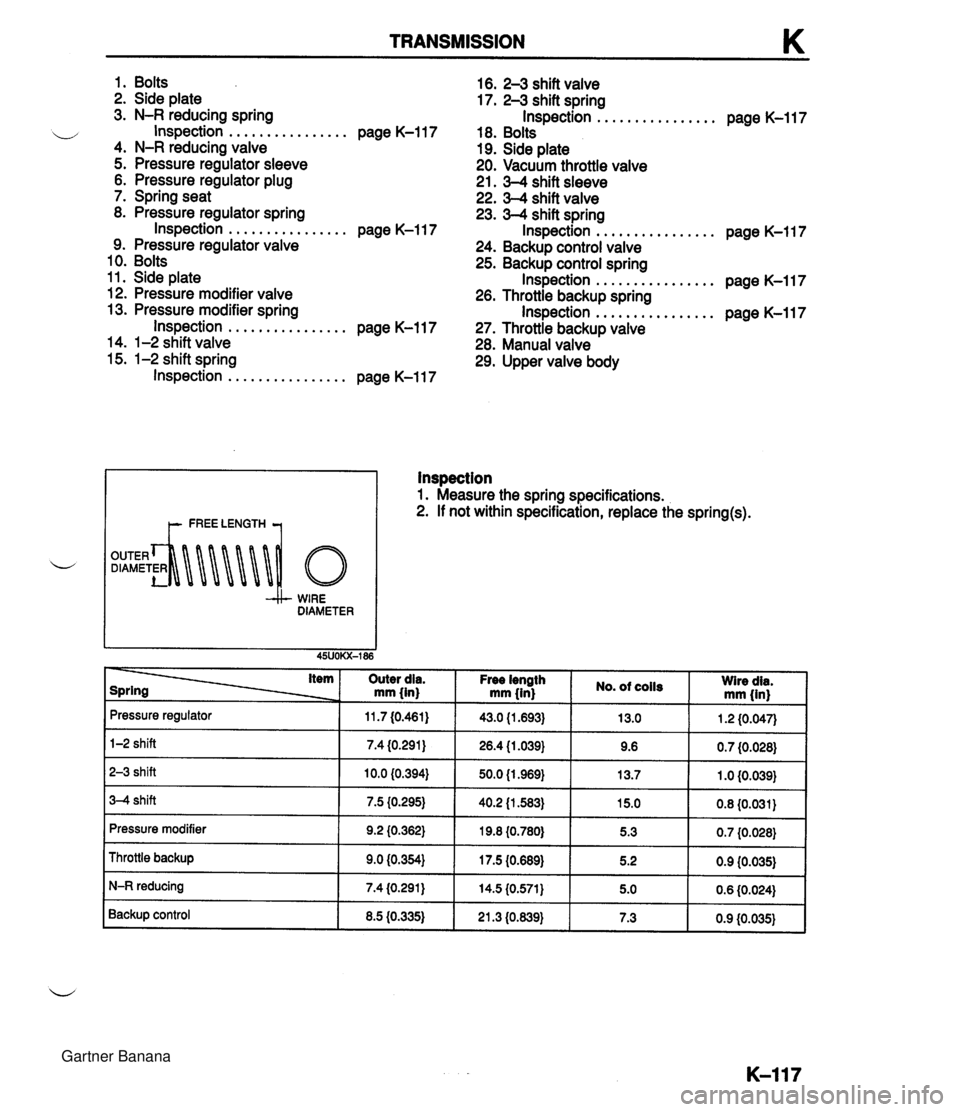
TRANSMISSION 1. Bolts 16. 2-3 shift valve 2. Side plate 17. 2-3 shift spring 3. N-R reducing spring Inspection ................ page K-117 ................ w Inspection page K-117 18. Bolts 4. N-R reducing valve 19. Side plate 5. Pressure regulator sleeve 20. Vacuum throttle valve 6. Pressure regulator plug 21. 3-4 shift sleeve 7. Spring seat 22. 3-4 shift valve 8. Pressure regulator spring 23. 3-4 shift spring Inspection ................ page K-117 Inspection ................ page K-117 9. Pressure regulator valve 24. Backup control valve 10. Bolts 25. Backup control spring 11. Side plate Inspection ................ page K-117 12. Pressure modifier valve 26. Throttle backup spring ................ 13. Pressure modifier spring Inspection page K-117 Inspection ................ page K-117 27. Throttle backup valve 14. 1-2 shift valve 28. Manual valve 15. 1-2 shift spring 29. Upper valve body Inspection ................ page K-117 I t- FREE LENGTH 7 WIRE DIAMETER lnspection 1. Measure the spring specifications. 2. If not within specification, replace the spring(s). item Outer dia. mm (in) Pressure regulator 1-2 shift Free iength mm (in} 2-3 shift 3-4 shift 11.7 (0.461) 7.4 (0.291) Pressure modifier Throttle backup No. of coils 10.0 (0.394) 7.5 (0.295) I I I I Wire dia. mm (in} 43.0 (1.693) 26.4 (1.039) 9.2 (0.362) 9.0 (0.354) N-R reducing Backup control 50.0 (1 .969) 40.2 (1 583) 13.0 9.6 19.8 {0.780} 17.5 {0.689) 8.5 (0.335) 1.2 (0.047) 0.7 (0.028) 13.7 15.0 0.6 (0.024) 7.4 (0.291) 1 .O (0.039) 0.8 (0.031) 5.3 5.2 21.3 (0.639) 0.7 (0.028) 0.9 (0.035) 14.5 (0.571) 5.0 7.3 0.9 (0.035) Gartner Banana
Page 544 of 1708

TRANSMISSION K 33. Apply ATF to the piston stem. 34. Adjust the 2nd brake band. (1) Loosen the locknut and tighten the piston stem. Tightening torque: 12.3--14.2 N-m (125--145 kgf-cm, lOg--l25 in-lbf) (2) Loosen the stem the number of turns shown below. Stem: 2 112 turns (3) Hold the stem and tighten the locknut. Tightening torque: 15-39 N.m (1.5-4.0 kgf-m, 11-28 ft-lbf) Caution Applying compressed air to the servo piston for longer than 3 seconds at a time will damage the seal. 35. Check the servo piston operation by applying com- pressed air through the oil passages of the 2nd band servo. @: Engage @: Release Air pressure: 392 kPa (4.0 kg/cm2, 57 psi) max. 36. Apply ATF to the piston stem. Adjust the fourth gear brake band. (1) Loosen the locknut and tighten the piston stem. Tightening torque: 12-15 N-m (1.2-1.5 kgf-m, 8.7-11 ft-lbf) 11.8-14.7 N-m (1 20-150 kgf.cm, 105-1 30 in-lbf) (2) Loosen the stem the number of turns shown below. Stem: 2 turns Gartner Banana
Page 545 of 1708

K TRANSMISSION 0 (3) Hold the stem and tighten the locknut. Tightening torque: 15--39 N-m (1.5-4.0 kgf-m, 11-28 ftelbf) Caution Applying compressed air to the servo piston for longer than 3 seconds at a time will damage the seal. I 1 37. Check the servo piston operation by applying com- 45UOM431 pressed air through the oil passage of the fourth gear band servo. Air pressure: 392 kPa (4.0 kg/cm2, 57 psi) max. MANUAL PLATE 38. Set a new gasket on the fourth gear band servo. Install the fourth gear band servo cover. Tightening torque: 5.0-6.8 N-m (50-70 kgfscm, 44--60 indbf) 39. Apply ATF to a new O-ring and install it onto the solenoid valve connector. 40. Install the solenoid valve connector in the transmission case. 41. Set the valve body assembly in piston, and align the manual plate and manual valve. 42. Install the bolts. Tightening torque: 10.8-14.7 N.m (110--150 kgf-cm, 95.5--130 in-lbf) Gartner Banana
Page 632 of 1708

MANUAL STEERING TROUBLESHOOTING GUIDE Problem Steering heavy Posslble Cause Poor lubrication, foreign material, or abnormal wear of steering ball joint Stuck or damaged lower arm ball joints lmproper steering pinion preload Damaged steering gear Malfunction of steering shaft joint lmproperly adjusted wheel alignment Malfunctioning steering gear Replace Replace gear Replace Replace Adjust Replace ~ction- Lubricate or replace section R N-12 N-12 N- 9 section R N-12 ~i&d~ection N-13 General instability while driving Steering wheel pulls to one side Shake (Steering wheel vibrates upidown) Worn or damaged stabilizer and/or suspension arm bushings Dragging brake Loose lower arm lmproperly adjusted wheel alignment lncorrect tire pressure Damaged or unbalanced wheel Worn or damaged steering joints lmproper steering pinion preload Weak front coil spring Worn or damaged stabilizer andlor suspension arm bushings Malfunctioning shock absorber lmproperly adjusted wheel alignment Excessive tire and/or wheel runout Loose lug nuts Unbalanced wheel(s) Incorrect tire pressure Incorrect tire pressure Unevenly worn tires Weak front spring Replace Repair Tighten Adjust Adjust Adjust or replace Replace Replace gear Replace Replace Replace Adjust Replace Tighten Adjust or replace section R section P section R section R section Q section Q N- 9 N-12 section R section R section R section R section Q section Q section Q Adjust Adjust Replace Replace section Q section Q section Q section R I Cracked or worn transmission mount I Cracked or worn engine mount 1 ~e~lace I section B lncorrect tire pressure Unevenly worn tires Malfunction of shock absorber Shimmy (Steering wheel vibrates circumferentially) Excessive steering wheel play Cracked or worn steering gear mount Loose steering gear mounting bolts Stuck or damaged steering ball joint Excessive tire and/or wheel runout Loose lug nuts Unbalanced wheel(s) Adjust Replace Replace Replace Replace Tighten Replace Replace Tighten Adjust or replace section Q section Q section R section J N-12 N-12 N-13 section Q section Q section Q I Loose shock absorber mounting bolts 1 Tighten I section R Stuck or damaged lower arm ball joint Cracked or worn suspension bushings Damaged or worn front wheel bearing lmproperly adjusted front wheel alignment Worn steering gear Worn or damaged steering joints Worn or damaged suspension arm bushings Loose steering gear mounting bolts I lmproperly adjusted front wheel alignment Poor steering wheel return Replace Replace Replace Adjust Replace Replace Replace Tighten Replace Adjust Replace Adjust Worn linkage &-tie-rod ball joint lncorrect tire pressure Stuck or damaged steering joints section R section R section M section R N-12 N- 9 section R N-12 N-12 section Q N- 9 section R Abnormal noise from steering system 25UONX-00! Improper steering pinion preload Ball joint not operating smoothly Steering shaft contacting something Loose steering gear Malfunctioning steering gear Obstruction near steering column Loose steering linkage Worn steering joints Replace gear Replace Repair Tighten Replace Repair or replace Tighten or replace Replace N-12 N-13 N- 9 N-12 N-12 N- 9 N-12 N- 9 Gartner Banana
Page 645 of 1708

N ENGINE SPEED SENSING POWER STEERING ENGINE SPEED SENSING POWER STEERING PREPARATION SST For removal of tie-rod end For installation of tie-rod end boot 49 01 1 8 850C Puller, ball joint Installer, boot For inspection of power steering fluid pressure For inspection of power steering fluid pressure - --- - - Gauge (Part of 49 1232 670A) Gauge set, power steering For inspection of power steering fluid pressure For inspection of power steering fluid pressure 49 H002 671 Adapter, power steering gauge dP--= &--- Valve body (Part of 49 1232 670A) For removal and installation of upper bearing For pressurize oil seal For removal of backup ring and oil seal For inspection of power steering fluid pressure 49 DO32 306 Support block For removal of upper bearing For pressurize oil seal For removal of backup ring and oil seal 49 DO32 304 Installer, oil seal and bearing Handle / For installtion of oil seal and center bearing 49 DO32 301 Installer body, oil seal and bearing 49 NO32 303 Remover, backup ring and oil seal 49 DO32 31 6 Protractor For removal of oil seal and center bearing For installation of adjusting cover 49 DO32 307 Remover, oil seal and bearing For installtion of oil seal 49 DO32 303 Attachment For installation of center bearing Attachment Gartner Banana
Page 647 of 1708

N ENGINE SPEED SENSING POWER STEERING TROUBLESHOOTING GUIDE Steering feels heavy - - Poor lubrication, foreign material, or abnormal wear of steering ball joint Stuck or damaged lower arm ball joints lmproper steering pinion preload Damaged steering gear Malfunctioning steering shaft joint Problem I lmproperly adjusted wheel alignment Possible Cause 1 Malfunctioning steering gear lncorrect tire pressure Loose or damaged oil pump drive belt Low fluid level or air in fluid I Leakage of fluid I Insufficient oil pump pressure Steering wheel pulls lncorrect tire pressure to one side Unevenly worn tires ( Weak front spring General instability while driving Worn or damaged stabilizer and/or upper or lower arm bushing Dragging brake Loose lower arm lmproperly adjusted wheel alignment lncorrect tire pressure Damaged or unbalanced wheel Worn or damaged steering joint(s) lmproper steering pinion preload Weak front coil spring Worn or damaged stabilizer and/or upper or lower arm bushing Malfunctioning shock absorber Cracked or worn engine mount Cracked or worn transmission mount Shake (Steering wheel vibrates up/ down) Shimmy (Steering wheel vibrates left1 right) lmproperly adjusted wheel alignment Excessive tire and/or wheel runout Loose lug nuts Unbalanced wheel(s) Excessive steering wheel play Poor steering wheel return Cracked or worn steering gear mount Loose steering gear mounting bolts Stuck or damaged steering ball joint Excessive tire and/or wheel runout Loose lug nuts Unbalanced wheel@) lncorrect tire pressure Unevenly worn tires Malfunctioning shock absorber Loose shock absorber mounting bolts Stuck or damaged lower arm ball joint Cracked or worn suspension bushings Damaged or worn front wheel bearing lmproperly adjusted front wheel alignment Worn steering gear Worn or damaged steering joints Worn or damaged lower arm bushing Loose steering gear mounting bolts Worn linkage or tie-rod ball joint lncorrect tire pressure Stuck or damaged steering joints lmproperly adjusted front wheel alignment lmproper steering pinion preload Ball joint not operating smoothly Steering shaft contacting something Action Lubricate or replace Replace Adjust Replace Replace Adjust Replace Adjust Adjust or replace Add fluid or bleed air Repair or replace Replace Adjust Replace Replace Replace Repair Tighten or replace Adjust Adjust Adjust or replace Replace Adjust Replace Replace Replace Adjust Replace Tighten Adjust or replace Replace Replace Replace Tighten Replace Replace Tighten Adjust or replace Adjust Replace Replace Tighten Replace Replace Replace Adjust Replace Replace Replace Tighten Replace Adjust Replace Adjust Adjust Replace Repair Pagelsection N-25 section R N-32 N-25 N- 9 section R N-25 section Q N-37 N-21,22 - N-34 section Q section Q section R section R section P section R section R section Q section Q N- 9 N-32 section R section R section R section R section Q section Q section Q section B section J N-26 N-25 N-25 section Q section Q section Q section Q section Q section R section R section R section R section M section R N-25 N- 9 section R N-25 N-25 section Q N- 9 section R N-32 N-25 N- 9 Gartner Banana
Page 648 of 1708

ENGINE SPEED SENSING POWER STEERING N TROUBLESHOOTING GUIDE (CONT'D) Possible Cause I Problem Abnormal noise from steering system Loose oil pump Loose steering gear Loose oil pump bracket Drive belt loosettight Air in system Malfunctioning steering gear Malfunctioning oil pump Obstruction near steering column or pressure hose Loose steering linkage Worn steering joints Action Tighten Tighten Tighten Adjust Bleed air Replace Replace Repair or replace Tighten or replace Replace PageISection section B N-25 N- 9 N- 9 25UONX41 AIR BLEEDING 1. Check the fluid level. (Refer to page N-22.) 2. Turn the steering wheel fully to the left and right several times with the engine not running. 3. Recheck the fluid level. If it has dropped, add fluid. 4. Repeat steps 2 and 3 until the fluid level stabilizes. 5. Start the engine and let it idle. 6. Turn the steering wheel fully to the left and right several times. 7. Verify that the fluid is not foamy and that the fluid level has not dropped. 8. Add fluid if necessary, and repeat steps 6 and 7. Gartner Banana
Page 650 of 1708

ENGINE SPEED SENSING POWER STEERING N THERMOMETER GAUGE (50"--60°C (1 22-1 40°F)) / THERMOMETER GAUGE (50"--60°C {I 22-140°F)) / Fluid pressure 1. Assemble the SST as shown in the figure. Tightening torque: 40-49 N-m i4.0-5.0 kgf-m, 2%--36 ft.lbf) 2. Mark both hose connections to ensure that the hose is reinstalled in its original position. 3. Disconnect the pressure hose from the oil pump. Attach the SST. 4. Bleed the air from the system. (Refer to page N-21.) 5. Open the gauge valve fully. Start the engine and turn the steering wheel fully left and right to raise the fluid temper- ature to 50-60°C (122-140°F). Caution Do not let the valve stay closed for more than 5 seconds. The increase in fluid temperature will damage the oil pump. 6. Close the gauge valve completely. Increase the engine speed to 1,000-1,500 rpm and measure the fluid pres- sure generated by the oil pump. If the pressure is not within specification, replace the oil pump assembly. Oil pump fluid pressure: 7,601--8,335 kPa (77.5--85.0 kgf/cm2, 1 ,I 03-1,208 psi) 7. Open the gauge valve fully and increase the engine speed to 1,000-1,500 rpm. Gartner Banana