oil pressure MAZDA MX-5 1994 Repair Manual
[x] Cancel search | Manufacturer: MAZDA, Model Year: 1994, Model line: MX-5, Model: MAZDA MX-5 1994Pages: 1708, PDF Size: 82.34 MB
Page 651 of 1708

N ENGINE SPEED SENSING POWER STEERING Caution Never hold the steering wheel to the extreme left or right for more than five seconds with the engine running. This could damage the power steering d pump- 8. Turn the steering wheel fully to the left and right and measure the fluid pressure generated by the gear hous- ing. If the pressure is not within specification, replace the gear housing assembly. Gear housing fluid pressure: 7,601--8,335 kPa (77.545.0 kgflcm2, 1,103-1,208 psi) 9. Remove the gauge set. Install and tighten the pressure hose to the specified torque. Tightening torque: 3247 N.m (3.24.8 kgf.m, 24--34 ft.lbf} 10. Bleed the air from the system. (Refer to page N-21.) STEERING WHEEL AND COLUMN Obtain the code number and deactivate the audio anti- theft system before disconnecting the battery. (Refer to section T.) On-vehicle Inspection -1 Steering wheel effort 1. With the vehicle on a hard, level surface, put the wheels in the straight-ahead position. 2. Start the engine and warm the power steering fluid to 50--60°C (1 22-1 40°F). 3. With the engine running at idle, attach a pull scale to the outermost point of the steering wheel spoke. Then, starting with the wheels in the straight-ahead posi- tion, measure the effort required to turn the steering wheel to the left and to the right. Steering wheel effort: 2635 N (2.63.6 kgf, 5.3-7.9 Ibf) (during one turn of the steering wheel) 2 4. If not within specification, check the following: fluid level, air in system, fluid leakage at hose or connections, func- tion of oil pump and steering gear, and tire pressure. Gartner Banana
Page 660 of 1708

ENGINE SPEED SENSING POWER STEERING N POWER STEERING OIL PUMP Removal / Installation 1. Remove in the order shown in the figure, referring to Removal Note. u 2. Install in the reverse order of removal. 3. After installation: (1) Check connections for fluid leakage. (Refer to page N-22.) (2) Bleed air from the system. (Refer to page N-21.) 1. Drive belt 3. Press~~re pipe ................... ............... w Inspection page N-37 Removal Note page N-34 Adjustment .................. page N-38 4. Return hose Replacement ................ page N-38 5. Power steering oil pump 2. Power steering pressure switch connector Gartner Banana
Page 670 of 1708

BRAKE SYSTEM P BRAKE SYSTEM PREPARATION - SST Wrench, flare nut 49 0221 600C Expand tool, disc brake 49 8043 001 Adjust gauge 49 8043 004 Wrench, socket Gauge, oil pressure (Part of 49 U043 OAO) - 49 U043 006 Hose (Part of 49 U043 OAO) For removal and installation brake PIPS For installation of disc pads 49 F043 001 Adjust gauge For Adjustment of push rod clearance For adjustment of push rod clearance 49 0208 701 A Boot air out tool For adjustment of push rod clearance For inspection of brake fluid pressure For removal of piston seal 49 8043 003 Lock tool, turning For inspection of brake fluid pressure For adjustment of push rod clearance 49 U043 OAO Gauge set, oil pressure & - For inspection of brake fluid pressure 49 U043 005 Joint (Part of ,-, 49 U043 OAO) For inspection of brake fluid pressure Gartner Banana
Page 671 of 1708

BRAKE SYSTEM TROUBLESHOOTING GUIDE Problem Poor braking Brakes pull to one side Brakes do not release Pedal goes too far (Too much pedal stroke) Abnormal noise or vibra- tion durlng braking Possible cause Leakage of brake fluid Air in lines Worn pad Brake fluid, grease, oil, or water on pad Hardening of pad surface or poor contact Malfunction of disc brake piston Malfunction of master cylinder Malfunction of power brake unit Malfunction of check valve (vacuum hose) Damaged vacuum hose Deterioration of flexible hose Malfunction of proportioning bypass valve (PBV) Worn pad Brake fluid, grease, oil, or water on pad Hardening of pad surface or poor contact Abnormal wear, distortion, or eccentricity of disc Malfunction of automatic adjuster in rear brake Looseness or deformation of dust cover mounting bolt Malfunction of disc brake piston Worn or improperly adjusted wheel bearing preload lmproper adjustment of wheel alignment Unequal tire air pressure No brake pedal play lmproper adjustment of push rod clearance Clogged master cylinder return port Pad not returning properly lmproper return of malfunction of brake caliper piston Excessive runout of disc plate lmproper adjustment of wheel bearing preload Air in system because of insufficient brake fluid lmproper adjustment of pedal play Worn pad Air in lines Worn pad Deterioration of pads Brakes do not release Foreign material or scratches on disc plate contact surface Looseness of caliper mounting bolt(s) Damage or deviation of disc contact surface Poor contact of pads Insufficient grease on sliding parts Action Repair Air bleed Replace Clean or replace Grind or replace Replace Repair or replace Repair or replace Repair or replace Replace Replace Replace Replace Clean or replace Grind or replace Repair or replace Repair Tighten or replace Repair or replace Replace or adjust Adjust Adjust Adjust Adjust Clean Repair Replace Replace Adjust or replace Add fluid and bleed air Adjust Replace Bleed air Replace Grind or replace Repair Clean Tighten Replace Repair or replace Apply grease Page - P- 7 P-25,29 P-25,29 P-25,29 P-28,32 P-11, 14 P-22 P-22 P-22 P- 7 P-23,24 P-25,29 P-25,29 P-25,29 section M - section M P-28,32 section M section R section Q P- 9 P-l2,15 - - P-28,32 section M section M P- 7 P- 9 P-25,29 P- 7 P-25,29 P-25,29 - - P-26,30 section M P-25,29 - 15UOPX-00 Gartner Banana
Page 702 of 1708
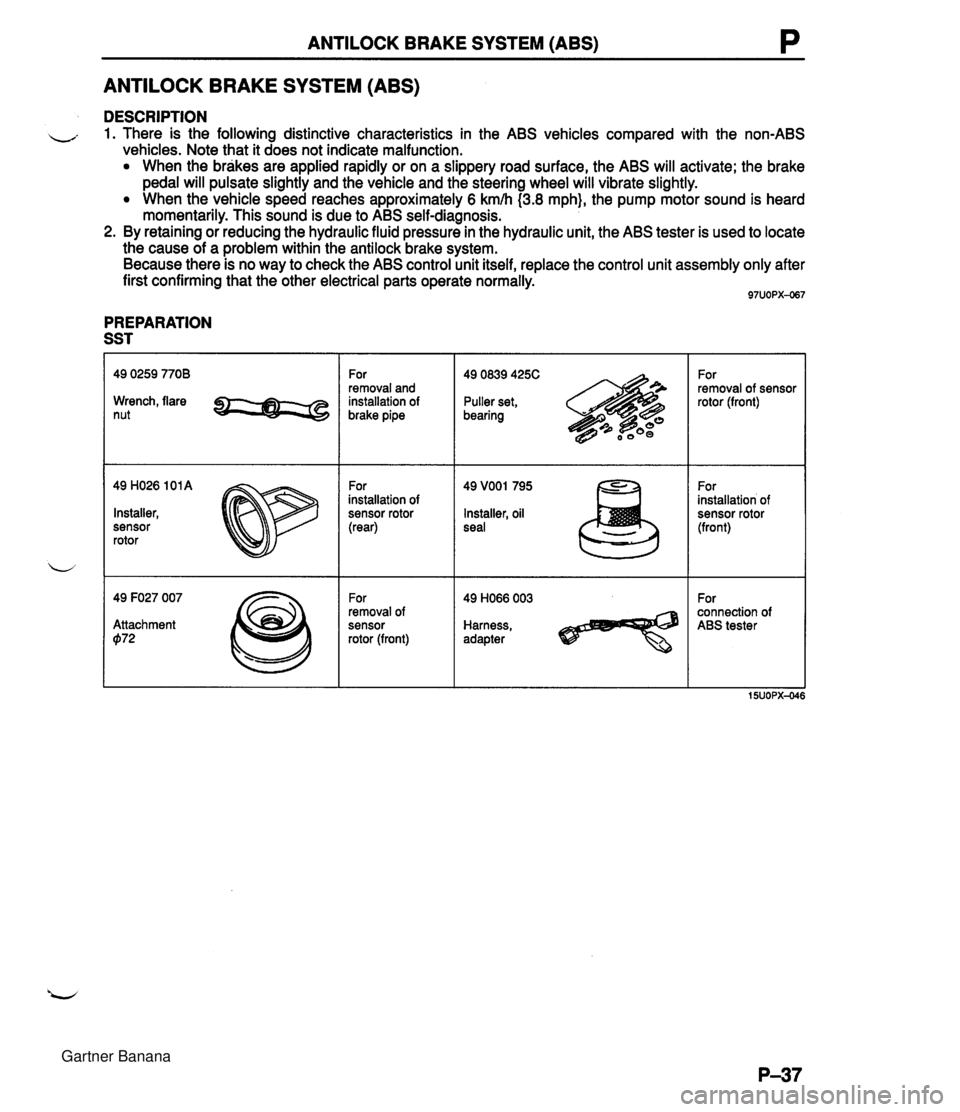
ANTILOCK BRAKE SYSTEM (ABS) P ANTILOCK BRAKE SYSTEM (ABS) DESCRIPTION - 1. There is the following distinctive characteristics in the ABS vehicles compared with the non-ABS vehicles. Note that it does not indicate malfunction. When the brakes are applied rapidly or on a slippery road surface, the ABS will activate; the brake pedal will pulsate slightly and the vehicle and the steering wheel will vibrate slightly. When the vehicle speed reaches approximately 6 kmh (3.8 mph}, the pump motor sound is heard momentarily. This sound is due to ABS self-diagnosis. 2. By retaining or reducing the hydraulic fluid pressure in the hydraulic unit, the ABS tester is used to locate the cause of a problem within the antilock brake system. Because there is no way to check the ABS control unit itself, replace the control unit assembly only after first confirming that the other electrical parts operate normally. PREPARATION SST Wrench, flare nut 49 H026 101 A Installer, sensor rotor 49 F027 007 Attachment 072 For removal and installation of brake pipe For installation of sensor rotor (rear) For removal of sensor rotor (front) 49 0839 425C Puller set, bearing Installer, oil seal Harness, adapter For removal of sensor rotor (front) For installation of sensor rotor (front) For connection of ABS tester Gartner Banana
Page 730 of 1708
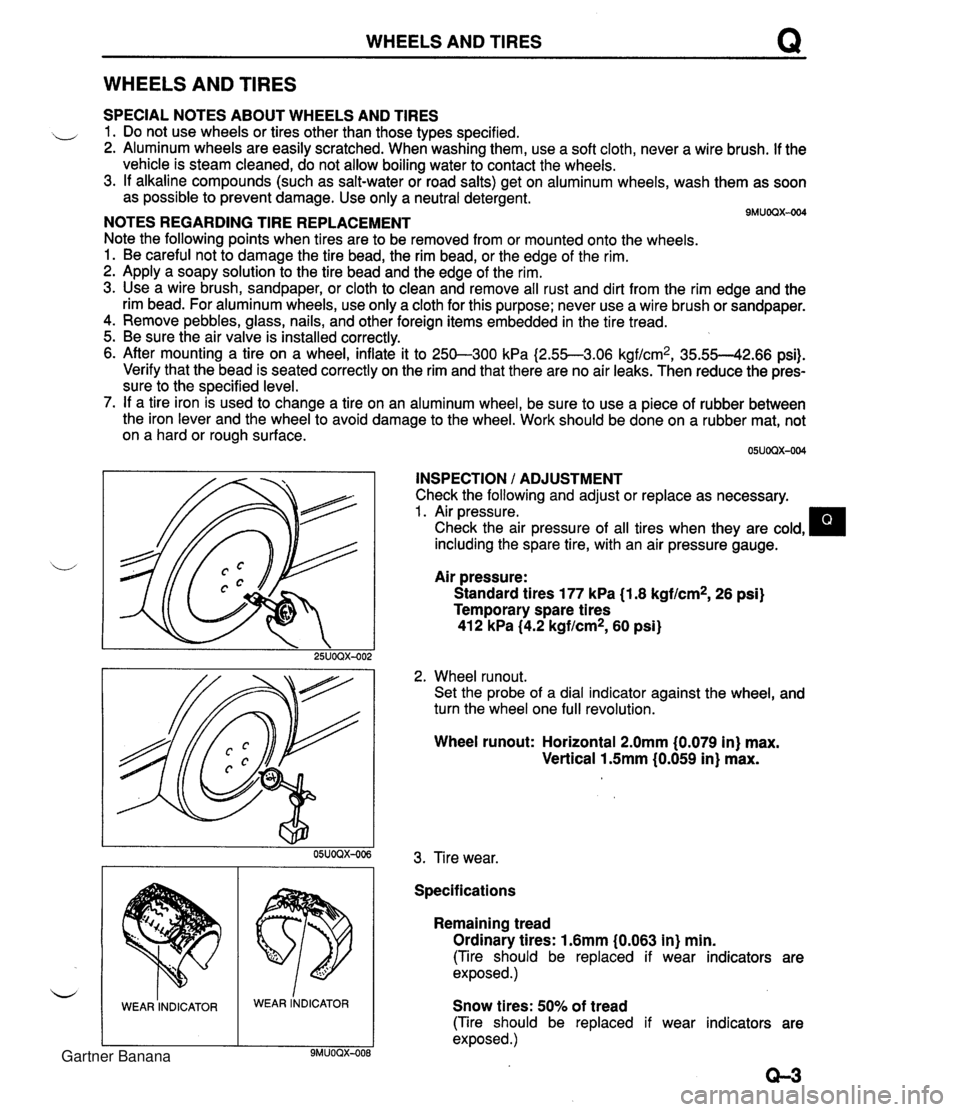
WHEELS AND TIRES Q WHEELS AND TIRES SPECIAL NOTES ABOUT WHEELS AND TIRES ,, 1. Do not use wheels or tires other than those types specified. 2. Aluminum wheels are easily scratched. When washing them, use a soft cloth, never a wire brush. If the vehicle is steam cleaned, do not allow boiling water to contact the wheels. 3. If alkaline compounds (such as salt-water or road salts) get on aluminum wheels, wash them as soon as possible to prevent damage. Use only a neutral detergent. - - 9MUOQX-004 NOTES REGARDING TIRE REPLACEMENT Note the following points when tires are to be removed from or mounted onto the wheels. 1. Be careful not to damage the tire bead, the rim bead, or the edge of the rim. 2. Apply a soapy solution to the tire bead and the edge of the rim. 3. Use a wire brush, sandpaper, or cloth to clean and remove all rust and dirt from the rim edge and the rim bead. For aluminum wheels, use only a cloth for this purpose; never use a wire brush or sandpaper. 4. Remove pebbles, glass, nails, and other foreign items embedded in the tire tread. 5. Be sure the air valve is installed correctly. 6. After mounting a tire on a wheel, inflate it to 250-300 kPa I2.55--3.06 kgf/cm2, 35.55--42.66 psi). Verify that the bead is seated correctly on the rim and that there are no air leaks. Then reduce the pres- sure to the specified level. 7. If a tire iron is used to change a tire on an aluminum wheel, be sure to use a piece of rubber between the iron lever and the wheel to avoid damage to the wheel. Work should be done on a rubber mat, not on a hard or rough surface. INSPECTION / ADJUSTMENT Check the following and adjust or replace as necessary. 1. Air pressure. Check the air pressure of all tires when they are cold, including the spare tire, with an air pressure gauge. u Air pressure: Standard tires 177 kPa (1.8 kgf/cm2, 26 psi) Temporary spare tires 412 kPa (4.2 kgf/cm2, 60 psi) 2. Wheel runout. Set the probe of a dial indicator against the wheel, and turn the wheel one full revolution. WEAR INDICATOR Wheel runout: Horizontal 2.0mm (0.079 in) max. Vertical 1.5mm (0.059 in) max. WEAR lNDICAToR 3. Tire wear. Specifications Remaining tread Ordinary tires: 1.6mm (0.063 in) min. (Tire should be replaced if wear indicators are exposed.) Snow tires: 50% of tread (Tire should be replaced if wear indicators are exposed .) Gartner Banana
Page 731 of 1708
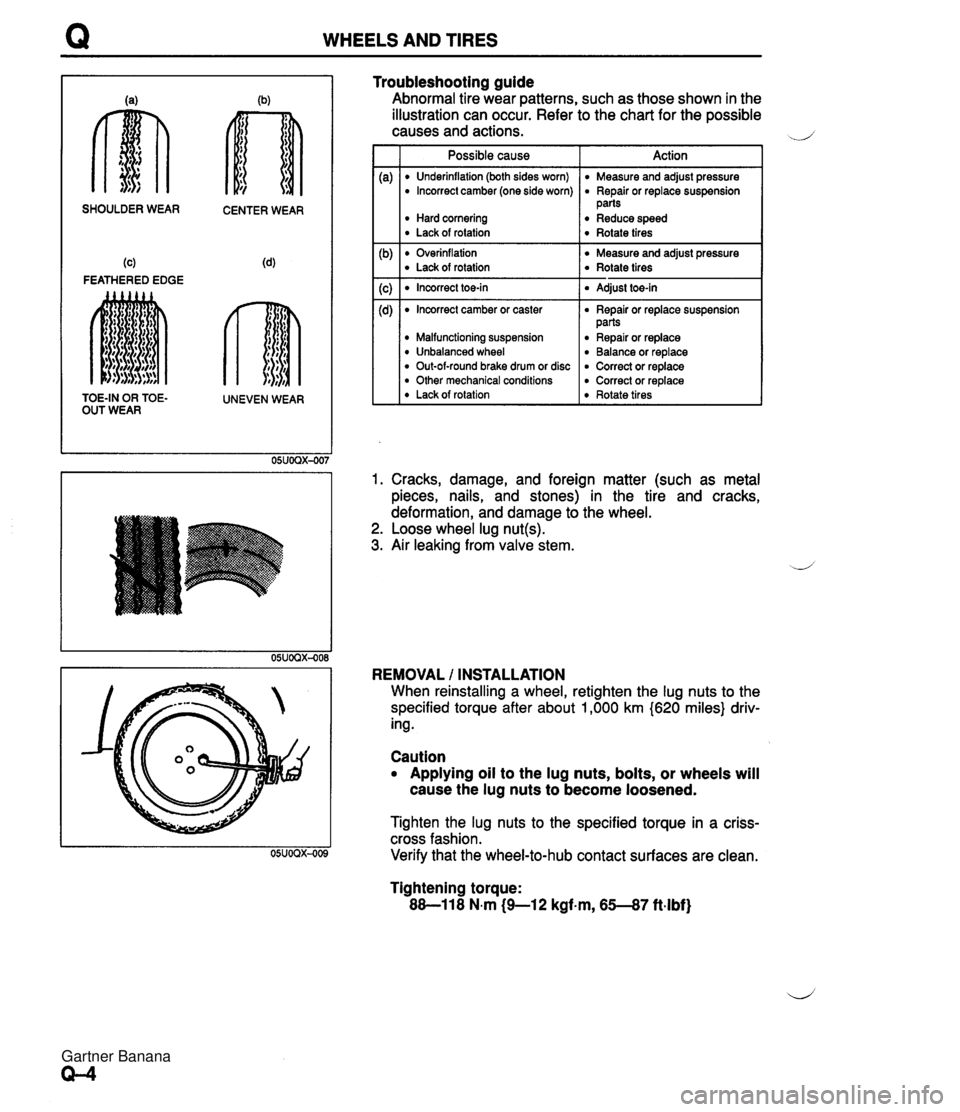
WHEELS AND TIRES SHOULDER WEAR CENTER WEAR (c) (4 FEATHERED EDGE TOE-IN OR TOE- UNEVEN WEAR OUT WEAR Troubleshooting guide Abnormal tire wear patterns, such as those shown in the illustration can occur. Refer to the chart for the possible causes and actions. d' Possible cause I Action I I Underinflation (both sides worn) I Measure and adjust pressure Overinflation Measure and adjust pressure Lack of rotation Rotate tires I Incorrect camber (one side worn) Hard cornering Lack of rotation Incorrect toe-in I Adjust toe-in I Repair or replace suspension parts Reduce speed Rotate tires 1. Cracks, damage, and foreign matter (such as metal pieces, nails, and stones) in the tire and cracks, deformation, and damage to the wheel. 2. Loose wheel lug nut(s). 3. Air leaking from valve stem. Incorrect camber or caster Malfunctioning suspension Unbalanced wheel Out-of-round brake drum or disc Other mechanical conditions Lack of rotation REMOVAL / INSTALLATION When reinstalling a wheel, retighten the lug nuts to the specified torque after about 1,000 km (620 miles} driv- ing. Repair or replace suspension parts Repair or replace Balance or replace Correct or replace Correct or replace Rotate tires Caution Applying oil to the lug nuts, bolts, or wheels will cause the lug nuts to become loosened. Tighten the lug nuts to the specified torque in a criss- cross fashion. Verify that the wheel-to-hub contact surfaces are clean. Tightening torque: 88-11 8 N.m (9-1 2 kgf.m, 65--87 ft-lbf) Gartner Banana
Page 736 of 1708

OUTLINE OUTLINE SPECIFICATIONS Front Suspension - Transmission item (Stabilizer Specifications MT I AT - I Susoension tvoe I . , . , I . , Shock absorber Cylindrical double acting, low-pressure-gas charged I Double-wishbone TY pe Torsion bar Coil spring I - Diameter mm linl I 20.0 10.79) Identification mark color 19.0 (0.75) White Wire diameter mm (in) Coil inner diameter mm {in) I Blue Free length mm {in) Coil number 11 .O (0.43) 83 i3.27) 11 .O (0.43) 83 (3.27) 292.5 (1 1 32) 6.32 3 +. 3 (0.12 + 0.12) 0°18' + 18' Total toe-in I - I 35UORX-001 Rear Suspension 302.0 (1 1.89) 6.32 mm {in) degree Total toe-in (per side) 1 degree Front wheel alignment (Unladedt1) 0°09' +. 09' Caster anglee3 4"26' +. 45' Kingpin angle 11 "20' Maximum steering angle Transmission Specifications MT I AT Item Differential - Suspension type Inner Outer "TORSEN" LSD 1 Standard Double-wishbone Coil springs 370 23' a 2" 32" 32' -t 2" Camber anglee2 Torsion bar 12.0 (0.47) 1 11.0 (0.43) 1 11 .O (0.43) Cylindrical double acting, low-pressure-gas charged - Stabilizer Identification mark color Wire diameter mm {in) 0°24' + 45' Type Diameter mm {in) I Coil number I 7.68 I 7.96 I Shock absorber Yellow 10.1 {0.40} Coil inner diameter mm {in) Free length mm {in) Green 10.2 {0.40) 35UORX-002 *I Fuel tank full; radiator coolant and engine oil at specified levels; spare tire, jack, and tools in designated positions. '2 Difference between left and right must not exceed I O. '3 Difference between left and right must not exceed 1'30'. "TORSEN" is a registered trademark of ZEXEL-GLEASON USA.INC 83 I3.27) 348.5 j13.72) Rear wheel alignment (Unladed*') 83 (3.27) 356.5 (1 4.04) Total toe-in Total toe-in (per side) mm (in) degree degree 3 -c 3 (0.12 + 0.121 0°18' + 18' 0°09' + 09' Camber angle*2 -0°43' 2 30' Gartner Banana
Page 737 of 1708

TROUBLESHOOTING GUIDE TROUBLESHOOTING GUIDE Problem General instabllity Body "rolls" "Heavy" steering wheel operation Steering wheel pulls to one side Excessive steering wheel play Body leans Abnormal noise from suspension system Shake (Steering wheel tibrates upldown) Shimmy (Steering wheel vibrates leftlright) Possible cause Weak coil spring Malfunction of shock absorber Worn or damaged stabilizer and/or suspension arm bushings Worn or damaged upper or lower arm ball joint Improperly adjusted wheel alignment Weak stabilizer Worn or damaged stabilizer and/or suspension arm bushings Insufficiently lubricated or stuck upper arm lower arm ball joint lmproperly adjusted wheel alignment Weak coil spring Worn or damaged stabilizer and/or suspension arm bushings Deformed upper or lower arm or knuckle Loose upper or lower arm bushing Worn or damaged upper or lower arm bushing Worn or damaged upper or lower arm ball joint Weak coil spring Weak stabilizer andlor suspension arm bushings Loose mounting component Poorly lubricated or worn upper or lower arm ball joint Malfunction of shock absorber Worn or damaged stabilizer and/or suspension arm bushings Excessive tire or wheel runout Loose lug nuts Unbalanced wheel@) Cracked or worn engine mounting rubber Cracked or worn steering gear mounting rubber Loose steering gear mounting bolts Stuck or damaged steering ball joint Excessive tire or wheel runout Loose lug nuts Unbalanced wheel(s) Insufficient tire pressure Unevenly worn tires Malfunction of shock absorber Loose shock absorber mounting bolts Stuck or damaged upper or lower arm ball joint Cracked or worn suspension bushings Damaged or worn front wheel bearing lmproperly adjusted front wheel alignment Action Replace Replace Replace Replace Adjust Replace Replace Replace Adjust Replace Replace Replace Replace Replace Replace Replace Replace Tighten Replace Replace Replace Replace Tighten Adjust or replace Replace Replace Tighten Replace Replace Tighten Adjust or replace Adjust Replace Replace Tighten Replace Replace Replace Adjust Page R-13 R-12,22 R-16, 18, 19, 23,24,25 section M R-15,17 R- 6 R-19,25 R-16, 18,19, 23, 24,25 section M R-15,17 R- 6 R-13 R-16, 18,19, 23, 24,25 R-15,17 section M R-16,18 R-16,18 R-15,17 R-13 R-16, 18, 19, 23,24,25 section M 7 R-15,17 R-l2,22 R-16, 18,19, 23,24,25 section M - section Q section Q section B section N section N section N - section Q section Q section Q section Q R-l2,22 R-12,22 R-15, 17 R-16,18,19 section M R- 6 15UORX-00 Gartner Banana
Page 738 of 1708
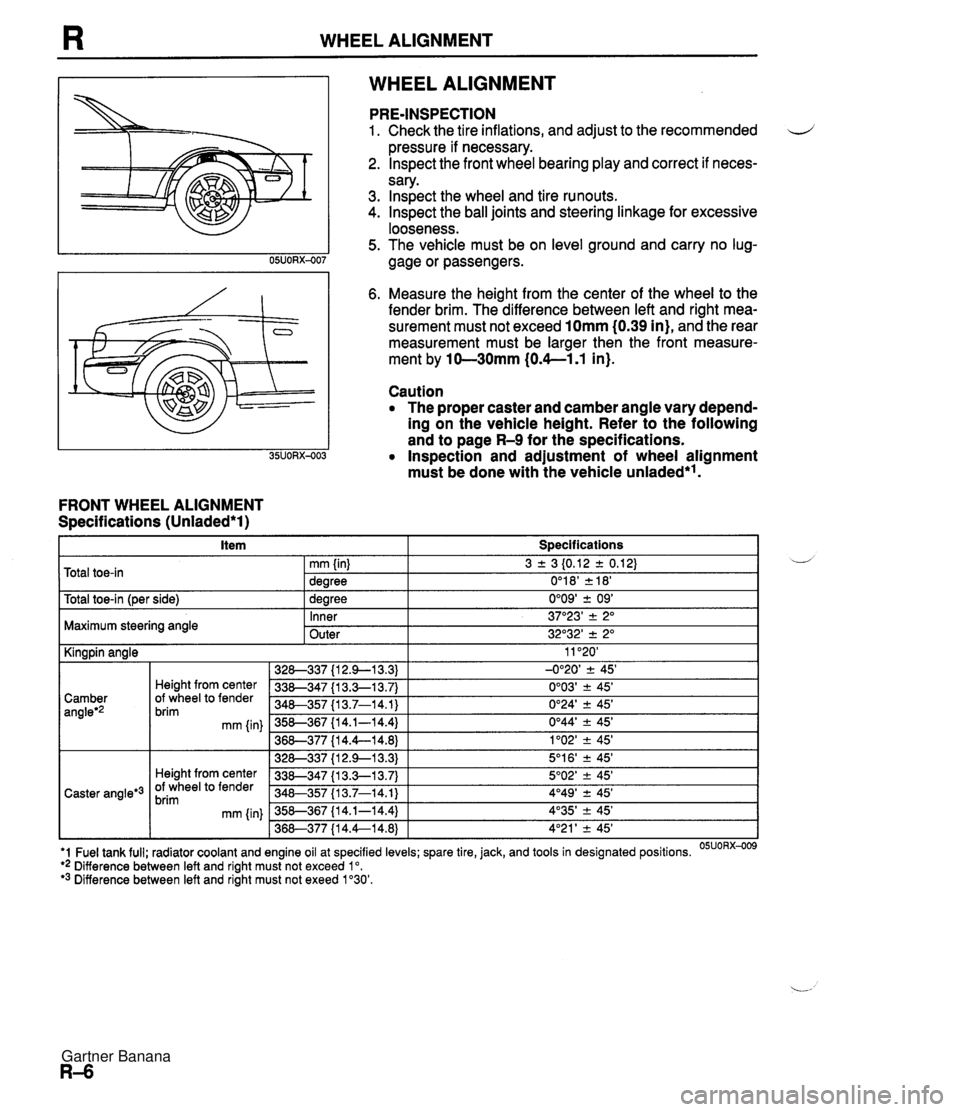
WHEEL ALIGNMENT WHEEL ALIGNMENT FRONT WHEEL ALIGNMENT Specifications (Unladed*l) PRE-INSPECTION 1. Check the tire inflations, and adjust to the recommended d pressure if necessary. 2. lnspect the front wheel bearing play and correct if neces- sary. 3. lnspect the wheel and tire runouts. 4. Inspect the ball joints and steering linkage for excessive looseness. 5. The vehicle must be on level ground and carry no lug- gage or passengers. 6. Measure the height from the center of the wheel to the fender brim. The difference between left and right mea- surement must not exceed 10mm (0.39 in), and the rear measurement must be larger then the front measure- ment by 10-30mm (0.4--1.1 in). Caution The proper caster and camber angle vary depend- ing on the vehicle height. Refer to the following and to page R-9 for the specifications. Inspection and adjustment of wheel alignment must be done with the vehicle unladed*'. . . I Y -- t~otal toe-in l~er side) I 1 dearee 0'09' + 09' I Total toe-in 3 2 3 I0.12 2 0.12) 0'1 8' 2 18' mm (in) dearee Maximum steering angle U - Inner Outer 11 '20' -0°20' 2 45' 0'03' ? 45' 0'24' 2 45' 0°44' -+ 45' 1'02' -+ 45' 5'1 6' ? 45' 5O02' -+ 45' 4O49' 2 45' 4'35' -+ 45' 4'21 ' -+ 45' I Kingpin angle 37"23' -+ 2" 32O32' 2 2" '1 Fuel tank full; radiator coolant and engine oil at specified levels; spare tire, jack, and tools in designated positions. OSUORX-009 ** Difference between left and right must not exceed lo. '3 Difference between left and right must not exeed 1'30'. 328-337 {I 2.9-1 3.3) 338-347 {I 3.3-1 3.7) 340-357 I13.7-14.1) 358-367 {I 4.1-14.4) 36&377 {I 4.4--14.8) 328-337 {I 2.9--13.3) 338-347 {I 3.3-1 3.7) 348-357 113.7-14.1) 358-367 {I 4.1-14.4) 368-377 {I 4.4--14.8) Camber angleg2 Caster angle*3 Height from center Of wheel to fender brim mm {in) Height from center Of wheel to fender brim mm (in) Gartner Banana