belt MAZDA MX5 MIATA 2017 Owner's Manual
[x] Cancel search | Manufacturer: MAZDA, Model Year: 2017, Model line: MX5 MIATA, Model: MAZDA MX5 MIATA 2017Pages: 568, PDF Size: 16.58 MB
Page 36 of 568
2 –22 Essential Safety Equipment
Child Restraint Passenger's Seat Child-Restraint
System Installation (With Passenger
Occupant Classification System)
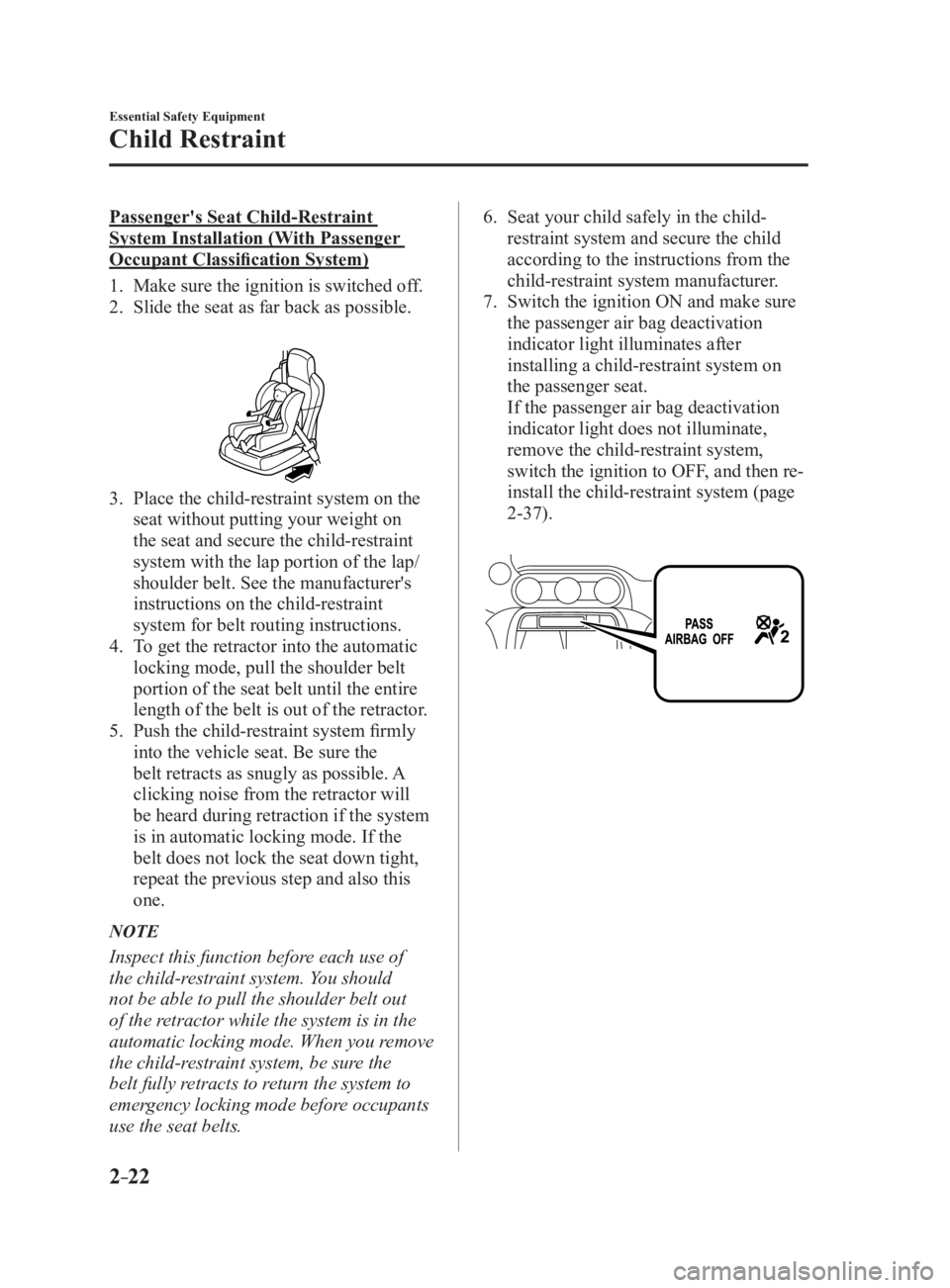
1. Make sure the ignition is switched off.
2. Slide the seat as far back as possible.
3. Place the child-restraint system on the
seat without putting your weight on
the seat and secure the child-restraint
system with the lap portion of the lap/
shoulder belt. See the manufacturer's
instructions on the child-restraint
system for belt routing instructions.
4. To get the retractor into the automatic
locking mode, pull the shoulder belt
portion of the seat belt until the entire
length of the belt is out of the retractor.
5. Push the child-restraint system firmly
into the vehicle seat. Be sure the
belt retracts as snugly as possible. A
clicking noise from the retractor will
be heard during retraction if the system
is in automatic locking mode. If the
belt does not lock the seat down tight,
repeat the previous step and also this
one.
NOTE
Inspect this function before each use of
the child-restraint system. You should
not be able to pull the shoulder belt out
of the retractor while the system is in the
automatic locking mode. When you remove
the child-restraint system, be sure the
belt fully retracts to return the system to
emergency locking mode before occupants
use the seat belts. 6. Seat your child safely in the child-
restraint system and secure the child
according to the instructions from the
child-restraint system manufacturer.
7. Switch the ignition ON and make sure
the passenger air bag deactivation
indicator light illuminates after
installing a child-restraint system on
the passenger seat.
If the passenger air bag deactivation
indicator light does not illuminate,
remove the child-restraint system,
switch the ignition to OFF, and then re-
install the child-restraint system (page
2-37 ).
MX-5_8FR4-EA-16J_Edition1.indb 22 2016/08/11 20:28:24
Page 37 of 568

2 –23 Essential Safety Equipment
Child Restraint
WARNING Do not seat a child in a child-restraint
system on the passenger seat if the
passenger air bag deactivation
indicator light does not illuminate (With
Passenger Occupant Classification
System):
Seating a child in a child-restraint
system installed on the passenger
seat with the passenger air bag
deactivation indicator light not
illuminated is dangerous. If this
indicator light does not illuminate,
this means that the passenger front
and side air bags, and seat belt
pretensioner are ready for deployment.
If an accident were to deploy an air
bag, a child in a child-restraint system
sitting in the passenger seat could
be seriously injured or killed. If the
indicator light does not illuminate
after seating a child in a child-restraint
system on the passenger seat consult
an Authorized Mazda Dealer as soon
as possible.
MX-5_8FR4-EA-16J_Edition1.indb 23 2016/08/11 20:28:24
Page 38 of 568

2 –24 Essential Safety Equipment
SRS Air Bags
Supplemental Restraint System (SRS) Precautions The front and side supplemental restraint systems (SRS) include different types of air bags.
Please verify which kinds of air bags are equipped on your vehicle by locating the
“SRS AIRBAG” location indicators. These indicators are visible in the area where the air
bags are installed.
The air bags are installed in the following locations:
The steering wheel hub (driver air bag)
The passenger dashboard (passenger air bag)
The outboard sides of the seatbacks (side air bags)
The air bag supplemental restraint systems are designed to provide supplemental protection
in certain situations so seat belts are always important in the following ways:
Without seat belt usage, the air bags cannot provide adequate protection during an accident.
Seat belt usage is necessary to:
Keep the occupant from being thrown into an inflating air bag.
Reduce the possibility of injuries during an accident that is n ot designed for air bag
inflation, such as roll-over or rear impact.
Reduce the possibility of injuries in frontal, near frontal or side collisions that are not
severe enough to activate the air bags.
Reduce the possibility of being thrown from your vehicle.
Reduce the possibility of injuries to lower body and legs durin g an accident because the
air bags provide no protection to these parts of the body.
Hold the driver in a position which allows better control of the vehicle.
If your vehicle is also equipped with a passenger occupant classification system, refer
to the Passenger Occupant Classification System (page 2-37 ) for details.
If your vehicle is equipped with a passenger occupant classifica tion system, the passenger
air bag deactivation indicator light illuminates for a specified time after the ignition is
switched ON.
MX-5_8FR4-EA-16J_Edition1.indb 24 2016/08/11 20:28:24
Page 39 of 568

2 –25 Essential Safety Equipment
SRS Air BagsSmall children must be protected by a child-restraint system as stipulated by law in every
state and province. In certain states and provinces, larger children must use a child-restraint
system (page 2-15 ).
Carefully consider which child-restraint system is necessary for your child and follow
the installation directions in this Owner's Manual as well as the child-restraint system
manufacturer's instructions.
Do not use a child-restraint system which employs an upper tether because there is no
appropriate means to anchor the tether.
WARNING Seat belts must be worn in air bag equipped vehicles:
Depending only on the air bags for protection during an accident is dangerous. Alone, air
bags may not prevent serious injuries. The appropriate air bags can be expected to inflate
only in the first accident, such as frontal, near frontal or side collisions that are at least
moderate. Vehicle occupants should always wear seat belts.
Always make sure the passenger air bag deactivation indicator light is illuminated
when using a child-restraint system (With Passenger Occupant Classification System):
Seating a child in a child-restraint system that is installed on the passenger seat with the
passenger air bag deactivation indicator light not illuminated is extremely dangerous. In
an accident, an air bag could inflate and cause serious injuries or even death to the child
seated in the child-restraint system. Always make sure the passenger air bag deactivation
indicator light is illuminated.
Refer to Occupant Classification System on page 2-37 .
Do not sit too close to the driver and passenger air bags:
Sitting too close to the driver and passenger air bag modules or placing hands or feet on
them is extremely dangerous. The driver and passenger air bags inflate with great force
and speed. Serious injuries could occur if someone is too close. The driver should always
hold onto only the rim of the steering wheel. The passenger should keep both feet on
the floor. Seat occupants should adjust their seats as far back as possible and always sit
upright against the seatbacks with seat belts worn properly.
Do not sit too close to a door or lean against doors in vehicles with side air bags:
Sitting too close to the side air bag modules or placing hands on them is extremely
dangerous. A side air bag inflates with great force and speed directly out of the outboard
shoulder of the seat and expands along the door on the side the car is hit. Serious injury
could occur if someone is sitting too close to the door or leaning against a window in the
seats. Furthermore, sleeping up against the door or hanging out the driver-side window
while driving could block the side air bag and eliminate the advantages of supplemental
protection. Give the side air bags room to work by sitting in the center of the seat while
the vehicle is moving with seat belts worn properly.
MX-5_8FR4-EA-16J_Edition1.indb 25 2016/08/11 20:28:24
Page 40 of 568

2 –26 Essential Safety Equipment
SRS Air Bags Sit in the center of the seat and wear seat belts properly:
Sitting too close to the side air bag modules or placing hands on them, or sleeping up
against the door or hanging out the windows is extremely dangerous. The side air bags
inflate with great force and speed directly expanding along the door on the side the car is
hit. Serious injury could occur if someone is sitting too close to the door. Give the side air
bags room to work by sitting in the center of the seat while the vehicle is moving with seat
belts worn properly.
Do not attach objects on or around the area where driver and passenger air bags
deploy:
Attaching an object to the driver and passenger air bag modules or placing something in
front of them is dangerous. In an accident, an object could interfere with air bag inflation
and injure the occupants.
Do not attach objects on or around the area where a side air bag deploys:
Attaching objects to the seat in such a way as to cover the outboard side of the seat in any
way is dangerous. In an accident the object could interfere with the side air bag, which
inflates from the outboard side of the seats, impeding the added protection of the side air
bag system or redirecting the air bag in a way that is dangerous. Furthermore, the bag
could be cut open releasing the gas.
Do not hang net bags, map pouches or backpacks with side straps on the seats. Never use
seat covers on the seats. Always keep the side air bag modules in your seats free to deploy
in the event of a side collision.
Do not touch the components of the supplemental restraint system after the air bags
have inflated:
Touching the components of the supplemental restraint system after the air bags have
inflated is dangerous. Immediately after inflation, they are very hot. You could get burned.
Never install any front-end equipment to your vehicle:
Installation of front-end equipment, such as frontal protection bar (kangaroo bar, bull
bar, push bar, or other similar devices), snowplow, or winches, is dangerous. The air bag
crash sensor system could be affected. This could cause air bags to inflate unexpectedly,
or it could prevent the air bags from inflating during an accident. Occupants could be
seriously injured.
Do not modify the suspension:
Modifying the vehicle suspension is dangerous. If the vehicle's height or the suspension is
modified, the vehicle will be unable to accurately detect a collision resulting in incorrect
or unexpected air bag deployment and the possibility of serious injuries.
MX-5_8FR4-EA-16J_Edition1.indb 26 2016/08/11 20:28:25
Page 41 of 568

2 –27 Essential Safety Equipment
SRS Air BagsDo not modify a door or leave any damage unrepaired. Always have an Authorized
Mazda Dealer inspect a damaged door:
Modifying a door or leaving any damage unrepaired is dangerous. Each door has a side
crash sensor as a component of the supplemental restraint system. If holes are drilled in
a door, a door speaker is left removed, or a damaged door is left unrepaired, the sensor
could be adversely affected causing it to not detect the pressure of an impact correctly
during a side collision. If a sensor does not detect a side impact correctly, the side air bags
and the seat belt pretensioner may not operate normally which could result in serious
injury to occupants.
Do not modify the supplemental restraint system:
Modifying the components or wiring of the supplemental restraint system is dangerous.
You could accidentally activate it or make it inoperable. Do not make any modifications
to the supplemental restraint system. This includes installing trim, badges, or anything
else over the air bag modules. It also includes installing extra electrical equipment on or
near system components or wiring. An Authorized Mazda Dealer can provide the special
care needed in the removal and installation of seats. It is important to protect the air bag
wiring and connections to assure that the bags do not accidentally deploy, and that the
passenger occupant classification system and the seats retain an undamaged air bag
connection.
Do not place luggage or other objects under the seats:
Placing luggage or other objects under the seats is dangerous. The components essential
to the supplemental restraint system could be damaged, and in the event of a side
collision, the appropriate air bags may not deploy, which could result in death or serious
injury. To prevent damage to the components essential to the supplemental restraint
system, do not place luggage or other objects under the seats.
Do not operate a vehicle with damaged air bag/seat belt pretensioner system
components:
Expended or damaged air bag/seat belt pretensioner system components must be
replaced after any collision which caused them to deploy or damage them. Only a trained
Authorized Mazda Dealer can fully evaluate these systems to see that they will work in
any subsequent accident. Driving with an expended or damaged air bag or pretensioner
unit will not afford you the necessary protection in the event of any subsequent accident
which could result in serious injury or death.
Do not remove interior air bag parts:
Removing any components such as the seats, front dashboard, the steering wheel,
containing air bag parts or sensors is dangerous. These parts contain essential air bag
components. The air bag could accidentally activate and cause serious injuries. Always
have an Authorized Mazda Dealer remove these parts.
MX-5_8FR4-EA-16J_Edition1.indb 27 2016/08/11 20:28:25
Page 44 of 568

2 –30 Essential Safety Equipment
SRS Air Bags
*Some models.(Without Passenger Occupant Classification System)
Driver/Passenger inflators and air bags
Crash sensors, and diagnostic module (SAS unit)
Seat belt pretensioners (page 2-12 )
Front air bag sensors
Side crash sensors
Air bag/seat belt pretensioner system warning light (page 4-18 )
Side inflators and air bags
Passenger air bag deactivation indicator light *
(page 2-37 )
Passenger occupant classification sensor *
(page 2-37 )
Passenger occupant classification module *
MX-5_8FR4-EA-16J_Edition1.indb 30 2016/08/11 20:28:25
Page 45 of 568

2 –31 Essential Safety Equipment
SRS Air Bags
How the SRS Air Bags WorkYour Mazda is equipped with the following types of SRS air bags. SRS air bags are
designed to work together with the seat belts to help to reduce injuries during an accident.
The SRS air bags are designed to provide further protection for passengers in addition to the
seat belt functions. Be sure to wear seat belts properly.
Seat Belt PretensionersThe seat belt pretensioners are designed to deploy in moderate or severe frontal, near frontal
collisions.
In addition, during a side collision, the pretensioner operates on the side in which the
collision occurs. The pretensioners operate differently depending on what types of air bags
are equipped. For more details about seat belt pretensioner ope ration, refer to the SRS Air
Bag Deployment Criteria (page 2-34 ).
Driver Air BagThe driver's air bag is mounted in the steering wheel.
When air bag crash sensors detect a frontal impact of greater than moderate force, the
driver's air bag inflates quickly helping to reduce injury mainl y to the driver's head or chest
caused by directly hitting the steering wheel.
For more details about air bag deployment, refer to "SRS Air Bag Deployment Criteria"
(page 2-34 ).
(With Passenger Occupant Classification System)
The driver's dual-stage air bag controls air bag inflation in tw o energy stages. During an
impact of moderate severity, the driver's air bag deploys with lesser energy, whereas during
more severe impacts, it deploys with more energy.
MX-5_8FR4-EA-16J_Edition1.indb 31 2016/08/11 20:28:25
Page 48 of 568

2 –34 Essential Safety Equipment
SRS Air Bags
SRS Air Bag Deployment CriteriaThis chart indicates the applicable SRS equipment that will dep loy depending on the type of
collision.
(The illustrations are the representative cases of collisions.) SRS
equipment Types of collision
A severe frontal/near frontal collision A severe side collision *2
A rear collision
Seat belt
pretensioner X *1
(both sides) X *1
(impact side only)
No air bag and seat belt
pretensioner will be
activated in a rear collision.Driver air
bag X
Passenger
air bag X *1
Side air bag X *1
(impact side only)
X : The SRS air bag equipment is designed to deploy in a collision.
*1 (Passenger Occupant Classification System)
The passenger front and side air bags and the seat belt pretensioner are designed to deploy when the passenger
occupant classification sensor detects a passenger sitting on th e passenger's seat.
*2 In a side collision, the seat belt pretensioners and the side air bags deploy (only on the side in which the
collision occurs).
NOTE
In a frontal offset collision, the equipped air bags and pretensioners may all deploy
depending on the direction, angle, and rate of impact.
MX-5_8FR4-EA-16J_Edition1.indb 34 2016/08/11 20:28:26
Page 51 of 568

2 –37 Essential Safety Equipment
SRS Air Bags
* Some models.Passenger Occupant Classification System *
First, please read "Supplemental Restraint System (SRS) Precaut ions" (page 2-24 )
carefully.
Passenger Occupant Classification SensorYour vehicle is equipped with a passenger occupant classification sensor as a part of the
supplemental restraint system. This sensor is equipped in the passenger's seat cushion. This
sensor measures the electrostatic capacity of the passenger's seat. The SAS unit is designed
to prevent the passenger front and side air bags and seat belt pretensioner system from
deploying if the passenger air bag deactivation indicator light turns on.
To reduce the chance of injuries caused by deployment of the passenger air bag, the system
deactivates the passenger front and side air bags and also the seat belt pretensioner system
when the passenger air bag deactivation indicator light turns o n. Refer to the following table
for the passenger air bag deactivation indicator light illumination conditions.
This system shuts off the passenger front and side air bags and seat belt pretensioner system,
so make sure the passenger air bag deactivation indicator light turns on according to the
following table.
The air bag/seat belt pretensioner system warning light flashes and the passenger air bag
deactivation indicator light illuminates if the sensors have a possible malfunction. If this
happens, the passenger front and side air bags and seat belt pretensioner system will not
deploy.
Passenger air bag deactivation indicator light
This indicator light turns on to remind you that the passenger front and side air bags and seat
belt pretensioner will not deploy during a collision.
MX-5_8FR4-EA-16J_Edition1.indb 37 2016/08/11 20:28:26