fuel consumption MAZDA PROTEGE 1992 Workshop Manual
[x] Cancel search | Manufacturer: MAZDA, Model Year: 1992, Model line: PROTEGE, Model: MAZDA PROTEGE 1992Pages: 1164, PDF Size: 81.9 MB
Page 33 of 1164
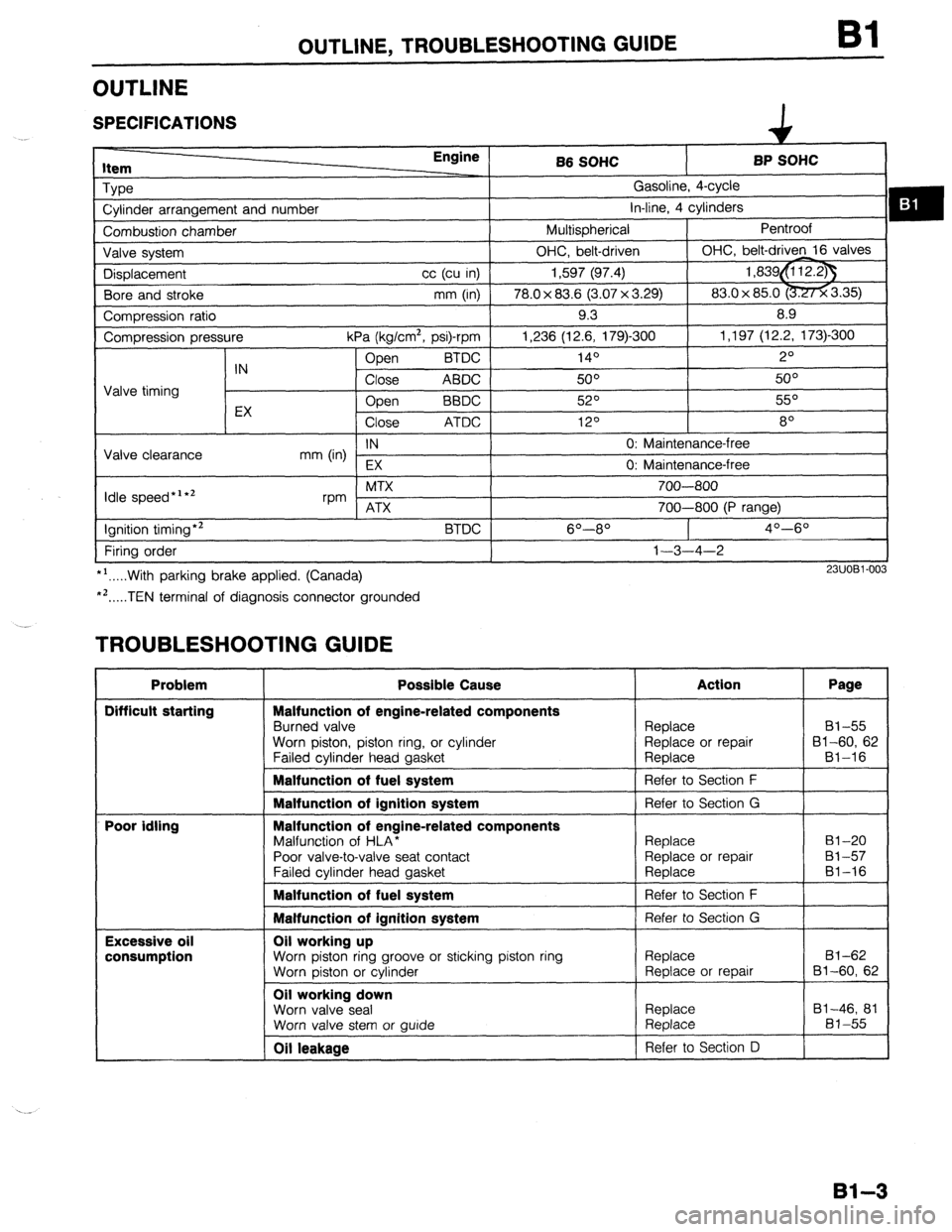
OUTLINE, TROUBLESHOOTING GUIDE Bl
OUTLINE
SPECIFICATIONS
item Engine
Type
Cylinder arrangement and number
Combustion chamber
Valve system
Displacement cc (cu in)
Bore and stroke mm (in)
Compression ratio
Compression pressure
kPa (kg/cm2, psi)-rpm
Open BTDC
IN
Close ABDC
Valve timing
EX Open
BBDC
Close ATDC
IN
Valve clearance
mm (in)
EX
Idle speed*‘*’ MTX
rpm ATX
Ignition timing*2
BTDC
Firing order
*‘.....With parking brake applied. (Canada)
*‘.....TEN terminal of diagnosis connector grounded B6 SOHC BP SOHC
Gasoline, 4-cycle
in-line, 4 cylinders
Multispherical Pentroof
OHC, belt-driven OHC, belt-driven 16 valves
1,597 (97.4) 1,839&i 12.23
78.0 x 83.6 (3.07 x 3.29) 83.0x 85.0 -3.35)
9.3 8.9
1,236 (12.6, 179)300 1,197 (12.2, 173)-300
140 2O
50° 5o”
52O 55O
120 8
0: Maintenance-free
0: Maintenance-free
700-800
700-800 (P range)
6O----8O 4O--6O
1-3-4-2
23UOBl-003
TROUBLESHOOTING GUIDE
Problem
Difficult starting
Poor idling
Excessive oil
consumption Possible Cause
Malfunction of engine-related components
Burned valve
Worn piston, piston ring, or cylinder
Failed cvlinder head aasket Action Page
Replace 81-55
Replace or repair 81-60, 62
Reolace Bl-16
Malfunction of fuel system
1 Refer to Section F
I
Malfunction of ignition system
Malfunction of engine-related components
Malfunction of HLA*
Poor valve-to-valve seat contact
Failed cvlinder head aasket Refer to Section G
Replace
Replace or repair
Reolace 81-20
81-57
81-16
Malfunction of fuel system 1 Refer to Section F
I
Malfunction of ignition system Refer to Section G
Oil working up
Worn piston ring groove or sticking piston ring
Worn piston or cylinder
Oil working down
Worn valve seal
Worn valve stem or wide Replace
Replace or repair
Replace
Replace 81-62
Bl-60, 62
81-46, 81
81-55
Oil leakage Refer to Section D
81-3
Page 135 of 1164

OUTLINE, TROUBLESHOOTING GUIDE
OUTLINE
SPECIFICATIONS
ItC- Engine
BP DOHC
Type Gasoline, 4-cycle
Cylinder arrangement and number In-line, 4 cylinders
Combustion chamber Pentroof
Valve svstem DOHC, belt-driven 16 valves
Displacement
Bore and stroke cc (cu in) 1,839 (112.2)
mm (in) I 83.0 x 85.0 (3.27 x 3.35)
Compression ratio
Compression pressure
IN
Valve timing
EX kPa (kg/cm*, psi)-rpm
BTDC Open
Close ABDC
Open BBDC
Close ATDC 9.0
1,256 (12.8, 182)300
!zJ”
48O
56O
140
Valve clearance IN 0: Maintenance-free
mm (in)
EX 0: Marntenance-free
Idle speed *’ *’ MTX
rpm
ATX
Ignition timing*2
Firing order
::...With parking brake applied. (Canada)
. ..TEN terminal of diagnosis connector grounded BTDC 700-800
700-800 (P range)
90-l 1 O
l-3-4-2
P3UOBZ003
TROUBLESHOOTING GUIDE
Problem
Difficult starting
Poor idling
Excessive oil
consumption Possible Cause
Malfunction of engine-related components
Burned valve
Worn piston, piston ring, or cylinder
Failed cylinder head gasket
Malfunction of fuel system
Malfunction of ignition system
Malfunction of engine-related components
Malfunction of HLA*
Poor valve-to-valve seat contact
Failed cylinder head gasket
Malfunction of fuel system
Malfunction of ignition system
Oil working up
Worn piston ring groove or sticking piston ring
Worn oiston or cvlinder
Oil working down
Worn valve seal
Worn valve stem or auide
Oil leakaae i
Replace 82-55
Replace or repair 92-60, 62
Reolace B2-16
Refer to Section F
I
Replace 82-47, 79
Replace 82-55
Refer to Section 0 I
82-3
Page 293 of 1164
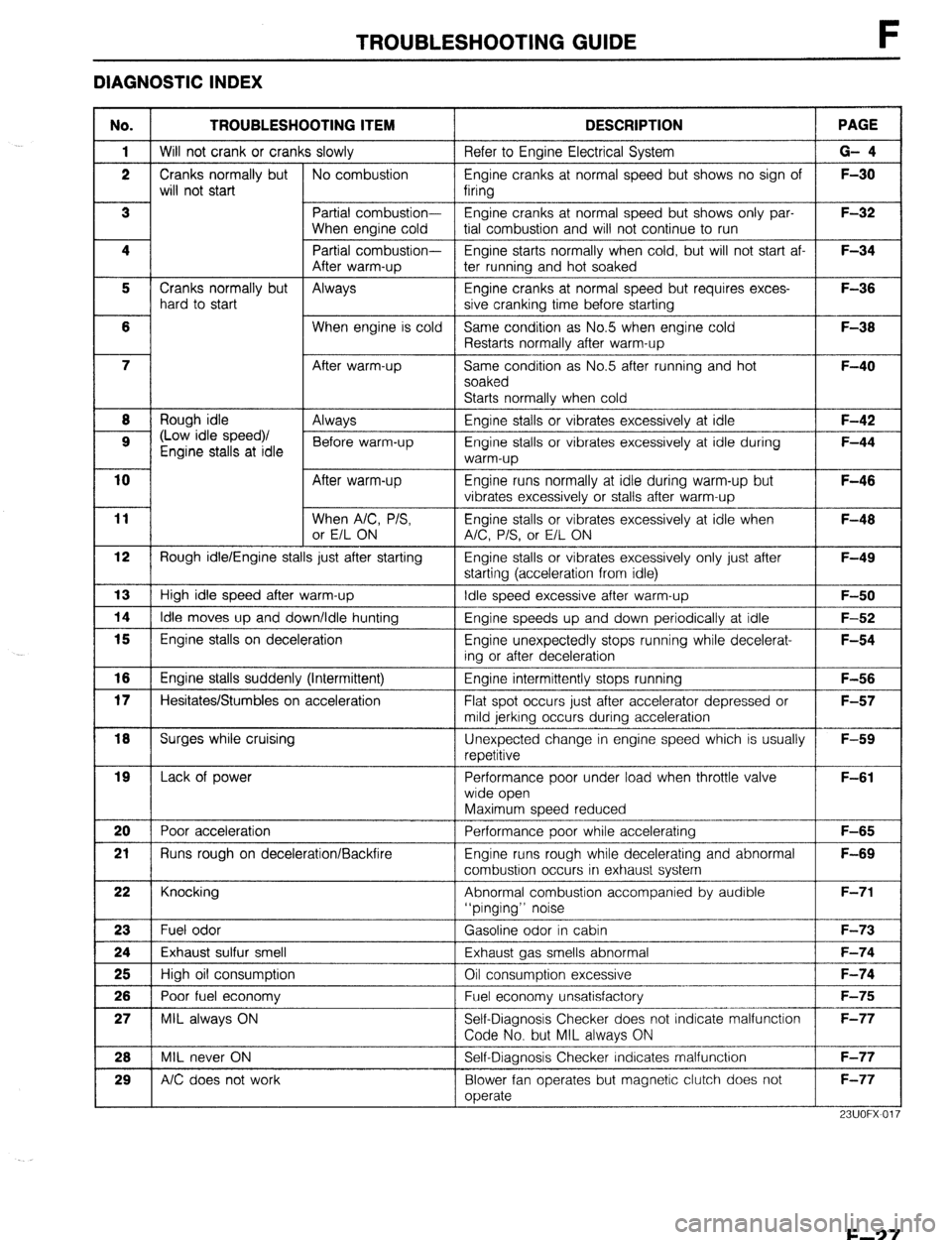
TROUBLESHOOTING GUIDE
DIAGNOSTIC INDEX
No. TROUBLESHOOTING ITEM DESCRIPTION
1 Will not crank or cranks slowly Refer to Engine Electrical System PAGE
G- 4
Engine cranks at normal speed but shows no sign of 1 F-30
Engine cranks at normal speed but shows only par-
I
tial combustion and will not continue to run
Engine starts normally when cold, but will not start af-
After warm-up
5 Cranks normally but
Always
hard to start Engine cranks at normal speed but requires exces-
sive cranking time before starting F-36
F-38
I----
F-40 Same condition as No.5 when engine cold
Restarts normally after warm-up
Same cond;ion as No.5 after running and hot
soaked
Starts normally when cold
8
H
Rough idle
9 (Low idle speed)/
Engine stalls at idle Enaine stalls or vibrates excessivelv at idle
Engine stalls or vibrates excessively at idle during
warm-up 1 F-42
F-44
Engine runs normally at idle during warm-up but
vibrates excessively or stalls after warm-up
Engine stalls or vibrates excessively at idle when
A/C, P/S, or E/L ON F-46
F-46
starting (acceleration from idle)
l---- Engine stalls or vibrates excessively only just after
Idle speed excessive after warm-up 1 F-50 F-49 12 Rough idle/Engine stalls just after starting
13 High idle speed after warm-up
1 14 1 Idle moves up and down/Idle hunting Engine speeds up and down periodically at idle
1 F-52
I l5 I Engine stalls on deceleration
Engine unexpectedly stops running while decelerat-
ing or after deceleration F-54
Engine intermittently stops running
Flat spot occurs just after accelerator depressed or
mild jerkrng occurs during acceleration
Unexpected change in engine speed which is usually
repetitive F-56
F-57
F-59 16 Engine stalls suddenly (Intermittent)
17 Hesitates/Stumbles on acceleration
1 18 1 Surges while cruising
19
I I
Lack of power Performance poor under load when throttle valve F-61
wide open
Maximum speed reduced
Performance poor-while accelerating
-I- F-65 20 Poor acceleration
21 Runs rough on deceleration/Backfire Engine runs rough while decelerating and abnormal
combustion occurs in exhaust system F-69
Abnormal combustion accompanied by audible
“pinging” noise
Gasoline odor in cabin 22 Knocking
23 Fuel odor
24 Exhaust sulfur smell
26 High oil consumption Exhaust gas smells abnormal
Oil consumption excessive
Fuel economy unsatisfactory 1 26 1 Poor fuel economy 1 F-75
Self-Diagnosis Checker does not indicate malfunction
23UOFX~O’
F-27
Page 340 of 1164
![MAZDA PROTEGE 1992 Workshop Manual F TROUBLESHOOTING GUIDE
I 24 I EXHAUST SULFUR SMELL I
DESCRIP-
l Exhaust gas smells abnormally
TION
[TROUBLESHOOTING HINTS]
High sulfur content fuel used
STEP INSPECTION
1
Change fuel to anot](/img/28/57077/w960_57077-339.png "MAZDA PROTEGE 1992 Workshop Manual F TROUBLESHOOTING GUIDE
I 24 I EXHAUST SULFUR SMELL I
DESCRIP-
l Exhaust gas smells abnormally
TION
[TROUBLESHOOTING HINTS]
High sulfur content fuel used
STEP INSPECTION
1
Change fuel to anot")
F TROUBLESHOOTING GUIDE
I 24 I EXHAUST SULFUR SMELL I
DESCRIP-
l Exhaust gas smells abnormally
TION
[TROUBLESHOOTING HINTS]
High sulfur content fuel used
STEP INSPECTION
1
Change fuel to another brand ACTION
03UOFX-039
25 HIGH OIL CONSUMPTION
DESCRIP-
l Oil consumption excessive
TION
[TROUBLESHOOTING HINTS]
@ PCV system malfunction
@ Engine malfunction (Oil working up, working down, or leakage)
iTEP
INSPECTION
1 Check if PCV hose, ventilation hose or their at- Yes Repair or replace
taching nipples are separated, damaged,
clogged, or restricted
w page F-138 No Go to next step
2 Check if air pressure or oil is present at ventila- Yes Go to next step
tion hose ACTION
No Check engine condition w page 81-3
82-3
l Oil leakage
*Worn valve seal
*Worn valve stem
*Worn valve guide
3 Check if vacuum is felt at PCV valve at idle Yes Check engine condition w page 91-3
w page F-138 82-3
*Worn piston ring groove
*Stuck piston rings l
Worn piston or cylinder
No Replace PCV valve
23UOFX-040 /-.
F-74
Page 341 of 1164
![MAZDA PROTEGE 1992 Workshop Manual TROUBLESHOOTING GUIDE F
26 POOR FUEL ECONOMY
DESCRIP-
l Fuel economy unsatisfactory TION
[TROUBLESHOOTING HINTS]
While fuel consumption is drastically increased by city driving, short-run operati](/img/28/57077/w960_57077-340.png "MAZDA PROTEGE 1992 Workshop Manual TROUBLESHOOTING GUIDE F
26 POOR FUEL ECONOMY
DESCRIP-
l Fuel economy unsatisfactory TION
[TROUBLESHOOTING HINTS]
While fuel consumption is drastically increased by city driving, short-run operati")
TROUBLESHOOTING GUIDE F
26 POOR FUEL ECONOMY
DESCRIP-
l Fuel economy unsatisfactory TION
[TROUBLESHOOTING HINTS]
While fuel consumption is drastically increased by city driving, short-run operation, stop and go driving, extended winter
warm-up periods, etc., as opposed to “trip” mileage, an attempt should be made to determine these factors when con-
fronted with “poor mileage” conditions. However, since the operator is not always at fault, the following is offered.
@II Operator depressing accelerator more than usual due to
@ Air/Fuel mixture too rich
low engine power
l Poor ignition *High fuel line pressure
@ Alcohol blended fuel used
*Low intake air amount
l Electronic spark advance control system malfunction @ High vehicle load l Low tire pressure
*Clutch slipping/ATX slipping l Incorrect tire size l Exhaust component restricted l Brake dragging ;TEP
INSPECTION ACTION
1
Check factors other than engine Yes
Go to next step
l Low tire pressure = Section Q 9 Unrecommended tire srze v Section Q l Clutch slipping w Section H l Brake dragging No
0 Section P Repair
l Exhaust component restricted cz= page F-136
2
Check if air hoses are connected correctly - Yes
Go to next step CI page F-109
No
Repair 3
Check if “00” IS displayed on Self-Diagnosis
Yes
Checker with ignition switch ON Go to next step W page F-82 No
SYSTEM SELECT: 1 Service Code No. displayed Check for cause (Refer to specified
check sequence) w page F-63
“88” flashes
Check ECU terminal 1F voltage w page F-150
Specification: Battery voltage
(Ignition switch ON)
* If OK, replace ECU CT= page F-149 e If not OK, check wiring between
ECU and Self-Diagnosis Checker 4
Check for correct intake manifold vacuum at idle
Yes Go to next step Vacuum: More than 450 mmHg (17.7 inHg) No
Check for air leakage at intake air sys-
tem components 5
Check if air cleaner element is clean Yes
Go to next step CT= page F-79
No
Replace air cleaner element
F-75