belt MERCEDES-BENZ A-CLASS HATCHBACK 2008 User Guide
[x] Cancel search | Manufacturer: MERCEDES-BENZ, Model Year: 2008, Model line: A-CLASS HATCHBACK, Model: MERCEDES-BENZ A-CLASS HATCHBACK 2008Pages: 305, PDF Size: 5.43 MB
Page 41 of 305

Occupant safety
38airbag deployment must take place during
the impact and must be adapted to provide
calculated, additional protection for the
vehicle occupants. Not all airbags are
deployed in an accident.
The different airbag systems work inde-
pendently of each other. However, the
deployment of each individual system will
depend on the type of accident determined
by the control system in the first stages of
the collision (head-on collision, side impact
and overturn) and the extent of the acci-
dent (in particular, the vehicle's rate of
deceleration or acceleration).
The rate of vehicle deceleration or accelera-
tion and the direction of the force are basi-
cally determined by:
R the distribution of forces during the colli-
sion
R the collision angle
R the deformation characteristics of the vehi-
cle
R the characteristics of the object with which
the vehicle has collided, e.g. the other vehi-
cle
Factors which can only be seen and measured
after a collision has occurred do not play a decisive role in the deployment of an airbag,
nor do they provide an indication of it.
The vehicle may be deformed significantly,
e. g. on the bonnet or the wing, without an
airbag being deployed. This is the case if only
parts which are relatively easily deformed are
affected and the necessary deceleration does
not occur. Conversely, airbags may be
deployed even though the vehicle suffers only
minor deformations. This is the case if, for
example, very rigid vehicle parts such as lon-
gitudinal body members are affected and suf-
ficient deceleration occurs as a result.
Belt tensioners, belt force limiters
The front seat belts and the outer seat belts
in the rear are equipped with belt tensioners.
If the seat belt is also equipped with a belt
force limiter, the force exerted by the seat
belt on the seat occupant is reduced.
Belt tensioners tighten the seat belts in an
accident, pulling them close against the body.
i
Belt tensioners do not correct incorrect
seat positions or incorrectly fastened seat
belts.
Belt tensioners do not pull occupants back
towards the backrest. The front belt force limiters are synchronised
with the front airbags, which distribute the
forces exerted by the belt force limiters on
the occupant over a greater area.
When the ignition is switched on, the belt ten-
sioner is triggered:
R
only if the restraint systems are operational
(the 1 warning lamp lights up after the
ignition is switched on and goes out once
the engine is running) (Y page 37)
R in the event of a head-on or rear-end colli-
sion if the vehicle decelerates or acceler-
ates rapidly in a longitudinal direction dur-
ing the initial stages of impact
If the airbags are deployed, you will hear a
bang and a small amount of powder may also
be released. Only in rare cases will the bang
affect your hearing. The powder that escapes
does not generally constitute a health hazard.
The 1 warning lamp lights up. G
Risk of injury
If the seat belt tensioners have been trig-
gered, they provide no additional protec-
tion in the event of another accident. There-
fore, have belt tensioners which have been
triggered replaced at a qualified specialist
workshop. Safety
169_AKB; 2; 4, en-GB
wdomann
,V ersion: 2.10.6
2008-07-16T08:52:06+02:00 - Seite 38 Dateiname: 6515_0315_02_buchblock.pdf; preflight
Page 42 of 305

Occupant safety
39Comply with safety regulations when dis-
posing of belt tensioners. Any Mercedes-
Benz Service Centre can provide details of
these regulations.
Airbags Airbag deployment slows down and restricts
the movement of the vehicle occupant.
If the airbags are deployed, you will hear a
bang and a small amount of powder may also
be released. Only in rare cases will the bang
affect your hearing. The powder that escapes
does not generally constitute a health hazard.
The
1 warning lamp lights up.
The SRS/AIRBAG identification indicates the
location of the airbags. G
Risk of injury
Airbags provide additional protection; they
are not, however, a substitute for seat
belts.
Observe the following notes to reduce the
risk of serious or even fatal injury if an air-
bag is deployed:
R all vehicle occupants — in particular preg-
nant women — must wear their seat belt
correctly at all times and lean back against the backrest, which should be
positioned as close to the vertical as pos-
sible. The head restraint must support
the back of the head at about eye level.
R always secure children less than 1.50 m
tall or under 12 years of age in suitable
child restraint systems.
R all vehicle occupants must select a seat
position that is as far away from the air-
bag as possible. The driver's seat posi-
tion must allow the vehicle to be driven
safely. The driver's chest should be as far
away from the middle of the driver's front
airbag cover as possible.
R move the front-passenger seat as far
back as possible, especially if a child is
secured in a child restraint system on the
seat.
R vehicle occupants – in particular, chil-
dren – must not lean their head on the
area of the window in which a sidebag or
head/thorax airbag* is deployed.
R Rearward-facing child restraint systems
must not be fitted to the front-passenger
seat unless the front-passenger front air-
bag has been disabled. The front-
passenger front airbag of a vehicle fitted with automatic child seat recognition* is
only disabled when a child restraint sys-
tem with automatic child seat recogni-
tion is fitted to the front-passenger seat.
The
5 PASSENGER AIRBAG OFF
warning lamp must be constantly lit.
If the front-passenger seat of your vehicle
does not have automatic child seat rec-
ognition*, or your rearward-facing child
restraint system does not have such a
feature, children must be secured in a
child restraint system on a suitable seat
in the rear. If you secure a forward-facing
child restraint system to the front-
passenger seat, you must move the front-
passenger seat as far back as possible.
R make sure there are no heavy or sharp-
edged objects in pockets of clothing.
R do not lean forwards, e.g. over the cover
of the driver's front airbag, particularly
when the vehicle is in motion.
R do not put your feet on the dashboard.
R only hold the steering wheel by the rim.
This allows the airbag to inflate fully. You
could be injured if the airbag is deployed
and you are holding the inside of the
steering wheel. Safety
* optional
169_AKB; 2; 4, en-GB
wdomann
,V ersion: 2.10.6
2008-07-16T08:52:06+02:00 - Seite 39 ZDateiname: 6515_0315_02_buchblock.pdf; preflight
Page 43 of 305

Occupant safety
40 R
do not lean on the doors from inside the
vehicle.
R make sure that there are no people, ani-
mals or objects between the vehicle
occupants and the area of deployment of
the airbag.
R do not place any objects between the
seat backrest and the door.
R do not hang any hard objects, for exam-
ple coat hangers, on the grab handles or
coat hooks.
R do not attach accessories, e.g. cup hold-
ers, to the doors.
It is not possible to rule out a risk of injuries
caused by an airbag due to the high speed
at which the airbag is required to deploy. G
Risk of injury
The airbag's functionality can only be guar-
anteed if the following parts are not cov-
ered and no badges or stickers are
attached to them:
R padded steering wheel boss
R front-passenger front airbag cover
R outer side of front seats
R side panel next to the rear seat backrest G
Risk of injury
When an airbag deploys, a small amount of
powder is released. The powder may cause
short-term breathing difficulties to persons
suffering from asthma or other pulmonary
conditions.
In order to prevent potential breathing dif-
ficulties you should leave the vehicle as
soon as it is safe to do so. You can also open
the window to allow fresh air to enter the
interior. The powder does not constitute a
health hazard and does not indicate that
there is a fire in the vehicle. G
Risk of injury
The airbag parts are hot after the airbag has
been deployed. Do not touch them, other-
wise you may burn yourself.
Have the airbags checked at a qualified
specialist workshop. Otherwise, occupants
are not protected by the airbags in the
event of another accident.
Front airbags
The front airbags are designed to increase
protection for the driver's and front-
passenger head and chest. The driver's front airbag and front-passenger
front airbag are deployed:
R
at the start of an accident with a high rate
of vehicle acceleration or deceleration in a
longitudinal direction
R if the system determines that airbag
deployment can offer additional protection
to that provided by the seat belt
R if the seat belt is fastened
R independently of other airbags in the vehi-
cle
R if the vehicle overturns, but only if the sys-
tem detects high vehicle deceleration in a
longitudinal direction 1
Driver's front airbag
2 Front-passenger front airbag Safety
169_AKB; 2; 4, en-GB
wdomann,
Version: 2.10.6 2008-07-16T08:52:06+02:00 - Seite 40Dateiname: 6515_0315_02_buchblock.pdf; preflight
Page 44 of 305
Occupant safety
41
Driver's front airbag
1deploys in front of the
steering wheel; front-passenger front airbag
2 deploys in front of and above the glove
compartment.
On vehicles with automatic child seat recog-
nition in the front-passenger seat*, front-
passenger front airbag 2is only deployed if
the 5 PASSENGER AIRBAG OFF warning
lamp in the centre console is not lit
(Y page 45). This means that there is not a
child restraint system with automatic child
seat recognition* fitted to the front-
passenger seat or that a child restraint sys-
tem with automatic child seat recognition*
has been fitted to the front-passenger seat
incorrectly.
Head/thorax airbags, rear sidebags*
i If you have specified windowbags* as
optional equipment, the front seats of the
vehicle will be equipped with sidebags
instead of head/thorax airbags. G
Risk of injury
If you wish to use seat covers, Mercedes-
Benz recommends that, for safety reasons,
you only use seat covers that have been
approved for Mercedes-Benz vehicles. The seat covers must have a special tear
seam for head/thorax airbags. Otherwise,
a head/thorax airbag cannot deploy cor-
rectly and would fail to provide the intended
protection in the event of an accident.
Appropriate seat covers can be obtained
from a Mercedes-Benz Service Centre.
The purpose of head/thorax airbag deploy-
ment is to enhance the level of protection for
the head and thorax (but not the arms) of the
vehicle occupants on the side of the vehicle
on which the impact occurs.
The purpose of rear sidebag deployment is to
enhance the level of protection for the thorax
(but not the head, neck or arms) of the vehicle
occupants on the side of the vehicle on which
the impact occurs. 1
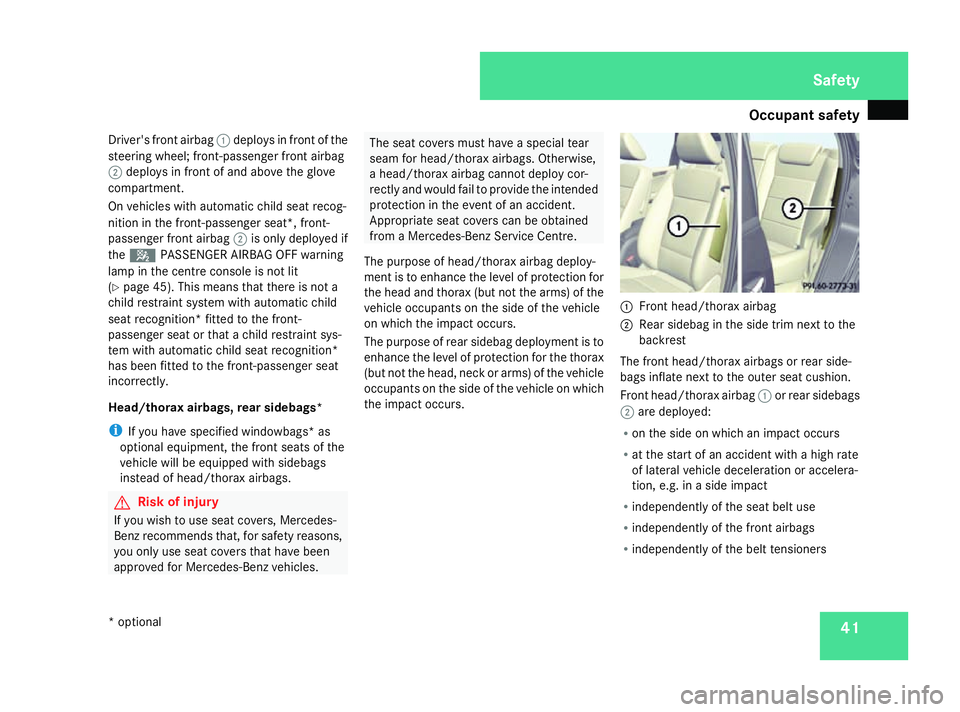
Front head/thorax airbag
2 Rear sidebag in the side trim next to the
backrest
The front head/thorax airbags or rear side-
bags inflate next to the outer seat cushion.
Front head/thorax airbag 1or rear sidebags
2 are deployed:
R on the side on which an impact occurs
R at the start of an accident with a high rate
of lateral vehicle deceleration or accelera-
tion, e.g. in a side impact
R independently of the seat belt use
R independently of the front airbags
R independently of the belt tensioners Safety
* optional
169_AKB; 2; 4, en-GB
wdomann,
Version: 2.10.6 2008-07-16T08:52:06+02:00 - Seite 41 ZDateiname: 6515_0315_02_buchblock.pdf; preflight
Page 46 of 305
Occupant safety
43system could heat up and the child could
burn itself on them.
If a child opens a door, the child or other
persons could be injured as a result. The
child could get out and be injured in the
process or be injured by a passing vehicle.
G
Risk of injury
An unsecured or incorrectly positioned load
increases the risk of injury to the child in
the event of:
R an accident
R a braking manoeuvre
R a sudden change of direction
Do not carry heavy or hard objects inside
the vehicle unless they are secured. You
will find further information under "Loading
guidelines" in the index.
Child restraint systems Mercedes-Benz recommends that you only
use the child restraint systems listed on
(Y page 47). G
Risk of injury
To reduce the risk of serious or even fatal
injury to the child in the event of a sudden
change in direction, braking or an accident:
R children less than 1.50 m tall and under
twelve years of age must always be
secured in special child restraint systems
on a suitable vehicle seat. This is neces-
sary because the seat belts are not
designed for children of this size.
R Do not secure children less than 1.50 m
tall or under twelve years of age on the
front-passenger seat. Exception: the
child is secured in a vehicle with auto-
matic child seat recognition on the front-
passenger seat* and is secured in a child
restraint system with automatic child
seat recognition.
R If you secure a forward-facing child
restraint system to the front-passenger
seat, you must move the front-passenger
seat as far back as possible.
R children must never travel sitting on the
lap of another occupant. Due to the
forces occurring in the event of a sudden
change of direction, heavy braking or an
accident, it would not be possible to restrain the child. The child could be
thrown against parts of the vehicle inte-
rior and be seriously or even fatally
injured.
G
Risk of injury
The child restraint system cannot perform
its protective function if is not correctly fit-
ted to a suitable vehicle seat. The child can-
not be restrained in the event of a sudden
change of direction, heavy braking or an
accident. This may lead to serious or even
fatal injuries. For this reason, when fitting
a child restraint system, observe the man-
ufacturer's installation instructions and the
correct use of the child restraint system.
Child restraint systems should be fitted to
the rear seats. Children are generally better
protected there.
The entire base of the child restraint system
must always rest on the seat cushion.
Never place objects, e.g. a cushion, under
the child restraint system.
Only use child restraint systems with their
original covers. Only replace damaged cov-
ers with genuine Mercedes-Benz covers.
For safety reasons, you should only use
child restraint systems which have been Safety
* optional
169_AKB; 2; 4, en-GB
wdomann
,V ersion: 2.10.6
2008-07-16T08:52:06+02:00 - Seite 43 ZDateiname: 6515_0315_02_buchblock.pdf; preflight
Page 48 of 305
Occupant safety
45
Automatic child seat recognition on the
front-passenger seat*
If your vehicle does not have automatic child
seat recognition on the front-passenger seat,
this is indicated by a special sticker. The
sticker is affixed to the side of the dashboard
on the front-passenger side. It is visible when
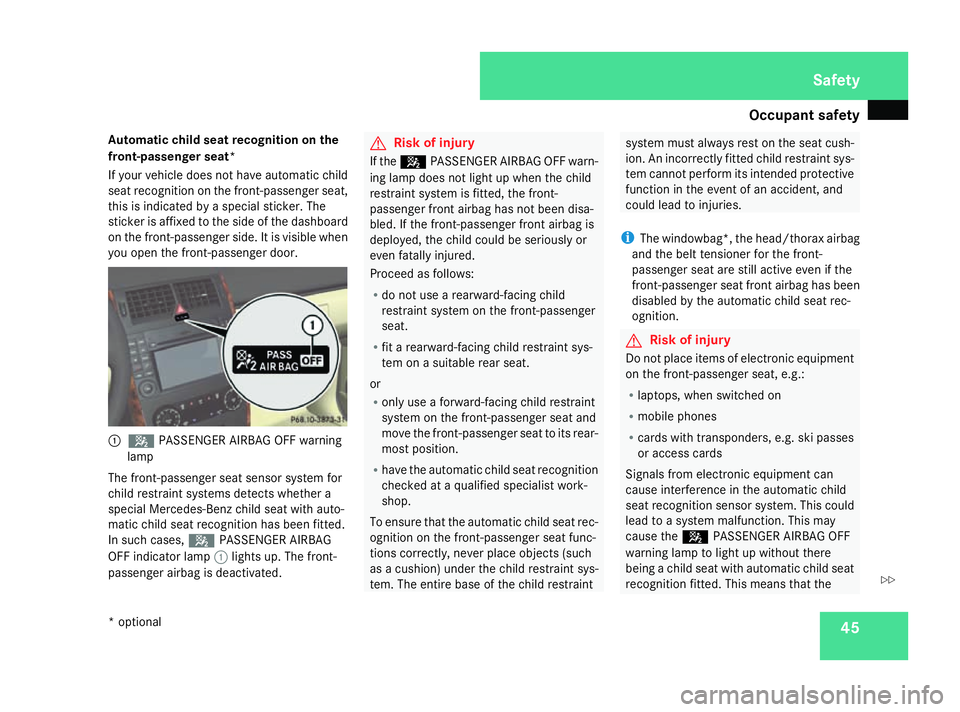
you open the front-passenger door. 1
5 PASSENGER AIRBAG OFF warning
lamp
The front-passenger seat sensor system for
child restraint systems detects whether a
special Mercedes-Benz child seat with auto-
matic child seat recognition has been fitted.
In such cases, 5PASSENGER AIRBAG
OFF indicator lamp 1lights up. The front-
passenger airbag is deactivated. G
Risk of injury
If the 5 PASSENGER AIRBAG OFF warn-
ing lamp does not light up when the child
restraint system is fitted, the front-
passenger front airbag has not been disa-
bled. If the front-passenger front airbag is
deployed, the child could be seriously or
even fatally injured.
Proceed as follows:
R do not use a rearward-facing child
restraint system on the front-passenger
seat.
R fit a rearward-facing child restraint sys-
tem on a suitable rear seat.
or
R only use a forward-facing child restraint
system on the front-passenger seat and
move the front-passenger seat to its rear-
most position.
R have the automatic child seat recognition
checked at a qualified specialist work-
shop.
To ensure that the automatic child seat rec-
ognition on the front-passenger seat func-
tions correctly, never place objects (such
as a cushion) under the child restraint sys-
tem. The entire base of the child restraint system must always rest on the seat cush-
ion. An incorrectly fitted child restraint sys-
tem cannot perform its intended protective
function in the event of an accident, and
could lead to injuries.
i The windowbag*, th e head/thorax airbag
and the belt tensioner for the front-
passenger seat are still active even if the
front-passenger seat front airbag has been
disabled by the automatic child seat rec-
ognition. G
Risk of injury
Do not place items of electronic equipment
on the front-passenger seat, e.g.:
R laptops, when switched on
R mobile phones
R cards with transponders, e.g. ski passes
or access cards
Signals from electronic equipment can
cause interference in the automatic child
seat recognition sensor system. This could
lead to a system malfunction. This may
cause the 5PASSENGER AIRBAG OFF
warning lamp to light up without there
being a child seat with automatic child seat
recognition fitted. This means that the Safety
* optional
169_AKB; 2; 4, en-GB
wdomann,
Version: 2.10.6 2008-07-16T08:52:06+02:00 - Seite 45 ZDateiname: 6515_0315_02_buchblock.pdf; preflight
Page 51 of 305
Occupant safety
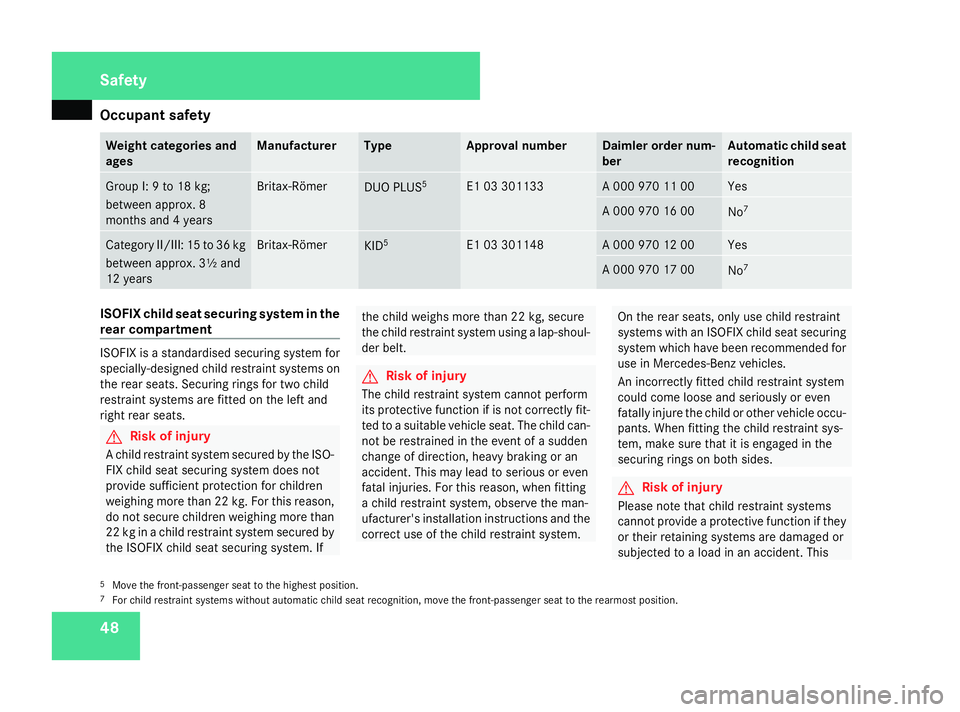
48 Weight categories and
ages Manufacturer Type Approval number Daimler order num-
ber Automatic child seat
recognition
Group I: 9 to 18 kg;
between approx. 8
months and 4 years Britax-Römer
DUO PLUS
5 E1 03 301133 A 000 970 11 00 Yes
A 000 970 16 00
No
7 Category II/III: 15 to 36 kg
between approx. 3½ and
12 years Britax-Römer
KID
5 E1 03 301148 A 000 970 12 00 Yes
A 000 970 17 00
No
7 ISOFIX child seat securing system in the
rear compartment
ISOFIX is a standardised securing system for
specially-designed child restraint systems on
the rear seats. Securing rings for two child
restraint systems are fitted on the left and
right rear seats. G
Risk of injury
A child restraint system secured by the ISO-
FIX child seat securing system does not
provide sufficient protection for children
weighing more than 22 kg. For this reason,
do not secure children weighing more than
22 kg in a child restraint system secured by
the ISOFIX child seat securing system. If the child weighs more than 22 kg, secure
the child restraint system using a lap-shoul-
der belt. G
Risk of injury
The child restraint system cannot perform
its protective function if is not correctly fit-
ted to a suitable vehicle seat. The child can-
not be restrained in the event of a sudden
change of direction, heavy braking or an
accident. This may lead to serious or even
fatal injuries. For this reason, when fitting
a child restraint system, observe the man-
ufacturer's installation instructions and the
correct use of the child restraint system. On the rear seats, only use child restraint
systems with an ISOFIX child seat securing
system which have been recommended for
use in Mercedes-Benz vehicles.
An incorrectly fitted child restraint system
could come loose and seriously or even
fatally injure the child or other vehicle occu-
pants. When fitting the child restraint sys-
tem, make sure that it is engaged in the
securing rings on both sides.
G
Risk of injury
Please note that child restraint systems
cannot provide a protective function if they
or their retaining systems are damaged or
subjected to a load in an accident. This
5 Move the front-passenger seat to the highest position.
7 For child restraint systems without automatic child seat recognition, move the front-passenger seat to the rearmost position. Safety
169_AKB; 2; 4, en-GB
wdomann
,V ersion: 2.10.6
2008-07-16T08:52:06+02:00 - Seite 48 Dateiname: 6515_0315_02_buchblock.pdf; preflight
Page 52 of 305
Occupant safety
49could result in serious or even fatal injuries
to the secured child in the event of an acci-
dent, heavy braking or a sudden change in
direction.
For this reason, have child restraint sys-
tems and their anchorages which have
been damaged or subjected to a load in an
accident checked immediately at a quali-
fied specialist workshop.
! When fitting the child restraint system,
make sure that the seat belt for the middle
seat does not become trapped. It could
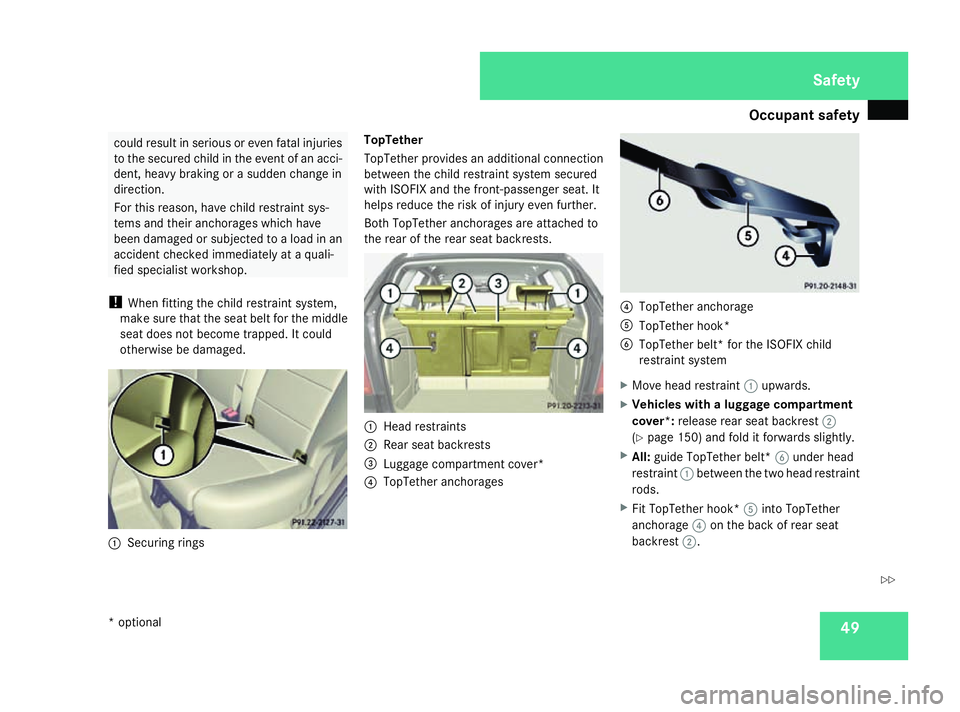
otherwise be damaged. 1
Securing rings TopTether
TopTether provides an additional connection
between the child restraint system secured
with ISOFIX and the front-passenger seat. It
helps reduce the risk of injury even further.
Both TopTether anchorages are attached to
the rear of the rear seat backrests.
1
Head restraints
2 Rear seat backrests
3 Luggage compartment cover*
4 TopTether anchorages 4
TopTether anchorage
5 TopTether hook*
6 TopTether belt* for the ISOFIX child
restraint system
X Move head restraint 1upwards.
X Vehicles with a luggage compartment
cover*: release rear seat backrest 2
(Y page 150) and fold it forwards slightly.
X All: guide TopTether belt* 6under head
restraint 1between the two head restraint
rods.
X Fit TopTether hook* 5into TopTether
anchorage 4on the back of rear seat
backrest 2. Safety
* optional
169_AKB; 2; 4, en-GB
wdomann,
Version: 2.10.6 2008-07-16T08:52:06+02:00 - Seite 49 ZDateiname: 6515_0315_02_buchblock.pdf; preflight
Page 53 of 305
Occupant safety
50Vehicles with a luggage compartment
cover*: make sure you do not route the belt
across luggage compartment cover 3.
X Vehicles with a luggage compartment
cover*: swing back rear seat backrest 2
until it engages.
The red lock verification indicator is no lon-
ger visible (Y page 151). G
Risk of injury
Make sure that the rear seat backrest is
fully locked. The red lock verification indi-
cators on the left and right should no longer
be visible. If they are, the rear seat backr-
ests are not locked. If this is the case, occu-
pants could be injured in the event of an
accident, e.g. by objects being thrown for-
wards from the luggage compartment.
X All: move head restraints 1slightly down
again if necessary (Y page 66). Make sure
that you do not interfere with the correct
routing of TopTether belt* 6.
X Install the ISOFIX child restraint system
with TopTether*. Comply with the manu-
facturer's installation instructions. Integrated child seat* The child seats are integrated into the right
and left-hand sides of the seats of the rear
bench seat. They comply with the legal
requirements of ECE Regulation 44.03.
Mercedes-Benz recommends the integrated
child seat for children from approximately
two to twelve years of age or with a body
weight of 12.5 kg to 36 kg.
For children between approximately two and
four years of age or weighing between
approximately 12.5 kg and 22 kg, you must
also use a padded table* which has been spe-
cially approved for the integrated child seat
(Y
page 51). G
Risk of injury
To reduce the risk of serious or even fatal
injury to the child in the event of a sudden
change in direction, braking or an accident:
R Do not modify the integrated child seat.
R When the child seat is occupied, adjust
the head restraint to a position at which
the back of the child's head is supported
by the centre of the head restraint at
about eye level. R
Replace an integrated child seat that has
been damaged or subjected to a heavy
load as the result of an accident.
R Be aware that children under two years
of age require a different child restraint
system. Information about other child
restraint systems is available from any
Mercedes-Benz Service Centre.
R The rear seat backrest in the vehicle
must be securely locked in position.
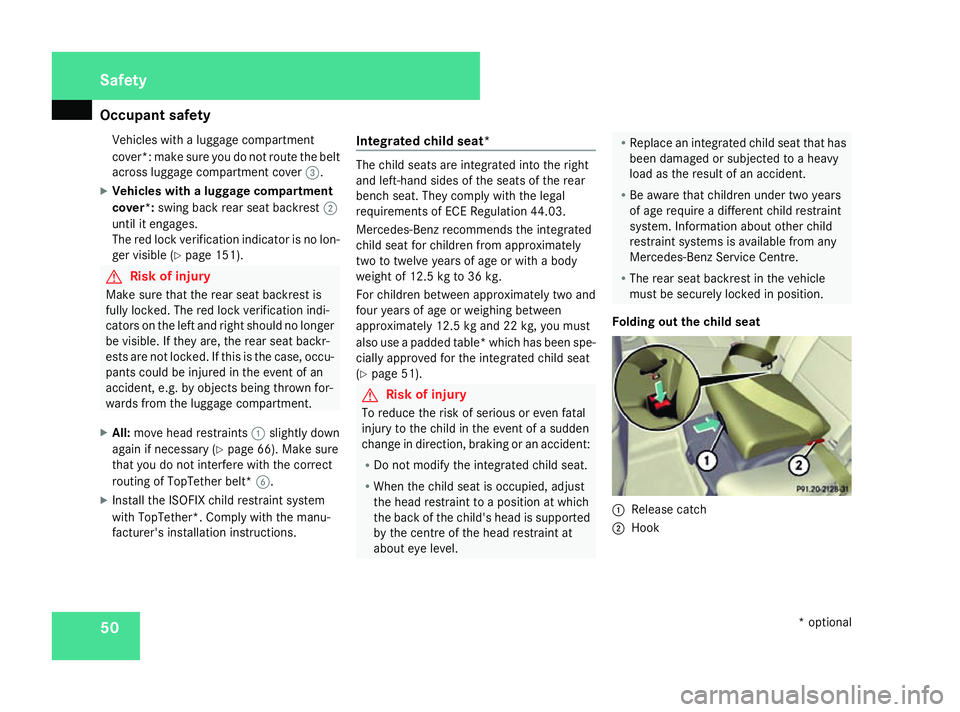
Folding out the child seat 1
Release catch
2 Hook Safety
* optional
169_AKB; 2; 4, en-GB
wdomann
,V ersion: 2.10.6
2008-07-16T08:52:06+02:00 - Seite 50 Dateiname: 6515_0315_02_buchblock.pdf; preflight
Page 54 of 305
Occupant safety
51
X
Press release catch 1.
The child seat folds upwards.
X Push the child seat back to the stop so that
it engages.
Fastening a child's seat belt G
Risk of injury
To reduce the risk of serious or even fatal
injury to the child in the event of a sudden
change in direction, braking or an accident:
R The shoulder belt section of the seat belt
must be routed across the middle of the
child's shoulder – never across the
child's neck – and be pulled tight against
the child's chest. The lap section of the
seat belt must be routed across the
child's pelvis – not across the abdomen
– and be pulled tight against the child's
body; retighten the belt strap if neces-
sary.
R Never secure more than one child at a
time in the child restraint system.
R The belt must be routed through the
hook.
R The belt strap must not be trapped or
twisted, nor rub against any sharp edges. X
Pull the belt smoothly from the inertia reel.
X Guide the lower lap section of the belt
through hook 2.
X Engage the seat belt tongue in the belt
buckle.
X Make sure that the belt:
R
is routed as low as possible across the
pelvic area, in front of the hips
R is tightened across the lap by pulling
upwards on the child's shoulder belt
R is tight and is routed across the middle
of the child's shoulder
R is not twisted and does not pass across
the child's neck or under the child's arm
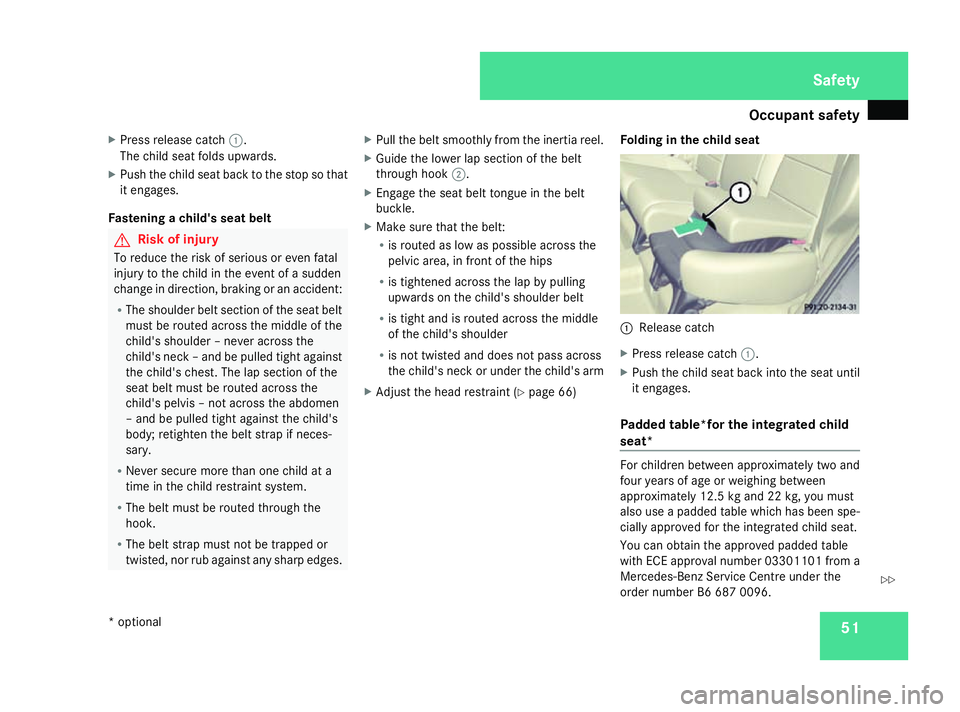
X Adjust the head restraint (Y page 66)Folding in the child seat 1
Release catch
X Press release catch 1.
X Push the child seat back into the seat until
it engages.
Padded table*for the integrated child
seat* For children between approximately two and
four years of age or weighing between
approximately 12.5 kg and 22 kg, you must
also use a padded table which has been spe-
cially approved for the integrated child seat.
You can obtain the approved padded table
with ECE approval number 03301101 from a
Mercedes-Benz Service Centre under the
order number B6 687 0096. Safety
* optional
169_AKB; 2; 4, en-GB
wdomann,
Version: 2.10.6 2008-07-16T08:52:06+02:00 - Seite 51 ZDateiname: 6515_0315_02_buchblock.pdf; preflight