service MERCEDES-BENZ A-CLASS HATCHBACK 2008 Repair Manual
[x] Cancel search | Manufacturer: MERCEDES-BENZ, Model Year: 2008, Model line: A-CLASS HATCHBACK, Model: MERCEDES-BENZ A-CLASS HATCHBACK 2008Pages: 305, PDF Size: 5.43 MB
Page 264 of 305
Flat tyre
261
X
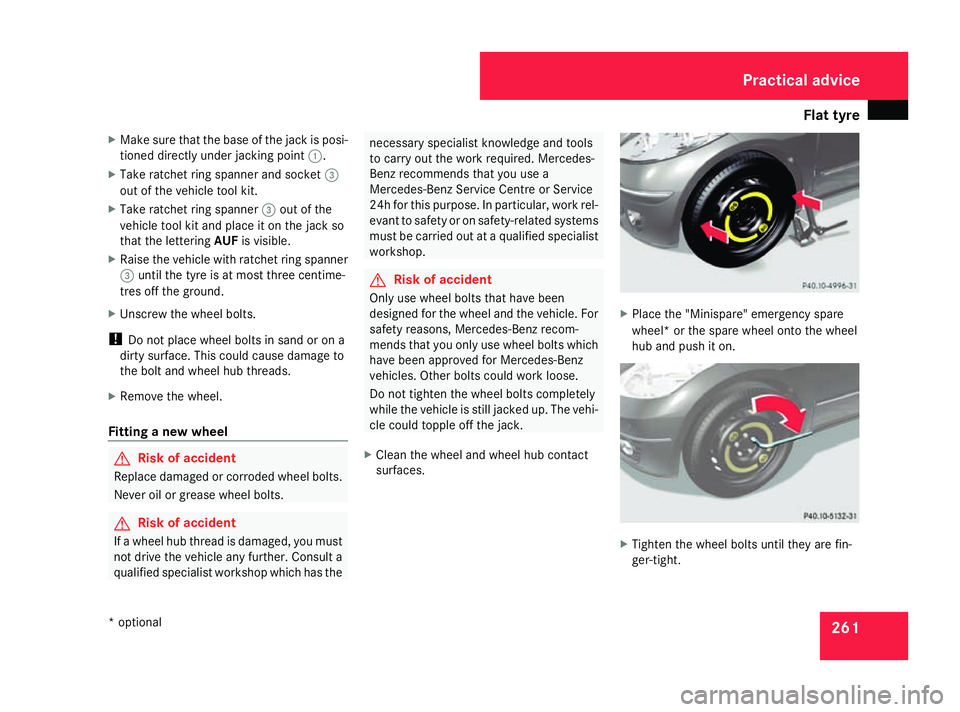
Make sure that the base of the jack is posi-
tioned directly under jacking point 1.
X Take ratchet ring spanner and socket 3
out of the vehicle tool kit.
X Take ratchet ring spanner 3out of the
vehicle tool kit and place it on the jack so
that the lettering AUFis visible.
X Raise the vehicle with ratchet ring spanner
3 until the tyre is at most three centime-
tres off the ground.
X Unscrew the wheel bolts.
! Do not place wheel bolts in sand or on a
dirty surface. This could cause damage to
the bolt and wheel hub threads.
X Remove the wheel.
Fit ting a new wheel G
Risk of accident
Replace damaged or corroded wheel bolts.
Never oil or grease wheel bolts. G
Risk of accident
If a wheel hub thread is damaged, you must
not drive the vehicle any further. Consult a
qualified specialist workshop which has the necessary specialist knowledge and tools
to carry out the work required. Mercedes-
Benz recommends that you use a
Mercedes-Benz Service Centre or Service
24h for this purpose. In particular, work rel-
evant to safety or on safety-related systems
must be carried out at a qualified specialist
workshop. G
Risk of accident
Only use wheel bolts that have been
designed for the wheel and the vehicle. For
safety reasons, Mercedes-Benz recom-
mends that you only use wheel bolts which
have been approved for Mercedes-Benz
vehicles. Other bolts could work loose.
Do not tighten the wheel bolts completely
while the vehicle is still jacked up. The vehi-
cle could topple off the jack.
X Clean the wheel and wheel hub contact
surfaces. X
Place the "Minispare" emergency spare
wheel* or the spare wheel onto the wheel
hub and push it on. X
Tighten the wheel bolts until they are fin-
ger-tight. Practical advice
* optional
169_AKB; 2; 4, en-GB
wdomann
,V ersion: 2.10.6
2008-07-16T08:52:06+02:00 - Seite 261 ZDateiname: 6515_0315_02_buchblock.pdf; preflight
Page 266 of 305
Battery
263R
ESP ®
is intervening constantly.
R there are tears in the sidewalls of the
tyre.
After driving in run-flat mode, you must
have the wheel(s) checked for damage at a
qualified specialist workshop which has the
necessary specialist knowledge and tools
to carry out the work required. The faulty
tyre must be replaced in every case.
Mercedes-Benz recommends that you use
a Mercedes-Benz Service Centre for this
purpose. In particular, work relevant to
safety or on safety-related systems must be
carried out at a qualified specialist work-
shop.
i On a vehicle with MOExtended tyres, only
use MOExtended spare tyres. These must
be of the size specified for the vehicle. Battery
Notes on the vehicle battery
In order for the battery to achieve the maxi-
mum possible service life, it must always be
sufficiently charged.
Have the battery charge checked more fre-
quently if you use the vehicle mainly for short
trips or if you leave it standing idle for a
lengthy period.
To prevent damage from corrosion, only
replace the battery with one that has a central
ventilation cover.
Consult a Mercedes-Benz Service Centre if
you wish to leave your vehicle parked up for
a long period of time. G
Risk of injury
Comply with safety precautions and take
protective measures when handling batter-
ies. Risk of explosion
Fire, naked flames and
smoking are prohibited
when handling the bat- tery. Avoid creating
sparks.
Battery acid is caustic.
Avoid contact with the
skin, eyes or clothing.
Wear suitable protective
clothing, in particular
gloves, an apron and a
face mask.
Immediately rinse acid
splashes off with clean
water. Consult a doctor if
necessary.
Wear eye protection.
Keep children away.
Observe this Owner's
Manual.
H
Environmental note
Do not dispose of batteries with the house-
hold rubbish. Dispose of defective batteries
in an environmentally responsible manner. Practical advice
169_AKB; 2; 4, en-GB
wdomann, Version: 2.10.6 2008-07-16T08:52:06+02:00 - Seite 263 ZDateiname: 6515_0315_02_buchblock.pdf; preflight
Page 267 of 305
Battery
264 Take them to a Mercedes-Benz Service
Centre or to a special collection point for
old batteries. G
Risk of injury
For safety reasons, Mercedes-Benz recom-
mends that you only use batteries which
have been tested and approved for your
vehicle by Mercedes-Benz. These batteries
provide increased impact protection to pre-
vent vehicle occupants from suffering acid
burns should the battery be damaged in the
event of an accident.
To prevent acid burns, observe the follow-
ing safety notes when handling batteries:
R Do not lean over batteries.
R Do not place any metal objects on a bat-
tery. You could otherwise cause a short
circuit and the battery's gas mixture
could ignite.
R Make sure that you do not create an elec-
trostatic charge, e.g. by wearing syn-
thetic clothing or as a result of friction on
fabrics. Therefore, you should not pull or
slide the battery over carpets or other
synthetic materials.
R Never touch the battery first. To dis-
charge a possible electrostatic charge, step out of the vehicle first and touch the
bodywork.
R Do not wipe the battery using a cloth. The
battery could be destroyed as a result of
electrostatic charge or due to flying
sparks.
! Switch off the engine and remove the key
before disconnecting or removing the ter-
minal clamps from the battery. You may
otherwise destroy electronic components,
such as the alternator.
i Mercedes-Benz recommends that you
have all work involving the battery, e.g.
removing, charging and replacing, carried
out at a qualified specialist workshop, e.g.
a Mercedes-Benz Service Centre.
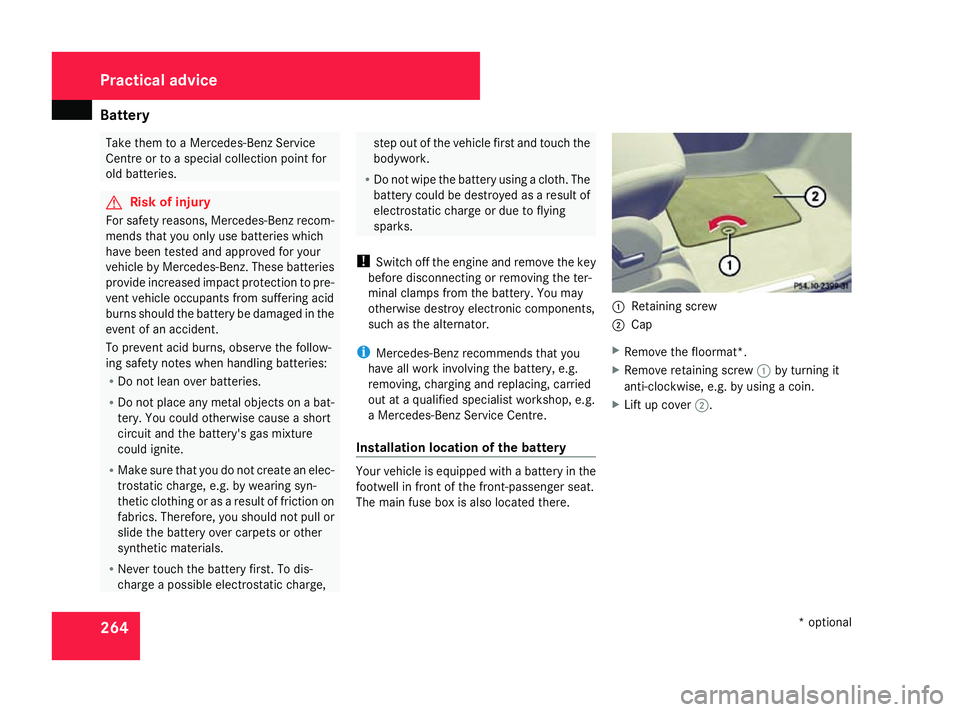
Installation location of the battery Your vehicle is equipped with a battery in the
footwell in front of the front-passenger seat.
The main fuse box is also located there. 1
Retaining screw
2 Cap
X Remove the floormat*.
X Remove retaining screw 1by turning it
anti-clockwise, e.g. by using a coin.
X Lift up cover 2. Practical advice
* optional
169_AKB; 2; 4, en-GB
wdomann,
Version: 2.10.6
2008-07-16T08:52:06+02:00 - Seite 264 Dateiname: 6515_0315_02_buchblock.pdf; preflight
Page 268 of 305
Battery
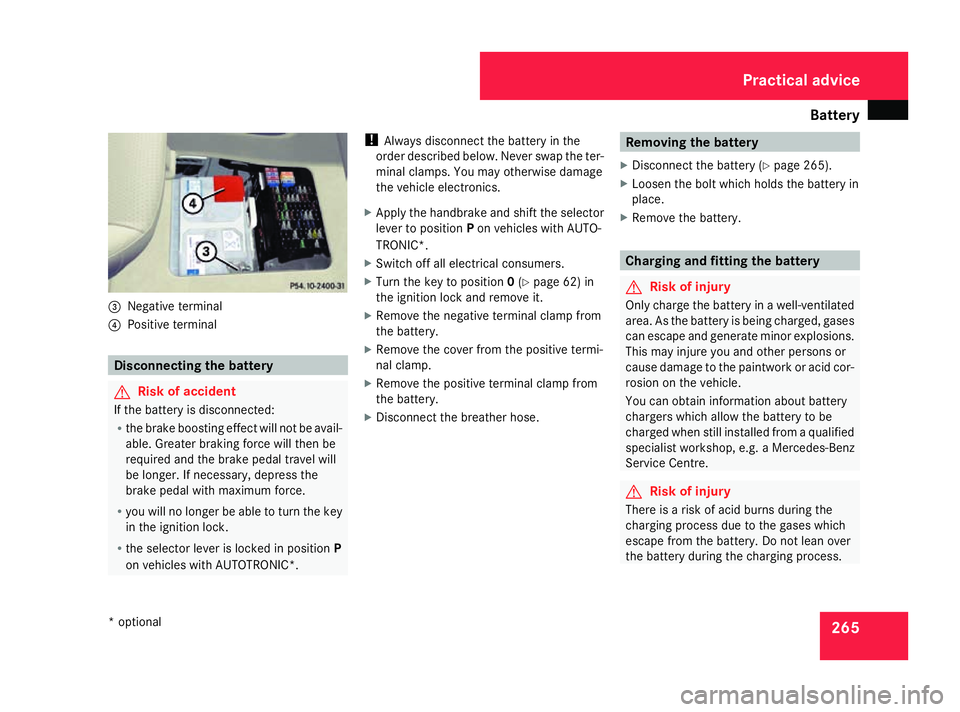
2653
Negative terminal
4 Positive terminal Disconnecting the battery
G
Risk of accident
If the battery is disconnected:
R the brake boosting effect will not be avail-
able. Greater braking force will then be
required and the brake pedal travel will
be longer. If necessary, depress the
brake pedal with maximum force.
R you will no longer be able to turn the key
in the ignition lock.
R the selector lever is locked in position P
on vehicles with AUTOTRONIC*. !
Always disconnect the battery in the
order described below. Never swap the ter-
minal clamps. You may otherwise damage
the vehicle electronics.
X Apply the handbrake and shift the selector
lever to position Pon vehicles with AUTO-
TRONIC*.
X Switch off all electrical consumers.
X Turn the key to position 0(Y page 62) in
the ignition lock and remove it.
X Remove the negative terminal clamp from
the battery.
X Remove the cover from the positive termi-
nal clamp.
X Remove the positive terminal clamp from
the battery.
X Disconnect the breather hose. Removing the battery
X Disconnect the battery ( Ypage 265).
X Loosen the bolt which holds the battery in
place.
X Remove the battery. Charging and fitting the battery
G
Risk of injury
Only charge the battery in a well-ventilated
area. As the battery is being charged, gases
can escape and generate minor explosions.
This may injure you and other persons or
cause damage to the paintwork or acid cor-
rosion on the vehicle.
You can obtain information about battery
chargers which allow the battery to be
charged when still installed from a qualified
specialist workshop, e.g. a Mercedes-Benz
Service Centre. G
Risk of injury
There is a risk of acid burns during the
charging process due to the gases which
escape from the battery. Do not lean over
the battery during the charging process. Practical advice
* optional
169_AKB; 2; 4, en-GB
wdomann,
Version: 2.10.6 2008-07-16T08:52:06+02:00 - Seite 265 ZDateiname: 6515_0315_02_buchblock.pdf; preflight
Page 269 of 305
Jump-starting
266 G
Risk of injury
Battery acid is caustic. Avoid contact with
the skin, eyes or clothing.
! Only charge the installed battery with a
battery charger which has been tested and
approved by Mercedes-Benz. These battery
chargers allow the battery to be charged
while it is still installed. However, the bat-
tery must always be disconnected first.
! Only use battery chargers with a maxi-
mum charging voltage of 14.8 V.
X Charge the battery. Observe the notes in
the operating instructions for your battery
charger.
X Refit the charged battery.
To do this, follow the steps described in
"Removing the battery" (Y page 265) in
reverse order. Reconnecting the battery
! Always reconnect the battery in the
sequence described below. Never swap the
terminal clamps. You may otherwise dam-
age the vehicle electronics.
X Switch off all electrical consumers.
X Connect the positive terminal clamp and
secure the cover.
X Connect the negative terminal clamp.
X Connect the breather hose. Make sure that
a cell cap is fitted on the side.
i If the battery power supply has been inter-
rupted (e.g. if it has been reconnected), you
must carry out the following tasks:
R set the time (Y page 109).
R reset the function for folding the exterior
mirrors in/out automatically* by folding
the mirrors out once (Y page 72).
R reset the side windows ( Ypage 85) Jump-starting
If your vehicle's battery is discharged, the
engine can be jump-started from another
vehicle or from an external battery using jump
leads.
Observe the following points:
R Jump-starting may only be performed when
the engine and catalytic converter are cold.
R Do not start the engine if the battery is fro-
zen. Let the battery thaw first.
R Jump-starting may only be performed from
batteries with a nominal voltage of 12 V.
R Only use jump leads which have a sufficient
cross-section and insulated terminal
clamps.
i Jump leads and further information about
jump-starting can be obtained from any
Mercedes-Benz Service Centre.
! Avoid repeated and lengthy starting
attempts.
Never start the vehicle using a rapid battery
charger. Practical advice
* optional
169_AKB; 2; 4, en-GB
wdomann
,V ersion: 2.10.6
2008-07-16T08:52:06+02:00 - Seite 266 Dateiname: 6515_0315_02_buchblock.pdf; preflight
Page 270 of 305
Jump-starting
267G
Risk of injury
There is a risk of acid burns when jump-
starting a vehicle due to the gases which
escape from the battery. Do not lean over
the battery while the engine is being jump-
started. G
Risk of explosion
Gases escaping from the battery during
jump-starting may cause minor explosions.
Avoid creating sparks. Keep naked flames
away from the battery, and do not smoke.
Comply with safety precautions and take
protective measures when handling batter-
ies. You will find these under "Battery" in
the index.
X Make sure that the two vehicles do not
touch.
X Apply the parking brake.
X Manual transmission: engage neutral.
X AUTOTRONIC*: move the DIRECT SELECT
selector lever to P.
X Switch off all electrical consumers.
X Open the bonnet (Y page 171). 1
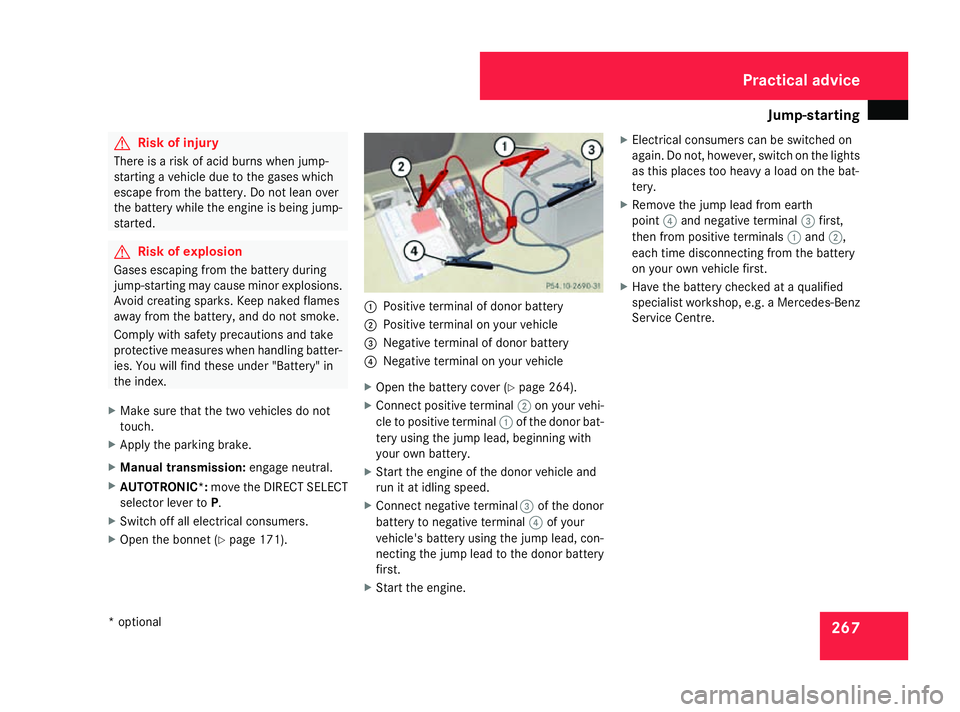
Positive terminal of donor battery
2 Positive terminal on your vehicle
3 Negative terminal of donor battery
4 Negative terminal on your vehicle
X Open the battery cover (Y page 264).
X Connect positive terminal 2on your vehi-
cle to positive terminal 1of the donor bat-
tery using the jump lead, beginning with
your own battery.
X Start the engine of the donor vehicle and
run it at idling speed.
X Connect negative terminal 3of the donor
battery to negative terminal 4of your
vehicle's battery using the jump lead, con-
necting the jump lead to the donor battery
first.
X Start the engine. X
Electrical consumers can be switched on
again. Do not, however, switch on the lights
as this places too heavy a load on the bat-
tery.
X Remove the jump lead from earth
point 4and negative terminal 3first,
then from positive terminals 1and 2,
each time disconnecting from the battery
on your own vehicle first.
X Have the battery checked at a qualified
specialist workshop, e.g. a Mercedes-Benz
Service Centre. Practical advice
* optional
169_AKB; 2; 4, en-GB
wdomann,
Version: 2.10.6 2008-07-16T08:52:06+02:00 - Seite 267 ZDateiname: 6515_0315_02_buchblock.pdf; preflight
Page 271 of 305
Towing and tow-starting
268 Towing and tow-starting
Points to remember
G
Risk of accident
If you have the vehicle towed, you must use
a rigid towing bar if:
R the engine is not running.
R there is a brake system malfunction.
R there is a malfunction in the voltage sup-
ply or the vehicle's electrical system.
The electric power steering and the brake
force booster do not work when the engine
is not running. Greater braking force will
then be required and brake pedal travel will
be longer. If necessary, depress the brake
pedal with full force.
Do not tow the vehicle if the key cannot be
turned in the ignition lock. If this is the case,
the steering is locked and the vehicle can-
not be steered.
If you tow or tow-start another vehicle, its
weight must not exceed the maximum per-
missible gross vehicle weight of your vehi-
cle.
It is better to have the vehicle transported
than to have it towed. When towing, observe the legal requirements
in all countries concerned.
!
When towing, pull away slowly and with-
out jerking. If the tractive power is too high,
the vehicles could be damaged.
! Do not use the towing eye for recovery,
as this could damage the vehicle. If in
doubt, recover the vehicle with a crane.
! You may tow the vehicle for a maximum
of 50 km. A towing speed of 50 km/h must
not be exceeded.
With towing distances over 50 km, the
entire vehicle needs to be lifted up and
transported.
! Only secure the tow cable or towing bar
to the towing eyes. You may otherwise
damage the vehicle.
R Vehicles with AUTOTRONIC* must not be
tow-started.
R If the engine does not start, try jump-start-
ing it (Y page 266).
R If it is not possible to jump-start the vehicle,
have it towed to the nearest qualified spe-
cialist workshop, e.g. a Mercedes-Benz
Service Centre. R
The selector lever must be in position N
when towing a vehicle with AUTO-
TRONIC*.
R If you are towing the vehicle over a consid-
erable distance, this must only be done
with the front axle raised.
R The ignition must be switched off if you are
towing the vehicle with the front/rear axle
raised. Intervention by ESP ®
could other-
wise damage the brake system.
R Before towing the vehicle, make sure that
the battery is connected and charged. Oth-
erwise:
-you cannot switch on the ignition
- you cannot move the selector lever
to N(on vehicles with AUTOTRONIC*)
- you have no support when braking
i Switch off the automatic locking feature
before the vehicle is towed (Y page 111).
You could otherwise be locked out when
pushing or towing the vehicle. Practical advice
* optional
169_AKB; 2; 4, en-GB
wdomann,
Version: 2.10.6
2008-07-16T08:52:06+02:00 - Seite 268 Dateiname: 6515_0315_02_buchblock.pdf; preflight
Page 274 of 305

Fuses
271Fuses
Notes on changing fuses
The fuses in your vehicle serve to close down
faulty circuits. If a fuse blows, all the compo-
nents on the circuit and their functions will
fail.
Blown fuses must be replaced with fuses of
the same rating, which you can recognise by
the colour and value. The fuse ratings are lis-
ted in the fuse allocation chart. A Mercedes-
Benz Service Centre will be happy to advise
you. G
Risk of fire
Only use fuses that have been approved for
Mercedes-Benz vehicles and which have
the correct fuse rating for the systems con-
cerned. Do not attempt to repair or bridge
faulty fuses. Otherwise, a circuit overload
could cause a fire. Have the cause traced
and rectified at a qualified specialist work-
shop, e.g. a Mercedes-Benz Service Centre.
If the newly inserted fuse also blows, have the
cause traced and rectified at a qualified spe-
cialist workshop, e.g. a Mercedes-Benz
Service Centre.
! Only use fuses that have been approved
for Mercedes-Benz vehicles and which have the correct fuse rating for the system
concerned. Otherwise, components or sys-
tems could be damaged.
The fuses are located in the main fuse box in
the front-passenger footwell.
Fuse allocation chart The fuse allocation chart is in the main fuse
box in the front-passenger footwell.
Before changing a fuse
X Park the vehicle.
X Switch off all electrical consumers.
X Remove the key from the ignition lock. Main fuse box
The main fuse box is in the front-passenger
footwell in front of the seat. 1
Cover
2 Retaining screw
X Remove the footmats*.
X Turn retaining screw 2anti-clockwise, e.g.
with a coin.
X Lift up cover 1.
X Remove the cover mat from the battery. Practical advice
* optional
169_AKB; 2; 4, en-GB
wdomann,
Version: 2.10.6 2008-07-16T08:52:06+02:00 - Seite 271 ZDateiname: 6515_0315_02_buchblock.pdf; preflight
Page 276 of 305
273
Introduction to technical data
.........274
Genuine Mercedes-Benz parts .........274
Vehicle electronics ...........................275
Vehicle identification plates ............276
Engine ................................................ 278
Performance ...................................... 280
Tyres and wheels .............................. 282
Vehicle dimensions ..........................286
Vehicle weights ................................. 286
Trailer coupling* ............................... 290
Service products and capacities .....292 Technical data
169_AKB; 2; 4, en-GB
wdomann,
Version: 2.10.6 2008-07-16T08:52:06+02:00 - Seite 273Dateiname: 6515_0315_02_buchblock.pdf; preflight
Page 277 of 305

Genuine Mercedes-Benz parts
274 Introduction to technical data
i The technical data was determined in
accordance with EU directives. All data
applies to the vehicle's standard equip-
ment. The data may therefore differ for
vehicles with optional equipment. You can
obtain further information from a
Mercedes-Benz Service Centre. Genuine Mercedes-Benz parts
Mercedes-Benz tests genuine parts and con-
version parts and accessories which have
been specifically approved for your vehicle for
their reliability, safety and suitability. Despite
ongoing market research, Mercedes-Benz is
unable to evaluate other parts. Therefore,
Mercedes-Benz accepts no responsibility for
the use of such parts in Mercedes-Benz vehi-
cles, even if they have been independently or
officially approved.
In Germany and some other countries, certain
parts are only officially approved for installa-
tion or modification if they comply with legal
requirements. All genuine Mercedes-Benz
parts meet this requirement. The use of non-
approved parts may invalidate the vehicle's
general operating permit. This is the case if:
R they cause a change of the vehicle type
from that for which the vehicle's general
operating permit was granted
R other road users could be endangered
R the emission or noise levels are adversely
affected
The use of non-approved parts could affect
your vehicle's operating safety. Therefore,
Mercedes-Benz recommends genuine Mercedes-Benz parts and conversion parts
and accessories that have been approved for
your vehicle. H
Environmental note
Daimler also supplies reconditioned
assemblies and parts which are of the same
quality as new parts. For these, the same
warranty applies as for new parts.
Genuine Mercedes-Benz parts and approved
conversion parts and accessories are availa-
ble from Mercedes-Benz Service Centres.
There, you can also receive advice about tech-
nical modifications and have the parts pro-
fessionally fitted.
Always quote the vehicle identification num-
ber and the engine number when ordering
genuine parts. For example, you will find
these numbers on your vehicle's identifica-
tion plates (Y page 276). Technical data
169_AKB; 2; 4, en-GB
wdomann,
Version: 2.10.6
2008-07-16T08:52:06+02:00 - Seite 274 Dateiname: 6515_0315_02_buchblock.pdf; preflight